


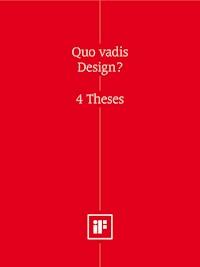
Quo vadis Design? (GB) E-Book
4,99 €
Mehr erfahren.
- Herausgeber: IF DESIGN MEDIA
- Kategorie: Fachliteratur
- Sprache: Englisch
In September 2013, designers met scientists and business representatives on the island Frauenchiemsee to discuss the future of design. The association Industrie Forum Design invited them there for this purpose. The results of the conference are documented in this publication. The focus is on the presenters’ four propositions which have been developed into essays. These four central propositions are complemented by contributions from discussion participants. Prof. Dr. Wilhelm Vossenkuhl hosted the event and he is also the editor of this book.
Das E-Book können Sie in Legimi-Apps oder einer beliebigen App lesen, die das folgende Format unterstützen:
Seitenzahl: 158
Veröffentlichungsjahr: 2014
Ähnliche




















Quo vadis Design?
4 Theses
14. September 2013
Frauenchiemsee
Andreas Dorschel
Winfried Nerdinger
Nils Ole Oermann
Wolfgang Sattler
Editor
iF Industrie Forum Design e.V.
in collaboration with
Prof.Dr.
Cover
Title
Preface
Wilhelm Vossenkuhl
Introduction
Wilhelm Vossenkuhl
Thesis 1
Icons without Turn: On Images and Words
Andreas Dorschel
Thesis 2
Quo Vaditis Architecture and Design?
Winfried Nerdinger
Impressions
Frauenchiemsee
Thesis 3 -
Quo vadis Design? – The Whole Is at Stake
Nils Ole Oermann
Thesis 4
Quo vadis Design?
Wolfgang Sattler
Discussion
Design as a Translation Competency
Thorsten Frackenpohl
Who the Fuck Cares about Design? Or: Of Gardening on Icebergs
Kristian Gohlke
Qualitative Decision-Making Competence as an Opportunity for the Discipline of Design
Sandra Hirsch
Society Shapes Design – Design Shapes Society. A Plea for Openness
Lisa Hoffmann
What Is the Role of Design? Three Views
Johanna Kleinert
Live Long and Prosper. A View on Product Design
Helge Oder
When the Kids Come Home in the Dark
Ingo Wick
Appendices
Speakers, Program, Administration, Participants
Imprint
Preface
In September 2013, designers met scientists and business representatives on the island Frauenchiemsee to discuss the future of design. The association Industrie Forum Design invited them there for this purpose.
The event was shaped, for one, by a persistent, though not exactly new concern that design is being marginalized and merely plays a cosmetic role determined by marketing. However, the more profound concern that gave impetus to the event is the prevailing lack of clarity for many with regard to the place and importance of design in the sciences and in society. The discussions on Frauenchiemsee served as a way to take stock of, orient, reappraise and sketch the future of design.
The participants aimed to give serious consideration to the challenge of how to design all aspects of the professional and private spheres in a way that is both dignified and humane. Anyone who takes this matter seriously knows that planet Earth is in jeopardy − in both environmental and financial terms − due to the overexploitation of resources and the excessive amount of debts. Though the situation was once different, this is why a design conference is now bound to tackle more than just the graphic and technical aspects of design. One question that kept coming up during the discussions was whether and how design can also live up to environmental responsibilities. This issue addressed not least the design education, which ought to have a solid scientific basis, as many called for, to make the connection to other disciplines and to science and research a fertile one.
Among the many insights from the conference is the realization that approaches already exist that demonstrate how design can contribute to the solutions to the current crises. A broad and basic scientific education provides the necessary knowledge for working with and designing environmentally friendly materials, for instance. With these kinds of skills, it is possible to develop energyefficient means of transportation. The job of designing means of communication in a sustainable way, thereby playing a part in putting the internet in the service of humane objectives, no longer requires any special justification. The conference considered all aspects of the spaces in which humans live and work. From apartments to the workplace and the routes in between: Everything needs to be redesigned if anything at all is to change for the better. All of the conference participants agreed that the corporate importance of design in global economic competition also has to be a major consideration in establishing this new understanding. At which point in the development, planning and production process is design deployed in a positive, appropriate and profitable way?
The conference speakers (Andreas Dorschel, Winfried Nerdinger, Nils Ole Oermann, Wolfgang Sattler) wrote essays based on their talks.1 Several discussants (Thorsten Frackenpohl, Sandra Hirsch, Lisa Hoffmann, Kristian Gohlke, Johanna Kleinert, Helge Oder, Ingo Wick) also turned their contributions to the discussions into essays. These essays round off the scope of the conference. Information on all of the authors, the organization, the program and the list of participants are located at the end of this volume.
Wilhelm Vossenkuhl
Annotation
Unfortunately due to a lack of time, Torsten Oltmanns was unable to turn his presentation into an essay ready for publication.
Wilhelm Vossenkuhl
Prof.Dr.Wilhelm Vossenkuhl (*1945 in Engen) is Professor Emeritus of Philosophy at the Ludwig Maximilian University of Munich. From 1997 to 2003 he was Senator of the German Research Association (Deutsche Forschungsgemeinschaft) in Bonn. In 1998 he received the international philosophy prize from the Margrit-Egnér Foundation in Zürich. In the 1980s he worked with Otl Aicher on a number of projects. Prof.Vossenkuhl is the author of books and articles on ethics, Ockham, Kant and Wittgenstein. He achieved public prominence by way of appearances on television and radio programs.
Introduction
Where are we today
and
Lesen Sie weiter in der vollständigen Ausgabe!
Lesen Sie weiter in der vollständigen Ausgabe!
Lesen Sie weiter in der vollständigen Ausgabe!
Lesen Sie weiter in der vollständigen Ausgabe!
Lesen Sie weiter in der vollständigen Ausgabe!
Lesen Sie weiter in der vollständigen Ausgabe!
Lesen Sie weiter in der vollständigen Ausgabe!
Lesen Sie weiter in der vollständigen Ausgabe!
Lesen Sie weiter in der vollständigen Ausgabe!
Lesen Sie weiter in der vollständigen Ausgabe!
Lesen Sie weiter in der vollständigen Ausgabe!
Lesen Sie weiter in der vollständigen Ausgabe!
Lesen Sie weiter in der vollständigen Ausgabe!
Lesen Sie weiter in der vollständigen Ausgabe!
Lesen Sie weiter in der vollständigen Ausgabe!
Lesen Sie weiter in der vollständigen Ausgabe!
Lesen Sie weiter in der vollständigen Ausgabe!
Lesen Sie weiter in der vollständigen Ausgabe!
Lesen Sie weiter in der vollständigen Ausgabe!
Lesen Sie weiter in der vollständigen Ausgabe!
Lesen Sie weiter in der vollständigen Ausgabe!
Lesen Sie weiter in der vollständigen Ausgabe!
Lesen Sie weiter in der vollständigen Ausgabe!
Lesen Sie weiter in der vollständigen Ausgabe!
Lesen Sie weiter in der vollständigen Ausgabe!
Lesen Sie weiter in der vollständigen Ausgabe!
Lesen Sie weiter in der vollständigen Ausgabe!




