


45,99 €
Mehr erfahren.
- Herausgeber: John Wiley & Sons
- Kategorie: Fachliteratur
- Serie: Rad Tech's Guides'
- Sprache: Englisch
An up-to-date guide to CT that offers a comprehensive discussion of the technology and science of computed tomography and instructions for applying that knowledge to real-world practice
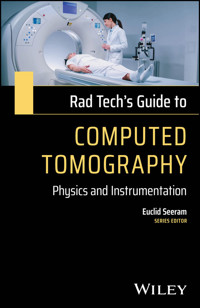
Rad Tech’s Guide to Computed Tomography: Physics and Instrumentation is a comprehensive and accessible approach to learning the physics and instrumentation of CT. The text offers an intuitively organized treatment of the history of CT development, data acquisition, image reconstruction, and the relationship between image quality and radiation dose.
Using clear language, hands-on examples and useful diagrams, the book is written to demystify complex topics like Hounsfield units, attenuation coefficients, and interpolation algorithms, without compromising technical accuracy. This is an educational resource that shows readers how to perform imaging that generates diagnostically useful results that keep patients safe.
Readers will find:
- An up-to-date exploration of the use of artificial intelligence in medical imaging
- Concise explorations of the physics of state-of-the-art CT scanners, relevant to the day-to-day work of practicing RTs
- Practical discussions of relevant, selected topics, including multi-slice CT, the basics of image postprocessing, and quality control fundamentals
- Guidance on how to ensure consistent diagnostic performance without compromising patient safety
- Complete treatments of data acquisition, including slice-by-slice and volume data acquisition
Perfect for students preparing to take professional certification examinations in CT, Rad Tech’s Guide to Computed Tomography will also benefit practicing technologists interested in advancing their understanding, refining their technique, and expanding their professional skillset.
Sie lesen das E-Book in den Legimi-Apps auf:
Seitenzahl: 151
Veröffentlichungsjahr: 2026
Ähnliche















Table of Contents
Cover
Table of Contents
Title Page
Copyright Page
Dedication Page
Foreword
Preface
Acknowledgments
1 The Invention of the CT Scanner and the Nobel Prize
Computed Tomography: A Definition
Three Major Stages of CT Imaging
Invention of the CT Scanner: The Nobel Prize for Pioneers Godfrey Hounsfield and Alan Cormack
Evolution of CT Scanners Leading to Present‐Day Multi‐Slice CT Imaging
References
2 Essential Physics of CT
Introduction
Radiation Attenuation: Essential Physics Related to CT Imaging
Attenuation and Hounsfield Units
The CT Gray‐Scale Image
References
3 Data Acquisition: Principles and Technology
What Is Data Acquisition?
Types of Data Acquisition
Major Technical Data Acquisition Components
Detectors: Types, Principles, and Technology
References
4 Image Reconstruction Principles
Image Reconstruction: A Definition
Image Reconstruction Algorithms
Artificial Intelligence and Its Subsets: Definitions
References
5 Multi‐Slice CT: Principles and Instrumentation
What Is Multi‐Slice CT (MSCT)?
MSCT System Components
Selectable Scan Parameters
Advantages of MSCT
References
6 Image Postprocessing
Scope of Image Processing
Windowing: Effect on Image Contrast and Image Brightness
Multiplanar Image Reformatting
Advanced Image Postprocessing Techniques
References
7 Image Quality
What Is Image Quality in Computed Tomography?
Spatial Resolution
Low‐Contrast Resolution
Noise
Artifacts in a Nutshell
References
8 CT Radiation Dose Considerations
CT Dose Trends
The Basics of CT Dosimetry
Factors Affecting the Dose in CT
Dose Optimization
References
9 CT Quality Control for Technologists/Radiographers
Quality Assurance/Quality Control: Definitions
Essential Steps in QC
Tolerance Limits/Acceptance Criteria
Equipment for QC Testing
Routine QC Tests for the CT Technologist
References
Index
End User License Agreement
List of Tables
Chapter 1
Table 1.1 Brief biographies of the pioneers of the CT scanner.
Chapter 2
Table 2.1 The Hounsfield scale for several tissues.
List of Illustrations
Chapter 1
Figure 1.1 CT imaging produces images of transverse axial sections of the pati...
Figure 1.2 Current CT scanners have the processing capabilities to use two‐dim...
Figure 1.3 The three major stages of CT imaging, namely data acquisition, imag...
Figure 1.4 An elaboration of the three stages noted in Figure 1.3.
Figure 1.5 Essential features of the PACS‐AI platform.
Figure 1.6 CT coronary angiography. The image on the left shows a 3D model of ...
Figure 1.7 Functional testing using CT‐FFR. The image on the left shows an int...
Chapter 2
Figure 2.1 The collection of radiation attenuation readings from the patient....
Figure 2.2 Attenuation of a homogeneous beam follows an exponential curve desc...
Figure 2.3 Attenuation following a single ray of the x‐ray beam through a sing...
Figure 2.4 Attenuation through a single voxel containing water, and subsequent...
Figure 2.5 CT numbers (HUs) displayed as a digital image, where numerical valu...
Figure 2.6 Basic steps in converting a numerical image into a gray‐scale image...
Chapter 3
Figure 3.1 The evolution of CT beam geometries and detector types.
Figure 3.2 Volume data acquisition using spiral/helical beam geometry characte...
Figure 3.3 Major technical components that play a role in collecting attenuati...
Figure 3.4 The shape of the bow‐tie filter not only removes low‐energy photons...
Figure 3.5 The major system components of two classes of CT detectors: energy‐...
Figure 3.6 Schematic drawings of the side and top views of an energy‐integrati...
Figure 3.7 The signal pulses induced by absorbed x‐rays in a photon‐counting d...
Figure 3.8 Comparison of spatial resolution in the phantom images between ultr...
Figure 3.9 The major technical system components of the data acquisition syste...
Chapter 4
Figure 4.1 Data collection and conversion of attenuation values into profiles ...
Figure 4.2 Three types of algorithms and the time periods of use in CT, includ...
Figure 4.3 The basic steps of the FBP algorithm.
Figure 4.4 Flowchart showing the fundamental difference between the FBP and IR...
Figure 4.5 Flowchart illustrating the basic steps of an IR algorithm without m...
Figure 4.6 A Venn diagram illustrating AI and its subsets, ML and DL. While ML...
Figure 4.7 Typical architecture of a simple convolutional neural network, cons...
Figure 4.8 Implementation of a simple convolution neural network model to iden...
Figure 4.9 A generalized overview of the use of a neural network in CT image r...
Figure 4.10 An overview of how a CT Deep Learning Reconstruction Engine is tra...
Chapter 5
Figure 5.1 A brief summary of the development of MSCT scanners.
Figure 5.2 The major design difference between SSCT and MSCT detector arrays. ...
Figure 5.3 The path traced by the x‐ray beam as the patient moves through the ...
Figure 5.4 The major difference between two types of slip rings scanners: a lo...
Figure 5.5 The use of interpolation in MSCT.
Figure 5.6 The basic difference between the 360° and 180° linear interpolation...
Figure 5.7 The fundamental difference between two MSCT detector designs used b...
Figure 5.8 The process of binning the detector elements in MSCT determines the...
Figure 5.9 The effect of pitch on image quality and radiation dose.
Chapter 6
Figure 6.1 Image processing includes preprocessing operations and post process...
Figure 6.2 Definitions of window width (WW) and window level (WL).
Figure 6.3 The assignment of gray levels to shades of gray creating a gray‐sca...
Figure 6.4 The effect of window width (WW) on image contrast. While keeping th...
Figure 6.5 The effect of window level (WL) on the brightness of an image. Whil...
Figure 6.6 Curved multiplanar reconstructions (cMPR) of the right coronary (RC...
Figure 6.7 Four essential steps of 3D operations leading to the creation of se...
Figure 6.8 Contrast‐enhanced 3D CT images after endovascular stent graft treat...
Chapter 7
Figure 7.1 The MTF can be obtained by using the line‐pair test pattern.
Figure 7.2 Since the CT image is inherently a digital image, the spatial resol...
Figure 7.3 In CT imaging, thinner slices result in sharper images.
Figure 7.4 Two images of a contrast resolution test tool. While the image show...
Figure 7.5 Image noise shown in two images of the abdomen. It is visually clea...
Figure 7.6 Image noise in CT is illustrated on this 4 × 4 matrix.
Figure 7.7 Increasing the number of photons from an average of 200 per unit ar...
Chapter 9
Figure 9.1 The format of conducting CT QC tests as outlined by the American Co...
Figure 9.2 A conceptual overview of tolerance limits in quality control testin...
Figure 9.3 The SMPTE test pattern for use in CT QC testing of display monitors...
Figure 9.4 The four modules of the ACR CT QC phantom and associated images. Wh...
Guide
Cover Page
Table of Contents
Title Page
Copyright Page
Dedication Page
Foreword
Preface
Acknowledgments
Begin Reading
Index
Wiley End User License Agreement
Pages
i
ii
iii
viii
ix
x
xi
xii
xiii
xiv
xv
1
2
3
4
5
6
7
8
9
10
11
12
13
14
15
16
17
18
19
20
21
22
23
24
25
26
27
28
29
30
31
32
33
34
35
36
37
38
39
40
41
42
43
44
45
46
47
48
49
50
51
52
53
54
55
56
57
58
59
60
61
62
63
64
65
66
67
68
69
70
71
72
73
74
75
76
77
78
79
80
81
82
83
84
85
86
87
88
89
90
91
92
93
94
95
96
97
98
99
100
101
102
103
104
105
106
107
108
109
110
111
112
113
114
115
116
117
118
119
120
121
122
123
124
125
126
127
128
129
Rad Tech's Guide to Computed Tomograph
Physics and Instrumentation
Euclid Seeram
Medical Imaging and Radiation Sciences, Monash University, Melbourne, Australia
Medical Radiation Sciences, Faculty of Health, University of Canberra, Canberra, Australia
Vision, Compassion, Awareness (VCA) Education Solutions for Health Professionals Inc., Toronto, Ontario, Canada
Copyright © 2026 by John Wiley & Sons, Inc. All rights reserved, including rights for text and data mining and training of artificial intelligence technologies or similar technologies.
Published by John Wiley & Sons, Inc., Hoboken, New Jersey.
No part of this publication may be reproduced, stored in a retrieval system, or transmitted in any form or by any means, electronic, mechanical, photocopying, recording, scanning, or otherwise, except as permitted under Section 107 or 108 of the 1976 United States Copyright Act, without either the prior written permission of the Publisher, or authorization through payment of the appropriate per‐copy fee to the Copyright Clearance Center, Inc., 222 Rosewood Drive, Danvers, MA 01923, (978) 750‐8400, fax (978) 750‐4470, or on the web at www.copyright.com. Requests to the Publisher for permission should be addressed to the Permissions Department, John Wiley & Sons, Inc., 111 River Street, Hoboken, NJ 07030, (201) 748‐6011, fax (201) 748‐6008, or online at http://www.wiley.com/go/permission.
The manufacturer’s authorized representative according to the EU General Product Safety Regulation is Wiley‐VCH GmbH, Boschstr. 12, 69469 Weinheim, Germany, e‐mail: [email protected].
Trademarks: Wiley and the Wiley logo are trademarks or registered trademarks of John Wiley & Sons, Inc. and/or its affiliates in the United States and other countries and may not be used without written permission. All other trademarks are the property of their respective owners. John Wiley & Sons, Inc. is not associated with any product or vendor mentioned in this book.
Limit of Liability/Disclaimer of Warranty: The contents of this work are intended to further general scientific research, understanding, and discussion only and are not intended and should not be relied upon as recommending or promoting scientific method, diagnosis, or treatment by physicians for any particular patient. In view of ongoing research, equipment modifications, changes in governmental regulations, and the constant flow of information relating to the use of medicines, equipment, and devices, the reader is urged to review and evaluate the information provided in the package insert or instructions for each medicine, equipment, or device for, among other things, any changes in the instructions or indication of usage and for added warnings and precautions. While the publisher and the authors have used their best efforts in preparing this work, including a review of the content of the work, neither the publisher nor the authors make any representations or warranties with respect to the accuracy or completeness of the contents of this work and specifically disclaim all warranties, including without limitation any implied warranties of merchantability or fitness for a particular purpose. No warranty may be created or extended by sales representatives, written sales materials or promotional statements for this work. The fact that an organization, website, or product is referred to in this work as a citation and/or potential source of further information does not mean that the publisher and authors endorse the information or services the organization, website, or product may provide or recommendations it may make. This work is sold with the understanding that the publisher is not engaged in rendering professional services. The advice and strategies contained herein may not be suitable for your situation. You should consult with a specialist where appropriate. Further, readers should be aware that websites listed in this work may have changed or disappeared between when this work was written and when it is read. Neither the publisher nor authors shall be liable for any loss of profit or any other commercial damages, including but not limited to special, incidental, consequential, or other damages.
For general information on our other products and services or for technical support, please contact our Customer Care Department within the United States at (800) 762‐2974, outside the United States at (317) 572‐3993 or fax (317) 572‐4002.
Wiley also publishes its books in a variety of electronic formats. Some content that appears in print may not be available in electronic formats. For more information about Wiley products, visit our web site at www.wiley.com.
Library of Congress Cataloging‐in‐Publication Data Applied for:
Paperback ISBN: 9781394312603
Cover Design: WileyCover Image: © VesnaArt/Shutterstock
This book is dedicated to my smart, caring, charming, and loving wife, Trish, with love and blessings forever.
Foreword
Over the past several decades, medical imaging has transformed how clinicians diagnose and treat diseases. Among the most significant advancements in this field is the development of Computed Tomography (CT), a modality that allows for non‐invasive, highly detailed visualization of internal anatomy. From the early experiments that brought us the first CT images to the sophisticated, multi‐slice, AI‐enhanced scanners of today, the journey of CT has been nothing short of revolutionary. As this technology becomes increasingly complex and indispensable, the need for radiologic technologists to grasp the underlying science grows ever more urgent.
Rad Tech’s Guide to Computed Tomography: Physics and Instrumentation arrives at a critical moment. With the continued integration of advanced algorithms, dose optimization strategies, and quality assurance protocols, technologists are expected to do more than operate equipment. They must understand how it works, how to optimize its use, and how to ensure it performs at its highest potential for the safety and benefit of patients. This guide provides a comprehensive yet accessible approach to learning CT physics and instrumentation. The book is organized into logically progressing chapters that cover essential topics such as the historical development of CT, principles of data acquisition, image reconstruction, and the relationship between image quality and radiation dose. Particularly valuable is the inclusion of chapters dedicated to quality control, a domain often overlooked but vitally important in ensuring consistent diagnostic performance and patient radiation safety.
Each chapter is designed to support learners at various levels. Students entering the field will benefit from the clear, step‐by‐step explanations of key concepts, while seasoned technologists will find the text to be an excellent refresher and reference tool as new technologies emerge. The inclusion of updated content on artificial intelligence, iterative reconstruction, and multi‐slice CT demonstrates the book’s commitment to staying current with technological advancements and clinical realities.
The strength of this guide lies not only in its technical accuracy but also in its educational clarity. The author presents difficult concepts with admirable simplicity, using language that respects the learner’s starting point while guiding them toward deeper understanding. Concepts such as Hounsfield Units, attenuation coefficients, and interpolation algorithms are demystified through practical examples, thoughtful diagrams, and well‐structured narratives. The chapter on radiation dose, for instance, goes beyond definitions to explore the ethical and clinical implications of dose management, underscoring the vital role that technologists play in protecting patients while achieving diagnostic excellence.
It is also important to acknowledge the author behind this outstanding work. Dr. Euclid Seeram, a globally respected educator and pioneer in medical imaging, brings to this book the weight of decades of scholarship, teaching, and innovation. With over 35 published textbooks and more than 60 peer‐reviewed papers, Dr. Seeram’s contributions have shaped generations of radiologic technologists around the world. His unwavering commitment to high standards in diagnostic imaging quality and patient‐centered care has left an indelible mark on the profession. For many of us, our own journey in CT imaging began by reading his foundational texts.
In sum, this book stands out as both a scholarly and practical resource, well suited to formal classroom settings, clinical environments, or personal study. It provides the kind of foundation that empowers technologists to not only pass certification exams, but to practice with confidence and care.
I commend Dr. Seeram for creating a guide that fills an important gap in the literature on radiologic technology. With its balanced combination of rigor and readability, Rad Tech’s Guide to Computed Tomography: Physics and Instrumentation is poised to become a staple in the professional development of CT technologists for years to come.
Valentina Al Hamouche, RTR, BSc. (Hons), MSc.
CEO, VCA Education Solutions for Health Professionals Inc.
Toronto, Ontario, Canada
Preface
Computed Tomography (CT) is a sectional x‐ray imaging technique introduced in the 1970s and one that has been labeled a revolutionary evolution in the medical imaging community. Through the years, there have been significant advancements and improvements in CT physics and technology for the benefit of the patient. The evolution of CT from its beginnings to the present day has been described in the literature. Two most notable articles include one by Hsieh and Flohr entitled “Computed tomography recent history and future perspectives,” published in the Journal of Medical Imaging in 2021, and the other by McCollough and Rajiah, published in Radiology in 2023.
The major purpose of this book, Rad Tech’s Guide to Computed Tomography: Physics and Instrumentation, is to provide a comprehensive coverage of the developments and technical innovations in CT evolution. This guide is intended to serve as a useful resource for not only students preparing to write professional certification examinations in CT, but practitioners, throughout the globe.




