


111,99 €
Mehr erfahren.
- Herausgeber: John Wiley & Sons
- Kategorie: Wissenschaft und neue Technologien
- Serie: Wiley Series in Probability and Statistics
- Sprache: Englisch
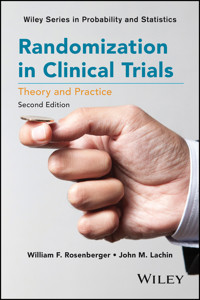
Praise for the First Edition "All medical statisticians involved in clinical trials should read this book..." - Controlled Clinical Trials Featuring a unique combination of the applied aspects of randomization in clinical trials with a nonparametric approach to inference, Randomization in Clinical Trials: Theory and Practice, Second Edition is the go-to guide for biostatisticians and pharmaceutical industry statisticians. Randomization in Clinical Trials: Theory and Practice, Second Edition features: * Discussions on current philosophies, controversies, and new developments in the increasingly important role of randomization techniques in clinical trials * A new chapter on covariate-adaptive randomization, including minimization techniques and inference * New developments in restricted randomization and an increased focus on computation of randomization tests as opposed to the asymptotic theory of randomization tests * Plenty of problem sets, theoretical exercises, and short computer simulations using SAS to facilitate classroom teaching, simplify the mathematics, and ease readers' understanding Randomization in Clinical Trials: Theory and Practice, Second Edition is an excellent reference for researchers as well as applied statisticians and biostatisticians. The Second Edition is also an ideal textbook for upper-undergraduate and graduate-level courses in biostatistics and applied statistics. William F. Rosenberger, PhD, is University Professor and Chairman of the Department of Statistics at George Mason University. He is a Fellow of the American Statistical Association and the Institute of Mathematical Statistics, and author of over 80 refereed journal articles, as well as The Theory of Response-Adaptive Randomization in Clinical Trials, also published by Wiley. John M. Lachin, ScD, is Research Professor in the Department of Epidemiology and Biostatistics as well as in the Department of Statistics at The George Washington University. A Fellow of the American Statistical Association and the Society for Clinical Trials, Dr. Lachin is actively involved in coordinating center activities for clinical trials of diabetes. He is the author of Biostatistical Methods: The Assessment of Relative Risks, Second Edition, also published by Wiley.
Sie lesen das E-Book in den Legimi-Apps auf:
Seitenzahl: 503
Veröffentlichungsjahr: 2015
Ähnliche



















Table of Contents
Cover
Series Page
Title Page
Copyright
Preface
Preface to The Second Edition
Preface to The First Edition
Chapter 1: Randomization and the Clinical Trial
1.1 Introduction
1.2 Causation and Association
1.3 Randomized Clinical Trials
1.4 Ethics of Randomization
1.5 Problems
1.6 References
Chapter 2: Issues in the Design of Clinical Trials
2.1 Introduction
2.2 Study Outcomes
2.3 Sources of Bias
2.4 Experimental Design
2.5 Recruitment and Follow-Up
2.6 Determining The Number of Randomized Subjects
2.7 Problems
2.8 References
Chapter 3: Randomization for Balancing Treatment Assignments
3.1 Introduction
3.2 Complete Randomization
3.3 Forced Balance Procedures
3.4 Forced Balance Randomization Within Blocks
3.5 Efron's Biased Coin Design
3.6 Other Biased Coin Designs and Generalizations
3.7 Wei's Urn Design
3.8 Other URN Models and Generalizations
3.9 Comparison of Balancing Properties
3.10 Restricted Randomization for Unbalanced Allocation
3.11
K
> 2 Treatments
3.12 Problems
3.13 References
3.14 Appendix
Chapter 4: The Effects of Unobserved Covariates
4.1 Introduction
4.2 A Bound on The Probability of A Covariate Imbalance
4.3 Simulation Results
4.4 Accidental Bias
4.5 Maximum Eigenvalue of
4.6 Accidental Bias for Biased Coin Designs
4.7 Chronological Bias
4.8 Problems
4.9 References
4.10 Appendix
Chapter 5: Selection Bias
5.1 Introduction
5.2 The Blackwell–Hodges Model
5.3 Predictability of A Randomization Sequence
5.4 Selection Bias for The Random Allocation Rule and Truncated Binomial Design
5.5 Selection Bias in A Permuted Block Design
5.6 Selection Bias for Other Restricted Randomization Procedures
5.7 Simulation Results
5.8 Controlling and Testing for Selection Bias in Practice
5.9 Problems
5.10 References
5.11 Appendix
Chapter 6: Randomization as a Basis for Inference
6.1 Introduction
6.2 The Population Model
6.3 The Randomization Model
6.4 Randomization Tests
6.5 Linear Rank Tests
6.6 Variance of The Linear Rank Test
6.7 Optimal Rank Scores
6.8 Exact and Large-sample Randomization Tests
6.9 Monte Carlo Re-Randomization Tests
6.10 Preservation of Error Rates
6.11 Regression Modeling
6.12 Analyses with Missing Data
6.13 Sample Size Considerations for Random Sample Fractions
6.14 Group Sequential Monitoring
6.15 Problems
6.16 References
6.17 Appendix A
6.18 Appendix B
Chapter 7: Stratification
7.1 Introduction
7.2 Stratified Randomization
7.3 Is Stratification Necessary?
7.4 Treatment Imbalances in Stratified Trials
7.5 Stratified Analysis Using Randomization Tests
7.6 Efficiency of Stratified Randomization in A Stratified Analysis
7.7 Conclusions
7.8 Problems
7.9 References
Chapter 8: Restricted Randomization in Practice
8.1 Introduction
8.2 Stratification
8.3 Characteristics of Randomization Procedures
8.4 Selecting a Randomization Procedure
8.5 Generation of Sequences
8.6 Implementation
8.7 Special Situations
8.8 Some Examples
8.9 Problems
8.10 References
Chapter 9: Covariate-Adaptive Randomization
9.1 Early Work
9.2 More Recent Covariate-Adaptive Randomization Procedures
9.3 Optimal Design Based on A Linear Model
9.4 The Trade-Off Among Balance, Efficiency, and Ethics
9.5 Inference for Covariate-Adaptive Randomization
9.6 Conclusions
9.7 Problems
9.8 References
Chapter 10: Response-Adaptive Randomization
10.1 Introduction
10.2 Historical Notes
10.3 Optimal Allocation
10.4 Response-Adaptive Randomization to Target
10.5 Urn Models
10.6 Treatment Effect Mappings
10.7 Covariate-Adjusted Response-Adaptive Randomization
10.8 Problems
10.9 References
10.10 Appendix
Chapter 11: Inference for Response-Adaptive Randomization
11.1 Introduction
11.2 Population-Based Inference
11.3 Power
11.4 Randomization-Based Inference
11.5 Problems
11.6 References
Chapter 12: Response-Adaptive Randomization in Practice
12.1 Basic Assumptions
12.2 Bias, Masking, and Consent
12.3 Logistical Issues
12.4 Selection of A Procedure
12.5 Benefits of Response-Adaptive Randomization
12.6 Some Examples
12.7 Conclusions
12.8 Problems
12.9 References
Author Index
Subject Index
Series Page
End User License Agreement
Pages
xi
xii
xiii
xiv
xv
xvi
1
2
3
4
5
6
7
8
9
10
11
12
13
14
15
16
17
18
19
20
21
22
23
24
25
26
27
28
29
30
31
32
33
34
35
36
37
38
39
40
41
42
43
44
45
46
47
48
49
50
51
52
53
54
55
56
57
58
59
60
61
62
63
64
65
66
67
68
69
70
71
72
73
74
75
76
77
78
79
80
81
82
83
84
85
86
87
88
89
90
91
92
93
94
95
96
97
98
99
100
101
102
103
104
105
106
107
108
109
110
111
112
113
114
115
116
117
118
119
120
121
122
123
124
125
126
127
128
129
130
131
132
133
134
135
136
137
138
139
140
141
142
143
144
145
146
147
148
149
150
151
152
153
154
155
156
157
158
159
160
161
162
163
164
165
166
167
169
170
171
172
173
174
175
176
177
178
179
180
181
182
183
184
185
186
187
189
190
191
192
193
194
195
196
197
198
199
200
201
202
203
204
205
206
207
208
209
210
211
212
213
214
215
217
218
219
220
221
222
223
224
225
226
227
228
229
231
232
233
234
235
236
237
238
239
240
241
242
243
244
245
246
247
249
250
251
252
253
Guide
Cover
Table of Contents
Preface
Begin Reading
List of Illustrations
Chapter 2: Issues in the Design of Clinical Trials
Figure 2.1 Distribution of a test statistic under the null and alternative hypotheses, with the rejection region of size and a type II error rate of size .
Chapter 3: Randomization for Balancing Treatment Assignments
Figure 3.1 Power curves for the comparison of two normal means across values of .
Figure 3.2 Possible paths (light bold) of six different randomization procedures, with a particular path outlined in heavy bold. (a) Efron's BCD (). (b) Big stick design (). (c) Maximal procedure (). (d) Hadamard randomization. (e) Permuted block design (). (f) Permuted block design ().
Figure 3.3 The brick tunnel for 4 : 3 allocation
Chapter 5: Selection Bias
Figure 5.1 The Blackwell–Hodges model for selection bias.
Figure 5.2 Expected bias factor for the random allocation rule (RAR) and the truncated binomial design (TBD) across values of .
Figure 5.3 Expected bias factor for the permuted block design (filled using the random allocation rule) with block sizes across values of .
Figure 5.4 The effect of block size on the expected bias factor for the permuted block design with , comparing the random allocation rule (RAR) and the truncated binomial design (TBD).
Chapter 6: Randomization as a Basis for Inference
Figure 6.1 The population model versus the invoked population model for a clinical trial
Figure 6.2 The randomization model for a clinical trial.
Chapter 8: Restricted Randomization in Practice
Figure 8.1 Trade-off plot for various values of for Efron's biased coin design, .
Figure 8.2 Trade-off plot for various values of for the big stick design, .
Figure 8.3 Trade-off plot for various restricted randomization procedures, , comparing imbalance and predictability measures.
Figure 8.4 Trade-off plot for various restricted randomization procedures, , comparing imbalance and predictability measures.
Figure 8.5 Trade-off plot for various restricted randomization procedures, , comparing predictability and type II error rate under a linear time trend.
Chapter 9: Covariate-Adaptive Randomization
Figure 9.1 Multiple objectives of a phase III clinical trial.
List of Tables
Chapter 3: Randomization for Balancing Treatment Assignments
Table 3.1 Percentiles of the distribution of for complete randomization
Table 3.2 Six permutation sequences for with probabilities under truncated binomial randomization (each sequence has probability under random allocation)
Table 3.3 Percentiles of the distribution of for Wei's urn design
Table 3.4 Simulated variance of and expected maximum imbalance for eight different randomization procedures, , based on replications
Chapter 4: The Effects of Unobserved Covariates
Table 4.1 Simulated for three different types of covariate streams, , replications
Chapter 5: Selection Bias
Table 5.1 Simulated expected selection bias factor, , based on replications.
Chapter 6: Randomization as a Basis for Inference
Table 6.1 Unconditional and conditional reference sets for computation of the linear rank test from complete randomization. Source: Lachin (1988, p. 298). Reproduced with permission of Elsevier
Table 6.2 Unconditional and conditional reference sets for computation of the linear rank test from the . Source: Wei and Lachin (1988, p. 352). Reproduced with permission of Elsevier
Table 6.3 Monte Carlo re-randomization test -values for the DCCT data in Appendix A under four different re-randomization procedures
Table 6.4 Simulated size and power of the randomization test and the -test under two different models and seven different randomization procedures. Each simulation based on 10,000 tests, . For the randomization test, . All tests are unconditional unless noted.
Table 6.5 Sample size requirements for Smith's design for (, , and ). Source: Hu and Rosenberger (2006, p. 101), reproduced with permission of John Wiley and Sons, Inc
Table 6.6 Cholesterol levels and treatment assignment codes from 50 patients from the Diabetes Complications and Control Trial
Chapter 7: Stratification
Table 7.1 Relative efficiency of estimators for stratified randomization and stratified analysis versus stratified analysis only, for various values of and
Table 7.2 Limits of imbalance occurring with probabilities and , for various values of and
Chapter 8: Restricted Randomization in Practice
Table 8.1 Biased coin allocation ratios to , , and such that the probability of assignment to is , and to is , when there is an excess number of prior allocations to
Chapter 10: Response-Adaptive Randomization
Table 10.1 Asymptotic variances and optimal allocation for minimizing expected number of failures at a fixed variance, for three measures of the treatment effect from binary response trials
Table 10.2 Simulated values of expected allocation proportions, (standard deviation), for the sequential maximum likelihood procedure targeting ((10.4)) (A), the sequential maximum likelihood procedure targeting Neyman allocation (N), and equal allocation (E), 5000 replications
Table 10.3 Exact values of (standard deviation) for for the rule and the rule
Table 10.4 Simulated values of expected allocation proportions, (standard deviation), for the procedure, 5000 replications
Chapter 11: Inference for Response-Adaptive Randomization
Table 11.1 Unconditional reference set for computation of the linear rank test following randomization
Wiley Series in Probability and Statistics
Established by WALTER A. SHEWHART and SAMUEL S. WILKS
Editors: David J. Balding, Noel A. C. Cressie, Garrett M. Fitzmaurice, Geof H. Givens, Harvey Goldstein, Geert Molenberghs, David W. Scott, Adrian F. M. Smith, Ruey S. Tsay, Sanford Weisberg
Editors Emeriti: J. Stuart Hunter, Iain M. Johnstone, Joseph B. Kadane, Jozef L. Teugels
Randomization in Clinical Trials
Theory and Practice
Second Edition
WILLIAM F. ROSENBERGER
George Mason University
JOHN M. LACHIN
The George Washington University
Copyright © 2016 by John Wiley & Sons, Inc. All rights reserved
Published by John Wiley & Sons, Inc., Hoboken, New Jersey
Published simultaneously in Canada
No part of this publication may be reproduced, stored in a retrieval system, or transmitted in any form or by any means, electronic, mechanical, photocopying, recording, scanning, or otherwise, except as permitted under Section 107 or 108 of the 1976 United States Copyright Act, without either the prior written permission of the Publisher, or authorization through payment of the appropriate per-copy fee to the Copyright Clearance Center, Inc., 222 Rosewood Drive, Danvers, MA 01923, (978) 750-8400, fax (978) 750-4470, or on the web at www.copyright.com. Requests to the Publisher for permission should be addressed to the Permissions Department, John Wiley & Sons, Inc., 111 River Street, Hoboken, NJ 07030, (201) 748-6011, fax (201) 748-6008, or online at http://www.wiley.com/go/permissions.
Limit of Liability/Disclaimer of Warranty: While the publisher and author have used their best efforts in preparing this book, they make no representations or warranties with respect to the accuracy or completeness of the contents of this book and specifically disclaim any implied warranties of merchantability or fitness for a particular purpose. No warranty may be created or extended by sales representatives or written sales materials. The advice and strategies contained herein may not be suitable for your situation. You should consult with a professional where appropriate. Neither the publisher nor author shall be liable for any loss of profit or any other commercial damages, including but not limited to special, incidental, consequential, or other damages.
For general information on our other products and services or for technical support, please contact our Customer Care Department within the United States at (800) 762-2974, outside the United States at (317) 572-3993 or fax (317) 572-4002.
Wiley also publishes its books in a variety of electronic formats. Some content that appears in print may not be available in electronic formats. For more information about Wiley products, visit our web site at www.wiley.com.
Library of Congress Cataloging-in-Publication Data:
Rosenberger, William F.
Randomization in clinical trials : theory and practice / William F. Rosenberger, John M. Lachin.
pages cm
Includes bibliographical references and indexes.
ISBN 978-1-118-74224-2 (cloth)
1. Clinical trials. 2. Sampling (Statistics) I. Lachin, John M., 1942- II. Title.
R853.C55R677 2016
610.72′4–dc23
2015024059
Cover image courtesy of Getty/Shikhar Bhattarai
Preface
Preface to The Second Edition
Thirteen years have passed since the original publication of Randomization in Clinical Trials: Theory and Practice, and hundreds of papers on randomization have been published since that time. This second edition of the book attempts to update the first edition by incorporating the new methodology in many of these recent publications. Perhaps the most dramatic change is the deletion of Chapters 13–15, which describe asymptotic methods for the theory of randomization-based inference under a linear rank formulation. Instead, we have added several sections on Monte Carlo methods; modern computing has now made randomization-based inference quick and accurate. The reliance on the linear rank test formulation is now less important, as its primary interest was in the formulation of an asymptotic theory. We hope that Monte Carlo re-randomization tests will now become standard practice, since they are computationally convenient, assumption free, and tend to preserve type I error rates even under heterogeneity. The re-randomization techniques also reduce the burden on stratified analysis, and this description has now been folded into a single chapter on stratification, which is now separate from the chapter on covariate-adaptive randomization. Covariate-adaptive randomization, while still controversial, has seen the most growth in publications of any randomization technique, and it now merits its own chapter. We have also added a section on inference following covariate-adaptive randomization, along with (sometimes heated) philosophical arguments about the subject. Many new restricted and response-adaptive randomization procedures are now described. Many homework problems have been added.
Acknowledgments: This work was completed while W.F.R. was on a 1-year sabbatical during 2014–2015. In Fall 2014, he was supported on a Fulbright scholarship to visit RWTH Aachen University, Germany, and conversations with Prof. Ralf-Dieter Hilgers, Nicole Heussen, Miriam Tamm, David Schindler, and Diane Uschner were enormously helpful in preparing the second edition. In Spring 2015, he was Visiting Scholar in the Department of Mathematics, University of Southern California, and also at The EMMES Corporation. He thanks Prof. Jay Bartroff, Marian Ewell, and Anne Lindblad for facilitating these arrangements. He is also grateful to the many colleagues and former students who have helped him understand randomization better, in particular, Prof. Ale Baldi Antognini, Prof. Alessandra Giovagnoli, Prof. Feifang Hu, Prof. Anastasia Ivanova, Alex Sverdlov, Yevgen Tymofyeyev, and Lanju Zhang.
Alex Sverdlov was especially generous in his assistance on the second edition. He provided the authors with a bibliography of papers on randomization in the past 13 years and also suggested numerous homework problems that now appear in Chapter 9. Victoria Plamadeala developed Problem 6.11. Diane Uschner, Hui Shao, and Ionut Bebu assisted with some of the figures.
W. F. R.
Fairfax, VA
J. M. L.
Rockville, MD
Preface to The First Edition
The Department of Statistics at The George Washington University (GWU) was a hotbed of activity in randomization during the 1980s. L. J. Wei was on the faculty during the early 1980s and drew Bob Smythe into his randomization research with some interesting asymptotics problems. At the same time, John Lachin was working on his series of papers on randomization for Controlled Clinical Trials that appeared in 1988. He, too, was influenced by Wei and began advocating the use of Wei's urn design for clinical trials at The Biostatistics Center, which he directed at that time and now codirects. I studied at GWU from 1986 to 1992, taking many classes from Lachin, Smythe, and also the late biostatistician Sam Greenhouse. I wrote my doctoral thesis under the direction of Smythe, on asymptotic properties of randomization tests and response-adaptive randomization, topics covered in the latter chapters of this book. I also worked on clinical trials at The Biostatistics Center from 1990 to 1995 under the great clinical trialist Ray Bain (now at Merck). Needless to say, I was well indoctrinated in the importance of randomization to protect against biases and the importance of incorporating the particular randomization design into analyses.
Currently, I am continuing my research on randomization and adaptive designs at University of Maryland, Baltimore County, where I teach several graduate-level courses in biostatistics and serve as a biostatistician for clinical trials data and safety monitoring boards for the National Institutes of Health, the Veterans Administration and Industry. One of my graduate courses is the design ofclinical trials, and much of this book is based on the notes from teaching that course.
The book fills a niche in graduate-level training in biostatistics, because it combines both the applied aspects of randomization in clinical trials along with a probabilistic treatment of properties of randomization. Although the former has been covered in many books (albeit sparsely at times), the latter has not. The book takes an unabashedly non-Bayesian and nonparametric approach to inference, focusing mainly on the linear rank test under a randomization model, with some added discussion on likelihood-based inference as it relates to sufficiency and ancillarity. The strong focus on randomization as a basis for inference is another unique aspect of the book.
Chapters 1–12 represent the primary focus of the book, while Chapters 13–15 present theoretical developments that will be interesting for Ph.D. students in statistics and those conducting theoretical research in randomization. The prerequisite for Chapters 1–12 is a course in probability and mathematical statistics at the advanced undergraduate level. The probability in those chapters is presented at the level of Sheldon Ross's Introduction to Probability Models, and a thorough knowledge of only the first three chapters of that book will allow the student to get through the text and problem sets of those chapters (with the exception of Section Efron's Biased Coin Design, which requires material on Markov chains from Chapter 4 of Ross). Chapters 13–15 require probability at the level of K. L. Chung's A Course in Probability Theory. Chapter 13 excerpts the main results needed in large-sample theory for Chapters 14 and 15.
Problem sets are given at the end of each chapter; some are short theoretical exercises, some are short computer simulations that can be done efficiently in SAS, and some are questions that require a lot of thinking on the part of students about ethics and statistical philosophy and are useful for inspiring discussion. I have found that students love to read some of the great discussion papers on such topics as randomization-based inference, the ECMO controversy, and ethical dilemmas in clinical trials. I try to have two or three debates during a semester's course, in which every student is asked to present and defend a viewpoint. Some students are amazed, for instance, that there is any question about appropriate techniques for inference, because they have been presented a single viewpoint in their mathematical statistical course, and have basically taken their instructor's lecture notes as established fact.
One wonderful side-benefit of teaching randomization is the opportunity to meld the concepts of conditional probability and stochastic processes into real-life applications. Too often probability is taught completely independently of applications, and applications are taught completely independently of probability and statistical theory. As each randomization sequence forms a stochastic process, exploring the properties of randomization is an exercise in exploring the properties of certain stochastic processes. I have used these randomization sequences as illustrations when teaching stochastic processes.
This book can be used as a textbook for a one-quarter or one-semester course in the design of clinical trials. In our one-semester course, I supplement this materialwith a unit on sequential monitoring of data. I assume that students already have a basic knowledge of survival analysis, including the log-rank family of tests and hazard functions. Computational problems can be done in SAS, or in any other programming language, such as MATLAB, but I anticipate students would be facile in SAS before taking such a course.
I also hope that this book will be quite useful for statisticians and clinical trialists working in the pharmaceutical industry. Based on my many conversations and collaborations with statisticians in industry and government, I believe the fairly new techniques of response-adaptive randomization are attractive to the industry and also to the Food and Drug Administration. This book will be the first clinical trials book to devote a substantial portion to these techniques. However, this book should not be construed as a book on “adaptive designs.” Adaptive design has become a major subdiscipline of experimental design over the past two decades, and the breadth of this subdiscipline makes a book on the subject very difficult to write. In this book, we focus on adaptive designs only as they relate to the very narrow area of randomized clinical trials.
Finally, the reader will note many “holes” in the book, representing open problems. Many of these concern randomization-based inference for covariate-adaptive and response-adaptive randomization procedures, and also some for more standard restricted randomization, in areas of group sequential monitoring and large sample theory. I hope this book will be a catalyst for further research in these areas.
Acknowledgments: I am grateful for the help and comments of Boris Alemi, Steve Coad, Susan Groshen, Janis Hardwick, Karim Hirji, Kathleen Hoffman, Feifang Hu, Vince Melfi, Connie Page, Anindya Roy, Andrew Rukhin, Bob Smythe, and Thomas Wanner. Yaming Hang researched sections of Chapter 14 during a 1-year research assistantship. During the writing of this book, I was supported by generous grants from the National Institute of Diabetes and Digestive and Kidney Diseases and the National Cancer Institute. Large portions of the book were written during the first semester of my sabbatical spent at The EMMES Corporation, a clinical trials coordinating center in Rockville, MD. I am grateful to EMMES, in particular Ravinder Anand, Anne Lindblad, and Don Stablein, for their support of this research and their kindness in allowing me to use their office resources. On the second semester of my sabbatical, I was able to “test” a draft of the book while teaching Biostatistics 219 in the Department of Biostatistics, UCLA School of Public Health. I thank Bill Cumberland and Weng Kee Wong for arranging a visiting position there and the students of that course for finding a good number of errors.
W. F. R.
Baltimore, Maryland
I joined the Biostatistics Center of the George Washington University in 1973, 1 year after receiving my doctorate, to serve as the junior staff statistician for the National Institutes of Health (NIH)-funded multicenter National Cooperative Gallstone Study (NCGS). Jerry Cornfield and Larry Shaw were the Director and Codirector of the Biostatistics Center and the Principal Investigator and Coprincipal Investigator of the NCGS coordinating center. Among my initial responsibilities for the NCGS were to determine the sample size and to generate the randomization sequences. Since I had not been introduced to these concepts in graduate school, I started with a review of the literature that led to a continuing interest in both topics.
While Jerry Cornfield thought of many problems from a Bayesian perspective, in which randomization is ancillary, he thought that randomization was one of the central characteristics of a clinical trial. In fact, he once remarked that the failure of Bayesian theory to provide a statistical justification for randomization was a glaring defect. Thus in 1973–1974, Larry Shaw and I approached the development of randomization for the NCGS with great care. Larry and I agreed that we should employ a procedure as close to complete randomization (toss of a coin) as possible and decided to use a procedure that Larry had previously employed in trials he organized while a member of the Veterans Administration Cooperative Studies Program. That technique has since come to be known as the “big stick” procedure.
Later, around 1980, I served as the Principal Investigator for the statistical coordinating centers for the NIH-funded Lupus Nephritis Collaborative Study and the Diabetes Control and Complications Trial. Both were unmasked studies. In the late 1970s, I first met L. J. Wei while he was on sabbatical leave at the National Cancer Institute. He later joined the faculty at George Washington University, and we became close friends and colleagues. Thus, when it came time to plan the randomization for these two studies, I was drawn to Wei's urn design because of its many favorable properties. Later, I organized a workshop “The Role of Randomization in Clinical Trials” for the 1986 meeting of the Society for Clinical Trials. The papers from that workshop, coauthored with John Matts and Wei, were then published in Controlled Clinical Trials in 1988. During 1990–1991, I had a sabbatical leave, during which I began to organize material from these papers and other research into a book.
During 1991–1992, I taught a course on clinical trials in which I used the material from the draft chapters and my 1988 papers. One of the students auditing that course was Bill Rosenberger. Bill was concurrently writing his dissertation on large sample inference for a family of response-adaptive randomization procedures under the direction of Bob Smythe. Bob had conducted research with Wei and others on randomization-based inference for the family of urn designs. Bill went on to establisha strong record of research into the properties of response-adaptive randomization procedures.
In 1998, I again took sabbatical leave that I devoted to the writing of my 2000 textbook Biostatistical Methods: The Assessment of Relative Risks. During that time, Bill suggested that we collaborate to write a textbook on randomization. This book is the result.
In writing this text, we have tried to present the statistical theoretical foundation and properties of randomization procedures and also provide guidance for statistical practice in clinical trials. While the book deals largely with the theory of randomization, we summarize the practical significance of these results throughout, and some chapters are devoted to practical issues alone. Thus, we hope this textbook will be of use to those interested in the statistical theory of the topic, as well as its implementation.
Acknowledgments: I especially wish to thank L. J. Wei and Bob Smythe for their friendship and collaboration over the years and Naji Younes for assistance. I also wish to thank those many statisticians who worked with me to implement randomization procedures for clinical trials and the many physicians who collaborated in the conduct of these studies. Thank you for vesting the responsibility for these studies with me and for taking randomization as seriously as do I.
J. M. L.
Rockville, Maryland
Chapter 1Randomization and the Clinical Trial
1.1 Introduction
The goal of any scientific activity is the acquisition of new knowledge. In empirical scientific research, new knowledge or scientific results are generated by an investigation or study. The validity of any scientific results depends on the manner in which the data or observations are collected, that is, on the design and conduct of the study, as well as the manner in which the data are analyzed. Such considerations are often the areas of expertise of the statistician. Statistical analysis alone is not sufficient to provide scientific validity, because the quality of any information derived from a data analysis is principally determined by the quality of the data itself. Therefore, in the effort to acquire scientifically valid information, one must consider all aspects of a study: design, execution, and analysis.
This book is devoted to a time-tested design for the acquisition of scientifically valid information – the randomization of study units to receive one of the study treatments. One can trace the roots of the randomization principle to Sir R. A. Fisher (e.g., 1935), the founder of modern statistics, in the context of assigning “treatments” to blocks or plots of land in agricultural experiments. The principle of randomization is now a fundamental feature of the scientific method and is employed in many fields of empirical research. Much of the theoretical research into the principles and properties of randomization has been conducted in the domain of its application to clinical trials. A clinical trial is basically an experiment designed to evaluate the beneficial and adverse effects of a new medical treatment or intervention. In a clinical trial, often subjects sequentially enter a study and are randomized to one of two or more study treatments. Clinical trials in medicine differ in many respects from randomized experiments in other disciplines, and clinical trials in humans involve complex ethical issues, which are not encountered in other scientific experiments. The use of randomization in clinical trials has not been without controversy, as we shall see, and statistical issues for randomized clinical trials can be very different from those in other types of studies. Thus this book shall address randomization in the context of clinical trials.
Lesen Sie weiter in der vollständigen Ausgabe!
Lesen Sie weiter in der vollständigen Ausgabe!
Lesen Sie weiter in der vollständigen Ausgabe!
Lesen Sie weiter in der vollständigen Ausgabe!
Lesen Sie weiter in der vollständigen Ausgabe!
Lesen Sie weiter in der vollständigen Ausgabe!
Lesen Sie weiter in der vollständigen Ausgabe!
Lesen Sie weiter in der vollständigen Ausgabe!
Lesen Sie weiter in der vollständigen Ausgabe!
Lesen Sie weiter in der vollständigen Ausgabe!
Lesen Sie weiter in der vollständigen Ausgabe!
Lesen Sie weiter in der vollständigen Ausgabe!
Lesen Sie weiter in der vollständigen Ausgabe!
Lesen Sie weiter in der vollständigen Ausgabe!
Lesen Sie weiter in der vollständigen Ausgabe!




