


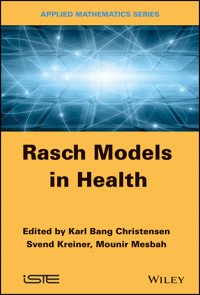
Rasch Models in Health E-Book
144,99 €
Mehr erfahren.
- Herausgeber: John Wiley & Sons
- Kategorie: Wissenschaft und neue Technologien
- Sprache: Englisch
The family of statistical models known as Rasch models started with a simple model for responses to questions in educational tests presented together with a number of related models that the Danish mathematician Georg Rasch referred to as models for measurement. Since the beginning of the 1950s the use of Rasch models has grown and has spread from education to the measurement of health status. This book contains a comprehensive overview of the statistical theory of Rasch models.
Part 1 contains the probabilistic definition of Rasch models, Part 2 describes the estimation of item and person parameters, Part 3 concerns the assessment of the data-model fit of Rasch models, Part 4 contains applications of Rasch models, Part 5 discusses how to develop health-related instruments for Rasch models, and Part 6 describes how to perform Rasch analysis and document results.
Sie lesen das E-Book in den Legimi-Apps auf:
Seitenzahl: 565
Veröffentlichungsjahr: 2013
Ähnliche




















Table of Contents
Preface
PART 1 Probabilistic Models
Chapter 1 The Rasch Model for Dichotomous Items
1.1. Introduction
1.2. Item characteristic curves
1.3. Guttman errors
1.4. Test characteristic curve
1.5. Implicit assumptions
1.6. Statistical properties
1.7. Inference frames
1.8. Specific objectivity
1.9. Rasch models as graphical models
1.10. Summary
1.11. Bibliography
Chapter 2 Rasch Models for Ordered Polytomous Items
2.1. Introduction
2.2. Derivation from the dichotomous model
2.3. Distributions derived from Rasch models
2.4. Bibliography
PART 2 Inference in the Rasch Model
Chapter 3 Estimation of Item Parameters
3.1. Introduction
3.2. Estimation of item parameters
3.3. Example
3.4. Bibliography
Chapter 4 Person Parameter Estimation and Measurement in Rasch Models
4.1. Introduction and notation
4.2. Maximum likelihood estimation of person parameters
4.3. Item and test information functions
4.4. Weighted likelihood estimation of person parameters
4.5. Example
4.6. Measurement quality
4.7. Bibliography
PART 3 Checking the Rasch Model
Chapter 5 Item Fit Statistics
5.1. Introduction
5.2. Rasch model residuals
5.3. Molenaar’s U
5.4. Analysis of item-restscore association
5.5. Group residuals and analysis of DIF
5.6. Kelderman’s conditional likelihood ratio test of no DIF
5.7. Test for conditional independence in three-way tables
5.8. Discussion and recommendations
5.9. Bibliography
Chapter 6 Overall Tests of the Rasch Model
6.1.Introduction
6.2. The conditional likelihood ratio test
6.3. Other overall tests of fit
6.4. Bibliography
Chapter 7 Local Dependence
7.1. Introduction
7.2. Local dependence in Rasch models
7.3. Effects of response dependence on measurement
7.4. Diagnosing and detecting response dependence
7.5. Summary
7.6. Bibliography
Chapter 8 Two Tests of Local Independence
8.1. Introduction
8.2. Kelderman’s conditional likelihood ratio test of local independence
8.3. Simple conditional independence tests
8.4. Discussion and recommendations
8.5. Bibliography
Chapter 9 Dimensionality
9.1. Introduction
9.2. Multidimensional models
9.3. Diagnostics for detection of multidimensionality
9.4. Tests of unidimensionality
9.5. Estimating the magnitude of multidimensionality
9.6. Implementation
9.7. Summary
9.8. Bibliography
PART 4 Applying the Rasch Model
Chapter 10 The Polytomous Rasch Model and the Equating of Two Instruments
10.1. Introduction
10.2. The Polytomous Rasch Model
10.3. Reparameterization ofthe thresholds
10.4. Tests of fit
10.5. Equating procedures
10.6. Example
10.7. Discussion
10.8. Bibliography
Chapter 11 A Multidimensional Latent Class Rasch Model for the Assessment of the Health-Related Quality of Life
11.1. Introduction
11.2. The data set
11.3. The multidimensional latent class Rasch model
11.4. Correlation between latent traits
11.5. Application results
11.6. Acknowledgments
11.7. Bibliography
Chapter 12 Analysis of Rater Agreement by Rasch and IRT Models
12.1. Introduction
12.2. An IRT model for modeling inter-rater agreement
12.3. Umbilical artery Doppler velocimetry and perinatal mortality
12.4. Quantifying the rater agreement in the Rasch model
12.5. Doppler velocimetry and perinatal mortality
12.6. Quantifying the rater agreement in the IRT model
12.7. Discussion
12.8. Bibliography
Chapter 13 From Measurement to Analysis
13.1. Introduction
13.2. Likelihood
13.3. First step: measurement models
13.4. Statistical validation of measurement instrument
13.5. Construction of scores
13.6. Two-step method to analyze change between groups
13.7. Latent regression to analyze change between groups
13.8. Conclusion
13.9. Bibliography
Chapter 14 Analysis with Repeatedly Measured Binary Item Response Data by Ad Hoc Rasch Scales
14.1. Introduction
14.2. The generalized multilevel Rasch model
14.3. The analysis of an ad hoc scale
14.4. Simulation study
14.5. Discussion
14.6. Bibliography
PART 5 Creating, Translating and Improving Rasch Scales
Chapter 15 Writing Health-Related Items for Rasch Models – Patient-Reported Outcome Scales for Health Sciences: From Medical Paternalism to Patient Autonomy
15.1. Introduction
15.2. The use of patient-reported outcome questionnaires
15.3. Writing new health-related items for new PRO scales
15.4. Selecting PROs for a clinical setting
15.5. Conclusions
15.6. Bibliography
Chapter 16 Adapting Patient-Reported Outcome Measures for Use in New Languages and Cultures
16.1. Introduction
16.2. Suitability for adaptation
16.3. Translation process
16.4. Translation methodology
16.5. Dual-panel translation
16.6. Assessment of psychometric and scaling properties
16.7. Bibliography
Chapter 17 Improving Items That Do Not Fit the Rasch Model
17.1. Introduction
17.2. The RM and the graphical log-linear RM
17.3. The scale improvement strategy
17.4. Application of the strategy to the Physical Functioning Scale
17.5. Closing remark
17.6. Bibliography
PART 6 Analyzing and Reporting Rasch Models
Chapter 18 Software for Rasch Analysis
18.1. Introduction
18.2. Stand alone softwares packages
18.3. Implementations in standard software
18.4. Fitting the Rasch model in SAS
18.5. Bibliography
Chapter 19 Reporting a Rasch Analysis
19.1. Introduction
19.2. Suggested elements
19.3. Bibliography
List of Authors
Index
First published 2013 in Great Britain and the United States by ISTE Ltd and John Wiley & Sons, Inc.
Apart from any fair dealing for the purposes of research or private study, or criticism or review, as permitted under the Copyright, Designs and Patents Act 1988, this publication may only be reproduced, stored or transmitted, in any form or by any means, with the prior permission in writing of the publishers, or in the case of reprographic reproduction in accordance with the terms and licenses issued by the CLA. Enquiries concerning reproduction outside these terms should be sent to the publishers at the undermentioned address:
ISTE Ltd
27-37 St George’s Road
London SW19 4EU
UK
www.iste.co.uk
John Wiley & Sons, Inc.
111 River Street
Hoboken, NJ 07030
USA
www.wiley.com
© ISTE Ltd 2013
The rights of Karl Bang Christensen, Svend Kreiner and Mounir Mesbah to be identified as the author of this work have been asserted by them in accordance with the Copyright, Designs and Patents Act 1988.
Library of Congress Control Number: 2012950096
British Library Cataloguing-in-Publication Data
A CIP record for this book is available from the British Library
ISBN: 978-1-84821-222-0
Preface
The family of statistical models known as Rasch models started with a simple model for responses to questions in educational tests presented together with a number of related models that the Danish mathematician Georg Rasch referred to as models for measurement. Since the beginning of the 1950s the use of Rasch models has grown and has spread from education to the measurement of health status. This book contains a comprehensive overview of the statistical theory of Rasch models.
Because of the seminal work of Georg Rasch [RAS 60] a large number of research papers discussing and using the model have been published. The views taken of the model are somewhat different. Some regard it as a measurement model and focus on the special features of measurement by items from Rasch models. Other publications see the Rasch model as a special case of the more general class of statistical models known as item response theory (IRT) models [VAN 97]. And, finally, some regard the Rasch model as a statistical model and focus on statistical inference using these models.
The statistical point of view is taken in this book, but it is important to stress that we see no real conflict between the different ways that the model is regarded. The Rasch model is one of the several measurement models defined by Rasch [RAS 60, RAS 61] and is, of course, also an IRT model. And even if measurement is the only concern, we need observed data and statistical estimates of person parameters to calculate the measures.
The statistical point of view is thus unavoidable. From this point of view, the sufficiency of the raw score is crucial and, following in the footsteps of Georg Rasch and his student Erling B. Andersen, we focus on methods depending on the conditional distribution of item responses given the raw score. The relationship between Rasch models and the family of multivariate models called graphical models [WHI 90, LAU 96] is also highlighted because this relationship enables analysis and modeling of properties like local dependence and non-differential item functioning in a very transparent way.
The book is structured as follows: Part I contains the probabilistic definition of Rasch models; Part II describes estimation of item and person parameters; Part III is about the assessment of the data-model fit of Rasch models; Part IV contains applications of Rasch models; Part V discusses how to develop health-related instruments for Rasch models; and Part VI describes how to perform Rasch analysis and document results.
The focus on the Rasch model as a statistical model with a latent variable means that little will be said about other IRT models, such as the two parameter logistic (2PL) model and the graded response model. This does not reflect a strong “religious” belief, that the Rasch model is the only interesting and useful IRT or measurement model, but only reflects our choice of a point of view for this book.
The book owes a lot to discussions at a series of workshops on Rasch models held in Stockholm (Sweden, 2001), Leeds (UK, 2002), Perth (Australia, 2003), Skagen (Denmark, 2005), Vannes (France, 2006), Bled (Slovenia, 2007), Perth (Australia, 2008 and 2012), Copenhagen (Denmark, 2010) and Dubrovnik (Croatia, 2011). Many of the authors have taken part and have helped create an atmosphere where topics relating to the Rasch model could be discussed in an open, friendly and productive manner.
The participants do not agree on everything and do not share all the points of views expressed. However, everyone agrees on the importance of Rasch’s contributions to measurement and statistics, and it is fair to say that this book would not exist if it had not been for these workshops.
Karl Bang CHRISTENSEN, Svend KREINER and Mounir MESBAHCopenhagen, November 2012
Bibliography
[LAU 96] LAURITZEN S. Graphical Models, Clarendon Press, 1996.
[RAS 60] RASCH G., Probabilistic Models for Some Intelligence and Attainment Tests, Danish National Institute for Educational Research, Copenhagen, 1960.
[RAS 61] RASCH G., “On general laws and the meaning of measurement in psychology”, Proceedings of the 4th Berkeley Symposium on Mathematical Statistics and Probability, University of California Press, Berkeley, CA, pp. 321–334, 1961.
[VAN 97] VAN DER LINDEN W.J., HAMBLETON R.K., Handbook of Modern Item Response Theory, Springer-Verlag, New York, NY, 1997.
[WHI 90] WHITTAKER J., Graphical Models in Applied Multivariate Statistics, Wiley, Chichester, UK, 1990.
PART 1
Probabilistic Models
Introduction
This part introduces the models that are analyzed in the book. The Rasch model was originally formulated by Georg Rasch for dichotomous items [RAS 60]. This model is described in Chapter 1, where different parameterizations are also introduced. The sources of polytomous Rasch models are less clear. Georg Rasch formulated a quite general polytomous model where each item measures several latent variables [RAS 61]. However, this model has seen little use. Later, several authors [AND 77, AND 78, MAS 82] formulated models where items with more than two response categories measure a single underlying latent variable.
Bibliography
[AND 77] ANDERSEN E.B., “Sufficient statistics and latent trait models”, Psychometrika, vol. 42, pp. 69–81, 1977.
[AND 78] ANDRICH D., “A rating formulation for ordered response categories”, Psychometrika, vol. 43, pp. 561–573, 1978.
[MAS 82] MASTERS G.N., “A Rasch model for partial credit scoring”, Psychometrika, vol. 47, pp. 149–174, 1982.
[RAS 60] RASCH G., Probabilistic Models for Some Intelligence and Attainment Tests, Danish National Institute for Educational Research, Copenhagen, 1960.
[RAS 61] RASCH G., “On general laws and the meaning of measurement in psychology”, Proceedings of the Fourth Berkeley Symposium on Mathematical Statistics and Probability, IV, University of California Press, Berkeley, CA, pp. 321–334, 1961.
Chapter 1
The Rasch Model for Dichotomous Items
1.1. Introduction
The family of statistical models, which is known as Rasch models, was first introduced with a simple model for responses to dichotomous items (questions) in educational tests [RAS 60]. It was presented together with a number of related models that the Danish mathematician Georg Rasch called models for measurement. Since then, the family of Rasch models has grown to encompass a number of statistical models.
1.1.1. Original formulation of the model
All Rasch models share a number of fundamental properties, and we introduce this book with a brief recapitulation of the very first Rasch model: the Rasch model for dichotomous items. This model was developed during the 1950s when Georg Rasch got involved in educational research. The model describes responses to a number of items by a number of persons assuming that responses are stochastically independent, depending on unknown items and person parameters. In Rasch’s original conception of the model (see Figure 1.1), the structure of the model was multiplicative. In this model, the probability of a positive response to an item depends on a person parameterξ and an item parameterδ in such a way that the probability of a positive response to an item depends on the product of the person parameter and the item parameter.
Figure 1.1.The Rasch model 1952/1953
If we refer to the response of person v to item i as Xvi and code a positive response as 1 and a negative response as 0, the Rasch model asserts that
[1.1]
where both parameters are non-negative real numbers. It follows from [1.1] that
[1.2]
The interpretation of the parameters in this model is straightforward: the probability of a positive response increases as the parameters increase toward infinity. In educational testing, the person parameter represents the ability of the student and the item parameter represents the easiness of the item: the better the ability and the easier the item, the larger the probability of a correct response to the item. In health sciences, the person parameter could represent the level of depression whereas the item parameters could represent the risk of experiencing certain symptoms relating to depression.
EXAMPLE 1.1.– Consider the following dichotomous items intended to measure depression:
Items like these appear in several questionnaires. According to the Rasch model, responses to these items depend on the level of depression measured by the ξ parameter and on four item parameters δ1–δ4. In a recent study, the item parameters were found to be 2.57, 1.57, 0.52 and 0.48, respectively [FRE 09, MES 09]. The interpretation of these numbers is that sleep disturbance is the most common and loss of appetite is the least common of the four symptoms. To better understand the role of the item parameters, we have to look at the relationships between the probabilities of positive responses to two questions. This is shown in Table 1.1, where it can be seen that the ratio between the two item parameters is the odds ratio (OR) comparing the odds of encountering the symptoms described by the items irrespective of the level of depression ξ of the persons. This interpretation should be familiar to persons with a working knowledge of epidemiological methods. According to the Rasch model, the level of depression does not modify the relative risk of the symptoms. In the theory of Rasch models, this is sometimes called no item-trait interaction.
Table 1.1.Response probabilities for two items when the person parameter is ξv
Lesen Sie weiter in der vollständigen Ausgabe!
Lesen Sie weiter in der vollständigen Ausgabe!
Lesen Sie weiter in der vollständigen Ausgabe!
Lesen Sie weiter in der vollständigen Ausgabe!
Lesen Sie weiter in der vollständigen Ausgabe!
Lesen Sie weiter in der vollständigen Ausgabe!
Lesen Sie weiter in der vollständigen Ausgabe!
Lesen Sie weiter in der vollständigen Ausgabe!
Lesen Sie weiter in der vollständigen Ausgabe!
Lesen Sie weiter in der vollständigen Ausgabe!
Lesen Sie weiter in der vollständigen Ausgabe!
Lesen Sie weiter in der vollständigen Ausgabe!
Lesen Sie weiter in der vollständigen Ausgabe!
Lesen Sie weiter in der vollständigen Ausgabe!
Lesen Sie weiter in der vollständigen Ausgabe!
Lesen Sie weiter in der vollständigen Ausgabe!
Lesen Sie weiter in der vollständigen Ausgabe!
Lesen Sie weiter in der vollständigen Ausgabe!
Lesen Sie weiter in der vollständigen Ausgabe!
Lesen Sie weiter in der vollständigen Ausgabe!
Lesen Sie weiter in der vollständigen Ausgabe!
Lesen Sie weiter in der vollständigen Ausgabe!
Lesen Sie weiter in der vollständigen Ausgabe!
Lesen Sie weiter in der vollständigen Ausgabe!
Lesen Sie weiter in der vollständigen Ausgabe!




