


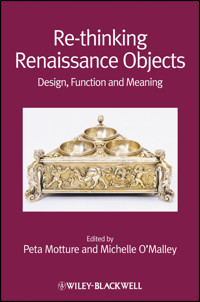
Re-thinking Renaissance Objects E-Book
21,99 €
Mehr erfahren.
- Herausgeber: John Wiley & Sons
- Kategorie: Geisteswissenschaft
- Sprache: Englisch
Inspired by research undertaken for the new Medieval & Renaissance Galleries at the Victoria and Albert Museum, Re-thinking Renaissance Objects explores and often challenges some of the key issues and current debates relating to Renaissance art and culture. * Puts forward original research, including evidence provided by an in-depth study arising from the Medieval & Renaissance Gallery project * Contributions are unusual in their combination of a variety of approaches, but with each paper starting with an examination of the objects themselves * New theories emerge from several papers, some of which challenge current thinking
Sie lesen das E-Book in den Legimi-Apps auf:
Seitenzahl: 438
Veröffentlichungsjahr: 2011
Ähnliche




















Table of Contents
Cover
Title page
Copyright page
Epigraph
Notes on contributors
Introduction
Chapter 1: Finding fame: painting and the making of careers in Renaissance Italy
ALESSANDRO BOTTICELLI (c.1445–1510)
DOMENICO GHIRLANDAIO (1449–1494)
PIETRO PERUGINO (c.1445–1523)
THE SISTINE COMMISSION
Chapter 2: Set in stone: monumental altar frames in Renaissance Florence
Chapter 3: Veit Stoss and the origins of collecting of small-scale sculpture before 1500
Chapter 4: New light on a Venetian lantern at the V&A
MANUFACTURE
DATING
THE MANUFACTURE OF LANTERNS IN VENICE
FUNCTION
NAVAL LANTERNS IN VENICE
THE GRADENIGO CONNECTION
CONCLUSION
Chapter 5: Rethinking the Petrucci Pavement
APPENDIX 1
APPENDIX 2: V&A ACQUISITIONS AND DISPOSALS
Chapter 6: Dancing, love and the ‘beautiful game’: a new interpretation of a group of fifteenth-century ‘gaming’ boxes
MATERIALS AND DECORATION
THE MORESCA
THE BARGELLO GAMES BOARD
THE IMAGERY OF THE BOXES
Chapter 7: Sharing and status: the design and function of a sixteenth-century Spanish spice stand in the Victoria and Albert Museum
Chapter 8: Scattered knives and dismembered song: cutlery, music and the rituals of dining
CUTLERY: PRODUCTION AND DESIGN
CUTLERY IN USE
MUSICAL INSCRIPTIONS
MUSICAL KNIVES
Appendix 1
Appendix 2
Bibliography
Index
Download CD/DVD content
This edition first published 2011
Originally published as Volume 24, Issue 1 of Renaissance Studies
Chapters © 2011 The Authors
Editorial organization © 2011 The Society for Renaissance Studies and Blackwell Publishing Ltd
Blackwell Publishing was acquired by John Wiley & Sons in February 2007. Blackwell’s publishing program has been merged with Wiley’s global Scientific, Technical, and Medical business to form Wiley-Blackwell.
Registered Office
John Wiley & Sons Ltd, The Atrium, Southern Gate, Chichester, West Sussex, PO19 8SQ, United Kingdom
Editorial Offices
350 Main Street, Malden, MA 02148-5020, USA
9600 Garsington Road, Oxford, OX4 2DQ, UK
The Atrium, Southern Gate, Chichester, West Sussex, PO19 8SQ, UK
For details of our global editorial offices, for customer services, and for information about how to apply for permission to reuse the copyright material in this book please see our website at www.wiley.com/wiley-blackwell.
The right of Peta Motture and Michelle O’Malley to be identified as the authors of the editorial material in this work has been asserted in accordance with the UK Copyright, Designs and Patents Act 1988.
All rights reserved. No part of this publication may be reproduced, stored in a retrieval system, or transmitted, in any form or by any means, electronic, mechanical, photocopying, recording or otherwise, except as permitted by the UK Copyright, Designs and Patents Act 1988, without the prior permission of the publisher.
Wiley also publishes its books in a variety of electronic formats. Some content that appears in print may not be available in electronic books.
Designations used by companies to distinguish their products are often claimed as trademarks. All brand names and product names used in this book are trade names, service marks, trademarks or registered trademarks of their respective owners. The publisher is not associated with any product or vendor mentioned in this book. This publication is designed to provide accurate and authoritative information in regard to the subject matter covered. It is sold on the understanding that the publisher is not engaged in rendering professional services. If professional advice or other expert assistance is required, the services of a competent professional should be sought.
Library of Congress Cataloging-in-Publication data
Re-thinking Renaissance objects : design, function, and meaning / edited by Peta Motture, Michelle O’Malley.
p. cm. – (Renaissance studies special issues ; 5)
Includes bibliographical references and index.
ISBN 978-1-4443-3775-4 (pbk.)
1. Renaissance. 2. Art, Renaissance. 3. Art, Renaissance–Italy. 4. Art objects, European–History. 5. Art objects, Italian–History. 6. Material culture–Europe–History. 7. Material culture–Italy–History. 8. Art and society–Europe–History. 9. Europe–Civilization. 10. Victoria and Albert Museum. I. Motture, Peta. II. O’Malley, Michelle.
CB361.R34 2011
709.02′4094—dc22
2011013988
A catalogue record for this book is available from the British Library.
This book is published in the following electronic formats: ePDFs (9781444396751); Wiley Online Library (9781444396775); ePub (9781444396768)
Notes on contributors
Martino Ferrari Bravo works in Venice on architectural heritage projects. For his thesis at the Università degli Studi di Padova he wrote on Venetian navigation in the 18th century. He is currently researching and publishing on various aspects of Venetian maritime history.
Meghan Callahan was the Samuel H. Kress Foundation Post-Doctoral Curatorial Fellow on the Medieval & Renaissance Galleries project team at the V&A during 2006-8. She is an independent scholar in London currently working with Patricia Wengraf Ltd. Callahan’s research concentrates on sixteenth-century Florence, particularly the architectural patronage of Sister Domenica da Paradiso and the paintings of Lorenzo di Credi and his school.
Donal Cooper is Associate Professor in the Department of History of Art at the University of Warwick. While Renaissance Course Tutor at the V&A from 2002-5, and subsequently as an Honorary Research Fellow, he contributed to the development of the Medieval & Renaissance Galleries. His research focuses on ecclesiastical patronage of art and architecture in medieval and Renaissance Italy, particularly with regard to the Franciscan Order.
Flora Dennis lectures in the Art History Department at the University of Sussex and is an Honorary Fellow of the Research Department at the V&A. Co-curator of the 2006 V&A exhibition At Home in Renaissance Italy, her research focuses on relationships between music, sound and the visual and material culture of sixteenth-century Italy.
Alun Graves is a Curator in the Department of Sculpture, Metalwork, Ceramics and Glass at the V&A. He has responsibility for the collections of twentieth-century and contemporary ceramics, and has published widely in this field. He is also the author of Tiles and Tilework of Europe (2002).
Nick Humphrey is a curator in the department of Furniture, Textiles and Fashion at the V&A, where he works on European woodwork, from Medieval to c.1660. Before contributing to the development of the V&A’s new Medieval and Renaissance Galleries, he co-ordinated the Tudor and Stuart sections of the British Galleries at the V&A (opened 2001).
Norbert Jopek is Curator in the Department of Sculpture, Metalwork, Ceramics and Glass and contributed to the Medieval & Renaissance Galleries. He has published widely on German late Gothic sculpture and metalwork. His publications include Studien zur deutschen Alabasterplastik des 15. Jahrhunderts (1988) and German Sculpture 1430–1540: A catalogue of the collection in the Victoria and Albert Museum (2002).
Kirstin Kennedy is a curator of metalwork at the Victoria and Albert Museum. Before joining the Concept Team of the Medieval and Renaissance Galleries at the V&A, she held a British Academy Postdoctoral Fellowship in the Department of Spanish and Spanish American Studies, King’s College London. Her publications include Medieval and Renaissance Art: People and Possessions, with co-author Glyn Davies.
Elizabeth Miller is Deputy Head of Research and Senior Curator of Prints at the V&A. She contributed to the development of the Medieval and Renaissance Galleries and was a member of the research team for the exhibition ‘At Home in Renaissance Italy’, V&A, 2006. She is the author of Sixteenth-century Italian Ornament Prints in the Victoria and Albert Museum (1999).
Peta Motture was Chief Curator of the Medieval and Renaissance Galleries at the Victoria and Albert Museum. As Senior Curator of Sculpture at the Museum she has published widely on medieval and later sculpture, specializing primarily in the Italian Renaissance. She has co-curated several exhibitions and is curator of the Robert H. Smith Renaissance Sculpture Programme at the V&A.
Paula Nuttall is Director of the Medieval and Renaissance Year Course at the V&A, and an independent scholar with a specialist interest in artistic relations between Italy and northern Europe in the fifteenth century. She is currently working on a study of the moresca and other secular themes.
Michelle O’Malley is Reader in Art History at the University of Sussex and was the V&A-Sussex Exchange Senior Research Fellow, attached to the Medieval and Renaissance Galleries Project, 2005-6. She has published widely in the field, including The Business of Art (2005) and The Material Renaissance, co-edited with Evelyn Welch (2007). She is presently working on a book concerning the force that high demand for an artist’s work had on the production strategies, workshop organization, prices and output quality of Perugino, Botticelli, Ghirlandaio and Filippino Lippi.
Introduction
Peta Motture and Michelle O’Malley
The new Medieval & Renaissance Galleries at the Victoria and Albert Museum result from a fundamental reinterpretation of the museum’s world-class collections covering 300–1600, and are designed to tell the story of art and design in Europe within a broad cultural perspective. Such an approach to contextualizing objects not only opens up a rich and nuanced understanding of artistic production, but also allows us to investigate how function and meaning were embedded in material and visual culture over 1300 years, a period stretching from the decline of the Roman Empire to, arguably, the establishment of modern Europe. While period terms, such as ‘medieval’ and ‘Renaissance’ have long provided a helpful framework for grouping and viewing the museum’s objects, they are also misleading. In order to avoid what can be seen as artificial period divisions, the objects from this long time frame have been presented and interpreted in a coherent narrative for the first time. Similarly, Italian art has been reunited with that from northern Europe and Spain – an amendment to the previous arrangement in which the Italian fifteenth- and sixteenth-century material was separated out – thereby allowing associations and interconnections across Europe to be made, as well as regional differences to be more immediately evident. While each room has its own narrative and date range, the chronology overlaps. This not only makes clear crucial continuities of form and function across time, but also highlights the growing number of objects and types of objects in the fifteenth and sixteenth centuries in comparison with earlier periods.
One of the objectives of the reinstallation is to create displays that challenge popular misconceptions about nomenclature, and to present complex ideas in a manner that is direct and easily accessible. By arranging the material in a series of ‘subject displays’ with a set of underlying themes that link their concepts together, the V&A aims to provided a focus for considering key issues at the heart of current scholarly debate.1 These include the overlap between sacred and secular belief, the problems inherent in distinguishing between ‘artists’ and ‘artisans’, and the various ways in which ideas were exchanged across media and cultural boundaries. Some of these conceptual issues have been drawn out in the chapters in this volume, which, like the galleries, take an object or group of objects as their starting point for considering problems such as appearance, meaning, style and function. Here, as well as in the galleries, the works of art themselves lead the story, and this object-based approach has often helped to revolutionize our thinking about individual pieces and our understanding of the culture for which they were created. Focussing on the later periods, the volume builds on a wealth of existing scholarship, particularly the recent trends in material culture studies. In addition, it emphasizes the traditional V&A approach in which so-called ‘high art’ has long been studied with ‘decorative art’. This is notably highlighted by Glyn Davies and Kirstin Kennedy in their book Medieval & Renaissance Art: People and Possessions, written to complement the galleries, which draws together some of the central strands of enquiry across the entire period.2Re-thinking Renaissance Objects is unique amongst the gallery-related publications in bringing together authors representing different specialisms from within and outside the museum, some writing in collaboration, to shed new light on how the design, function and meaning of an object has an impact on our understanding of the culture for which it was made.
Specifically, this volume takes up a strand of research that focuses on the re-conceptualization of the Renaissance as a culture in which civic, religious and personal status was both shaped and conveyed by the proliferation of objects that people and social groups owned, used and displayed. Richard Goldthwaite first tracked the sheer numbers of objects developed and produced in Renaissance Italy; later scholars have underlined the meaning of these objects in everyday life.3 Dora Thornton’s important work The Scholar in his Study, for example, demonstrates the central place objects held in the practice of humanism, and Objects of Virtue, written by Thornton and Luke Syson, shows how the deeply humanist interests, embedded in Renaissance social life, were expressed through the use of objects whose shape or decoration made clear the popular understanding of the classical past.4 Other central studies of the value placed on objects, particularly objects that encapsulate the rituals of marriage and childbirth, embody meanings in the decorated domestic interior, or were significant for maintaining and developing human relationships include the work of Isabella Palumbo-Fossati, Jacqueline Musacchio, Natasha Korda, Patricia Fortini Brown, Gabriele Neher and Rupert Shepherd, Evelyn Welch, Andrea Bayer, the Material Renaissance project, as well as Marta Ajmar-Wollheim and Flora Dennis, whose ground-breaking exhibition At Home in Renaissance Italy was held at the V&A in 2006.5 This scholarship is the product of both academics and museum curators, and in many instances it represents scholars from those arenas working in collaboration. At the heart of the research is a concern for classes of material and their meanings within early modern society – primarily in Italy.
Inspired by and largely coming out of research undertaken in connection with the new Medieval & Renaissance Galleries at the V&A, this volume builds on recently developed approaches and findings, presenting new research that explores issues of production and of meaning in objects manufactured across Europe. The chapters here primarily arise from two central aspects of the study of Renaissance material culture. The first is the study of the object as primary document – an approach that, though not unique to museum scholarship, is a fundamental element of it, given the exceptional potential the museum environment provides for in-depth examination of the tangible remains of both past and present cultures. The chapters in Re-Thinking Renaissance Objects overtly explore the works of art under scrutiny as primary evidence of the period: in each case, research begins with close examination of a particular object and uses that as the nexus for investigating its human context and cultural importance. The research shows how understanding materials, processes of manufacture, original appearance and initial finish are crucial for establishing the meaning of an artefact. Indeed, the procedures followed in analysing objects are outlined in many of the chapters, demonstrating the value of prolonged and repeated engagement with single works of art or with specific, coherent classes of objects.
The second focus of the volume is the deep connection between our understanding of the materiality of objects and our comprehension of the practices of early modern social life. Anthropologists as well as art historians have widely demonstrated how the complexities of human interaction and the intricacies of social values are embedded in objects. They have shown how things evince not only skill and ingenuity, but also systems of thought.6 Many of the studies published here underline how understanding the nature of Renaissance objects – that is, how they were made, what their iconography is and how they functioned in the period – can uncover hitherto unrecognized modes of behaving, exchanging and valuing that may elude surviving written documentation.
Running throughout the volume is the consideration of a subject implicit in work undertaken across the discipline yet now rarely taught in university art history departments or even discussed outside the museum context: the issue of quality. This is an element recognized through connoisseurship, an approach that has frequently been ignored in studies that deal with issues of cultural context, but is alive and well for those working directly with objects. The consideration of quality is not, however, mutually exclusive to other modes of scholarship and is only meaningful if taken into account along with other evidence. The research presented here touches on the notion of quality in the Renaissance itself and considers such issues as the deliberate creation of different levels of quality in the workshop, particularly in relation to painting, tableware and decorated boxes, as similar objects were made for different markets.
In each chapter the issues that are investigated arose from direct and prolonged confrontation with the object itself. In some cases, the most pressing issue was about functionality. ‘What is it?’ was a key question asked, for example, of a small, silver, indented object in the V&A’s Metalwork collection and of a group of decorated boxes assumed to be gaming boards, examples of which are held in the museum’s Sculpture collection. Here, the analysis of form, as well as the consideration of various types of related visual material and archival documentation, brought to light the original character of the works, providing a clearer insight into their function as well as the nature of their production. For other chapters, however, questions focused not on what the object was but on where or how it performed in everyday life. Cases in point include the carved marble altar frame long on view in the museum near to the Florentine Santa Chiara Chapel, as well as a large Venetian wooden lantern and a table knife engraved with musical notation. For the latter pair, the authors drew on both visual and technical investigation, exploring exactly how the pieces in question were manufactured, what signs they show of wear, and how they relate visually to similar objects in order to elucidate their function, their physical context and their place of manufacture.
The Petrucci Pavement offered an example of another kind of conundrum: that is, dealing with objects that are composed of numerous elements. While each pavement tile is an individual artefact, made using both technical and artistic skill, the question of how this large group of tiles fitted together to create a coherent flooring pattern has been a vexing one since their acquisition in the late 1850s. Solving the problem of the pavement’s original appearance required working with hundreds of tiles of several different shapes: a research task complicated by the fact that the V&A does not hold the entire pavement, though relevant pieces exist in other collections. The study of the altar frame provided a similar research puzzle because it was never intended to exist on its own, but to complement and enclose yet-to-be-identified figurative works of art, probably both painted and sculpted, integral to an unknown architectural setting. It is arguable, in fact, that many of the individual artefacts studied here were, or might have been created to form part of a larger ensemble or set.
While an object’s form, and thus frequently its function, can be recovered through analysis of its visual and material qualities, information about the identity of its maker, original owner and location, as well as its cost and provenance are often almost impossible to discover, especially given that many objects were not specifically commissioned. Many such questions were, however, answered long ago for works of so-called high art, for which there is precise documentation. For this reason, the study of paintings and sculptures as material objects gives us the scope to consider wide issues that pertain to a broad spectrum of Renaissance artefacts. This includes the way human relationships might engender the creation of new works, the meaning objects had for the career trajectory of their makers, the agency objects might exert in particular professional and social lives, and the monetary value of things in the early modern world. Just as the study of ‘high’ art can illuminate aspects of the ‘decorative’ arts, research into the production and use of functional (albeit also decorative) objects can illuminate attitudes towards the acquisition and ownership of painting and sculpture that was viewed primarily as ‘art’. Indeed, central to this volume is our belief that studying designed, functional objects together with commissioned paintings and sculptures is critical for understanding the depth and breadth of the early modern visual, tactile, and even aural social world. Just one example of this is provided by the role of prints in spreading ideas and prompting the use or interpretation of specific motifs in new media.7
This volume begins with a consideration of the people behind the commissioning and making of works of art; specifically it looks at the importance that human relationships had for generating the professional lives of artists and artisans. By examining the early careers of the painters Alessandro Botticelli, Domenico Ghirlandaio and Pietro Perugino, Michelle O’Malley draws on precise information to trace associations among painters, clients and potential clients in order to argue that certain connections played powerful roles in the artists’ development. As an outcome of this, she considers a new understanding of the route these painters took to employment in the Sistine Chapel in 1481.
Some objects are rare survivals of a whole class of artefact that offer glimpses of a material ambiance that is now largely lost. In the second chapter, Meghan Callahan and Donal Cooper discuss such an object: a Florentine altar frame that offers evidence of a growing appreciation of aesthetic integration, formal order and spatial symmetry within Florentine church interiors in the years around 1500. They analyse the frame’s technical qualities, architectural details, and means of installation to suggest how it may have been designed to incorporate a painted altarpiece and tin-glazed terracotta lunette. Looking at these aspects, and considering its scale, the quality of its carving and what can be gleaned of its history, the authors are able to suggest a potential candidate for its original location. The object allows us to reconstruct the appearance of a generation of altarpiece frames highly significant in Florentine design but now mainly destroyed.
Norbert Jopek’s analysis of small-scale German sculpture again underlines the value of networks for the well-being of artists’ careers, particularly those that introduce new types of work, including religious images produced primarily – and consciously – as works of art. It also proposes a much earlier date than has hitherto been recognized for the impact of Italian humanist ideas on artistic production north of the Alps. The way that leading workshops served both the elite and the broader market is also touched upon. The Venetian lantern examined by Nick Humphrey and Martino Ferrari Bravo is an example of another type of sculptural work; in this case a large functional object of a kind seldom studied. Yet the work’s quality and condition offer opportunities rarely possible in the investigation of related wooden furnishings of the period, which are commonly highly modified. In an interdisciplinary study, the authors demonstrate the significance and value of combining close examination of surviving textual material, the analysis of the techniques used in the lantern’s manufacture and the investigation of historical cultural evidence. The approach gives them the evidence to argue for a review of the lantern’s original setting, and, through the formal investigation of its ornament, to reconsider its date.
In reconstructing the pavement of the Petrucci Palace, Elizabeth Miller and Alun Graves examine a type of splendid flooring once commonly found in elite Renaissance interiors, the elements of which are now often dispersed as individual tiles that give no hint of their original roles in a coherent decorative ensemble. The authors discuss the problems involved in studying such a multi-part work and describe the almost-forensic approach required in piecing it together. Their discovery of the overall design of the flooring, taken with its original setting, is vital to our understanding of the richness and diversity of the visual culture in Italy; it demonstrates how the distinctions between eastern and western decorative elements were clearly blurred in the period. Such findings are also emphasized in Paula Nuttall’s chapter on a group of ‘gaming’ boxes decorated with carved ivory and bone. She shows that a strand of Islamic design was integral to the world of Catholic, European decoration from at least the thirteenth century, and that Arabic dance was the foundation of an erotic, abandoned mode of performance at both courtly entertainments and civic celebrations. Indeed, Nuttall’s work on the connections between moresque dance and the carved decoration of ‘gaming’ boxes demonstrates the profound link between objects and social practices, for she argues that the boxes were connected to marriage and their decoration to prompting discussion of love. Her research underlines the power that decoration might have to shape the routines of daily life.
The ability of objects to influence patterns of behaviour is also particularly apparent in the studies that deal with dining and its etiquette. Kirstin Kennedy’s consideration of a small silver piece of Spanish tableware shows that the use of spices at table engendered particular kinds of dining. She also makes clear the longevity and strength of the national characteristics that infused the practices of preparing and serving food, and underlines how closely systems of eating were bound up with the development of objects for the table. Flora Dennis’s exploration of a hybrid table object reveals a fascinating relationship between music and the material culture of dining. Dennis outlines the precision of the musical notation engraved on a group of sixteenth-century knives and explores the appearance, quality, production and design of the objects to suggest the place of their manufacture and the context of their use. Furthermore, her analysis of the musical voices on the small group of surviving knives makes it clear that polyphonic song, not chant, was performed at table, and underlines the fact that sets of such objects were created for singing blessings and benedictions. Like pavement tiles, the knives are often presently admired as single objects, and while the design of each object is unique, research emphasizes that it only functioned properly as an element of a coherent group.
The musical knives are a perfect example of Alfred Gell’s convincing argument that decorated objects and works of art might play crucial roles as agents for particular kinds of social interaction.8 Indeed, many of the objects discussed in this volume functioned as causal instruments for particular behaviour. Small-scale sculptures, for example, created opportunities for intellectual interaction, such as the exquisite Virgin and Child by Veit Stoss that would have been admired as a collector’s piece, or the decorated marriage boxes, with their references to the sexual space of gaming, which prompted discussions of love. Saltcellars clustered diners into distinctive groups at table and knives engraved with musical notation had the potential to weld them into choruses. Paintings were often the nodal points for connections between people that reached widely and deeply into the social world. By expressing such elements as political interests, geographical connections and the visual fascinations of particular groups, such as bankers, paintings provoked behaviour and were often the causal agents for new works. Objects fulfilled similar functions. Moreover they were frequently adopted and adapted, like the Venetian lantern that journeyed from ship to palace, and this underscores the ability of objects to bridge places and social groups.
The chapters here explore objects as carriers of meaning in everyday life, culture and ritual in the Renaissance. They provide an insight into how objects acted as an effective force in the relationship between artist and patron and underline how designed works were significant for the transmission of ideas, trade, diplomacy, friendship and belief. Reflecting the aims of the new galleries, the research of Re-Thinking Renaissance Objects demonstrates the complex, multivalent qualities of artefacts. It highlights the variety of meaning sited in them and makes plain the rich evidence of social life embedded in their fabric.
Notes
1 The brief of the Medieval & Renaissance Galleries Concept Team, set up in July 2002 and led by Malcolm Baker until October 2003, was to build on the award-winning thematic approach established in the British Galleries, which opened to critical acclaim in 2001. As part of the development process, the team consulted widely with curatorial and academic colleagues – for example, holding seminars to debate some of the overarching issues.
2 Glyn Davies and Kirstin Kennedy, Medieval & Renaissance Art: People and Possessions (London: V&A Publishing, 2009). This volume is part of a substantial publication programme, consisting of several books and articles, including Marian Campbell, Medieval Jewellery in Europe 1100–1500 (London: V&A Publishing, 2009); Angus Patterson, Fashion and Armour in Renaissance Europe. Proud Lookes and Brave Attire (London: V&A Publishing, 2009); Eleanor Townsend, Death and Art: Europe 1200–1530 (London: V&A Publishing, 2009); Jo Wheeler, with the assistance of Katy Temple, Renaissance Secrets, Recipes & Formulas (London: V&A Publishing, 2009); Paul Williamson and Peta Motture (eds.), Medieval & Renaissance Treasures (London: V&A Publishing, 2010). All the gallery interpretation, together with much additional new information on the collections (including aspects that were not possible to achieve through gallery displays), is available on the V&A website; a list of current V&A titles can also be found: see www.vam.ac.uk.
3 Richard A. Goldthwaite, ‘The Empire of Things: Consumer Demand in Renaissance Italy’, in F. W. Kent and P. Simons (eds.), Patronage, Art and Society in Renaissance Italy (Oxford: Clarendon Press, 1987), 63–77; Richard A. Goldthwaite, Wealth and the Demand for Art in Italy. 1300–1600 (Baltimore and London: The Johns Hopkins University Press, 1993).
4 See Dora Thornton, The Scholar in his Study: Ownership and Experience in Renaissance Italy (New Haven and London: Yale University Press, 1998) and Luke Syson and Dora Thornton, Objects of Virtue: Art in Renaissance Italy (London: Yale University Press, 2001).
5 Isabella Palumbo-Fossati, ‘L’interno della casa dell’artigiano e dell’artista nella Venezia del Cinquecento’, Studi veneziani VII (1984), 109–53; Jacqueline M. Musacchio, The Art and Ritual of Childbirth in Renaissance Italy (New York and London: Yale University Press, 1999); idem., Art, Marriage and Family in the Florentine Renaissance Palace (New York and London: Yale, 2008); Gabriele Neher and Rupert Shepherd (eds.), Revaluing Renaissance Art (Aldershot: Ashgate, 2000); Natasha Korda, Shakespeare’s Domestic Economies: Gender and Property in Early Modern England (Philadelphia: University of Pennsylvania Press, 2002); Patricia Fortini Brown, Private Lives in Renaissance Venice (New Haven and London: Yale University Press, 2004); Marta Ajmar-Wollheim and Flora Dennis (eds.), At Home in Renaissance Italy (London: V&A Publications, 2006); Michelle O’Malley, ‘Altarpieces and Agency: The Altarpiece of the Society of the Purification and its “invisible skein of relations” ’, Art History 28, No. 4 (2005), 417–41; Evelyn Welch, Shopping in the Renaissance (New Haven and London: Yale University Press, 2005); Michelle O’Malley and Evelyn Welch (eds.), The Material Renaissance (Manchester: Manchester University Press, 2007) and Andrea Bayer (ed.), Art and Love in Renaissance Italy (New York; New Haven and London: Metropolitan Museum; Yale University Press, 2008).
6 See, for instance, Arjun Appadurai (ed.), The Social Life of Things: Commodities in Cultural Perspective (Cambridge: Cambridge University Press, 1986); Mary Douglas and Baron Isherwood, The World of Goods: Towards an Anthropology of Consumption (London: Routledge, 1996); Alfred Gell, Art and Agency (Oxford: Oxford University Press, 1998); Carl Knappett, Thinking Through Material Culture (Philadelphia: University of Pennsylvania Press, 2005).
7 David Landau and Peter Parshall, The Renaissance Print: 1470–1550 (New Haven and London: Yale University Press, 1994); Michael Snodin and Maurice Howard, Ornament: A Social History since 1450 (New Haven and London: Yale University Press, 1996); Elizabeth Miller, Sixteenth-Century Italian Ornament Prints in the Victoria and Albert Museum (London: V&A Publications, 1999).
8 Gell, Art and Agency.
1
Finding fame: painting and the making of careers in Renaissance Italy
Michelle O’Malley
The following studies in this collection address central issues about the design and function of works of art and they bring to light crucial findings concerning the appearance of works, their intended sites, the requirements of their owners and the import they held for their users. These are essential for understanding the meaning that works of art had in the world. It is worth noting, however, that the objects made by artists and artisans also had an important meaning for the professions of their makers: they were the materials that constructed their careers. By the end of the fifteenth century, works of art stood as much for their creators as for their purchasers. What this meant in practice is evident in the panel of the Madonna di Loreto altarpiece, now installed in the Medieval and Renaissance Galleries at the Victoria and Albert Museum (Fig. 1).1 Pietro Perugino painted the altarpiece in 1507, when he was arguably at the height of his fame as one of the most important artists in Italy. Despite this, he took on the commission for a fee much lower, in real terms, than he commonly accepted. The clients were the heirs of a Perugian carpenter, perhaps a former colleague, and this may explain the low payment. The manufacture of the work, however, reflects a higher level of attention than the cost might lead us to expect. In particular, aspects of the underdrawing, probably made from existing cartoons, were corrected freehand, and the relatively inexpensive pigments used to colour the robes of the Madonna and St Jerome were carefully glazed to look more expensive. This suggests that one of the requirements of fame was to turn out objects of excellence, whatever their price, and that Perugino was well aware that the works of art that his business produced reflected directly upon him: he could not afford to be associated with a cheap-looking product.
Lesen Sie weiter in der vollständigen Ausgabe!
Lesen Sie weiter in der vollständigen Ausgabe!
Lesen Sie weiter in der vollständigen Ausgabe!
Lesen Sie weiter in der vollständigen Ausgabe!
Lesen Sie weiter in der vollständigen Ausgabe!
Lesen Sie weiter in der vollständigen Ausgabe!
Lesen Sie weiter in der vollständigen Ausgabe!
Lesen Sie weiter in der vollständigen Ausgabe!
Lesen Sie weiter in der vollständigen Ausgabe!
Lesen Sie weiter in der vollständigen Ausgabe!




