


3,49 €
Mehr erfahren.
- Herausgeber: Misti Wolanski
- Kategorie: Geisteswissenschaft
- Sprache: Englisch
Do you wonder what goes into editing, or how to look at your writing the way an editor or teacher would? Do you ever wish an editor would just tell you what's at the core in editing?This editor's now doing just that!Learn how to identify the types of editing and what goes into a good edit, so you can make your essay, article, or book the best that you can make it—and find out what to look for in an editor, when you need help to take your work to the next level.
Das E-Book können Sie in Legimi-Apps oder einer beliebigen App lesen, die das folgende Format unterstützen:
Veröffentlichungsjahr: 2015
Ähnliche















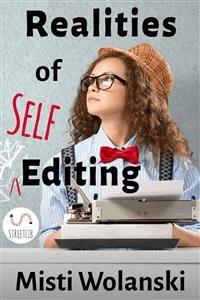
Realities of Self-Editing
from a line editor
Misti Wolanski
MistiWolanski.com
First Edition
Copyright 2015
All Rights Reserved
The information presented in this book stems from the author’s own experiences and opinions, and your use of this book means you accept that she’s as fallible as anyone else. Any and all references to websites, authors, book, movies, etc. do not indicate any affiliation or agreement, express or implied, between the author and the reference, unless the author is referencing one of her own works (in which case, the connection between the two is obvious). Any and all affiliate links herein only mean that the author finds that source or vendor particularly worth using, not that the author was paid off to recommend that item or vendor because of its affiliate program.
Translation: There’s no such thing as a perfect book, and this is no exception. I also refer to other people and their products, and when I particularly like a product or a vendor, I sign up for its affiliate program. That doesn’t mean those other people agree with or even like me. So don’t assume they share my opinions, that I necessarily share theirs, or that this book is perfection embodied. Thank you for understanding. ^_^
Cover Designed by the Author
Image © adam121 - Kozzi.com
Alegreya font © Juan Pablo del Peral of Huerta Tipográfia
Amatic font © Vernon Adams of NewTypography.co.uk
Bird fleuron by ikole @ Fiverr.com
Edition Notes
first edition, reformattedA Few Grammar Notes
I have a few grammar preferences that are considered wrong in some circles. Please be aware that if you follow my lead on any of these, you may wrongfully get accused of incompetence, despite these decisions being entirely logical and completely defensible.
What grammar preferences are those, you ask?
I intentionally use “they” and “their” instead of the clunky “he or she” and “his or her” in cases of unknown gender. There are linguistic and historic reasons for doing this. (Namely, “their” has long been plural and singular, which can be proven by looking to classic literature.)
I follow UK grammar rules for where I place my commas and periods with quotation marks. (Per US grammar, periods and commas are almost always supposed to go within quotation marks, even when not part of the original quote. UK grammar says to only do that if the periods and commas are part of the original quote.) I also use the UK rules for abbreviations (no periods), and the presumably UK “towards”, etc.; although I’m 100% USian, that’s what I and my friends say.
For other things, I pretty much follow Chicago Manual of Style, 16th edition, though I format suspension points (usually called “ellipses”) like em dashes.
If you encounter something that’s consistently “wrong”, I ask you to bear in mind that some details of correct spelling and grammar differ depending on your dictionary, handbook, and region. Thanks to the Internet, the reading world has gone global. I see no reason to stick to downright confusing rules unique to US grammar.
That aside, I apologize for any typos or issues that have slipped through the editing.
Foreword
I could describe all my credentials that make me qualified to speak on editing, but that’s simply irrelevant. You’re reading this book either because you believe me when I say I know what I’m talking about, or because you think I’m full of it.
You’re entitled to your opinion, and nothing I claim is likely to dissuade you of that opinion, even though particular titles I’ve edited have ended up on bestseller lists. After all, how much an editor influences a person’s place on sales charts is debatable.
So let’s move on…
With self-publishing’s return to viability, and with freelancing also getting more widely accepted, I find myself at an impasse.
As a self-employed writer, I’m expected to adequately edit my own work, so anything I submit is ready for publication.
For as a self-employed editor, I’m expected to say that it’s impossible for writers to adequately edit their own work.
That contradiction bothers me.
So, with that in mind, I ran a mini-series on my blog about self-editing, answering such questions as:
Is it possible to adequately edit your own work?Is it advisable to adequately edit your own work?Is it professional to edit your own work?What does an editor do, anyway? (And what should they be doing?)You see, I’m a self-publishing author. (Obviously.)
But…
I’m also a freelancer—a freelance writer and line editor. (So, no, not all line editors lack the skillz to write their own books. It just so happens that the things that make me good at ghostwriting also make me good at line editing, and I enjoy both things. I also have an active aversion to letting only one skill pay all my bills—and I easily become bored when I’m doing the same type of work all the time.)
I also do some basic web coding—and that’s an interesting field in itself, because “self-editing” (called “debugging” or “parsing” in the world of coding) is standard. It’s often even easiest to debug code you yourself wrote, because everyone has their own…quirks in how they format and arrange their code.
Who this book is for:
• Anyone who has to write, whether you like it or not, who wants to broaden their understanding of what, exactly goes into a professional edit.
This book contains details that apply to everyone from the person who writes company memos to the person in the middle of writing their nineteenth novel. (While I hope the latter person already knows these things, I likely cover some details that even a professional writer won’t know, unless they’ve been a professional editor, too. If you have been a professional writer and editor, you’ll likely find another resource more worth your time and money.)
What this book is:
• An overview of what’s involved in editing a book, for writers who need or want to edit their own work, either for release to their audience (such as co-workers, a teacher, or a publisher) or to minimize the issues in what they submit to their support group (such as an editor, a publisher, or an agent).
Note that a good hired editor can produce a better end product if the editor’s good at editing their own work—because then the editor can focus on what would improve the writer’s goal for the story, rather than having to focus on merely making the story readable.
• A compilation and expansion of my blog posts on all the various types of editing, what they involve, and methods a writer can use to help themselves edit their own work, adjusted into book form.
In the interest of being true to the original articles, that blog origin will show at times, and I include the discussion question(s) at the end of each article, with a link. Please feel free to join in the comments. I don’t make you jump through hoops to comment, and my comments manager means I’ll see your comment, even if it’s years after the original blog post.
What this book is not:
A checklist for specific items to do, to edit your own writing.A book deriding self-editing as impossible.A book lauding self-editing as easy and doable by everyone.So if you’re seeking a checklist for what specifically to edit or how, this is not the book you’re looking for. I don’t know what type of editing you need, nor do I know what stage of editing you’re on.
A “checklist” book for all the various types of editing—for all types of writers—would be unwieldy, even self-contradictory, because every writer is different. If you want resources more along those lines, though, I recommend you check out Janice Hardy’s blog, Jami Gold’s blog, and Holly Lisle’s books. (Full disclosure: That last link is an affiliate link. I’ve yet to find a single resource from Holly Lisle that is not worth at least the cover price.)
If you’re looking for advice on specific issues you know you’re having problems with, this book is not what you’re looking for.
If you’re wanting reinforcement of your opinion that failing to have your work edited by a third party is necessarily unprofessional and rude to your audience, this book is not what you’re looking for. (But I address the professionalism of self-editing in the first chapter, so perhaps you might be interested in checking that out.)
If you’re wanting someone to pat you on the back and say how great and innovative you are for self-editing and that of course everyone can self-edit, this book is not what you’re looking for. You aren’t nearly as innovative as you think you are. You’re incorrect about that “of course”, too.
But if you’re wanting an overview of how to approach editing, to help you improve of a writer? This book is for you.
The original blog post series can still be read for free at http://carradee.blogspot.com, but this book features revised and expanded editions of those posts.
For the full list of top resources that I recommend (and some popular ones that I recommend you avoid), please see Appendix A.For a list of the various authors and books I reference in this book, please see Appendix B.Between this book and its appendixes, I hope all readers can readily find what’s most useful to them in this book.
Professionalism and the Writer
Is Self-Editing Unprofessional?
Before I answer the question, lets address the feasibility of self-editing. The professionalism of an action means little if the action is itself impossible.
There are two main schools of thought in self-editing:
Nobody can adequately edit themselves.Everybody can (learn to) adequately edit themselves.My day job is as a freelancer. I proofread, write, edit, and writefor small businesses, with small businesses, for individual entrepreneurs, for self-publishers, a self-publisher, etc.
Lesen Sie weiter in der vollständigen Ausgabe!
Lesen Sie weiter in der vollständigen Ausgabe!
Lesen Sie weiter in der vollständigen Ausgabe!
Lesen Sie weiter in der vollständigen Ausgabe!
Lesen Sie weiter in der vollständigen Ausgabe!
Lesen Sie weiter in der vollständigen Ausgabe!
Lesen Sie weiter in der vollständigen Ausgabe!
Lesen Sie weiter in der vollständigen Ausgabe!
Lesen Sie weiter in der vollständigen Ausgabe!
Lesen Sie weiter in der vollständigen Ausgabe!




