


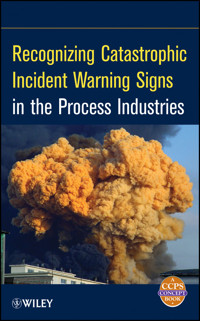
Recognizing Catastrophic Incident Warning Signs in the Process Industries E-Book
125,99 €
Mehr erfahren.
- Herausgeber: John Wiley & Sons
- Kategorie: Fachliteratur
- Sprache: Englisch
This book provides guidance on characterizing, recognizing, and responding to warning signs to help avoid process incidents and injuries before they occur. The guidance can be used by both process safety management (PSM) professionals in evaluating their processes and PSM systems as well as for operators who are often the frontline defense against process incidents. Warning signs may consist of process deviations or upsets, instrumentation warnings or alarms, past operating history and incidents, observable problems such as corrosion or unusual odors, audit results indicating procedures are not being followed, or a number of other indicators. Filled with photos and practical tips, this book will turn anyone in a process plant into a hazard lookout and will help prevent potential incidents before they turn into catastrophic events.
Sie lesen das E-Book in den Legimi-Apps auf:
Seitenzahl: 364
Veröffentlichungsjahr: 2013
Ähnliche




















Contents
Cover
Half Title page
Title page
Copyright page
List of Tables
List of Figures
Files on the Web Accompanying this Book
Acknowledgments
Foreword
Preface
Chapter 1: Introduction
1.1 Process Safety management
1.2 Normalization of deviance
1.3 A Strategy for response
1.4 Maintaining organizational memory and a healthy sense of vulnerability
1.5 Risk Based Process Safety
1.6 Our target audience
1.7 How to use this book
1.8 Case Study - Toxic gas release in india
Chapter 2: Incident Mechanics
2.1 Incidents do not just happen
2.2 Incident models
2.3 Case study - Benzene plant explosion in China
Chapter 3: Leadership and Culture
3.1 How does leadership affect culture?
3.2 The leadership and culture related warning signs
3.3 Case Study - Challenger space shuttle explosion in the United States
Chapter 4: Training and Competency
4.1 What is effective training, and how is competency measured?
4.2 The training and competency related warning signs
4.3 Case study - Gas plant vapor cloud explosion in Australia
Chapter 5: Process Safety Information
5.1 Critical information to identify hazards and manage risk
5.2 The process safety information related warning signs
5.3 Case Study - Batch still fire and explosion in the UK
Chapter 6: Procedures
6.1 Safe and consistent operation
6.2 The procedure-related warning signs
6.3 Case Study - Nuclear plant meltdown and explosion in the Ukraine
Chapter 7: Asset Integrity
7.1 Systematic Implementation
7.2 The asset integrity related warning signs
7.3 Case study - Refinery naphtha fire in the United States
Chapter 8: Analyzing Risk and Managing Change
8.1 Risk management
8.2 The risk analysis and management of change related warning signs
8.3 Case Study - Cyclohexane explosion in the UK
Chapter 9: Audits
9.1 Audits support operational excellence
9.2 The audit related warning signs
9.3 Case study - Chemical warehouse fire in the UK
Chapter 10: Learning from Experience
10.1 Methods for continuous improvement
10.2 The learning from experience warning signs
10.3 Case study - Space shuttle Columbia incident in the United States
Chapter 11: Physical Warning Signs
11.1 The everyday things matter
11.2 The physical warning signs
11.3 Case study - Resin plant dust explosion in the United States
Chapter 12: A Call to Action
12.1 Actions that you can take now for each warning sign
12.2 A simple plan to consider for rigorous implementation and follow-up
12.3 Actions to consider
12.4 Summary
12.5 Case study - Oil platform explosion and fire in the North Sea
Appendix A - Incident Warning Sign Self-Assessment Tool
Appendix B - Composite List of Catastrophic Incident Warning Signs
References and Selected Regulations
Acronyms and Abbreviations
Glossary
Index
RECOGNIZING CATASTROPHIC INCIDENT WARNING SIGNS
IN THE PROCESS INDUSTRIES
This book is one in a series of process safety guideline and concept books published by the Center for Chemical Process Safety (CCPS). Please go to www.wiley.com/go/ccps for a full list of titles in this series.
Copyright © 2012 by John Wiley & Sons, Inc. All rights reserved.
Published by John Wiley & Sons, Inc., Hoboken, New Jersey.Published simultaneously in Canada.
No part of this publication may be reproduced, stored in a retrieval system or transmitted in any form or by any means, electronic, mechanical, photocopying, recording, scanning or otherwise, except as permitted under Section 107 or 108 of the 1976 United States Copyright Act, without either the prior written permission of the Publisher, or authorization through payment of the appropriate per-copy fee to the Copyright Clearance Center, Inc., 222 Rosewood Drive, Danvers, MA 01923, (978) 750-8400, fax (978) 750-4470, or on the web at www.copyright.com. Requests to the Publisher for permission should be addressed to the Permissions Department, John Wiley & Sons, Inc., 111 River Street, Hoboken, NJ 07030, (201) 748-6011, fax (201) 748-6008, or online at http://www.wiley.com/go/permission.
Limit of Liability/Disclaimer of Warranty: While the publisher and author have used their best efforts in preparing this book, they make no representation or warranties with respect to the accuracy or completeness of the contents of this book and specifically disclaim any implied warranties of merchantability or fitness for a particular purpose. No warranty may be created or extended by sales representatives or written sales materials. The advice and strategies contained herein may not be suitable for your situation. You should consult with a professional where appropriate. Neither the publisher nor author shall be liable for any loss of profit or any other commercial damages, including but not limited to special, incidental, consequential, or other damages.
For general information on our other products and services please contact our Customer Care Department within the United States at (800) 762-2974, outside the United States at (317) 572-3993 or fax (317) 572-4002.
Wiley also publishes its books in a variety of electronic formats. Some content that appears in print, however, may not be available in electronic formats. For more information about Wiley products, visit our web site at www.wiley.com.
Library of Congress Cataloging-in-Publication Data:
Recognizing catastropic incident warning signs in the process industries / Center for Chemical Process Safety. p. cm. Includes index. ISBN 978-0-470-76774-0 1. Chemical engineering—Safety measures. 2. Chemicals—Accidents—Prevention. 3. Warnings. I. American Institute of Chemical Engineers. Center for Chemical Process Safety. TP150.S24R44 2012 660’.2804—dc23 2011033614
It is sincerely hoped that the information presented in this document will lead to an even more impressive safety record for the entire industry; however, neither the American Institute of Chemical Engineers, its consultants, CCPS Technical Steering Committee and Subcommittee members, their employers, their employers’ officers and directors, nor AntiEntropics, Incorporated (AEI) and its employees warrant or represent, expressly or by implication, the correctness or accuracy of the content of the information presented in this document. As between (1) American Institute of Chemical Engineers, its consultants, CCPS Technical Steering Committee and Subcommittee members, their employers, their employers’ officers and directors, and AntiEntropics, Inc., and its employees, and (2) the user of this document, the user accepts any legal liability or responsibility whatsoever for the consequence of its use or misuse.
LIST OF TABLES
TABLE 1-1 Key Questions for Warning Sign Incident Investigations
TABLE 1-2 Risk Based Process Safety’s (RBPS) Four Pillars and Twenty Elements
TABLE 1-3 Catastrophic Incident by Element Analysis
LIST OF FIGURES
Figure 1-1 A Strategy for Response
Figure 2-1 Safety Pyramid
Figure 2-2 Swiss Cheese Model of Barriers to Consequences
Figure 2-3 Remove the Fuel
Figure 2-4 The Dam Model
Figure 2-5 The Iceberg Model
Figure 2-6 Incident Trends
Figure 2-7 Simplified Logic Tree Root Cause Analysis
Figure 2-8 The Jilin Explosion Aftermath
Figure 8-1 The Nypro Explosion Aftermath
FILES ON THE WEB ACCOMPANYING THIS BOOK
Access the incident warning sign self-assessment tool and a list of the warning signs using the Microsoft Explorer Web browser at
http://www.aiche.org/ccps/publications/IWSMaterial.aspx
Password: IWS2010
ACKNOWLEDGMENTS
The American Institute of Chemical Engineers (AIChE) wishes to thank the Center for Chemical Process Safety (CCPS) and those involved in its operation, including its many sponsors whose funding made this project possible, and the members of the Technical Steering Committee, who conceived of and supported this concept book project. The members of the CCPS Incident Warning Signs Subcommittee who worked with AntiEntropics, Inc. to write this text deserve special recognition for their dedicated efforts, technical contributions, and overall enthusiasm for creating a useful addition to the concept book series. CCPS also wishes to thank the subcommittee members’ respective companies for supporting their involvement in this project.
The co-chairpersons of the Incident Warning Signs Subcommittee were Joyce Becker of BP and Ronald Rhodes of Total Petrochemicals USA, Inc. The CCPS project manager was Brian Kelly. The members of the CCPS subcommittee were:
• Steve Arendt
ABS Consulting
• Todd Aukerman
LANXESS Corporation
• Larry Bowler
SABIC Americas, Inc.
• Michael Boyd
Husky Energy
• Owen Chappel
BP
• Robert Fischer
Total Petrochemicals USA, Inc.
• Kevin He
Dow Corning Corporation
• John Herber
CCPS Emeritus
• James Klein
DuPont
• David Lewis
Occidental Chemical Corporation
• Kevin MacDougall
Husky Energy
• Doug Morrison
Nexen Inc.
• John Murphy
CCPS Emeritus
• Charles Pacella
Baker Engineering and Risk Consultants, Inc.
• Fred Simmons
Savannah River Nuclear Solutions, LLC
• Jim Slaugh
LyondellBasell Industries
Robert Walter, president of AntiEntropics, Inc., was the lead writer for this book. Sandra A. Baker of AntiEntropics, Inc. was the editor. Richard Foottit, Kerry Fritz, and Cliff Van Goethem of AntiEntropics, Inc. provided internal team review. In addition, AntiEntropics would like to recognize the entire CCPS team for their writing contributions throughout the book.
CCPS also gratefully acknowledges the comments submitted by the following peer reviewers:
• John Alderman
Aon Consulting
• Martyn Fear
Husky Energy (Offshore Operations)
• Andy Hart
Nova Chemical
• Dennis Hendershot
CCPS Emeritus
• Gregg Kiihne
BASF Corporation
• R. Craig Matthiessen
US Environmental Protection Agency
• Louisa A. Nara
CCPS
• Robert Ormsby
CCPS Emeritus
• Stephen Selk
US Department of Homeland Security
• Kenneth Wengert
Kraft Foods Global, Inc.
• David Worthington
Amerada Hess
• David Wulf
ConocoPhillips
Their insights, comments, and suggestions helped ensure a balanced perspective. Although the peer reviewers have provided many constructive comments and suggestions, they were not asked to endorse this book and were not shown the final draft before its release.
The photograph used for the cover and as Figure 2-8 is reproduced with permission from the Associated Press.
FOREWORD
The oil spill from the Macondo well in the Gulf of Mexico in 2010 was a classic example of the thesis of this book. In the lead up to the accident there were numerous warning signs, some subtle, but some utterly unambiguous. Most strikingly, in the hours immediately before the blowout, the well was giving unmistakable signs that it had not been properly sealed. These were either missed, because people had stopped paying attention in the rush to get the job finished, or dismissed, because ways were found to normalize them. Hours earlier there were a number of other anomalies. The meaning of these anomalies was less clear at the time, but in retrospect were probably signs that something was wrong. These were passed over without adequate thought as to their implications.
Warning signs can sometimes be used as the basis for safety indicators. For instance, a well instability event (often called a kick) is a warning of danger, and the number of such events could possibly be used as the basis for a safety indicator. However, well integrity was not considered a safety matter in the Gulf of Mexico and so no such safety indicators had been developed. Safety with respect to major hazards depends on developing such indicators and incorporating them into management systems.
This book catalogs a large range of warning signs that are worthy of attention. It is an extremely useful source for people seeking to develop key performance indicators (KPIs) for how well major hazard safety is being managed. The book also discusses some of the reasons why these signs are passed over so often and what needs to be done to ensure that we pay them proper attention. As such, it is a valuable addition to safety literature in hazardous industries.
Andrew HopkinsEmeritus Professor of Sociology, Australian National UniversityMarch 2011
PREFACE
The American Institute of Chemical Engineers (AIChE) has been closely involved with process safety and loss control issues in the chemical and allied industries for more than four decades. Through its strong ties with process designers, constructors, operators, safety professionals, and members of academia, AIChE has enhanced communications and fostered continuous improvement of the industry’s high safety standards. AIChE publications and symposia have become information resources for those devoted to process safety and environmental protection.
AIChE created the Center for Chemical Process Safety (CCPS) in 1985 after the chemical disasters in Mexico City, Mexico, and Bhopal, India. The CCPS charter is to develop and disseminate technical information for use in the prevention of major chemical catastrophic incidents. The center is supported by more than 135 chemical process industry (CPI) sponsors who provide the necessary funding and professional guidance to its technical committees. The major product of CCPS activities has been a series of guidelines and concept books to assist those implementing various elements of a process safety and risk management system. This book is part of that series.
The CCPS Technical Steering Committee initiated the creation of the concept books and guidelines to assist facilities in meeting these challenges. This book contains approaches for continually improving a process safety management system and developing the culture necessary to implement it. The Web files accompanying this book contain resource materials and support information.
Process safety programs to protect the lives of workers and the public deserve the same level of attention, investment, and scrutiny as companies now dedicate to maintaining their financial controls.
Carolyn Merritt (1947 – 2008)Former United States Chemical Safety Board Chairman
CHAPTER 1
INTRODUCTION
Warning signs are indicators that something is wrong or about to go wrong. When we recognize and act on these indicators, a loss may be prevented. Of course, this will only happen when we know what to look for and are willing to take the initiative to do something about it. A review of significant incidents in the process industries suggests that most if not all incidents were preceded by warning signs. Some of these signs were clearly visible but not acted upon because their significance was not understood. Other warning signs were less obvious, but observant personnel may have detected them.
This book is about warning signs that have preceded or contributed to past incidents. There is one common characteristic shared by the incident warning signs presented here:
The organization does not perceive or recognize them.
An incident warning sign is a subtle indicator of a problem that could lead to an incident. Some minor incidents might have the potential to escalate to a catastrophic level. There are warning signs of a physical or tangible nature, and there are warning signs related to the management practices of an organization. Some warning signs may be problems in themselves while others may be symptoms of potential problems or incidents. Every sign provides a clue that may be an early warning of catastrophe. These clues give us an opportunity to do things differently to reduce the risk of a catastrophe.
Lesen Sie weiter in der vollständigen Ausgabe!
Lesen Sie weiter in der vollständigen Ausgabe!
Lesen Sie weiter in der vollständigen Ausgabe!
Lesen Sie weiter in der vollständigen Ausgabe!
Lesen Sie weiter in der vollständigen Ausgabe!
Lesen Sie weiter in der vollständigen Ausgabe!
Lesen Sie weiter in der vollständigen Ausgabe!
Lesen Sie weiter in der vollständigen Ausgabe!
Lesen Sie weiter in der vollständigen Ausgabe!
Lesen Sie weiter in der vollständigen Ausgabe!
Lesen Sie weiter in der vollständigen Ausgabe!
Lesen Sie weiter in der vollständigen Ausgabe!
Lesen Sie weiter in der vollständigen Ausgabe!
Lesen Sie weiter in der vollständigen Ausgabe!
Lesen Sie weiter in der vollständigen Ausgabe!
Lesen Sie weiter in der vollständigen Ausgabe!
Lesen Sie weiter in der vollständigen Ausgabe!




