


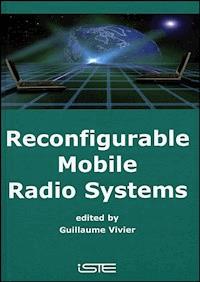
Reconfigurable Mobile Radio Systems E-Book
160,99 €
Mehr erfahren.
- Herausgeber: John Wiley & Sons
- Kategorie: Wissenschaft und neue Technologien
- Sprache: Englisch
Different aspects of the reconfigurability of mobile radio systems are analyzed in this book. These include services, object modeling applied to software radio, flexible spectrum management, trade-offs for building a reconfigurable terminal, an example of a pure software radio modem, adaptive MIMO techniques and analog-to-digital converters.
Sie lesen das E-Book in den Legimi-Apps auf:
Seitenzahl: 340
Veröffentlichungsjahr: 2013
Ähnliche




















Table of Contents
Introduction
Chapter 1. Services and Adaptive Uses
1.1. New networks and new uses
1.2. Mobile communications customers
1.3. Technological and adaptability factors of mobile services
1.4. Conclusion: “I am a nomad in at least five different ways”
Chapter 2. Object Modeling and Software-defined Radio
2.1. Introduction
2.2. Applicability of the component-based approach to the field of software-defined radio
2.3. The constraints of the component-based approach
2.4. An outline of the works pertaining to the component-based approach for software-defined radio
2.5. Conclusion
Chapter 3. Trade-offs for Building a Reconfigurable Radio Terminal
3.1. Introduction
3.2. Architectures and reconfiguration mechanisms
3.3. Compromise for the hardware reconfiguration
3.4. Compromise for software reconfiguration
3.5. Some open problems
3.6. Conclusion
3.7. Bibliography
Chapter 4. A UMTS-TDD Software Radio Platform
4.1. Introduction
4.2. Hardware architecture
4.3. Software architecture
4.4. Connection to the IPv6 network
4.5. Reconfigurability
4.6. Conclusion
4.7. Bibliography
Chapter 5. Iterative Approach for Hardware Reconfigurability: The Rake Receiver
5.1. Introduction
5.2. Concept of hardware reconfigurability
5.3. Example 1: reconfigurable rake receiver with an “interference canceller”
5.4. Example 2: an interference canceller based on realistic channel estimation
5.5. Conclusion
5.6. Bibliography
Chapter 6. Antenna Arrays and Reconfigurable MIMO Systems
6.1. Introduction
6.2. Large broadband transmission and reconfigurable transceivers
6.3. Space-time processing and MIMO systems
6.4. Existing architectures
6.5. Reconfigurable MIMO systems
6.6. Case study
6.7. Conclusion
6.8. Bibliography
Chapter 7. Analog-to-Digital Conversion for Software Radio
7.1. Introduction
7.2. Current ADC performances
7.3. Architecture of receivers
7.4. ADC architectures
7.5. ADC evolution
7.6. Conclusion
7.7. Bibliography
Chapter 8. Flexible Spectrum Management
8.1. Introduction
8.2. Flexible spectrum management drivers
8.3. Flexible spectrum management models
8.4. The technologies
8.5. Conclusion
8.6. Bibliography
List of Authors
Index
First published in France in 2005 by Hermes Science/Lavoisier entitled “Les systèmes radiomobiles reconfigurables”
Published in Great Britain and the United States in 2007 by ISTE Ltd
Apart from any fair dealing for the purposes of research or private study, or criticism or review, as permitted under the Copyright, Designs and Patents Act 1988, this publication may only be reproduced, stored or transmitted, in any form or by any means, with the prior permission in writing of the publishers, or in the case of reprographic reproduction in accordance with the terms and licenses issued by the CLA. Enquiries concerning reproduction outside these terms should be sent to the publishers at the undermentioned address:
ISTE Ltd6 Fitzroy SquareLondon W1T 5DXUKISTE USA4308 Patrice RoadNewport Beach, CA 92663USAwww.iste.co.uk© ISTE Ltd, 2007
© LAVOISIER, 2005
The rights of Guillaume Vivier to be identified as the author of this work have been asserted by him in accordance with the Copyright, Designs and Patents Act 1988.
Library of Congress Cataloging-in-Publication Data
[Systemes radiomobiles reconfigurables. English] Reconfigurable mobile radio systems: reconfigurable mobile radio systems:
a snapshot of key aspects related to reconfigurability in wireless systems/edited by Guillaume Vivier.
p. cm.
Originally published: France: Les systèmes radiomobiles reconfigurables.
Hermes Science/Lavoisier, 2005.
Includes index.
ISBN-13: 978-1-905209-46-0
1. Mobile communication systems. 2. Wireless communication systems.
I. Vivier, Guillaume.
TK6570.M6S97 2007
621.382--dc22
2007001890
British Library Cataloguing-in-Publication Data
A CIP record for this book is available from the British Library
ISBN 13: 978-1-905209-46-0
Introduction
Digital mobile wireless communication and the Internet have undergone a fantastic growth in the last few years and, despite originating from two different worlds, they are converging. This convergence corresponds to the evolution of mobile systems towards the highest broadband data transmissions (GSM, EDGE/GPRS, UMTS then HSDPA), while the computing world gets equipped with wireless technologies such as Wi-Fi or Wi-Max.
Due to progress and the integration of digital technologies, communication systems (either network systems or user terminals) have become multimode, i.e. able to operate in multiple standards within various frequency bands. Applications, protocol stacks or transceivers are adaptive, optimizing processing based on environmental conditions, users’ preferences and provisioned services. Soon, all equipment and systems will be entirely reconfigurable, meeting the vision of software radio developed initially in the military field.
Obviously, this increase of flexibility within the equipment in return requires a more complex management: how should this reconfiguration capability be managed? Why, when and how should reconfiguration be used? Is it possible to design a radio system with a flexible spectrum allocation? What would be the roles of service providers, operators, regulators and users? Who controls what? Which are the technological limits of the reconfiguration? Will the services and users know how to make adjustments?
In this book, our objective is to put forward answers to these questions, by gathering around the theme of reconfigurable radiomobile systems a panel of experts, coming from various horizons: universities, manufacturers and operators, all of them being time users.
Chapter 1, written by Guillaume Dorbes, addresses the new models of services and the applications induced by the technological evolutions associated with the convergence of the fixed and mobile communication systems, showing increasing reconfigurability capability, and bearing in mind that more and more people use them.
The implementation of reconfigurable mobile radio systems requires more and more software. Chapter 2, written by Antoine Delautre and Yann Denef introduces the concept of object modeling in the software context and presents its interest in the reconfigurable systems. A review of the most relevant developments and standards, especially in the military field, is then proposed.
Chapter 3, written by a team of France Telecom R&D engineers, looks into the design of a software radio terminal. The interests of such an approach as well as its underlying constraints are described through concrete examples, at the level of the hardware, of the software and also at the terminal overall architecture.
An example of concrete design of a reconfigurable terminal and a base station is then described in Chapter 4. The mobile communications team group in the Eurecom institute presents a UMTS-TDD software-defined radio platform whose protocol stacks are entirely implemented in C under Linux and thus are totally reconfigurable on request.
This full software approach is then completed by Chapter 5, which discusses hardware reconfiguration. Iannis Krikidis, Lirida Naviner and Jean-Luc Danger propose improvement axes of a Rake receiver, by automatic reconfiguration. Various reconfiguration strategies as well as the associated performances are also presented.
Sébastien Roy and Jean-Yves Chouinard extend the topic of hardware reconfiguration by covering in Chapter 6 the specific problem of the multiantenna transmissions (MIMO). Indeed, MIMO is considered by all the recent mobile radio systems. After a presentation of the MIMO systems and their performances, this chapter discusses their practical implementation in reconfigurable architectures.
Chapter 7 focuses on a key element of the software-defined radio: analog-todigital converters. Firstly, Patrick Loumeau, Lirida Naviner and Jean-François Naviner describe the role of the converters in typical receivers as well as the current performances. They then present various converter structures, especially the most promising ones to be used in reconfigurable mobile radio systems.
Finally, to conclude this book, David Grandblaise extends the flexible spectrum management concept to the most general cognitive radio topic. In fact, the final stage of the reconfigurable mobile radio systems would be to be able to use any standard in any band. Chapter 8 thus presents the (r)evolutions of thought around the spectrum and its management at the regulatory level as well as on concrete techniques which enable to share it efficiently.
This book thus provides an extended overview of the most relevant subjects related to reconfigurable mobile radio systems. A reader involved in this field can stop to the most technical chapters and go into more detail by means of the numerous references given at the end of each chapter, while a reader in a hurry may satisfy himself picking up the sufficient information by simply going through the chapters, in order to understand the problems related to the reconfigurability of a wireless communication system.
Chapter 1
Services and Adaptive Uses1
1.1. New networks and new uses
1.1.1. Broadband mobile radio systems: why do it?
Why would we cover adaptive services and uses within a work dedicated to reconfigurable mobile radio systems? We can raise this question because the two issues are very distant: one is very technological and focused on wireless networks, whereas the other, equally (but only) technological, is also focused on the person who will use these networks.
Why should wireless broadband networks be deployed? For what kind of services? How can these networks improve our everyday life? What is going to change due to these networks? Will we have access to new services or will the existing services be adapted to this mobile dimension?
This part of the study tries to respond to these questions and perhaps raises others. We will try to understand the uses leading to the use of these networks, having taken time to think about the problem in order to analyze what our “customers” expect from these networks and then we will think of the technological and human factors which will condition the large scale adoption of these mobile networks.
At first there was the fixed network, then came the mobile one, but is it not the same story?
1.1.2. From Internet services on a voice network to voice services on an Internet network
Will mobile Internet be the future of fixed Internet? We can believe this, since the progress of technologies and behaviors have increased so much in the last 10 years. Therefore, even if this work deals with mobile networks, the aim of this chapter is to present “services and adaptive uses” by addressing the fixed telephony networks which, in this regard, are rich in considerations regarding the new mobile services.
Let us cast our minds back… In that period, in France there was only a single fixed telephony operator that used to sell us minutes of communication. Then we witnessed the appearance of modems, those boxes that made the Internet connection possible by dialing a phone number billed at the price of a local communication. The telephony services were kings and the transport of Internet services using these wires dedicated to spoken communication was tolerated.
Lesen Sie weiter in der vollständigen Ausgabe!
Lesen Sie weiter in der vollständigen Ausgabe!
Lesen Sie weiter in der vollständigen Ausgabe!
Lesen Sie weiter in der vollständigen Ausgabe!
Lesen Sie weiter in der vollständigen Ausgabe!
Lesen Sie weiter in der vollständigen Ausgabe!
Lesen Sie weiter in der vollständigen Ausgabe!
Lesen Sie weiter in der vollständigen Ausgabe!
Lesen Sie weiter in der vollständigen Ausgabe!




