


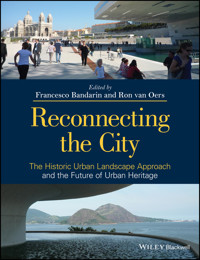
Reconnecting the City E-Book
77,99 €
Mehr erfahren.
- Herausgeber: John Wiley & Sons
- Kategorie: Wissenschaft und neue Technologien
- Sprache: Englisch
Historic Urban Landscape is a new approach to urban heritage management, promoted by UNESCO, and currently one of the most debated issues in the international preservation community. However, few conservation practitioners have a clear understanding of what it entails, and more importantly, what it can achieve.
- Examples drawn from urban heritage sites worldwide – from Timbuktu to Liverpool
- Richly illustrated with colour photographs
- Addresses key issues and best practice for urban conservation
Sie lesen das E-Book in den Legimi-Apps auf:
Seitenzahl: 794
Veröffentlichungsjahr: 2014
Ähnliche




















Table of Contents
Title page
Copyright page
Acknowledgements
Preface
The Structure of the Book
Section 1: The Layered Dimensions of Urban Conservation
Section 2: Building the Toolkit
Notes
Contributors
About the Companion Website
Introduction: Urban Conservation and the End of Planning
Post-War Attempts to Reconnect the City
Contemporary Views on Urbanism and Landscape
Repositioning Urban Conservation, Reconnecting the City
Notes
SECTION 1: The Layered Dimension of Urban Conservation
1: Archaeology: Reading the City through Time
Introduction
Problems and Issues
Challenges to Presenting Archaeological Sites in Modern Urban Landscapes
Preservation
in situ
and Mitigation Strategies
Approaches and Potential
Archaeological Knowledge and Its Potential Impact on Urban Communities
Conclusion
Notes
2: How Geology Shapes Human Settlements
Introduction
Clay-Based Human Settlements
Soft Rock-Based Human Settlements
Hard Rock-based Human Settlements
Time Variability and Complex Urban Environments
Conclusions
Notes
3: Morphology as the Study of City Form and Layering
Introduction
Origins and Implications of the Term Morphology
The Scope of Urban Morphology
Methodology and Procedures
Advantages and Problems of the Urban Morphology Approach
Relevance within the Historic Urban Landscape Concept
Notes
4: Historic Cities and Climate Change
The Emerging Challenges
Exposure of World Heritage Cities to Multiple Hazards
Historic Cities and Urban Resilience
Historic Cities and Climate Change Mitigation
Historic Cities and Climate Action Plans: The Case of Edinburgh, Scotland
Risks
Actions
Notes
5: The Intangible Dimension of Urban Heritage
Introduction
Defining Intangible Values in Historic Urban Landscapes
Urbanisation Processes and Impacts on Intangible Values
Recognition of Intangible Values in Existing Urban Management Systems
Documentation and Impact Assessment of Intangible Heritage Values
‘Heritage’ – Elitist or Inclusive?
Role of Intangible Heritage in Building Disaster Resilience of Cities
Integrating Intangible Heritage Values in Urban Planning and Management
Mainstreaming Intangible Heritage Through Sustainable Livelihoods and Cultural Tourism
Redefining the Role of Professionals
Notes
6: Planning and Managing Historic Urban Landscapes
Integrated Planning
Key Aspects of Analysing and Planning Historic Urban Landscapes
Governance: The Case for Public Management in Historic Urban Areas
What Kind of Public Institution?
Organisational Framework of the Conservation Agency
Participatory Planning and Implementation Strategies
Conclusion
Notes
7: Cities as Cultural Landscapes
Reflections
A Paradigm Shift
The Cultural Landscape Model: Landscape as History and Expression of Human Values and Identity
Bangkok and the Chao Phraya River
Canberra
Cultural Landscape Characteristics
Urban Identity, Plurality, Sustainable Development Tools for Urban Landscape Planning and Conservation Practice
Tools
Conclusion
Notes
SECTION 2: Building the Toolkit
8: Evolution of the Normative Framework
Introduction
Early Appreciation of Historic Townscape
The Development and Impact of Modern City Planning
Development of Instruments for Urban Conservation
International Recognition of Historic Urban Areas
How Normative Frameworks Respond to the Challenges of Change Caused by Urban Development
New Tools for the Management of the Historic Urban Landscape
Notes
9: Civic Engagement Tools for Urban Conservation
Introduction
Ways of Seeing
Cultural Mapping
The Concepts of Equilibrium and Resilience
Sustainable Diversity
Influences of Civic Engagement: Towards Community-Based Design and Development
Conclusion
Notes
10: Knowledge and Planning Tools
Introduction
Mapping, Measuring, and Visualising the Urban Landscape
Reading and Interpreting the Urban Landscape
Protecting, Enhancing, and Improving the Urban Landscape
Traditional and Customary Systems of Management
Contextualising the Historic Urban Landscape Approach
Notes
11: The Role of Regulatory Systems
Defining Regulatory Systems
Legal Regulations Directly Addressing Public and Private Lands
Legal Regulations with Indirect Influence on Urban Heritage
Conclusion
Notes
12: Devising Financial Tools for Urban Conservation
Introduction
Why are Financial Tools Required?
What Do Financial Tools Do?
What are the Characteristics of the Most Effective Financial Tools?
What are Some Examples of Financial Tools and How Do They Work?
Conclusion
13: Researching and Mapping the Historic Urban Landscape
Introduction
The Diverse City
Methodologies and Tools
The Role of University Research
The Role of UNESCO Chairs
The Role of Category 2 Centres (C2C)
Conclusion
Notes
Conclusion: The Way Forward: An Agenda for Reconnecting the City
Managing the City as a Living Heritage
Identity and Sense of Place
Local Heritage and Corporate Image
The City as Repository of Urban Experiences
Integrating Disciplines and Professional Practices
Future Challenges of Urban Conservation
The Critical Path: Historic Urban Landscape Action Plan
Historic Urban Landscape: A Stepped Approach
Interdisciplinary Context and Operational Coordination
A 20-Point Research Agenda for Planners and Designers
Notes
Index
End User License Agreement
List of Tables
Table 2.1 An attempt to classify the geo-diversity of the Historic Urban Landscape.
Table 2.2 Different types of bricks and related masonry units.
Table 4.1 Top ten World Heritage cities by multi-hazard risk.
Table 4.2 Top ten World Heritage cities by flood risk.
Table 4.3 Top ten World Heritage cities by landslide risk.
Table 12.1 Appraisal of indicators on city branding.
Table 12.2 Aggregate results for the assessment of the economic value.
Table 12.3 Recommendations to city managers.
Table 13.1 Distribution of UNESCO chairs. Source: http://www.unesco.org/en/university-twinning-and-networking/access-by-domain/education/
List of Illustrations
Figure 1.1 Extensive excavations in advance of development in Beirut, Lebanon.
Figure 1.2 A reconstruction of excavated mosaics in the modern shopping area of the Beirut Souks, Lebanon.
Figure 1.3 Display
in situ
of part of the rock cut city ditch within the new shopping complex of the Beirut Souks, Lebanon.
Figure 1.4 The Duomo in Syracuse, Sicily, Italy, showing elements of a classical structure incorporated into later builds of the medieval and post-medieval periods: there is no distinction between the complexity of the built fabric and its below-ground elements.
Figure 1.5 Parco Archeologico della Neapolis, Syracuse, Sicily. A general air of abandonment and the lack of interpretation does little to integrate this area into the modern urban landscape.
Figure 1.6 Parco Archeologico della Neapolis, Syracuse, Sicily. Vegetation growth makes the interpretation of the site impossible, but also suggests that it is no longer making a contribution to the present.
Figure 1.7 Part of the Roman amphitheatre on display beneath the Guildhall Art Gallery in London, UK. Although only a relatively small part of the overall monument, because of the nature of the structure the remains are easily understood by visitors.
Figure 1.8 Impressive remains of the thirteenth century Winchester Palace in Southwark, London. While visually striking, most visitors find it difficult to understand the original context and setting of the huge medieval complex, nor can relate these remains to the development of the modern urban landscape.
Figure 1.9 Partially excavated and conserved remains, covered by a shelter, in the centre of Bukhara, Uzbekistan. This fragment of a wider landscape is currently under-interpreted, and the design of the shelter visually divorces the remains from the contemporary landscape: indeed, most visitors pass it by without recognising that archaeology is on display, nor how these remains contribute to their sense of place, either past or present.
Figure 1.10 Trajan's Market and the forum, Rome, Italy.
Figure 1.11 Archaeological remains displayed under a modern building in Ravenna, Italy. Accessed via the Church of Sant'Eufemia.
Figure 1.12 The Museu d'Història de la Ciutat-Plaça del Rei, Barcelona, Spain. (Photograph from APPEAR project).
Figure 1.13 Roman Saragossa, Spain: ‘Roman Walk’ links monuments and the city wall, integrating them in the urban setting and with other cultural walks, and with linked signposts in the town (Photograph by © Tony Rotondas (under Creative Commons Attribution-Share Alike 3.0 Unported)).
Figure 1.14 (a,b) Hoarding around the MoLA Bloomberg excavation site in the City of London, UK, with imagery linked to QR codes for further information.
Figure 1.15 Part of the ‘Topography of Terror’ in Berlin, Germany, where archaeological evidence of the Gestapo buildings and Berlin Wall are juxtaposed with graphic and textural interpretations to engage the visitors with an understanding of the evolution of the landscape of Berlin through these processes.
Figure 2.1 A Conceptual Framework for the Historic Urban Landscape.
Figure 2.2 The red town and fortress of Shahr-i-Zohak in Afghanistan.
Figure 2.3 Location of the ruins of Shar-i-Zohak (topographic map courtesy of ICONEM, elaboration ISPRA).
Figure 2.4 Aerial photo of the upper part of the Fortress (courtesy of ICONEM).
Figure 2.5 Mud bricks construction over rock foundation.
Figure 2.6 The ancient citadel of Bam before the 2003 earthquake.
Figure 2.7 Typical adobe construction in Southern Morocco, with buildings close to each other for protection against direct sunlight.
Figure 2.8 Durbar Square in Kathmandu with its traditional architecture.
Figure 2.9 Bakhtapur in Kathmandu Valley.
Figure 2.10 Bakhtapur in Kathmandu Valley and the traditional craft makers.
Figure 2.11 Traditional construction in Patan, in Kathmandu Valley, with brick, stone and wood.
Figure 2.12 Buildings made with local soft rock material, volcanic tuff in Civita di Bagnoregio, Italy.
Figure 2.13 Buildings made with local soft rock material, volcanic tuff in Sorano, Italy.
Figure 2.14 Varzia, Georgia, example of a settlement directly built into a volcanic tuff strata (soft rock).
Figure 2.15 Rock cave houses on typical soft rock formation (volcanic pumice) in Cappadocia, Turkey.
Figure 2.16 Cave dwellings, typical peasant homes in the Sassi of Matera, Italy.
Figure 2.17 General view of Orvieto: most of the building material is from quarries located under the town.
Figure 2.18 (a) X-ray diffractogram from a sample of weathered basalt in Lalibela. The red arrow shows the peak interpreted as
montmorillonite
(smectite family), (b) thin section of intact basalt, and (c) thin section of weathered basalt.
Figure 2.19 The rock-hewn Church of Biet Giorgis in Lalibela, Ethiopia.
Figure 2.20 The Church of Biet Emmanuel in Lalibela, in critical condition due to the loss of bearing capacity of the rock-wall.
Figure 2.21 (a) Weathering processes in Lalibela, (b) the roof of Biet Medane Alhem, and (c) Biet Macorewos; damage to internal reliefs in Biet Mikael Golgota.
Figure 2.22 Some examples of square blocks of hard rock: the top is Machu Picchu, Peru, and above the fortress of Saksaywaman in Cusco, Peru.
Figure 2.23 (a,b) Example of constructions with small sized, rounded blocks in Ficulle, Italy.
Figure 2.24 General view of Machu Picchu.
Figure 2.25 Machu Picchu detailed geological map.
Figure 2.26 (a) Possible quarry/paleo landslide deposit of the archaeological site of Machu Picchu and (b) technique for squared hard rock block production.
Figure 2.27 Location of the stone quarry used in Machu Picchu.
Figure 2.28 Type of construction in the Orongo Village, Easter Island, Chile.
Figure 2.29 Type of construction in the Orongo Village, Easter Island, Chile.
Figure 2.30 (a,b) Street views of Parrano, Italy: rounded stones from river alluvial deposits are the main construction material, very often cut in two or more pieces to allow a better stabilisation of the wall.
Figure 2.31 (a,b) Dubrovnik's historic centre surrounded by walls and the large expansion of modern constructions, not present at the beginning of the twentieth century.
Figure 2.32 The progressive development of the San Clemente Basilica in Rome, from the initial construction in the first century AD to the Basilica in the twelfth century.
Figure 2.33 Example of the variety of building materials in the Forum of Augustus in Rome.
Figure 2.34 Plan of the ground level of the Theatre of Marcellus. The following numbers refer to the colour grid in the figure: 1. Travertine dimension stone; 2.
Tufo Lionato
dimension stone; 3. Augustan age concrete with
Tufo Lionato opus reticulatum
facing; 4. Augustan age concrete with
opus testaceum
brick coating; 5. Later Julio-Claudian age concrete with Tufo Giallo della Via Tiberina
opus reticulatum
coating; 6. Julio-Claudian age conglomeratic concretes; 7. Structures of Late Antiquity.
Figure 2.35 Types of building material in the Theatre of Marcellus in Rome.
Figure 3.1 Survey of the urban fabric of the historic centre of Bern (Switzerland), showing its homogeneous morphology, as grown and maintained over centuries. (Source: Paul Hofer, Berne Studio, ETH-Zürich 1974/75).
Figure 3.2 Detailed section through a typical residential/commercial unit of the plan shown in Figure 3.1. (Source: idem).
Figure 3.3 (a–c) Typological variations of a characteristic shopping arcade relating to Figures 3.1 and 3.2, the variations being due to the adaption of the basic prototype to different contextual situations and topographic levels. (Source: idem).
Figure 3.4 (a, b) Plan of the inner city of Vienna, showing juxtaposed urban morphologies of different scale and character, with the preserved medieval nucleus in the centre and the surrounding nineteenth century development of the ‘Ringstrasse’ (and beyond) that was planned and built partly on the site of the former moats and fortifications. (Source: Carlo Aymonino, ‘Lo studio dei fenomeni urbani’, Roma 1977).
Figure 3.5 Aerial view of the historic fabric of Aleppo (Syria), before the current war, showing its ‘organic’ cellular tissue that provides variety of individual architectural forms on the basis of consistent structural affinities between its components.
Figure 3.6 Urban rehabilitation project for the Ashekan wa Arefan district in Kabul, Afghanistan, based on morphological and typological surveys and corresponding intervention criteria. (Source: AKTC).
Figure 3.7 (a, b) Two excerpts from a conservation and design manual for the Old Stone Town in Zanzibar, with exemplary guidelines concerning typical elevation elements. (Source: AKTC).
Figure 3.8 (a) Negative example of a large scale planning intervention by the Uzbek government that led to the loss of substantial parts of the historic fabric in favour of anonymous and meaningless public open space (b). (Source: AKTC).
Figure 3.9 Morphologically faithful infill and rehabilitation proposal for a partly destroyed residential area in historic Samarkand. (Source: AKTC).
Figure 3.10 (a) Urban renewal from within, based on existing environmental, architectural and community potentials and (b) view of the historic district of Darb al-Ahmar in Cairo before and after intervention. (Source: AKTC).
Figure 3.11 Multifold intervention on a housing cluster in Darb al-Ahmar, combining conservation, upgrading infill and community development projects. (Source: AKTC).
Figure 3.12 Aerial view of the core of the historic centre of Bologna. Photo courtesy of Comune di Bologna, Assessorato all'Urbanistica e all'Ambiente.
Figure 3.13 The Historic Centre of Bologna in the 1960s Conservation Plan. Photo courtesy of Comune di Bologna, Assessorato all'Urbanistica e all'Ambiente.
Figure 3.14 The Historic City as seen in the new Bologna Master Plan. Graphic by Patrizia Gabellini.
Figure 4.1 Global average surface temperature increase. Source: ‘Turn down the heat: why a 4° world must be avoided’: a Report for the World Bank by the Potsdam Institute for Climate Impacts Research and Climate Analytics, November 2012. Reproduced by permission of the World Bank.
Figure 4.2 World Heritage Cities examined in the study. Source: ‘Climate-resilient, Climate-friendly World Heritage Cities’, reproduced by permission of the World Bank.
Figures 4.3 and 4.4 Multi-Hazard Risk for World Heritage Cities. Source: ‘Climate-resilient, Climate-friendly World Heritage Cities’, reproduced by permission of the World Bank.
Figure 4.5. Flood Risk for World Heritage Cities. Source: ‘Climate-resilient, Climate-friendly World Heritage Cities’, reproduced by permission of the World Bank.
Figure 4.6 A view of the centre of Edinburgh, Scotland, inscribed in the UNESCO World Heritage List.
Figure 4.7 The centre of Edinburgh, Scotland.
Figure 5.1 Panchakoshi Yatra of Varanasi.
Figure 5.2 Place where the deceased of the Hindu faith are cremated in Varanasi.
Figure 5.3 Nizamuddin Dargah in the historic urban district (Basti) of Delhi is an important urban space that has retained its character due to intangible heritage values associated with a famous Sufi Saint.
Figure 5.4 Darbar Square: the public open space in the historic town of Patan in Kathmandu Valley.
Figure 5.5 (a) Due to social and religious functions, semi-public open spaces in Patan have remained intact while surrounding buildings have undergone massive transformations. (b) Semi-public open spaces characterise traditional Newari settlements in Kathmandu valley as in the case of Bungamati.
Figure 5.6 Ritual paths define the boundaries of traditional settlements such as Bungamati in Kathmandu Valley.
Figure 5.7 The historic city of Patan in Kathmandu Valley with a distinct morphology characterised by interconnected open spaces.
Figure 5.8 Uncontrolled urbanisation in Kathmandu Valley is destroying the ecological relationship of the settlements with fertile agricultural land and water resources.
Figure 5.9 Map of the City of Jiankang (
建康
, Ancient Nanjing in Southern Song Dynasty), 1129 CE.
Figure 5.10 Map of the Core City of Lin An (
临安
, Ancient Hangzhou in Southern Song Dynasty), Southern Song Dynasty, 1268 CE.
Figure 5.11 Ci Yun Xiang Xue (
慈云香雪
), one of the 24 Scenic Views of the Slender Lake of Yangzhou, Qing Dynasty.
Figure 5.12 The West lake in the Four Seasons (Spring), Liu Songnian (
刘松年
) Southern Song Dynasty.
Figure 5.13 Que Hua Qiu Se Tu (Autumn view of Mount Que and Hua
鹊华秋色图
) Zhao Mengfu (
赵孟頫
) , Yuan Dynasty. Image of the ancient city of Jinan (
济南
).
Figure 5.14 The poetic shan shui (
山水
) landscape of the City of Hangzhou.
Figure 5.15 Map of ancient Hangzhou, Qing Dynasty, 1724CE.
Figure 5.16 Image of the city of Hangzhou in the 1930s.
Figure 5.17 Mountain, spring, lake and city, the four components of the city of Jinan (
济南
).
Figure 5.18 Local people get bubbling spring water from the moat as daily drinking water.
Figure 5.19 New high-density residential development along the Qianjiang River in Qianjiang new town, Hangzhou.
Figure 7.1 Interactive phenomenon of landscape. Copyright of Ken Taylor.
Figure 7.2 View South from Mount Ainslie along the Central Axis of Canberra. Source: Image supplied courtesy of the National Capital Authority. Copyright of Commonwealth. All rights reserved.
Figure 7.3 Royal Barge procession, Chao Praya River, Bangkok.
Figure 7.4 The Suzhou River in Shanghai.
Figure 7.5 (a) The old town of Zhuijiajiao near Shanghai. (b) Local craftsperson displaying traditional skills to the public.
Figure 7.6 Nature and culture in the city setting.
Figure 7.7 Nature absent in Canberra new medium density development.
Figure 7.8 Academy of Science National Heritage listed building, 2011.
Figure 7.9 New high-rise building impact on the setting and context of the Academy of Science, 2013.
Figure 7.10 West Lake looking east towards protected hills. Hangzhou city is on the right.
Figure 7.11 Model looking south showing relationship of city with the lake and protection of the eastern, western and southern hills along the lake.
Figure 7.12 Protected low density urban area on east side of lake.
Figure 7.13 Enjoying a lake park near the city.
Source: University of Santo Tomas. In Cook, I & Taylor, K. (2013).54
Figure 9.1 Skyline, Cairo.
Figure 9.2 Kolam exploration by a young girl in south India.
Figure 9.3 Part of Giambattista Nolli's map of Rome, 1748.
Figure 9.4 Montreal triplex: a low-rise high-density approach to ecological urban living.
Figure 9.5 (a) Three overlapping cultural landscapes in the Byward Market area of Ottawa, Canada, (b) the aesthetic landscape of tourism, the market landscape of the rural farmer participants, (c) the late-night bar landscape of university students and others.
Figure 9.6 The Byward Market area today, managed as an area of layered experiences.
Figure 9.7 Hanoi: the layered urban landscape.
Figure 9.8 Kensington Market, Toronto.
Figure 9.9 (a, b, c, d and e) Five cognitive maps of Kensington Market: a satisfied retail consumer, an uncomfortable visitor, a resident, a merchant, a musician. These maps are part of restructuring the governance model for this neighbourhood to recognise and preserve its diversity.
Figure 9.10 The Cultural Diversity Lens.
Figure 10.1 (a, b) 3D model of a Hindu temple. Drawing of a temple complex around a public space in Bangalore.
Figure 10.2 Drawing of street elevation of northside of Devalaya Beedi (main Temple Street) in the historic core of Belur, India.
Figure 10.3 Community mapping exercise. Sketch of the Ratha Beedi (Chariot Street) north of the temple in the historic core of Belur, India.
Figure 10.4 (a) Map of Srirangapatna Fort. A 3D model of the fort area of the island town of Srirangapatna, India, showing spaces of religious and ritual significance including steps for bathing in the river, and processional routes. (b) Shows the remnants of different layers of fortification, and the spatial distribution of the age of structures.
Figure 10.5 Relationship of the mountain ridge road in the Yamanote area and
daimyo
residences.
Figure 10.6 Configuration of the historical layers of a suburban community.
Figure 10.7 Layers of history in the communities surrounding Nakano.
Figure 10.8 Spatial structure of the region in Toyota, Hino-City, Japan.
Figure 10.9 Model of a plateau – configuration of the topography and village structure (Hirayama region).
Figure 12.1 Mapping of visitors and carrying capacity of sites.
Figure 13.1 Cultural map as developed in the participatory workshop of the Roman Decapolis city of Pella, located in Jordan, a site included in the PUSH project.
Figure 13.2 Cultural map as developed in the participatory workshop.
Figure 13.3 The integration methodology that can be applied to multi-cultural situations.
38
Guide
Cover
Table of Contents
Start Reading
Preface
CHAPTER 1
Index
Pages
iv
xi
xii
xiii
xiv
xv
xvi
xvii
xviii
xix
xx
xxi
xxii
xxiii
xxiv
xxv
xxvi
xxvii
xxviii
xxix
xxx
1
2
3
4
5
6
7
8
9
10
11
12
13
14
15
16
17
18
22
23
24
25
26
28
38
39
37
41
19
20
21
27
29
30
31
32
33
34
35
36
40
42
43
44
45
46
52
54
53
57
58
61
62
64
69
70
71
68
73
75
76
77
78
74
80
81
82
79
84
47
48
49
51
55
56
59
60
63
65
66
67
72
83
85
89
92
93
94
96
99
97
101
98
103
105
106
108
110
109
86
87
88
90
91
95
100
102
104
107
111
112
114
115
117
118
119
120
121
122
126
127
128
113
116
123
124
125
129
133
137
136
140
139
142
144
145
146
147
148
149
150
152
153
154
155
151
156
157
159
160
158
130
131
132
134
135
138
141
143
165
164
166
168
169
170
171
173
174
176
177
178
161
162
163
167
172
175
185
189
193
196
198
199
201
179
180
181
182
183
184
186
187
188
190
191
192
194
195
197
200
202
203
204
205
219
220
206
207
208
209
210
211
212
213
214
215
216
217
218
221
222
223
224
225
226
228
229
230
233
231
232
234
235
236
237
238
239
240
241
242
243
244
245
246
247
248
227
250
252
254
255
256
260
261
262
263
264
265
266
267
268
249
251
253
257
258
259
269
279
280
281
282
270
271
272
273
274
275
276
277
278
283
284
285
286
287
288
289
290
291
292
294
295
296
297
298
299
300
308
313
314
315
316
301
302
303
304
305
306
307
309
310
311
312
325
317
318
319
320
321
322
323
324
326
327
328
329
330
331
332
1
2
333
334
335
336
337
338
339
340
341
342
343
344
This edition first published 2015
© 2015 by John Wiley & Sons, Ltd
Registered office:
John Wiley & Sons, Ltd, The Atrium, Southern Gate, Chichester, West Sussex, PO19 8SQ, United Kingdom.
Editorial offices:
9600 Garsington Road, Oxford, OX4 2DQ, United Kingdom.
The Atrium, Southern Gate, Chichester, West Sussex, PO19 8SQ, United Kingdom.
For details of our global editorial offices, for customer services and for information about how to apply for permission to reuse the copyright material in this book please see our website at www.wiley.com/wiley-blackwell.
The right of the author to be identified as the author of this work has been asserted in accordance with the UK Copyright, Designs and Patents Act 1988.
All rights reserved. No part of this publication may be reproduced, stored in a retrieval system, or transmitted, in any form or by any means, electronic, mechanical, photocopying, recording or otherwise, except as permitted by the UK Copyright, Designs and Patents Act 1988, without the prior permission of the publisher.
Designations used by companies to distinguish their products are often claimed as trademarks. All brand names and product names used in this book are trade names, service marks, trademarks or registered trademarks of their respective owners. The publisher is not associated with any product or vendor mentioned in this book.
Limit of Liability/Disclaimer of Warranty: While the publisher and author(s) have used their best efforts in preparing this book, they make no representations or warranties with respect to the accuracy or completeness of the contents of this book and specifically disclaim any implied warranties of merchantability or fitness for a particular purpose. It is sold on the understanding that the publisher is not engaged in rendering professional services and neither the publisher nor the author shall be liable for damages arising herefrom. If professional advice or other expert assistance is required, the services of a competent professional should be sought.
Library of Congress Cataloging-in-Publication Data
Reconnecting the city : the historic urban landscape approach and the future of urban heritage / editors, Francesco Bandarin and Ron van Oers.
pages cm
Summary: “The Historic Urban Landscape aims to respect and celebrate diversity–of heritage resources and cultural traditions” – Provided by publisher.
Includes bibliographical references and index.
ISBN 978-1-118-38398-8 (paperback)
1. Historic buildings–Conservation and restoration. 2. Historic sites–Conservation and restoration. 3. Historic districts–Conservation and restoration. 4. Cities and towns–Conservation and restoration. 5. Urban landscape architecture–Conservation and restoration. 6. Cultural landscapes–Conservation and restoration. 7. Historic preservation. 8. City planning. 9. Cultural policy. 10. Urban policy. I. Bandarin, Francesco. II. Oers, Ron van, 1965– III. Bandarin, Francesco. Historic urban landscape.
CC135.R39 2014
363.6'9–dc23
2014012363
A catalogue record for this book is available from the British Library.
The ideas and opinions expressed in this text are those of the authors and do not necessarily reflect the views of UNESCO.
Wiley also publishes its books in a variety of electronic formats. Some content that appears in print may not be available in electronic books.
Cover image courtesy of Francesco Bandarin and Ron van Oers.
Acknowledgements
This edited book on the on-going process of elaboration and implementation of the 2011 Recommendation on the Historic Urban Landscape, as developed and promoted by UNESCO since 2005, is part of an international effort to adapt urban conservation to the operational realities of the twenty-first century in which cities have assumed a critical role in human development.
A broad and growing coalition of professionals, decision-makers and community representatives in all parts of the world is participating in this process. It would be impractical to name all of them here.
We would like however to thank all our colleagues at the UNESCO Headquarters and in the Field Offices for their continued support and encouragement.
Various professionals in different parts of the world have provided critical reflections and observations on the Historic Urban Landscape as a process or product. We would like to acknowledge, in particular, the contribution of: Joseph King and Gamini Wijesuriya at ICCROM in Rome; Gustavo Araoz, Kristal Buckley and Sheridan Burke at ICOMOS; Stefania Abakerli and Guido Licciardi at the World Bank in Washington; Jeffrey Soule at the American Planning Association; Ana Pereira-Roders in Eindhoven; Marie-Theres Albert in Cottbus; Sarah Semple, Andreas Pantazatos, David Petts and Seif al-Rashidi in Durham; Karel Bakker in Pretoria; Alfredo Conti in La Plata; Muhammad Juma in Zanzibar; Susan Fayad in Ballarat; Louise Cox in Sydney; Jian Zhou in Shanghai; Lynne DiStefano in Hong Kong; Ayesha Pamela Rogers and Nadeem Tarar in Rawalpindi; Nobuko Inaba in Tokyo; Augusto Villalon in Manila; Christopher Young in London; Birgitta Ringbeck in Berlin; Jad Tabet in Beirut; Marc Breitman in Paris; Daniele Pini in Ferrara; Paolo Ceccarelli in Milan; Heleni Porfyriou in Rome; Pietro Laureano in Florence; Sophia Labadi in Canterbury; Lynn Meskell in Stanford; Paola Falini in Rome; Alessandro Balducci in Milan.
We would like to thank them all sincerely for their involvement and their dedication to the cause of urban conservation and we look forward to continued collaboration and expansion of the Historic Urban Landscape network.
Our final thank you, goes to all the contributors of this book: in total, 30 people (including the editors) offered a contribution to the reflection: 17 for the essays, 6 for the case studies and 7 for the interviews. While their texts have been in some cases revised before being integrated into the book, we have done our best to respect the meaning of the original. The editors have inserted most of the quotes at the beginning of the chapters. The interviews have been conducted and drafted by the editors and revised by the interviewee. Errors or imprecisions remain, of course, our full responsibility.
Francesco Bandarin, Paris
Ron van Oers, Shanghai
May 2014
Preface
Francesco Bandarin and Ron van Oers
Writing a book is an adventure. To begin with, it is a toy and an amusement; then it becomes a mistress, and then it becomes a master, and then a tyrant. The last phase is that just as you are about to be reconciled to your servitude, you kill the monster, and fling him out to the public.
Winston Churchill
In our previous book The Historic Urban Landscape: Managing Heritage in an Urban Century (Wiley-Blackwell, 2012), we argued that in spite of the decades long call for interdisciplinary work that was formally codified in the 1975 Amsterdam Declaration on Integrated Conservation, there is currently little integration of professions dealing with the process of heritage conservation and urban development. This leaves the field of urban heritage management seriously compartmentalised, with limited exchanges between the professional ‘silos’. This obviously reduces the efficiency and effectiveness of conservation efforts and it creates gaps that can be exploited by the forces that are not interested in the preservation of heritage resources.
In our view, the natural follow-up to the first book was to assemble a range of professional practices and viewpoints related to urban management to broaden the scope and reach of the Historic Urban Landscape as a conceptual framework and operational approach. The Historic Urban Landscape aims to respect and celebrate diversity – of heritage resources cultural traditions – by suggesting a critical (not a model) of identification and analysis to arrive at informed decisions regarding the policies and tools aimed at fostering sustainable urban conservation and management.
Lesen Sie weiter in der vollständigen Ausgabe!
Lesen Sie weiter in der vollständigen Ausgabe!
Lesen Sie weiter in der vollständigen Ausgabe!
Lesen Sie weiter in der vollständigen Ausgabe!
Lesen Sie weiter in der vollständigen Ausgabe!
Lesen Sie weiter in der vollständigen Ausgabe!
Lesen Sie weiter in der vollständigen Ausgabe!
Lesen Sie weiter in der vollständigen Ausgabe!
Lesen Sie weiter in der vollständigen Ausgabe!
Lesen Sie weiter in der vollständigen Ausgabe!
Lesen Sie weiter in der vollständigen Ausgabe!
Lesen Sie weiter in der vollständigen Ausgabe!
Lesen Sie weiter in der vollständigen Ausgabe!
Lesen Sie weiter in der vollständigen Ausgabe!
Lesen Sie weiter in der vollständigen Ausgabe!
Lesen Sie weiter in der vollständigen Ausgabe!
Lesen Sie weiter in der vollständigen Ausgabe!
Lesen Sie weiter in der vollständigen Ausgabe!
Lesen Sie weiter in der vollständigen Ausgabe!
Lesen Sie weiter in der vollständigen Ausgabe!
Lesen Sie weiter in der vollständigen Ausgabe!
Lesen Sie weiter in der vollständigen Ausgabe!




