


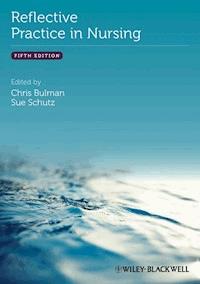
Reflective Practice in Nursing E-Book
35,99 €
Mehr erfahren.
- Herausgeber: John Wiley & Sons
- Kategorie: Fachliteratur
- Sprache: Englisch
From reviews of previous editions:
'This excellent book provides useful guidance on the use of reflection in practice.... a helpful addition to any nursing library.’ Primary Health Care
'…an excellent investment in any nurses’ library portfolio.' Journal of Advanced Nursing
'An extremely welcome addition to nursing's literature on thoughtful, knowledgeable practice.' Nursing Times
'This is an excellent practical guide to reflective practice…I would highly recommend this book to all practice teachers and students.' Journal of Practice Nursing
The ability to reflect on practice has become a competency demanded of every healthcare professional in recent years. It can be a daunting prospect- but this practical and accessible text guides the way, using the latest research and evidence to support the development of skills in reflective practice and provides help and advice on how to get started, how to write reflectively and how to continue to use reflective practice in everyday situations.
This fifth edition of Reflective Practice in Nursing is an indispensable guide for students and practitioners alike who wish to learn more about reflective practice, as well as containing essential information for teachers and lecturers.
Sie lesen das E-Book in den Legimi-Apps auf:
Seitenzahl: 530
Veröffentlichungsjahr: 2013
Ähnliche




















Contents
List of Contributors
Preface
Chapter 1: An introduction to reflection
Introduction
Contemporary challenges for reflective nursing practice and education
Explaining the concept of reflection
Contemporary descriptions of reflection
The influence of critical theory
Similarities and differences in explanations of reflection
Some key points about the concept of reflection
Noteworthy concepts for a deeper understanding of reflection
Evidence-based practice and reflection
Reflection for communicating practice knowledge
Empowerment and change
Nurse education and knowledge tensions
Nurse education and reflection
Liberating and using practice experience
Conclusion
Chapter 2: Developing skills for reflective practice
Introduction
The importance of underlying skills
Limitations of a skills-based approach to developing reflective practice
An alternative approach to developing reflective practice
Guidance on using the exercises in this chapter
Self-awareness
Description
Critical analysis
Synthesis
Evaluation
A more wide-ranging approach to developing reflective practice
Attributes of the reflective practitioner
Conclusion
Chapter 3: Writing to learn: writing reflectively
Introduction
Your personal journal
Where does your personal journal fit into your reflective learning?
The purpose of a personal journal
Starting your journal
Blocks to writing
Content
What is reflective writing?
Professional responsibilities
Ethical considerations
Conclusion
Appendix 1 The park: comments on the quality of reflection (Adapted from Moon 2004)
The park (4)
Appendix 2 Gibbs’ reflective cycle (Gibbs 1998, adapted by Tate)
Chapter 4: Reflecting in groups
Introduction
Work-based learning, organisational learning and learning organisations
Groups to support reflection, learning and supervision
Group working: challenges and benefits
Running a group: ground rules and other pragmatic issues
Conclusion: many hands or too many cooks?
Chapter 5: An exploration of the student and mentor journey into reflective practice
Introduction
Changes and pressures on nursing and education – why reflection is increasingly important for students and mentors
The student’s journey into reflection
The mentor’s journey into reflection
Mentor preparation and reflection
Conclusion
Chapter 6: Supervision for supervisors: icing on the cake or a basic ingredient for the development of clinical supervision in nursing?
Introduction
Making connections between reflective practice and clinical supervision
Background to team supervision as the focus for supervision on supervisory practice
Establishing the relationship for supervision on supervision
The use of the telephone as a method of clinical supervision
Using reflection for supervision on (John’s) supervision
Focusing on the supervisory process to identify ‘blind spots’
The use of parallel process
Game playing in supervision
Supervisory preferences and styles
Just like supervision for supervisors: more questions than answers?
Chapter 7: A personal exploration of reflective and clinical expertise
Back to the beginning
Step 1 Return to the experience: finding what is at the heart of your experience
Side-step: the art of finding knowledge in experience
Step 2 Attend to the feelings – finding what is in your heart
Step 3 Re-evaluate the experience – putting my heart and mind into knowing my practice
Concluding reflections
Chapter 8: Assessing and evaluating reflection
Introduction
Definitions
The assessment of reflection
Grading reflection
Issues for students and teaching staff in the assessment of reflection
Evaluating reflection
Conclusion
Chapter 9: Getting started on a journey with reflection
Contemplating the journey
Key suggestions for your journey with reflection
Conclusion
Index
Acknowledgements
Thanks go to our students, Jenny Harlow, Anna Simpson and Anne Wright for their generous contributions to this book.
Dedication
This book is dedicated to our sadly missed, dear friend and colleague Bev Gillings-Grayson (1959–2009) who contributed to the second edition of this book.
This edition first published 2013 © 2013 by John Wiley & Sons, Ltd
Wiley-Blackwell is an imprint of John Wiley & Sons, formed by the merger of Wiley’s global Scientific, Technical and Medical business with Blackwell Publishing.
Registered OfficeJohn Wiley & Sons, Ltd, The Atrium, Southern Gate, Chichester, West Sussex, PO19 8SQ, UK
Editorial Offices9600 Garsington Road, Oxford, OX4 2DQ, UKThe Atrium, Southern Gate, Chichester, West Sussex, PO19 8SQ, UK111 River Street, Hoboken, NJ 07030-5774, USA
For details of our global editorial offices, for customer services and for information about how to apply for permission to reuse the copyright material in this book please see our website at www.wiley.com/wiley-blackwell.
The right of the author to be identified as the author of this work has been asserted in accordance with the UK Copyright, Designs and Patents Act 1988.
All rights reserved. No part of this publication may be reproduced, stored in a retrieval system, or transmitted, in any form or by any means, electronic, mechanical, photocopying, recording or otherwise, except as permitted by the UK Copyright, Designs and Patents Act 1988, without the prior permission of the publisher.
Designations used by companies to distinguish their products are often claimed as trademarks. All brand names and product names used in this book are trade names, service marks, trademarks or registered trademarks of their respective owners. The publisher is not associated with any product or vendor mentioned in this book.
Limit of Liability/Disclaimer of Warranty: While the publisher and author(s) have used their best efforts in preparing this book, they make no representations or warranties with respect to the accuracy or completeness of the contents of this book and specifically disclaim any implied warranties of merchantability or fitness for a particular purpose. It is sold on the understanding that the publisher is not engaged in rendering professional services and neither the publisher nor the author shall be liable for damages arising herefrom. If professional advice or other expert assistance is required, the services of a competent professional should be sought.
Library of Congress Cataloging-in-Publication Data
Reflective practice in nursing / edited by Chris Bulman, Sue Schutz. – 5th ed. p. ; cm. Includes bibliographical references and index.
ISBN 978-0-470-65810-9 (pbk. : alk. paper)I. Bulman, Chris. II. Schutz, Sue. [DNLM: 1. Nursing. 2. Education, Nursing.3. Learning. 4. Nursing Process. 5. Philosophy, Nursing. 6. Thinking. WY 16] 610.73–dc23
2012032716
A catalogue record for this book is available from the British Library.
Wiley also publishes its books in a variety of electronic formats. Some content that appears in print may not be available in electronic books.
Cover image: iStock image 19247374Cover design by Sophie Ford www.hisandhersdesign.co.uk
List of Contributors
Sue Atkins MSc, RN, RM, Dip Nursing, Dip Nursing Ed, Senior Lecturer, Faculty of Health and Life Sciences, Oxford Brookes University, Oxford, UKChris Bulman PhD, MSc, BSc (Hons), RN, RNT, PGCEA, Senior Lecturer, Faculty of Health and Life Sciences, Oxford Brookes University, Oxford, UKBernadetteCarter PhD, PGCE, BSc, RSCN, SRN, Professor of Children’s Nursing, Families, Children and Life Transitions Research Group, Department of Nursing, University of Central Lancashire, Preston, UKPaul Cassedy RMN, RNT, MA Counselling Practice, Health Lecturer, School of Nursing, University of Nottingham, Nottingham, UKJohn Driscoll BSc (Hons) Nursing, DPSN, Cert Ed (FE), RGN, RMN, Freelance CPD Consultant and Coach, Norfolk, UKSue Duke PhD, MSc, BSc, PGDE, RN, RNT, Consultant Practitioner in Cancer and Palliative Care, Senior Lecturer, Faculty of Health Sciences, University of Southampton, Southampton, UKCharlotte Maddison MSc, BA (Hons), RGN, PGCE, Senior Lecturer, Faculty of Health and Life Sciences, Oxford Brookes University, Oxford, UKSue Schutz MSc, RGN, Cert Ed (FE), Senior Lecturer, Faculty of Health and Life Sciences, Oxford Brookes University, Oxford; Part-time PhD Student, University of Southampton, Southampton, UKPam Sharp MSc, PG Dip, RGN, Senior Lecturer, Faculty of Health and Life Sciences, Oxford Brookes University, Oxford, UKSylvina Tate MSc, PGDE, BSc (Hons), Dip Nursing (London), RGN, ENB 998, BTech Certificates Massage and Aromatherapy, Dru Yoga Teachers Diploma, Reiki II Practitioner Certificate, Life Coach, formerly Principal Lecturer, School of Life Sciences, University of Westminster, London, UK
Preface
Welcome to the fifth edition of Reflective Practice in Nursing. This new edition responds to the interest in reflective practice amongst nurses and offers a motivating and accessible text about reflection. Fundamentally, this book does not assume any previous knowledge about reflection and aims to be useful to those wanting to learn about what it has to offer them. Past editions of Reflective Practice in Nursing have appealed to a wide variety of readers – undergraduate and postgraduate students, practitioners from a range of backgrounds and experience, plus teachers, managers, mentors and professionals from other disciplines. This past success has motivated us to produce this latest publication.
The fifth edition has much new to offer. The extensively updated first chapter introduces you to reflection in relation to the current issues that affect nursing. The chapter considers some philosophical underpinnings, plus some of the ‘dangers’ of reflection and the role reflection can play in the evidence-based practice movement. It looks at other key issues including communicating practice knowledge, empowerment and change, knowledge tensions and the relevance of reflection to nurse education and practice. The chapter on skills for reflection has also been updated and includes a valuable exploration of the attributes of the reflective practitioner.
A new chapter on writing reflectively offers some inspiring and uplifting guidance and introduces the idea of reflective writing as a method of deep, self-directed learning. An extensively updated chapter on group reflection offers plenty of advice and tips for practitioners and educationalists, as well as a lively critique of the current literature. The chapter on the student’s and mentor’s journey into reflection focuses on pre-registration students and the preparation and support of mentors. The chapter deliberates some of the contemporary issues that affect nurses’ and mentors’ capacities to develop and use reflection. The chapter illustrates how the development and use of reflection is valuable to nurses’ and mentors’ personal development and the ongoing achievement of thoughtful and excellent professional practice.
The chapter focusing on clinical supervision in nursing is another exciting new addition to this book. It draws on the experiences and knowledge of two highly experienced supervisors and considers the issues around supervision for supervisors. A new chapter on a personal exploration of reflection and clinical expertise adds to those contributed by Sue Duke to past editions of this book and offers some controversial and essential ‘food for thought’ concerning being a reflective practitioner in nursing today. The chapter on assessing and evaluating reflection remains and has been added to and updated. This is a challenging area for debate but remains one that we feel needs to be raised, if practice knowledge is to be valued in the same way as theoretical knowledge. Finally, the last chapter gives an extensively revised guide to getting started with reflection, drawing on other areas of the book and giving more tips, cautions, helpful frameworks and new examples to help you to begin your journey with reflection.
In essence, our aim is to make you curious about reflection, in a spirit that gets you thinking about the issues involved and challenges you to look at your view of the world. Essentially, we hope it will be useful to all those involved and interested in developing, using and exploring reflective practice.
Chris Bulman and Sue Schutz2012
Chapter 1
An introduction to reflection
Chris Bulman
Faculty of Health and Life Sciences, Oxford Brookes University, Oxford, UK
Introduction
Every contributor to this book is motivated by an interest in reflection. Within this fifth edition, we have presented experience, research and theory in order to help you get a better grasp of reflection, especially if you are considering it for the first time. This probably means that you are a student but you could equally be a supervisor, mentor or senior nurse furthering your understanding of reflection, or a nurse teacher interested in reflective education. Whilst this is a book that clearly advocates reflection, we are also aware of the difficulties and criticisms associated with it. Thus we offer a book that will give you some help with whatever journey you are taking with reflection, but will also get you thinking critically about the issues involved.
Contemporary challenges for reflective nursing practice and education
There is no doubt that reflection continues to be of interest to nurses and to influence nursing practice and education around the world. It remains a concept that I and fellow authors are committed to. We believe that being reflective is essential for effective and person-centred professional practice. Significantly, current financial concerns and pressures are affecting health services across many countries. This has had an impact on nursing education and frontline clinical services. It has unquestionably influenced the amount of time, energy and support that nurses have to constructively consider and learn from their practice. All this has affected learning opportunities, such as provision of clinical supervision for practitioners, time for informally reflecting with colleagues, and defending the relevance of reflective education for the development of clinical judgement, alongside the juggernaut which is evidence-based practice education. (I’ll return to this later in the chapter.) With these current challenges in mind, we believe it is even more vital to continue to write about reflection as a positive way to learn from experience – warts and all!
Explaining the concept of reflection
Starting with Aristotle
Getting to grips with an explanation of reflection is a sensible place to start. The concept of reflection is not as new as you might imagine. At the outset, I will underline the influence of the Ancient Greek philosopher Aristotle and his notion of practical wisdom/judgement or phronesis. Aristotle emphasised the importance of reflecting in the ‘real world’ and developing experience of it. He emphasised the requirement to pay attention to emotions and imagination in order to develop our perception of the world, so that emotion and imagination are not relegated to unwanted self-indulgent urges or corrupting influences that get in the way of ‘good’ rational thinking, but rather are a responsive and elective part of our thinking. In this way, Aristotle believed it was possible to develop real practical insight, responsiveness and understanding (Nussbaum 1990). So you can begin to see how this might be related to the development of practical knowledge, considering how we feel, as well as think, about practice, and finding a way of communicating this sort of knowledge to others.
Dewey
The educationalist and philosopher John Dewey has been extremely influential in contemporary discussion about the concept of reflection. Dewey developed his ideas on thinking and learning and focused on the concept of thinking reflectively. He defined reflection as:
Lesen Sie weiter in der vollständigen Ausgabe!
Lesen Sie weiter in der vollständigen Ausgabe!
Lesen Sie weiter in der vollständigen Ausgabe!
Lesen Sie weiter in der vollständigen Ausgabe!
Lesen Sie weiter in der vollständigen Ausgabe!
Lesen Sie weiter in der vollständigen Ausgabe!
Lesen Sie weiter in der vollständigen Ausgabe!
Lesen Sie weiter in der vollständigen Ausgabe!
Lesen Sie weiter in der vollständigen Ausgabe!




