


Erhalten Sie Zugang zu diesem und mehr als 300000 Büchern ab EUR 5,99 monatlich.
- Herausgeber: Gedisa Editorial
- Kategorie: Bildung
- Sprache: Spanisch
La Universidad se encuentra en pleno progreso desde su tiempo cero; de hecho, halla su carta de naturaleza en la necesidad de mejorar el medio que la nutre y por y para el que existe: la sociedad. Rompiendo las viejas membranas de la enseñanza imperante hasta el siglo XX, las nuevas (r)evoluciones de contenidos y fórmulas, como lo fuera el EEES (o Plan Bolonia) o las TIC, suponen la respuesta a esas actualizadas necesidades docentes y curriculares. Las Humanidades, las Artes, las Ciencias sociales y la Docencia se reescriben, hibridando, gracias a los nuevos lenguajes y herramientas, contenidos otrora lejanos. La nueva Academia es poliédrica, ínter y multi disciplinar, dialógica y colaborativa. En este estado de cosas la colección Herramientas universitarias se erige como atalaya para agrupar bajo su égida al más amplio conjunto de autores internacionales que iluminen, con sus investigaciones, la panoplia de contenidos que conforman el mundo científico donde nace el futuro. La calidad intelectual queda refrendada mediante la rigurosa implantación del habitual proceso garante, basado en la revisión o arbitraje por pares ciegos (peer review) de estos capítulos, sin renunciar a la más antigua tradición universitaria que obliga al opositor de lo publicado, a soportar el peso de la prueba. Este doble modelo de evaluación, a priori y a posteriori, garantiza la calidad del contenido de los textos de esta colección. Pertenecer a la Academia, y en ello radica orgullosamente su valía, supone que todos sus miembros responden a una ambición irrenunciable: mostrar que el conjunto de sus trabajos conforma la vanguardia científica internacional. El texto que aquí se presenta está auspiciado por el Fórum Internacional de Comunicación y Relaciones Públicas (Fórum XXI), la Sociedad Española de Estudios de la Comunicación Iberoamericana (SEECI), la Asociación cultural Historia de los Sistemas Informativos y el Grupo Complutense (nº 931.791) de Investigación en Comunicación Concilium.
Sie lesen das E-Book in den Legimi-Apps auf:
Seitenzahl: 1031
Veröffentlichungsjahr: 2019
Das E-Book (TTS) können Sie hören im Abo „Legimi Premium” in Legimi-Apps auf:
Ähnliche












BIBLIOTECA de EDUCACIÓN
Herramientas universitarias
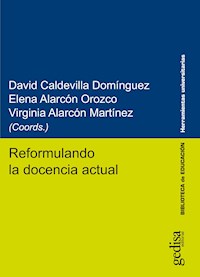
David Caldevilla Domínguez Elena Alarcón Orozco Virginia Alarcón Martínez (Coords.)
Reformulando la docencia actual
David Caldevilla Domínguez Elena Alarcón Orozco Virginia Alarcón Martínez(Coords.)
Reformulandola docencia actual
© De los autores y coordinadores, 2018
© FÓRUM XXI, 2018
Primera edición, 2018, Barcelona
© Editorial Gedisa, S.A.
Av. del Tibidabo, 12, 3º
08022 Barcelona (España)
Tel. (00 34) 93 253 09 04
www.gedisa.com
Reservados todos los derechos. Queda rigurosamente prohibida, sin la autorización escrita del titular del Copyright, bajo las sanciones establecidas de las leyes, la repro-ducción parcial o total de esta obra por cualquier medio o procedimiento de difusión y copia, incluidos la reprografía y el tratamiento informático, para su uso comercial. Dichas leyes contemplan penas de prisión, multas e indemnizaciones por daños y per-juicios para quienes reprodujeren, plagiaren, distribuyeren o publicaren el contenido de este libro, o alguna parte del mismo, sin permiso explícito del titular de los dere-chos de reproducción (Fórum XXI).
Fórum XXI no se responsabiliza de las opiniones vertidas por los autores en los textos recogidos en el presente libro ni éstas representan la postura oficial de Fórum XXI sobre los temas tratados, quedando bajo exclusiva responsabilidad legal de los auto-res las consecuencias que sus afirmaciones pudieran comportar.
Preimpresión y cubierta:
Moelmo, S.C.P.
eISBN: 978-84-17690-13-7
VII
Consejo Editorial
Pablo Aguilar Conde
Universidad de Burgos (España)
María Julia Ajejas Bazán
Universidad Complutense de Madrid (España)
Virginia Alarcón Martínez
Universidad Internacional de La Rioja (España)
Elena Alarcón Orozco
Universidad de Málaga (España)
José María Albalad Aiguabella
Universidad de San Jorge de Zaragoza (España)
Elena Alcalde Peñalver
Universidad de Alcalá de Henares (España)
Verónica Paulina Altamirano Benítez
Universidad Técnica Particular de Loja (Ecuador)
Ana Amaro Agudo
Universidad de Granada (España)
Miguel Ángel Beltrán Bueno
Universidad Católica San Antonio de Murcia (España)
Naiara Berasategi Sancho
Universidad del País Vasco (España)
Olga Bernad Cavero
Universidad de Lleida (España)
Jara Bernués Oliván
Universidad de Murcia (España)
Jelena Bobkina
Universidad Politécnica de Madrid (España)
Ana Botella Nicolás
Universidad de Valencia (España)
Lorena Busto Salinas
Universidad de Burgos (España)
David Caldevilla Domínguez
Universidad Complutense de Madrid (España)
Basilio Cantalapiedra Nieto
Universidad de Burgos (España)
Oliver Carrero Márquez
ESIC Business & Marketing School (España)
Reina Castellanos Vega
Universidad de Zaragoza (España)
Maria Teresa Castilla Mesa
Universidad de Málaga (España)
Mª Pilar Castro García
Universidad de Oviedo (España)
Antonio Castro Higueras
Universidad de Málaga (España)
Mª José Cerdá Bertoméu
Universidad Miguel Hernández de Elche (España)
VIII
Rocío Chao Fernández
Universidad da Coruña (España)
Alberto DafonteGómez
Universidad de Vigo (España)
Raquel De la Fuente Anuncibay
Universidad de Burgos (España)
Carlos De las Heras Pedrosa
Universidad de Málaga (España)
Carmen Del Rocio Monedero Morales
Universidad de Málaga (España)
María Elena Del Valle Mejías
Universidad Metropolitana de Caracas (Venezuela)
Mª Isabel De Vicente-Yagüe Jara
Universidad de Murcia (España)
Elena Domínguez Romero
Universidad Complutense de Madrid (España)
José Francisco Durán Medina
Universidad de Castilla-La Mancha (España)
Andrea Felipe Morales
Universidad de Málaga (España)
Mónica Fernández Morilla
Universidad de Internacional de Catalunya (España)
Diana Fernández Romero
Universidad Rey Juan Carlos de Madrid (España)
Carmen Gaona Pisonero
Universidad Rey Juan Carlos de Madrid (España)
Almudena García Manso
Universidad Rey Juan Carlos (España)
Silvia García Mirón
Universidad de Vigo (España)
Rosa García Orellán
Universidad Pública de Navarra (España)
Marta García Sampedro
Universidad de Oviedo (España)
Manuel García Torre
Universidad da Coruña (España)
Ana María Gayol González
Universidad de Vigo (España)
Marta Gil Ramírez
Universidad de Málaga (España)
Francisco Javier Godoy Martín
Universidad de Málaga (España)
Ruth Gómez de Travesedo Rojas
Universidad de Málaga (España)
Gregorio González Alcaide
Universidad de Valencia (España)
Juan Enrique Gonzálvez Vallés
Universidad San Pablo-CEU de Madrid (España)
Ana Gregorio Cano
Universidad de Texas en Arlington (Estados Unidos)
Cristina Guirao Mirón
Universidad de Murcia (España)
María Isabel Huerta Viesca
Universidad de Oviedo (España)
Coral Ivy HuntGómez
Universidad de Sevilla (España)
Elena Jiménez Pérez
Universidad de Jaén (España)
IX
Clotilde Lechuga Jiménez
Universidad de Málaga (España)
Gonzalo Lizardo Méndez
Universidad Autónoma de Zacatecas (México)
Vicente López Chao
Universidad de Almería (España)
Lourdes López Pérez
Universidad de Granada (España)
Paloma López Villafranca
Universidad de Málaga (España)
Luis Mañas Viniegra
Universidad Complutense de Madrid (España)
José Antonio Marín Casanova
Universidad de Sevilla (España)
Pedro Pablo Marín Dueñas
Universidad de Cádiz (España)
Cristina Marín Palacios
ESIC Business & Marketing School (España)
Natalia Martínez-León
Universidad de Granada (España)
Soledad Mª Martínez María-Dolores
Universidad Politécnica de Cartagena (España)
Luz Martínez Martínez
Universidad Rey Juan Carlos (España)
Silvia Martínez Martínez
Universidad de Granada (España)
Estrella Martínez Rodrigo
Universidad de Granada (España)
Xabier Martínez Rolán
Universidad de Vigo (España)
Mª Begoña Medina Gómez
Universidad de Burgos (España)
Sendy Meléndez Chávez
Universidad Veracruzana (México)
Blanca Miguélez Juan
Universidad del País Vasco (España)
Sonia Morales Calvo
Universidad de Castilla-La Mancha (España)
Cristina Morilla García
Universidad de Córdoba (España)
Viviana Muñiz Zúñiga
Universidad de Oriente (Cuba)
José Muñoz Jiménez
Universidad de Málaga (España)
Magdalena Mut Camacho
Universidad de Jaume I de Castellón (España)
Héctor Navarro Güere
Universidad de Vic (España)
Daniel Navas Carrillo
Universidad de Sevilla (España)
Sonia Núñez Puente
Universidad Rey Juan Carlos de Madrid (España)
Graciela Padilla Castillo
Universidad Complutense de Madrid (España)
María Concepción Parra Meroño
Universidad Católica San Antonio de Murcia (España)
Gema Pastor Andrés
Universidad Rey Juan Carlos de Madrid (España)
X
Beatriz Peña Acuña
Universidad de Huelva (España)
Alicia PeñalvaVélez
Universidad de Navarra (España)
Mª Luisa Pertegal Felices
Universidad de Alicante (España)
Javier Puche Gil
Universidad de Navarra (España)
Rocío Recio Jiménez
Universidad de Sevilla (España)
Paula Requeijo Rey
Universidad Complutense de Madrid (España)
Paola Eunice Rivera Salas
Benemérita Universidad Autónoma de Puebla (México)
Monia Rodorigo
Universidad de Almería (España)
Alfredo Rodríguez Gómez
Universidad Camilo José Cela (España)
Gloria Araceli Rodríguez Lorenzo
Universidad de Oviedo (España)
Javier Rodríguez Moreno
Universidad de Jaén (España)
José Rodríguez Terceño
ESERP (España)
Javier Rodríguez Torres
Universidad de Castilla-La Mancha (España)
Guadalupe Romero Sánchez
Universidad de Granada (España)
Carmen Romero Sánchez-Palencia
Universidad Francisco Vitoria de Madrid (España)
Encarnación Ruiz Callejón
Universidad de Granada (España)
Pilar Sánchez González
ESIC Business & Marketing School (España)
Sofía Sánchez Mompeán
Universidad de Murcia (España)
Virginia Sánchez Rodríguez
Universidad de Castilla-La Mancha (España)
José Sánchez Santamaría
Universidad de Castilla-La Mancha (España)
Alexandra Sandulescu Budea
Universidad Rey Juan Carlos (España)
Clara Janneth Santos Martínez
Universidad Autónoma del Caribe (Colombia)
Javier Serrano Puche
Universidad de Navarra (España)
Maritza Sobrados León
Universidad de Sevilla (España)
Blanca Tejero Claver
Universidad Internacional de La Rioja (España)
Laura Trujillo Liñán
Universidad Panamericana (México)
María Rita Vega Baeza
Universidad Autónoma de Zacatecas (México)
XI
Felip Vidal Auladell
Universidad Oberta de Catalunya (España)
Óscar Javier Zambrano Valdivieso
Corporación Universitaria UNIMINUTO (Colombia)
José Luis Zurita Andión
Universidad de La Laguna (España)
XIII
Índice
Prefacio. . . . . . . . . . . . . . . . . . . . . . . . . . . . . . . . . . . . . . . . . . . . . . . . . . . XVII
Prólogo. . . . . . . . . . . . . . . . . . . . . . . . . . . . . . . . . . . . . . . . . . . . . . . . . . . . XIX
1. Parents’ Perceptions on Bilingual Primary Education. . . . . . . . . . 1Irene Acosta-Manzano and Elvira Barrios
2. La técnica puzzleaplicada al aprendizaje basado en proyectos en la Universidad. El Plan de Empresa Periodística como caso de estudio. . . . . . . . . . . . . . . . . . . . . . . . . . . . . . . . . . . . . . . . . . . . . .15Gema Alcolea-Díaz
3. Mejorar el currículum investigador del alumnado a través de actividades de investigación . . . . . . . . . . . . . . . . . . . . . . . . . . . .27Anabel Amores
4. El futuro de la clase magistral en las aulas universitarias. . . . . .33Frederic Aparisi Romero
5. Programación didáctica del español como lengua extranjera (ELE). Consideraciones pedagógicas. . . . . . . . . . . . . . . . . . . . . . . . . . . . . . .43José María Arribas Estebaranz
6. Características de un buen y mal profesor y estilos de enseñanza en futuros docentes de educación primaria. . . . . . . . . . . . . . . . . . .59Reina Castellanos Vega
7. Metodología didáctica aplicada a la tutela de trabajos académicos. . . . . . . . . . . . . . . . . . . . . . . . . . . . . . . . . . . . . . . . . . . . .71Mª Pilar Castro García
8. ¿Podemos evaluar la escritura como aprendizaje en el grado de educación? propuesta para un diseño de evaluación autorregulada. . . . . . . . . . . . . . . . . . . . . . . . . . . . . . . . . . . . . . . . . . .79María José Cornejo Sosa
9. La aplicación de recursos Polimedia en la enseñanza de la Historia del Cine. . . . . . . . . . . . . . . . . . . . . . . . . . . . . . . . . . . .95Isabel Durante Asensio y José Javier Aliaga Cárceles
XIV
10. La Dominancia Social en la actitud inclusiva del profesorado. . . .105Jacqueline Franco Ochoa
11. Experiencias didácticas adaptadas al alumno extranjero en la Universidad. . . . . . . . . . . . . . . . . . . . . . . . . . . . . . . . . . . . . . . .117Noelia Frechilla y Roberto Serrano
12. Mindfulness como práctica educativa: conceptualización y experiencias. . . . . . . . . . . . . . . . . . . . . . . . . . . . . . . . . . . . . . . . . . .127Mª Teresa Gómez Domínguez, Diego Navarro Mateu y Ana E. Amaro Agudo
13. Relación vital: metacompetencias dinamizadoras de las competencias investigativas. . . . . . . . . . . . . . . . . . . . . . . . . .143Rosa Gonzales Llontop
14. Las estrategias educativas y el desarrollo profesional individual: ¿la transformación de la cantidad en la calidad?. . . . . . . . . . . . . . .161Elena Koreneva
15. Trabajar con el territorio: el empleo de las metodologías Flipped Learningy Problem Based Learningen la enseñanza práctica en arquitectura y patrimonio. . . . . . . . . . . . . . . . . . . . . . . . . . . . . .167Celia López-Bravo y Mercedes Molina-Liñán
16. Assessing fourth year students’ perceptions within the English Medium Instruction group in the Primary Education Teachers Degree. . . . . . . . . . . . . . . . . . . . . . . . . . . . . . . . . . . . . . . . . . . . . . . . .181Aurora López-Gutiérrez
17. Indicadores para el estudio de la creatividad musical en el aula de composición. . . . . . . . . . . . . . . . . . . . . . . . . . . . . . . . . . . . . . . . . .189Arantza Lorenzo de Reizábal
18. Los trabajos-proyecto en Educación Infantil: propuesta metodológica para la enseñanza del Patrimonio cultural andaluz. . .203María Marcos Cobaleda y Belén Calderón Roca
19. Innovando en la enseñanza de la Criminología: el alumnado como sujeto activo del proceso de aprendizaje. . . . . . . . . . . . . . . . .219María del Mar Martín Aragón
20. Contextualización económica en el aprendizaje de las Matemáticas. . . . . . . . . . . . . . . . . . . . . . . . . . . . . . . . . . . . . .229Inmaculada C. Masero Moreno, Mª Enriqueta Camacho Peñalosa y Mª José Vázquez Cueto
21. El diseño universal para el aprendizaje (DUA): inclusión, diversidad y complejidad en la transformación de la educación superior. . . . . . . . . . . . . . . . . . . . . . . . . . . . . . . . . . . . . . . . . . . . . . . .239Víctor Molina Bahamonde y Zulema Serrano Espinoza
XV
22. La investigación y la formación en competencias. . . . . . . . . . . . . .255Carlos Jesús Molina-Ricaurte
23. Trazos de la inteligencia emocional en la enseñanza bilingüe. . . .271Cristina Morilla García
24. Improving teaching and learning methods. An innovative approach to Urban Heritage Management. . . . . . . . . . . . . . . . . . . .287Daniel Navas-Carrillo, Javier Navarro-de-Pablos and Teresa Pérez-Cano
25. El repertorio musical en educación secundaria. Correlaciones músico-expresivas y espacios culturales. . . . . . . . . . . . . . . . . . . . . .299Julio Raúl Ogas Jofré
26. Os saberes e as práticas docentes do professor tutor no ensino superior na modalidade a distância. . . . . . . . . . . . . . . . . . . . . . . . .311Roberta Rossi Oliveira Palermo e Luciana Maria Giovanni
27. Explorando las actitudes hacia la Educación Plástica, Visual y Audiovisual del alumnado de Educación Secundaria Obligatoria. . . . . . . . . . . . . . . . . . . . . . . . . . . . . . . . . . . . . . . . . . . . .327Jairo Ortiz-Revilla y Raquel Sanz-Camarero
28. Publicidad digital y estudios universitarios. Hacia un análisis situacional. . . . . . . . . . . . . . . . . . . . . . . . . . . . . . . . . . . . . . . . . . . . .341Natalia Papí-Gálvez y Alejandra Hernández-Ruiz
29. Análisis y desarrollo de las estrategias de argumentación en alumnos de Magisterio. . . . . . . . . . . . . . . . . . . . . . . . . . . . . . . . .353Gloria Pérez de Albéniz Garrote y Raúl Urbina Fonturbel
30. Representaciones de la autoevaluación y coevaluación formativas en los futuros docentes. . . . . . . . . . . . . . . . . . . . . . . . . . . . . . . . . . .363Josefa Piñeiro Castro
31. Dificultades lingüísticas detectadas durante la formación inicial de maestros de Educación Primaria en el aprendizaje autónomo de algunos nombres de huesos del cuerpo humano. . . .375Susana Rams Sánchez y María Vallespín Guitart
32. Trabajando la inmigración mediante prácticas. Para una escuela multicultural en España. . . . . . . . . . . . . . . . . . . . . . . . . . . . . . . . . .389Gabriel Robles Gavira y Ana-Beatriz Pérez-González
33. Musicología y turismo cultural: recreando itinerarios musicales en las aulas universitarias. . . . . . . . . . . . . . . . . . . . . . . . . . . . . . . .403Gloria Araceli Rodríguez-Lorenzo
34. Sketches humorísticos como recurso para la enseñanza de la lengua inglesa. . . . . . . . . . . . . . . . . . . . . . . . . . . . . . . . . . . . . .415Sergio Ruiz y Lidia Taillefer
XVI
35. La inclusión como medida de atención a la diversidad de inteligencias múltiples. . . . . . . . . . . . . . . . . . . . . . . . . . . . . . . . .431Sabina Sánchez Alex
36. Propiedades Psicométricas de la Escala de Medición del Pensamiento Reflexivo de Kember et al. (2000). . . . . . . . . . . . .447José Sánchez-Santamaría y Brenda Imelda Boroel Cervantes
37. Makerspace móvil: herramientas y accesorios para realizar proyectos interdisciplinarios e intercampus. . . . . . . . . . . . . . . . . . .463Jonathan Velázquez, María Clara Morales y Priscila Quiñones
XVII
Prefacio
El presente título, Reformulando la docencia actual, incluido en la colec-ción ‘Herramientas universitarias’ de la editorial GEDISA está formado por las aportaciones, originales y punteras, de Académicos internacionales de las áreas de conocimiento que son propias del ámbito universitario (en especial, aunque no exclusivamente, de las Ciencias Sociales, Artes y Humanidades, así como su plasmación en el mundo de la Docencia, Innovación e Investiga-ción), ya que aplicar lo investigado, es el fundamento de la Universidad, así como lo es el instruir a futuros formadores en la Enseñanza Superior en un perpetuum mobile.
Con especial presencia y relevancia de los países de la Lengua y de la Comunidad Iberoamericana, los capítulos de este texto son el resultado de investigaciones innovadoras egresadas desde la Academia y su difusión obe-dece al imperativo moral de aportar ésta a la sociedad, mediante trabajos profundos y rigurosos, nuevos conocimientos que la hagan progresar en un avance constante en pro de un mundo más libre.
Por ello, la colección ‘Herramientas universitarias’ apuesta por una ri-gurosa selección de textos que deben responder a unas exigencias inexcusa-bles: han de ser innovadores, sea en formas y/o en contenidos, han de cum-plir las normas éticas propias de toda investigación superior (en especial las que regulan el plagio), han de emplear fuentes contrastadas, actuales y rele-vantes, han de ser originales y pertinentes, no han de responder a criterios interesados o personales y han de aplicar el método científico si derivan de una investigación o aportar reflexiones válidas y fundamentadas si se trata de un ensayo.
Con el fin de cumplir con las exigencias de toda labor científica para la confección de textos (desde la selección crítica y valorativa de las fuentes, pa-sando por los métodos empleados, hasta la extracción de conclusiones uni-versalizables por su valor académico), ‘Herramientas universitarias’ evalúa mediante el sistema de dobles pares ciegos —con tercer árbitro en caso de di-vergencia— (peer review) todos los trabajos antes de ser aceptados y presen-tados públicamente. Así quedan asegurados los aspectos nucleares en la ca-lidad científica:
Consentimiento de todos los autores en la publicación o sus entidades fi-nanciadoras (tácita o explícitamente),
Originalidad del texto, como fruto de análisis y/o reflexión personal,
Las citas empleadas no obedecen a criterios de favor,
XVIII
La bibliografía es actualizada y pertinente,
Trabajo de revisión a cargo de revisores externos a la editorial GEDISA y pertenecientes a la Comunidad Universitaria Internacional, en especial a la Hispana.
Coherencia y calidad de los resultados, objetivos y conclusiones.
El resultado de todo ello es que la colección ‘Herramientas universita-rias’ puede ser encuadrada a la altura de las mejores y más grandes coleccio-nes de literatura científica, propias de una editorial tan prestigiosa como GEDISA y que se perfila, ya desde su nacimiento, como referente en sus campos temáticos y curriculares académicos, con especial hincapié en las Ciencias Sociales, Humanidades y Artes así como su Docencia, Innovación e Investigación.
El lector y la Academia serán, sin duda, quienes juzguen si nuestra la-bor merece su atención y aplauso, y a ellos nos remitimos, como jueces fina-les que dictarán su veredicto, al traspasar el umbral que supone la presente página.
David Caldevilla Domínguez
Grupo Complutense de investigación en comunicación Concilium (nº 931.791)
Universidad Complutense de Madrid (Reino de España)
Coordinador adjunto en la colección ‘Herramientas universitarias’
1
2
3
4
5
6
7
8
9
10
11
12
13
14
15
16
17
18
19
20
21
22
23
24
25
26
27
28
29
30
31
32
33
34
35
36
37
38
39
40
41
42
43
44
45
46
XIX
Prólogo
Todo lo que podemos considerar hoy como pasado, fue futuro, para más tar-de ser presente. Ante esta continuidad temporal que hace que todo pase, te-nemos que plantear que cualquier cambio es, axiomáticamente, efímero. Esta naturaleza transitoria de las cosas va de la mano de los avances tecno-lógicos que van surgiendo y que convierten en obsoletos los avances anterio-res. No se trata de una obsolescencia programada, tan del gusto del consu-mismo actual, sino de la constante mejora del perpetuum mobileque supone la mente humana.
La comunicación y la docencia son áreas que evolucionan constante-mente, hijas de la necesidad y madres del porvenir, precisan ser renovadas en formas y contenidos para que la Humanidad avance y mejore su nivel de vida, fin último de la evolución.
En esto radica la necesidad de textos como el presente, Reformando la docencia actual, ya que muestra la cresta de la ola de las novedades docen-tes que pueblan las aulas de los países de la Lengua y de allende sus fron-teras.
Desde la inteligencia emocional, pasando por las omnipresentes TIC hasta llegar a las más modernas fórmulas de motivación para el alumnado, estas páginas repasan experiencias de docentes que comparten sus hallazgos para mejorar, por acumulación de opciones, la enseñanza del siglo XXI. La Academia siempre ha podido presumir de compartir sus logros y no conser-varlos, avariciosamente, en manos de unos pocos, de ahí su grandeza.
El texto que el lector va a descubrir tras esta presentación supone tam-bién una toma de conciencia por parte de los docentes en cuanto lo son, ya que compila reflexiones sobre su trabajo profesional en su día a día. El saber transmitir conocimientos supone, las más de las veces, un logro mayor que el atesorarlos, pues si bien la investigación es el origen de la docencia (se trans-miten sus innovaciones) ésta supera a aquélla en valor pues hace que se in-corporen a la ciencia nuevos valores que permanecen aún nescientes para que crezca y se amplíe.
Los planes de estudio, leyes de educación y sistemas educativos son los que verdaderamente marcan el ritmo de la enseñanza en un país, pero son los docentes, la infantería de la tropa del aprendizaje, los que han de ganar-le el último metro a la ignorancia. Este libro pretende reflejar esas ‘reflexio-nes de trinchera’ en el cuerpo a cuerpo con experiencias diarias, reales y en-riquecedoras que pueden saltar de frente a frente para mejorar el resultado del ejército docente.
1
2
3
4
5
6
7
8
9
10
11
12
13
14
15
16
17
18
19
20
21
22
23
24
25
26
27
28
29
30
31
32
33
34
35
36
37
38
39
40
41
42
43
44
45
46
XX
Mucho se ha hablado de la clase magistral como obsoleta frente a las nuevas técnicas más creativas y participativas que se considera la amplían y superan, como son las clases invertidas, la ludificación, el puzle, el mindful-ness, el humor… pero que surgen en compañía de sus novedosos límites: ne-cesidad de formación del profesorado, recurrencia a tecnología cara o de difí-cil popularización, falta de visión en los proyectos arcaicos… así como sus necesidades inherentes: financiación, acomodo tanto físico del aula como men-tal de los participantes o incluso diseños avanzados de aprendizaje que los reconozcan y favorezcan, lo que en resumen podemos definir como adapta-ción aptitudinal y actitudinal por parte de todos los elementos intervinien-tes: humanos (alumnado, profesorado, administraciones en sus más diversos niveles…) y físicos (medios técnicos y espaciales para su correcto desarrollo).
Todas estas necesidades son presentadas, analizadas y solucionadas en los diversos capítulos que las enfocan, planteando sus amplias posibilidades pero sin olvidar sus limitaciones.
Finalmente también queremos remarcar ante el lector que aquí se pre-sentan capítulos cuyo eje temático principal se centra en la inmersión de los estudiantes en el mundo de la investigación como actores principales junto con la labor del docente y su posible evolución en un mundo curricularmen-te cada vez más complejo.
Nos hallamos ante múltiples propuestas y múltiples opciones, compila-das en 37 capítulos, para que el lector encuentre respuestas a las situaciones más variadas y a los enfoques más modernos de lo que damos en llamar edu-cación y enseñanza; ése es el propósito de esta colección de textos llamada ‘Herramientas universitarias’ y que hace honor a su título con páginas como las que se siguen.
Las experiencias trasladadas a texto que conforman el presente libro suponen una apuesta por el presente, un presente que sin duda será el pasa-do en cuanto el futuro nos alcance.
David Caldevilla Domínguez, Elena Alarcón Orozco y Elena Alarcón Martínez
U. Complutense, U. de Málaga y U. Internacional de La Rioja (España)
1
2
3
4
5
6
7
8
9
10
11
12
13
14
15
16
17
18
19
20
21
22
23
24
25
26
27
28
29
30
31
32
33
34
35
36
37
38
39
40
41
42
43
44
45
46
1
1. Parents’ Perceptions on Bilingual Primary Education
Irene Acosta-Manzano1Elvira Barrios2
1. Introduction
The term Content and Language Integrated Learning (henceforth CLIL) re-fers to “all types of provision in which a foreign language is used to teach cer-tain subjects in the curriculum, other than language lessons themselves” (Eurydice European Unit, 2006, p. 8). Since 1990s, numerous European schools have been implementing CLIL as an innovative approach to teaching foreign languages and to achieve the aims stated by the European Commis-sion regarding multilingualism in Europe. CLIL, therefore, responds to the European recommendations on multilingualism and attempts to provide a solution to the apparent failure of foreign language learning in Europe (La-sagabaster & Sierra, 2010). In that sense, emphasis is placed on exposure to the foreign language in a naturalistic and meaningful way. CLIL may be viewed “as an alternative that could overcome the deficiencies in previous language models” (Muñoz, 2007, p. 17). The reason why CLIL can be such a powerful approach to the learning of foreign languages lies in its integration of both language and content with no preference of one over the other (Coyle, 2006, 2007). Therefore, CLIL denotes a type of bilingual education prevalent in Europe and supported by the European Commission, in which equal im-portance is given to content learning and language acquisition (Dobson, Pérez & Johnstone, 2010).
Although a considerable corpus of research on the topic of bilingual ed-ucation through CLIL is now available, some areas are still in need of further scrutiny. One such area is that of stakeholders’ perceptions whose conceptu-alisations are key to understanding the implementation of the bilingual pro-gramme as well as the expectations it generates (among the students and the society at large) and even the social demand for it. As Dalton-Puffer and Smit (2013, pp. 548-549) contend,
1. Irene Acosta Manzano is a PhD student at the Universidad de Málaga (Spain).
2. Elvira Barrios is an Associate Professor at the Universidad de Málaga (Spain).
1
2
3
4
5
6
7
8
9
10
11
12
13
14
15
16
17
18
19
20
21
22
23
24
25
26
27
28
29
30
31
32
33
34
35
36
37
38
39
40
41
42
43
44
45
46
2
[a]nother important force in educational innovation is the stakeholders them-selves. What do students, teachers and parents think about using an addi-tional language for subjects such as geography, sport or mathematics? Given that social changes are intricately linked to how they are constructed by those concerned, educationalists as well as CLIL practitioners should find out how their target groupings perceive their educational activities and how they view their success – or lack of it.
Stakeholders’ perceptions of CLIL have already received some research attention (e.g. Mehisto & Asser, 2007; Massler, 2012; Pladevall-Ballester, 2015; Ráez-Padilla, 2018; Rascón & Bretones, 2018); however, conditions, interpre-tations and concrete realisations of CLIL are so widely varied and percep-tions are so heavily context-dependent that findings concerning stakeholder perceptions in one context cannot be generalised to other settings.
On the other hand, programmes that engage the parents in the educa-tional process are arguably more likely to improve academic success and al-though research is inconclusive and inconsistent, several studies have proved that parental school involvement has a positive influence on children’s aca-demic success and other school-related outcomes (Boonk, Gijselaers, Ritzen, & Brand-Gruwel, 2018; Hill & Taylor, 2004).
This reasoning, coupled with the relative scarcity of studies concerning parents’ perceptions of CLIL at primary level (cf. Massler, 2012; Pladevall-Balles-ter, 2015) led us to conduct a study on parents’ views of the bilingual education being provided for their children at a primary school in Andalusia (Spain) and, in particular, in relation to the two compulsory subjects —Natural Science (hence-forth NSc) and Social Sciences (henceforth SSc)— that must be taught through the foreign language in the CLIL strand of a so-called bilingual school. Andalu-sia, a Spanish autonomous community with a population of more than 8 mil-lion, is currently developing a bilingual programme —mostly Spanish-English— through CLIL, that will reach 1,573 schools by 2020 (Junta de Andalucía, 2017).
2. Literature review
The literature on parents’ perceptions on bilingual primary education pub-lished thus far mainly addresses parental involvement and satisfaction with CLIL programmes, and the advantages and disadvantages they perceive in them. This literature review will focus on said fields.
Mehisto and Asser (2007) especially highlight parental involvement as an integral part of the success of enriched bilingual programmes. In their study 85% of parents indicated that their children’s homeroom teacher was open to di-alogue, 80% reported being well informed about their progress and 79% report-ed that subject area teachers were open to dialogue. Despite this general open-ness to dialogue, parents still claimed that there was room for improvement in two-way communication. A significant portion of parents indicated that they would like to have more information about the following: programme develop-ment, student achievement, quality of teaching, teacher qualifications and CLIL
1
2
3
4
5
6
7
8
9
10
11
12
13
14
15
16
17
18
19
20
21
22
23
24
25
26
27
28
29
30
31
32
33
34
35
36
37
38
39
40
41
42
43
44
45
46
3
methodology. The perceived lack of information may contribute to dissatisfac-tion with the programme. In fact, as schools have not fully recognised parental concerns, they are not likely to be fully aware of them and the fears parents have in relation to bilingual education may not have been articulated. This im-plies tacit parental concerns that require dialogue to have them articulated and addressed. The study also showed that from a parental perspective, the ability of schools to focus on language skills and general academic achievement in a balanced manner is an important factor contributing to programme success. In addition, in this study parents were found to be satisfied with student achieve-ment in all subjects addressed in the questionnaire, with the exception of histo-ry, which received a combined rating of 64%. In general, parents tend to be sat-isfied with CLIL programmes. The findings additionally highlighted the fact that 85% were very or somewhat satisfied with the programme, no parents were very dissatisfied, 94% thought their child was attending a good school and 89% reported that their child will continue studies in secondary school in CLIL. It can, then, be concluded that parental satisfaction levels were high. Nonetheless, parental views seem to indicate that there is considerable room for improving home-school communications and cooperation.
As far as the advantages are concerned, in parents’ eyes, CLIL seems to be exerting positive effects on students’ language level and motivation, inter-est, and participation within the bilingual classroom (Ráez-Padilla, 2018). The parents’ perceptions regarding the potential benefits of CLIL programmes are primarily related with the belief that CLIL improves the students’ level of English. According to Pladevall-Ballester (2015), despite most parents as-suming that CLIL classes only improved the learners’ level of English, a num-ber of them also pointed out other cognitive and cultural benefits, such as learning to learn, working hard, applying English to real subjects, training cog-nitive abilities, and opening the children’s minds to other cultures. According-ly, Pladevall-Ballester’s (2015) results show that 54.46% of the parents in sci-ence schools and 20% of the parents in arts schools were convinced that their children had learned both content and English but none of them believed that only content was learned in CLIL classes. The rest of parents thought that they only learned English in class. When contrasting parents and children’s views, it seems that parental perceptions are generally inferred from the children’s grades. Another positive aspect showed by Pladevall-Ballester’s (2015) study is that the findings illustrate that 75.80% and 85.71% of the parents in science and arts schools, respectively, agreed that their children enjoyed English more than before taking CLIL classes. Parents also reported that CLIL contributed to enriched engagement with other cultures, increased learner motivation and improved readiness for higher education and professional life. In line with Massler (2012), parents acknowledged that their children had improved their English and increased their motivation.
A progressive change in parents’ mentalities has occurred throughout the years since CLIL was first implemented. This transformation is associated to parents having gained a broader understanding of CLIL and its possibilities after observing their children’s results and development within the programmes.
1
2
3
4
5
6
7
8
9
10
11
12
13
14
15
16
17
18
19
20
21
22
23
24
25
26
27
28
29
30
31
32
33
34
35
36
37
38
39
40
41
42
43
44
45
46
4
The number of students enrolled in CLIL has increased by 10% compared to 2008 (Pladevall-Ballester, 2015). This is probably due to an understanding of CLIL and its benefits, which may have reduced potential anxieties.
Despite the numerous benefits of CLIL, parents also point out its dis-advantages and provide some interesting feedback on bilingual programmes. In general, parents show unrealistic perceptions of CLIL (Pladevall-Balles-ter, 2015). They were overenthusiastic, stating that CLIL would sort out their children’s foreign language deficiencies and prepare them for their future; furthermore, they considered CLIL detrimental to the children’s content gains and first language acquisition. Similarly, parents were worried about low achievers and slow finishers, who were in a CLIL class and did not seem to be learning much. According to Pladevall-Ballester (2015), most parents be-lieved their children learned just English in CLIL classes. For this reason, they thought CLIL should only be implemented in ‘non-serious’ subjects, such as arts and crafts, in case content was lost.
Parents also fear that the limited exposure to the foreign language might not be enough for CLIL to be effective. They feel institutions are limited in the number of qualified teachers and their timetables. Consequently, more intensity and more exposure would be desirable, which is in fact unattaina-ble. According to Ráez-Padilla (2018), parents’ feedback casts light upon CLIL’s methodological controversies and possible mismatches between theory and practice; parents also believe institutions should include further guidelines in Spanish for them and increase mobility given that it plays an important role in furthering bilingual programmes. Additionally, this researcher argues that measures taken to involve parents in the bilingual programmes are not enough; parents struggle to offer their children support at home and they be-lieve their information about CLIL principles is not sufficient. Even though they believe their offspring have greatly improved their use of English, they confess that communication with teacher should be more fluid to track their children’s progress. Besides, parents believe that extracurricular support offered to their children depends upon socioeconomic status and level of education and that mo-bility via exchange programmes is beneficial, but that they should try to moti-vate their children to enrol in them.
Gefäll (2009) carries out a specific study in which she analyses parents’ reasons for registering their children in bilingual programmes, their satisfac-tion level and their assessment of their children’s progress with an emphasis on parental attitudes. The main reasons why parents registered their children in bilingual programmes were that English opens up opportunities on the job market, English is an advantage when staying abroad and in further educa-tion, learners are taught in teams, children appear to be gifted, native speak-er teachers are involved, and English can be used as the home language. The reasons pointed out illustrate parents’ high expectations of the bilingual pro-grammes, which will hopefully have a positive influence on the learners’ occu-pational and educational future. According to the parents in Gefäll’s study, the greatest advantage of the programme will be the use of the English compe-tence acquired in their future jobs: 85.3% of the parents think English will be
1
2
3
4
5
6
7
8
9
10
11
12
13
14
15
16
17
18
19
20
21
22
23
24
25
26
27
28
29
30
31
32
33
34
35
36
37
38
39
40
41
42
43
44
45
46
5
useful for their careers. The second greatest advantage is related to the use of English during their education: 68.2% think the programme will help their children. In addition, 51.2% of the parents believe that CLIL is good prepara-tion to study or work abroad. Alongside the advantages in education and occu-pation, parents expect the programme to provide their children with a better social status in the future. Additionally, 41.4% believe CLIL will have positive effects on their children’s linguistic skills. Several diverse methodological as-pects of CLIL teaching are seen as positive by parents. For example, 51.2% em-phasise the significance of team teaching whereas the participation of a native speaker teacher is barely appreciated (only 29.2% consider the native speaker teacher an advantage). As far as parental attitudes towards English and CLIL are concerned, 90.2% of the parents in the study consider English important, about 40% use English while on holiday, 40% of the parents have English books and movies and many use English to communicate with friends and relatives. Nevertheless, one third claims to hardly ever encounter English in their every-day life. All data considered, 80.4% of the parents are very satisfied. Their sat-isfaction becomes most apparent when 39 out of 41 parents state that they would register their children in CLIL again. Regarding their children’s pro-gress, most parents seem to be convinced of their children’s improvements and greater interest in languages. Therefore, this enthusiasm for language learn-ing could be an indicator for the success of the programme.
3. Study
3.1. Context
The study took place at a Primary public school where the two groups per grade are bilingual —that is, the subjects of NSc and SSc are taught in Eng-lish; in addition, Music— one of the potential subjects that can also be taught in English according to the official programme guidelines, is also taught in this language. The school is situated in an urban low-to-middle socioeconomic area at the outskirts of Málaga (Andalusia, Spain). All other public schools in the same catchment area are schools where all groups are bilingual. This means that parents do not have the choice of a school other than a bilingual school in the area. This circumstance substantially reduces the possibility of CLIL ben-eficial effects being attributed to self-selection and conditioned by the social class of parents as Bruton (2011a, 2011b, 2013) and Paran (2013) suggest.
3.2. Participants
A letter was sent to parents whose children were 4th, 5th and 6th grade stu-dents (age range: 9-12); the bilingual programme had been in place at the school since these students were in the 1st grade. In the letter they were in-formed about the innovation and research project the school was involved in,
1
2
3
4
5
6
7
8
9
10
11
12
13
14
15
16
17
18
19
20
21
22
23
24
25
26
27
28
29
30
31
32
33
34
35
36
37
38
39
40
41
42
43
44
45
46
6
in collaboration with a department at the Faculty of Education from the Uni-versity of Málaga. As part of such project information was to be collected from the teachers, the students and the parents with the aim of tapping into the perspectives of those mostly affected by the bilingual programme and, ultimately, of identifying and addressing areas of improvement.
To this end, they were requested to fill in an attached paper-and pencil questionnaire on their opinions on the functioning and general aspects of the bilingual programme at the school. Participation was voluntary and anony-mous. A total of 123 out of the 142 parents to whom the questionnaire was sent took part in the study (return rate: 86.6%). Of the 123 parents who chose to fill in the questionnaire, 74.2% are female. Their mean age is 41 years and 6 months (SD: 6.08, range 29 to 68). Focus group interviews were also organ-ised. All participants in these two interviews are also female. Just over 25% of the questionnaire respondents reported having a university degree where-as 40% of the respondents reported only having compulsory school education level as their highest qualification; 4% responded having no education level. When asked about the use of English by the respondent or by someone in the family, 60.5% answer that they do not use English on a regular basis, while 26.6% answer that they do. Most respondents either strongly agree (48%) or agree (36.6%) that their children get good grades in NSc and SSc.
3.3. Study design
The study followed a mixed-methods sequential explanatory design “which implies collecting and analysing quantitative and then qualitative data in two consecutive phases within one study” (Ivankova, Creswell & Stick, 2006, p. 3). The quantitative data collection through a questionnaire and data anal-ysis through descriptive statistics were given priority. Qualitative data were used to assist in further explaining and interpreting the findings in the quan-titative part of the study; findings from the quantitative and qualitative en-quiries were integrated at the interpretation stage of the study.
3.4. Data gathering and analysis
Perception data were obtained through a questionnaire and two focus group in-terviews (of 6 participants each) on the following issues: satisfaction with the teaching of NSc and SSc curricular content in English and with their children’s learning, difficulties that their children are experiencing with these subjects and need for extra-school support, and their own ability to support their children’s school learning. The questionnaire included sociodemographic and personal background data (age, education status and use of English by the respondent or a family member and perception of their children’s success in the two afore-men-tioned subjects) and 16 4-point Likert items ranging from “Strongly disagree” to “Strongly agree” created for the study, one rating scale (from 1 to 10) to assess the satisfaction with the bilingual programme at the school, one open question
1
2
3
4
5
6
7
8
9
10
11
12
13
14
15
16
17
18
19
20
21
22
23
24
25
26
27
28
29
30
31
32
33
34
35
36
37
38
39
40
41
42
43
44
45
46
7
1
2
3
4
5
6
7
8
9
10
11
12
13
14
15
16
17
18
19
20
21
22
23
24
25
26
27
28
29
30
31
32
33
34
35
36
37
38
39
40
41
42
43
44
45
46
8
Both in the focus-group interviews and in the questionnaire open questions parents refer first and foremost to the opportunity to improve English com-petence as reasons for their satisfaction with the programme; mention is made by some participants to the dramatic impact of the programme on chil-dren’s pronunciation in English and in understanding oral English. Some participants with older children at the school or with children that had al-ready left the school remark that it is in the last year of primary education when their children’s fluency in English starts to emerge. Furthermore, their experience challenges the view held elsewhere (cf. Barrios & Milla, 2018; Pladevall-Ballester, 2015) that the bilingual programme basically consists of vocabulary learning and that, contrary to policy guidelines, most teaching is conducted in Spanish.
Additionally, they refer to student motivation and flexibility to being taught and to learn in a foreign language, the innovative methodologies be-ing used in the programme —including oral presentations and project-work— and their enhanced preparation for labour market competition. They also refer to their children learning of interdisciplinary competences such as presenta-tion and research skills, of attitudes such as tolerance and openness to new perspectives and cultures and to the personal development that facing the challenge of understanding and expressing oneself in a foreign language entails. Most of these benefits have also been identified in previous studies on parents’ perceptions (Massler, 2012; Mehisto & Asser, 2007; Pladevall-Ba-llester, 2015).
Parents who report being dissatisfied with the teaching of these two subjects in English mention the added difficulty it entails, more superficial learning of content, focus on vocabulary learning and an increased school failure in students with a low competence in English. Some participants ex-press the concern that some complex NSc and SSC contents are difficult to understand and teaching them in English certainly adds an extra processing load. Other participants, however, explicitly mention that they are not wor-ried that content is sacrificed since information can easily be accessed these days on the internet and the research skills the school is equipping children with allows them to pursue their interests and obtain further information on any topic; besides, they add that the NSc and SSc contents will be covered at the secondary school in greater detail.
In sum, parents who completed the questionnaire and those who partic-ipated in the focus group interviews seem reasonably satisfied with their chil-dren’s opportunity to attend a bilingual school. This finding is consistent with previous studies in which parents were found to be satisfied with bilingual edu-cation (e.g. Gefäll, 2009; Massler, 2012; Mehisto & Asser, 2007). However, critics of the programme among the parents are not a small minority. This is evi-denced by the fact that around 20% do not seem satisfied with the programme. Additionally, curiously enough, despite this overall declared satisfaction, al-most 35% would prefer these two subjects to be taught in Spanish (item 8).
1
2
3
4
5
6
7
8
9
10
11
12
13
14
15
16
17
18
19
20
21
22
23
24
25
26
27
28
29
30
31
32
33
34
35
36
37
38
39
40
41
42
43
44
45
46
9
4.2. Perceptions on NSc and SSc learning in English
Parents’ perceptions on NSc and SSc learning as obtained through the closed questionnaire items are presented on Table 2.
While an overwhelming majority of parents admits that their children are learning the NSc and SSc contents well (item 2), they concomitantly ac-knowledge that they are finding it intellectually demanding (items 4 and 7). Likewise, it is not negligible that more than 20% do not find that their chil-dren are adequately understanding the content they are being taught in English. Furthermore, about half of the parents believe their children would better learn the NSc and SSc contents in Spanish (item 10). Additionally, it is also remarkable that more than 36% of the participants are in favour of a rethinking of the bilingual programme in view of its negative effect on the learning of part of the pupils (item 14). A further striking finding is that around half the respondents are convinced that the bilingual programme prioritises language over content (item 11) since the education authority pol-icy concerning these non-linguistic subjects establishes just the opposite. Finally, some parents seem to assume that the bilingual programme was negatively impacting on their children’s acquisition of NSc and SSc content knowledge but that the gains in English outweigh the negative effects on subject knowledge (item 16).
ITEM
D
A
SA
Miss.
2. My child is learning the NSc and SSc contents reasonably well.
4.1
9.8
61.0
23.6
1.6
4. My child finds it easy to learn the NSc and SSc contents in English.
9.8
22.8
52.8
12.2
2.4
7. My child is finding NSc and SSc learning in English challenging.
23.6
48.0
21.1
6.5
0.8
10. My child would learn the NSc and SSc contents in Spanish better than s/he does in English.
13.0
33.3
26.8
25.2
1.6
11. The bilingual programme gives priority to language over content learning.
7.3
39.8
32.5
17.9
2.4
13. My child understands the NSc and SSc contents s/he is taught in English adequately.
5.7
14.6
59.3
19.5
0.8
14. The bilingual programme should be reconsidered as it is negatively affecting some students’ NSc and SSc learning.
18.7
41.5
24.4
12.2
3.3
16. Even if it were true that my child learns less NSc and SSc contents when taught in English, this is compensated by the fact that s/he learns more English.
13.8
33.3
36.6
15.4
0.8
Table 2. Parents’ perceptions on NSc and SSc learning in English.
1
2
3
4
5
6
7
8
9
10
11
12
13
14
15
16
17
18
19
20
21
22
23
24
25
26
27
28
29
30
31
32
33
34
35
36
37
38
39
40
41
42
43
44
45
46
10
In addition to the views from parents on learning already discussed in the section above, in the focus-group interviews participants acknowledge that parents whose children are facing problems with these two subjects tend to blame difficulties on the fact that they are taught through the medi-um of English (some parents from primary schools in Catalonia (Spain) also pointed out that the learners had a limited competence in English as one of the reasons to object to CLIL (Pladevall-Ballester, 2015)). However, most mothers in these interviews seem to agree with the opinion that children who struggle in NSs and SSc in English also experience difficulties in other curricular areas, not only in English-taught subjects.
In connection with the learning difficulties faced by children in NSc and SSc in English, two participants in the interviews agree that the bilin-gual programme should start with less academic subjects such as Music, Arts and Physical Education which, together with that of English as a For-eign Language, could build up children’s competence in English before they are taught NSc and SSc in English; they further argue that the programme, as it stands, does not provide the children with the necessary linguistic com-petence for them to be able to understand, analyse, discuss, etc. the complex issues that need to be processed and communicated in two subjects, thus hindering their learning.
4.3. Perceptions on children’s need for out-of-school support
Results for items investigating parents’ views on children’s need for out-of-school support are displayed on Table 3. As items 3 and 9 show, a significant proportion of respondents seem to be of the opinion that their children need some out-of-school help in these two subjects. Additionally, about a third of them feel that they are not capable of helping their children in them (item 6) and that there is no one in the family who can do it (item 15). Previous stud-ies (Gálvez Gómez, 2013; Lancaster, 2016) have also detected parents’ concern over the effect of the bilingual programme on their involvement in their chil-dren’s learning. However, inconclusive research has been found concerning pa-rental involvement in children’s homework and academic achievement since it has not been definitely established that any modality of the former can be ben-eficial to the latter (Boonk, Gijselaers, Ritzen, & Brand-Gruwel, 2018).
In our view, extreme care should be taken not to interpret the results from the questionnaire concerning parents’ inability to help their children with their children’s schoolwork in English-taught subjects as being associ-ated to English-taught content within the bilingual programme alone. Re-sults for item 12 prevents from doing so as just above 40% of the respond-ents recognise that even if these two subjects were delivered in Spanish they could still not be able to help their children. Together with the participants’ education level (as mentioned above, 40% reported only having compulsory school education level as their highest qualification and 4% having no edu-
1
2
3
4
5
6
7
8
9
10
11
12
13
14
15
16
17
18
19
20
21
22
23
24
25
26
27
28
29
30
31
32
33
34
35
36
37
38
39
40
41
42
43
44
45
46
11
cation level) other factors such as workload, working hours and housekeep-ing chores —suggested by participants in the focus groups as explanations for these data— can contribute to parents not being able to help them with their homework, irrespective of the language.
ITEM
SD
D
A
SA
Miss.
3. My child’s school classes are enough for him/her to learn the NSs and SSs contents in English.
8.9
39.0
43.1
7.3
1.6
6. We can help our child with his/her NSc/SSc homework.
17.9
22.8
39.8
17.1
2.4
9. My child needs out-of-school support (e.g. from a private academy or tutor or from a relative) in order to learn the NSc and SSc content in English.
20.3
35.0
26.0
17.1
1.6
12. If my child was taught NSc and SSc in Spanish we could help him/her with his/her homework.
9.8
30.9
36.6
18.7
4.1
15. If my child needs help with his/her homework one of his/her relatives can help him/her out.
12.2
20.3
48.0
18.7
0.8
Table 3. Parents’ perceptions on children’s need for out-of-school support.
In the focus group interviews, informants confirm that some parents feel frustrated because they cannot help their children with school-related work in English. In addition, they understand that attending afternoon Eng-lish lessons —about 50% of the children from the last three grades report that they attend a language school or have a private tutor— may be helpful to improve their English; however, they are confident that teachers do their best so that out-of-school support is not indispensable.
5. Concluding remarks
This chapter presents a study on perceptions held by parents of primary school children who learn NSc and SSc curricular content through the medium of English. Overall, parents seem moderately satisfied with the bilingual pro-gramme developed at their children’s school. However, a relatively high per-centage of parents seem concerned about the potentially adverse effects of the programme on learning and advocate for reconsidering it. Additionally, many of them are convinced that their children need extra-school support in order to learn the NSc and SSc contents in English. Furthermore, almost half of the respondents seem convinced that the bilingual programme gives priority to language over content. These findings call for improved communi-
1
2
3
4
5
6
7
8
9
10
11
12
13
14
15
16
17
18
19
20
21
22
23
24
25
26
27
28
29
30
31
32
33
34
35
36
37
38
39
40
41
42
43
44
45
46
12
cation and cooperation between the school and parents in order to explain the programme and features of its




