


Erhalten Sie Zugang zu diesem und mehr als 300000 Büchern ab EUR 5,99 monatlich.
- Herausgeber: Plataforma
- Kategorie: Ratgeber
- Sprache: Englisch
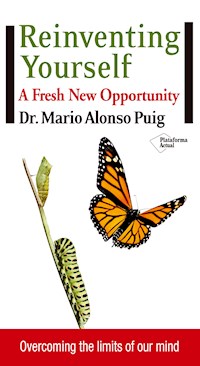
At the oracle in Delphos, at the entrance to Apollo's temple in ancient Greece, there was a stone which had some strange signs written on it. It was an invitation to begin one of the most fascinating adventures that a human being can undertake. In other words, the adventure of self-discovery. This book is a map which will accompany us on this trip inside ourselves. Little by little the secret of how people create the eyes through which we observe and perceive the world, will be revealed. It is with the same eyes that so often make us focus on our guiltabout the past rather than on future opportunities. Reinventing yourself does not mean becoming someone different from how we really are but rather bring our REAL SELF to the surface. It is in this new area of possibilities where creativity fl ows, along with the wisdom and energy to completely transform our experience, bringing with it more calm, desire and confi dence into our lives. The key lies within ourselves, in the exercising of our personal freedom, taking choices that slowly but surely lead us to transform our outlook. Marcel Proust said that, "the real act of discovery does not consist in going out to look for a new land but in learning to see the old land with new eyes." It is with our new eyes that we will be able to see what before we were blind to. It is also these new eyes which will lead us to discover how to reach what before had seemed unattainable.
Sie lesen das E-Book in den Legimi-Apps auf:
Seitenzahl: 166
Veröffentlichungsjahr: 2020
Das E-Book (TTS) können Sie hören im Abo „Legimi Premium” in Legimi-Apps auf:
Ähnliche
















Reinventing Yourself
A Fresh New Opportunity
Mario Alonso Puig
First edition published in Spanish in 2010 by Plataforma Editorial
© Mario Alonso Puig, 2010
© Plataforma Editorial, 2010
Plataforma Editorial
c/ Muntaner, 269, entlo. 1ª – 08021 Barcelona
Tel.: (+34) 93 494 79 99 – Fax: (+34) 93 419 23 14
www.plataformaeditorial.com
ISBN: 978-84-18285-91-2
Cover design: Utopikkawww.utopikka.com
Typesetting: Grafime. Mallorca 1 – 08014 Barcelonawww.grafime.com
All rights reserved. No part of this publication may be reproduced, stored in a retrieval system, or transmitted, in any form or by any means, electronic, mechanical, photocopying, recording, or otherwise, without the prior consent of the publisher.
For my wife, Isabella and my three sons, Mario, Joaquín and Borja for being lovely individuals that inspire me every day and help me to be a little better. You are my true masters and the biggest motivation which helps me to get over the fear of overcoming my own limitations.
For my mother, María Celia, somebody full of beauty, courage, Commitment and love of life. A never-ending inspiration and an example of a person who can overcome anything.
For my five brothers, José María, Manuel, Juan Ignacio, Fernando, and Alejandro. I will always feel an infinite gratitude for the great luck of having found you on my path.
To the memory of my father who will always remain in my heart as someone who tried to give me the roots to grow from and wings to fly.
To the memory of Joaquín, someone I shall never forget.
“In our naivety we have forgotten that beneath our world of reason another one lies buried.”
CARL GUSTAV JUNG
Contents
Introduction1. Reinventing yourself2. Looking inside3. Two minds in one head4. The treasure map5. Drawing the most valuable of pictures6. The most beautiful legacy7. Jumping off the cliff8. The doors of perception9. Questions that heal and questions that cause sickness10. Words create realities11. Hope for victory and you’ll be victorious12. The fuel of life13. The cellular brain14. Learn to forgive yourself15. The necessary lessons16. From darkness to light17. Returning home18. The dark night of the soul19. A new lifeAcknowledgementsIntroduction
We all have to face obstacles and problems in life which very often bring us to a standstill. It is as if we are invaded with a profound conviction that the problem cannot be sorted out or, simply, that we do not have the talent or the necessary ability to find a solution.
Many people do not know what to do when their relationship with another person is not as they would like it to be. Others would like to be more daring, more decisive, to learn a new sport, a foreign language or, simply, to understand better how a computer works. Nevertheless, something gets in the way and they finally decide to give up. There are human beings that wish to feel appreciated a little bit more, to strengthen their self-esteem, so that others respect them. In the end, after a series of failed attempts they end up giving in.
Nowadays, there are also people who have experienced one failure after another and they feel unable to keep going. They are individuals who have done everything in their hands to keep their companies up and running, their work, their families and their lives. They feel that so much effort has not been worth it, that at heart it has been a complete waste of time. I have written this book for all these people because their suffering is not foreign to me.
I have spent many years of my life trying to understand the complexity to be found in every one of us and the curious reactions that we have when we need to face adverse circumstances. My research started out with a simple question: what is it that, when faced with certain challenges, clouds our mind and makes us unable to think clearly, while at the same time all our energy is drained and we experience funy feelings in our stomach?
“Anxiety is a curious state of uneasiness because we start to suffer in the present for something that we do not even know for sure is going to happen in the future.”
Faced with the profound changes that are occuring and the huge doubts which we live with, the levels of anxiety never cease to increase throughout the world. The formula for generating an anxious state is really simple. It is sufficient to imagine that in the future a series of problems will appear and that we are going to be unable to solve them. Anxiety is a curious state of uneasiness because we start to suffer in the present for something that we do not even know for sure is going to happen in the future. René Descartes, the great XVII century French mathematician and philosopher, wrote a letter at the end of his life in which this original comment was to be found, “My life has been full of misfortunes, many of which never took place”.
“If we wish to increase our capacity to solve problems […], we need to learn how to transcend the limits that our own mind sets us.”
We need to see what is hidden in the depths of our mind, because only then will we understand with much greater clarity where exactly our real limitations lie. We will not find the answer to this state of mind by thinking things over and over again in our bewildered minds, but rather by looking in a very different place. As Albert Einstein put it, “no problem can be solved from the same level of consciousness that created it.”
If the mind has such an ability to let worry take root, how are we going to be able to solve this situation by using the same method that created the problem in the first place? If we wish to increase our capacity to solve problems and we hope to become more competent when looking for opportunities, we need to learn how to transcend the limits that our minds set us.
In this book we are going to spend time looking at many of the least known, but most important aspects, of how the human brain works. I have a great desire and complete confidence that when we understand why we act as we do, we will be able to start planning new strategies which will allow us to obtain what, until now, seemed out of our reach.
Training schemes in general attach great value to erudition and, in fact, it is this they evaluate. However, they neither grade nor measure in any way the ability to listen, empathy, self-knowledge, wisdom, leadership, courage, compassion or other virtues which later often make for success in life.
This book is an inward journey because some of the resources thatwe most need in order to face the challenges which life presents to us, could only be found within ourselves.
Personal change is not about knowledge or erudition but about motivation, as it is only people who feel truly motivated who will make the necessary effort to bring into flower what had remained hidden and unexplored within themselves.
I invite the reader to walk with me on this road of self-discovery, in which, we progressively will learn that what is within us, is a magical and surprising realm. When we delve a little bit further into our real selves we will realize that much of the anxiety and suffering we feel in life is optional and that our basic nature is a source of Energy, Wisdom, Serenity, Joy, Creativity and Love.
MARIO ALONSO PUIG
January, 2010
1.Reinventing yourself
“It isn’t the strongest species which survives, neither the most intelligent, but rather that which adapts best to change.”
CHARLES DARWIN
One of the hardest things to do is to be open-minded when you are exploring some ideas which challenge our usual way of thinking. We all know that what our brain is capable of perceiving is only a small part of what reality entails. However, the moment we wish to act, we tend to do it as if what we saw was the only thing that exists. How often, for example, the well-trained eye isn’t what makes out colours and shapes instantly but what discovers what people feel but don’t say. There are areas of reality which, if we were to reach them, would reveal many things which would make us live longer and with a better quality of life. It is logical that we ask ourselves why this strange situation has arisen which makes us so blind to those life opportunities, which without our awareness, are being offered to us.
Only understanding a little more about the interaction between the mind and the brain can we find an explanation as to why the brain doesn’t work at the level of efficiency that we would expect of it. We often hear that we only use 10% of our brain. This statement has no scientific base, and even if it had, we all know, in some intuitive way that we have resources, strengths and talent within ourselves which are still to be discovered.
The brain is such a complex organ that, despite only taking up 2% of our body weight, consumes 25% of our blood flow. Processes such as analysis, learning or creative thinking require a great deal of energy which comes in the form of glucose and oxygen through the blood. The most important mission that the brain has is to help us to survive.
“The brain is such a complex organ that, despite only weighing 2% of our body weight, it takes up 25% of our blood.”
More than two million years ago, Homo habilis survived whilst his cousins, the parantropos did not. The reason is simply that the first of the two developed a bigger and more efficient brain.
The task of surviving has a lot to do with the problem-solving capacity, decision making, facing challenges and learning from one’s mistakes. Our ability to observe and analyse, combined with intelligence, memory, imagination and creativity, make up the foundations we need in order to face life’s challenges efficiently. That said, all of these abilities and faculties are pretty much useless if we get overcome with anxiety and worry when we come face to face with our challenges.
Whether we like it or not, someone who is overcome with emotions is intellectually dead-end.
The emotions we feel and which have such importance when we come to try to solve problems, do not come out of a void but rather have a clear and specific root. Knowing the origins of these emotions is very important if we wish to manage them effectively. This is particularly true when we find ourselves in tricky situations where we are put under a lot of pressure and in those in which our decisions can have important consequences.
When feelings like fear or desperation take hold of us we experience a kind of “brain kidnapping”, and however intelligent we may be, our intelligence will not be found anywhere. What makes most of our problems unsolvable is not the difficulty of the problem but rather the feeling we get that we are not up to the challenge, the moment we face them. For this reason, the true capacity to solve problems in a creative way lies in keeping the sufficient mental balance when these problems arise, so that we react in the best possible way and find an efficient solution.
From metallurgy we have adopted the word resilience which basically refers to the resistence that a metal has to being deformed. We have also adopted the word elasticity from the same science, which is the capacity of the metal to return to its original form when the force that has deformed it has disappeared. Steel, for example, has a great resistence as it is very difficult to deform it and it also has a great elasticity to return to its original shape once the force that has acted on it has gone.
There are people who have an extraordinary capacity to put up with adversity and who rarely lose their patience. It tends to be these same people who overcome in a faster way a painful episode in their lives.
We have coined the word homeostasis from medicine which refers to the group of mechanisms which stabilize internal physiological conditions. We are keen to learn how to develop this resilience and this elasticity within ourselves. We are interested to find out how to develop these mechanisms to hold on to our homeostasis, our balanced state, when we find ourselves in difficult and even adverse, circumstances. To achieve such competence, it is necessary to look into the complex springs of the human mind with the aim of discovering how to manage them in the best possible way.
Even though I do not like the analogy between the human brain and the computer it could be very useful in order to understand certain slippery notions. Our brain is quite like a very sophisticated computer able to carry out the most challenging calculations and to find the most innovative solutions. Nevertheless, just as a computer works with a software programme, our brain also functions with a kind of software located within it. A wonderful computer using poor software generates poor results. An exceptional brain functioning with a limiting mental software will only produce limited operations.
“Mental software is basically built up of experiences.”
Our mental software is basically built up of experiences. These experiences become the reference points which decide the way the brain has to work in the future. Let’s imagine, for example, that someone has had a series of very negative experiences with a person of the opposite sex as a boss. The consequence of this would be that if that person has a boss of the opposite gender in their next job, he would most likely begin to feel some very unpleasant feelings. Among these we could, perhaps, find frustration, resentment, or even anger. The performance of this individual could be poor, being absent-minded and making many mistakes in their work. This would be a clear case of a perfectly capable brain being made unable to cope due to an experiencial software that is continually imposing limits on him.
Something similar could happen to a child who has experienced a lot of suffering when learning something new. Pushed into a new learning experience, the child will be unable to hold his attention, to understand and to memorise things.
Part of the experiences we have built up throughout our lives are essential for survival and, therefore, are where they should be. Nevertheless, other experiences are, as we have seen, deeply limiting, and they impede an adaptation to unstable and changing circumstances. It is precisely these kinds of experiences which we most need to know about and understand because, when we change them, our brain also changes and becomes more capable.
The software cannot damage the hardware (the physical structure of the computer) except if it has caught some kind of computer virus. However, the mental software, when it is dysfunctional, can harm the physical hardware in the brain. For this reason, if we change a dysfunctional mental programme for one that works well, this does indeed produce a clear improvement in the physical structure of the human brain.
It is generally accepted that the adult brain is malleable. We now know that, changing the way we think, changes the neural networks. We also know that people trapped in a negative frame of mind favour the death of neurons, and those of us that have decided to think positively, give birth to new neurons from stem cells in the brain.
“Mental software, when it is dysfunctional, can do harm to the physical body, the hardware in the brain.”
Human beings, when we change our most limiting mental programmes for others which are less so, physically modify the structure of our brains. Perhaps it is for this reason that Dr. Santiago Ramón y Cajal, our first Nobel Prize winner of Medicine, who won it in 1906, declared that, every human being can be, if he so wishes, the sculptor of his own brain. It is important to realise that Cajal was not speaking metaphorically but literally. This should make those of us who aspire to grow and develop our intelligence and our capacity for learning very joyful. But it also puts into our hands a great responsibility, that of discovering what it is we need to do, and to train ourselves to reinvent ourselves.
Final Summary
If you wish to reinvent yourself, focus on what you wish for and not on what you fear.
2.Looking inside
“Who is able to make dirty water clean? Leave it be and little by little it will become clear.”
LAO TZU
Our experiences, when they have been intense from an emotional point of view, above all if they have taken place during our childhood, can give rise to what is known as “unconscious beliefs”. This type of beliefs are in fact convictions that we have. We are dealing with what we feel is a certainty and that, therefore, cannot be debated. They are not like ideas, but rather are true feelings. It is very different to think, for example, that I am not capable of doing something, than to feel myself unable and to know I am unable. When we speak of these beliefs we are speaking of something deeply rooted in our minds. I would like to highlight the fact that the majority of the convictions which limit us, do so without us even being aware of it. That is, they act in our subconscious mind.
Possibly, many of us have heard of the intelligence coeficience test which, for years, was considered able to measure the intelligence of a person. It is curious that when a group of young people were helped to uncover some of those deeply limiting convictions they had about who they were and to transform them into more positive convictions, they managed to raise their intellectual coefficient by an extraordinary degree. This means, basically, that some of our convictions can limit our intellectual development in a very significant way.
“Most of the convictions that limit us, do so without us being aware of it. That is, they act in our subconscious mind.”
Very often we are convinced that we are made a certain way and we feel it is impossible to transform ourselves. However, I state again that what our brain is capable of recognising and to understand about ourselves is only a small part of the reality about who we are. Besides, it is convenient to know that our brain, in regard to perceptions, can completely mislead us.
When you observe a sunrise and follow the movement of the sun until it disappears from sight, the visual perception that one has is that the sun has moved, while you stayed still. It was very difficult for Galileo to open the minds of the people to an idea that was in complete opposition, not only to what they thought, but also to what they saw.
There are a series of ideas that we tend to ignore from the start because they contradict what our five senses show us. I’ll give you another example to make the point clearer. We all understand that matter is formed of atoms and that, as our body is composed of matter, it is also made up of atoms. When we look at our body, we perceive it as something solid and, nevertheless, this is a perception which does not tally with reality.




