


Religion in the Roman Empire E-Book
Erhalten Sie Zugang zu diesem und mehr als 300000 Büchern ab EUR 5,99 monatlich.
- Herausgeber: Kohlhammer Verlag
- Kategorie: Religion und Spiritualität
- Sprache: Englisch
The Roman Empire was home to a fascinating variety of different cults and religions. Its enormous extent, the absence of a precisely definable state religion and constant exchanges with the religions and cults of conquered peoples and of neighbouring cultures resulted in a multifaceted diversity of religious convictions and practices. This volume provides a compelling view of central aspects of cult and religion in the Roman Empire, among them the distinction between public and private cult, the complex interrelations between different religious traditions, their mutually entangled developments and expansions, and the diversity of regional differences, rituals, religious texts and artefacts.
Sie lesen das E-Book in den Legimi-Apps auf:
Seitenzahl: 778
Veröffentlichungsjahr: 2021
Das E-Book (TTS) können Sie hören im Abo „Legimi Premium” in Legimi-Apps auf:
Ähnliche




















Die Religionen der Menschheit
Begründet vonChristel Matthias Schröder
Fortgeführt und herausgegeben vonPeter Antes, Manfred Hutter, Jörg Rüpke und Bettina Schmidt
Band Band 16,2
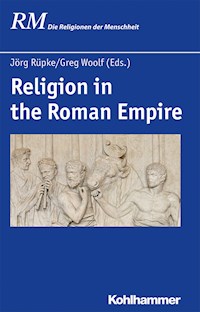
Preparation of an animal sacrifice; marble, fragment of an architectural relief, first quarter of the 2nd century CE. Department of Greek, Etruscan and Roman Antiquities, Rome, Italy.
Jörg Rüpke, Greg Woolf (Eds.)
Religion in the Roman Empire
Verlag W. Kohlhammer
Alle Rechte vorbehalten
© W. Kohlhammer GmbH, Stuttgart
Gesamtherstellung: W. Kohlhammer GmbH, Stuttgart
Print:
ISBN 978-3-17-029224-6
E-Book-Formate:
pdf: ISBN 978-3-17-029225-3
epub: ISBN 978-3-17-029226-0
All rights reserved. This book or parts thereof may not be reproduced in any form, stored in any retrieval system, or transmitted in any form by any means—electronic, mechanical, photocopy, recording, microfilm/microfiche or otherwise—without prior written permission of W. Kohlhammer GmbH, Stuttgart, Germany.
Any links in this book do not constitute an endorsement or an approval of any of the services or opinions of the corporation or organization or individual. W. Kohlhammer GmbH bears no responsibility for the accuracy, legality or content of the external site or for that of subsequent links.
The Roman Empire was home to a fascinating variety of different cults and religions. Its enormous extent, the absence of a precisely definable state religion and constant exchanges with the religions and cults of conquered peoples and of neighbouring cultures resulted in a multifaceted diversity of religious convictions and practices.
This volume provides a compelling view of central aspects of cult and religion in the Roman Empire, among them the distinction between public and private cult, the complex interrelations between different religious traditions, their mutually entangled developments and expansions, and the diversity of regional differences, rituals, religious texts and artefacts.
Prof. Dr. Jörg Rüpke teaches Religious Studies at Erfurt.
Prof. Greg Woolf teaches Ancient History at the University of California, Los Angeles.
Contents
Introduction: Living Roman Religion
Jörg Rüpke and Greg Woolf
1 Approaching Roman Religion
2 The Idea of Religion
3 Lived Ancient Religion
4 The Story of Rome
5 Themes and Methods
Bibliography
Empire as a field of religious action
Greg Woolf and Miguel John Versluys
1 A Religion of the Empire?
2 Emperors in the Religious life of the Roman World
3 Empire as an interaction sphere
4 The Empire in the World
5 Empire and Religions
Bibliography
The City as a Field of Religious Action: Manufacturing the Divine in Pompeii
William Van Andringa
1 A city full of gods
2 The Gods in Action
3 Working with the Gods
4 Conclusion
Bibliography
Sanctuaries – places of communication, knowledge and memory in Roman religion
Rubina Raja and Anna-Katharina Rieger
1 Sanctuaries – places for people and gods
2 The role of sanctuaries in an empire full of differences
2.1 New temples and gods under new rulers
2.2 Villages, towns and regions: spatial-religious references and regional traditions in sanctuaries
2.3 Sanctuaries as places of permanence, political appropriation and religious change
3 Costs, events and experiences: Visitors, users and religious specialists in a sanctuary
3.1 Space for experience—personal needs and religious experience
3.2 Oracles, healing and life counselling
3.3 Great feasts and great gifts
4 Collection of knowledge and objects – sanctuaries in the dynamic between memory and oblivion
Bibliography
People and Competencies
Georgia Petridou and Jörg Rüpke
1 Introduction
2 Public priests
3 Divination, diviners and the diagnostic value of signs
4 Oracular officials in the Eastern Roman Provinces
5 Anchoring religious innovation
6 Small-group religious entrepreneurs
7 Developing a priestly role in Christ-centred imaginations
8 The philosophers as religious experts and henotheistic tendencies before Christianity
9 Setting borders to religious experts
Bibliography
The Gods and Other Divine Beings
Heidi Wendt
1 Introduction
2 The Gods and Roman ›Religion‹
3 Whose Roman Religion?
4 Interacting with Divine Beings in the Roman World
5 Intellectualizing Religious Experts
Bibliography
Managing problems: Choices and solutions
Richard Gordon
1 Introduction
2 Mainstream options
2.1 Healing waters, therapeutic dreams
2.2 Divinatory shrines
2.2.1 Oracles, mainly in Italy
2.2.2 The eastern Mediterranean
2.3 Settling the dead
2.3.1 Monumentum and sepulcrum
2.3.2 Ritual meals
3 Minor ritual specialists
4 Self-help
5 Conclusion
Bibliography
Artefacts and their humans: Materialising the history of religion in the Roman world
Miguel John Versluys and Greg Woolf
1 Introduction: From (Late) Prehistoric to Roman
2 Artefacts and religious change in the Roman world
3 Objects, affordances, and religion
4 Objectscape and semiotic form
5 How new objects and materials change religious practices:
6 Religion in the Empire of things
7 Beyond wood
8 With terracotta (and double moulds)
9 Through marble and
10 Led by lead
11 Conclusion
Bibliography
The Impact of Textual Production on the Organisation and Proliferation of Religious Knowledge in the Roman Empire
Georgia Petridou and Jörg Rüpke
1 Introduction
2 Calendars: Appropriating Time and Systematizing Religious Action
3 Controlling ›Religion‹: Legalization and Ratification of Religious Knowledge
4 Re-framing ›Religion‹: Exegesis, Appropriation and Translation as Means of Reiterating Old and Propagating New Religious Ideas
5 Texts and Rituals in the Second Century CE: A Century of Intense Religious Experimentation
6 ›Religion‹ as Philosophy in the Second Sophistic
7 Martyrologies: Textualizing Death and Embodying
Bibliography
Economy and Religion
Richard Gordon, Rubina Raja and Anna-Katharina Rieger
1 Introduction
1.1 The wider context: the demography and macro-economy of the Roman Empire
1.2 Implications for expenditure on religious activity
2 Income, outgoings and the nature of the evidence
3 Public versus private: an unhelpful opposition?
4 Funding civic and imperial religion
4.1 Standing revenues of sanctuaries and their protection
4.2 Revenues from sacrifice
4.3 Regular income from non-agricultural sources
4.4 Variable income: patronage
4.5 Income versus wealth
5 The finances of associations and small religious groups
6 Pilgrimage as an economic factor
6.1 Competition stimulates business
6.2 Infrastructure and services in and around pilgrimage sites
7 Conclusion
Bibliography
Abbreviations
Figures
Index
Places
Names
Keywords
Fig. 1: The Roman Empire 117 A.D.
Empire as a field of religious action
Greg Woolf and Miguel John Versluys
1 A Religion of the Empire?
Official papyri from Egypt are often dated quite precisely, which is how we know that forty-six certificates (libelli), each testifying that its recipient had performed a sacrifice to the gods in the proper way, were all produced in the summer of AD 250.1 Women and men, all over Roman Egypt, were conforming to an edict issued by the Roman emperor Decius, a universal edict in fact that commanded all Roman citizens to sacrifice on behalf of the empire. That edict has been interpreted by modern scholars both as a deliberate exercise to root out atheists—as Christians were often described—and as a desperate attempt to win divine support in the depths of the military crisis of the third century. Either way it seems to express the sense of the Roman Empire as a single worshipping community, united by particular ritual practices and directed unambiguously by a single authority. Nothing could be further from the truth.2
Deciusʼ edict was only possible because one generation before most inhabitants of the empire had been enfranchised through an earlier universal edict, the Constitutio Antoniniana issued by Caracalla in AD 212. Caracalla’s motives have been much discussed and the decision certainly had many unintended consequences, including major consequences for the use of the ius civile documented in the works of the jurist Ulpian.3 Before that point perhaps only a third of the empire’s inhabitants were Roman citizens.4 The remainder were either foreigners (peregrini) or had one or other of a range of statuses that can be thought of as part citizenships, among them Latins, Junian Latins, Alexandrines and the former slaves of Roman citizens.
Almost all inhabitants of the empire had at least one additional citizenship of a much more local and immediate kind, membership of one or more of the many communities of which the empire was made up, such as the Treveri, formerly a powerful Iron Age tribe living around the Mosel Valley in western Germany; or the Athenians once an imperial people themselves; the Corinthians, descendants of Roman colonists settled on the site of a Greek city sacked a century before by a Roman army, and so on. There were between two and three thousand such communities in the empire. Local citizenships were often proudly proclaimed on tombstones even by those whose families were also Romans. Local identity never lost its importance in antiquity.5 Indeed the local and the universal went hand in hand, and were rarely mutually exclusive or even opposed categories, as modern scholars sometimes seem to think when writing about ›Roman identity‹.6
The collective rituals in which individuals participated were almost always conducted at the local scale, whether it was the worship of gods with strange indigenous names sometimes through ancient ritual forms; prayers and vows to Mars, Saturn, Apollo or Jupiter; the worship of Roman emperors, living and dead; and eventually rituals performed at the tombs of Christian martyrs. When dedicators in Greek speaking areas of the east set up inscriptions to patrioi theoi (the ancestral gods) they did not mean the gods of the Romans, but the gods of their own cities. There were even more localised forms of collective cult, in villages, in city quarters, and in households.
Many of the same people also took part in worshipping communities that were not defined by existing ties of kin, locality or citizenship.7 Little clusters of male worshippers came together in many of the western provinces to take part in the mysteries of the Persian god Mithras.8 And as individuals some men and women made their way to healing shrines like those of Asclepius at Epidauros and Pergamum; visited places like Bath and Mainz where they could enrol the gods in cursing their enemies; consulted oracles in Delphi, Dodona, Praeneste, Grand, Abonouteichos, the Siwa Oasis and countless other places; promised offerings if they returned safely from dangerous journeys as they did at shrines to Nehalennia at the Rhine mouth; traveled huge distances to undergo initiations like those performed at Eleusis; climbed to mountaintop sanctuaries like Mount Casius in Syria or the Puy de Dôme in the Auvergne, travelled to temples at sources of rivers like the Clitumnus or visited sacred lakes like lake Avernus; and everywhere they prayed for fertility and good health.9 Most of these religious traditions were not new, and some of these sanctuaries claimed to be very ancient indeed. Our question in this chapter is what difference did Empire make to the religious practices and experiences of individuals on all these different levels of participation?
Our answer is that Empire did operate as a distinct field of religious action, but not in a straightforward sense. Imperial authority constrained where it could not direct, and accidently facilitated developments no emperor could have dreamt of. Few of these transformations were planned and the consequences of empire building were mostly unintended.10 The limits of empire, vague as they sometimes seem, created a vessel within which religious change followed a distinctive course. That vessel was, however, a leaky one. The last part of this chapter will consider the space of empire as just one part of a much more extensive set of cultural spaces through which objects and images and ideas as well as people circulated quite freely, with consequences of their own for religious developments.
2 Emperors in the Religious life of the Roman World
Let us start, however, with what was clearly the most recognizable universal aspect of this religious field: the emperor. Deciusʼ edict was the first of a series of attempts by emperors to extend their fiat over ritual practice. During the decades that followed there would be imperially instigated persecutions of Christians and Manicheans, imperial constitutions prohibiting Jews from converting Christians, bans on public funding for sacrifices to the gods, and attempts to impose particular varieties of Christian dogma and discipline. In parallel to this process the emperors began to claim a special relationship to the divine and a divine mandate. This had been a strand in imperial ideology from the very start but became more explicit during the military crisis of the third century AD. Deciusʼ predecessor Philip celebrated Rome’s Thousand Year Birthday, and the rhetoric of the tetrarchs allocated the ruling emperors to Jovian and Herculean dynasties. Constantine’s decision to proclaim himself a follower of Christ was just the latest version of this. An unintended consequence was that from the early fourth century Christian bishops began to press emperors to assist them against those they regarded as pagans, schismatics or heretics. Some resisted but by the end of the fourth century a new explicitly Christian Roman Empire had emerged.
The increased involvement of imperial authorities in religious affairs was not unique to Rome. Around the same time Christians in the Persian Empire found their loyalty suspect, and Sasanian Emperors began to persecute Manichaeans and to develop a closer connection to the Zoroastrian priesthood.11 These changes in the religious conduct of emperors respond to the emergence of the precursors of modern religions, in the sense of organized and disciplined entities that demanded exclusive adherence and made claims to uniquely authoritative accounts of the cosmos.12 This includes the spread of monotheisms, the precursors of modern religions such as Zoroastrianism, Judaism, Christianity and Islam, and the appearance of priesthoods that asserted an authority independent of that of early propertied classes, political elites and monarchs.
Earlier emperors had tried to centre themselves in religious practice in different ways. From Julius Caesar on emperors had claimed the senior priesthood in Rome, as pontifex maximus, been members of the more important priestly colleges, had their names inserted into public vows, performed sacrifices and dedicated temples and had had themselves portrayed in the likeness of gods.13 Formally all this was in relation to the local cults of the city of Rome and the community of the Romans: neither the emperor nor the Roman priestly colleges had jurisdiction in the territory of subject populations. In practice echoes of these titles and powers can be found in the cults of Roman colonies and municipia in the west, while in other regions emperors were assimilated to local traditions of divine monarchy, such as the Pharaohs of Egypt.
There was never an official pantheon for the empire as a whole: hundreds of gods received cult even if some were much more widely worshipped than others. The municipal




