


25,99 €
Mehr erfahren.
- Herausgeber: John Wiley & Sons
- Kategorie: Wissenschaft und neue Technologien
- Serie: RGS-IBG Book Series
- Sprache: Englisch
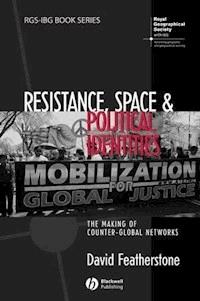
Utilizing research on networked struggles in both the 18th-century Atlantic world and our modern day, Resistance, Space and Political Identities: The Making of Counter-Global Networks challenges existing understandings of the relations between space, politics, and resistance to develop an innovative account of networked forms of resistance and political activity. * Explores counter-global struggles in both the past and present--including both the 18th-century Atlantic world and contemporary forms of resistance * Examines the productive geographies of contestation * Foregrounds the solidarities and geographies of connection between different place-based struggles and argues that such solidarities are essential to produce more plural forms of globalization
Sie lesen das E-Book in den Legimi-Apps auf:
Seitenzahl: 467
Veröffentlichungsjahr: 2011
Ähnliche



















Resistance, Space and Political Identities
David Featherstone
Contents
series
Copyright
Dedication
Preface
Acknowledgements
Introduction
Theorizing Networked Resistances
Spatial Politics of Past and Present
Part One: Networking the Political
Chapter One Place and the Relational Construction of Political Identities
Spaces of Subaltern Politics and the Making of Counter-Global Networks
The Black Jacobins, Subaltern Agency and Geographies of Connection
Place, Agency, Identity
Conclusions: Towards the Relational Construction of Militant Particularisms
Chapter Two Geographies of Solidarities and Antagonisms
Networking Solidarities
Space, the Political and the Construction of Antagonisms
Geographies of Resistance and Maps of Grievance
Conclusions
Part Two: Geographies of Connection and Contestation
Chapter Three Labourers’ Politics and Mercantile Networks
Atlantic Networks and Subaltern Political Identities
Spatial Relations, Antagonisms, Inventiveness
Subaltern Identities and the Constitution of Mercantile Networks
Connections, Solidarities, Materialities
Conclusions
Chapter Four Making Democratic Spatial Practices
Spatial Relations, Collective Experimentation and Democracy
Space, Democracy and Political Identities
The Contested Geographies of Transnational Democratic Networks
Conclusions
Chapter Five Counter-Global Networks and the Making of Subaltern Nationalisms
‘To banish all tyrants’:58 The Dynamic Trajectories of Mutiny
Shipboard Spaces and Irish Nationalisms
Oaths: Key Repertoire of Irish Subaltern Political Activity
Subaltern Nationalisms and Geographies of Connection
Conclusions
Part Three: Political Geographies of the Counter-Globalization Movement
Chapter Six Geographies of Power and the Counter-Globalization Movement
Counter-Global Networks and the Spatial Politics of the ‘Multitude’
Contesting Neo-Liberal Geographies
Contested Networks
Populist Logics and the Construction of Maps of Grievance
Conclusions
Chapter Seven Constructing Transnational Political Networks
The Inter-Continental Caravan
The Productive Spatialities of Counter-Global Networks
Process Geographies of the Inter-Continental Caravan93
The Maps of Grievance of the Inter-Continental Caravan
Productive and Contested Outcomes of Transnational Organizing
Conclusions
Chapter 18
Geographies of Connection and the Making of Usable Pasts
Space, Neo-Liberalism and Contestation
‘Common Sense’ Beyond Neo-Liberalism
Chapter 19
Chapter 20
Chapter 21
RGS-IBG Book Series
Published
Resistance, Space and Political Identities: The Making of Counter-Global Networks
David Featherstone
Mental Health and Social Space: Towards Inclusionary Geographies?
Hester Parr
Climate and Society in Colonial Mexico: A Study in Vulnerability
Georgina H. Endfield
Geochemical Sediments and Landscapes
Edited by David J. Nash and Sue J. McLaren
Driving Spaces: A Cultural-Historical Geography of England’s M1 Motorway
Peter Merriman
Badlands of the Republic: Space, Politics and Urban Policy
Mustafa Dikeç
Geomorphology of Upland Peat: Erosion, Form and Landscape Change
Martin Evans and Jeff Warburton
Spaces of Colonialism: Delhi’s Urban Governmentalities
Stephen Legg
People/States/Territories
Rhys Jones
Publics and the City
Kurt Iveson
After the Three Italies: Wealth, Inequality and Industrial Change
Mick Dunford and Lidia Greco
Putting Workfare in Place
Peter Sunley, Ron Martin and Corinne Nativel
Domicile and Diaspora
Alison Blunt
Geographies and Moralities
Edited by Roger Lee and David M. Smith
Military Geographies
Rachel Woodward
A New Deal for Transport?
Edited by Iain Docherty and Jon Shaw
Geographies of British Modernity
Edited by David Gilbert, David Matless and Brian Short
Lost Geographies of Power
John Allen
Globalizing South China
Carolyn L. Cartier
Geomorphological Processes and Landscape Change: Britain in the Last 1000 Years
Edited by David L. Higgitt and E. Mark Lee
Forthcoming
Aerial Geographies: Mobilities, Subjects, Spaces
Peter Adey
Politicizing Consumption: Making the Global Self in an Unequal World
Clive Barnett, Nick Clarke, Paul Cloke and Alice Malpass
Living Through Decline: Surviving in the Places of the Post-Industrial Economy
Huw Beynon and Ray Hudson
Swept-Up Lives? Re-envisaging ‘the Homeless City’
Paul Cloke, Sarah Johnsen and Jon May
Complex Locations: Women’s Geographical Work and the Canon 1850–1970
Avril Maddrell
In the Nature of Landscape: Cultural Geography on the Norfolk Broads
David Matless
Value Chain Struggles: Institutions and Governance in the Plantation Districts of South India
Jeffrey Neilson and Bill Pritchard
Arsenic Pollution: A Global Synthesis
Peter Ravenscroft, Hugh Brammer and Keith Richards
Domesticating Neo-Liberalism: Social Exclusion and Spaces of Economic Practice in Post Socialism
Adrian Smith, Alison Stenning, Alena Rochovská and Dariusz Świątek
Queer Visibilities: Space, Identity and Interaction in Cape Town
Andy Tucker
This edition first published 2008
© 2008 David Featherstone
Blackwell Publishing was acquired by John Wiley & Sons in February 2007. Blackwell’s publishing program has been merged with Wiley’s global Scientific, Technical, and Medical business to form Wiley-Blackwell.
Registered Office
John Wiley & Sons Ltd, The Atrium, Southern Gate, Chichester, West Sussex, PO19 8SQ, United Kingdom
Editorial Offices
350 Main Street, Malden, MA 02148–5020, USA
9600 Garsington Road, Oxford, OX4 2DQ, UK
The Atrium, Southern Gate, Chichester, West Sussex, PO19 8SQ, UK
For details of our global editorial offices, for customer services, and for information about how to apply for permission to reuse the copyright material in this book please see our website at www.wiley.com/wiley-blackwell.
The right of David Featherstone to be identified as the author of this work has been asserted in accordance with the Copyright, Designs and Patents Act 1988.
All rights reserved. No part of this publication may be reproduced, stored in a retrieval system, or transmitted, in any form or by any means, electronic, mechanical, photocopying, recording or otherwise, except as permitted by the UK Copyright, Designs and Patents Act 1988, without the prior permission of the publisher.
Wiley also publishes its books in a variety of electronic formats. Some content that appears in print may not be available in electronic books.
Designations used by companies to distinguish their products are often claimed as trademarks. All brand names and product names used in this book are trade names, service marks, trademarks or registered trademarks of their respective owners. The publisher is not associated with any product or vendor mentioned in this book. This publication is designed to provide accurate and authoritative information in regard to the subject matter covered. It is sold on the understanding that the publisher is not engaged in rendering professional services. If professional advice or other expert assistance is required, the services of a competent professional should be sought.
Library of Congress Cataloging-in-Publication Data
Featherstone, David, 1974–
Resistance, space and political identities: the making of counter-global networks/David Featherstone.
p. cm.—(RGS-IBG book series)
Includes bibliographical references and index.
ISBN 978-1-4051-5808-4 (hardcover: alk. paper)—ISBN 978-1-4051-5809-1 (pbk.: alk. paper) 1. Anti-globalization movement. 2. Globalization—Political aspects. 3. International relations. 4. Power (Social sciences). 5. Geopolitics. I. Title.
JZ1318.F43 2008
303.48′2—dc22
2008006981
To my parents
Series Editors’ Preface
The RGS-IBG Book Series only publishes work of the highest international standing. Its emphasis is on distinctive new developments in human and physical geography, although it is also open to contributions from cognate disciplines whose interests overlap with those of geographers. The Series places strong emphasis on theoretically informed and empirically strong texts. Reflecting the vibrant and diverse theoretical and empirical agendas that characterize the contemporary discipline, contributions are expected to inform, challenge and stimulate the reader. Overall, the RGS-IBG Book Series seeks to promote scholarly publications that leave an intellectual mark and change the way readers think about particular issues, methods or theories.
For details on how to submit a proposal please visit: www.rgsbookseries.com
Kevin Ward
University of Manchester, UK
Joanna Bullard
Loughborough University, UK
RGS-IBG Book Series Editors
Acknowledgements
Writing a book, as Billy Bragg has remarked, is not like writing a song. Along the way I have incurred many debts and received much help, support and encouragement. Parts of this book started out life in my Ph.D. thesis that was supervised by Doreen Massey and Steve Hinchliffe. The work here owes a vast amount to their intellectual engagement and support over many years.
The Department of Geography at the University of Liverpool has been an engaging environment in which to be based during the writing of this book. In particular my fellow travellers in the Globalization, Development and Place research group have been the source of much comradeship, insight and humour. Pete North’s relentless enthusiasm for all things spatial has been a constant source of inspiration. Richard Phillips has been strongly supportive of this project since its inception, has commented on drafts of various chapters and has supplied many helpful mugs of proper tea. I have benefited from discussion with Benedikt Korf in the ‘space of exception’ that is the Albert in Lark Lane. I would also like to thank Bethan Evans, Richard Powell, David Sadler and Jo Waters. Andy Davies’s insights into networked forms of political activity have been very useful.
The students who have taken my third year course ‘Space, Place and the Making of Political Identities’ have been subjected to these arguments at length. Their engagement, discussion and criticisms have helped me to clarify the arguments presented here. Not all, I hope, have found the course ‘frankly bloody irritating’.
I am glad that despite the increasingly neo-liberal environment in universities it is still possible to do some activities that are not subject to funding! Nonetheless I would like to acknowledge the ESRC grant that supported my Ph.D. The work on the London Corresponding Society was supported by a Liverpool University Research Development Fund grant and thanks go also to the research assistance of Andy Jobling that it helped support. The British Academy funded my attendance at the ‘Middle Passages’ conference at the Western Australia Maritime Museum, which was very useful for chapter 5.
Thanks to the networks and many helpful individuals of the InterContinental Caravan for allowing me to participate in discussions and events. Thanks are also due to the many helpful archivists who have assisted with this research. The ideas in this book have benefited from discussion in many seminars and conferences. I would like to thank the many helpful engagements and criticisms that have helped me to develop these arguments.
Many people have encouraged the work here. I would like in particular to thank John Allen, Alan Lester, Miles Ogborn, Marcus Rediker and Jane Wills. At Blackwell/RGS-IBG book series Nick Henry was very encouraging in the early days of developing the proposal. Jacqueline Scott’s editorial help and guidance has been indispensable and I would also like to thank Jack Messenger, Hannah Morrell and Kevin Ward. The generous and insightful comments of two anonymous readers were very helpful. Working with Noel Castree and Andy Herod was very useful in terms of sharpening my understandings of the debates over scales and networks, though they won’t necessarily agree with the position outlined here. Clive Barnett generously commented on chapter 4, though likewise will not necessarily agree with it. In Glasgow, Andy Cumbers and Paul Routledge have provided indispensable support, discussion and engagement.
Cian O’Driscoll, Kelly Kollman, Karen Wright, Ana Langer and Orian Brook have all contributed in different ways. The support and engagement of Harriet Fletcher, Jon Hallé and William Mortada goes way back and is much appreciated. Occasional forays to ‘the Nook’ with Tim Bunnell have helped the process even if my pool technique remains unimproved. Thank also to Bev Bishop and Polly North for their hospitality. Many thanks are due to my brother and sister for their support.
I would like to thank the generous support and engagement of all the Humes, especially John and Pat. Their hospitality, discussion, humour and warmth are much appreciated.
My parents Mike and Tess Featherstone have been a constant source of encouragement, support and love. I would also like to thank them for keeping some sense of progressive values alive in the border hills in the dark years of Thatcherism.
Two people have made writing this book a much more enjoyable experience than it otherwise would have been. My daughter Marni has been a great mate. Hanging out together has brought my life much joy. She has also been a useful source of scepticism about my arguments, reminding me, for example, that despite my concern with mutinous sailors, Nelson was the bravest man ever and that pirates were just sea robbers. Finally, my debt to my partner Mo Hume is immeasurable! She has supported the book in more ways than is reasonable. Her love, irreverent humour, support and intellectual companionship have made this a better book. She has also tolerated the frequent interjection of conversations with random remarks about the relationships between different chapters and arcane aspects of eighteenth-century radicalism. Her insights, discussion and engagement have sharpened the arguments in many ways. More importantly, she has made the process of writing it a much happier one.
David Featherstone
Glasgow and Liverpool, November, 2007
The editor and publisher gratefully acknowledge the permission granted to reproduce the copyright material in this book:
Extracts from the Newfoundland missionaries’ letters used in chapter 3. Reprinted by permission of the United Society for the Propagation of the Gospel. Extracts from the Shelburne papers. Reprinted by permission of William L. Clements Library, University of Michigan. Parts of chapters 2 and 7 were previously published in Featherstone, D. J. (2003), ‘Spatialities of transnational resistance to globalization: the maps of grievance of the Inter-Continental Caravan’, Transactions of the Institute of British Geographers vol. 28, issue 4, pp. 404–21. Reprinted by permission of Wiley-Blackwell. Parts of chapter 3 was previously published in Featherstone, D. J. (2005), ‘Skills for heterogeneous associations: the Whiteboys, collective experimentation and subaltern political ecologies’, first published in Environment and Planning D: Society and Space, 2007, 25, pp. 284–306; reprinted by permission of Pion Limited, London. Parts of chapters 1 and 4 were previously published in Featherstone, D. J. (2007), ‘The spatial politics of the past unbound: transnational networks and the making of political identities’, Global Networks vol. 7, issue 4, pp. 430–52. Reprinted by permission of Wiley-Blackwell. Thanks to the South Wales Miners’ Library at the University of Swansea for permission to reproduce the illustration of the banner of the Abercrave Lodge of the NUM (figure 1.1).
Every effort has been made to trace copyright holders and to obtain their permission for the use of copyright material. The publisher apologizes for any errors or omissions in the above list and would be grateful if notified of any corrections that should be incorporated in future reprints or editions of this book.
Introduction
Space, Contestation and the Political
In Glasgow in June 2007 a delegation of activists from trade unions and social movements in Colombia presented evidence of British Petroleum’s ‘corporate crimes’. They gave testimonies of BP’s poor environmental record in Colombia, particularly in Casanare. They also demonstrated what was at the very least complicity between BP and assassinations of leaders and activists of the Colombian Oilworkers Union USO. Since 1988 USO has suffered ‘105 assassinations of its members, 2 members “disappeared”, 6 kidnapped, 35 wounded in assassination attempts, 400 internal refugees, 4 members in exile, 300 members have experienced death threats, 30 have been detained, 900 are undergoing criminal proceedings and 55 have been subject to “mobbing”.’1 The Colombian speakers related this to the broader context of assassination and intimidation of trade unionists and to the impunity of multinationals in Colombia.
This event was part of a transnational set of mobilizations instigated by the People’s Permanent Tribunal (PPT), a non-governmental tribunal set up to investigate and challenge the role of multinationals in Colombia. The PPT uses ‘exemplary cases’ ‘to show how the Colombian state has facilitated and contributed to the exploitation of our natural resources by these companies, by committing crimes and permanently violating the rights of the individual citizens and their organizations’ (PPT, 2007). The Glasgow event was one of seven preliminary public hearings being held in relation to the oil industry. There were four hearings in Colombia in Saravena, Barrancabermeja, El Tarra–Northern Santander and Cartagena. The PPT also ‘invited supporting organizations in the home countries of the three biggest corporations Occidental (USA); Repsol YPF (Spain) and BP (UK) to hold preliminary public hearings in the run up to the full tribunal’ (Colombia Solidarity Campaign, 2007). The evidence presented at these preliminary hearings fed into a formal public hearing of these three oil corporations in Bogotá in August 2007.
These events produced a networked opposition constructed through connections between activists in different places and through bringing together different groups mobilising around oil politics and the political situation in Colombia. This book is about the forms of political identity and agency crafted through such ‘unruly alliances and flows’. The book explores the geographies of connection that have shaped forms of opposition to dominant forms of globalised practices. I argue that there are significant histories and geographies of networked forms of subaltern political activity that have frequently been omitted from both more totalising and nation-centred accounts of resistance. Further, the importance of these forms of political activity has been marginalized in debates on globalisation. This has had significant effects in both theoretical and political terms.
Lesen Sie weiter in der vollständigen Ausgabe!
Lesen Sie weiter in der vollständigen Ausgabe!
Lesen Sie weiter in der vollständigen Ausgabe!
Lesen Sie weiter in der vollständigen Ausgabe!
Lesen Sie weiter in der vollständigen Ausgabe!
Lesen Sie weiter in der vollständigen Ausgabe!
Lesen Sie weiter in der vollständigen Ausgabe!
Lesen Sie weiter in der vollständigen Ausgabe!
Lesen Sie weiter in der vollständigen Ausgabe!
Lesen Sie weiter in der vollständigen Ausgabe!
Lesen Sie weiter in der vollständigen Ausgabe!
Lesen Sie weiter in der vollständigen Ausgabe!
Lesen Sie weiter in der vollständigen Ausgabe!
Lesen Sie weiter in der vollständigen Ausgabe!




