


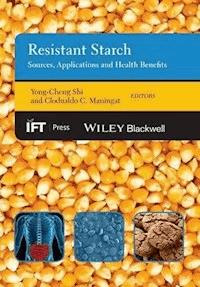
Resistant Starch E-Book
187,99 €
Mehr erfahren.
- Herausgeber: John Wiley & Sons
- Kategorie: Fachliteratur
- Serie: Institute of Food Technologists Series
- Sprache: Englisch
The discovery of resistant starch is considered one of the major developments in our understanding of the importance of carbohydrates for health in the past twenty years. Resistant starch, which is resistant to digestion and absorption in the human small intestine with complete or partial fermentation in the large intestine, is naturally present in foods.
Resistant Starch: Sources, Applications and Health Benefits covers the intrinsic and extrinsic sources of resistant starch in foods, and compares different methods of measuring resistant starch and their strengths and limitations. Applications in different food categories are fully covered, with descriptions of how resistant starch performs in bakery, dairy, snack, breakfast cereals, pasta, noodles, confectionery, meat, processed food and beverage products.
Sie lesen das E-Book in den Legimi-Apps auf:
Seitenzahl: 498
Veröffentlichungsjahr: 2013
Ähnliche




















Contents
Cover
IFT Press
Titles in the IFT Press series
Title Page
Copyright
Dedication
Preface
About the Editors
List of Contributors
Acknowledgements
Chapter 1: Starch Biosynthesis in Relation to Resistant Starch
1.1 Introduction
1.2 Factors Affecting Starch Digestibility
1.3 Starch Biosynthesis
1.4 Starch Biosynthesis in Relation to RS
1.5 Concluding Remarks
Acknowledgements
References
Chapter 2: Type 2 Resistant Starch in High-Amylose Maize Starch and its Development
2.1 Introduction
2.2 RS Formation in High-Amylose Maize Starch
2.3 RS Formation During Kernel Development
2.4 Elongated Starch Granules of High-Amylose Maize Starch
2.5 Roles of High-Amylose Modifier (HAM) Gene in Maize ae-Mutant
2.6 Conclusions
References
Chapter 3: RS4-Type Resistant Starch: Chemistry, Functionality and Health Benefits
3.1 Introduction
3.2 Historical account of starch indigestibility
3.3 Starch modification yielding increased resistance to enzyme digestibility
3.4 Physicochemical properties affecting functionality
3.5 Physiological responses and health benefits
3.6 Performance in food and beverage products
3.7 Conclusions and future perspectives
References
Chapter 4: Novel Applications of Amylose-Lipid Complex as Resistant Starch Type 5
4.1 Introduction
4.2 Enzyme Digestibility of Amylose-Lipid Complex
4.3 Production of Resistant Granular Starch Through Starch-Lipid Complex Formation
4.4 Applications of the RS Type 5
4.5 Health Benefits of RS Type 5
4.6 Conclusion
References
Chapter 5: Digestion Resistant Carbohydrates
5.1 Introduction
5.2 Starch Digestion
5.3 Physical Structures of Starch
5.4 Resistant Starch Due to Physical Structure
5.5 Molecular Structure of Starch
5.6 Enzyme Resistance Due to Molecular Structure
5.7 Conclusion
References
Chapter 6: Slowly Digestible Starch and Health Benefits
6.1 Introduction
6.2 SDS and Potential Beneficial Health Effects
6.3 The Process of Starch Digestion
6.4 Structural and Physiological Fundamentals of SDS
6.5 Application-Oriented Strategies to Make SDS
6.6 Considerations
References
Chapter 7: Measurement of Resistant Starch and Incorporation of Resistant Starch into Dietary Fibre Measurements
7.1 Introduction
7.2 Development of AOAC Official Method 2002.02
7.3 Development of an Integrated Procedure for the Measurement of Total Dietary Fibre
References
Chapter 8: In Vitro Enzymatic Testing Method and Digestion Mechanism of Cross-linked Wheat Starch
8.1 Introduction
8.2 Materials and Methods
8.3 Results and Discussion
8.4 Conclusions
8.5 Acknowledgements
8.6 Abbreviations Used in This Chapter
References
Chapter 9: Biscuit Baking and Extruded Snack Applications of Type III Resistant Starch
9.1 Introduction
9.2 Thermal Characteristics of Heat-Shear Stable Resistant Starch Type III Ingredient
9.3 Application to Biscuit Baking: Cookies
9.4 Cracker Baking
9.5 Extruded Cereal Application
References
Chapter 10: Role of Carbohydrates in the Prevention of Type 2 Diabetes
10.1 Introduction
10.2 Background
10.3 Carbohydrates and Risk of Type 2 Diabetes
10.4 Pathogenesis of Type 2 Diabetes
10.5 Effect of Altering Source or Amount of Dietary Carbohydrate on Insulin Sensitivity, Insulin Secretion and Disposition Index
10.6 Mechanisms by Which Low-GI Foods Improve Beta-Cell Function
10.7 Conclusions
References
Chapter 11: Resistant Starch on Glycemia and Satiety in Humans
11.1 Introduction
11.2 Diet and Resistant Starch
11.3 Resistant Starch and Insulin Sensitivity
11.4 Current Theoretical Mechanism
11.5 Satiety
11.6 Fermentation and Gut Microbiota
11.7 Effect of RS Type
11.8 Summary
References
Chapter 12: The Acute Effects of Resistant Starch on Appetite and Satiety
12.1 Appetite Regulation
12.2 Measurement of Appetite in Humans
12.3 Proposed Mechanisms for an Effect of Resistant Starch on Appetite
12.4 Rodent Data
12.5 Human Data
References
Chapter 13: Metabolic Effects of Resistant Starch
13.1 Fermentation of RS and its Impact on Colonic Metabolism
13.2 Resistant Starch, Glycemia, Insulinaemia and Glucose Tolerance
13.3 RS Consumption and Lipid Metabolism
13.4 RS consumption, GIP, GLP-1 and PYY Secretion
13.5 RS consumption, satiety and satiation and fat deposition
13.6 Conclusion
References
Chapter 14: The Microbiology of Resistant Starch Fermentation in the Human Large Intestine: A Host of Unanswered Questions
14.1 Introduction
14.2 Identifying the Major Degraders of Resistant Starch in the Human GI Tract
14.3 Systems for Starch Utilization in Gut Bacteria
14.4 Metagenomics
14.5 Factors Influencing Competition for Starch as a Growth Substrate
14.6 Metabolite Cross-Feeding
14.7 Impact of Dietary Resistant Starch Upon Colonic Bacteria and Bacterial Metabolites in Humans
14.8 Conclusions and Future Prospects
Acknowledgements
References
Chapter 15: Colon Health and Resistant Starch: Human Studies and Animal Models
15.1 RS Classification
15.2 RS and Colon Health: Overview
15.3 RS, Gut Microbes and Microbial Fermentation
15.4 Colon Cancer Prevention – Animal Models
15.5 Conclusions
References
Index
The IFT Press series reflects the mission of the Institute of Food Technologists — to advance the science of food contributing to healthier people everywhere. Developed in partnership with WileyBlackwell, IFTPress books serve as leading-edge handbooks for industrial application and reference and as essential texts for academic programs. Crafted through rigorous peer review and meticulous research, IFT Press publications represent the latest, most significant resources available to food scientists and related agriculture professionals worldwide. Founded in 1939, the Institute of Food Technologists is a nonprofit scientific society with 18,000 individual members working in food science, food technology, and related professions in industry, academia, and government. IFT serves as a conduit for multidisciplinary science thought leadership, championing the use of sound science across the food value chain through knowledge sharing, education, and advocacy.
IFT Press Advisory Group
Nicolas Bordenave
YiFang Chu
J. Peter Clark
Christopher J. Doona
Jung Hoon Han
Florence Feeherry
Chris Findlay
David McDade
Thomas J. Montville
Karen Nachay
Martin Okos
David S. Reid
Sam Saguy
Fereidoon Shahidi
Cindy Stewart
Herbert Stone
Kenneth R. Swartzel
Bob Swientek
Hilary Thesmar
Yael Vodovotz
Ron Wrolstad
This edition first published 2013 © 2013 by John Wiley & Sons, Ltd.
Registered office: John Wiley & Sons, Ltd, The Atrium, Southern Gate, Chichester, West Sussex, PO19 8SQ, UK
Editorial offices: 9600 Garsington Road, Oxford, OX4 2DQ, UK The Atrium, Southern Gate, Chichester, West Sussex, PO19 8SQ, UK 111 River Street, Hoboken, NJ 07030-5774, USA
For details of our global editorial offices, for customer services and for information about how to apply for permission to reuse the copyright material in this book please see our website at www.wiley.com/wiley-blackwell.
The right of the author to be identified as the author of this work has been asserted in accordance with the UK Copyright, Designs and Patents Act 1988.
All rights reserved. No part of this publication may be reproduced, stored in a retrieval system, or transmitted, in any form or by any means, electronic, mechanical, photocopying, recording or otherwise, except as permitted by the UK Copyright, Designs and Patents Act 1988, without the prior permission of the publisher.
Designations used by companies to distinguish their products are often claimed as trademarks. All brand names and product names used in this book are trade names, service marks, trademarks or registered trademarks of their respective owners. The publisher is not associated with any product or vendor mentioned in this book.
Limit of Liability/Disclaimer of Warranty: While the publisher and author(s) have used their best efforts in preparing this book, they make no representations or warranties with respect to the accuracy or completeness of the contents of this book and specifically disclaim any implied warranties of merchantability or fitness for a particular purpose. It is sold on the understanding that the publisher is not engaged in rendering professional services and neither the publisher nor the author shall be liable for damages arising herefrom. If professional advice or other expert assistance is required, the services of a competent professional should be sought.
Library of Congress Cataloging-in-Publication Data
Resistant starch: sources, applications and health benefits / edited by Clodualdo C. Maningat, Yong-Cheng Shi.
pages cm
Includes bibliographical references and index.
ISBN 978-0-8138-0951-9 (cloth)
1. Low-carbohydrate diet. 2. Starch--Health aspects. 3. Reducing diets. I. Maningat, Clodualdo C., editor of compilation. II. Shi, Yong-Cheng, editor of compilation.
RM237.73R47 2013
613.2’833–dc23
2013014149
A catalogue record for this book is available from the British Library.
Wiley also publishes its books in a variety of electronic formats. Some content that appears in print may not be available in electronic books
Cover design by Andy Meaden
Titles in the IFT Press series
Accelerating New Food Product Design and Development (Jacqueline H. Beckley, Elizabeth J. Topp, M. Michele Foley, J.C. Huang, and Witoon Prinyawiwatkul)Advances in Dairy Ingredients (Geoffrey W. Smithers and Mary Ann Augustin)Bioactive Proteins and Peptides as Functional Foods and Nutraceuticals (Yoshinori Mine, Eunice Li - Chan, and Bo Jiang)Biofilms in the Food Environment (Hans P. Blaschek, Hua H. Wang, and Meredith E. Agle)Calorimetry in Food Processing: Analysis and Design of Food Systems (Gönül Kaletunç)Coffee: Emerging Health Effects and Disease Prevention (YiFang Chu)Food Carbohydrate Chemistry (Ronald E. Wrolstad)Food Ingredients for the Global Market (Yao-Wen Huang and Claire L. Kruger)Food Irradiation Research and Technology, Second Edition (Christoper H. Sommers and Xuetong Fan)Foodborne Pathogens in the Food Processing Environment: Sources, Detection and Control (Sadhana Ravishankar, Vijay K. Juneja, and Divya Jaroni)High Pressure Processing of Foods (Christopher J. Doona and Florence E. Feeherry)Hydrocolloids in Food Processing (Thomas R. Laaman)Improving Import Food Safety (Wayne C. Ellefson, Lorna Zach, and Darryl Sullivan)Innovative Food Processing Technologies: Advances in Multiphysics Simulation (Kai Knoerzer, Pablo Juliano, Peter Roupas, and Cornelis Versteeg)Microbial Safety of Fresh Produce (Xuetong Fan, Brendan A. Niemira, Christopher J. Doona, Florence E. Feeherry, and Robert B. Gravani)Microbiology and Technology of Fermented Foods (Robert W. Hutkins)Multiphysics Simulation of Emerging Food Processing Technologies (Kai Knoerzer, Pablo Juliano, Peter Roupas and Cornelis Versteeg)Multivariate and Probabilistic Analyses of Sensory Science Problems (Jean-François Meullenet, Rui Xiong, and Christopher J. FindlayNanoscience and Nanotechnology in Food Systems (Hongda Chen)Natural Food Flavors and Colorants (Mathew Attokaran)Nondestructive Testing of Food Quality (Joseph Irudayaraj and Christoph Reh)Nondigestible Carbohydrates and Digestive Health (Teresa M. Paeschke and William R. Aimutis)Nonthermal Processing Technologies for Food (Howard Q. Zhang, Gustavo V. Barbosa-Cánovas, V.M. Balasubramaniam, C. Patrick Dunne, Daniel F. Farkas, and James T.C. Yuan)Nutraceuticals, Glycemic Health and Type 2 Diabetes (Vijai K. Pasupuleti and James W. Anderson)Organic Meat Production and Processing (Steven C. Ricke, Ellen J. Van Loo, Michael G. Johnson, and Corliss A. O'Bryan)Packaging for Nonthermal Processing of Food (Jung H. Han)Practical Ethics for the Food Professional: Ethics in Research, Education and the Workplace (J. Peter Clark and Christopher Ritson)Preharvest and Postharvest Food Safety: Contemporary Issues and Future Directions (Ross C. Beier, Suresh D. Pillai, and Timothy D. Phillips, Editors; Richard L. Ziprin, Associate Editor)Processing and Nutrition of Fats and Oils (Ernesto M. Hernandez and Afaf Kamal-Eldin)Processing Organic Foods for the Global Market (Gwendolyn V. Wyard, Anne Plotto, Jessica Walden, and Kathryn Schuett)Regulation of Functional Foods and Nutraceuticals: A Global Perspective (Clare M. Hasler)Resistant Starch: Sources, Applications and Health Benefits (Yong-Cheng Shi and Clodualdo Maningat)Sensory and Consumer Research in Food Product Design and Development (Howard R. Moskowitz, Jacqueline H. Beckley, and Anna V.A. Resurreccion)Sustainability in the Food Industry (Cheryl J. Baldwin)Thermal Processing of Foods: Control and Automation (K.P. Sandeep)Trait - Modified Oils in Foods (Frank T. Orthoefer and Gary R. List)Water Activity in Foods: Fundamentals and Applications (Gustavo V. Barbosa-Cánovas, Anthony J. Fontana Jr., Shelly J. Schmidt, and Theodore P. Labuza)Whey Processing, Functionality and Health Benefits (Charles I. Onwulata and Peter J. Huth)To my wife Lei and my son Gary – YCS
To my wife Josie, my daughter Barbara and my sister Susan – CCM
Preface
Since the term ‘dietary fibre’ was first coined in 1953, it has undergone several transformations with respect to its definition, composition, analytical methodology and physiological effects. Its heterogeneous composition of naturally-occurring non-starch polysaccharides, lignin and associated substances has grown to include other synthetic or novel fibres, comprising digestion-resistant dextrins and resistant starches. Because of this diverse composition, analysts are often confronted with the challenge of accurately quantifying the level of total dietary fibre of food or beverage products. Dietary fibre is now less frequently associated with bulk or regularity and is discussed much more conspicuously with its role in attenuation of glycemic/insulinemic responses, blood cholesterol lowering, satiety effects, weight management, large bowel fermentation and changes in gut microbiota composition and metabolism in regard to their impact on the general health and well-being of consumers.
Consumer demand for fibre-rich foods and beverages in the United States, Europe and Asia-Pacific is rising due primarily to the preponderance of positive epidemiological and scientific data and also an increase in consumer awareness and support from dieticians and nutritionists. Ironically, however, many Americans on average consume only about 50–60% of their recommended daily intake of 25 g of fibre.
Resistant starch (RS), in particular, has captivated leading research scientists and prominent educators, and their investigations have been featured prominently in scientific literature on fibre. Many research activities on RS highlighted its structure, composition, functionality, in vitro and in vivo studies and performance in food and beverage products. RS has five types or classes and, therefore, it provides diverse materials for research investigators. These, together with the commercial significance of RS, account for the abundance of published articles and inventions in the scientific and patent literature. Commercial sources of RS number around 30 – a substantial increase since the first RS product was introduced to the market in 1993.
The idea of writing this book was developed from the Carbohydrate Division Symposium on resistant starch and health during the 2009 IFT Annual Meeting in Anaheim, California. The symposium attracted speakers who are leading researchers and scientists from the academia and the food industry. In order to capture the important developments in RS, with emphasis on sources, applications and health benefits, the editors embarked on a project to write this book using the symposium papers plus the contribution of invited scientists and academic professionals who excel in this important area of RS.
There are 15 chapters in the book, covering various topics on RS, such as its biosynthesis, types or classes, slowly digestible starch, methodology for measurement and food applications, and also the physiological effects of RS, primarily in the area of glycemic/insulinemic control, appetite/satiety, gut microbiota metabolism and large bowel health. This book caters to a wide audience and can be a valuable resource for students, professors, research scientists, product developers and other food industry professionals, as they investigate the ever-growing area of RS and its diverse properties, numerous food and beverage applications, commercial significance and physiological effects.
About the Editors
Yong-Cheng Shi, Ph.D. is Professor and Director of the Carbohydrate Polymers – Technology and Product Innovation group in the Department of Grain Science and Industry at Kansas State University in Manhattan, Kansas. He has authored or co-authored more than 40 journal articles and book chapters and holds more than 15 patents. His research interests include: structure and properties of starches; physical, chemical, and enzymatic modifications of starches, biopolymers and flours; carbohydrate and health; starch digestibility, resistant starch and dietary fibre; ingredient functionality in cereal products; and developing technologies and products for food, nutrition, emulsion, encapsulation, pharmaceutical and other industrial applications.
Dr. Shi received his B.S. in Chemical Engineering from Zhejiang University (Hangzhou, China) and his M.S. and Ph.D. in Grain Science from Kansas State University (Manhattan, Kansas). He is a professional member of the American Association of Cereal Chemists International and Institute of Food Technologists. He is an associate editor for Cereal Chemistry and a member of Advisory Board for Starch and Food Digestion journals.
Clodualdo ‘Ody’ C. Maningat, Ph.D. is Vice President of Applications Technology and Technical Services at MGP Ingredients, Inc. in Atchison, Kansas and Adjunct Faculty Member in the Department of Grain Science and Industry at Kansas State University in Manhattan, Kansas. He is a member and former chair of the Advisory Board of the Food Processing Center of the University of Nebraska in Lincoln, Nebraska. He has authored or co-authored more than 25 journal articles and book chapters in grain and food science publications and holds more than 30 patents on grain-based technologies. His research and business interests include: chemistry, modification and functionality of starches and proteins; analysis and function of dietary fibres; value-addition concepts; technology of RS4-type resistant starch; physiological benefits of grain-derived ingredients; and research alliances with scientists and product developers in the food industry, government and academia.
Dr. Maningat received his B.S. in Chemistry from Adamson University (Manila, Philippines), his M.S. in Agricultural Chemistry from the University of the Philippines at Los Banos (Laguna, Philippines) and his Ph.D. in Grain Science from Kansas State University (Manhattan, Kansas). He is a professional member of the American Association of Cereal Chemists International, Institute of Food Technologists, American Society of Baking and American Chemical Society.
List of Contributors
Geetika Ahuja
Department of Plant Sciences
College of Agriculture & Bioresources
University of Saskatchewan
Canada
Yongfeng Ai
Department of Food Science and Human Nutrition
Iowa State University
USA
Vijay Arora
Ingredient and Process Research
Mondelez International
USA
Diane F. Birt
Interdepartmental Graduate Program in Genetics
Department of Food Science and Human Nutrition
Nutrition and Wellness Research Center
Iowa State University
USA
Caroline L. Bodinham
Department of Nutritional Sciences
Faculty of Health and Medical Sciences
University of Surrey
UK
Martine Champ
INRA, UMR 1280
Physiologie des Adaptations Nutritionnelles
Universite de Nantes, CRNH, IMAD, CHU de Nantes, Nantes
France
Ravindra N. Chibbar
Department of Plant Sciences
College of Agriculture & Bioresources
University of Saskatchewan
Canada
Annette Evans
Innovation and Commercial Development
Tate & Lyle
USA
Harry J. Flint
Microbial Ecology Group
Rowett Institute of Nutrition and Health
University of Aberdeen
Aberdeen, UK
Bruce R. Hamaker
Whistler Center for Carbohydrate Research and Department of Food Science
Purdue University
USA
Jovin Hasjim
Queensland Alliance for Agriculture and Food Innovation
Centre for Nutrition and Food Sciences
The University of Queensland
Australia
Mark D. Haub
Department of Human Nutrition
Kansas State University
USA
Lynn Haynes
Ingredient and Process Research
Mondelez International
USA
Suzanne Hendrich
Interdepartmental Graduate Program in Genetics
Department of Food Science and Human Nutrition
Nutrition and Wellness Research Center
Iowa State University
USA
Sarita Jaiswal
Department of Plant Sciences
College of Agriculture & Bioresources
University of Saskatchewan
Canada
Jay-lin Jane
Department of Food Science and Human Nutrition
Iowa State University
USA
Hongxin Jiang
Department of Food Science and Human Nutrition
Iowa State University
USA
Li Li
Interdepartmental Graduate Program in Genetics
Department of Food Science and Human Nutrition
Nutrition and Wellness Research Center
Iowa State University
USA
Clodualdo C. Maningat
MGP Ingredients
Inc., USA; Department of Grain Science and Industry
Kansas State University
USA
Barry V. McCleary
Megazyme International
Bray Business Park
Ireland
M. Denise Robertson
Department of Nutritional Sciences
Faculty of Health and Medical Sciences
University of Surrey
UK
Paul A. Seib
Department of Grain Science and Industry
Kansas State University
USA
Yong-Cheng Shi
Carbohydrate Polymers – Technology and Product Innovation
Department of Grain Science and Industry
Kansas State University
USA
Radhiah Shukri
Department of Grain Science and Industry
Kansas State University
USA
Thomas M.S. Wolever
Department of Nutritional Sciences
University of Toronto
Canada; Division of Endocrinology and Metabolism
St. Michael's Hospital
Canada
Genyi Zhang
School of Food Science and Technology
Jiangnan University
China
Yinsheng Zhao
Interdepartmental Graduate Program in Genetics
Department of Food Science and Human Nutrition
Nutrition and Wellness Research Center
Iowa State University
USA
Jeanny Zimeri
Ingredient and Process Research
Mondelez International
USA
Acknowledgements
We are profoundly grateful to the chapter authors for their expertise and their valuable contributions to make this book a reality. This is a tribute to their hard work and the countless hours devoted in writing the chapters. A number of scientists and academicians, to whom we extend sincere thanks, volunteered their time to review and provide critique to the book's contents. They are as follows: Mike Gidley (University of Queensland), Ya-Jane Wang (University of Arkansas), David Robbins (University of Kansas Medical Center), Jens Walter (University of Nebraska, Lincoln), M. Denise Robertson (University of Surrey), Paul A. Seib (Kansas State University), Steve Pickman (Consultant) and Annette Evans (Tate & Lyle). The patience, accommodating attitude and excellent editorial assistance of Mr. David McDade, Ms. Becky Ayre, Mr. Sharib Asrar, Ms. Jasmine Chang and other Wiley staff are also gratefully acknowledged.
1
Starch Biosynthesis in Relation to Resistant Starch
Geetika Ahuja, Sarita Jaiswal and Ravindra N. Chibbar
Department of Plant Sciences, College of Agriculture & Bioresources, University of Saskatchewan, Canada
1.1 Introduction
1.1.1 Starch components
Starch is present in amyloplasts as semi-crystalline intracellular water-insoluble granules, with alternating crystalline and amorphous layers. Starch is a glucan homopolymer composed of one-quarter amylose (molecular mass 105–106 Da) and three-quarters amylopectin (molecular mass 107–109 Da), along with traces of lipids (0.1–1.0%) and proteins (0.05–0.5%). Amylose is essentially a linear glucan polymer, composed of α-1,4 linked glucose residues with a degree of polymerization (dp) ranging between 800 (in maize and wheat) to more than 4500 (in potato) with sparse branching (approximately one branch per 1000 residues) (Morrison & Karkalas, 1990; Alexander, 1995). Structural and functional aspects of these glucan polymers affect starch functionality and its end use.
Amylose chains are capable of forming single or double helices. On the basis of orientation of its fibres in X-ray diffraction studies, amylose can be divided into A- and B-type allomorphs (Galliard et al., 1987). In B-type allomorph, six double helices are packed in an anti-parallel hexagonal mode surrounding the central water channel (36 H2O per unit cell). In A-type, the central water channel is replaced by another double helix, making the structure more compact. In this allomorph, only eight molecules of water per unit cell are inserted between the double helices (Galliard ., 1987).
Lesen Sie weiter in der vollständigen Ausgabe!
Lesen Sie weiter in der vollständigen Ausgabe!
Lesen Sie weiter in der vollständigen Ausgabe!
Lesen Sie weiter in der vollständigen Ausgabe!
Lesen Sie weiter in der vollständigen Ausgabe!
Lesen Sie weiter in der vollständigen Ausgabe!
Lesen Sie weiter in der vollständigen Ausgabe!
Lesen Sie weiter in der vollständigen Ausgabe!
Lesen Sie weiter in der vollständigen Ausgabe!
Lesen Sie weiter in der vollständigen Ausgabe!
Lesen Sie weiter in der vollständigen Ausgabe!
Lesen Sie weiter in der vollständigen Ausgabe!
Lesen Sie weiter in der vollständigen Ausgabe!
Lesen Sie weiter in der vollständigen Ausgabe!
Lesen Sie weiter in der vollständigen Ausgabe!




