


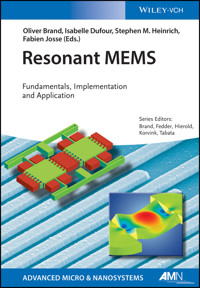
Resonant MEMS E-Book
147,99 €
Mehr erfahren.
- Herausgeber: Wiley-VCH
- Kategorie: Wissenschaft und neue Technologien
- Serie: Advanced Micro and Nanosystems
- Sprache: Englisch
Part of the AMN book series, this book covers the principles, modeling and implementation as well as applications of resonant MEMS from a unified viewpoint. It starts out with the fundamental equations and phenomena that govern the behavior of resonant MEMS and then gives a detailed overview of their implementation in capacitive, piezoelectric, thermal and organic devices, complemented by chapters addressing the packaging of the devices and their stability. The last part of the book is devoted to the cutting-edge applications of resonant MEMS such as inertial, chemical and biosensors, fluid properties sensors, timing devices and energy harvesting systems.
Sie lesen das E-Book in den Legimi-Apps auf:
Seitenzahl: 880
Veröffentlichungsjahr: 2015
Ähnliche




















Table of Contents
Cover
Related Titles
Title Page
Copyright
Series Editor Preface
Preface
About the Volume Editors
List of Contributors
Part I: Fundamentals
Chapter 1: Fundamental Theory of Resonant MEMS Devices
1.1 Introduction
1.2 Nomenclature
1.3 Single-Degree-of-Freedom (SDOF) Systems
1.4 Continuous Systems Modeling: Microcantilever Beam Example
1.5 Formulas for Undamped Natural Frequencies
1.6 Summary
Acknowledgment
References
Chapter 2: Frequency Response of Cantilever Beams Immersed in Viscous Fluids
2.1 Introduction
2.2 Low Order Modes
2.3 Arbitrary Mode Order
References
Chapter 3: Damping in Resonant MEMS
3.1 Introduction
3.2 Air Damping
3.3 Surface Damping
3.4 Anchor Damping
3.5 Electrical Damping
3.6 Thermoelastic Dissipation (TED)
3.7 Akhiezer Effect (AKE)
References
Chapter 4: Parametrically Excited Micro- and Nanosystems
4.1 Introduction
4.2 Sources of Parametric Excitation in MEMS and NEMS
4.3 Modeling the Underlying Dynamics – Variants of the Mathieu Equation
4.4 Perturbation Analysis
4.5 Linear, Steady-State Behaviors
4.6 Sources of Nonlinearity and Nonlinear Steady-State Behaviors
4.7 Complex Dynamics in Parametrically Excited Micro/Nanosystems
4.8 Combined Parametric and Direct Excitations
4.9 Select Applications
4.10 Some Parting Thoughts
Acknowledgment
References
Chapter 5: Finite Element Modeling of Resonators
5.1 Introduction to Finite Element Analysis
5.2 Application of FEA in MEMS Resonator Design
5.3 Summary
References
Part II: Implementation
Chapter 6: Capacitive Resonators
6.1 Introduction
6.2 Capacitive Transduction
6.3 Electromechanical Actuation
6.4 Capacitive Sensing and Motional Capacitor Topologies
6.5 Electrical Isolation
6.6 Capacitive Resonator Circuit Models
6.7 Capacitive Interfaces
6.8 Conclusion
Acknowledgment
References
Chapter 7: Piezoelectric Resonant MEMS
7.1 Introduction to Piezoelectric Resonant MEMS
7.2 Fundamentals of Piezoelectricity and Piezoelectric Resonators
7.3 Thin Film Piezoelectric Materials for Resonant MEMS
7.4 Equivalent Electrical Circuit of Piezoelectric Resonant MEMS
7.5 Examples of Piezoelectric Resonant MEMS: Vibrations in Beams, Membranes, and Plates
7.6 Conclusions
References
Chapter 8: Electrothermal Excitation of Resonant MEMS
8.1 Basic Principles
8.2 Actuator Implementations
8.3 Piezoresistive Sensing
8.4 Modeling and Optimization of Single-Port Thermal-Piezoresistive Resonators
8.5 Examples of Thermally Actuated Resonant MEMS
References
Chapter 9: Nanoelectromechanical Systems (NEMS)
9.1 Introduction
9.2 Carbon-Based NEMS
9.3 Toward Functional Bio-NEMS
9.4 Summary and Outlook
References
Chapter 10: Organic Resonant MEMS Devices
10.1 Introduction
10.2 Device Designs
10.3 Quality Factor of Polymeric Micromechanical Resonators
10.4 Applications
References
Chapter 11: Devices with Embedded Channels
11.1 Introduction
11.2 Theory
11.3 Device Technology
11.4 Applications
11.5 Conclusion
References
Chapter 12: Hermetic Packaging for Resonant MEMS
12.1 Introduction
12.2 Overview of Packaging Types
12.3 Die-Level Vacuum-Can Packaging
12.4 Wafer Bonding for Device Packaging
12.5 Thin Film Encapsulation-Based Packaging
12.6 Getters
12.7 The “Stanford epi-Seal Process” for Packaging of MEMS Resonators
12.8 Conclusion
References
Chapter 13: Compensation, Tuning, and Trimming of MEMS Resonators
13.1 Introduction
13.2 Compensation Techniques in MEMS Resonators
13.3 Tuning Methods in MEMS Resonators
13.4 Trimming Methods
References
Part III: Application
Chapter 14: MEMS Inertial Sensors
14.1 Introduction
14.2 Accelerometers
14.3 Gyroscopes
14.4 Multi-degree-of-Freedom Inertial Measurement Units
References
Chapter 15: Resonant MEMS Chemical Sensors
15.1 Introduction
15.2 Modeling of Resonant Microcantilever Chemical Sensors
15.3 Effects of Chemical Analyte Sorption into the Coating
15.4 Figures of Merit
15.5 Chemically Sensitive Layers
15.6 Packaging
15.7 Gas-Phase Chemical Sensors
15.8 Liquid-Phase Chemical Sensors
References
Chapter 16: Biosensors
16.1 Introduction
16.2 Design Considerations: Length Scale, Geometry, and Materials
16.3 Surface Functionalization: Preparation, Passivation, and Bio-recognition
16.4 Biosensing Application Formats
16.5 Application Case Studies
16.6 Conclusions and Future Trends
Acknowledgment
References
Chapter 17: Fluid Property Sensors
17.1 Introduction
17.2 Definition of Fluid Properties
17.3 Resonator Sensors
17.4 Examples of Resonant Sensors for Fluid Properties
17.5 Conclusions
References
Chapter 18: Energy Harvesting Devices
18.1 Introduction
18.2 Generic Harvester Structures
18.3 MEMS Energy Harvester Transduction Mechanisms
18.4 Review and Comparison of MEMS Energy Harvesting Devices
18.5 Conclusions
References
Index
End User License Agreement
Pages
xv
xvi
xvii
xviii
xix
xx
xxi
xxii
xxiii
xxiv
xxv
3
4
5
6
7
8
9
10
11
12
13
14
15
16
17
18
19
20
21
22
23
24
25
26
27
28
29
30
31
32
33
34
35
36
37
38
39
40
41
42
43
44
45
46
47
48
49
50
51
52
53
55
56
57
58
59
60
61
62
63
64
65
66
67
68
69
70
71
73
74
75
76
77
78
79
80
81
82
83
84
85
86
87
88
89
90
91
92
93
94
95
97
98
99
100
101
102
103
104
105
106
107
108
109
110
111
112
113
114
115
116
117
121
122
123
124
125
126
127
128
129
130
131
132
133
134
135
136
137
138
139
140
141
142
143
144
145
146
147
148
149
150
151
152
153
154
155
156
157
158
159
160
161
162
163
164
165
166
167
168
169
170
171
172
173
174
175
176
177
178
179
180
181
182
183
184
185
186
187
188
189
190
191
192
193
194
195
196
197
198
199
200
201
203
204
205
206
207
208
209
210
211
212
213
214
215
216
217
218
219
220
221
222
223
224
225
226
227
228
229
230
231
233
234
235
236
237
238
239
240
241
242
243
244
245
246
247
248
249
250
251
252
253
254
255
256
257
258
259
260
261
262
263
264
265
266
267
268
269
270
271
272
273
274
275
276
277
278
279
280
281
282
283
284
285
287
288
289
290
291
292
293
294
295
296
297
298
299
300
301
302
303
304
305
306
307
308
309
310
311
312
313
314
315
316
317
318
319
320
321
322
323
324
325
329
330
331
332
333
334
335
336
337
338
339
340
341
342
343
344
345
346
347
348
349
350
351
352
353
355
356
357
358
359
360
361
362
363
364
365
366
367
368
369
370
371
372
373
374
375
376
377
378
379
380
381
382
383
384
385
386
387
388
389
390
391
392
393
394
395
396
397
398
399
400
401
402
403
404
405
406
407
408
409
410
411
412
413
414
415
416
417
418
419
420
421
422
423
424
425
426
427
428
429
430
431
432
433
434
435
436
437
438
439
440
441
442
443
444
445
446
447
448
449
450
451
452
453
454
455
456
457
458
459
460
461
462
463
464
465
466
467
468
469
470
471
472
473
474
475
476
477
478
479
480
481
482
483
Guide
Cover
Table of Contents
Preface
Part I: Fundamentals
Begin Reading
List of Illustrations
Figure 1.1
Figure 1.2
Figure 1.3
Figure 1.4
Figure 1.5
Figure 1.6
Figure 1.7
Figure 1.8
Figure 1.9
Figure 2.1
Figure 2.2
Figure 2.3
Figure 2.4
Figure 2.5
Figure 2.6
Figure 2.7
Figure 3.1
Figure 3.2
Figure 3.3
Figure 3.4
Figure 3.5
Figure 3.6
Figure 3.7
Figure 3.8
Figure 3.9
Figure 3.10
Figure 4.1
Figure 4.2
Figure 4.3
Figure 5.1
Figure 5.2
Figure 5.3
Figure 5.4
Figure 5.5
Figure 5.6
Figure 5.7
Figure 5.8
Figure 5.9
Figure 5.10
Figure 5.11
Figure 5.12
Figure 5.13
Figure 5.14
Figure 5.15
Figure 5.16
Figure 5.17
Figure 5.18
Figure 5.19
Figure 6.1
Figure 6.2
Figure 6.3
Figure 6.4
Figure 6.5
Figure 6.6
Figure 6.7
Figure 6.8
Figure 6.9
Figure 6.10
Figure 6.11
Figure 6.12
Figure 6.13
Figure 6.14
Figure 6.15
Figure 6.16
Figure 6.17
Figure 7.1
Figure 7.2
Figure 7.3
Figure 7.4
Figure 7.5
Figure 7.6
Figure 7.7
Figure 7.8
Figure 7.9
Figure 7.10
Figure 7.11
Figure 7.12
Figure 7.13
Figure 8.1
Figure 8.2
Figure 8.3
Figure 8.4
Figure 8.5
Figure 8.6
Figure 8.7
Figure 8.8
Figure 8.9
Figure 8.10
Figure 8.11
Figure 8.12
Figure 8.13
Figure 8.14
Figure 8.15
Figure 8.16
Figure 8.17
Figure 9.1
Figure 9.2
Figure 9.3
Figure 9.4
Figure 9.5
Figure 9.6
Figure 9.7
Figure 9.8
Figure 9.9
Figure 9.10
Figure 9.11
Figure 9.12
Figure 10.1
Figure 10.2
Figure 10.3
Figure 10.4
Figure 10.5
Figure 10.6
Figure 10.7
Figure 10.8
Figure 10.9
Figure 10.10
Figure 10.11
Figure 10.12
Figure 10.13
Figure 10.14
Figure 10.15
Figure 10.16
Figure 10.17
Figure 10.18
Figure 10.19
Figure 11.1
Figure 11.2
Figure 11.3
Figure 11.4
Figure 11.5
Figure 11.6
Figure 11.7
Figure 11.8
Figure 12.1
Figure 12.2
Figure 12.3
Figure 12.4
Figure 12.5
Figure 12.6
Figure 12.7
Figure 13.1
Figure 13.2
Figure 13.3
Figure 13.4
Figure 13.5
Figure 13.6
Figure 13.7
Figure 13.8
Figure 13.9
Figure 13.10
Figure 13.11
Figure 13.12
Figure 13.13
Figure 13.14
Figure 13.15
Figure 13.16
Figure 13.17
Figure 13.18
Figure 14.1
Figure 14.2
Figure 14.3
Figure 14.4
Figure 14.5
Figure 14.6
Figure 14.7
Figure 14.8
Figure 14.9
Figure 14.10
Figure 14.11
Figure 14.12
Figure 14.13
Figure 14.14
Figure 14.15
Figure 14.16
Figure 14.17
Figure 14.18
Figure 15.1
Figure 15.2
Figure 15.3
Figure 15.4
Figure 15.5
Figure 15.6
Figure 15.7
Figure 16.1
Figure 16.2
Figure 16.3
Figure 16.4
Figure 16.5
Figure 17.1
Figure 17.2
Figure 18.1
Figure 18.2
Figure 18.3
Figure 18.4
Figure 18.5
Figure 18.6
Figure 18.7
Figure 18.8
Figure 18.9
Figure 18.10
List of Tables
Table 1.1
Table 1.2
Table 1.3
Table 2.1
Table 3.1
Table 4.1
Table 7.1
Table 8.1
Table 8.2
Table 11.1
Table 11.2
Table 12.1
Table 15.1
Table 15.2
Table 15.3
Table 16.1
Table 16.4
Table 17.1
Table 17.2
Table 18.1
Table 18.2
Related Titles
Briand, D., Yeatman, E., Roundy, S. (eds.)
Micro Energy Harvesting
2015
Print ISBN: 978-3-527-31902-2; also available in electronic formats
Bechtold, T., Schrag, G., Feng, L. (eds.)
System-level Modeling of MEMS
2013
Print ISBN: 978-3-527-31903-9; also available in electronic formats
Korvink, J.G., Smith, P.J., Shin, D. (eds.)
Inkjet-based Micromanufacturing
2012
Print ISBN: 978-3-527-31904-6; also available in electronic formats
Erturk, A.A.
Piezoelectric Energy Harvesting
2011
Print ISBN: 978-0-470-68254-8; also available in electronic formats
Bolic, M.M. (ed.)
RFID Systems - Research Trends and Challenges
2010
Print ISBN: 978-0-470-74602-8; also available in electronic formats
Ramm, P., Lu, J.J., Taklo, M.M. (eds.)
Handbook of Wafer Bonding
2012
Print ISBN: 978-3-527-32646-4; also available in electronic formats
Garrou, P., Bower, C., Ramm, P. (eds.)
Handbook of 3D Integration
Volumes 1 and 2: Technology and Applications of 3D Integrated Circuits
2012
Print ISBN: 978-3-527-33265-6; also available in electronic formats
Garrou, P., Koyanagi, M., Ramm, P. (eds.)
Handbook of 3D Integration
Volume 3: 3D Process Technology
2014
Print ISBN: 978-3-527-33466-7; also available in electronic formats
Edited by Oliver Brand, Isabelle Dufour, Stephen M. Heinrich, and Fabien Josse
Resonant MEMS
Fundamentals, Implementation and Application
The Editor
Prof. Oliver Brand
School Electrical/Comp.Eng.
Georgia Inst. of Technology
777 Atlantic Drive
Atlanta, GA
United States
Prof. Isabelle Dufour
Université de Bordeaux
Laboratoire IMS
Bâtiment CBP
16 av. Pey Berland
33607 Pessac cedex
France
Prof. Stephen M. Heinrich
Marquette University
Civil, Construction and Environmental Engineering
Haggerty Hall 265
Milwaukee, WI
United States
Prof. Fabien Josse
Marquette University
Electrical & Computer Eng.
Haggerty Hall 294
Milwaukee, WI
United States
All books published by Wiley-VCH are carefully produced. Nevertheless, authors, editors, and publisher do not warrant the information contained in these books, including this book, to be free of errors. Readers are advised to keep in mind that statements, data, illustrations, procedural details or other items may inadvertently be inaccurate.
Library of Congress Card No.: applied for
British Library Cataloguing-in-Publication Data
A catalogue record for this book is available from the British Library.
Bibliographic information published by the Deutsche Nationalbibliothek
The Deutsche Nationalbibliothek lists this publication in the Deutsche Nationalbibliografie; detailed bibliographic data are available on the Internet at <http://dnb.d-nb.de>.
© 2015 Wiley-VCH Verlag & Co. KGaA, Boschstr. 12, 69469 Weinheim, Germany
All rights reserved (including those of translation into other languages). No part of this book may be reproduced in any form – by photoprinting, microfilm, or any other means – nor transmitted or translated into a machine language without written permission from the publishers. Registered names, trademarks, etc. used in this book, even when not specifically marked as such, are not to be considered unprotected by law.
Print ISBN: 978-3-527-33545-9
ePDF ISBN: 978-3-527-67636-1
ePub ISBN: 978-3-527-67635-4
Mobi ISBN: 978-3-527-67634-7
oBook ISBN: 978-3-527-67633-0
Series Editor Preface
You hold in your hands the eleventh volume of our book series Advanced Micro & Nanosystems, dedicated to the field of Resonant MEMS. We have been very fortunate to enlist Prof. Oliver Brand, Prof. Isabelle Dufour, Prof. Stephen Heinrich, and Prof. Fabien Josse as Volume Editors. All four have extensive expertise in different aspects of Resonant MEMS and, as a team, actually have collaborated in recent years, resulting in a number of joint research publications. In a similar way, this book project turned out to be a true team project, from establishing the desired table of contents; to selecting an international team of experts as chapter authors; to assembling, editing, and fine-tuning the contents.
You might ask, why a book on Resonant MEMS? Clearly, resonant devices fabricated using MEMS (MicroElectroMechanical Systems) technologies are not new; in fact, one of the early MEMS devices is the Resonant Gate Transistor, published by Harvey C. Nathanson and co-workers in the IEEE Transactions on Electron Devices in 1967. Over the years, a resonant sensor version of just about every sensor imaginable has been investigated. In general, Resonant MEMS (and in particular resonant sensors) promise very high sensitivities, but often come at the expense of a more complicated device design and fabrication. In recent years, modern numerical modeling tools, in particular finite element modeling (FEM) software, and a number of fundamental theoretical studies have helped design better Resonant MEMS, and, as a result, first commercial devices based on Resonant MEMS have been developed. The best example might be the success of MEMS-based resonant gyroscopes in consumer electronic devices, such as smart phones and gaming consoles. As the field matures, we found a book that summarizes all aspects of Resonant MEMS, ranging from the Fundamentals to Implementation and Application, to be very timely. You have the result in your hands, and we hope that you enjoy reading this book as much as we do.
This book would not have been possible without a significant time commitment by the volume editors as well as the chapter authors. We want to thank them most heartily for their effort! Our thanks also go to the Wiley staff for their strong support of this project. The final printed result once again speaks for itself!
Oliver Brand, Gary K. Fedder,
Christofer Hierold, Jan G. Korvink,
Osamu Tabata, Series Editors
Atlanta, Pittsburgh,
Zurich, Freiburg,
Kyoto, January 2015
Preface
As the editing team for Vol. 11 of the Advanced Micro & Nanosystems series, entitled Resonant MEMS: Fundamentals, Implementation and Application, we hope that you benefit from this significant collaborative effort among the experts who have kindly contributed to this project. The book's raison d'être is to elucidate the various aspects of MEMS resonators, to identify the state of the art in this rapidly changing field, and to serve as a valuable reference tool to the readership, including serving as a springboard for future advances in this discipline.
Given the breadth of the resonant MEMS field, we have elected to group the various chapters of this volume into three parts as indicated by the book's subtitle. Part I, Fundamentals, comprises five chapters, each of which focuses on the theoretical description of the underlying physical phenomena that are relevant to virtually all resonant MEMS devices. This part includes detailed treatments on the fundamental theory of mechanical resonance; the effects of viscous fluids (a surrounding gas or liquid) on vibrating microcantilevers; a broad-based examination of various sources of damping (energy dissipation mechanisms); resonant response caused by parametric excitation, i.e., variations in resonator properties as opposed to direct (e.g., force) excitation; and an overview of the fundamentals of the finite element method with specific applications to MEMS resonators. Having laid the fundamental groundwork in Part I, the eight chapters of Part II, Implementation, examine how the fundamentals are applied in a practical setting to yield specific types of resonant MEMS devices and how these devices are designed to reliably perform a specific function. In particular, this group of chapters includes detailed discussions of resonant MEMS devices on the basis of the following materials and device designs: capacitive transducers, piezoelectric materials, nanoelectromechanical systems (NEMS), and organic materials (polymers). Also included in Part II are chapters treating the following practical implementation topics: electrothermal excitation methods; the use of embedded channels to overcome challenges posed by liquid-phase applications; hermetic packaging to protect the resonator and to ensure its long-term stability and reliability; and the development of compensation, tuning, and trimming techniques for the realization of high-precision resonators by accounting for variations in material properties, fabrication processes, and environmental operating conditions. Finally, in Part III, Application, we have included chapters that are dedicated to particular functionalities. Part III comprises four chapters on resonant MEMS for sensing applications, including the following: inertial sensing (motion detection); chemical detection in both gaseous and liquid environments; biochemical sensing for label-free, quantitative measurement of biomolecules such as proteins and nucleic acids, or even entire cells and viruses; and resonant MEMS-based rheometers for measuring the physical properties of fluids. The final chapter of Part III focuses on energy harvesting applications for converting ambient mechanical vibrations into useful electrical energy.
Finally, we would like to extend a sincere expression of gratitude to all of the chapter authors and their associated institutions, to the editorial staff at Wiley-VCH, especially Martin Preuss and Martin Graf-Utzmann, and to Sangeetha Suresh and the production staff at Laserwords. Without the tireless efforts of all of these people, this book would not have been possible. Also, all four co-editors gratefully acknowledge the financial support of CNRS (France, Projet PICS, 2012–2014) for the international collaboration required to plan and realize this volume, while three of the co-editors (Brand, Heinrich, Josse) gratefully acknowledge research funding from the National Science Foundation (U.S.) over the period 2008–present. The support provided by both of these funding agencies was instrumental in bringing this book to fruition.
Oliver Brand
Isabelle Dufour
Stephen M. Heinrich
Fabien Josse
Co-Editors
Atlanta, Pessac,
Milwaukee, January 2015
About the Volume Editors
Oliver Brand, PhD Oliver Brand received his diploma degree in Physics from Technical University Karlsruhe, Germany, in 1990 and his PhD degree from ETH Zurich, Switzerland, in 1994. From 1995 to 1997, he worked as a postdoctoral fellow at Georgia Tech. From 1997 to 2002, he was a lecturer at ETH Zurich and deputy director of the Physical Electronics Laboratory. In 2003, he joined the Electrical and Computer Engineering faculty at the Georgia Institute of Technology where he is currently a Professor. Since 2014, he serves as the Executive Director of Georgia Tech's Institute for Electronics and Nanotechnology. He has co-authored more than 190 publications in scientific journals and conference proceedings. He is a co-editor of the Wiley-VCH book series Advanced Micro & Nanosystems , a member of the editorial board of Sensors and Materials, and has served as General Co-Chair of the 2008 IEEE International Conference on Micro Electro Mechanical Systems (MEMS 2008). Dr. Brand is a senior member of the IEEE and a co-recipient of the 2005 IEEE Donald G. Fink Prize Paper Award. His research interests are in the areas of silicon-based microsystems, microsensors, MEMS fabrication technologies, and microsystem packaging.
Isabelle Dufour, PhD Isabelle Dufour graduated from Ecole Normale Supérieure de Cachan in 1990 and received her PhD and HDR degrees in engineering science from the University of Paris-Sud, Orsay, France, in 1993 and 2000, respectively. She was a CNRS research fellow from 1994 to 2007, first in Cachan working on the modeling of electrostatic actuators (micromotors, micropumps) and then after 2000 in Bordeaux working on microcantilever-based chemical sensors. She is currently a Professor of electrical engineering at the University of Bordeaux, and her research interests are in the areas of microcantilever-based sensors for chemical detection, rheological measurements, material characterization, and energy harvesting.
Stephen M. Heinrich, PhD Stephen M. Heinrich earned the BS degree summa cum laude from Penn State in 1980 and the MS and PhD degrees from the University of Illinois at Urbana-Champaign in 1982 and 1985, all in civil engineering. Hired as an Assistant Professor at Marquette University in 1985, he was promoted to his current rank of Professor in 1998. In 2000, Prof. Heinrich was awarded the Rev. John P. Raynor Faculty Award for Teaching Excellence, Marquette's highest teaching honor, while in 2006 he was a awarded a Fulbright Research Scholar Award to support research collaboration at the Université de Bordeaux. Dr. Heinrich's research has focused on structural mechanics applications in microelectronics packaging and analytical modeling of cantilever-based chemical/biosensors and, more recently, MEMS energy harvesters. The investigations performed by Dr. Heinrich and his colleagues have resulted in more than 100 refereed publications and three best paper awards from IEEE and ASME. His professional service activities include membership on the ASCE Elasticity Committee, Associate Editor positions for the IEEE Transactions on Advanced Packaging and the ASME Journal of Electronic Packaging, and technical review activities for more than 40 journals, publishers, and funding agencies.
Fabien Josse, PhD Fabien Josse received the MS and PhD degrees in Electrical Engineering from the University of Maine in 1979 and 1982, respectively. He has been with Marquette University, Milwaukee, WI, since 1982 and is currently Professor of Electrical, Computer and Biomedical Engineering. He is also an Adjunct Professor with the Department of Electrical Engineering, Laboratory for Surface Science and Technology, University of Maine. He has been a Visiting Professor with the University of Heidelberg, Germany, the Laboratoire IMS, University of Bordeaux, France, and the Physical Electronics Laboratory, ETH Zurich, Switzerland, and IMTEK, University of Freiburg, Germany. His research interests include solid state sensors, acoustic wave sensors, and MEMS devices for liquid-phase biochemical sensor applications, investigation of novel sensor platforms, and smart sensor systems. Prof. Josse is a senior member of IEEE and associate editor (2002–2009) of the IEEE Sensors Journal.
List of Contributors
Gabriel Abadal
Universitat AutonÒma de Barcelona (UAB)
Escola d'Enginyeria
Department d'Enginyeria ElectrÒnica
Campus UAB 08193
Bellaterra
Spain
Reza Abdolvand
University of Central Florida
Department of Electrical Engineering and Computer Sciences
4000 Central Florida Blvd.
Building 116 – Room 346
Orlando, FL 32816-2362
USA
Vaida Auzelyte
Microsystem Laboratory
Ecole Polytechnique Federal de Lausanne (EPFL)
EPFL STI IMT IMT-LS-GE
BM 3107 (Batiment BM)
Station 17, 1015 Lausanne
Switzerland
Farrokh Ayazi
Georgia Institute of Technology
School of Electrical and Computer Engineering
777 Atlantic Drive
Atlanta, GA 30332-0250
USA
and
Qualtré Inc
225 Cedar Hill St
Marlborough, MA 01752
USA
N. Barniol
Universitat AutonÒma de Barcelona (UAB)
Escola d'Enginyeria
Department d'Enginyeria ElectrÒnica
Campus UAB 08193
Bellaterra
Spain
Luke A. Beardslee
Lesen Sie weiter in der vollständigen Ausgabe!
Lesen Sie weiter in der vollständigen Ausgabe!
Lesen Sie weiter in der vollständigen Ausgabe!
Lesen Sie weiter in der vollständigen Ausgabe!
Lesen Sie weiter in der vollständigen Ausgabe!
Lesen Sie weiter in der vollständigen Ausgabe!
Lesen Sie weiter in der vollständigen Ausgabe!
Lesen Sie weiter in der vollständigen Ausgabe!
Lesen Sie weiter in der vollständigen Ausgabe!
Lesen Sie weiter in der vollständigen Ausgabe!
Lesen Sie weiter in der vollständigen Ausgabe!
Lesen Sie weiter in der vollständigen Ausgabe!
Lesen Sie weiter in der vollständigen Ausgabe!
Lesen Sie weiter in der vollständigen Ausgabe!
Lesen Sie weiter in der vollständigen Ausgabe!
Lesen Sie weiter in der vollständigen Ausgabe!
Lesen Sie weiter in der vollständigen Ausgabe!
Lesen Sie weiter in der vollständigen Ausgabe!
Lesen Sie weiter in der vollständigen Ausgabe!
Lesen Sie weiter in der vollständigen Ausgabe!
Lesen Sie weiter in der vollständigen Ausgabe!
Lesen Sie weiter in der vollständigen Ausgabe!
Lesen Sie weiter in der vollständigen Ausgabe!




