


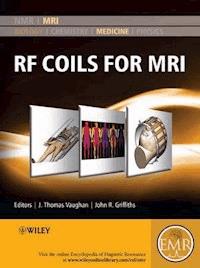
RF Coils for MRI E-Book
142,99 €
Mehr erfahren.
- Herausgeber: John Wiley & Sons
- Kategorie: Wissenschaft und neue Technologien
- Serie: EMR Books
- Sprache: Englisch
The content of this volume has been added to eMagRes (formerly Encyclopedia of Magnetic Resonance) - the ultimate online resource for NMR and MRI.
To date there is no single reference aimed at teaching the art of applications guided coil design for use in MRI. This RF Coils for MRI handbook is intended to become this reference.
Heretofore, much of the know-how of RF coil design is bottled up in various industry and academic laboratories around the world. Some of this information on coil technologies and applications techniques has been disseminated through the literature, while more of this knowledge has been withheld for competitive or proprietary advantage. Of the published works, the record of technology development is often incomplete and misleading, accurate referencing and attribution assignment being tantamount to admission of patent infringement in the commercial arena. Accordingly, the literature on RF coil design is fragmented and confusing. There are no texts and few courses offered to teach this material. Mastery of the art and science of RF coil design is perhaps best achieved through the learning that comes with a long career in the field at multiple places of employment…until now.
RF Coils for MRI combines the lifetime understanding and expertise of many of the senior designers in the field into a single, practical training manual. It informs the engineer on part numbers and sources of component materials, equipment, engineering services and consulting to enable anyone with electronics bench experience to build, test and interface a coil. The handbook teaches the MR system user how to safely and successfully implement the coil for its intended application. The comprehensive articles also include information required by the scientist or physician to predict respective experiment or clinical performance of a coil for a variety of common applications. It is expected that RF Coils for MRI becomes an important resource for engineers, technicians, scientists, and physicians wanting to safely and successfully buy or build and use MR coils in the clinic or laboratory. Similarly, this guidebook provides teaching material for students, fellows and residents wanting to better understand the theory and operation of RF coils.
Many of the articles have been written by the pioneers and developers of coils, arrays and probes, so this is all first hand information! The handbook serves as an expository guide for hands-on radiologists, radiographers, physicians, engineers, medical physicists, technologists, and for anyone with interests in building or selecting and using RF coils to achieve best clinical or experimental results.
About EMR Handbooks / eMagRes Handbooks
The Encyclopedia of Magnetic Resonance (up to 2012) and eMagRes (from 2013 onward) publish a wide range of online articles on all aspects of magnetic resonance in physics, chemistry, biology and medicine. The existence of this large number of articles, written by experts in various fields, is enabling the publication of a series of EMR Handbooks / eMagRes Handbooks on specific areas of NMR and MRI. The chapters of each of these handbooks will comprise a carefully chosen selection of articles from eMagRes. In consultation with the eMagRes Editorial Board, the EMR Handbooks / eMagRes Handbooks are coherently planned in advance by specially-selected Editors, and new articles are written (together with updates of some already existing articles) to give appropriate complete coverage. The handbooks are intended to be of value and interest to research students, postdoctoral fellows and other researchers learning about the scientific area in question and undertaking relevant experiments, whether in academia or industry.
Have the content of this Handbook and the complete content of eMagRes at your fingertips!
Visit: www.wileyonlinelibrary.com/ref/eMagRes
View other eMagRes publications here
Sie lesen das E-Book in den Legimi-Apps auf:
Seitenzahl: 1102
Veröffentlichungsjahr: 2012
Ähnliche




















EMR Handbooks
Based on the Encyclopedia of Magnetic Resonance (EMR), this monograph series focuses on hot topics and major developments in modern magnetic resonance and its many applications. Each volume in the series will have a specific focus in either general NMR or MRI, with coverage of applications in the key scientific disciplines of physics, chemistry, biology or medicine. All the material published in this series, plus additional content, will be available in the online version of EMR, although in a slightly different format.
Previous EMR Handbooks
NMR CrystallographyEdited by Robin K. Harris, Roderick E. Wasylishen, Melinda J. DuerISBN 978–0-470–69961–4
Multidimensional NMR Methods for the Solution StateEdited by Gareth A. Morris, James W. EmsleyISBN 978–0-470–77075–7
Solid-State NMR Studies of BiopolymersEdited by Ann E. McDermott, Tatyana PolenovaISBN 978–0-470–72122–3
NMR of Quadrupolar Nuclei in Solid MaterialsEdited by Roderick E. Wasylishen, Sharon E. Ashbrook, Stephen WimperisISBN 978–0-470–97398–1
Forthcoming EMR Handbooks
MRI of Tissues with ShortT2 and T2*Edited by Ian R. Young, Gary Fullerton and Graeme M. BydderISBN 978–0-470–68835–9
Encyclopedia of Magnetic Resonance
Edited by Robin K. Harris, Roderick E. Wasylishen, Edwin D. Becker, John R. Griffiths, Vivian S. Lee, Ian R. Young, Ann E. McDermott, Tatyana Polenova, James W. Emsley, George A. Gray, Gareth A. Morris, Melinda J. Duer and Bernard C. Gerstein.
The Encyclopedia of Magnetic Resonance (EMR) is based on the original printed Encyclopedia of Nuclear Magnetic Resonance, which was first published in 1996 with an update volume added in 2000. EMR was launched online in 2007 with all the material that had previously appeared in print. New updates have since been and will be added on a regular basis throughout the year to keep the content up to date with current developments. Nuclear was dropped from the title to reflect the increasing prominence of MRI and other medical applications. This allows the editors to expand beyond the traditional borders of NMR to MRI and MRS, as well as to EPR and other modalities. EMR covers all aspects of magnetic resonance, with articles on the fundamental principles, the techniques and their applications in all areas of physics, chemistry, biology and medicine for both general NMR and MRI. Additionally, articles on the history of the subject are included.
For more information see: www.wileyonlinelibrary.com/ref/emr
This edition first published 2012© 2012 John Wiley & Sons Ltd
Registered office
John Wiley & Sons Ltd, The Atrium, Southern Gate, Chichester, West Sussex, PO19 8SQ, United Kingdom
For details of our global editorial offices, for customer services and for information about how to apply for permission to reuse the copyright material in this book please see our website at www.wiley.com.
The right of the authors to be identified as the authors of this work has been asserted in accordance with the Copyright, Designs and Patents Act 1988.
All rights reserved. No part of this publication may be reproduced, stored in a retrieval system, or transmitted, in any form or by any means, electronic, mechanical, photocopying, recording or otherwise, except as permitted by the UK Copyright, Designs and Patents Act 1988, without the prior permission of the publisher.
Wiley also publishes its books in a variety of electronic formats. Some content that appears in print may not be available in electronic books.
Designations used by companies to distinguish their products are often claimed as trademarks. All brand names and product names used in this book are trade names, service marks, trademarks or registered trademarks of their respective owners. The publisher is not associated with any product or vendor mentioned in this book. This publication is designed to provide accurate and authoritative information in regard to the subject matter covered. It is sold on the understanding that the publisher is not engaged in rendering professional services. If professional advice or other expert assistance is required, the services of a competent professional should be sought.
Front cover image credit:Cover images were kindly supplied by Brandon Tramm and Jinfeng Tian.
Library of Congress Cataloging-in-Publication Data
RF coils for MRI / editors, J. Thomas Vaughan, John R. Griffiths. p. ; cm.
Includes bibliographical references and index. ISBN 978–0-470–77076–4 (cloth)
I. Vaughan, J. Thomas (John Thomas), 1957- II. Griffiths, John R., 1945-
III. Encyclopedia of magnetic resonance.
[DNLM: 1. Magnetic Resonance Imaging – methods. 2. Electromagnetic Fields.
3. Magnetic Resonance Spectroscopy – instrumentation. 4. Radio Waves.
5. Transducers. WN 185]
616.07’548 – dc23
2012015267
A catalogue record for this book is available from the British Library. ISBN-13: 978–0-470–77076–4
Set in 9.5/11.5 pt Times by Laserwords (Private) Limited, Chennai, India Printed and bound in Singapore by Markono Print Media Pte Ltd
Encyclopedia of Magnetic Resonance
Editorial Board
Editors-in-Chief
Robin K. HarrisUniversity of DurhamDurhamUK
Roderick E. WasylishenUniversity of AlbertaEdmonton, AlbertaCanada
Section EditorsSOLID-STATE NMR & PHYSICS
Melinda J. DuerUniversity of CambridgeCambridgeUK
Bernard C. GersteinAmes, IAUSA
SOLUTION-STATE NMR & CHEMISTRY
James W. EmsleyUniversity of SouthamptonSouthamptonUK
George A. GrayVarian Inc.Palo Alto, CAUSA
Gareth A. MorrisUniversity of ManchesterManchesterUK
BIOCHEMICAL NMR
Ann E. McDermottColumbia UniversityNew York, NYUSA
Tatyana PolenovaUniversity of DelawareNewark, DEUSA
MRI & MRS
John R. GriffithsCancer Research UKCambridge Research InstituteCambridgeUK
Ian R. YoungImperial CollegeLondonUK
HISTORICAL PERSPECTIVES
Edwin D. BeckerNational Institutes of HealthBethesda, MDUSA
International Advisory Board
David M. Grant (Chairman)University of UtahSalt Lake City, UTUSA
Isao AndoTokyo Institute of TechnologyTokyoJapan
Adriaan BaxNational Institutes of HealthBethesda, MDUSA
Chris BoeschUniversity of BernBernSwitzerland
Paul A. BottomleyJohns Hopkins UniversityBaltimore, MDUSA
William G. BradleyUCSD Medical CenterSan Diego, CAUSA
Graeme M. BydderUCSD Medical CenterSan Diego, CAUSA
Paul T. Callaghan (deceased)Victoria University of WellingtonWellingtonNew Zealand
Richard R. ErnstEidgenössische Technische Hochschule (ETH)ZürichSwitzerland
Ray FreemanUniversity of CambridgeCambridgeUK
Lucio FrydmanWeizmann Institute of ScienceRehovotIsrael
Maurice GoldmanVillebon sur YvetteFrance
Harald GüntherUniversität SiegenSiegenGermany
Herbert Y. KresselHarvard Medical SchoolBoston, MAUSA
C. Leon PartainVanderbilt University Medical CenterNashville, TNUSA
Alexander PinesUniversity of California at BerkeleyBerkeley, CAUSA
George K. RaddaUniversity of OxfordOxfordUK
Hans Wolfgang SpiessMax-Planck Institute of Polymer ResearchMainzGermany
Charles P. SlichterUniversity of Illinois at Urbana-ChampaignUrbana, ILUSA
John S. WaughMassachusetts Institute of Technology (MIT)Cambridge, MAUSA
Bernd WrackmeyerUniversität BayreuthBayreuthGermany
Kurt WüuthrichThe Scripps Research InstituteLa Jolla, CAUSAandETH ZüurichZürichSwitzerland
Contents
Cover
Title
Copyright
Contributors
Series Preface
Volume Preface
Part A: Surface Coils
1 An Historical Introduction to Surface Coils: The Early Days
2 Radiofrequency Coils for NMR: A Peripatetic History of Their Twists and Turns
3 Quadrature Surface Coils
4 Double-Tuned Surface Coils
5 Nested Surface Coils for Multinuclear NMR
6 Quadrature Transverse Electromagnetic (TEM) Surface Coils
Part B: Loop Arrays
7 Receiver Loop Arrays
8 Coil Array Design for Parallel Imaging: Theory and Applications
9 Transceiver Loop Arrays
10 Characterization of Multichannel Coil Arrays on the Benchtop
Part C: Volume Coils
11 Birdcage Volume Coil Design
12 Double-Tuned Birdcage Coils: Construction and Tuning
13 TEM Body Coils
14 TEM Arrays, Design and Implementation
15 TEM Transceiver Head Array Coils for Ultra High Magnetic Fields
16 Transverse Electromagnetic (TEM) Coils for Extremities
17 Antennas as Surface Array Elements for Body Imaging at Ultra-high Field Strengths
Part D: Special Purpose Coils
18 Catheter Coils
19 Microcoils
20 Cryogenic and Superconducting Coils for MRI
21 Litz Coils for High Resolution and Animal Probes, Especially for Double Resonance
22 Millipede Coils
Part E: Coil Interface Circuits
23 Receiver Design for MR
24 Radiofrequency Power Amplifiers for NMR and MRI
25 Impedance Matching and Baluns
Part F: Coil Modeling and Evaluation
26 Radiofrequency MRI Coil Analysis: A Standard Procedure
27 Practical Electromagnetic Modeling Methods
28 Radiofrequency Fields and SAR for Bird Cages
29 RF Field Modeling for Double-Tuned Volume Coils
30 Radiofrequency Fields and SAR for Transverse Electromagnetic (TEM) Surface Coils
31 TEM Coil Fields and SAR
Part G: RF Safety
32 RF Device Safety and Compatibility
33 Radiofrequency Heating Models and Measurements
Index
Contributors
Joseph J. H. Ackerman
Department of Chemistry, Campus Box 1134, Washington University, Saint Louis, MO 63130, USA
Chapter 1: An Historical Introduction to Surface Coils: The Early Days
Gregor Adriany
Department of Radiology, Center for Magnetic Resonance Research, University of Minnesota, Minneapolis, MN 55455, USA
Chapter 15: TEM Transceiver Head Array Coils for Ultra High Magnetic Fields
Can Eyup Akgun
Center for Magnetic Resonance Research, University of Minnesota, Minneapolis, MN 55455, USA
Chapter 30: Radiofrequency Fields and SAR for Transverse Electromagnetic (TEM) Surface Coils
Ergin Atalar
Electrical & Electronics Engineering Department, Bilkent University, Ankara, TR-06800, Turkey
Chapter 18: Catheter Coils
Nikolai I. Avdievich
Department of Neurosurgery, Yale University, New Haven, CT 06520, USA
Chapter 6: Quadrature Transverse Electromagnetic (TEM) Surface CoilsChapter 16: Transverse Electromagnetic (TEM) Coils for Extremities
Barbara L. Beck
McKnight Brain Institute, University of Florida, Gainesville, FL 32610, USA
Chapter 4: Double-Tuned Surface Coils
C. A. T. van den Berg
Department of Radiotherapy, University Medical Center Utrecht, Utrecht 3508GA, The Netherlands
Chapter 17: Antennas as Surface Array Elements for Body Imaging at Ultra-high Field Strengths
Christopher M. Collins
Department of Radiology, The Pennsylvania State University, College of Medicine, Hershey, PA 17033, USA
Chapter 3: Quadrature Surface Coils
F. David Doty
Doty Scientific Inc., Columbia, SC 29229, USA
Chapter 21: Litz Coils for High Resolution and Animal Probes, Especially for Double Resonance
Randy Duensing
Invivo Corporation, Gainesville, FL 32608, USA
Chapter 9: Transceiver Loop Arrays
George Entzminger Jr
Doty Scientific Inc., Columbia, SC 29229, USA
Chapter 21: Litz Coils for High Resolution and Animal Probes, Especially for Double Resonance
Eiichi Fukushima
ABQMR, Albuquerque, NM 87106, USA
Chapter 2: Radiofrequency Coils for NMR: A Peripatetic History of Their Twists and Turns
Mark A. Griswold
Department of Radiology, Case Western Reserve University, Cleveland, OH 44106, USA
Chapter 10: Characterization of Multichannel Coil Arrays on the Benchtop
Rolf Gruetter
Laboratory of Functional and Metabolic Imaging, Ecole Polytechnique Federale de Lausanne, CH-1015 Lausanne, Switzerland
Department of Radiology, University of Lausanne, CH-1015 Lausanne, Switzerland
Department of Radiology, University of Geneva, CH-1211 Geneva, Switzerland
Chapter 5: Nested Surface Coils for Multinuclear NMR
David I. Hoult
Institute for Biodiagnostics, National Research Council Canada, Winnipeg, Manitoba, MB R3B 1Y6, Canada
Chapter 23: Receiver Design for MR
Tamer S. Ibrahim
Departments of Bioengineering and Radiology, University of Pittsburgh, Pittsburgh, PA 15213, USA
Chapter 28: Radiofrequency Fields and SAR for Bird Cages
Jian-Ming Jin
Department of Electrical and Computer Engineering, University of Illinois, 1406 West Green Street, Urbana, IL 61801, USA
Chapter 27: Practical Electromagnetic Modeling Methods
Sven Junge
Bruker Biospin MRI GmbH, Ettlingen 76275, Germany
Chapter 20: Cryogenic and Superconducting Coils for MRI
Riccardo Lattanzi
New York University School of Medicine, New York, NY 10016, USA
Chapter 8: Coil Array Design for Parallel Imaging: Theory and Applications
Rostislav A. Lemdiasov
Insight Neuroimaging Systems, 11 Canterbury St., Worcester, MA 01610, USA
Chapter 26: Radiofrequency MRI Coil Analysis: A Standard Procedure
Wanzhan Liu
Medtronic Inc., Minneapolis, MN 55126, USA
Chapter 29: RF Field Modeling for Double-Tuned Volume Coils
Reinhold Ludwig
ECE Department, Worcester Polytechnic Institute, 100 Institute Road, Worcester, MA 01609, USA
Chapter 26: Radiofrequency MRI Coil Analysis: A Standard Procedure
Arthur W. Magill
Laboratory of Functional and Metabolic Imaging, Ecole Polytechnique Federale de Lausanne, CH-1015 Lausanne, Switzerland
Department of Radiology, University of Lausanne, CH-1015 Lausanne, Switzerland
Department of Radiology, University of Geneva, CH-1211 Geneva, Switzerland
Chapter 5: Nested Surface Coils for Multinuclear NMR
Joseph Murphy-Boesch
National Institutes of Health, Bethesda, MD 20892, USA
Chapter 12: Double-Tuned Birdcage Coils: Construction and Tuning
Daniel P. Myer
Communication Power Corporation (CPC), Hauppauge, NY 11788, USA
Chapter 24: Radiofrequency Power Amplifiers for NMR and MRI
John Nyenhuis
School of Electrical and Computer Engineering, Purdue University, WestLafayette, IN 47907, USA
Chapter 32: RF Device Safety and Compatibility
Michael A. Ohliger
University of California San Francisco, San Francisco, CA 94143, USA
Chapter 8: Coil Array Design for Parallel Imaging: Theory and Applications
David M. Peterson
McKnight Brain Institute, University of Florida, Gainesville, FL 32610, USA
Chapter 25: Impedance Matching and Baluns
A. J. E. Raaijmakers
Department of Radiotherapy, University Medical Center Utrecht, Utrecht 3508GA, The Netherlands
Chapter 17: Antennas as Surface Array Elements for Body Imaging at Ultra-high Field Strengths
Devashish Shrivastava
Center for Magnetic Resonance Research, University of Minnesota, Minneapolis, MN 55455, USA
Chapter 33: Radiofrequency Heating Models and Measurements
Carl Snyder
Department of Radiology, Center for Magnetic Resonance Research, University of Minnesota, Minneapolis, MN 55455, USA
Chapter 14: TEM Arrays, Design and Implementation
Daniel K. Sodickson
New York University School of Medicine, New York, NY 10016, USA
Chapter 8: Coil Array Design for Parallel Imaging: Theory and Applications
Jinfeng Tian
Center for Magnetic Resonance Research, University of Minnesota, Minneapolis, MN 55455, USA
Chapter 31: TEM Coil Fields and SAR
J. Thomas Vaughan
Center for Magnetic Resonance Research, University of Minnesota, Minneapolis, MN 55455, USA
Chapter 13: TEM Body CoilsChapter 33: Radiofrequency Heating Models and Measurements
Andrew G. Webb
Department of Radiology, Leiden University Medical Center, Leiden2333, The Netherlands
Chapter 3: Quadrature Surface CoilsChapter 19: Microcoils
Graham C. Wiggins
New York University School of Medicine, New York, NY 10016, USA
Chapter 8: Coil Array Design for Parallel Imaging: Theory and Applications
Ernest W. H. Wong
Agilent Technologies, Santa Clara, CA 95051, USA
Chapter 22: Millipede Coils
Steven M. Wright
Texas A&M University, College Station, TX 77845, USA
Chapter 7: Receiver Loop Arrays
Nicola De Zanche
Alberta Health Services and University of Alberta, Edmonton, Alberta, AB T6G 1Z2, Canada
Chapter 11: Birdcage Volume Coil Design
Abbreviations and Acronyms
1Q
Single-Quantum
2D
Two Dimensional
2QF-COSY
Double-Quantum-Filtered Correlation Spectroscopy
AAG
Ala-Ala-Gly
ABCs
Absorbing Boundary Conditions
ABMS
Anisotropy of the Bulk Magnetic Susceptibility
ACR
American College of Radiology
ADC
Analog-to-digital Converter
ADF
Amsterdam Density Functional
ADRF
Adiabatic Demagnetization in the Rotating Frame
AlN
Aluminum Nitride
AP
Anterior-Posterior
APW
Augmented Plane Wave Method
ARP
Adiabatic Rapid Passage
ARRL
American Radio Relay League
ATC
American Technical Ceramic
AWE
Asymptotic Waveform Evaluation
BCS
Bardeen -Cooper-Schrieffer
BeO
Beryllium Oxide
BHP
Balanced High Pass
BHTMs
Bioheat Transfer Models
BLEW
Burum, Linder & Ernst (Windowless pulse sequence)
BLP
Balanced Low Pass
BLYP
Becke, Lee, Yang, Parr
BO
Bridging Oxygen
BOM
Bond Orbital Model
BPP
B loembergen - Purcell - Pound
BR-24
Burum & Rhim (pulse sequence)
CAS
Crystal Axis System
CB
Conduction Band
CEA
Atomic Energy Commission
CEE
Convective Energy Equation
CF1T
Center-fed One-turn
CG
Conjugate
CH
Choline
CI
Confidence Interval
cLC
Capillary Liquid Chromatography
CMRR
Center for Magnetic Resonance Research
CODEX
Centerband-only Detection of Exchange Experiment
COSY
Correlation Spectroscopy
CP
Circular Polarization
CP
Cross Polarization
CPMAS
Cross Polarization and Magic Angle Spinning
CPMG
Carr-Purcell-Meiboom-Gill
Cr
Creatine
CRAMPS
Combined Rotation and Multiple-Pulse Spectroscopy
CRC
Counter-rotating Current
CS
Chemical Shift
CSA
Chemical Shift Anisotropy
CST
Chemical Shift Tensor
CST
Computer Simulation Technology
CT
Central Transition
CT
Contact Time
CTMAS
Central Transition Magic Angle Spinning
CW
Continuous Wave
CYCLOPS
Cyclically Ordered Phase Sequence
D
Dipolar
DAH
Dynamic Angle Hopping
DANTE
Delays Alternating with Nutations for Tailored Excitation
DAS
Dynamic Angle Spinning
DD
Dipole-Dipole
DDC
Dual Directional Coupler
DEAR
Dipolar Exchange-Assisted Recoupling
DEISM
Direct Enhancement of Integer-Spin Magnetization
DEPT
Distortionless Enhancement by Polarization Transfer
DFS
Double Frequency Sweeps
DFT
Density Functional Theory
DFT
Discrete Fourier Transform
DMS
Dilute Magnetic Semiconductors
DNP
Dynamic Nuclear Polarization
DOR
Double Rotation
DOS
Density of States
DPPC
Dipalmitoylphosphatidylcholine
DQ
Double-Quantum
DQC
Double-Quantum Coherence
DQF
Double-Quantum Filter
DR-NQR
Double-Resonance Nuclear Quadrupole Resonance
DRESS
Depth-resolved Surface Coil Spectroscopy
DRSE
Dipolar-Rotational Spin Echoes
DSPC
Distearoyl-sn-Glycero-3-Phosphatidylcholine
EFG
Electric Field Gradient
EM
Electromagnetic
EMC
Electromagnetic Compatibility
EMF
Electromotive Force
EMI
Electromagnetic Interference
ENDOR
Electron-Nucleus Double Resonance
EP
Electrophysiology
EPI
Echo Planar Images
EPR
Electron Paramagnetic Resonance
ER
End-ring Mode
EXAFS
Extended X-Ray Absorption Fine Structure
FAM
Fast Amplitude Modulation
FC
Fermi-Contact
FDA
Food and Drug Administration
FDTD
Finite Difference Time Domain
FEA
Finite Element Analysis
FEM
Finite Element Method
FFLO
Fulde-Ferrell-Larkin-Ovchinnikov
FFT
Fast Fourier Transform
FID
Free Induction Decay
FIR
Finite Impulse Response
FIT
Finite Integration Technique
FLASH
Fast Low Angle SHot
FML
Fast Motion Limit
fMRI
Functional Magnetic Resonance Imaging
FOQI
First-Order Quadrupolar Interaction
FOV
Field of View
FSLG
Frequency-Switched Lee Goldburg
FSW
Fourier Series Window
FT
Fourier Transform
FWD
Forward
FWHM
Full-width Half-maximum
GBHTM
Generic Bioheat Transfer Model
GGA
Generalized Gradient Approximation
GIPAW
Gauge Including Projector Augmented Waves
GRAPPA
Generalized Auto-calibrating Partially Parallel Acquisition
GRE
Gradient Echo
GRP
Glass-reinforced Plastic
HDOR
Heteronuclear Dipolar-Order Rotor-Encoding
HETCOR
Heteronuclear Correlation
HF
Hartree-Fock
HLW
High-Level Waste
HMQC
Heteronuclear Multiple Quantum Correlation
HMQC
Heteronuclear Multiple-Quantum Coherence
HMT
Hexamethylenetetramine
HOHAHA
Homonuclear Hartman-Hahn
HORROR
Homonuclear Rotary Resonance
HP
High-pass
HPBC
High Pass Birdcage
HS
Hyperbolic Secant
HSQC
Heteronuclear Single-Quantum Coherence
HTS
High-temperature Superconducting
IBMS
Isotropic Bulk Magnetic Susceptibility
ICNIRP
International Commission of Non-Ionizing Radiation Protection
ICRF
Inductively Coupled RF
ID
Inside Diameter
IEC
International Electro-technical Commission
INADEQUATE
Incredible Natural Abundance Double Quantum Transfer Experiment
INEPT
Insensitive Nuclei Enhanced by Polarization Transfer
INEPT-HSQC
Insensitive Nuclei Enhanced by Polarization Transfer-Heteronuclear Single-Quantum Correlation
IR
Infrared
ISIS
Image-selected In Vivo Spectroscopy
ISMRM
International Society of Magnetic Resonance in Medicine
ISNR
Intrinsic Signal-to-noise Ratio
KSAs
Knight Shifts and Associated Anisotropies
LG-CP
Lee-Goldberg CP
LMTO
Linear Muffin Tin Orbital
LO
Local Oscillator
LP
Low-pass
LR
Left-Right
LT
Low Temperature
MAH
Magic Angle Hopping
MAS
Magic Angle Spinning
MAS-J-HMQC
Magic Angle Spinning-J-Heteronuclear Multiple Quantum Coherence
MAS-J-HSQC
Magic Angle Spinning-J-Single Quantum Coherence
MD
Molecular Dynamics
MGH
Massachusetts General Hospital
MIL
Materials of the Institute Lavoisier
MIT
Metal-Insulator Transition
Series Preface
The Encyclopedia of Nuclear Magnetic Resonance was published in eight volumes in 1996, in part to celebrate the fiftieth anniversary of the first publications in NMR in January 1946. Volume 1 contained an historical overview and ca. 200 short personal articles by prominent NMR practitioners, while the remaining seven volumes comprise ca. 500 articles on a wide variety of topics in NMR (including MRI). Two “spin-off” volumes incorporating the articles on MRI and MRS (together with some new ones) were published in 2000 and a ninth volume was brought out in 2002. In 2006, the decision was taken to publish all the articles electronically (i.e. on the World Wide Web) and this was carried out in 2007. Since then, new articles have been placed on the web every three months and a number of the original articles have been updated. This process is continuing. The overall title has been changed to the Encyclopedia of Magnetic Resonance to allow for future articles on EPR and to accommodate the sensitivities of medical applications.
The existence of this large number of articles, written by experts in various fields, is enabling a new concept to be implemented, namely the publication of a series of printed handbooks on specific areas of NMR and MRI. The chapters of each of these handbooks will comprise a carefully chosen selection of Encyclopedia articles relevant to the area in question. In consultation with the Editorial Board, the handbooks are coherently planned in advance by specially selected editors. New articles are written and existing articles are updated to give appropriate complete coverage of the total area. The handbooks are intended to be of value and interest to research students, postdoctoral fellows, and other researchers learning about the topic in question and undertaking relevant experiments, whether in academia or industry.
Robin K. Harris
University of Durham, Durham, UK
Roderick E. Wasylishen
University of Alberta, Edmonton, Alberta, Canada
November 2009
Volume Preface
The RF coil is the component of the MRI system by which the MRI signal is stimulated and received or lost. Therefore informed specification, design, construction, evaluation, and application of properly selected RF coils are critical to a safe and successful MRI scan. Toward this goal, this handbook serves as an expository guide for engineers, scientists, medical physicists, radiographers, technologists, hands-on radiologists and other physicians, and for anyone with interests in building or selecting and using coils to achieve the best clinical or experimental results.
Since Purcell, Torrey, and Pound’s re-entrant cavity resonator and Bloch, Hansen, and Packard’s crossed transmit and receive coil pair (Physical Review, 1946), RF coils have evolved from the simple test-tube loaded, wire-wound solenoids and copper- tape resonators of chemistry laboratories to the complex multichannel transmitters and receivers of modern clinical and preclinical MRI systems. With deference to the literature already covering basic coil structures, this guide primarily addresses the dearth of reporting on modern coils for state-of-the-art MRI systems used in clinical diagnostics, biomedical research, and engineering R&D. Current RF coil designs and methods are covered across 33 chapters, divided into seven sections: surface coils, loop arrays, volume coils, special purpose coils, coil interface circuits, coil modeling and evaluation, and RF safety.
The first topic addressed is “surface coils,” which are loosely defined as coils placed adjacent to a surface of a region of interest (ROI) in an NMR- active sample such as human anatomy. A surface coil is used for localizing a near-surface ROI, with high transmit efficiency and/or receive sensitivity. The first two chapters introduce surface coils by their history of development, design, and application. Chapters 3–6 include designs for quadrature surface coils, double-tuned surface coils, nested multinuclear surface coils, and surface coils built of transmission line (TEM) elements.
A loop array might be regarded as an array of surface coils. There are surface arrays to be applied to surfaces, and volume arrays to subtend sample volumes. Developed initially as a means of efficiently transmitting to and receiving from larger ROIs with the sensitivity and efficiency of a surface coil, receive, transmit, and transceiver arrays of loops or transmission line elements have found new and more powerful applications in parallel imaging and parallel transmit schemes to further improve imaging speed, quality, and safety. To address this important topic, four chapters are included covering receiver loop arrays, array design for parallel imaging, transceiver loop arrays, and bench top characterization of multichannel coil arrays.
Volume coils, as their name suggests, encompass a sample volume. Common clinical examples are head, limb, and body coils. While there are a number of volume coil technologies by various names, two popular designs are the birdcage and TEM coils and their many variants. The birdcage was originally developed and used as a transceiver head and body coil. It continues to be the most widely used body coil in clinical systems today for exciting a uniform field over a large ROI in the body. Chapters 11 and 12 cover birdcage, and double-tuned birdcage volume coil design. The TEM coil is essentially an array of transmission line elements surrounding a volume, or adjacent to a surface. This structure preserves the inherent field uniformity of a birdcage, but gains the benefits of an array with independent element operation. Accordingly, it is a popular option for parallel-transceiver and parallel-transmit applications. Chapters 13–16 give examples of TEM volume coil designs. Chapter 17 extends the topic further with antenna array elements.
A wide variety of coils offering significant solutions to problems in clinical diagnosis and preclinical science but not neatly fitting into the above categories have been classified as “special purpose coils.”
Examples of five such coils are given in Chapters 18–22. Catheter coils for MRI-guided catheterization and high resolution vascular wall imaging is one example for clinical utility. Micro coils of sub-micrometer scale for nanoliter samples are an example of nanotechnology in coil design. Three popular approaches to preclinical probes are included with cryogenic and superconducting coils, single and double resonance litz probes, and millipede coils.
RF coils are of course not stand-alone devices. They must be designed within the context of the MRI system to which they interface. Receive coils must interface the system receiver(s). Transmit coils must interface the system power amplifier(s). Interfaces to the transmitter and receiver require close attention to impedance matching and baluns. The design, interface, and implementation of the receiver, transmitter, and impedance matching are covered in Chapters 23–25.
Coil design requires rigorous modeling and evaluation. The engineer must be familiar with these methods to design and build a safe and successful coil. Models are heavily relied upon by MRI technicians and physicians for predicting image quality and specific absorption rate (SAR) characteristics of a coil for a given application. This section lists six chapters dedicated to methods and examples of analytical and numerically based design and evaluation. A standard approach to RF coil analysis is given in Chapter 26. Chapter 27 reviews the analytical, finite difference time domain, finite element and moments methods of coil field modeling. Chapters 28–31 contribute specific examples of how to model fields and losses (SAR) for the birdcage and TEM coil designs.
The final section is reserved for the foremost concern for all coil designs and applications: “RF safety.” Chapter 32 reviews the current SAR-based safety standards by which safety practices and procedures for coil design and use are regulated. SAR and how to calculate SAR in the body with different coils and implants are explained. Tissue heating is demonstrated adjacent to implants and lead wires due to RF-E-field coupling. Chapter 33 addresses the primary safety concern, RF heating, through design and validation of a more accurate bioheat equation. The electrodynamics (SAR) as well as thermodynamics (perfusion and convective heat transfer) and physiology (thermoregulatory reflex) must all be considered for an accurate prediction of temperature contours in the MRI subject. Phantom, animal, and human experimental models are described for measuring systemic and local RF-induced temperature rise.
Thirty nine outstanding authors contributed 33 chapters for this handbook on RF Coils for MRI. Authors were invited by the editors to contribute RF designs or design methods for which they are best known; in many cases they are the inventors and leading innovators of their respective technologies. In an effort analogous to collecting recipes for a community cookbook, authors were asked to contribute an expository account of their favorite RF recipes. Emphasis on the materials and methods sections was requested. This was an opportunity for the senior experts to teach the next generation of coil builders and users how to design, build, and use their most effective designs. Tricks of the trade and other “proprietary” information were called for, information that could not be found in the sparse and disparate literature on these topics. With little more than copyediting, the results are before the readers in the authors’ own words. The personalities of the chapters therefore vary in style and content, but are preserved giving the reader an opportunity to meet the authors as well as to learn from them. Finally, Professor Vaughan wishes to thank his friend and colleague, Professor Griffiths whose steadfast patience, gentle prodding, and compensatory toil were necessary ingredients in baking this cake.
Above all else, we hope that engineers, scientists, technicians, and physicians will find “RF Coils for MRI” to be a useful addition to their laboratory benches and library shelves.
J. Thomas Vaughan
University of Minnesota, Minneapolis, Minnesota, USA
John R. Griffiths
Cancer Research UK, Cambridge Research Institute, Cambridge, UK
April 2012
PART A
Surface Coils
Chapter 1
An Historical Introduction to Surface Coils: The Early Days
Joseph J. H. Ackerman
Department of Chemistry, Campus Box 1134, Washington University, Saint Louis, MO 63130, USA
1.1 INTRODUCTION
Before the advent of modern magnetic resonance (MR) imaging scanners possessing superb magnetic-field-gradient systems and RF pulse shaping capabilities, it was common for objects that were to be examined by MR to be placed inside what are today known as RF volume transmit/receive coils. MR magnets “back in the day” had relatively narrow bores (few centimeters/inches) and similarly small samples, the most common sample-containing glass tube having an outer diameter of 5 mm. Small-diameter RF volume transmit/receive coils are highly sensitive on a per-unit-volume basis and provide quite homogeneous RF fields. The 5-mm MR probes now in use, common to all high-field, high-resolution analytical (structural chemistry/biology) magnetic resonance spectroscopy (MRS) systems, are highly evolved, offering extraordinary sensitivity, linewidth resolution, and multinuclide detection capabilities.
The introduction of larger bore superconducting magnets motivated the use of MRS for study of larger samples, in particular, intact biological systems, including small laboratory-animal models such as mice and rats. Volume coils had two disadvantages for studies such as these: they became increasingly insensitive with increasing sample size (receptivity scaling roughly as the inverse of the coil radius) and they offered no spatial selectivity (i.e., were unable to focus on a single organ or tissue of interest). Driven by a need for greater signal-to-noise sensitivity and spatial localization, surface coils were introduced, enabling numerous MRS studies of living systems and motivating additional engineering developments in concert with advances in magnet, magnetic-field-gradient, and RF technology.
Lesen Sie weiter in der vollständigen Ausgabe!
Lesen Sie weiter in der vollständigen Ausgabe!
Lesen Sie weiter in der vollständigen Ausgabe!
Lesen Sie weiter in der vollständigen Ausgabe!
Lesen Sie weiter in der vollständigen Ausgabe!
Lesen Sie weiter in der vollständigen Ausgabe!
Lesen Sie weiter in der vollständigen Ausgabe!
Lesen Sie weiter in der vollständigen Ausgabe!
Lesen Sie weiter in der vollständigen Ausgabe!
Lesen Sie weiter in der vollständigen Ausgabe!
Lesen Sie weiter in der vollständigen Ausgabe!
Lesen Sie weiter in der vollständigen Ausgabe!
Lesen Sie weiter in der vollständigen Ausgabe!
Lesen Sie weiter in der vollständigen Ausgabe!
Lesen Sie weiter in der vollständigen Ausgabe!
Lesen Sie weiter in der vollständigen Ausgabe!
Lesen Sie weiter in der vollständigen Ausgabe!
Lesen Sie weiter in der vollständigen Ausgabe!
Lesen Sie weiter in der vollständigen Ausgabe!
Lesen Sie weiter in der vollständigen Ausgabe!
Lesen Sie weiter in der vollständigen Ausgabe!
Lesen Sie weiter in der vollständigen Ausgabe!
Lesen Sie weiter in der vollständigen Ausgabe!
Lesen Sie weiter in der vollständigen Ausgabe!
Lesen Sie weiter in der vollständigen Ausgabe!
Lesen Sie weiter in der vollständigen Ausgabe!
Lesen Sie weiter in der vollständigen Ausgabe!
Lesen Sie weiter in der vollständigen Ausgabe!
Lesen Sie weiter in der vollständigen Ausgabe!
Lesen Sie weiter in der vollständigen Ausgabe!
Lesen Sie weiter in der vollständigen Ausgabe!
Lesen Sie weiter in der vollständigen Ausgabe!
Lesen Sie weiter in der vollständigen Ausgabe!
Lesen Sie weiter in der vollständigen Ausgabe!
Lesen Sie weiter in der vollständigen Ausgabe!
Lesen Sie weiter in der vollständigen Ausgabe!
Lesen Sie weiter in der vollständigen Ausgabe!
Lesen Sie weiter in der vollständigen Ausgabe!
Lesen Sie weiter in der vollständigen Ausgabe!
Lesen Sie weiter in der vollständigen Ausgabe!




