


19,99 €
Mehr erfahren.
- Herausgeber: John Wiley & Sons
- Kategorie: Wissenschaft und neue Technologien
- Sprache: Englisch
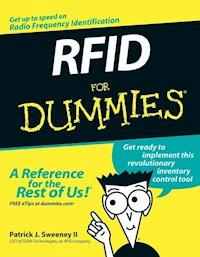
* Many companies have asked suppliers to begin using RFID (radio frequency identification) tags by 2006 * RFID allows pallets and products to be scanned at a greater distance and with less effort than barcode scanning, offering superior supply-chain management efficiencies * This unique plain-English resource explains RFID and shows CIOs, warehouse managers, and supply-chain managers how to implement RFID tagging in products and deploy RFID scanning at a warehouse or distribution center * Covers the business case for RFID, pilot programs, timelines and strategies for site assessments and deployments, testing guidelines, privacy and regulatory issues, and more
Sie lesen das E-Book in den Legimi-Apps auf:
Seitenzahl: 657
Veröffentlichungsjahr: 2010
Ähnliche




















RFID For Dummies
by Patrick J. Sweeney II
RFID For Dummies®
Published by Wiley Publishing, Inc. 111 River Street Hoboken, NJ 07030-5774 www.wiley.com
Copyright © 2005 by Wiley Publishing, Inc., Indianapolis, Indiana
Published by Wiley Publishing, Inc., Indianapolis, Indiana
Published simultaneously in Canada
No part of this publication may be reproduced, stored in a retrieval system or transmitted in any form or by any means, electronic, mechanical, photocopying, recording, scanning or otherwise, except as permitted under Sections 107 or 108 of the 1976 United States Copyright Act, without either the prior written permission of the Publisher, or authorization through payment of the appropriate percopy fee to the Copyright Clearance Center, 222 Rosewood Drive, Danvers, MA 01923, (978) 750-8400, fax (978) 646-8600. Requests to the Publisher for permission should be addressed to the Legal Department, Wiley Publishing, Inc., 10475 Crosspoint Blvd., Indianapolis, IN 46256, (317) 572-3447, fax (317) 572-4355, or online at http://www.wiley.com/go/permissions
Trademarks: Wiley, the Wiley Publishing logo, For Dummies, the Dummies Man logo, A Reference for the Rest of Us!, The Dummies Way, Dummies Daily, The Fun and Easy Way, Dummies.com, and related trade dress are trademarks or registered trademarks of John Wiley & Sons, Inc. and/or its affiliates in the United States and other countries, and may not be used without written permission. All other trademarks are the property of their respective owners. Wiley Publishing, Inc., is not associated with any product or vendor mentioned in this book.
LIMIT OF LIABILITY/DISCLAIMER OF WARRANTY: The publisher and the author make no representations or warranties with respect to the accuracy or completeness of the contents of this work and specifically disclaim all warranties, including without limitation warranties of fitness for a particular purpose. No warranty may be created or extended by sales or promotional materials. The advice and strategies contained herein may not be suitable for every situation. This work is sold with the understanding that the publisher is not engaged in rendering legal, accounting, or other professional services. If professional assistance is required, the services of a competent professional person should be sought. Neither the publisher nor the author shall be liable for damages arising herefrom. The fact that an organization or Website is referred to in this work as a citation and/or a potential source of further information does not mean that the author or the publisher endorses the information the organization or Website may provide or recommendations it may make. Further, readers should be aware that Internet Websites listed in this work may have changed or disappeared between when this work was written and when it is read.
For general information on our other products and services, please contact our Customer Care Department within the U.S. at 800-762-2974, outside the U.S. at 317-572-3993, or fax 317-572-4002.
For technical support, please visit www.wiley.com/techsupport.
Wiley also publishes its books in a variety of electronic formats. Some content that appears in print may not be available in electronic books.
Library of Congress Control Number: 2005921609
ISBN: 0-7645-7910-X
Manufactured in the United States of America
10 9 8 7 6 5 4 3 2 1
1O/RU/QT/QV/IN
About the Author
As you may have guessed by the dangling participles and misused gerunds, this is the first book by Patrick J. Sweeney II (despite Amazon’s link to books on gynecology by an author of the same name). When not negotiating with his editor to push back book deadlines, he leads ODIN technologies as President and CEO.
ODIN technologies is a global RFID software and services company focusing on RFID infrastructure. Mr. Sweeney is well recognized as a visionary in the RFID industry with several RFID patents in various stages of approval. He has appeared in such publications as CIO Magazine,The Washington Post, Fortune magazine, Internet Week, and many others. He has been interviewed by ABC news and CNN, among others, and is a frequent speaker worldwide on all topics relating to RFID. He is also an active member of several standards bodies and regulatory groups helping to shape the evolution of the RFID industry.
Mr. Sweeney is a second-generation IT professional; his father was one of the first employees at Electronic Data Systems (EDS), where “Pops” entertained him and his brother on weekends by teaching them to read punch cards and other useful skills. Mr. Sweeney took that genetic proclivity toward data centers and started a successful, secure managed hosting company in the late 1990s, which he later sold. His brother took that same early training and started XS Speed Choppers, making custom motorcycles — go figure.
Mr. Sweeney finished second in the 1996 Olympic trials in the single scull, is an avid outdoorsman, enjoys helping other entrepreneurs, and is passionate about various Irish causes. He is a board member of Trinity College business school in Dublin, Ireland, and an Alumni Board member at the Darden School of Business at the University of Virginia. He graduated from Darden and received a Bachelor of Science degree from the University of New Hampshire. He is blessed with a great family—wife Christen, daughter Shannon, son P.J., and three dogs. They live in Middleburg, Virginia, in a house full of useless RFID gadgets.
Dedication
This book is dedicated to everyone who makes the dream of entrepreneurship and innovation possible, from the brave men and women defending our freedom in the armed forces, police, and fire departments to college professors, mentors, and angel investors.
Topping the list of people who make entrepreneurship (and crazy book projects) possible are loving, understanding, and helpful spouses like mine. This book is especially dedicated to my beautiful wife Christen, who helps and supports me as I build companies, write books, and travel around the world chasing birds and the Red Sox.
Author’s Acknowledgments
First and foremost my family gets a big thanks for letting me bang away on the laptop during dinner, in bed, and at other times made awkward because an electronic device is the center of my world instead of them. Thanks Betty, Shannon, and P.J.!
The book flow, formatting, and funniness (I recently learned that there is called alliteration) is largely due to the great work of Becky Huehls at Wiley who was my project editor and learned me all sorts of interesting things about writing.
Of course the book wouldn’t even be possible if not for the guys in ODIN technologies labs; Bret, Charles, Nick, Ray, Dave, and the rest of the crew played an invaluable role, and they deserve a ton of updog.
I could not have written such a comprehensive book on this diverse technology without significant contributions from some first-class industry experts. Many of these folks contributed an entire chapter to the book, so although the pronoun “I” is used throughout the book to stay consistent with Wiley’s For Dummies style, much of the credit goes to an amazing team of contributors:
Earl Cox Scianta Intelligence www.scianta.comwww.autoidlabsus.org
Daniel Engels, Ph.D. Robert Goodman Yankee Group www.yankee.com
Pat King, Ph.D. Bob Brescia Michelin US www.michelin.com
Sharyn Leaver Forrester www.forrester.com
Chris Fennig ODIN technologies www.odintechnologies.com
I also thank God for blessing me with great family and friends who helped me get to a position where taking on this project became a reality. Thanks Mom and Pops, Blanche, MAF, Jimbo, Shelley, Rusty, Vas and Linda, Chris and Kate, Gregg, John M, David B, Robert, Zohar and Sam, Bernard, Charles, Murph, Melchoir, Bo, Dr. R, and everyone else who helped me get here.
Publisher’s Acknowledgments
We’re proud of this book; please send us your comments through our online registration form located at www.dummies.com/register/.
Some of the people who helped bring this book to market include the following:
Acquisitions, Editorial, and Media Development
Project Editor: Rebecca Huehls
Acquisitions Editor: Melody Layne
Copy Editor: Andy Hollandbeck
Technical Editor: Christopher Bratten
Editorial Manager: Leah P. Cameron
Media Development Manager: Laura VanWinkle
Media Development Supervisor: Richard Graves
Editorial Assistant: Amanda Foxworth
Cartoons: Rich Tennant, www.the5thwave.com
Composition Services
Project Coordinators: Adrienne Martinez, Emily Wichlinski
Layout and Graphics: Carl Byers, Andrea Dahl, Lauren Goddard, Denny Hager, Joyce Haughey, Lynsey Osborn, Melanee Prendergast
Proofreaders: Laura Albert, Leeann Harney,Jessica Kramer, Linda Morris, Carl William Pierce
Indexer: TECHBOOKS Production Services
Special Help: Kim Darosett, Teresa Artman
Publishing and Editorial for Technology Dummies
Richard Swadley, Vice President and Executive Group Publisher
Andy Cummings, Vice President and Publisher
Mary Bednarek, Executive Acquisitions Director
Mary C. Corder, Editorial Director
Publishing for Consumer Dummies
Diane Graves Steele, Vice President and Publisher
Joyce Pepple, Acquisitions Director
Composition Services
Gerry Fahey, Vice President of Production Services
Debbie Stailey, Director of Composition Services
Contents
Title
Introduction
About This Book
Who This Book Is For
You Don’t Need a Slide Rule and Pocket Protector to Use This Book
How This Book Is Organized
Icons Used in This Book
Part I : Now That You Can Spell RFID, Here’s the Rest of the Story
Chapter 1: Taking the Mystery out of RFID
What Is RFID?
Sizing Up the Benefits of RFID
Mandates, Womendates, Blind Dates — Forcing Efficiency
Calling All Physicists! Calling All Physicists!
Finding Success with Four Ps in a Pod
A Ride in the Time Machine
Chapter 2: Auto-ID Technologies: Why RFID Is King of the Hill
Planning an Auto-ID Strategy for the Times
To EPC or Not to Be: Unraveling the Words, Words, Words of the Electronic Product Code
Addressing Privacy Concerns
Chapter 3: Making Basic Decisions about Your RFID System
Midas Touch Points: Where RFID Impacts Your Organization
What’s the Frequency, Kenneth?
Speed, Accuracy, or Distance — Pick Two
Now What about the Tags and Objects?
Part II : Ride the Electromagnetic Wave: The Physics of RFID
Chapter 4: What Makes Up an RFID Network
Elements of a Basic RFID System
Time to Make Some Waves — Electromagnetic Waves
Chapter 5: Understanding How Technology Becomes a Working System
Anatomy of a Passive Tag: Understanding How It Works and Choosing the Right One
Tracking the Tags with a Reader
Air in Her Face — Blowing Sweet Nothings
Chapter 6: Seeing Different RFID Systems at Work
Setting Up RFID Interrogation Zones
From Ski Resorts to Airlines: Applying RFID in the Real World
Part III : Fitting an RFID Application into Your World
Chapter 7: Seeing the Invisible: The Site Assessment
Planning for Your Site Assessment
Measuring for AEN during Normal Operations (And Beyond)
Testing to Plan Your RFID Installation
Chapter 8: Testing One, Two, Three: Developing Your Own Lab
To Lab or Not to Lab
Beyond a Swanky White Lab Coat: The Tools You Need for Successful Testing
Setting Up Your Lab
Chapter 9: Tag, You’re It: Testing for Best Tag Design and Placement
Ready, Set, Test!
Looking at the Material Composition of the Items You’re Tagging
Choosing a Tag to Test
Testing Tags in an Applications Test Facility
Frequency Response Characterization: Testing Tags with Physics
Encoding and Applying Tags
The Secrets of Read Success
Chapter 10: Hooked on Phonics: Reader Testing, Selection, and Installation
Choosing a Hand-held, Mobile, or Fixed-location Reader
Reading between the Lines: Critical Buying Criteria
Installing a Reader and Antennas
Chapter 11: Middle Where? It’s Not Just about the Readers
Filter, Smooth, Route: Understanding What You Need Middleware to Do
Exploring Middleware Vendors and Their Offerings
Piecing Together a Middleware Architecture
Getting the Most from Your RFID Middleware
Part IV : Raising the Beams for Your Network
Chapter 12: From Pilot to Admiral: Deploying RFID Successfully
Creating a Pilot Project Plan
Factors for a Successful Pilot Test
Moving from Pilot to Production
Chapter 13: Getting Set to Administer and Maintain Your System
Configuring and Setting Up Tag Readers
Getting the Digits
Applying Tags to Objects
Sending Objects through Your Business
School’s in Session — Training Your Staff
Chapter 14: Ping-pong, the Tags Are Gone: How to Monitor Your RFID Network
Why Monitor an RFID Station?
Setting Up Two Types of Monitoring
Checking That a Reader Is Active
Measuring and Interpreting System Behavior
Part V : How to Speak Bean Counter
Chapter 15: Making the Business Case
Finding the First-Round Draft Picks for Your RFID Team
A Game Plan Is More Than Xs and Os — Use a Proven Methodology
Chapter 16: Fitting RFID into Strategic Plans
Just in Time to Justify: Overcoming Skepticism with Strategic Thinking
Calculating ROI — A Tactical Approach to RFID
Tag and You’re It: RFID as a Competitive Strategy
Chapter 17: What to Look for When Considering Outsourcing
Why Outsource Your RFID Network?
Identifying and Avoiding the Risks
Is Outsourcing Right for You?
Finding the Perfect Match
Sealing the Deal with an SLA
Part VI : The Part of Tens
Chapter 18: Ten (Or So) Equipment Vendors
Alien Technology
ACCU-SORT
Applied Wireless Identifications (AWID)
FOX IV Technologies
Impinj
Intermec Technologies
MARKEM
Symbol Technologies, Inc. (Formerly Matrics)
ODIN technologies
OMRON electronics
SAMSys Technologies
Texas Instruments (TI)
ThingMagic
Chapter 19: Ten Web Sites for Information on RFID
RFID Journal Online
EPCglobal
IDTechEx
RFID Solutions Online
RFID Exchange
RFID Update
Auto-ID Labs
Auto-ID Lab @ Adelaide
The RFID Gazette
UCLA’s RFID@WINMEC site
Slashdot
Chapter 20: Ten Tips from the Experts
Chris Fennig, ODIN technologies
Joe White, Symbol Technologies (Formerly Matrics, Inc.)
Duncan McCollum, Computer Sciences Corporation (CSC)
Dr. Daniel Engels, MIT Auto-ID Labs
Dr. Patrick King, Michelin Tire Corporation
Steve Kowalke, ACCU-SORT Systems
Team Tag-IT, Texas Instruments
Kevin MacDonald, Lead RFID Architect, Sun Microsystems
Mark Nelson, Savi Technology
Chapter 21: Ten (Or So) RFID Standards and Protocols
EAN.UCC
EPCglobal
UCCnet
ISO/IEC JT1/SC17
ISO/IEC JTC1/SC31/WG4
AIAG
Container Shipments
Appendix: Glossary of Electrical, Magnetic, and Other Scientific Terms
Introduction
S omewhere, separated from you by just a few degrees, is not Kevin Bacon, but an 800-pound gorilla demanding that you adopt radio frequency identification, or RFID — a technology you may have never even heard of until just a few months ago. Chances are that gorilla wears a stylish blue smock with a yellow smiley face on it and greets you with a “Welcome to Wal-Mart.” If not Wal-Mart, the US Department of Defense, Target, Albertsons, Best Buy, Tesco, Metro, the FDA or a number of other companies may be requiring you to implement this technology by a certain deadline. If you don’t have a mandated deadline for adopting RFID, consider yourself lucky. You can discover and make decisions about this exciting technology based on your normal process for evaluating new business tools.
Whatever your situation is, you either want or need to set up an RFID network. So you went out and picked up RFID For Dummies and are ready to go — yippee!
About This Book
This is a book that is on a mission to take the confusion out of RFID. RFID is based on well-known laws of physics. It’s easy to understand how things work after you get your arms around those basics. The better news is that the technology works really well if you know what you’re doing. So without sending you to MIT for a couple of years of RF engineering school, this book explains everything you need to know to start setting up and deploying your own RFID network — what more could you ask for?
Who This Book Is For
Whether you are just curious, scared, worried, or simply mad at the prospect of implementing yet another new technology — even if you know nothing about RFID — RFID For Dummies is here to help. And, unlike a similar promise by the IRS, this book really will help. You find out what RFID is, what it does, and how it works. I guide you through the concepts and ideas in plain English, walk you through the basics of RFID from a business perspective, and speculate on where this technology is headed (although I do, from time to time, provide sufficient Geek Speak for the engineers and systems guys who, no doubt reluctantly, bought this book in an attempt to actually understand the mechanics of Radio Frequency Identification).
If you know the basics about running a laptop or PC and know what an IP address is, you are armed with just about all you need to know to initially set up an RFID network. If you have any background in physics and understand some things from an electronics perspective, you’ve got a running start. I assume that you come from a supply chain or warehouse background and might not have a detailed IT background.
You Don’t Need a Slide Rule and Pocket Protector to Use This Book
Other than the willingness to learn and basic knowledge, you need some equipment to set up your RFID network and follow some of the processes outlined in this book. At some point, plan to get
A spectrum analyzer (discussed in Chapter 8)
A budget to buy an RFID reader, antennas, tags, and a rack (about $7,500 total)
An area large enough to begin testing and using the equipment (at least 20 feet x 20 feet)
Another person to help you occasionally try out the technology
A penchant for experimentation and thirst for knowledge
How This Book Is Organized
RFID For Dummies is broken into six different parts. If you are new to the technology, it is helpful to read the parts in sequential order. If you have a physics or RF background and you want to get into the nuts and bolts of the technology, skip right to Part II and then move on to Part III. If you are trying to justify the RFID project, you may want to go right to Part V, which addresses some of the business concerns around strategic planning and ROI. You can read all the technical chapters in Parts II and III by themselves and use them for reference, as well as the last part, the Part of Tens. Here’s a quick rundown of what you’ll find in each part.
Part I: Now That You Can Spell RFID, Here’s the Rest of the Story
This part introduces the basics of RFID. In Chapter 1, you find an overview of the technology, what advantages are driving the mandates, and a blueprint for implementing RFID, which I call the four Ps. In Chapter 2, I explain how RFID fits into the world of Auto-ID technology and explain some of the basics about the protocols that make it work. Chapter 3 helps you start assessing the impact RFID will have on your business and helps you make some basic decisions about how you’ll use RFID.
Part II: Ride the Electromagnetic Wave: The Physics of RFID
In this part, I peel away the layers of RFID to uncover the underlying science of RFID. This part gives you the physics knowledge you need in order to design your network for optimal performance and make wise purchases. In Chapter 4, you can find an overview of how the physics of RFID systems work. Chap- ter 5 digs a little deeper by delving it parts inside each of the key components of a system. Whereas Chapters 4 and 5 focus on the invisible realm of electromagnetic waves, Chapter 6 is focused squarely in warehouse or marketplace, covering common setups of RFID systems and case studies so that you can learn from early adopters.
Part III: Fitting an RFID Application into Your World
This part is your key to designing an RFID network specifically for your environment and needs. In Chapter 7, I walk you through the process of testing for electromagnetic noise in your warehouse or building using a spectrum analyzer. Chapter 8 helps you set up a lab (or find one you can use) so that you test for the right tag (Chapter 9) and tag reader (Chapter 10). And last but not least, Chapter 11 helps you wend your way through maze of middleware (the software the connects the RFID network) by explaining what features to look for and how to fit middleware into your network architecture.
Part IV: Raising the Beams for Your Network
This part walks you through the process of actually implementing your carefully planned-out RFID network. Chapter 12 explains a few project management tools that will keep your trial run and follow-up network designs on schedule. Chapter 13 covers the process of setting up the hardware in the warehouse, or other real-world setting (as opposed to a lab), and how to train your employees to use the new system. And Chapter 14 explains now to set up monitoring systems for both operators and system administrators, so that your system keeps running strong, and thus helps your bottom line.
Part V: How to Speak Bean Counter
Deploying an RFID system is a big project, and the bottom line needs to drive your implementation. This part walks you through the key RFID-related business decisions you need to make. In Chapter 15, I explain who in your organization needs to be involved in these decisions and walk you through a nine-step process for building and presenting a business case study. In Chapter 16, I explain strategic benefits you need to include in the business case in more detail, including how to calculate return on investment, or ROI, for all the money you’re about to spend on RFID hardware and software. Chapter 17 is your guide to outsourcing: I explain how you decide whether to outsource, what to look for in an outsourcing partner, and how to seal the deal.
Part VI: The Part of Tens
No For Dummies book is complete without a Part of Tens. The four chapters in this part offer (more or less) ten equipment vendors to assess, ten of the best RFID-related Web sites, ten tips from RFID experts who are part of that rare fraternity that has actually done real-world deployments and lived to tell about it, and ten standards and protocols for RFID that you may want to investigate.
In the back of this book, you can also find a glossary of electrical, magnetic, and scientific terms. So if, in your RFID reading, you come across terminology that leaves you baffled, you can use this glossary as a handy resource.
Icons Used in This Book
Throughout this book, you find icons in the margins, marking specific paragraphs. Here’s what those icons indicate:
The Tip icon marks tips and shortcuts that you can use to make your RFID installation, testing, and implementation easier.
Remember icons mark the information that’s especially important to know. To siphon off the most important information in each chapter, just skim through these icons.
The Technical Stuff icon marks information of a highly technical nature that you can normally skip over unless you have a closet desire to geek out on radio frequency. But face it: If you’re reading about RFID, you’re probably a technical-minded person. If this is the case, you’re more likely to skip to this icon instead of skipping over it.
The Warning icon tells you to watch out! It marks important information that may save you headaches, long talks with government officials, and maybe even bodily injury.
The Case Study icon points out real-life examples of how RFID has been used (and misused) in the marketplace.
Part I
Now That You Can Spell RFID, Here’s the Rest of the Story
In this part . . .
P art I gets you prowling down the path to RFID adoption. In these three chapters, you become acquainted with the basics of the technology and understand how it compares to other automatic identification (Auto-ID) technologies. I explain why RFID has blossomed into the latest and greatest technology since the electric toaster. You also find out why so many people need to adopt this technology in such a short period of time.
The last chapter of Part I shows you, in simple, easy-to-understand terms, how to compare the different RFID networking and technology systems. This serves as a primer for more detailed discussions later in the book.
Chapter 1
Taking the Mystery out of RFID
In This Chapter
Discovering RFID
Getting a handle on the technology
Figuring out what you need to know
Knowing what to expect in the future
W ith all the recent hype over radio frequency identification (RFID) and the requirements to implement it, you might think that RFID can turn water into wine, transform lead into gold, and cure the world’s diseases. You might also be worried that RFID will enable Big Brother to track your movements to within a foot of your location from a satellite five hundred miles up in space. The truth is, RFID can do none of these things.
In this chapter, you find out the basics of what RFID is, what forces are driving RFID as a replacement for the bar code in the marketplace, and what benefits RFID can offer.
If you are responsible for complying with high-profile mandates from one of your suppliers or customers, this chapter also offers a framework to help you begin setting up a system and making it work within your existing business process. The bad news is that an RFID implementation is a daunting project even at a minimal compliance level, sometimes referred to as slap and ship or, more appropriately, tag and ship. The good news is that the benefits to the business are substantial, particularly if your trading partners are involved. RFID technology is here to stay, so the sooner you understand it, the quicker you can make key strategic decisions for your company.
What Is RFID?
RFID is a very valuable business and technology tool. It holds the promise of replacing existing identification technologies like the bar code. RFID offers strategic advantages for businesses because it can track inventory in the supply chain more efficiently, provide real-time in-transit visibility(ITV), and monitor general enterprise assets. The more RFID is in the news, the more creative people are about its potential applications. For example, I recently heard from someone who wanted to use RFID to track fishing nets in the North Sea.
The origins of RFID in inventory tracking
Wal-Mart has spent millions of dollars since the late 1990s researching the efficacy of RFID systems to replace bar codes (which have been in use since the days of The Brady Bunch and Gilligan’s Island — that’s the early 1970s, for those of you with all your hair left).
In 1999, with the help of scientists at the Massachusetts Institute of Technology (MIT), a consortium of companies formed the Auto-ID Center — a center for continued research into the nature and use of radio frequency identification. The consortium had a new idea about how organizations could identify and track their assets. The vision underlying automatic identification (or Auto-ID) is the creation of an “Internet of Objects.” In such a highly connected network, devices dispersed through an enterprise can talk to each other — providing real-time information about the location, contents, destination, and ambient conditions of assets. This communication allows much-sought-after machine-to-machine communication and decision-making, rendering humans unnecessary and mistakes a thing of the past.
Lesen Sie weiter in der vollständigen Ausgabe!
Lesen Sie weiter in der vollständigen Ausgabe!
Lesen Sie weiter in der vollständigen Ausgabe!
Lesen Sie weiter in der vollständigen Ausgabe!
Lesen Sie weiter in der vollständigen Ausgabe!
Lesen Sie weiter in der vollständigen Ausgabe!
Lesen Sie weiter in der vollständigen Ausgabe!
Lesen Sie weiter in der vollständigen Ausgabe!
Lesen Sie weiter in der vollständigen Ausgabe!
Lesen Sie weiter in der vollständigen Ausgabe!
Lesen Sie weiter in der vollständigen Ausgabe!
Lesen Sie weiter in der vollständigen Ausgabe!
Lesen Sie weiter in der vollständigen Ausgabe!
Lesen Sie weiter in der vollständigen Ausgabe!
Lesen Sie weiter in der vollständigen Ausgabe!
Lesen Sie weiter in der vollständigen Ausgabe!
Lesen Sie weiter in der vollständigen Ausgabe!
Lesen Sie weiter in der vollständigen Ausgabe!
Lesen Sie weiter in der vollständigen Ausgabe!
Lesen Sie weiter in der vollständigen Ausgabe!
Lesen Sie weiter in der vollständigen Ausgabe!
Lesen Sie weiter in der vollständigen Ausgabe!
Lesen Sie weiter in der vollständigen Ausgabe!
Lesen Sie weiter in der vollständigen Ausgabe!
Lesen Sie weiter in der vollständigen Ausgabe!
Lesen Sie weiter in der vollständigen Ausgabe!




