


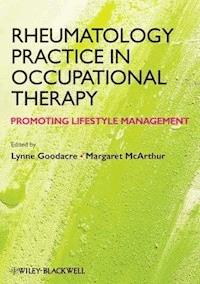
Rheumatology Practice in Occupational Therapy E-Book
37,99 €
Mehr erfahren.
- Herausgeber: John Wiley & Sons
- Kategorie: Fachliteratur
- Sprache: Englisch
Rheumatology Practice in Occupational Therapy: Promoting Lifestyle Management is a valuable new
handbook focusing on rheumatology, a core area of occupational therapy practice. It provides practical guidance to help occupational therapists treat and manage rheumatic conditions in both clinical and community settings and emphasises a contemporary ‘client-centred’ approach as a fundamental requirement of effective and rewarding occupational therapy practice.
Drawing upon personal, clinical and theoretical perspectives, Rheumatology Practice in Occupational Therapy equips the reader with an understanding of the relevant practical skills and of the clinical reasoning required to modify and apply these skills to the needs of individual people. Written by experts from occupational therapy, sociology and psychology, this book addresses the need to adapt occupational therapy interventions to each client’s own experience of living with a rheumatic condition and develops the reader’s understanding of key theoretical and clinical approaches to person-centred management.
Rheumatology Practice in Occupational Therapy is essential reading for all occupational therapists helping people with rheumatic conditions in hospital and community settings, and for students preparing for practice. It will also be of interest to other healthcare professionals working with people with these conditions.
• Includes personal narratives of people trying to live their lives within the context of a debilitating condition
• Promotes understanding of key theoretical and clinical approaches to person-centred management
• Written by authors with extensive experience in clinical and research contexts
• Offers practical resource sections at the end of each chapter
Related titles
Occupational Therapy and Older People, 2nd Edition
Anita Atwal, Anne McIntyre
978-1-4443-3333-6
Role Emerging Occupational Therapy: Maximising Occupation Focused Practice
Miranda Thew, Mary Edwards, Sue Baptiste, Matthew Molineux
978-1-4051-9782-3
Interprofessional Rehabilitation: A Person-Centred Approach
Sarah G. Dean, Richard J. Siegert, William J. Taylor
978-0-470-65596-2
Sie lesen das E-Book in den Legimi-Apps auf:
Seitenzahl: 434
Veröffentlichungsjahr: 2013
Ähnliche




















Contents
Notes on contributors
Preface
Acknowledgements
Chapter 1: Living with a rheumatic disease: the personal perspective
1.1 Introduction
1.2 Living with a rheumatic condition
1.3 Developing new skills and learning
1.4 Summary
Chapter 2: Living with rheumatic diseases: the theoretical perspective
2.1 Introduction
2.2 Understanding and being understood
2.3 The impact of a rheumatic condition on a person’s sense of self
2.4 The experience of living with a rheumatic condition
2.5 Acknowledge the loss, promote the gain
Chapter 3: Understanding rheumatic diseases: the occupational therapy perspective
3.1 The centrality of occupation
3.2 Occupational potential
3.3 Occupational science
3.4 Understanding need
3.5 Occupational identity
3.6 Occupational adaptation
3.7 Occupational balance
3.8 Occupational gain
3.9 Clinical reasoning – the thinking that guides practice
3.10 Personal perspectives
Chapter 4: Managing rheumatic conditions: the policy perspective
4.1 Introduction
4.2 Increase in the ageing population
4.3 Increase in long-term conditions
4.4 The delivery of efficient client-centred approaches to health and social care
4.5 Shaping policy to meet the needs of people with rheumatic conditions
4.6 Conclusions
Chapter 5: Occupational therapy assessment and outcome measurement
5.1 Introduction
5.2 Outcome measurement: the policy context
5.3 The occupational therapy assessment process
5.4 Commonly used data-collection tools
5.5 Factors influencing the choice of data-collection tool
5.6 Summary
Chapter 6: Psychological approaches to understanding and managing rheumatic conditions
6.1 Introduction
6.2 Health psychology and biopsychosocial perspectives
6.3 Coping with illness
6.4 Transactional model of stress
6.5 Self-efficacy and hardiness
6.6 Locus of control
6.7 Crisis theory
6.8 Coping styles
6.9 Moving beyond coping: hope
6.10 Conclusion
Chapter 7: Approaches to promoting behaviour change
7.1 Introduction
7.2 Relevance to occupational therapists
7.3 Health behaviour change
7.4 Social Cognition theories
7.5 Implications for practice
7.6 Implications for practice
7.7 Motivational interviewing
7.8 Clinical example of the TTM
7.9 Limitations of the TTM
7.10 Conclusion
Chapter 8: Joint protection
8.1 Introduction
8.2 What is joint protection?
8.3 The aims of joint protection
8.4 Why and when to use joint protection
8.5 Joint protection and energy conservation principles
8.6 Understanding and perceptions of joint protection
8.7 Goals of joint protection education
8.8 Evidence for joint protection effectiveness
8.9 The Looking After Your Joints Programme and the Lifestyle Management for Arthritis Programme
8.10 Teaching joint protection
8.11 Practical techniques
8.12 Conclusion
Chapter 9: Pain management
9.1 Introduction
9.2 What is pain?
9.3 Pain and rheumatology
9.4 Living with rheumatic pain
9.5 Pain assessment
9.6 Pain and occupational therapy
9.7 Patient education
9.8 Fatigue management
9.9 Sleep hygiene
9.10 Medication
9.11 Changing behaviour
9.12 Vocational rehabilitation
9.13 Psychological interventions
9.14 Social support
9.15 Summary
Chapter 10: Maintaining independence
10.1 Introduction
10.2 What is assistive technology?
10.3 Reducing non-use of assistive technology
10.4 Matching person and technology
10.5 Applying the MPT to AT for people with rheumatic conditions
10.6 Assistive technology outcomes
10.7 Methods of obtaining AT
10.8 Commonly used AT and home adaptations for people with rheumatic conditions
10.9 Inclusive design
10.10 Conclusion
Chapter 11: Vocational rehabilitation
11.1 Introduction
11.2 The importance of employment
11.3 The current context of vocational rehabilitation
11.4 Predictors of work disability and work instability
11.5 Vocational rehabilitation
11.6 Occupational therapy and vocational rehabilitation
11.7 Work evaluation and monitoring
11.8 Condition-specific interventions
11.9 Work-specific interventions
11.10 Advice on redeployment or retraining
11.11 Counselling and advocacy
11.12 Post-work support
11.13 Summary
Chapter 12: Rheumatology splinting
12.1 Introduction
12.2 Splinting rationale
12.3 Clinical decision making
12.4 Approaches to evaluation
12.5 Splint construction
12.6 Summary
Chapter 13: Maintaining a sense of self
13.1 Introduction
13.2 Impact of rheumatic conditions on body experience
13.3 An introduction to strategies to increase confidence in personal presentation and clothing style
13.4 The impact of rheumatic conditions on personal and sexual relationships
13.5 Conclusions
Index
This edition first published 2013 © 2013 by John Wiley & Sons, Ltd
Wiley-Blackwell is an imprint of John Wiley & Sons, Ltd, formed by the merger of Wiley’s global Scientific, Technical and Medical business with Blackwell Publishing, Ltd.
Registered OfficeJohn Wiley & Sons, Ltd, The Atrium, Southern Gate, Chichester, West Sussex, PO19 8SQ, UK
Editorial Offices9600 Garsington Road, Oxford, OX4 2DQ, UKThe Atrium, Southern Gate, Chichester, West Sussex, PO19 8SQ, UK2121 State Avenue, Ames, Iowa 50014-8300, USA
For details of our global editorial offices, for customer services and for information about how to apply for permission to reuse the copyright material in this book please see our website at www.wiley.com/wiley-blackwell.
The right of the author to be identified as the author of this work has been asserted in accordance with the UK Copyright, Designs and Patents Act 1988.
All rights reserved. No part of this publication may be reproduced, stored in a retrieval system, or transmitted, in any form or by any means, electronic, mechanical, photocopying, recording or otherwise, except as permitted by the UK Copyright, Designs and Patents Act 1988, without the prior permission of the publisher.
Designations used by companies to distinguish their products are often claimed as trademarks. All brand names and product names used in this book are trade names, service marks, trademarks or registered trademarks of their respective owners. The publisher is not associated with any product or vendor mentioned in this book.
Limit of Liability/Disclaimer of Warranty: While the publisher and author(s) have used their best efforts in preparing this book, they make no representations or warranties with respect to the accuracy or completeness of the contents of this book and specifically disclaim any implied warranties of merchantability or fitness for a particular purpose. It is sold on the understanding that the publisher is not engaged in rendering professional services and neither the publisher nor the author shall be liable for damages arising herefrom. If professional advice or other expert assistance is required, the services of a competent professional should be sought.
Library of Congress Cataloging-in-Publication data has been applied for
ISBN: 9780470655160
A catalogue record for this book is available from the British Library.
Wiley also publishes its books in a variety of electronic formats. Some content that appears in print may not be available in electronic books.
Cover image: iStockphoto/CactuSoupCover design by Meaden Creative
Notes on contributors
Jo Adams is Professional Lead for Occupational Therapy at the University of Southampton. She is an experienced musculoskeletal researcher and has a special interest in the clinical effectiveness of rehabilitation interventions.Sarah Bradley is an Advanced Occupational Therapy Practitioner in Hand Therapy at Poole Hospital NHS Foundation Trust. She has over 20 years experience as an Occupational Therapist in hand therapy and has a special interest in the impact of rheumatic conditions in the hand and their therapeutic management.Sarah Drake is a lecturer in Occupational Therapy at the University of East Anglia (UEA) specialising in psychology, sociology, occupational engagement and mental health. She has a special interest in predicting behaviour change, with a focus on factors that influence a person’s intention to change.Lynne Goodacre is an Occupational Therapist and Research Fellow at Lancaster University. She has worked clinically in rheumatology and the voluntary sector and developed a research programme exploring the experiences of living with and managing rheumatic conditions.Alison Hammond is an Occupational Therapist and researcher at the University of Salford. She has particular interests in client education, joint protection, work rehabilitation, development of outcome measures and the evaluation of interventions through using clinical trials and mixed methods.Janet Harkess is Head Occupational Therapist, Fife Rheumatic Diseases Unit. The Occupational Therapy service has provided a vocational rehabilitation service for the last 18 years.Deborah Harrison is an Occupational Therapist is a lecturer at the University of East Anglia where she teaches psychology, mental health practice and qualitative research. She has extensive experience of working in mental health services.Jill Jepson is a lecturer in occupational therapy at the University of East Anglia (UEA). She has worked in a variety of hospital, community and voluntary sector settings. Prior to joining UEA, she worked for the Bath Institute of Medical Engineering on assistive technology design and development.Margaret McArthur is Director of the MSc pre-registration Occupational Therapy programme at the University of East Anglia. She has represented Occupational Therapy in a variety of profession-specific and other healthcare contexts. She has developed a programme of research related to management of change in long-term illness.Lucy Reeve is an Occupational Therapist and works as a Specialist Lupus Practitioner at the Norfolk and Norwich University Hospital and as an Associate Tutor at the University of East Anglia.Annette Sands is Therapy Lead at Wrightington, Wigan and Leigh NHS Foundation Trust. She is an Occupational Therapist with over 30 years experience of working in rheumatology and orthopaedics.Penny Sloane is an Image Consultant and Personal Brand Coach. She is a qualified Master of the Federation of Image Professionals and a founder member of the Association of Stylists and Image Professionals.
Preface
The focus of this book is on locating occupational therapy interventions within the context of the personal experience of living with and managing a rheumatic condition. Our aim is to draw upon personal, clinical and theoretical perspectives to develop the reader’s understanding not only of relevant clinical skills but of the clinical reasoning which is required to adapt and apply these skills within the context of individual client’s experiences of living with a rheumatic condition. The book focuses on a person-centred approach and draws upon perspectives from occupational therapy, occupational science, health and social care policy, sociology and psychology.
We have spent a significant amount of time, within clinical and research contexts, listening to the personal narratives of people with rheumatic conditions who are trying to make sense of what is happening to them and to live their lives within the context of such challenges. This has introduced us to a different way of thinking about these conditions and what working in a truly person-centred way means. Many publications, by focusing on the development of clinical skills, lose sight of the challenges of integrating clinical approaches into the evolving context of people’s lives. We suggest that this is fundamental to the ethos of the practice of occupational therapy and a central tenet of this book.
The first section of the book is designed to introduce readers to different perspectives of living with and managing a rheumatic condition, drawing upon the personal narratives of clients and therapists to explore these issues in detail. The importance of narrative is encompassed within the philosophy of occupational therapy where it is recognised that clients can be helped through the telling of stories. The first section also locates the management of rheumatic conditions within relevant theoretical and policy contexts shaping current approaches to the management of long-term conditions.
The second section of the book is focused on specific occupational therapy interventions with contributions. Throughout this section, each chapter provides insights into clinical reasoning and provides not only evidence-based information about the interventions but also the rationale behind their use. Contributors offer considerable experience in the management of long-term conditions, and many of the chapters are co-authored by an academic and clinical occupational therapist.
We hope that the book provides a unique mixture of personal narrative, theoretical perspectives and clinical skills appropriate to modern health and social care delivery which fosters a reflective critical approach in the reader.
Acknowledgements
Many people have informed the production of this book and helped to bring it to fruition. We would like to thank all of the contributors who have given freely of their time, expertise and experience.
Anyone working in clinical rheumatology will understand the sense of community which is derived from the multidisciplinary team ethos central to this specialty, and the same is true in the world of rheumatology research. Throughout our careers, we have been lucky to have learnt from many colleagues who have helped to develop our skills and expertise. We value greatly being part of this community and hope that in some small way this book makes a positive contribution to informing and developing current and future practice within this specialty.
However, it is the clients with whom we have worked, in both our clinical and academic lives, to whom we owe the greatest debt of gratitude. They have both informed our practice, challenged our thinking and opened up their homes and their lives to us, and it is to them that we dedicate this book.
Chapter 1
Living with a rheumatic disease: the personal perspective
Lynne Goodacre1and Margaret McArthur2
1Lancaster University, Lancaster, United Kingdom;2University of East Anglia, Norfolk, United Kingdom
1.1 Introduction
Attention to human suffering means attention to stories, for the ill and their healers have many stories to tell…. The need to narrate the strange experience of illness is part of the very human need to be understood by others, to be in communication even if from the margins (Mattingly 1998, p. 1).
The aim of this chapter is to ensure that your focus is, from the outset, on the personal experience of living with a rheumatic condition illustrated by composite narratives informed by the many personal stories we have listened to and collected in the conduct of our research. We are conscious that in adopting this approach, we depart from the traditional structure of many clinical textbooks which usually start with an overview of the aetiology, pathology and clinical management of impairments. However, as suggested by Frank, ‘not all stories are equal. The story of illness that trumps all others…is the medical narrative’ (1995, p. 5). In a clinical textbook, it is easy for the clinical/medical narrative to dominate, and even though occupational therapy practice is informed by person-centred working, the voice of the person is often lost within the clinical story.
As occupational therapists who have worked clinically in rheumatology before moving into research, we are struck by the different narratives we hear when undertaking research to those we heard within our daily clinical practice. As researchers, we are alert to the emerging stories shared with us and those we work with are more obviously aware of their role as storyteller. Within our therapeutic encounters, some of these stories are unconscious revelations which still require due care and attention as highlighted by the following example. On a project looking at the social interaction of the client/practitioner relationship, there was an observation of a health professional taking the initial history of a woman who was being admitted to an inpatient rheumatology unit:
Interviewer, I; Hattie, HI: Who is your next of kin?H: Not my eldest daughter, she done my husband’s funeral. She gets so terrible upset so she can’t take no more.
Lesen Sie weiter in der vollständigen Ausgabe!
Lesen Sie weiter in der vollständigen Ausgabe!
Lesen Sie weiter in der vollständigen Ausgabe!
Lesen Sie weiter in der vollständigen Ausgabe!
Lesen Sie weiter in der vollständigen Ausgabe!
Lesen Sie weiter in der vollständigen Ausgabe!
Lesen Sie weiter in der vollständigen Ausgabe!
Lesen Sie weiter in der vollständigen Ausgabe!
Lesen Sie weiter in der vollständigen Ausgabe!
Lesen Sie weiter in der vollständigen Ausgabe!
Lesen Sie weiter in der vollständigen Ausgabe!
Lesen Sie weiter in der vollständigen Ausgabe!
Lesen Sie weiter in der vollständigen Ausgabe!




