


34,79 €
Mehr erfahren.
- Herausgeber: Packt Publishing
- Kategorie: Wissenschaft und neue Technologien
- Sprache: Englisch
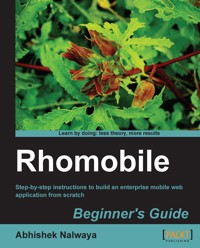
The four Rhomobile products – Rhodes, Rhosync, RhoHub, and Rhogallery – provide a complete toolkit for creating a mobile application. Rhomobile is cross-platform and so allows you to build your application for many different types of smartphone – including iPhone and Blackberry – just with a single codebase. This makes it the most preferred and quickest way of developing mobile apps. As you create a native Rhomobile application, you can use the built-in device features such as GPS, Push, and Camera, all with offline capabilities.Rhomobile Beginner's Guide is filled with practical examples to help you to create a mobile application from scratch. You can choose on which operating system to build, as well as for which smartphone to develop your application, giving you the freedom to create a customized mobile application quickly and easily.Once you have learned how to install Rhomobile on Windows, Mac, or Linux, you will create a simple application, which will be used to explore the products of Rhomobile one by one. Things really get going when you write unit test cases for your application before deploying it to the server and making builds for your chosen Smartphone.
You will learn about the different aspects of Rhomobile, starting with Rhodes 3, which helps you to build a native mobile application. Rhosync 2.1 carries out the offline device capabilities and RhoHub deploys the code on the server and creates a build for the different smartphones.
Rhomobile Beginner's Guide gives you the freedom to create a mobile web application on the platform of your choice, for the smartphone of your choice.
Das E-Book können Sie in Legimi-Apps oder einer beliebigen App lesen, die das folgende Format unterstützen:
Seitenzahl: 227
Veröffentlichungsjahr: 2011
Ähnliche



















Table of Contents
Rhomobile Beginner's Guide
Rhomobile Beginner's Guide
Copyright © 2011 Packt Publishing
All rights reserved. No part of this book may be reproduced, stored in a retrieval system, or transmitted in any form or by any means, without the prior written permission of the publisher, except in the case of brief quotations embedded in critical articles or reviews.
Every effort has been made in the preparation of this book to ensure the accuracy of the information presented. However, the information contained in this book is sold without warranty, either express or implied. Neither the author, nor Packt Publishing, and its dealers and distributors will be held liable for any damages caused or alleged to be caused directly or indirectly by this book.
Packt Publishing has endeavored to provide trademark information about all of the companies and products mentioned in this book by the appropriate use of capitals. However, Packt Publishing cannot guarantee the accuracy of this information.
First published: July 2011
Production Reference: 1180711
Published by Packt Publishing Ltd.
32 Lincoln Road
Olton
Birmingham, B27 6PA, UK.
ISBN 978-1-849515-16-0
www.packtpub.com
Cover Image by Parag Kadam (<[email protected]>)
Credits
Author
Abhishek Nalwaya
Reviewers
Deepak Vohra
Brian Moore
Acquisition Editor
Sarah Cullington
Development Editor
Neha Mallik
Technical Editors
Ajay Shanker
Mohd. Sahil
Project Coordinator
Shubhanjan Chatterjee
Proofreader
Linda Morris
Indexer
Monica Ajmera Mehta
Graphics
Geetanjali Sawant
Production Coordinator
Melwyn D'sa
Cover Work
Melwyn D'sa
About the Author
Abhishek Nalwaya is a Ruby, Rhomobile, and Rails enthusiast. He is a regular participant at Ruby/Rails meetups and has taken technical sessions on Rhodes framework within the company and at Ruby meetups. His blog is listed on the official third-party tutorial section at the Rhomobile site.
He was associated with Tata Consultancy Services and is presently working as an application developer with Column Software Technology. He has worked on many projects providing solutions to Fortune 500 companies using Ruby, Rhodes, and Ruby on Rails.
I would like to express my gratitude to my family and friends especially Akshat Paul, Manu Singhal, and Anuj Bhargava who saw me through this book, who provided support, talked things over, read, wrote, offered comments, without which conceiving this book wouldn't have been possible.
Also, I would like to thank Sarah, Kartikey, Shubhanjan, and the PacktPub team who allowed me to quote their remarks and assisted in the editing, proofreading, and design. Writing a book was not my cup of tea but they made this complicated journey effortless.
About the Reviewers
Deepak Vora is a consultant and a principal member of the NuBean.com Software Company. Deepak is a Sun Certified Java Programmer and Web Component Developer, and has worked in the fields of XML and Java programming and J2EE for over five years. Deepak is the co-author of the Apress book Pro XML Development with Java Technology and was the technical reviewer for the O'Reilly book WebLogic: The Definitive Guide. Deepak was also the technical reviewer for the Course Technology PTR book Ruby Programming for the Absolute Beginner, and the technical editor for the Manning Publications book Prototype and Scriptaculous in Action. Deepak is also the author of the Packt Publishing book JDBC 4.0 and Oracle JDeveloper for J2EE Development, Processing XML documents with Oracle JDeveloper 11g, and EJB 3.0 Database Persistence with Oracle Fusion Middleware 11g.
Brian Moore is a Senior Engineer at Rhomobile, father of two, and quintessential hacker. Brian began coding at the age of 12. His early love for everything technological led to a job with Apple shortly after high school. Since that time Brian has worked at a series of start-ups and tech companies taking on interesting technical challenges. Brian has become the technical face of Rhomobile as he leads the Rhodes community in the latest Rhomobile innovation during the Friday webinars. When not guiding the next generation of Rhodes developers or hacking on a new debugger, Brian can be found climbing a hill in a remote Southern California desert in his baja bug.
www.PacktPub.com
Support files, eBooks, discount offers and more
You might want to visit www.PacktPub.com for support files and downloads related to your book.
Did you know that Packt offers eBook versions of every book published, with PDF and ePub files available? You can upgrade to the eBook version at www.PacktPub.com and as a print book customer, you are entitled to a discount on the eBook copy. Get in touch with us at <[email protected]> for more details.
At www.PacktPub.com, you can also read a collection of free technical articles, sign up for a range of free newsletters and receive exclusive discounts and offers on Packt books and eBooks.
http://PacktLib.PacktPub.com
Do you need instant solutions to your IT questions? PacktLib is Packt's online digital book library. Here, you can access, read and search across Packt's entire library of books.
Why Subscribe?
Free Access for Packt account holders
If you have an account with Packt at www.PacktPub.com, you can use this to access PacktLib today and view nine entirely free books. Simply use your login credentials for immediate access.
Preface
The Rhomobile Beginner's guide will speak to every developer's mind, and especially to the technocrats looking for a reliable cross-platform framework encouraging them to explore and try out these wonderful products by Rhomobile. This book guides you step by step to build an enterprise mobile application from scratch, through to deployment.
What this book covers
Chapter 1, What is Rhomobile?: In this chapter, we will briefly discuss the various products of Rhomobile and their architecture.
Chapter 2, Installation and Configuration—How to Set Off: In this chapter, we will learn to install the necessary softwares that are required before developing our mobile application using Rhomobile.
Chapter 3, Instant Gratification—Create Your First Application: In this chapter, we will create our first application and understand how Rhodes structures the application.
Chapter 4, Rhom—Playing with the Local Database: In this chapter, we'll explore Rhom, which is an Object-Relational Mapping (ORM) provided by Rhodes and take a look at how it manipulates data in our application. We'll find how ORM manages table relationships in this chapter and also dig into the ORM object life cycle.
Chapter 5, RhoSync—Synchronizing your data: In this chapter, we will learn about the synchronization framework RhoSync that keeps application data current and available on user's smart phones. We will create a sample RhoSync application and connect with a Rails application to put the current data on the device.
Chapter 6, Metadata and Push—Creating Agile Views: In this chapter, we will learn about a powerful feature of RhoSync called metadata and also configuring Push messages to the client. We will enhance the application created in the earlier chapter with metadata and Push.
Chapter 7, Native User Interface—Cosmetics for Your Smart Phones: In this chapter, we will learn about Native User Interface for different phones. We will perform device-specific operations to give a more native look to our application.
Chapter 8, Unit Testing and Logging—Writing Better Code: In this chapter, we will learn about testing and logging. We will write unit tests for both Rhodes and RhoSync applications. We will also learn to check logs in different devices.
Chapter 9, RhoHub—Deploying to Cloud: In this chapter, we will host our RhoSync application to RhoHub using Git and learn to create build for our Rhodes application.
Chapter 10, Rhodes Power Unleashed: In this chapter, we will learn about the Rhodes competence to access device-specific capabilities such as GPS, PIM, camera, System attributes, and many more functionalities.
Who this book is for
This book is for developers who are looking to build mobile applications. They may include the ones who are looking for a deep understanding of Rhomobile or they may be completely new to these products.
Familiarity with HTML, CSS, and Ruby will give you an extra edge but you do not need to be an expert on these topics.
Conventions
In this book, you will find a number of styles of text that distinguish between different kinds of information. Here are some examples of these styles, and an explanation of their meaning.
Code words in text are shown as follows: "The update_attributes call then takes the rest of the parameters from the request and applies them to this record."
A block of code is set as follows:
When we wish to draw your attention to a particular part of a code block, the relevant lines or items will be shown in bold:
Any command-line input or output is written as follows:
New terms and important words are shown in bold. Words that you see on the screen, in menus or dialog boxes for example, appear in the text like this: "run the executable file and click Next".
Note
Warnings or important notes appear in a box like this.
Tip
Tips and tricks appear like this.
Reader feedback
Feedback from our readers is always welcome. Let us know what you think about this book—what you liked or may have disliked. Reader feedback is important for us to develop titles that you really get the most out of.
To send us general feedback, simply send an e-mail to <[email protected]>, and mention the book title via the subject of your message.
If there is a book that you need and would like to see us publish, please send us a note in the SUGGEST A TITLE form on www.packtpub.com or e-mail <[email protected]>.
If there is a topic that you have expertise in and you are interested in either writing or contributing to a book, see our author guide on www.packtpub.com/authors.
Customer support
Now that you are the proud owner of a Packt book, we have a number of things to help you to get the most from your purchase.
Downloading the example code
You can download the example code files for all Packt books you have purchased from your account at http://www.PacktPub.com. If you purchased this book elsewhere, you can visit http://www.PacktPub.com/support and register to have the files e-mailed directly to you.
Errata
Although we have taken every care to ensure the accuracy of our content, mistakes do happen. If you find a mistake in one of our books—maybe a mistake in the text or the code—we would be grateful if you would report this to us. By doing so, you can save other readers from frustration and help us improve subsequent versions of this book. If you find any errata, please report them by visiting http://www.packtpub.com/support, selecting your book, clicking on the errata submission form link, and entering the details of your errata. Once your errata are verified, your submission will be accepted and the errata will be uploaded on our website, or added to any list of existing errata, under the Errata section of that title. Any existing errata can be viewed by selecting your title from http://www.packtpub.com/support.
Piracy
Piracy of copyright material on the Internet is an ongoing problem across all media. At Packt, we take the protection of our copyright and licenses very seriously. If you come across any illegal copies of our works, in any form, on the Internet, please provide us with the location address or website name immediately so that we can pursue a remedy.
Please contact us at <[email protected]> with a link to the suspected pirated material.
We appreciate your help in protecting our authors, and our ability to bring you valuable content.
Questions
You can contact us at <[email protected]> if you are having a problem with any aspect of the book, and we will do our best to address it.
Chapter 1. What is Rhomobile?
Welcome to the Rhomobile Beginner's Guide. The goal of this book is to teach you how to create your own Mobile application from scratch using Rhomobile. We will learn how to develop a mobile application with Rhomobile by building a sample application from scratch. We will try to have something tangible with running code by the end of every chapter so that you can see a clear progression from chapter to chapter.
Though Rhomobile products are large and part of a fast-moving framework, we'll focus on the smaller, more stable, set of core Rhomobile techniques that have crystallized in the last couple of years. This means that the knowledge you gain here will not become obsolete too quickly. This book is written keeping the Zero to Deployment approach in mind.
The Rhomobile family
Mobile devices are very powerful today and are getting more dominant with time. The success behind the phenomenal growth of smart phones is the mobile application loaded in them, which increases their functionality exponentially. Mobile applications can be developed by using different frameworks and programming languages based on the type of mobile device. Different mobile devices use different hardware components, therefore, mobile software and mobile applications have to be developed using different software architectures. It is a very painful process if we have to develop applications for all of the smart phones in the market. So Rhomobile came up with the idea of developing an application with one code base and building it for all smart phones. Before learning about the Rhomobile architecture we should have an understanding of Rhomobile and its products.
Rhomobile Inc. is a computer software company that provides leading products for building the new generation of mobile applications. It offers an open-source Ruby-based mobile development framework for business mobility solutions through its four major products Rhodes, RhoSync, Rhohub, and RhoGallery.
Rhomobile has revolutionized the process of developing mobile applications. It has enabled developers to become much faster and more efficient, allowing quicker application development. It enables software programmers to build applications for mobile devices using HTML and Ruby instead of proprietary languages such as Objective-C. Currently, the Rhodes framework supports development for the iPhone, Windows Mobile, Google Android, Symbian, and BlackBerry operating systems.
Now we will learn more about the four major products of Rhomobile.
Rhodes
Rhodes is an open source framework by Rhomobile. It develops native applications for almost all smart phones. The applications built through Rhodes are pure native applications and use device capabilities such as GPS, PIM contacts and calendar, camera, native mapping, push, barcode, signature capture, and Bluetooth.
Rhodes accelerates the development of mobile applications without compromising on its portability. This framework is similar to the popular Rails framework. It is based on Model view Controller and has inbuilt Object Relational Manager (ORM) called Rhom that is similar to active Record in Rails. Most user interface customization can be done in HTML templates (ERB, eruby files). A single set of source written with Rhodes can be compiled to run across all of the supported smart phones. This means that we will have the same code base for all your devices.
RhoSync
RhoSync is a standalone mobile sync server that keeps enterprise application data up to date and available on users' smart phones. Enterprise apps require local synchronized data to be used most of the time. The information is stored locally on a users' device and is available to them even in offline mode. It is very easy to write a source adapter as RhoSync generates most of the code while creating the source adapter. The source adapter can also be used to Create, Read, Update, and Delete (CRUD) operations on a model.
Rhosync uses Redis, which is a NoSql Key Value store for data caching. This makes Rhosync more scalable. RhoSync performs its push-based sync using the native smartphone push SDKs. It uses new advanced BlackBerry Enterprise Server and iPhone 3.0 SDKs for Push. It uses BES Push and iPhone Push for synchronization, allowing real-time updates of backend application information. We will explore RhoSync and its features in detail in Chapter 5.
RhoHub
RhoHub is a hosted development environment for Rhodes and Rhosync. The RhoSync application will be deployed on the famous Ruby cloud Heroku with the interface of RhoHub. RhoHub enables git-powered source control and collaboration with your team. It allows us to directly build an application for different smart phones without installing SDKs.
It makes the process of the build very smooth since we don't have to install any development toolkits. It is only a one click process that automatically creates a build for most of the smart phones. We will discuss this in detail in Chapter 9.
Rhohub provides us with the following functionalities:
RhoGallery
RhoGallery provides a hosted mobile app management solution. It allows administrators to manage the set of apps exposed to their users. It also makes it easy for them to get mobile apps onto their devices. It enables users to launch all of their important enterprise apps from a single place. RhoGallery consists of a management console for "app galleries" on RhoHub, as well as a RhoGallery App that users load onto their devices. Even for an individual developer with one or a few apps, RhoGallery makes it easy to expose those apps to their users. RhoGallery handles inviting the users and determining the appropriate downloads to provide to them.
RhoGallery provides the following functionalities:
Why Rhomobile is cutting edge
The following features give a cutting edge to Rhomobile in mobile application development:




