



Erhalten Sie Zugang zu diesem und mehr als 300000 Büchern ab EUR 5,99 monatlich.
- Herausgeber: Lechmere
- Kategorie: Fantasy und Science-Fiction
- Sprache: Englisch
RNA, the younger sibling of genetics, has led us to reformulate the theory of the origin of life and has managed to displace the arrogant DNA from its pedestal, producing a paradigm shift in the fields of biomedical sciences and the evolution of species. In early 2020 the COVID-19 pandemic struck humanity, causing millions of deaths. In an unprecedented technological feat, scientists created vaccines based on messenger RNA technology in just 12 months, with the spectacular result that millions of lives are being saved. RNA is already a part of our daily lives. But what if RNA were actually the forbidden fruit of the scientific tree of the knowledge of good and evil? Can we manipulate genetics at will? Or will we have to pay dearly for having had the audacity to eat that fruit? RNA, The Forbidden Fruit, is a novel written in three parts that poses a puzzling, verisimilar enigma in which Homo sapiens are no longer alone. There is a new, much more intelligent species among us that has been responsible for the amazing technological developments of the last 400 years. This first part describes a dystopian future just around the corner, in a Boston populated by endearing characters who rescue courage and friendship alongside others carried away by envy and religious dogmatism. The everyday life of the characters intertwines with the RNA discoveries that begin to change our history, turning the novel into a thriller that simultaneously maintains strong scientific content at all times. Frank Pedreno accompanies the reader in comprehending current issues while unfolding a multifaceted plot involving various actors from the worlds of religion, politics, biopharmaceuticals and large research institutes.
Sie lesen das E-Book in den Legimi-Apps auf:
Seitenzahl: 627
Veröffentlichungsjahr: 2022
Das E-Book (TTS) können Sie hören im Abo „Legimi Premium” in Legimi-Apps auf:
Ähnliche
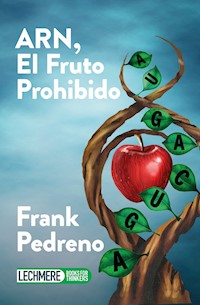



















RNA, the Forbidden Fruit
Part 1
Frank Pedreno
Table of Contents
Prologue1. Shattering Dogmas2. The Council3. The Mad Viking4. A Ten-Year Journey5. Alea Iacta Est6. The Atheist Who Played Dice with God7. The Evil Y Chromosome and Its Accomplice Testosterone8. A Minnow In a Shark Tank9. ATP Azzip10. Fast Track to the Top of the World11. Get Your Head out of the Clouds You Fool12. Concord13. Vengeance14. The Eternal Suffering of a Sorrowful Life15. The Stupidity of Human Beings16. The Involutionists17. The Genic WarsDear Alisha,
Of all the mistakes I have made in my life, the one I most regret is not keeping the promise I made you. I am not making excuses; I was the only one to blame for the fact that you were not able to publish the results of your brilliant work. I am not asking you to forgive me, I just hope that one day you understand why it happened.
I have written this story while remembering the talks we had in that small office at MIT.
James Andersen, Cambridge, MA, March 2024
Gorham’s Cave (Gibraltar, Iberian Peninsula) 28,000 BCE
The fear and the tears mixed with saliva barely let him breathe, and his broken crying competed with the dark silence of the cave. Lying on his back he felt his heart pounding, and his tormented head asked him the same question over and over again: Why?
Slowly he extended his hand to what was still left of Ella’s face, gently brushing away the dirt that hid her eyes. His profound pain became unbearable when he saw her desperate and naked gaze expressing the terrible suffering of the last moments of her life. Amid the mass of bones, torn flesh and exposed guts, he could identify his boy’s little hand gripping the cave bear femur flute that Ella had made for him. He could not stop crying at the thought that his son’s tender meat must have been an exquisite delicacy for the cursed Smilodon.
The intense smell of the massacre had taken over the cave, and in that instant he became fully aware that he had lost them forever. A chill ran down his spine and he let out a piercing scream that broke the deep, bitter silence of the cave. He tried to stand only to fall back to the ground on his knees and prostrate himself before them. All he wanted was to caress them, but a violent retching forced him to sit up and vomit. Desperate, he could not stop wondering how the Smilodon had been able to find the entrance to the cave. He went out into the daylight disoriented and staggered down the path that led to the small cove as best as he could. Upon arrival he collapsed and fell violently onto the sand. Bitter tears welled up in his eyes, but they did not prevent him from seeing the bone sticking out of the sand. He clumsily dug it up and saw that it was the jawbone of a long-dead animal on which hardly any flesh remained, but when he saw that it had a bit of fresh blood on it he again felt the cold rise up his back, and the sour taste of fear burned his mouth. With a great effort he got up and went back to the cave holding the bloody jaw in his hand; meanwhile, at the top of the crag that dominated the cove six tall, thin men with long, disheveled hair watched him in silence.
…
Six years had passed since they had decided to flee together to the distant lands of the south to find a place to live. Although neither of them knew with any certainty, Ella must have been about thirteen and El no more than fifteen when they had fled. The journey lasted many moons until they found what would become their home, a small cave with a barely-visible entrance in the face of a steep cliff from which could be seen a great expanse of water the likes of which they had never before encountered – the sea. Amid the bushes that concealed the entrance, a narrow path opened which branched off into thick grasslands. To the north a steep slope led to the top of a limestone bluff, half surrounded by a small plain that must once have been green but was now covered in a thin layer of ice. To the south a gentle slope led to a small shore of white sand and crystal-clear waters, replete with mollusks and crustaceans which would guarantee their livelihood. When the first summer arrived Ella was pregnant, and although ignorant of the fact, had become the last member of her species as the two males with whom she had lived since birth had at last been hunted and slaughtered by the savage ‘predators.’
It was still dark as El readied his tools to go hunting, but that fateful day Ella and their little one did not accompany him, in a departure from their custom. At sunrise he climbed to the top of the rock cliff where he remained motionless and silent, watching for prey to hunt. Before long he saw a sounder of wild boars and noted that the last of the group could barely keep up with the fast pace of the rest. El emitted a grunt of satisfaction and decided to pursue the chase. As he progressed the great rock receded, but he did not worry because he knew that Ella would take care of their little one, perfectly camouflaging the cave so that no predator would find them. In this, however, he was wrong.
Arcy-sur-Cure (France) 28,000 BCE
That winter was very harsh. Tongues of ice completely covered what had once been green meadows, and the lack of food was becoming more pressing. Despite adverse weather conditions, repeated attacks by large predators and a constant lack of food, their species had always been victorious in the struggle for survival. The reasons for this success were based on certain marvelous physical qualities which over hundreds of thousands of years had allowed them to adapt to the different environments they had inhabited out of necessity. They all had large, flattened noses and a keen sense of smell that allowed them to perceive the scent of any predator from a distance. The powerful jaw devoid of a chin had proven a highly effective tool for immobilizing prey, while large teeth augmented its remarkable defensive capacity. The frowning aspect of the prominent brow without a doubt enhanced their ability to focus their vision; the squat body with broad hips and sturdy legs made them unfit for running but on the contrary endowed them with great long-distance walking endurance. As for the rest of their tasks, each group member took a turn at everything, and no function amongst them was assigned solely to males or females. That was how it had been from the beginning and how it was supposed to continue in perpetuity.
For some time they had begun to feel threatened by a danger they had tried everything in their power to avoid. A new adversary had taken up residence in the valley at the foot of the great mountains and was stalking them ever more closely. When these ‘predators’ had first arrived they had brought food, beads and strange tools, and had always come in groups of several males, who would take advantage of the opportunity to copulate with the females of the band. On several occasions, several of the predators had forced themselves upon Ella’s mother before the naïve gaze of the males in her band, until she had become pregnant. Ella was the offspring of those evil and increasingly frequent visits.
When she was born, it became evident that something about her was different even though she had similar physical features to the rest of the females in her group. Her nose maintained its size but was not flat, and her brow was not frowning. Her hair, however, was reddish like that of everyone else, and her complexion was fair and freckled, with chubby cheeks. Without a doubt she possessed a very special air. Like all the females in the band she had a robust body, voluminous breasts and a bulging belly that she habitually decorated with black pigments obtained from plants known only to her. However, what really made her feel special and different was her small, almost imperceptible chin, to her eyes very beautiful. None of the rest of her group had one.
After a short time the predators stopped arriving with food or gifts but with weapons, and began to hunt the band mercilessly to then sacrifice them in strange rituals. The defense strategies that had served them so well for millennia were of no use against these fierce new adversaries.
Of the 21 members that had comprised the group, only six remained alive – five old males of over 30 years of age and Ella, the only female, who was barely 12. Fear had forced them to flee to remote lands to escape the horror, and after much walking they had found a small cave in one of the walls of a dangerous gorge. They innocently thought they would be able to survive there and prolong their agony for a few more years, but three males of the small group were unable to survive wounds given to them by the predators and died, leaving only two old, sick males plus Ella.
Every morning just before sunrise while the two old males still slept, she silently ascended a steep path until she reached a little summit. At her side ran the threatening mouth of the ravine, but Ella was hardly intimidated; the spectacle of sunrise excited her, and she would remain there alone for a long time. Little by little she had begun to name the things around her by different sounds, in such a way that ‘gur’ was heaven, ‘lar’ meant earth, ‘hor’ meant trees; and she proceeded in this manner with animals and many other things. The three lived calmly and in apparent safety, and thus began to forget about the existence of the bloodthirsty predators.
…
In a small valley beyond the mountains, a community of just over 80 individuals inhabited caves protected by sharp crags. Dressed in gaudy furs from skinned animals, the males leaped and circled the leader of the group. Like the others, the leader was tall and thin and possessed a fair complexion, rounded skull, long dark hair, and pointed nose. With astonishing agility he flexed and extended his muscular body following the rhythm indicated by the screams of the other males. In his right hand he grasped a long wooden spear with a charred end, and in his left a sharp arrowhead. At his feet like a precious trophy lay a magnificent specimen of mammoth. El, his son of about 14 years old, shared in the honors of the hunt. Everyone’s joy shone through as they knew that that night they would eat their fill and would be able to save enough food to face the harsh winter. A few feet away the docile females observed the ritual in silence while the young that surrounded them jumped and screamed ceaselessly, although always under the watchful eye of the females, who kept them away from the group of males. Everyone shared one thing in common – a pronounced, well-defined chin.
Suddenly the chief raised his voice and the whole group fell silent. The predators lived under the power and control of the males, and everyone accepted the dominance of the leaders, a hierarchy vital for the survival of the group. While the females were relegated to secondary tasks and dedicated themselves to caring for the young and gathering fruit, the males liked to hunt, travel and discover new territories, but above all to find new objects they could use as tools. They only had one desire – to seize the advances that other tribes possessed, whether ornaments, tools, or any other item that could be useful for the group. On many of their journeys they encountered other groups of predators, and if they could not acquire their tools peacefully they did so by force. The booty for the victor was plentiful; augmented technological capabilities were conducive to group growth, and that itself was more important than mere individual survival. Time and again El heard his father explain that survival was important, but it was much more important to obtain new technology, since only then could they dominate all other rival tribes.
In recent years their tribe had been successful in finding new tools, and as they integrated and improved upon them they became a much larger and above all more destructive group. This characteristic began to manifest itself in a ritual they had incorporated after having discovered it on one of their exploratory journeys. The cruel ritual consisted of hunts organized for the initiation of young people when they reached 10 years of age, and the objects of the hunts were the chinless, the name they called those like Ella. On many occasions the chief’s young son had shown a reticence to comply with the rules of the group, even going so far as to refuse to participate in the bloody hunts. Little by little the boy had begun realizing that the great destructive power of his tribe was based on the sacrifice of the individuality of each of its members. From a very young age they were taught that they had an obligation to interact with other groups, whether peacefully or aggressively. El was not in absolute agreement with the ideas of his father and his tribe, yet he could not refuse to participate, as every other male did, in the journeys they undertook seeking new tools.
Winter had passed and the moment had come to start a new journey. That day 12 males, including El and his father, undertook a journey to the distant lands where the sun emerged each morning. They traversed long distances with little luck, and after three months the chief decided to return to the settlement. The trip had been very unproductive; they carried nearly no new tools and had lost five males fighting rival groups. Tired, hungry and badly injured, they approached the dangerous cliff that marked the limit of their domain. The chief did not want to take any more risks, remembering how on one occasion or another after similar trips one of his own had rashly plunged into the void due to carelessness and fatigue. He ordered a stop upon reaching a summit that seemed safe and where there was a cave flanked by a dangerous and deep gorge.
…
Just like every morning, Ella climbed the steep path to the little hill while the old males still slept. Upon reaching the top she realized that a group of predators had spent the night inside the cave. El, who was sitting guarding the entrance, turned his head towards the gorge and saw the silhouette and the red hair of the young female illuminated by the orange sun just peeking over the horizon. For an instant, they locked eyes. Slowly he rose to his feet and let the spear he was holding fall as a sign that he meant her no harm. Ella did not understand his gesture and spun around to quickly disappear over the gorge’s edge. El continued watching, but the intense glare of the sun blinded him. He jumped up and ran to the edge of the gorge, wanting to see her again, but Ella had disappeared. That morning he held his tongue when the male predators arose, and they resumed their march towards the settlement. The entire way he could not stop wondering about the female with hair like fire who had appeared amidst the rays of the sun.
…
Many days passed during which Ella did not dare ascend the hill, although little by little she began to think that if nothing had happened, it was a sign to not fear the young predator, since they would all be dead if he had wanted. Unwittingly she began to think about the young male and remembered his height, his long brown hair, and especially the chin that protruded from his elongated face. Without giving it much thought she was composing the image in her imagination to make it hers little by little. From that moment on, when she went up the hill to contemplate the sunrise she no longer entertained herself by giving names to the things that surrounded her; now she passed the time thinking about El.
…
Although several days and nights had passed since he had seen her, El could not get the image of the young female with reddish hair and chubby cheeks out of his mind. Not a single day went by in which he did not think of Ella. Over and over he asked himself what he could do to see her again. He was exceedingly intrigued by the small chin insinuated in her freckled face, a detail that disoriented him, and although he realized that she was very different from the females of his group, that made it impossible to stop wondering if she was also one of the chinless. But if she was not a chinless, what was she?
…
That morning the activity in the valley was frenetic as they prepared for another great hunt. For a number of days they had seen a large herd of mammoths very close to the river. Whenever they had to hunt mammoths, the largest of beasts, excitement took hold of everyone, and while they treated it as a celebration they also knew that some of the males would not return. The day of the hunt, El decided the moment had come to return to the gorge again, hoping with all of his might to see her once more. The confusion and turmoil of the moment would allow him to slip away, but he was aware that as quickly as they realized that he was not back with the group, his father would organize an expedition to go in search of him and would move heaven and earth until he found him, because the very idea of losing his son would drive him crazy. He thought that in that case he would explain that during the hunt he had suffered a fall, leaving him prostrate and unconscious. Then he would say that although he did not know how much time had passed, he had tried to return as soon as he had awakened, but disorientation had mistakenly led him astray, forcing him to walk aimlessly until encountering the way back to the settlement. He knew he would have to wound himself convincingly enough so that his father would not suspect him; for this it would be necessary to use a sharp stone to administer a deep cut. If only he could see the young female again, he was ready to suffer anything. It was a sensation he did not recognize, a sensation which disoriented him; he had never felt anything comparable.
Just as he had planned, in the midst of the hunt he took advantage of a moment of great confusion to drop down a slope and conceal himself under some bushes. He waited until all of the males were well away before heading off in the opposite direction. After two days he reached the small summit of the gorge and went to the entrance of the cave from which he had seen her the first time, to remain until she appeared. The morning of the fifth day, when little hope remained, he finally saw her silhouette appear bathed in the rays of the sun.
When Ella saw him she was startled and remained immobile, perhaps wondering how to escape, but he made a gesture to her with his hand and gave the hint of a smile. Cautiously they drew closer until they were within a few feet of each other, and sat on the stones nearly at the same time, whereupon all of a sudden El began to speak, expressing things that Ella did not understand. At that she interrupted him and, signaling to the sky, said ‘gur’ and then, gathering a handful of earth, said ‘lar.’ El fell silent and waited until the young female extended her right arm again and pointed to the trees. ‘Hor,’ she said, and repeated the entire ritual, hoping the young male would understand. On the fourth time El succeeded in repeating the sounds while pointing to the sky, earth and trees, at which Ella looked him in the eye and returned his smile. They spent hours trading meaningful sounds and learning from each other, and neither seemed to want to leave until suddenly Ella rose to her feet, turned around, and returned to the cave. Before she left El looked at her and made some signs that meant that he would return, and said something that Ella did not understand although in some way she interpreted it and was sure that she would see him again very soon.
…
On the way to the settlement he began to formulate what to say had happened to him. He picked up a sharp stone and made a head wound large enough to leave a scar that offered no doubt, for his father was very astute and El knew he would be suspicious. One day at twilight he came across the expedition; they had been looking for him for five days and had begun to think he had been eaten by the Smilodon. When his father saw him, he sprung upon El and embraced him forcefully against his chest. No one suspected anything and everyone showed their joy, not least of all El, who knew that he would see her again very soon.
…
After two weeks the wait had become unbearable, and he decided it was time to see her again. The excuse on this occasion would be a hunt for the young males, since this type of event was frequently undertaken and surely his father would offer no objections. And so it was, but this time El’s father assigned him three companions so as to prevent any accident from occurring again. Before these companions departed, he gathered them together and gave them instructions to never leave his son alone, and that come what may, they had to be back on the sixth day. After two days and in the middle of the hunt for a herd of aurochs, El took advantage of the chaos to rid himself of the surveillance of the three companions. He clumsily let himself fall down the mountainside until a huge rock broke his fall; he had achieved his objective, but the impact had rendered him confused and bruised. Arising as well as he could, El slowly embarked upon his march towards the summit of the young female. He arrived at dawn of the third day, just before sunrise, and decided to lie down against the walls of the cave entrance to wait for her to appear with the rays of the sun.
That morning when she reached the top Ella was startled to see him lying on the ground completely motionless. The blow had left his ribcage area very sore, and although nothing seemed to be broken, the pain was so bad it was difficult to breathe. She approached with her arm extended, and El accepted the hand she held out to him. They did not know that a few yards up the hill, hidden in the thick undergrowth, the three young males were observing them, looking on in amazement and disgust as he caressed her and she laid her head on his shoulder. Stealthily they crawled back out of sight, rose, and began the return journey to the tribal settlement.
Meanwhile, Ella helped him up and El, leaning on her right shoulder, went into the cave where the group of predators had spent the night weeks before. Upon entering she helped him lie on the ground and immediately went out to check that there was no danger in the vicinity. After a few seconds she went back inside and approached El, observing that his forehead was drenched in sweat. Utilizing the antelope skin she used as a covering she began to dry the perspiration. The young male opened his eyes and could see her leaning over him, wringing out her skirt with clumsy movements, not realizing that she was showing him all of her most private and sexual parts. He noticed a strange sensation running through his entire body and with each movement of the hips of the young female, his excitement increased. Ella noticed this but did not stop drying the sweat from his face and chest. For a brief instant neither of the two knew what to do next although both knew what they wanted to do. Without knowing how, their naked bodies met and for the first time in her life, Ella hoped that the penetration would not be rapid and with the customary brutality of males; she wanted El to continue caressing and kissing her over and over again, and never stop. The boy felt a strong pressure inside him that instinctively prompted him to penetrate her, but he also held back because what he most wanted was to prolong the moment as long as possible and for her to be the one to ask him, to beg him, to penetrate her. Then she looked into his eyes and, exactly as he had been hoping for, invited him with her gaze, immediately afterwards feeling inside of her all the strength of the young male. For the first time in her short life Ella felt that she was not mating, but making love. His slow, deep movements along with the sweat from their naked bodies brought them to an immense and endless climax, which finally gave way to a sharp, shared cry that seemed to last an eternity. Ella somehow knew in that exact instant that she had just become pregnant.
…
Several months had passed since their arrival in the lands to the far south. They were two young adults of 16 and 14 years old, oblivious to everything happening around them, who had never minded abandoning their respective groups because all that they wanted was to give each other love. Being the chief’s son, El had been assured of power but had never agreed with the norms and customs of the predators, and his father had always been conscious of his son’s rebelliousness. Ella had also felt different since birth, thus neither one was willing to renounce the possibility of living together. During that first year Ella learned to caress and to smile, and above all she encountered a sensation that she did not know how to define, which was that of feeling loved. El spent hours observing her, feeling immense pleasure just watching her as she slept, ate or with great skill skinned, gutted and picked clean the bones of the animals they hunted together. Although he also did not know how to express what he felt, he loved her, and she demonstrated that she realized this at every moment. No roles were assigned between them, meaning that hunting, foraging and protecting the cave became shared tasks. It was very cold and the snow had not yet begun to melt, but she knew that the warm light of summer would help her with the arrival of the little one she carried in her womb.
At the beginning of the summer she gave birth to a handsome young male with dark hair, fair complexion and a small nose. The differences from the males of her species were apparent in the perfect jaw and the beautiful, well-defined chin. He would be a tall male, though possibly not taller than his father, a fact that did not matter in the least to El. While Ella looked over her little one’s body to check for any imperfections, El kissed him and thought that very soon he would teach his little one to run, jump, name objects; to listen, laugh, cry; and above all, to love. In that small cave in the temperate southern lands, the future was born – the son of a Neanderthal, the so-called chinless, and of a Homo sapiens, the predators.
What they did not know was that ever since they had made the long journey south, El’s father had never ceased looking for them. He had never trusted his son, and their continuous arguments as well as the lies about the false hunts had taken a toll on his heart, in which he now harbored only rancor. He had known something dangerous was happening and that he had the obligation, for the good of the group, to uncover his son’s schemes. For this reason he had instructed the three young males to accompany El on the hunt on which he had disappeared.
When they had returned after the six days the chief had been waiting for them, flanked by two young males while the females silently and attentively waited outside the cave. The three males, fearful of the fury of their chief, did not know how to explain what had happened. When they finished their story the face of the chief showed no suffering. On the contrary, hatred was drawn on his features and his tightly clenched jaw gave him a menacing visage. The females fidgeted uneasily and the young males guarding the chief’s back remained motionless and silent, nervously awaiting his orders and fearing his reaction.
The next morning the chief designated six other young males to set out in search of his son. It was clear that the only traces they would have to follow would be where the chinless female had lived, thus they searched the vicinity of the hill where they had been seen before their escape until they came across the cave hidden at the edge of the gorge. They entered and savagely killed the two old men, then searched each and every corner, finding nothing but some old animal skin coverings of the female which they carefully secured and brought with them, knowing that as long as they held her scent they would be useful to them. They then continued the expedition, not being permitted to return to the settlement without the chief’s son.
…
Six winters had passed since Ella and El had decided to depart for the warm southern lands, and that summer their little one would complete his fifth year. They were very happy to note that bit by bit the little one had been learning during his childhood; first sounds, then words, until not even a year ago he had become capable of speaking quite well. Although she could not speak like them, Ella understood them and made herself understood with sounds and gestures. One morning the three went hunting. Ella led the way because her powerful olfactory ability enabled her to detect the scent of animals from long distances. The little one followed her; he was learning to trace tread marks, footprints, broken branches, excrement and anything else that could be of importance in detecting the presence of an animal. El completed the group, always attentive of the steps of his little one. The young boy imitated his mother by making gestures with his nose, although he still could not interpret the smells like her, and with his tiny thin hands caught the pieces of branches that his father dropped after having examined them carefully. The parents laughed watching their little explorer imitate what they did. They were sure that very soon he would be ready to find sustenance on his own.
Upon reaching a small open field, El extracted the fleshless jawbone of a boar from the leather sack on his back. Requesting a long sharp bone from Ella he made a cut in the palm of his hand. Next he let a few drops of his blood fall on the bone, threw it on the ground, and covered it with some earth so the blood would not dry. El then turned to his little one and motioned for him to maintain silence. The lure worked and that night they ate fresh meat.
…
All of a sudden one of the six male predators of the expedition in search of the chief’s son paused; the others followed suit. A half-buried jaw in the middle of a terrace was not out of the ordinary, but if it contained traces of fresh blood, that would be an unmistakable clue. The others approached and observed. It was the work of El, they were sure. That was the lure the adults of the settlement had taught the young males since they were little – the lure of the predators. Fresh blood meant they must be close. They would rest and the next morning search the area until they found them.
The next day when they reached the edge of the cliff, the six male predators contemplated the small cave and the white sand beach with crystal clear waters. After six years of searching they sensed that they had finally found their prey, and began planning the hunt. In spite of the time that had elapsed, they did not forget the precise instructions of the chief – “If my son has possessed the chinless female, bring him to me, and let the female die with her young, but not at the hands of one of our own; let her be a feast for the Smilodon.”
They spent several days searching for traces of the Smilodon, very few of which still remained alive. At last they found droppings and knew they were not far, perhaps less than a day away. They planned out how to lure them to the cave and when they found them, they ushered them to the cliff. They knew that once they were there it would be very easy for the Smilodon to detect the scent of the chinless female and her offspring.
That morning they had decided that El would hunt alone and that Ella and the little one would remain in the white sand cove collecting crustaceans. After several hours Ella gestured to the little boy for them to return to the cave to store the crustaceans they had collected. Not long after they reached the interior of the cave, Ella detected the scent of the Smilodon. She grabbed her son and pulled him roughly behind her, shielding him with her robust body, then gripped the spear firmly and waited. Ella was afraid for her stupefied little one, and could perceive his deep and ragged breathing. She had her gaze fixed on the cave entrance, and thanks to her angular vision could also see what her son was doing. The son, still and silent, held tightly to the cave bear femur flute that his mother had made for him very recently, and awaited her orders.
Ella was only 19 years old and from an extremely young age had always been very conscious of the agonizing emotion of being afraid. Instinct, developed by those of her species over millennia, allowed her to know with certainty that death was circling them and although fear gripped her, the only thing she could do for her little one was to fight to the end. Bitterly, she sensed that her own time and that of her beloved was running out and that the moments remaining would only worsen the suffering. She did not know how the Smilodon had found the cave, but the breeze carried their scent – that of death.
She put out the fire and huddled with her boy in a shadowy corner of the cave from where she could see the luminosity of the day entering faintly through the opening. Suddenly the three Smilodon appeared. Due to the narrowness of the cave, the three beasts entered one by one following the leader, who perished when Ella stabbed him with the rudimentary spear. It was all she could do; the other two pounced on her and her little one, attacking them fiercely and mercilessly.
From the top of the cliff, the six male predators heard the cries of pain from Ella and her little one without flinching, then turned and concealed themselves to await the arrival of the wayward young male. At last the expedition was at its end and they would return to the settlement with their mission accomplished.
…
Upon reaching the crag, El was thinking of all the happy moments he had spent with Ella. The first caresses, the first kiss, and the first time they had made love in that cave on the summit. Ella had never kissed nor been kissed before that, much less made love. That day in that little cave in the lands of the north he had known that he would never leave her, and that they would always live together. But again he had been wrong. The boar hunt had carried him extremely far away, but he could not have imagined that Ella and her little son would be savagely devoured while he was hunting. His pain would only subside in death, yet although he yearned to depart his life with all of his might, he could not do it; the six predators transported him tightly bound back to the settlement. During the long weeks of the trip not a single instant passed for El without the image of his little one and Ella playing in the white sand in the same place where the predators of his father, in order to attract the Smilodon, had left the bloody jawbone El had prepared.
…
Aged and with a tired aspect after six long years of waiting, his father addressed the males of the group. El no longer listened; he knew that this was the moment of the group and not of the individual. After the long discourse his father then addressed him, asking if he would like to speak. El did not answer; he merely opened his hand and displayed the cave bear femur flute that Ella had made for her little one very recently and that El had managed to bring, hidden among the few pieces of furs that his captors had permitted him to use so that he did not perish from cold during the journey. His father approached, glaring at him with contempt, grabbed the bone, and threw it angrily out of the cave.
The next day three young males led him to the edge of the cliff. He smiled when he remembered the moment his little one had said his first word and Ella, hearing him, could not stop crying with joy. “Goodbye my love” were his last words as he fell into the void.
1. Shattering Dogmas
The rattle of the clock began at 5:43 a.m. yet Dr. James Andersen, ‘Jimmy’ to his friends, knew the repugnant bottle of three-dollar Pinot Noir and the two milligrams of Clonazepam would prevent him from opening his eyes. That task was reserved for the squeaky wooden wagons of the old Boston subway system, known as ‘the T,’ and the first rays of dawn prying their way between the glass and the curtain to drill through his cranium and force his eyes open. What were you thinking when you rented this apartment? he asked himself as he wiped the puddle of saliva that had accumulated between his mouth and pillow with his fingers. “Okay, okay, I’m up!” he yelled while struggling to extricate himself from the knot the sheet had formed with his body. Just like every morning, when he finally managed to unlock one leg and part of his head he remained mesmerized staring at the ceiling of the room, thinking that he had committed an error from which he would never recover on the day he had signed the contract to rent that apartment. Returning to Lechmere, the neighborhood of his childhood, had never been a good idea; he had only left the exclusive neighborhood of Newton because his ex-wife had plundered him economically after their traumatic divorce. He was bankrupt, and although his salaries as Principal Investigator at the Massachusetts Institute of Technology – the famous MIT – and as professor at Boston University should have been more than sufficient to lead a comfortable life, there was no end to the bills. Somehow his ex-wife had made off with almost everything they had built over 13 years of matrimony, including the beautiful home in Newton and a hefty alimony payment to help support Xavier, the couple’s only child. In addition, each month he faced the ordeal of paying credit card debt, the rent for his awful apartment, the loan for his son’s Harvard tuition, and innumerable other bills. Jimmy could not help being naïve like that on the subject of money.
When at last he was able to free himself from the oppressive shroud after an intense struggle, he was plunged into a state of weakness that forced him to sit on the edge of the bed and rest a few moments. It was in those moments that he would clutch his head tightly with his hands, bend his neck towards his chest, look down at the floor, breathe deeply, and begin to review the endless list of problems in that ominous apartment. The unbearable screeching of the wooden wagons of the T was always first on the list. As if it were a kraken hidden in the abyss of the ocean, the old rail trolley emerged from the depths through the bowels of the TD Garden, home of the Boston Celtics, to reach the elevated station of Science Park a few blocks from his apartment.
In the mid-thirties of the past century, the Massachusetts Bay Transportation Authority – the MTBA – had built an elevated iron rail just 10 meters above the ground which ran over the water to Lechmere station, a tiny wooden depot. The old structure produced a cacophony of every sort of creak, click and metallic noise from the continuous friction the cars made when sliding on the worn rails, noises which could be heard throughout the duration of the journey. When at last the T entered the old Lechmere station, the noise of the brakes along with the sirens announcing the end of the journey made the whole experience insufferable. With an irritating punctuality the sirens signaled that a new convoy was leaving every eight minutes. The acoustic torture repeated itself in that manner throughout the day from 5:45 a.m. to 11:00 p.m.
In one of life’s paradoxes, however, whenever Jimmy found himself somewhat depressed – which was on a daily basis – riding the noisy, ramshackle T was all that calmed his resentment and bitterness. The journey offered him one of the most beautiful panoramas of the city, however fleetingly. He would sit in any vacant seat on the right side of the carriage and contemplate all the beauty of the Charles River for the brief ride between Lechmere and Science Park. On the south bank, Boston; on the north bank, Cambridge; far to the west, lofty Harvard. On sunny days in the winter months it was possible to see large parts of the completely frozen river from the old T, and in those instants the light of the sun reflected off the thin layers of ice in a manner so special as to allow Jimmy to feel deep inside himself that everything was going to be okay.
As always, however, he was fooling himself, as he did not factor in that scarcely 100 yards away in the direction of Charlestown the MBTA Commuter Rail Maintenance Facility had been built – the technical terminal station of the long-distance railways linking the large cities of the East Coast to Boston. The entire commuter rail system ended up there after each round trip to undergo mechanical and cleaning checks. Around 11 o’clock in the evenings when the noise festival of Lechmere station ended, the frantic wagon dance of the Commuter Rail Maintenance Facility began. Each movement was preceded by an intermittent alarm which announced the displacement of the wagons and which produced a metallic rattle that increased progressively until culminating in the squealing of the brakes of the entire convoy accompanied by bell sounds identical to those at railroad crossings. It would have been impossible to tolerate except that Jimmy had no other alternative; having made up his mind to return to his childhood neighborhood, he would never admit to anyone that he had erred.
He convinced himself he could endure the martyrdom, especially since he spent most of the day outside, yet although it scarcely seemed possible, everything became even more complicated. After many years of deliberation the MBTA approved an extension of the green line from Lechmere to Somerville. For an entire additional year he was tormented by construction work and the traffic of heavy trucks bringing every type of material for the extension of the line. The madness began every day at 3 a.m. and continued until 5 p.m., treating the fortunate Jimmy to a select repertoire of the best noises Cambridge had to offer such as sirens announcing every time a truck went in reverse. For 320 long nights in the year, since they only deigned to stop on Sundays, Jimmy enjoyed a front row seat for the acoustic spectacle. Twelve lengthy months passed before work on the green line concluded. Therefore, that morning in February 2004 he considered himself lucky; since construction had ended, from then on he would be left with just two companions – the screech of the train cars on the tracks, and the sirens and noises from the train fleets of the Maintenance Facility. What a luxury! Furthermore, his landlord unsurprisingly claimed that since the area was in high demand, he would have to impose a yearly 20 percent rent increase. Thus the $800-a-month bargain he had started with had risen to nearly $1,400 per month by just his third year.
Each morning after completing a mental review of the totality of his misfortunes, he repeated the same routine with scientific precision. After a quick shower of no more than five minutes he dressed in the first thing he found in the closet while listening to something from Tchaikovsky, his favorite classical composer, on his old CD player. The ritual proceeded with him watching the movement of the train wagons through the window of his small living room. While brewing a large pot of coffee in his ancient coffee maker without losing sight of the old railway he observed with a certain delight how some passengers, above all the more heavyset ones, strained to climb the three steps of the ramshackle wooden wagons. With its habitual stridency the siren warned the whole world that the statutory eight minutes had elapsed and that in a few seconds the doors would close. Whereas at first a few passengers suffered when trying to enter the T, next it was the T’s turn to suffer. The work required of the old kraken to prod itself into motion was enormous. With great anticipation Jimmy watched on more than one morning, always expecting to witness a magnificent spectacle – the failure of the T in its intent, and the disembarkation of its passengers, who would curse at having to change convoys and repeat the entire laborious ceremony.
While enjoying this little diversion Jimmy would pour fresh coffee into the thermos given to him by his friends at UMBe Green, the sustainability and biodiversity conservation program at the University of Massachusetts Boston. He required at least two complete eight-minute cycles to enjoy his coffee calmly and in an unhurried manner. After that he would wash his reusable mug and carefully dry it. Once clean it would be ready for a new use, which would be as soon as he arrived at his office at MIT. Next he would grab his small backpack and stuff his laptop, wireless mouse, mobile phone and reading glasses into the front pocket. In the larger pocket he would place a pack of menthol gum next to the UMBe Green thermos, not because he had halitosis that repelled everyone but because he knew he needed to chew something as he walked to his office in order to stay awake the whole way. Finally he would turn off the CD player and, as if imitating the old T, calmly descend the two floors of the old wooden house, exit onto Gore Street, and walk the 20 yards to Third Street. Jimmy’s morning commute to his laboratory was just over a mile long and barely lasted 20 minutes. Coupled with the 30 minutes he needed to fulfill his morning ritual, this afforded him sufficient time to recover from the sinister nightly combination of pills and an infamous bottle of cheap wine. The continuous chewing of a piece of menthol gum helped immensely.
…
The office clock read 9:25 a.m., signaling that the moment had come for his quarterly lecture in the MIT conference auditorium. Upon rising from the chair he felt a bit dazed; it was evident that he was still feeling the effects of the two milligrams of Clonazepam, and that neither the three huge coffees nor the two pieces of gum had helped him much. He approached the shelf with some difficulty walking, took down his trusty conference mug, and placed it in a paper bag. His grogginess did not help him in his attempt to discern the cause of his lightheadedness – was it that he had indulged in more wine than usual the night before, or was it the chronic sleep deficit that had undermined his few remaining defense mechanisms for the past three years running? As he opened the door to leave the office it occurred to him that the root source of each of his maladies was the same one as ever – his blasted apartment in Lechmere.
Holding tightly to the railing, he descended the two flights from his office to the lobby of the building. Upon reaching the auditorium door he paused for a moment, exhaled deeply, opened it, and entered with slow steps and a listless countenance. These bastards will all have come, he said to himself as he approached the lectern. They never miss one when it’s me speaking.
His face could not hide the detachment he felt at that moment. He would have liked to be doing anything other than giving that lecture. Like all professors and principal investigators at the Institute, however, he was obligated to present the results of his research to all parties on a quarterly basis. In Jimmy’s case, this only meant one thing – that he was going to suffer.
“Good morning. We’ll wait a few minutes before starting as a courtesy, if that is all right with you?” he asked the audience. As always he received the same answer, a deathly silence.
Over the past few years he had experienced so many frustrations in that hideous conference hall that for him it had gradually transformed into an authentic torture chamber. As had occurred with the Cathar heretics of the twelfth century who had denied the dogmas instituted by the Catholic Church, he too dared to question many scientific dogmas. Under normal conditions such a heresy would only have resulted in excommunication from a select, mainstream scientific society, but times were changing and nobody could prevent his being harshly judged by Official Science. He could barely recall the number of lectures he had given in that infamous auditorium, but by dint of failure and fierce contention Jimmy had learned that the objective of such summary trials was not to punish him with the death penalty, as medieval heretics had suffered; what they really wished was to torture him. For the pleasure of the audience to be complete, however, that torture would have to be slow, ruthless, and above all intensely cynical. In recent years Jimmy’s passionate audience had been able to develop certain extraordinary qualities for the exercise of dialectical torture, just like the Catholic kings of the Spanish monarchy who had sublimated the Spanish Inquisition, bringing it to incredible levels of sophistication. The virtuosity of the questions they asked him was surprising. The repertoire varied in each conference from the tricky to the ironic to the inane, but the questions he truly feared were the caustic ones, those that with a high degree of verbal abusiveness caused such excitement and hubbub in the audience that most of the time they resulted in loud laughter. Institutional violence was legitimized and accepted by all. Well, not by all; he himself was not willing to accept scorn as a legitimate manner of imposing scientific law, but it was evident that his opinion did not hold much weight at the Institute.
Although aware of the punishment that awaited him, Jimmy did not like to disappoint. Once again he would strive to rise to the occasion; once again he would try to smash a stupid dogma of Official Science into pieces. That day he had no doubt that he would outdo himself, thus he had asked his son Xavier to attend in his capacity as visiting student at MIT, promising him a display of strong emotions. The boy did not hesitate to go, and for good reason; although only 16 years of age, he knew full well the degree of genius and madness in his father, and was also perfectly capable of understanding the conference. Due to his exemplary grades he had already managed to pass the entrance exams to Harvard Medical School.
The conference auditorium of the Institute could hold 700 attendees, and just as in the amphitheaters of ancient Greece, its layout provided excellent acoustics. From deep and gloomy Hades, as Jimmy called the place where the unfortunate orator stood, to diaphanous and celestial Olympus, each row rose exactly eight inches. In the first row, aligned and in perfect hierarchical order, sat the Institute’s most important professors and principal investigators. In the center of the row the ‘Holy Trinity’ presided over the procession, consisting of the eminent Dr. Bacon, Director of MIT; to his right, the prestigious Dr. Damon; and to his left the celebrated Dr. Erans, known in scientific circles as ‘the Scourge of MIT.’ He himself boasted of the nickname, declaring that his specialty was hunting down false scientists, and never bothering to hide the fact that stalking Jimmy was one of his preferred activities.
It’s like the Joint Chiefs of Staff are all lined up here! But I promise they won’t go away empty-handed, Jimmy thought to himself with a wry smile while watching the clock devour the two courtesy minutes. He reached inside the bag, took out his conference mug, and delicately placed it next to the microphone so the entire audience could see the face and name of his idol and mentor, the great genius Anaximander, the first evolutionist in history, who more than 2,500 years ago was the first to postulate that human beings originated from other animals, specifically from fish, and who had been shunned by Darwin, who had never named him. That was Jimmy’s way of providing a fitting tribute to the philosophical scientists of ancient Greece, a group of extraordinary thinkers who had been unjustly cataloged and lumped together under the pejorative title of ‘Pre-Socratics.’ The mug was Jimmy’s particular way of protesting the forgetfulness and contempt made of them by Plato and his disciple Aristotle, the ‘dualists and idealists’ as he liked to call them.
“What do you know, once again that lucky little mug of that Greek from I don’t know how many thousands of years ago,” commented Dr. Erans to Dr. Bacon, covering his mouth with his hand.
“I hope this time he behaves decently and doesn’t attack biopharmaceutical companies as he did three months ago,” Dr. Bacon replied.
“I truly hope so too.”
The entire MIT world with the exception of Jimmy was aware that you should not bite the hand that feeds you, especially given the fact that over 40% of the annual budget was comprised of research studies and donations contributed by biotechnology and pharmaceutical companies. Although it had been madness to attack them in the way that Jimmy had done in his previous conference, the rules were clear; as long as Jimmy continued as a Principal Investigator at MIT, Dr. Bacon in his capacity as Director was obligated to invite him to present his results every three months.
As the stragglers settled in and the room became silent, Dr. Damon looked around with a distracted air, giving the impression that she was not listening to the conversation of her colleagues. The disinterest was feigned, however; what she was doing was pretending, a thing she knew how to do perfectly. Christina Damon was a prominent doctor in Epidemiology and Public Health, but what she really specialized in was the art of camouflage, an ability that had led her to a privileged position at MIT and in the biopharmaceutical industry. She had even achieved the unprecedented milestone of having fooled the brilliant but wayward Jimmy, the ‘Mad Viking’ as some of his colleagues contemptuously called him, into believing her to be his only friend. Everyone was aware that Dr. Damon and Dr. Andersen had known each other for a long time, specifically since the final years of medical school when they had met in various seminars and symposia. Even back then ‘Ina,’ as her friends called her, had realized whenever she saw Jimmy involved in an argument that her friend had a brilliant mind. Unlike him, she had serious difficulties formulating novel and original ideas, which is why she had had to dedicate herself to management and put research aside. She had never fully accepted having to remove herself from the world of the laboratory, a renunciation that gnawed at her deeply. Ina was aware that she had an unresolved issue with Jimmy but was not willing to accept that the issue was named envy. Throughout her professional life she had developed a marvelous strategic capacity that had brought her many benefits, and was not willing to change this strategy even for a lost cause like Jimmy. No one could deny that even that naïve and crazy dreamer might one day be capable of generating profits, a powerful incentive that justified spending time and resources on a supposed friendship, especially since the investment required of her regarding Jimmy was minimal in comparison to the high rewards it could bring. She comforted herself with the thought that since she already spent so much time, money and effort on her three adorable little dogs, she could invest a little bit in that wretched man.
“Don’t worry,” Dr. Damon chimed in, “this time he won’t talk about biopharmaceutical companies.”
“Oh no? Then what awaits us on this occasion?” Erans rolled his eyes ironically.
“Look how carefully and gently he puts that cup down! He told me today’s talk is about the evolution of the species Homo sapiens.”
“Dear God! Let’s see what happens this time,” Dr. Bacon replied, clutching his head with his right hand.
Dr. Erans and Dr. Damon covered their mouths in unison so that Jimmy could not see the hurtful smiles emerging.
From the last row Xavier could see his father in the distance, calculating that at least 50 yards separated them. Everything seemed prepared for what Jimmy had told him would happen, when that morning he had said with a sardonic smile, “I have asked the Bacchantes to help me organize the biggest Bacchanalia you’ll ever see.” Xavier, who knew of his father’s passion for Greco-Roman mythology, got the message to be ready for anything.




