


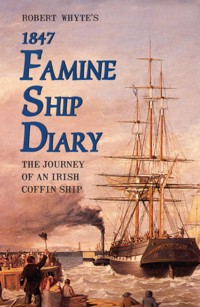
Robert Whyte's Famine Ship Diary 1847 E-Book
Erhalten Sie Zugang zu diesem und mehr als 300000 Büchern ab EUR 5,99 monatlich.
- Herausgeber: Mercier Press
- Kategorie: Geisteswissenschaft
- Sprache: Englisch
The voyage of the 'coffin ship' Ajax, from Dublin to Grosse Île, the Canadian quarantine station as described in the contemporary diary of one of the passengers, Robert Whyte. Whyte was a Protestant gentleman of education and position, as well as being a professional writer who intended to publish his diary. The diary appeared in 1848. It is signed in the author's own handwriting and features vivid descriptions of the spectacular scenery along the way and the striking delineations of the passengers, the crew and the suffering travellers.
Sie lesen das E-Book in den Legimi-Apps auf:
Seitenzahl: 182
Veröffentlichungsjahr: 1994
Das E-Book (TTS) können Sie hören im Abo „Legimi Premium” in Legimi-Apps auf:
Ähnliche




















Robert Whyte’s
1847 FAMINE SHIP DIARY
THE JOURNEY OF AN IRISH COFFIN SHIP
Edited by
James J. Mangan
MERCIER PRESS 3B Oak House, Bessboro Rd Blackrock, Cork, Ireland
www.mercierpress.iehttp://twitter.com/IrishPublisherhttp://www.facebook.com/mercier.press© Patrick Conroy, 1994
ISBN: 978 1 85635 091 4 ePub ISBN: 978 1 85635 746 3 Mobi ISBN: 978 1 85635 783 8
This eBook is copyright material and must not be copied, reproduced, transferred, distributed, leased, licensed or publicly performed or used in any way except as specifically permitted in writing by the publishers, as allowed under the terms and conditions under which it was purchased or as strictly permitted by applicable copyright law. Any unauthorised distribution or use of this text may be a direct infringement of the author’s and publisher’s rights and those responsible may be liable in law accordingly.
Contents
Preface
Introduction
Chapter I
Chapter II
Chapter III
Chapter IV
Chapter V
Chapter VI
Chapter VII
Chapter VIII
Chapter IX
Chapter X
Chapter XI
Chapter XII
Chapter XIII
Chapter XIV
Epilogue
Appendix I
Appendix II
Appendix III
Appendix IV
About the Publisher
PREFACE
WHYTE’S DIARY IS a sort of sequel to The Voyage of the Naparima. It is a confirmation as well as an extension of the message that Gerald Keegan wished to extend to the world. It has the same universality of appeal for all people deprived of their basic rights as well as for those who have not known deprivation.
It has sufficient originality to merit separate attention from Keegan’s diary. And it has sufficient similarity to establish the authenticity of that diary.
With all the discussion going on nowadays about the ultimate dedication of Grosse Île it should furnish enlightenment on the real meaning of this Island Graveyard.
The Appendix section brings us up to date on some of the world opinion on the thinking related to this world famous burial site of thousands of Irish immigrants.
ANN HARRISON
INTRODUCTION
EARLY ON THE morning of 20 May 1847, the Bark Ajax weighed anchor in Dublin harbour with over one hundred passengers on board facing a sixweek crossing of the North Atlantic to what they hoped would be a land of promise somewhere in Canada. The Ajax was a particularly small vessel carrying a load of immigrants that would ordinarily be between five and six hundred people, far more than the rated capacity of the boat. Vessels constituting what has aptly been called the coffin fleet transported over 100,000 immigrants in panic flight from famine, fever and conditions involving deprivation of all human rights. Greedy captains and shipping agents were responsible for the crowding which resulted in much suffering and enormous loss of life on the ocean.
Within a year after landing in Canada one of the passengers of the Ajax published a diary that gives remarkable details about the voyage from Dublin to Grosse Île, the Canadian quarantine station. The passenger signed his name as Robert Whyte.
This diary is important for two reasons. First of all, like Gerald Keegan’s diary described in The Voyage of the Naparima (Mangan, 1982) it tells us at firsthand what the Irish emigrant passengers endured. And secondly, in spite of the differences in the two diaries, Whyte’s confirms Keegan’s in the similarities of experiences met by the passengers in the coffin ships. This confirmation is important in view of the attacks that have recently been made on the authenticity of Keegan’s diary, particularly in Ireland. It has, among other things, been classified as a work of fiction. There are obviously other reasons why one might reject this diary. The religious nature of the journal could be among these.
Unfortunately at present there is an attempt being made to turn Grosse Île into a national park rather than a memorial site for the tens of thousands of Irish people who lie buried there. The people behind this movement want the former quarantine station to be an historic theme park commemorating Canada as a land of welcome and hope. Those who find this unacceptable – and they are many – are concerned about the thousands who ended their lives there. Furthermore, Grosse Île is recognised by some as the most important and evocative Great Famine site on earth. There was neither welcome nor hope for the thousands who lie buried in Canada’s island graveyard.
An article in the Montreal Gazette of 21 May 1992 expressed this concern. This article – together with an address to a Montreal panel by one of Toronto’s main supporters of Grosse Île, Norita Fleming – is included at the end of the diary in the Appendix section.
The author of the diary did not identify himself in any formal kind of way, though Jordan’s book, The Grosse Île Tragedy, claims that the observations in the diary came ‘from one who was actually an eyewitness of the tragic scenes described and who, though anonymous, was a Protestant gentleman of education and position as well as a man of humane feeling and impartial observation.’ On board ship he was a VIP, respected by the captain and the crew. He was apparently a professional writer intending to publish his diary. His reference to the psalms and to other inspirational writings suggests that he might even have been a cleric, though he never seems to have presided at a religious service on board. The captain, though by nature gruff, was extraordinarily deferential towards him and insisted on their eating together the meals prepared by the mistress, as she was usually called, who always travelled with him.
This diary of Whyte’s is an undisputed eyewitness report submitted by a professional writer. Some of us are already wondering what the enemies of Gerald Keegan’s diary will do about this book. Both diaries are plainly firsthand accounts of tragic occurrences – if we accept the part in Keegan’s that was taken from the historical documents listed in the references, which are not taken from the diary.
The few changes we made are not significant. In the period in which the diary was written, it was customary to load one’s text with semicolons and dashes. So we took the liberty of removing over a hundred of these distractions. We removed also a section of the text which was purely statistical and which had been referred to in other parts of the diary. In general you are being given Whyte’s diary as it was published in 1848.
The name of the ship on which he travelled presented a problem. All of the ships and their sailing dates were checked. The Bark Ajax appears to be the most likely as it sailed on 30 May in the morning.
Shortly after Whyte landed in Canada he apparently crossed the border into the US. This was a common practice among the Irish emigrants in their anxiety to escape from the shadow of the Union Jack, seeking what they considered a refuge from British domination.
The diary appeared in print in 1848. It is signed in the author’s own handwriting. Whether or not he used a pseudonym we cannot tell but it is likely that he signed his own name. In any case, this eyewitness account of an eventful voyage on an emigrant vessel is a literary gem submitted by a professional writer. It features vivid descriptions of the spectacular scenery along the St Lawrence River and striking delineations of the passengers, including the captain and his wife, the crew and the suffering travellers.
The title Whyte chose for his diary was The Ocean Plague: The Diary of a Cabin Passenger. In order to make the title more meaningful it was changed in this book to Robert Whyte’s 1847 Famine Ship Diary: The Journey of an Irish Coffin Ship.
You are now invited to travel the North Atlantic on the Ajax and learn first hand the ordeals suffered by those 1847 travellers. And don’t forget the Appendix sections which contain comments from the modern press on the meaning of Grosse Île and to whom it should be dedicated.
J.M.
CHAPTER I
Each moment plays
His little weapon in the narrower sphere
Of sweet domestic comfort, and cuts down
The fairest bloom of sublunary bliss.
Bliss – sublunary bliss – proud words and rain,
Implicit treason to divine decree,
A bold invasion of the rights of heaven,
I clasp’d the phantoms, and I found them air.
O, had I weighed it ere my fond embrace,
What darts of agony had miss’d my soul.
Young
30 May 1847
MANY AND DEEP are the wounds that the sensitive heart inflicts upon its possessor, as he journeys through life’s pilgrimage but on few occasions are they so acutely felt as when one is about to part from those who formed a portion of his existence; deeper still pierces the pang as the idea presents itself that the separation may be for ever, but when one feels a father’s nervous grasp, a dear sister’s tender, sobbing embrace and the eye wanders around the apartment, drinking in each familiar object, until it rests upon the vacant chair which she who nursed his helpless infancy was wont to occupy, then the agony he wishes to conceal becomes insupportable. But as the skilful surgeon tears off the bandage which the hand of affection gently withdraws from the wound, thereby unconsciously inflicting greater pain, so it is better not to linger upon the affecting scene but rush suddenly away.
It was a charming morning on which I left dear old Ireland. The balmy newborn day in all the freshness of early summer was gladdened by the beams of the sun which rose above the towers of the city, sunk in undisturbed repose. It was a morning calculated to inspire the drooping soul with hope auguring future happiness.
Too soon I arrived at the quay and left my last footprint on my native land. The boat pushed off and in a few minutes I was on board the brig that was to waft me across the wide Atlantic.
There was not a soul on deck but presently the grizzled head of the captain was protruded from the cabin and from the uninviting aspect of his face I feared that he would prove an unsocial companion for a long voyage. He received me as kindly as his stubborn nature would allow and I was forced to admire the manly dignity of the rude tar when, from the bent attitude he was obliged to assume while ascending the companion ladder, he stood upright on the deck. The sailors now issued from the forecastle and the mate came up and introduced himself to me.
The captain having given the word to weigh anchor, a bustle immediately arose throughout the vessel; the seamen promptly proceeded to their work with apparent pleasure although (being the Sabbath) they did not accompany the action with the usual chant. The chain having become entangled in the cables of some fishing boats, it was a considerable while before the anchor was hoisted. At length the topsails were unreefed and our bark glided through the beauteous bay.
In a short time we rounded the promontory of Howth having taken the north channel as the wind was southerly.
The captain then led me down to the cabin for breakfast and introduced me to his wife who he informed me always accompanied him to sea and whom I shall for the future designate as the mistress, as by that term she was known to both crew and passengers. Feeling an inclination towards squeamishness and being much more sick at heart, I retired to my stateroom and lying down upon the berth, fell into a dreamy slumber, in which I remained until aroused when I found it was late in the afternoon and tea was ready. I felt somewhat revived by the grateful beverage and accompanied the captain on deck. We were off Carlinford and the mountains of Mourne. The passengers were cooking their evening meal at their fires upon the foredeck and the sailors discussing their coffee in the forecastle. I endeavoured to enter into conversation with the captain but he was provokingly taciturn; however, we were soon joined by the mistress, who was not unwilling to make up for her husband’s deficiency. The sun set and twilight subsided into darkness. A cold night breeze also told that it was time to go below.
Monday, 31 May
I ROSE EARLY and inhaled the fresh morning air. We made good progress during the night and the bold cliffs of the coast of Antrim were visible on one hand, the Scotch shore on the other. At 8 a.m. the bell rang for breakfast and I took my seat opposite the captain. The mistress sat in an armchair and the mate on a stool next to me, completing the cabin circle. We were attended by Simon the cabinboy whom at first sight I took to be a ‘darky’.
His face was coated with smoke and soot, streaked by the perspiration that trickled from his brow which was surmounted by a thicket of short, wiry black hair standing on end, his lustreless brown eyes I cannot better describe than by borrowing a Yankee illustration: they were ‘like two glass balls lighted by weak rush lights’; his lips were thick, straight and colourless; his complexion (when unveiled) was a grimy yellow and the expression of his wide flat face, idiotic. He wore a red flannel shirt and loose blue pilot trousers but neither shoes nor stockings. His movements were slow, except at meals, when he seemed to regain his suspended animation and it was a goodly sight to see him gulping coffee, bolting dodges of fat pork and crunching hard biscuit as ravenously as a hungry bear.
No two specimens of human nature could possibly present more striking contrasts than Simon and his fellow apprentice, Jack. The latter was about 15 years of age, remarkably small and active. Squirrel never climbed a tree more nimbly than Jack could go aloft, and in the accomplishment of chewing and smoking he might compete with the oldest man aboard. His fair skin was set off by rosy cheeks and his sparkling blue eyes beamed with devilment. He was a favourite of everyone – except the mistress, with whom his pranks did not pass – being therefore exempt from the menial offices of cabin boy which devolved upon Simon. His principal amusement consisted in persecuting that genius.
The mate was a very little man not more than five feet high but in excellent condition, as seamen generally are. He was lame in one leg which deformity he took great pains to hide, causing a constrained limp that was extremely ludicrous. He was welllooking and sported a capacious pair of black whiskers, the outline of which he frequently altered. He had been a ‘captain’ but unfortunately, loving the bottle, he lost his ‘cast’. There existed little confidence between him and the captain and, both being of a warm temperament, there were occasional symptoms of collision but they were prevented from ending in open rapture by the timely interference of the mistress, on whom the captain would let loose his wrath, which though expressed in no gentle terms she bore with exemplary patience.
The mistress was small, ruddy and sunburnt, having seen some sixty winters, forty of which she had spent at sea, generally in the home trade but varied occasionally by voyage to Russia or to America. She was in the habit of keeping a private log, in which she noted the incidents of her travels. I was allowed to look into this interesting production, which amused me no less by the originality of the orthography, than its elegance of diction. Being a native of Cumberland her pronunciation was not particularly euphonious. She also, when addressing her husband, the mate and all familiar acquaintances, used the terms ‘thee’ and ‘thou’ invariably reversing their grammatical order.
Tuesday, 1 June
AFTER BREAKFAST, THE mate invited me to see the depot of provisions. I accordingly followed him, descending by a ladder into an apartment partitioned off from the hold, and dividing it from the cabin.
By the light from the lantern I perceived a number of sacks, which were filled with oatmeal and biscuit. The mate having proceeded to prepare the passengers’ rations for distribution, I sat down upon one of the sacks, from beneath which suddenly issued a groan. I jumped up, quite at a loss to account for the strange sound and looked at the mate in order to discover what he thought of it. He seemed somewhat surprised but in a moment removed two or three sacks and lo! there was a man crouched up in a corner. As he had not seen him before, the mate at once concluded that he was a ‘stowaway’, so giving him a shake to make him stand upright, he ordered him to mount the ladder, bestowing a kick upon the poor wretch to accelerate his tardy ascent.
The captain was summoned from below and a council immediately held for the trial of the prisoner, who confessed that, not having enough of money to pay for his passage, he bribed the watchman employed to prevent the possibility of such an occurrence. He had been concealed for three days but at night made his way into the hold, through a breach in the partition; His presence was therefore known to some of the passengers. He had no clothes but the rags he wore nor had he any provisions. To decide what was to be done with him was now the consideration, but the captain hastily terminated the deliberation by swearing that he should be thrown overboard. The wretched creature was quite discomfited by the captain’s wrath and earnestly begged for forgiveness. It was eventually settled that he should be landed upon the first island at which we should touch, with which decision he appeared to be quite satisfied. He said that he was willing to work for his support but the captain swore determinedly that he should not taste one pound of the ship’s provision. He was therefore left to the tender mercies of his fellow passengers.
In consequence of this discovery, there was a general muster in the afternoon, affording me an opportunity of seeing all the emigrants – and a more motley crowd I never beheld; of all ages, from the infant to the feeble grandsire and withered crone.
While they were on deck, the hold was searched, but without any further discovery, no one having been found below but a boy who was unable to leave his berth from debility. Many of them appeared to me to be quite unfit to undergo the hardship of a long voyage, but they were inspected and passed by a doctor, although the captain protested against taking some of them. One old man was so infirm that he seemed to me to be in the last stage of consumption.
The next matter to be accomplished was to regulate the allowance of provisions to which each family was entitled, one pound of meal or of bread being allowed for each adult, half a pound for each individual under fourteen years of age, and onethird of a pound for each child under seven years. Thus, although there were 110 souls, great and small, they counted as 84 adults. That was, therefore, the number of pounds to be issued daily. On coming on board, provisions for a week were distributed but as they wasted them most improvidently, they had to be served again today. The mate consequently determined to give out the day’s rations every morning.
Wednesday, 2 June
WE MADE BUT little progress during the night and were still in the channel, within sight of the Mull of Kintyre and the northern shore of Ireland.
Having but a few books with me, I seized upon a greasy old volume of sundry magazines, which I found in the cabin. I also commenced the study of a book of navigation. These, varied with the Book of books, Shakespeare and Maunder’s Treasuries, kept me free from ennui. When tired of reading, I had ample scope for observation.
The mistress spent the forenoon fishing, and the afternoon in curing the mackerel and gurnet she caught. We had some at tea when I met with a deprivation I had not anticipated – there was no milk! and I did not at all relish my tea without it. One cup was quite enough for me, but I soon became habituated to it. Having rounded the long promontory of Donegal, the outline of the shore became indistinct and, making our calculations not to see land again for some time, the mate took his ‘departure’ from Malin Head.
CHAPTER II
Roll on, thou dark and deep blue blue ocean, roll!
Byron
Thursday, 3 June
WHEN I CAME on deck this morning I found that we were sailing upon the bosom of the broad Atlantic, no object being visible to relieve the vast expanse of water and sky, except the glorious sun and as I turned my eyes from the survey of the distant horizon and fixed them upon the little bark that wafted us, a sensation akin to that of the ‘Ancient Mariner’ possessed my mind.
Alone, alone, all, all alone,
Alone on a wide, wide sea.




