


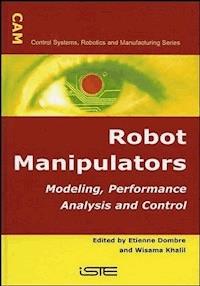
Robot Manipulators E-Book
266,99 €
Mehr erfahren.
- Herausgeber: John Wiley & Sons
- Kategorie: Wissenschaft und neue Technologien
- Sprache: Englisch
This book presents the most recent research results on modeling and control of robot manipulators. * Chapter 1 gives unified tools to derive direct and inverse geometric, kinematic and dynamic models of serial robots and addresses the issue of identification of the geometric and dynamic parameters of these models. * Chapter 2 describes the main features of serial robots, the different architectures and the methods used to obtain direct and inverse geometric, kinematic and dynamic models, paying special attention to singularity analysis. * Chapter 3 introduces global and local tools for performance analysis of serial robots. * Chapter 4 presents an original optimization technique for point-to-point trajectory generation accounting for robot dynamics. * Chapter 5 presents standard control techniques in the joint space and task space for free motion (PID, computed torque, adaptive dynamic control and variable structure control) and constrained motion (compliant force-position control). * In Chapter 6, the concept of vision-based control is developed and Chapter 7 is devoted to specific issue of robots with flexible links. Efficient recursive Newton-Euler algorithms for both inverse and direct modeling are presented, as well as control methods ensuring position setting and vibration damping.
Sie lesen das E-Book in den Legimi-Apps auf:
Seitenzahl: 497
Veröffentlichungsjahr: 2013
Ähnliche




















Table of Contents
Chapter 1. Modeling and Identification of Serial Robots
1.1. Introduction
1.2. Geometric modeling
1.3. Kinematic modeling
1.4. Calibration of geometric parameters
1.5. Dynamic modeling
1.6. Identification of dynamic parameters
1.7. Conclusion
1.8. Bibliography
Chapter 2. Modeling of Parallel Robots
2.1. Introduction
2.2. Machine types
2.3. Inverse geometric and kinematic models
2.4. Direct geometric model
2.5. Bibliography
Chapter 3. Performance Analysis of Robots
3.1. Introduction
3.2. Accessibility
3.3. Workspace of a robot manipulator
3.4. Concept of aspect
3.5. Concept of connectivity
3.6. Local performances
3.7. Conclusion
3.8. Bibliography
Chapter 4. Trajectory Generation
4.1. Introduction
4.2. Point-to-point trajectory in the joint space under kinematic constraints
4.3. Point-to-point trajectory in the task-space under kinematic constraints
4.4. Trajectory generation under kinodynamic constraints
4.5. Examples
4.6. Conclusion
4.7. Bibliography
Appendix: Stochastic Optimization Techniques
Chapter 5. Position and Force Control of a Robot in a Free or Constrained Space
5.1. Introduction
5.2. Free space control
5.3. Control in a constrained space
5.4. Conclusion
5.5. Bibliography
Chapter 6. Visual Servoing
6.1. Introduction
6.2. Modeling visual features
6.3. Task function and control scheme
6.4. Other exteroceptive sensors
6.5. Conclusion
6.6. Bibliography
Chapter 7. Modeling and Control of Flexible Robots
7.1. Introduction
7.2. Modeling of flexible robots
7.3. Control of flexible robot manipulators
7.4. Conclusion
7.5. Bibliography
List of Authors
Index
Part of this book adapted from “Analyse et modélisation des robots manipulateurs” and “Commande des robots manipulateurs” published in France in 2001 and 2002 by Hermès Science/Lavoisier
First published with revisions in Great Britain and the United States in 2007 by ISTE Ltd
Apart from any fair dealing for the purposes of research or private study, or criticism or review, as permitted under the Copyright, Designs and Patents Act 1988, this publication may only be reproduced, stored or transmitted, in any form or by any means, with the prior permission in writing of the publishers, or in the case of reprographic reproduction in accordance with the terms and licenses issued by the CLA. Enquiries concerning reproduction outside these terms should be sent to the publishers at the undermentioned address:
ISTE Ltd
ISTE USA
6 Fitzroy Square
4308 Patrice Road
London W1T 5DX
Newport Beach, CA 92663
UK
USA
www.iste.co.uk
© ISTE Ltd, 2007
© LAVOISIER, 2001, 2002
The rights of Etienne Dombre and Wisama Khalil to be identified as the authors of this work have been asserted by them in accordance with the Copyright, Designs and Patents Act 1988.
Library of Congress Cataloging-in-Publication Data
Modeling, performance analysis and control of robot manipulators/edited by Etienne Dombre, Wisama Khalil.
p. cm.
Includes index.
ISBN-13: 978-1-905209-10-1
ISBN-10: 1-905209-10-X
1. Robotics. 2. Manipulators (Mechanism) I. Dombre, E. (Etienne) II. Khalil, W. (Wisama)
TJ211.M626 2006
629.8′933--dc22
2006032328
British Library Cataloguing-in-Publication Data
A CIP record for this book is available from the British Library
ISBN 10: 1-905209-10-X
ISBN 13: 978-1-905209-10-1
Chapter 1
Modeling and Identification of Serial Robots1
1.1. Introduction
The design and control of robots require certain mathematical models, such as:
transformation models between the operational space (in which the position of the end-effector is defined) and the joint space (in which the configuration of the robot is defined). The following is distinguished:
- direct and inverse geometric models giving the location of the end-effector (or the tool) in terms of the joint coordinates of the mechanism and vice versa,
- direct and inverse kinematic models giving the velocity of the end-effector in terms of the joint velocities and vice versa,
dynamic models giving the relations between the torques or forces of the actuators, and the positions, velocities and accelerations of the joints.
This chapter presents some methods to establish these models. It will also deal with identifying the parameters appearing in these models. We will limit the discussion to simple open structures. For complex structure robots, i.e. tree or closed structures, we refer the reader to [KHA 02].
Mathematical development is based on (4 × 4) homogenous transformation matrices. The homogenous matrix iTj representing the transformation from frame Ri to frame Rj is defined as:
[1.1]
where isj, inj and iaj of the orientation matrix iRj indicate the unit vectors along the axes xj, yj and zj of the frame Rj expressed in the frame Ri; and where iPj is the vector expressing the origin of the frame Rj in the frame Ri.
1.2. Geometric modeling
1.2.1. Geometric description
A systematic and automatic modeling of robots requires an appropriate method for the description of their morphology. Several methods and notations have been proposed [DEN 55], [SHE 71], [REN 75], [KHA 76], [BOR 79], [CRA 86]. The most widely used one is that of Denavit-Hartenberg [DEN 55]. However, this method, developed for simple open structures, presents ambiguities when it is applied to closed or tree-structured robots. Hence, we recommend the notation of Khalil and Kleinfinger which enables the unified description of complex and serial structures of articulated mechanical systems [KHA 86].
A simple open structure consists of n+1 links noted C0, …, Cn and of n joints. Link C0 indicates the robot base and link Cn, the link carrying the end-effector. Joint j connects link Cj to link Cj-1 (Figure 1.1). The method of description is based on the following rules and conventions:
the links are assumed to be perfectly rigid. They are connected by revolute or prismatic joints considered as being ideal (no mechanical clearance, no elasticity);
the frame Rj is fixed to link Cj;
axis zj is along the axis of joint j;
axis xj is along the common perpendicular with axes zj and zj+1. If axes zj and zj+1 are parallel or collinear, the choice of xj is not unique: considerations of symmetry or simplicity lead to a reasonable choice.
The transformation matrix from the frame Rj-1 to the frame Rj is expressed in terms of the following four geometric parameters:
j: angle between axes zj-1 and zj corresponding to a rotation about xj-1;
dj: distance between zj-1 and zj along xj-1;
θj: angle between axes xj-1 and xj corresponding to a rotation about zj;
rj: distance between xj-1 and xj along zj.
Figure 1.1.A simple open structure robot
Figure 1.2.Geometric parameters in the case of a simple open structure
The joint coordinate qj associated to the jth joint is either θj or rj, depending on whether this joint is revolute or prismatic. It can be expressed by the relation:
[1.2]
with:
.
The transformation matrix defining the frame Rj in the frame Rj-1 is obtained from Figure 1.2 by:
[1.3]
where Rot(u, α) and Trans(u, d) are (4 × 4) homogenous matrices representing, respectively, a rotation α about the axis u and a translation d along u.
NOTES.
for a prismatic joint, the axis zj is parallel to the axis of the joint; it can be placed in such a way that dj or dj+1 is zero;
when zj is parallel to zj+1, the axis xj is placed in such a way that rj or rj+1 is zero;
in practice, the vector of joint variables q is given by:
where q0 represents an offset, qc are encoder variables and Kc is a constant matrix.
EXAMPLE 1.1. description of the structure of the Stäubli RX-90 robot (Figure 1.3). The robot shoulder is of an RRR anthropomorphic type and the wrist consists of three intersecting revolute axes, equivalent to a spherical joint. From a methodological point of view, firstly the axes zj are placed on the joint axes and the axes xj are placed according to the rules previously set. Next, the geometric parameters of the robot are determined. The link frames are shown in Figure 1.3 and the geometric parameters are given in Table 1.1.
Figure 1.3.Link frames for the Stäubli RX-90 robot
Table 1.1.Geometric parameters for the Stäubli RX-90 robot
1.2.2. Direct geometric model
The direct geometric model (DGM) represents the relations calculating the operational coordinates, giving the location of the end-effector, in terms of the joint coordinates. In the case of a simple open chain, it can be represented by the transformation matrix 0Tn:
[1.4]
The direct geometric model of the robot may also be represented by the relation:
Lesen Sie weiter in der vollständigen Ausgabe!
Lesen Sie weiter in der vollständigen Ausgabe!
Lesen Sie weiter in der vollständigen Ausgabe!
Lesen Sie weiter in der vollständigen Ausgabe!
Lesen Sie weiter in der vollständigen Ausgabe!
Lesen Sie weiter in der vollständigen Ausgabe!
Lesen Sie weiter in der vollständigen Ausgabe!
Lesen Sie weiter in der vollständigen Ausgabe!




