


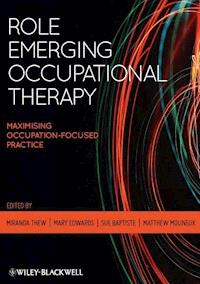
Role Emerging Occupational Therapy E-Book
37,99 €
Mehr erfahren.
- Herausgeber: John Wiley & Sons
- Kategorie: Fachliteratur
- Sprache: Englisch
Role Emerging Occupational Therapy: Maximising Occupation Focused Practice is written for an audience of occupational therapy practitioners, educators and students.
This text offers an exploration of emerging innovative directions for the profession of occupational therapy with a focus upon the theory and application of role emerging placements.
The book affords the reader an opportunity to explore how occupation focused practice can be applied to a wide variety of settings and circumstances in order to improve the health and well-being of a diverse range of people. Chapters cover relevant theory as well as offering practical guidance with examples drawn from the experiences of university educators, occupational therapists, setting/service providers and students.
The book describes, explores and discusses both the potential and ramifications of role emerging practice on the occupational therapy profession and offers a vision for the future of the profession that reflects current occupational, social and health needs.
Sie lesen das E-Book in den Legimi-Apps auf:
Seitenzahl: 366
Veröffentlichungsjahr: 2011
Ähnliche




















Contents
Cover
Dedication
Title Page
Copyright
Acknowledgements
Preface
Notes on contributors
Part I: Background to occupational therapy, and philosophy of occupational therapy and emergence/re-emergence of occupation-focused practice
Chapter 1: Emerging occupational therapy practice: Building on the foundations and seizing the opportunities
Introduction
Contemporary occupational therapy
The current world of health and social care
Bringing it together
Conclusion
Chapter 2: Models of role emerging placements
Introduction
The practice placement situation in Canada and the UK
Models of Role Emerging placements in Canada and the UK
Lessons learned in establishing and facilitating REPs
Conclusion and recommendations
Part II: Current examples of emerging practice for occupational therapists
Chapter 3: Successful role emerging placements: It is all in the preparation
Introduction
Preparation is key
Ensuring that the student is up to it
Great expectations – understanding hopes and concerns for an unfamiliar model of placement
Enabling student development whilst undertaking a role emerging placement
Supporting the practice educator whilst undertaking a role emerging placement
Conclusion
Chapter 4: The student experience of a role emerging placement
Introduction
Experience from the United Kingdom
Philippa's account
Lydia's experience
Contributing to future practice
Elisha's Canadian experience
Conclusion
Chapter 5: Promoting well-being in a large organisation: Challenges and opportunities
Introduction
The current ‘climate’ in healthy lifestyles and well-being
The importance of work as an occupation
Worksite well-being programmes
An example of a occupational therapists contribution
Conclusion
Chapter 6: An occupational perspective of a disability-focused employment service
Introduction
A need to be productive
The service
Socio-political context of the service
Applying an occupational perspective
Initiating change
The project
The experience
The future: vocational rehabilitation
The future: personal practice
Conclusion
Chapter 7: Promoting occupational therapy in a community health centre
Introduction: four villages, primary health care and the community health centre context
Health promotion: The foundational guiding framework
Community health centres: The primary health care context
Occupational therapy at the Four Villages Community Health Centre
Occupational therapy responding to individual occupational issues and health needs
Linking individuals with opportunities for occupational engagement through group programmes
Going broader: The CHC occupational therapist as a systemic change agent
Lessons learned: Reflections on 15 years of occupational therapy at FVCHC
Coupling evidence with good stories that resonate with the public
Articulating the added benefit of occupational therapy
Challenging medical hegemony over the primary health care discourse
Working towards sustainability
Broadening descriptions of who we serve
Infusing an occupational justice perspective to the CHC
Opportunities for greater occupational therapist involvement
Conclusion
Chapter 8: Occupational therapy: Making a difference to people with cardiac failure in the community
Introduction
Heart failure: the facts
Occupational perspective of cardiac services
An overview of community cardiac care in the community
Case study 1
Case study 2
Working occupationally with this client group
Heart failure service perspective
The potential and future of occupational therapy within this type of setting
Conclusion
Chapter 9: Community development
Introduction
Community development
Occupational justice
Cultural change
Community Development as a focus of role emerging placements: the Leeds Metropolitan University experience
Case study 1: working with asylum seekers
Case study 2: community development within a library service
Conclusion
Part III: Future of the profession
Chapter 10: Using policy and government drivers to create role emerging opportunities
Introduction
Policy transitions
Case example: the Community Scholar Project
Evaluation
Results
Discussion
Applying the lessons learned
Conclusions
Chapter 11: The way forward?
Introduction
The context of the past and present
Grasping contemporary opportunity to guide the future
Emerging trends
Future research directions
Conclusion
Index
This book is dedicated to occupational therapists over the globe who aim to deliver services that might not match what has traditionally been delivered, or what is expected by other professionals, but always match need and promote true occupational therapy.
This edition first published 2011 © 2011 by Blackwell Publishing Ltd
Blackwell Publishing was acquired by John Wiley & Sons in February 2007. Blackwell’s publishing program has been merged with Wiley’s global Scientific, Technical and Medical business to form Wiley-Blackwell.
Registered office: John Wiley & Sons Ltd, The Atrium, Southern Gate, Chichester, West Sussex, PO19 8SQ, UK
Editorial offices: 9600 Garsington Road, Oxford, OX4 2DQ, UK The Atrium, Southern Gate, Chichester, West Sussex, PO19 8SQ, UK 2121 State Avenue, Ames, Iowa 50014-8300, USA
For details of our global editorial offices, for customer services and for information about how to apply for permission to reuse the copyright material in this book please see our website at www.wiley.com/wiley-blackwell.
The right of the author to be identified as the author of this work has been asserted in accordance with the UK Copyright, Designs and Patents Act 1988.
All rights reserved. No part of this publication may be reproduced, stored in a retrieval system, or transmitted, in any form or by any means, electronic, mechanical, photocopying, recording or otherwise, except as permitted by the UK Copyright, Designs and Patents Act 1988, without the prior permission of the publisher.
Designations used by companies to distinguish their products are often claimed as trademarks. All brand names and product names used in this book are trade names, service marks, trademarks or registered trademarks of their respective owners. The publisher is not associated with any product or vendor mentioned in this book. This publication is designed to provide accurate and authoritative information in regard to the subject matter covered. It is sold on the understanding that the publisher is not engaged in rendering professional services. If professional advice or other expert assistance is required, the services of a competent professional should be sought.
Library of Congress Cataloging-in-Publication Data
Role emerging occupational therapy : maximising occupation focussed practice / edited by Miranda Thew … [et al.]. p. ; cm. Includes bibliographical references and index. ISBN 978-1-4051-9782-3 (pbk. : alk. paper) 1. Occupational therapy–Administration. 2. Medical care–Needs assessment. 3. Health promotion. I. Thew, Miranda. [DNLM: 1. Occupational Therapy–organization & administration. 2. Community Health Services–organization & administration. 3. Health Promotion. 4. Needs Assessment. 5. Professional Role. WB 555] RM735.4.R65 2011 615.8′515–dc22 2010040975
A catalogue record for this book is available from the British Library.
This book is published in the following electronic formats: ePDF 9781444339987; Wiley Online Library 9781444340006; ePub 9781444339994
Acknowledgements
We wish to thank the team at Wiley-Blackwell for patiently reminding us of deadlines and for their commitment to Role Emerging Occupational Therapy. Our inspiration for the book was from the students and professionals who have the determination to envision~and deliver occupational therapy that has occupation at its heart and are willing to keep convention at bay!
Preface
“We must become the change we want to see in the world”
Mahatma Ghandi
There is an increasing push for all professionals to expand their professional boundaries and scope of practice to meet the ever-changing need within health and social care. This can pay dividends where professional roles are well recognised and where there is an established evidence-based need. In some areas within occupational therapy there has been a shrinking of the profession, in part, due to increasing genericism in the health workforce. These forces coupled with a variable job market has increased the interest in developing practice in areas that have the potential for occupational therapy to make a contribution, and often this is in response to changing societal demands (Rodger et al., 2007; Fortune et al., 2006). Further, some contest that unless occupational therapists grasp the move to community and away from institutionalised practice the profession will not survive (Thomas et al., 2005).
Traditional practice placement education provides occupational therapy students with important opportunities to work in settings where many of them may gain employment (Mulholland & Derdall, 2004; Rodger et al., 2007. This, in effect, prevents a break away from the medical or other such models to support expansion of the profession for the future. Where student practice placement education has taken in place in non-traditional settings there has been an increase in the awareness of occupational therapy, an occupational perspective of humans and health, and consequent employment opportunities for occupational therapists (Friedland et al., 2001; Rodger et al., 2007; Thew et al, 2008). This is surprising, given that, by definition such placements are those where there has been no previous occupational therapy role (Bossers et al., 1997) but it appears that the heightened awareness of the benefits of occupation-focused practice seems to open up opportunities for the profession.
This book focuses on the potential areas for developing occupational therapy practice and widening the impact of an occupational perspective of humans and health; it particularly offers experiences and practical examples of how an occupational perspective was introduced to a range of settings and it firmly reinforces the core and key defining skills for occupational therapists. By describing and analysing needs in settings and through addressing those needs with occupational-focused practice interventions, an occupationally focused profession is illustrated.
This book draws on the experiences of university educators, occupational therapists who have supervised or actively work in innovative settings, non-occupational therapy service providers and students who have undertaken role emerging practice placements. It provides experiential evidence underpinned by research in order to inspire and support a future vision for the profession that not only honours the uniqueness of occupational therapy, but also reflects examples of how occupation focussed intervention can address occupational injustice and meet current social and health need.
Miranda Thew, Mary Edwards, Sue Baptiste & Matthew Molineux
References
Bossers, A., Cook, J., Polatajko, H., & Laine, C. (1997). Understanding the role emerging fieldwork placement. Canadian Journal of Occupational Therapy, 64, 70–81.
Fortune, T., Farnworth, L., & McKinstry, C. (2006). Viewpoint: Project-focussed fieldwork: Core business or fieldwork fillers? Australian Occupational Therapy Journal, 53 (3), 233–236.
Friedland. J., Polatajko, H., & Gage, M. (2001). Expanding the boundaries of occupational therapy practice through student field-work experiences: Description of a provisionally-funded community funded community development project. Canadian Journal of Occupational Therapy, 68 (5) 301–307.
Mulholland, S., & Derdall, M. (2004). Bridges to Practice - Employment - Exploring what employers seek when hiring occupational therapists. Canadian Journal of Occupational Therapy, 71 (4), 223.
Rodger, S., Thomas, Y., Dickson, D., McByrde, C., Broadbridge, J., Hawkins, R., & Edwards, A. (2007). Putting students to work: Valuing fieldwork placements as a mechanism for recruitment and shaping the future occupational therapy workforce. Australian Occupational Therapy Journal, 54, S94–S97.
Thew, M., Hargreaves, A., & Cronin-Davis, J. (2008). An evaluation of a role-emerging practice placement model for a full cohort of occupational therapy students. British Journal of Occupational Therapy. 71 (8), 348–853.
Thomas, Y., Penman, M., Williamson, P. (2005). Australian and New Zealand Fieldwork: Charting territory for future practice. Australian Occupational Therapy Journal, 52, 78–81.
Notes on contributors
Susan Baptiste is Professor at the School of Rehabilitation Science, McMaster University, Hamilton, Ontario.
Emma Brown qualified as an occupational therapist following the MSc Occupational Therapy (pre-registration) programme at Metropolitan University. She is now working as an occupational therapist in mental health in Leeds, UK.
Lynn Cockburn is an occupational therapist and Assistant Professor at the University of Toronto, Canada.
Mary Edwards is Associate Clinical Professor at the School of Rehabilitation Science at McMaster University, Ontario, Canada.
Philippa Jane Gregory qualified as an occupational therapist following the MSc Occupational Therapy (pre-registration) programme at Metropolitan University. Philippa now resides in Singapore where she has taken a position providing Occupational Therapy for children in a private paediatric clinic.
Barbara Gurney is a Lead Cardiac Team nurse working within the Community Cardiac Services within the Leeds NHS Trust UK.
Sally Hall graduated from Leeds Metropolitan University with the MSc Occupational Therapy (pre-registration). She is an occupational therapist with a treatment service for people with mental health problems in Pontefract, West Yorkshire, UK.
Lori Letts is Associate Professor at the School of Rehabilitation Science and Assistant Dean of the Occupational Therapy Program at McMaster University, Canada.
Matthew Molineux is Associate Professor at the School of Occupational Therapy and Social Work at Curtin University, Perth, Australia.
Lydia Quelch graduated with distinction from the Leeds Metropolitan University with the MSc Occupational Therapy (pre-registration) programme and is now working as an occupational therapist within social services within the UK.
Julie Richardson is Associate Professor in the School of Rehabilitation Sciences at McMaster University, Canada.
Sylvia Rodger is Professor and Head of Division of Occupational Therapy, School of Health and Rehabilitation Sciences at The University of Queensland, Australia.
Miranda Thew is the acting programme lead of the MSc Occupational Therapy (pre-registration) programme and Principal Lecturer in Occupational Science and Occupational therapy at Leeds Metropolitan University, UK.
Yvonne Thomas is an occupational therapist and Senior Lecturer at James Cook University, Queensland, Australia.
Barry Trentham is Assistant Professor at the Department of Occupational Science and Occupational Therapy, Faculty of Medicine, University of Toronto, Canada.
Elisha Watanabe graduated from the McMaster University Occupational Therapy Program and is currently practicing as an occupational therapist in neurological and amputee rehabilitation at the Health Sciences Centre in Winnipeg, Manitoba, Canada.
Deborah Windley is Senior Lecturer in Occupational Science and Occupational therapy at Leeds Metropolitan University, UK.
Part I
Background to occupational therapy, and philosophy of occupational therapy and emergence/re-emergence of occupation-focused practice
Part One of this book is designed to open up the discussion about who we have been as occupational therapists, who we are currently and what could be the core strategies and approaches to lead us into the future, building on the essential ‘fit’ between academic studies and fieldwork education in the preparation of our graduates.
As most practitioners who have graduated from an occupational therapy education programme within the past two decades know, the roots of the profession were laid within the moral treatment era of the nineteenth century. Some may also know that in the mural art of Ancient Egypt were depictions of women helping others to rid themselves of foul humours through the use of activities such as playing a lyre, working on canvas and weaving on wall looms. Wherever we each believe our profession originated, one thing we all know is that somehow somewhere in the middle of the twentieth century we seemed to lose our way. In committed attempts to fit into the medical model and the reductionist thinking of the 1970s, occupational therapy relinquished its hold on occupation, and joined the movement which focused on curing, healing and ameliorating that stemmed from the perceived importance of impairment as the central construct.
One of the initiatives that has shown particular growth is the intentional strategy of integrating fieldwork education into the academic mission rather than seeing it as something that stands alone and exists in isolation at the end of study. Some settings have organised fieldwork to occur during discrete time periods such as full semesters or within a full academic year, thus creating an isolated set of experiences rather than an integrated evolution of each student working towards competence at an entry-to-practice level.
There is a distinct commitment within the current climate to create models for occupational therapy practice that are centred around ‘occupation’ as the core construct, using client-centred and person-centred philosophies to establish partnerships between clients and therapists. There have been steps taken to move away from settings that are formed around a medical model and a few eager pioneers who have chosen to explore new territory and not be constrained by what has been or what is; they seek to uncover what can be.
Chapter 1
Emerging occupational therapy practice: Building on the foundations and seizing the opportunities
Matthew Molineux & Sue Baptiste
Introduction
Several decades ago, Mary Reilly (1962, p. 3) proposed, perhaps quite boldly, that occupational therapy could be one of the great ideas of twentieth-century medicine. Although we might now argue about the way she located occupational therapy within medicine, it is probably true that many occupational therapists would agree that the sentiment of her claim was reasonable and achievable. The extent to which her prophecy has come true varies between countries, and perhaps even between different locations and organisations within countries. For example, in some countries where occupational therapy is relatively new, occupational therapists tend to work within health systems dominated by a biomedical view of humans and health, and may in some instances have their interventions directed by a medical practitioner. Even in countries where the profession is well established, some health care systems or organisations are so biomedical in their outlook that occupational therapy practice is narrowly focused and limited. However, there are also a growing number of examples of occupational therapy practice which are contemporary, innovative and effective at meeting the needs of individuals, groups and communities to achieve and maintain health through occupation, and this book provides a few examples of this work. Nonetheless, there is more work to be done by the occupational therapy profession until we can feel comfortable that Mary Reilly's challenge has been fully met.
Lesen Sie weiter in der vollständigen Ausgabe!
Lesen Sie weiter in der vollständigen Ausgabe!
Lesen Sie weiter in der vollständigen Ausgabe!
Lesen Sie weiter in der vollständigen Ausgabe!
Lesen Sie weiter in der vollständigen Ausgabe!
Lesen Sie weiter in der vollständigen Ausgabe!
Lesen Sie weiter in der vollständigen Ausgabe!
Lesen Sie weiter in der vollständigen Ausgabe!
Lesen Sie weiter in der vollständigen Ausgabe!
Lesen Sie weiter in der vollständigen Ausgabe!
Lesen Sie weiter in der vollständigen Ausgabe!
Lesen Sie weiter in der vollständigen Ausgabe!
Lesen Sie weiter in der vollständigen Ausgabe!




