


Romania and the Holocaust E-Book
25,99 €
Mehr erfahren.
- Herausgeber: ibidem
- Kategorie: Geisteswissenschaft
- Sprache: Englisch
From summer 1941 onwards, Romania actively pursued at its own initiative the mass killing of Jews in the territories it controlled. 1941 saw 13,000 Jewish residents of the Romanian city of Iai killed, the extermination of thousands of Jews in Northern Bukovina and Bessarabia by Romanian armed forces and local people, large-scale deportations of Jews to the camps and ghettos of Transnistria, and massacres in and around Odessa. Overall, more than 300,000 Jews of Romanian and Soviet or Ukrainian origin were murdered in Romanian- controlled territories during the Second World War. In this volume, a number of renowned experts shed light on the events, the contexts, and the aftermath of this under-researched and lesser-known dimension of the Holocaust. 75 years on, this book gives much-needed impetus to research on the Holocaust in Romania and Romanian-controlled territories.
Das E-Book können Sie in Legimi-Apps oder einer beliebigen App lesen, die das folgende Format unterstützen:
Seitenzahl: 509
Veröffentlichungsjahr: 2016
Ähnliche




















ibidemPress, Stuttgart
Table of Contents
Simon Geissbühler
Introduction
Seventy-fiveyears ago, on July 2,1941, Romanian troops and the allied German Eleventh Army launched offensive combat operations on thesouthernfront against the USSR(Operation München), crossing from Romania intoNorthernBukovina and Bessarabia.[1]On July 3,1941, Romanian troops reached the villageofCiudeiclose to the Romanian-Soviet border. Moses Eisig, a young Jewish man fromCiudei, ran away in time. Hefirsthid with a local peasant who told him—invoking the propaganda stereotype of Judeo-Bolshevism—that the Romanians were“mad at the Jews”because theJewswere all Communists and hadblown upabridge—when in factthe Sovietshaddestroyed itduring their retreat a few days earlier.Moses then fled into the woods. There he “heard such a tremendously loud echo that the whole woods trembled. That’s when they shot all our people.…We thought they were shooting men, but not women and children like that.”[2]Sneaking back into the village a few days later, he found it deserted and destroyed, and Jewish property looted by villagers.[3]As he recounted,“The windows were gone!The doors were gone!The bricks were missing. And you couldn’t see a dog, or a cat. No people! Nothing!” Survivors later detailed what had happened. The Romanian troops, with the help of locals,[4]had herded some of the village’s Jews together and summarily shot them all: “[Not]everyonehad the luckto get a bullet in the heart or in the head. My fatherand my brothers and sister had to watch their own children dying.And the children had to watch how their parents died.” Other Jews were slain by villagers and peasants who joined in the massacre. Around 500 Jews were killed in Ciudei inearly July 1941.[5]
Seventy-five years ago, at the end of July 1941, in the small town of Zhabokrych in Romanian-controlled Transnistria in today’s southwestern Ukraine, German and Romanian military units drove approximately600 Jews, among them many women and children, into cellars and shot them.[6]A little girl, Manya, survived the mass shooting:
In July 1941, the German army entered the town, followed by the Romanian army. The Jews were ordered to gather in five cellars where the Romanian soldiers proceeded to shoot them. Manya lost consciousness. When she awoke, she saw that her mother had been killed. Her father had survived. Manya and her father hid in the cellar until nightfall. They then escaped to the forest but after a week, starving and cold, they returned. A few days later, they were herded into the town ghetto, where they lived under grueling conditions in one apartment with several other families. One day, the police ordered both adults and children back to the cellars to remove the bodies of those killed in the massacre. The bodies were in a terrible state of decomposition, and the horrified prisoners were forced to bury them in a mass grave. Manya identified her mother’s body by the red boots she had been wearing. She and her father managed to bury her in a grave near their house.[7]
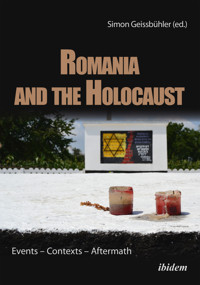
Today, Zhabokrych is a nondescript, rundown village on the Ukrainian periphery. The brick synagogue still exists, but it was closed long ago and is used for other purposes. The modestHolocaustmemorialin Zhabokrychis pictured on the cover of this volume.[8]
These are the stories of two survivors of the Holocaust perpetrated by Romanians or in Romanian-controlled territories during the Second World War.Fromthesummerof1941onward, Romania pursued at its own initiative the mass killing of Jews in the territories it controlled.Bythe end of June 1941, approximately 13,000 Jewswere killed in the Romanian city of Iașiand in thedeath trainsfrom that city.When theRomanianarmyinvaded the Soviet Union on the southern front at the beginning of July 1941, thousandsof Jews were exterminated in Northern Bukovina and Bessarabia by Romaniantroopsand local people.[9]This first wave of violence with up to 43,500 victims was followed in autumn1941by large-scale deportations of Jews from Southern and Northern Bukovina as well as Bessarabia to camps and ghettosinTransnistria. Many perished on the deportation marches, many more in the following years in the camps and ghettos. Tens of thousands of Jews were massacred by Romanian units in and around Odessa. Overall, more than 300,000 Jews of Romanian and of Soviet or Ukrainian origin were murdered in Romanian-controlled territories during the Second World War.
This volumesheds light on theevents, the contexts,and the aftermath of this under-researched and lesser-knownchapterof the Holocaust.The fact that Romania was “Germany’s major ally on the eastern front after 1941 [and] the only other state to generate an autonomous policy of the direct mass murder of Jews” is little known.[10]Seventy-fiveyears after these events, this bookgivesmuch-needed impetusto research on the Holocaust perpetrated by Romanians and in Romanian-controlled territories.
The idea to publish this volume about Romania and the Holocaust was born at the one-daysymposium“The Holocaust in Romania—Revisiting Research andPublic Discourse” onOctober29,2015, at Yad Vashem in Jerusalem. The symposium showed that considerable progress has been made in recent years in researching the Holocaust perpetrated by Romania. It has been positively noted thatyoung historians, also Romanians, are now doing research on Romania and the Holocaust. Differentorganizations, research groups, and individuals areworkingon specific aspects of Romania and the Holocaust.Also, Romaniais currently (2016–17) holding thepresidency of the International Holocaust Remembrance Alliance(IHRA),which isanotherpositive step.
At the same time, however, the event in Jerusalem once more revealed that much work is still to be done.Under the Communist regimes, recognition of the Holocaust was all but impossible. TheShoahindeed was a taboo foralmost 50years, andRomania was no exception. In fact, having been a close ally of Nazi Germany and having implemented the mass murder of Jews autonomously, Romania felt an even more acute urge to draw a veil of silence over its inglorious past. The breakupof the Soviet bloc and the end of the Ceaușescu regime did not lead to a comprehensive reassessment of Romanian historyorabroad evidence- and research-based critical reevaluation ofRomania’srole in the Second World War and the Holocaust. The fascist ghosts of the past,andespecially questionsconcerningcollaboration with Nazi Germany and the Holocaust perpetrated by Romania,remaineduntouched. Fascism was presented as an alien, German concept and Romania as a victim, innocent of any wrongdoing or crime.[11]The so-called revisionist school is still relatively influential in Romania. It minimizesand trivializesRomanian crimes during the Second World War in general and Romania’s responsibility for the Holocaust in Northern Bukovina, Bessarabia,and Transnistria in particular.[12]
But there is also avast gap between scholarly researchandpublic knowledge about the Holocaust in Romania. Not even a third of the respondentsina poll commissioned by the Elie Wiesel Institute in Bucharest in 2015believe that the Holocaust also happened in Romania.[13]Among themeager 28percentwhoadmitthat the Holocaust also took placein Romania,69percentsee Germany as the main culprit of the Holocaust in their country.Only a tiny minority among Romanians is therefore prepared to acknowledge the historical fact ofwho themainperpetratorswere in the killing ofmore than 300,000 Jews of Romanian and of Soviet or Ukrainian origin in Romanian-controlled territories during the Second World War: the Romanians themselves.
The German historian Armin Heinen claimed in 2007 that the Romanian historiography of the Holocaust had reached approximately the state of research in Germanyinthe mid-1960s.[14]Methodologically, many Romanian studies on the Holocaust have indeed beenand remaindescriptive and positivistic.[15]They donot take into account the state of international research on the Holocaust in general and donot work with specific research questions and theses.The research controversies about the nature of the Nazi dictatorship in general and the Holocaust in particular that Ian Kershaw so aptly summarized already in 1985, or later debates, for example, betweenDaniel Jonah GoldhagenandChristopher Browning, or the discussion surrounding the publications of Timothy Snyder seem to have had only a marginal, if any, impact on Romanian researchers and on research about Romania and the Holocaust.[16]International research on the Holocaust in Romanian-controlled territories remains relatively scarce to this day too.Little is published on the topic in English-language scholarly journals. There is also alackofcoordination between different groupsand scholars dealing with the topic; and new findings and research results should be better and more rapidlycommunicated within the scholarly community andto a broader public,as well as be madeavailable in Romania, Ukraine,and the Republic of Moldova.
But there hasbeen some progress. Radu Ioanid’sThe Holocaust in Romania,published in 2000,and the Final Report of the International Commission on the Holocaust in Romania, publishedinEnglish in2005, arecrucial synoptic worksand important starting points for further research.[17]These publications havehelped to breakthe “recurring cycle of official denial.”[18]They have been complemented in the last few years by new studies,for example,by Jean AncelandVladimir Solonari.[19]Certain topics such as the Iași massacres,with over 13,000 victims at the end of June 1941,as well as the campsand ghettos in Transnistria haveat lastreceived the scholarly attention they deserve.[20]
This volume presents new research on Romania and the Holocaust.All the contributions assembled here are original texts that have not been published before.Mariana Hausleitnerexposes the myth that the Jews were responsible for the“national disgrace”in the summer of 1940 when Romania had to retreat from Northern Bukovina and Bessarabia due to the Soviet ultimatum. There were some abuses of fleeing Romanians also by young Jews, but they are neither quantitatively nor qualitatively comparable to the murder ofJews by the Romanian military and the bloody pogroms in Dorohoi and Galaţi in the summer of 1940. In fact, the alleged Jewish-Communist gangs in Czernowitz and elsewhere, which neatly fitted the“thesis”of Judeo-Bolshevism, were an invention of the Romanian propaganda machine to create a scapegoat and justify violence against the Jewish population.
In his contribution,Henry Eatonmeticulously analyzes the Iași pogrom at the end of June 1941. More than 13,000 Jews were killed in this pogrom and in the death trains. Eaton disentangles the web of lies, falsified statements, and half-truths that were “created” to cement the idea that Romania was not responsible for the Holocaust in Romanian-controlled territories during the Second World War in general and the Iași pogrom in particular.
Alti Rodal’s articleis an outstanding exampleof a micro-study of localized eliminationist violence.[21]She looks at the massacre of Jews in the village of Borivtsi in Northern Bukovina that was planned and organized by theOrganization of Ukrainian Nationalists (OUN). It is micro-studies like these that are needed to better understand the contexts, the dynamics, and the perpetrators of the mass murders of Jews in many villages and small towns throughout Northern Bukovina and Bessarabia.
What happened inthesummerof1941 in Northern Bukovina and Bessarabia were by no means isolated and unique events, asKai Struveshows in his reconstruction of theanti-Jewish violence in aboutthirtycities and small towns as well asina number of villages during July 1941 in eastern Galicia.He makes the distinctionbetween three main contexts of the violence:the retrieval of murdered prison inmates, punishments and executions by OUN-B(group led by Stepan Bandera)insurgents, andtheviolent excesses of units oftheWaffen-SS.Struve compareseastern Galicia with otherEastern Europeanregionsand arguesthat deadly violence against Jews from the side of the local population emanated mostly from insurgent groups whose aim was to remove or punishalleged supporters of Soviet rule andto establishtheir own nation-states.Witold Mędykowskicomplements Struve’s contribution by looking at the same events inthesummerof1941 from another point of view and against a different theoretical background.
SarahRosenandGali Tibontake a closer look at the ghettos in Transnistria. They are interested in the complex relations between different Jewish groups within the ghettos, on the one hand, and between the Jewish ghetto population and the Romanian authorities and the local Ukrainian population, on the other. Rosen concentrates on the Djurin ghetto and bases her research mainly on the diary ofLipman Kunstadt. Tibon discusses the Jewish oppositionto the established Jewish leadershipin theghettos of the Mogilevdistrict in Transnistria.Diana Dumitrulooks at how Holocaust crimes in Romanian-controlled territories were reviewed after Stalin’s death in 1953. Even if some of the reviewsshowed that there were inconsistencies and even legal faults in theprevious investigations,in the overwhelming majority of cases,the Soviet prosecutors had little or no reason at all to assume that convicted criminals werein factinnocent.Tuvia Frilingwas one of the co-vice chairs of the International Commission on the Holocaust in Romania and one of the editors of its Final Report. He gives, for the first time, a personal insight into the inner workings of and the conflicts within the Commission and discusses its main conclusions and recommendations.
Michael Shafirdissects the public discourse in Romania.Hedistinguishesbetween theofficialversusunofficialmemory of the Holocaust and its remembrance, and shows that there is indeedan official and an unofficial narrative. The unofficial narrative is still surprisingly widespread and influential in Romania and extends deep into the political mainstream. To conclude,I give a short overview of ten insightsto begainedfrom research into the Holocaust perpetrated by Romanians and in Romanian-occupied areas. What we can learn from the history of Romania and the Holocaust matters because it complements, sharpens,and broadens our understanding of the origins and the background, the contexts, the perpetrators, collaborators and bystanders, the victims, and the aftermath of the Holocaust.
While Romania remains a laggard with regard to dealing with the past, therehave been—as I underlined earlier—somepositive developments, also in comparison with other Eastern European countries, some of which have regressed in recent years when it comes to confronting their role as allies or collaborators of Nazi Germany in the Second World War and in the Holocaust. International research and pressure, increased and broader education in schools and universities, the educational efforts of civil society and state institutions,as well as Romania’s presidency of the IHRA are factors thatcan,in the medium and long term,undermine the widespread attitude of wanting-not-to-know.
Pierre Nora has rightly emphasized that “there must be a will to remember.”[22]Remembrance and the will to deal with one’s past should not be imposed primarily from the outside and from above. But researchers, Romanian and international, canand should more forcefullycontribute to change by exposing again and again the historical facts, aswe reconstruct them on the basis of the available sources, even though—or especially because—they are everything but pleasant. This volume is a small contribution to that effort seventy-five years after the Holocaust in theeastwas unleashed.
[1]Operation München did not start on June 22, 1941, as it is sometimes assumed, but on July 2.See: Hans-Jacobsen, Adolf (ed.) (1965).Kriegstagebuch des Oberkommandos der Wehrmacht. Frankfurt am Main,p.504; Bundesarchiv Freiburg/Breisgau, RH/19/I (71).
[2]Eisig, Moses (1998).Yizkor Book for the Martyrs of Ciudin: www.jewishgen.org/yizkor/Chudyn/chu001.html (accessed on March 15, 2016).
[3]Oral history interview with Constantin Padure (2011), in United States Holocaust Memorial Museum (USHMM), RG-50.575*0103.
[4]Oral history interview with Constantin Burla (2011), in USHMM, RG-50.575*0104.
[5]Ioanid, Radu (2000).The Holocaust in Romania. Chicago,p.96f.; Ancel, Jean (2011).The History of the Holocaust in Romania. Lincoln/Jerusalem,p.223.
[6]Vinokurova, Faina A. (not dated).The Holocaust in Vinnitsa Oblast: www.rtrfoundation.org/webart/UK-arch-d2.pdf (accessed on May 22, 2016).
[7]Yad Vashem (ed.) (2007).Bearing Witness. Holocaust Martyrs’ and Heroes’ Remembrance Day 2007: www.yadvashem.org/yv/en/remembrance/2007/brodeski-titelman.asp#!prettyPhoto (accessed on May 23, 2016).
[8]Geissbühler, Simon (2014).Once Upon a Time Never Comes Again. The Traces of the Shtetl in Southern Podolia (Ukraine). Bern, pp.106–110.
[9]Geissbühler, Simon (2013).Blutiger Juli. Rumäniens Vernichtungskrieg und der vergessene Massenmord an den Juden 1941.Paderborn.
[10]Snyder, Timothy (2015).Black Earth. The Holocaust as History and Warning. London,p.229.
[11]Cioflâncă, Adrian (2004). A “Grammar of Exculpation” in Communist Historiography: Distortion of the History of the Holocaust under Ceausescu,Romanian Journal of Political Sciences2: 29–46.
[12]Shafir, Michael (2014). Unacademic Academics: Holocaust Deniers and Trivializers in Post-Communist Romania,Nationalities Papers42(6): 942–964; Geissbühler, Simon (2012). Staring at the Past with Eyes Wide Shut: Holocaust Revisionism and Negationism in Romania,Israel Journal of Foreign AffairsVI(3): 127–135.
[13]Institutul Naţional pentru Studierea Holocaustului din România “Elie Wiesel” (INSHR-EW) (ed.)(2015).Sondaj de opinie privind Holocaustul din România și percepția relațiilor interetnice.Bucharest.
[14]Heinen, Armin (2007).Rumänien, der Holocaust und die Logik der Gewalt. München,p.34.
[15]Ursprung, Daniel (2010/2011). Geschichtsschreibung und Vergangenheitsbewältigung in Rumänien. Von den Mühen des Umgangs mit zeitgeschichtlichen Themen,Südost-Forschungen69/70: 358–388.
[16]Kershaw, Ian (1985).The Nazi Dictatorship: Problems and Perspectives of Interpretation. London; Browning, Christopher (1993).Ordinary Men: Reserve Police Battalion 101 and the Final Solution in Poland. New York; Goldhagen, Daniel Jonah (1996).Hitler’s Willing Executioners: Ordinary Germans and the Holocaust. New York.
[17]Ioanid 2000; International Commission on the Holocaust in Romania (ed.) (2005).Final Report. Iași.
[18]Shapiro, Paul A. (2015).The Kishinev Ghetto 1941–1942. A Documentary History of the Holocaust in Romania’s Contested Borderlands. Tuscaloosa,p.91.
[19]See, for example: Solonari, Vladimir (2007). Patterns of Violence: Local Population and the Mass Murder of Jews in Bessarabia and Northern Bukovina, July–August 1941,Kritika: Explorations in Russian and Eurasian History8(4): 749–787; Solonari, Vladimir (2009).Purifying the Nation: Population Exchange and Ethnic Cleansing in Nazi-Allied Romania. Baltimore; Solonari, Vladimir (2010). The Treatment of the Jews of Bukovina by the Soviet and Romanian Administrations in 1940–1944,Holocaust and Modernity2(8): 149–180; Ancel, Jean (2005). The German-Romanian Relationship and the Final Solution,Holocaust and Genocide Studies19: 252–275; Ancel 2011; Chioveanu, Mihai (2008). Death Delivered, Death Postponed: Romania and the Continent-Wide Holocaust,Studia Hebraica8: 136–69; Chioveanu, Mihai (2012). The Dynamics of Mass Murder. Grasping the Twisted Decision-Making Process behind the Romanian Holocaust,Sfera Politicii2(168): 25–36; Deletant, Dennis (2012). Ion Antonescu and the Holocaust in Romania,East Central Europe39: 61–100; Geissbühler, Simon (2014). “He spoke Yiddish like a Jew”: Neighbors’ Contribution to the Mass Killing of Jews in Northern Bukovina and Bessarabia, July 1941,Holocaust and Genocide Studies28(3): 430–449.
[20]Voicu, George (ed.) (2006).Pogromul de la Iași (28–30 iunie 1941)—prologul Holocaustului din România. Iași; Eaton, Henry (2013).The Origins and Onset of the Romanian Holocaust. Detroit; Ofer, Dalia (1993). The Holocaust in Transnistria. A Special Case of Genocide, in Dobroszycki, Lucjan and Jeffrey S. Gurock (eds.).The Holocaust in the Soviet Union. New York, pp.133–154; Deletant, Dennis (2003). Transnistria: soluţia românească la “problema evreiască”, inDespre Holocaust şi Comunism. Anuarul IRIR, vol. 1, 2002. Iaşi, pp.79–101;Golbert, Rebecca L. (2004). Holocaust Sites in Ukraine: Pechora and the Politics of Memorialization,Holocaust and Genocide Studies18: 205–233; Mihok, Brigitte (2009).Orte der Verfolgung und Deportation, in Benz, Wolfgang und Brigitte Mihok (Hrsg.).Holocaust an der Peripherie. Judenpolitik und Judenmord in Rumänien und Transnistrien 1940–1944.Berlin, pp.71–80; Vynokurova, Faina (2010). The Fate of Bukovinian Jews in the Ghettos and Camps of Transnistria, 1941–1944: A Review of the Source Documents at the Vinnytsa Oblast State Archive,Holocaust and Memory2(8): 18–26; Baum, Herwig (2011).Varianten des Terrors. Ein Vergleich zwischen der deutschen und der rumänischen Besatzungsverwaltung in der Sowjetunion 1941–1944.Berlin.
[21]Kallis, Aristotle (2007). “Licence” and Genocide in the East: Reflections on Localised Eliminationist Violence during the First Stages of “Operation Barbarossa” (1941),Studies in Ethnicity and Nationalism7(3): 6–23.
[22]Nora, Pierre (1989). Between Memory and History: Les Lieux de Memoire,Representations26: 7–24.
Mariana Hausleitner
Jewish-Communist Gangs in Czernowitz?The Origin and Impact of a Constructed Enemy Stereotype[1]
On the dissemination ofthe enemy stereotype of “Jewish gangs”
The image of Jewish-Communist gangs was omnipresent in northeastern Romania inthesummerof1940 and wastimeand again revived even decades later. When Romania was forced to retreat from Northern Bukovina and Bessarabia following the Soviet ultimatum, the Romanian press was full of reports of attacks. The high-circulation Bucharest newspaperUniversul,for example,repeatedly published articles about armed Jewish gangs allegedly attacking soldiers and officers.[2]The Jewish writer Emil Dorian immediately understood that a scapegoatwas wanted tobeblamedforthe chaotic retreat of the Romanian army and administration. On June 30, 1940, he noted in his diary that he doubtedif theJews had attackedtheretreating armed Romanian soldiers by throwing stones at them.[3]Thepresident of the Bucharest Jewish community, Wilhelm Filderman, cast doubts on reports that the mostly Jewish-owned shops in the center of Czernowitz were plundered by Jews. He assumed that the plunderers were rather Ukrainians or Communists.[4]
The eyewitness Fritz Schellhorn who was the Germanconsul in Czernowitz confidentially reported to the legation in Bucharest that the tense situation was mainly due to the catastrophic organization and implementation of the withdrawal. The withdrawing units were overrun by the quick arrival of the first Soviet forces. But Schellhorn also sent reports about “Jewish gangs” making trouble in the towns of the Bukovina. According to the Germanconsul, they plundered shops and attacked men and women. Some Romanian units shot on Jews, for example,in Ciudei where they were said to be waiting along the road with red flags to greet the Soviets only to have realized too late that the troops were in fact retreating Romanians.[5]
Due to censorship, the Romanian press reported little about the chaos of the retreat. Only insiders got to knowthat a great many soldiershad deserted in these days.[6]Nothing at all was published about the attacks of Soviet advance troops on Romanian units in ordernot tocomplicate the negotiating position of the Romanian general in Odessa. Until October 1940, a Soviet-Romanian commission held meetings in Odessa. While the Soviet negotiators were mainly concerned about the return of locomotives the Romanians had confiscated, the Romanians wanted to ensure the departure of as many compatriots as possible.
Even though the Soviet Union was barely criticized publicly, the Romanian leader Ion Antonescu claimed that the Romanian people were thinking day and night of fighting the Soviets and were yearning for revenge. That is how he justified vis-à-vis Hitler on June 12, 1941,the readiness of his army to join the German attack against the Soviet Union.[7]Immediately after the beginning of the war,Romanian military units often reported about the defense of so-called Communist spies who were allegedly supported by the Jewish population. The massacre in Iaşi at the end of June 1941, with 14,850 victims, was presented as an attempt of insurrection by Communist Jews.[8]In October 1941, Antonescu justified the deportation of all Jews from Bessarabia and Northern Bukovina on account oftheir allegedly disloyal behavior in 1940. When Wilhelm Filderman protested,Antonescu, his former school colleague, answered as follows: “What did you do last year when you heard how the Jews in Bessarabia and in the Bukovina behaved who pulled of the badges of rank of our officers, who teared apart the soldiers’ uniforms, who killed soldiers by beating them up?”[9]This letter was published in several newspapers.
In the following, I analyze the role of Jewish Communists in the Bukovina during the days of the Soviet ultimatum. The enemy stereotype of Judeo-Communists appeared much later in Romania than in Germany where the Communists were already an important political factor in 1933. In Romania, the Communist Party was banned in 1924.Very few people supported the Communists in view of the drastic punishment for doing so. Furthermore, the population consisted overwhelmingly of peasants for whom the Soviet model with collective ownership of land was not attractive.
In Romania, the disenfranchisement of the Jews was mainlyjustified because of the high percentageof Jews in leading economic and social positions in the country. Only when the propaganda began to declare that the separation of the two eastern provinces was the wish of the Jews did the stereotype of Judeo-Communism become more important. Because of the Soviet occupation in 1940,tens of thousands of Romanians had to flee the eastern provinces. They linked their distress with the Jews. The despair of having lost their homes was expressed in feelings of revenge against the Jews.
This enemy stereotype of the Communist Jews was revived in 1990 when politicians from different parties wanted to rehabilitate Ion Antonescu. In the 1990s many pamphlets and booklets were published in which the stereotype of Jewish gangs was mentioned.
I will also analyze this kind of information about the activities of Communist Jews in 1940 in Northern Bukovina. As Northern Bukovina is a much smaller territory than Bessarabia with only a handful of towns, the analysis of existing information is easier. Furthermore, the most important activities were concentrated in the provincial capital Czernowitz. Most persons branded in contemporary documents as masterminds can therefore be identifiedeasilyon the basis of other documents. Finally, there are other useful contemporary witness accounts in Northern Bukovina.[10]
The most important sources for this contribution are those of the Romanian historian Vitalie Văratic who intensively researched the events in Northern Bukovina inthesummerof1940 and published a 555-page volume with 160 documents in 2001. Most of thesedocuments were published by members of the Romanian army and security forces,[11]many containing the stereotype of“terror gangs.”The author presents these documents as realistic appraisals of the events during the retreat of the Romanian army. For me, these documents were useful to gain an overview of the enemy stereotype of Jewish Communists.
Further evidence can be found in the reports of theaforementioned Germanconsul in Czernowitz,which have not been analyzed so far andwhichcan be checked in the Political Archive of theAuswärtige Amt(Foreign Offcie) in Berlin. I also consulted the memoirs of Jewish and German contemporaries. Furthermore, the Romanian side often refers to a pamphlet written in March 1941 by Pepe Georgescu, a Romanian actor who had fled Czernowitz.[12]
The transition from one regime to another is difficult to examine because of the lack of independent and neutral sources. Representatives of the losing side create their own myths, while winners create their legitimizing stories. In an open society,one can gain important insights through analysis of the media of that time. The Bukovina indeed had a very diverse press landscape until 1938. But the authoritarian governments in Romania since December 1937 established harsh censorship of the press. No hints at the preparation of a possible Soviet aggression could be published, as the government wanted to prevent a mass flight. Even on the day of the invasion of the Red Army,the last edition of theCzernowitzer Morgenblattcontained not a single article on the impending regime change.[13]
By piecing together the different contemporary testimonies,I firstreconstructedthe events in the Bukovina after the Soviet ultimatum. I then discuss the direct impact of the anti-Semitic agitation on the Jews in Romania after the evacuation of the two eastern provinces. At the same time, I sketch the reasons why some young Jews in Romania saw a bright future in the Soviet system and emigrated to the east. Finally, I analyze who in Romania revived the stereotype of Jewish gangs after 1990 and how historians dealt with it.
Events in Czernowitz immediatelybefore and during the Red Army invasion
Afterthe conclusion of the German-Soviet Non-AggressionPacton August 23, 1939, Romanian politicians reckoned that the Soviet Union might again lay claim to Bessarabia.[14]The occupation of eastern Poland and the breakup of the Balticstates proved the expansionist nature of the Soviet Union. But in contrast to Finland, the Romanian army was not prepared for a defensive war.[15]Theforeignminister noted in his diary on November 12, 1939,that the defense of the borders contested by Russia, Hungary,and Bulgaria was simply impossible.[16]In May 1940, theminister ofdefense ordered his staff to prepare plans for the army to retreat from Bessarabia. With regard to the Bukovina for which the Soviet Union voiced no claims until 1940, no plans for a worst-case scenario were drawn up.
But this worst-case scenario materialized the day after the capitulation of the French army when most German troops were still engaged in the west. On June 23, 1940, Sovietforeignminister Molotov told the Germanambassador in Moscow that the Soviet government would ask Romania to retreat from Bessarabia and the Bukovina. As only Bessarabia was mentioned in the secret Additional Protocol, Ribbentrop answered that the Soviet claim on the Bukovina was something new. The Bukovina was, Ribbentrop remarked, a former Austrian Crown Land and densely populated by Germans.[17]The density of German population was exaggerated because the Romanian census had established the following nationalities’ percentages in 1930: 44.5percentRomanians, 29.1percentUkrainians, 10.8percentJews,and only 8.9percentGermans; the rest being made up of smaller groups.[18]Molotov claimed that the Ukrainians were the biggest ethnic group in the Bukovina,which was only true for the part north of Czernowitz.Inthe afternoon of June 26, he reduced the Soviet claimto this partand Bessarabia.
The Romanian envoy to Moscow, Gheorghe Davidescu, received the ultimatum on June26at 22:00. Due to technical problems, he was able to transmit it to Bucharest only the next morning. However, he did not send the map showing the territories the Soviet Union demanded from Romania.[19]The German envoy recommended to the Romanianforeignminister to accept the Soviet ultimatum. The Romanianchief ofstaff saw no possibility of defending three borders at the same time as Hungary and Bulgaria had also amassed troops. The Crown Council held two sessions on June 27, in which only a minority voted for a confrontational approach. On June 27, the Romanian government accepted evacuation. Its request for a prolongation of the deadline was ignored by Molotov.[20]
Inthe morning of June 27, defensive lines were reinforced in the Bukovina. Based on the decision of the Crown Council, Radio Bucharest announced at 20:45 that Romania had accepted the Soviet ultimatum according to which Bessarabia and Northern Bukovina had to be evacuated within four days. The line of demarcation between the northern and southern parts of the Bukovina was not mentioned. Only earlyinthe morning of June28 did the military commanders learn that the strategically important cities of Czernowitz, Chişinău,and Cetatea Albă had to be surrendered to the Soviets by 20:00 the same day.[21]
In Czernowitz, members of the army, the gendarmerie,and the security police hectically started to pack weapons and ammunition. State employees learned the same morning (June 28) from the Royal Resident that they had toimmediately evacuate the most important documents to thesouthof the Bukovina. Many senior staff were mainly concerned with getting themselves and their families out as quickly as possible.Ateacher,Bohdan Fedorovych,for example,tried to get his salary from the school inspectorate, but the inspectors had already left.[22]
At that time, only few people owned a radio,and there was no public notification in Czernowitz.One reason forthiswas probably the fact that there was an explicit order not to let members of national minorities over the new border into Romania.[23]This order particularly affected the Jews who in 1940 represented 37.9percentof the population of Czernowitz (42,592 individuals).[24]In Czernowitz, the struggle for seats in cars, horse carts,and extra trains started in the morning of June28. The streets toward the south were soon jammed because many military units also evacuated animals from peasants in order to supply the troops.[25]
As the first Soviet units moved into the northern parts of the Bukovina from Galicia, the retreat took placeamid greatpanic. Some officers simply fled their units, while some Romanian troops marching toward the border were overtaken by Soviet units. The Soviets summoned those who were from the Bukovina or from Bessarabia to return to their families. Many soldiers from peasant families indeed did so. Large quantities of weapons and official documents as well as much ammunition were left on theroadside.[26]
The connections with manygendarmerieposts in the north were broken off due to the rapid advance of the Soviet troops. The gendarmes tried to flee together with their families.Telephone connections of many more gendarmerie and military units were taken down as Soviet troops took over gendarmerie posts and barracks. These Red Army advance units also prevented the Romanians from blowing up bridges during their retreat. The first motorized units arrived at 17:00 in Czernowitz and overtook many fleeing Romanians on their way to the city.[27]
The terror of the“Communist gangs”in Czernowitz is usually said to have taken place on June 28 between 9:00 and 17:00. There are two hotspots in these reports, namely the aggressive behavior of demonstrators around the military prison in the morning and close to the train station in the afternoon.
When the surrender of Northern Bukovina was made public on the radio in the morning, many inhabitants of Czernowitz flocked to the city center. A big crowd assembled after 9:00 in front of the military prison next to the barracks of the 8thDivision. It is possible that the information had spread that prisoners had been evacuated. Indeed, the gendarmerie had already evacuated some prisoners in the morning. The bodies offorty-eightprisonersshot deadwere found later,some 15 kilometers from Czernowitz.[28]Among the approximately 400 prisoners were many Communists and their supporters. The appeal proceedings against these persons had taken place shortly before the surrender of Northern Bukovina. As the Communist Party was banned, activities of organizations in its environment were severely punished. In September 1939, for example,nineteenwomen were sentenced for their part in providing “Red Aid,”forhaving supported prisoners. In April 1940, 250 individuals were preventively arrested because of an order from Bucharest demanding that all “subversive elements” be detained.[29]The speakerforthe political prisoners vis-à-vis the prison administration was the Ukrainian Vasyl’ Rusnak.[30]
The crowd in front of the prison demanded the release of the political prisoners. As nothing happened, the crowd started to threaten the guards (gardeini publici). When the latter started to shoot into the air, the demonstrators attacked them. Not all guards were able to flee,and three were arrested. The demonstrators also apprehended the prison director Alexandru Racoce and later handed him over to Soviet units. He disappeared in the Gulag.[31]
The descriptions of the liberation of the prisoners given to a committee of inquiry in Bucharest in July 1940 by guards and policemen who had fled the scene differed widely. Roman Ardeleanu reported that around 200–300 persons had assembled in front of the prison on June28. After the attack by the demonstrators, the guards had been forced to withdraw. According to Ardeleanu, five guards were shot and one defected to the crowd. PoliceCommissionerStefan Nedelcu,on the other hand,claimed that at around 13:00, 2,000–3,000 youthsaged15–20 had besieged the prison.[32]
During the siege of the prison,the situation escalated because of the shots fired by the guards. Colonel Gheorghe Barozzi, the inspector of the gendarmerie, had given the order to shoot,and one guard targeted and shot dead a youth, Mosche Schayer, trying to mount a red flag on the building.[33]The reasonfor the shooting ordercan only be explained by the hatred Colonel Barozzi felt against the demonstrators.[34]Major Constantin Cichindel, thecommanderof the gendarmerie in Czernowitz, legitimized the firing order on the alleged attacks of Jews against his units. Some youths had blocked the passage of these units that tried to support the guards. Cichindel also reported various attacks by “Communists” in other quarters, for example in the suburb of Sadagura.[35]
To legitimize the use of armed force, some gendarmes later claimed that there had been an uprising of Communist Jews in Czernowitz. In order to shore up this construct, the security forces looked for the organizers of the unrest. In the police reports, the same five or six names of the alleged leaders of the “Red Guards”are mentioned again and again. These persons were not prisoners who were liberated but individuals who allegedly called for the storming of the prison. In the documents published by Vitalie Văratic,four names are most often mentioned, which can be, eventhough their spelling varies, assigned to specific individuals: Siegfried Hitzig, Adolf Glaubach, Josef Brüll,and Max Weissmann.
According to the security forces, the lawyer Dr.Siegfried Hitzig was the mastermind behind the unrest. They had had an eye on him for many years as he and his wife Ida Hitzig had together with other lawyers defended left-wing activities in court already in 1932. The newspaperDer Tag,then,reported in great detail that several defendants,severely beatenby police guards,had been forced into wrong confessions. The guards were described as torturers by the newspaper. They protectedneitherthe defendantsnortheir defense attorneys when they were attacked by Romanian right-wing extremists during the trial.[36]The security policy claimed that the Hitzigs had had connections with Communists, but a house search in November 1936 brought no incriminating material to light.[37]In late 1937, the police in Czernowitz arrestedthirty-sevenschoolgirls for distributing left-wing flyers. Siegfried Hitzig was once more one of the defense attorneys in this case. Promptly, the security forces again searched Hitzig’s house.[38]It is unlikely that Hitzig played a main role in the storming of the prison,as he traveled to Bucharest inthesummerof1940. If he had been the mastermind of the storming, he would have faced very harsh punishment in Romania and would have therefore not traveled there.[39]
Most policemen were already on the run by mid-day on June 28 and could therefore not know who the many youngpeople in front of the prison were. Only the head of the security policeSiguranţa, Ioan Pihal, wanted to leave later by an extra train but protesters at the train station recognized him and handed him over to Soviet troops.[40]This fact was reported by thehead of the information department, together with the false report of the plunder of the Orthodox cathedral in Czernowitz.[41]Inthesummerof1940, the Bucharest inquiry committee submitted a list of names and pictures of suspects to the guards and policemen who had fled Czernowitz. Three guards went on record saying that they did not see Hitzig in front of the prison. Neither did they name any other mastermind of the protests. This is rather surprising as the security police put them under considerable pressure, also with regard to substantial amounts of money they had brought with them from Czernowitz.[42]
It is remarkable how much energy the military authorities spent trying to identify the offenders even though it was in any case no longer possible to punish them. Did Bureau II of the General Staff have nothing better to do at a time when Romanian soldiers indeed threw Jews out of trains and when plundering raids took place all over Southern Bukovina? The bureau with the cover name “Statistics” put together a report on “Jewish action” in the“lost”provinces on July 2, 1940. The report was supposed to explain the chaos during the retreat. With regard to Czernowitz, the report mentions Hitzig as well as another lawyer by the name of Glaubach as the leaders of a so-called people’s committee.[43]Glaubach is most probably Dr.Adolf Glaubach,who had a law firm in Czernowitz and sometimes defended left-wing activists. On June 28, he was indeed, together with his son, among the protesters in the city center, but he did not hold a speech there.[44]Most probably, the security police had put him and Hitzig on a list of “dangerous elements” well before June28. Interestingly, neither of them was among the 250 other “subversive elements” the Romanian security police had arrested as a preventive measure.
The same report by Bureau II mentioned one“Sale”Brüll as another mastermind of the unrest. The report alleged that Josef (Salo) Brüll was appointedpeople’scommissar by the crowd in front of the prison.[45]He was a famous photographer with his own studio in Czernowitz. From time to time he had published photographs inVorwärts, and,afteritwas banned,in the bourgeoisCzernowitzer Morgenpost. He was never able to state his point of view as he was deported to Transnistria where he died. In police reports Brüll’s friend Max Weissmann is also mentioned as one of the key persons behind the unrest. It is claimed that Weissmann was elected mayor by the crowd. Weissmann owned a printing house, and he had represented his guild—labor unions had been banned since 1938—in the Employees Chamber (Arbeiterkammer). The police documents state that he was a “covert informant.”[46]Weissmann was probably not the only one who would have had to fear negative consequences if thePeople’s Commissariat for Internal Affairs(NKVD)had got hold of the Romanian court documents.
It is clear that none of the persons mentioned in the security forces’ documents as masterminds of the unrest in front of the prison were prominent Communist leaders as they were never mentioned again in contemporary documents. According to Ukrainian documents from the Communist period, the main leaders of the illegal Communist Party before 1940 were Rusnak, Karl Terletzki,and Bernhard Katz, who all played an important role in the Communist administration.[47]
The attacks against Romanians after the storming of the prison is well documented. Some individuals in the crowd in the city center used the moment and the sudden powerlessness of the main decision-makers to attack. This becomes evident in the memoirs of Franz Kopecki who has been thedeputy mayorof Czernowitz since October 1938. On June 27,in the afternoon, Kopecki together with the Romanian mayor of the city, Nicu von Flondor, was on his way to the bridge over the Prut in order to hand over Czernowitz to the Soviet commander. Butin the town hall square,a few Jewish youth with red cockades in their buttonholes blocked them. Kopecki later wrote,
Those closest to us shouted at us and threatened us. Somewhere on the margins of the crowd gun shots were heard, but probably only alarm shots. The mayor turned to me, white with rage and fear, and crunched: “And I nurtured this brood on my breast for years.” Indeed, he had always been well-disposed and friendly towards the Jewish population.[48]
In allthepolice reports,it is indicated that after the burning of the court records close to the prison,the demonstrators moved from the city center to the train station. Many Romanians were taking the same way to try to get on an extra train to the south. Many of these people were civil servants originally from the Romanian Old Kingdom fleeing with their families. Some better-off individuals of all ethnic backgrounds were also on their way out of the city. Some affluent Jews had been advised by their informants in the administration already on June 27 that Czernowitz would be evacuated.[49]
The second venue of attacks was this route to the train station. In the afternoon, many young men blocked cars and carriagesthatwere on their way to the train station, and some persons had their luggage stolen. According to the police documents,the perpetrators were Jews and Ukrainians, some of them just freed from prisons. A lot of luggage was simply left at the train station as the trains were massively overcrowded. Some of the boxes left at the train station contained official documents.[50]When the last train left Czernowitz at 17:00, the passengers could already see the first Soviet tanks close to the train station.[51]
The commander of the advance units of the Red Army immediately ordered all crowds to be dispersed. He also decreed a curfew from 21:00. The official handover of the city dragged on into the night until the Soviet commander responsiblefor the handoverfinally arrived in Czernowitz. After the invasion by Soviet troops,there were only a few plunders. The “Red Guards,” who had been spontaneously created to protect the main factoriesfrom beingdismantledby the Romanian army,were dissolved on June29. All weapons had to be handed over within 24 hours.[52]
Jewsseldom received posts in the new administration. Most of the posts went to Ukrainians, many of them from the Soviet Republic of Ukraine.[53]At least two former inmates of the Czernowitz military prison received important posts, namely Vasyl’ Rusnak (new leader of the Komsomol),and Szekler Vasile Luca/Laszlo Lukacz(deputy mayor on the side of the Ukrainian mayor Mihailov), who was originally from Transylvania.Later on, Luca was appointed delegate to the Supreme Soviet of Ukraine.[54]
How and why did the enemy stereotype ofJewish gangs develop in 1940?
Summarizing the situation in Czernowitz on June 28, one can state that a crowd ofup to3,000 mostly young men assembled. It is probable that some Communist agitators were in the crowd. Some men took weapons off the guards and liberated the prisoners. Then,unarmed men molested fleeing Romanians. Some shops were plundered.
Why did the Bureau II of the General Staff put so much energy into identifying the masterminds of the unrest when it was clear theycould not be punished in the territorially reduced Romania? This happened at the same time that the General Staff would have had to determine how much the Romanian units had been reduced by desertion. But already on June30, First Lieutenant Ion Palade, the head of the Statistical Bureau of the General Staff in Iași, submitted a secret report to the King of Romaniathatclaimed that the entire Jewish population in Bessarabia was involved in attacking the Romanian military and in taking away its weapons.[55]
The same Bureau II wrote a second, extended report, dated July 22, 1940, with the title “Attitude of the Jews in regard to the evacuation of the lost territories.” The report summarizes the alleged attacks by Jews from Bessarabia and the Bukovina. With regard to Czernowitz,the report talks about Communist youthsaged15–16 committing barbaric acts. They supposedly disarmed Romanian soldiers, officers,and policemen and used the bayonets of the rifles. The report claimed that Jews and Ukrainians were responsible for the unrest in the town of Vyzhnytsia/Vijniţa to the west of Czernowitz.[56]With the expression “Jewish gangs,” the Bureau II implied that the unrest was well organized and steered by Communists. The fact that many units of the military as well as thegendarmerie received no order at all on June28to retreat was not analyzed.[57]These units,especially in the north of the Bukovina,were overrun by the Red Army and had to hand over their weapons. Many did not make it to the demarcation line by July 3 and were interned.
The chaotic retreat made it possible for many soldiers, especially from the“lost”territories, to desert. In July 1940, about 12,800 men were missing from the units that had retreated from Northern Bukovina and Bessarabia. For quite some time,it was unclear whether they were dead, interned,or had deserted. Only when the number of POWs was clarifieddidthe Romanian military authorities estimate that approximately 11,000 soldiers had deserted.[58]The General Staff mentioned in July 1940 that five officers had been killed.[59]A Soviet advance unit took a Romanian unitthatwas in the act of blowing up a bridge during the ultimatum by surprise. The Soviet unit is said to have executedfortyRomanian soldiers.[60]
The Soviet representatives to the mixed commission holding its meetings in Odessa promised the repatriation of 21,000 Romanians in November 1940 if Romania restituted the locomotives that had pulled the many extra trains from the Bukovina and Bessarabia.[61]Many Romanians were indeed freed in March 1941, among them the already-sentenced police inspector Ioan Pihal, others not.
Even though the high concentration of Soviet troops on the borders was known to the General Staff, the planning for an evacuation was inadequate. A mass flight of the population should have been prevented. Thekingwas given a distorted picture of the realities on the ground, as he wrote in his diary on June29: “Desertions of Bessarabian soldiers, excesses of all kinds from the minority populations, especially the Jews who attacked and mocked our people, ridiculed officers.”[62]
The General Staff justified the encroachments of its own soldiers,which continued throughout July, citing the alleged attacks by Jews in the“lost”territories.[63]Upset by the spreading anarchy,General Antonescu asked theking to completely reorganize the army. He was not given an audience. Instead, on July 9, 1940, Carol II ordered the isolation of the general in a monastery.[64]The Bureau II of the General Staff tried to cover up the general chaos with its reports about alleged attacks of Jews against the retreating army.
At the same time, the report was intended to “legitimize” two massacres of Jews by retreating Romanian soldiers. In Dorohoi, a small town in northern Moldavia, scattered retreating units opened fire on mourners in the Jewish cemetery on June 28, 1940, killingfiftypeople, among them women and children.[65]The commanding officer, Valeriu Carp, justified the murders by claiming that the honorary shots fired at the cemetery for the buried Jewish (Romanian) soldier were interpreted as an attack. After the massacre at the Dorohoi cemetery, the Romanian soldiers involved in the attack then plundered Jewish property in Dorohoi and close-by towns and villages.[66]The investigator sent to Dorohoiinformed the Prime Minister on July 11 that many Romanian officers backed anti-Semitic unrest thereby possibly creating a pretext for the neighboring countries to occupy more Romanian territory.[67]Major Carp was never brought to justice.[68]
On June29, there was yet another, much bloodier crime in Galaţi about which very different accounts exist. The Romanian military authorities gave the following version of the mass killing of people trying to emigrate to now-Soviet Bessarabia:
A group of 2,000 Bessarabians, 90% of them Jews, were waiting at the train station, accompanied by Romanian soldiers, to take the ferry boat to Bessarabia. Some of them rioted because the transports were not organized quickly enough, and some tried to escape. After warnings, those fleeing [sic] started to shoot. Then the soldiers shot back. They killed 10 to 12 people andinjured about 40. 80 more were arrested by the Galaţi police.[69]
The number of those killed is today estimated at over 300.[70]Even though this had been the first big massacre of Jews in Romania since 1907, it was never properly investigated. Those who survived the massacre made it to Bessarabia where most of them probably perished in the Holocaust in 1941.
Another version of the Galaţi events was provided by the Germanconsul, Alfred Lörner, who certainly did not have any sympathies for the Jews. He describedthe incidents on July 4, 1940,because he went to the prisoners’ camp to search for Bessarabian Germansthere. A German eyewitness described the events to Lörner as follows:As some civilians insulted retreating Romanian troops in Reni, there were some arrests. The arrested individuals were held outdoors in the hot July sun by 20 to 30 Romanian soldiers. At 16:00, five Russian-speaking Jews urged the arrested individuals to escape. When some tried to do so, the soldiers shot on them with machine guns and killed approximately 300. Lörner reported that there was a nightly search for the individuals who had escaped, and many more persons were shot.[71]
By inventing rioting Jewish agents, the Romanian authorities tried to cover up the breakdown of the command structures. The fear of attacks by the three neighboring countries paralyzed many officers. Some let their subordinates plunder because supply channels were broken off. Members of the gendarmerie and the army killed Jews everywhere in Romania in July 1940. Very often, Jews were thrown off trains. Fritz Schellhorn, the Germanconsul in Czernowitz, referred to the plunder of Jewish shops and houses throughout Romanian Southern Bukovina. He wrote on July 13 that the authorities themselves had given the figure of 2,000 Jews killed who were traveling by train.[72]Nobody even tried to stop the killers. Thegeneralprosecutor, Constantin Maroxim, who had fled Czernowitz said laconically that when he traveled to Bucharest on July 2, 1940,twentyJews had been thrown out of the windows of his train. The perpetrators, Maroxim explained, were students of the military academy in Czernowitz who justified their actioncitingthe “disloyal” behavior of the Jews of Czernowitz.[73]
The speaker of the Jewish Communities in Romania tried to counter the general accusations. On July10,anewspaper of the Bucharest Jewishcommunity, theCurierul Israelit, published the following statement:
Whatever the truth is, why are we made responsible for these acts of crazy violence by human beings who were born under a different regime and who did not have time to connect their souls to the Romanian people and land? We cannot be made responsible for acts which have nothing to do with our perceptions and our historical tradition.[74]
The Romanian press reported that tens of thousands of Jews were about to emigrate to“lost”Northern Bukovina and Bessarabia thereby corroborating the myth of Communist sympathies of the Jews. The press obviously did not report the fact that most emigrating Jews were originally from Northern Bukovina and Bessarabia and had lost their Romanian citizenship with the enactment of a new law. Until November 1939, approximately 225,000 Jews had lost their citizenship (36.5percentof all Romanian Jews).[75]They were excluded from all educational institutions and many professional associations. That is why many Jews hoped for a better future in the northeast after the change of regime there in 1940. A document produced by Bureau II of the General Staff accordingly predicted that all intellectuals and individuals with liberal professions wouldemigrateto the Soviet Union.[76]
The distancing of the Bucharest Jewish leadership from their brethren in Bessarabia and Northern Bukovina has to be understood against the backdrop of menacing developments. On July 2, 1940, King Carol II asked Hitler to send a military mission to Romania with a view to protecting Romania’s borders in anticipation of the Soviet annexation. Ion Gigurtu, who had particularly good relations with Germany, was namedprimeminister on July 4. In addition to several generals, some members of theLegionary movement were appointed as ministers for the first time. The new government signaled that Romania would join the German-Italian alliance.[77]It introduced key measures to further marginalize the Jews. These measures were pooled on August 8, 1940,in a lawthat




