


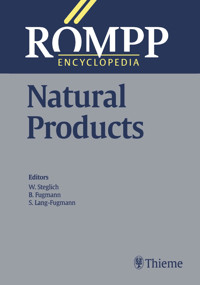
RÖMPP Encyclopedia Natural Products, 1st Edition, 2000 E-Book
54,99 €
Mehr erfahren.
- Herausgeber: Thieme
- Kategorie: Wissenschaft und neue Technologien
- Serie: RÖMPP Lexikon Erg.
- Sprache: Englisch
Compiled by German natural products chemist Wolfgang Steglich and his co-editors Burkhard Fugmann and Susanne Lang-Fugmann, RÖMPP Encyclopedia Natural Products provides highly reliable and comprehensive information on the 6,000 most relevant natural substances, including 15,000 cross references and 2,200 formulas. The book contains descriptions of the different substance classes and important analytical methods, comprehensive indices of Latin Species names and molecular formulas as well as a vast amount of cross referencing. It has been compiled by 40 leaders in their respective fields. Written in a clear, consistent style and thoroughly copy edited, this is a must-have reference work for chemists, biochemists working with natural products, researchers in plant protection, pharmacists and medical researchers, biologists working in drug research as well as microbiologists and botanists working on microorganisms, plants or marine organisms, and interested layman.
Das E-Book können Sie in Legimi-Apps oder einer beliebigen App lesen, die das folgende Format unterstützen:
Seitenzahl: 2941
Veröffentlichungsjahr: 2014
Ähnliche




















Preface
The Roempp Encyclopedia Natural Products intends to provide the reader with rapid information on organic natural products and phenomena connected with them. This book is directed to chemical scientists, biologists, pharmacists as well as to interested laymen who wish to learn about e.g. the lacrymator in onions or the typical flavor compounds of beetroot. Teaching staff at high schools and universities will be motivated to incorporate the fascinating realm of natural products into their classes.
The Roempp Encyclopedia Natural Products focusses on so-called Secondary Metabolites, compounds which occur in certain organisms only, often serving beneficial functions for the species. They are separated conceptually from the so-called Primary Metabolites which are essential for maintenance of cellular processes. The latter are ubiquitous in practically all organisms and provide the building blocks for the biosynthesis of secondary metabolites. Examples of secondary metabolites include toxins and defence compounds, which plants and animals employ against enemies or competitors; pheromones and flower pigments provide insects with essential information. Nevertheless, the biological function of many secondary metabolites remains unclear, e.g. it remains an open question why the fly agaric produces the red pigments in its cap, for which it is known. Secondary metabolites show remarkable structural diversity. Even structurally very “unusual” compounds like isocyanides, nitro compounds and halogenated aromatic ring systems, which were formerly thought to be of synthetic origin only, can be found among natural products. This encyclopedia is a rich source of such substances, which are usually not included in textbooks. This knowledge deficit has certainly contributed to the widespread opinion, that “natural” chemicals are benign and “synthetic” ones are hazardous.
The editors of this encyclopedia had the difficult task of choosing a representative selection from the more than 170,000 known secondary metabolites. The original first German edition of this book, published in 1997, has been completely revised, updated and expanded by the editors with the addition of new entries. The literature has been covered until the end of 1999. To keep the size of this book within reasonable limits, only primary metabolites that are related to secondary compounds have been mentioned. This applies especially to carbohydrates and nucleosides/nucleotides. Even macromolecular compounds and proteins are mentioned marginally only. Basic concepts and definitions that appear in standard textbooks are not covered as full entries. The main emphasis of this encyclopedia is on those types of microbial, plant or animal secondary metabolites which show interesting biological activities or are responsible for conspicuous properties of the organisms like color and smell. Our intention was to provide insight into the vast structural diversity of secondary metabolites which is becoming more and more important for the discovery of lead structures in pharmaceutical and crop protection research. Chemical ecology was another important focus. For certain phylogenetic groups of organisms, characteristic secondary metabolites are mentioned with respect to chemotaxonomic aspects. They can be found as specific entries under the compound names. Collective names like actinomycetes, toadstools, insect attractants or macrolides also facilitate searching. The numerous cross references are designed to make the information readily accessible. Furthermore, the Roempp Encyclopedia Natural Products contains an appendix with an extensive index of Latin species names and a molecular formula index.
The selection of compounds remains subjective and there are certainly important entries that are missing and should be considered for a subsequent edition of this book. The editors would very much appreciate your suggestions.
Due to the restricted size of this book, the names of authors have been omitted in the literature references. The coverage of total syntheses is restricted to references to the literature. Special attention was given to provide correct stereochemistry and concise texts.
Leverkusen, Ratingen, Munich,March 2000
B. FugmannS. Lang-FugmannW. Steglich
Preface
Although our ability to synthesize molecules has progressed dramatically over the course of the past several decades, organic synthesis is still in its infancy compared to the dazzling variety and complexity of molecules which nature can so deftly prepare. Taking the same number and types of constituent atoms, nature combines them with seemingly limitless variation, creating in the process molecular architectures which not even the most fanciful of chemists could be expected to conjure on their own. More significantly, nature’s ingenious collection of molecular designs exhibits a dazzling array of biological properties, affording opportunities to probe important biochemical processes as well as to develop therapeutic agents to treat some of the most serious ailments afflicting mankind. With new molecular constructs isolated and characterized daily, the constantly enriched library of natural products provides a vibrant engine that will undoubtedly continue to drive forward our quest for understanding and improving the world around us.
As one pages through the Roempp Encyclopedia Natural Products, these concepts come to life through a well selected sample of nature’s library of molecular diversity. More than a simple catalogue listing of structures, the editors provide thorough and meticulously researched information on the biology, biochemistry, and pharmacology of important natural products isolated from a myriad of organisms from all corners of the world. Whether searching for a historically important natural product such as the poison strychnine or a leading cancer therapeutic such as Taxol™, scientists and laymen alike are certain to find answers to their questions as well as key references, should their interest be piqued. This volume represents a fine addition to the reference literature, and hopefully it will be followed by a continuing series which will provide not only a detailed collection of important information, but also a source of inspiration for new generations of chemists and biologists.
K. C. NicolaouThe Scripps Research Institute andUniversity of California, San Diego9 June 2000
Preface
Natural products, whether their sources are animals, plants or microorganisms, are sources of inspiration not only for organic chemists, but also for physical and biological chemists and scientists in a variety of other fields. They are the motivating power that drives creative thought processes in various scientific disciplines. The compounds included in this encyclopedia were selected from an enormous number, approximately 170,000, of natural products by 39 recognized German experts from the various areas of natural products chemistry. The compounds were chosen in a well-balanced way from the most significant classes of natural products such as antibiotics, alkaloids, pheromones, flavonoids, and ionophores. Secondary metabolites are given priority, but important primary metabolites are also described, though fewer in number.
The stereochemical illustration of the structure of natural products seems to be the most effective way of drawing out creativity from scientists and even artists. In addition to the structure, various biological and physical properties are concisely described; the profiles of the compounds from discovery to application are also soundly arranged in this book. Useful synthetic derivatives and biosynthesis of natural products have been added. Thus the depth of coverage mirrors the breadth of natural products research.
One of the principal features of this book is that it serves as a reference to some important general terms related to natural products such as alkaloids, carotinoids, glycoproteins, and snake venoms. Moreover, historical coverage and overview texts, even headings like “screening”, can be found, indicating that this book is much more than a mere dictionary of natural products.
The original and review articles cited in this encyclopedia are not only related to the discovery of the compounds, but are also suitable for their comprehensive understanding.
The highly acclaimed original first German edition of this book was published in 1997. It was completely revised and updated by the editors and translated into English as an international version.
I believe that this encyclopedia is one of the most valuable books that people interested in natural products chemistry should have on hand, regardless of whether they are experts or newcomers in the field.
Satoshi Ōmura, Ph. D.(June, 2000)
Frequently cited books and periodicals
ApSimon 1
ApSimon (ed.), The Total Synthesis of Natural Products, Vol. 1–9, New York: Wiley and Sons 1973–1992
Arctander
Arctander, Perfume and Flavor Materials of Natural Origin, Elisabeth, N. J.: published by the author 1960
Asahina-Shibata
Asahina & Shibata, Chemistry of Lichen Substances, Tokyo: Japan Soc. for the Promotion of Science 1954
Atta-ur-Rahman 15
Atta-ur-Rahman (ed.), Studies in Natural Product Chemistry, 20 Vol., Amsterdam: Elsevier since 1988
Bauer et al. (2.)
Bauer, Garbe & Surburg, Common Fragrance and Flavor Materials, 2. edition, Weinheim: VCH Verlagsges. 1990
Bedoukian (3.)
Bedoukian, Perfumery and Flavoring Synthetics, 3. edition, Wheaton: Allured 1986
Beilstein E IV 7
Beilsteins Handbook of Organic Chemistry, 4. edition, Berlin: Springer since 1918, analog EIII/IV 17 for the 3./4. and EV 17/11 for the 5., since 1994 Beilstein Informationssysteme GmbH
Betina
Betina (ed.), Mycotoxins, Amsterdam: Elsevier 1984
Barton-Nakanishi 1
Barton & Nakanishi, Comprehensive Natural Products Chemistry, Vol. 1–9, Amsterdam: Elsevier Pergamon 1999
C. I. 1
Colour Index, 3. edition, 4. revision, 9 Vol. and Supplements, Bradford: Society of Dyers and Colourists 1971 -1992
Cole-Cox
Cole & Cox, Handbook of Toxic Fungal Metabolites, New York: Academic Press 1981
Culberson
Culberson, Chemical and Botanical Guide to Lichen Products, Chapel Hill: The University of North Carolina 1969
Collins-Ferrier
Collins & Ferrier, Monosaccharides, their Chemistry and Roles in Natural Products, Chichester: J. Wiley & Sons 1995
Czygan (2.)
Czygan (ed.), Pigments in Plants, 2. edition, Berlin: Akademie-Verl. 1980
Dictionary of Terpenoids 2
Conolly & Hill, Dictionary of Terpenoids, 3 Vol. (Vol. 1 Mono- and Sesquiterpenoids, Vol. 2 Di- and higher Terpenoids, Vol. 3 indexes), London: Chapman & Hall 1991
Dolphin I
Dolphin (ed.), The Porphyrins, 7 Vol., New York: Academic Press 1978, 1979
Dolphin B12, I
Dolphin (ed.), Vitamin B12, Vol. I, II, New York: Wiley 1982
Elsevier 14
Elsevier’s Encyclopedia of Organic Chemistry, Series III: Carboisocyclic Condensed Compounds (Vol. 12, 13, 14 and Supplement), Amsterdam: Elsevier 1940–1954; Berlin: Springer 1954–1969 Fenaroli (2.) 1
Fenaroli’s Handbook of Flavor Ingredients, 2. edition, Cleveland: CRC Press 1975
Florey 6
Florey (ed.), Analytical Profiles of Drug Substances, 23 Vol., New York: Academic Press 1972–1992
Gill-Steglich
Gill & Steglich, Pigments of Fungi (Macromycetes), in Progress in the Chemistry of Organic Natural Compounds (ed. Zechmeister), Vol. 51, Wien-New York: Springer 1987
Goodwin I (2.)
Goodwin (ed.), Chemistry and Biochemistry of Plant Pigments, 2. edition, Vol. 1, London: Academic Press 1976
Goodwin II
Goodwin (ed.), Plant Pigments, London: Academic Press 1988
Hager (5.) 7b
Hagers Handbuch der Pharmazeutischen Praxis (ed. Bruchhausen et al.), 5. edition, 10 Vol., Berlin: Springer 1991–1999
Handbook of Terpenoids I
Dev & Narula, Handbook of Terpenoids, Monoterpenoids, Vol. I, II, Boca Raton: CRC Press, Inc. 1982
Harborne (1988)
Harbome (ed.), The Flavonoids, part 1 & 2, London: Chapman & Hall 1975; 1. Supplement: Advances in Research, published 1982; 2. Supplement: Advances in Research since 1980, published 1988; 3. Supplement: Advances in Research since 1986, published 1994
Hegnauer I
Hegnauer, Chemotaxonomie der Pflanzen, X Vol., Basel: Birkhauser 1962, 1986
Isler
Isler et al. (eds.), Carotenoids, Basel: Birkhauser 1971
Jordan
Jordan (ed.), Biosynthesis of Tetrapyrroles, Amsterdam: Elsevier 1991
Karrer, Nr. 100
Karrer et al., Konstitution und Vorkommen der organischen Pflanzenstoffe (exklusive Alkaloide), Basel: Birkhauser 1958, 1977 (Supplement 1), 1981 (Supplement 2/1), 1985 (Supplement 2/2)
Kirk-Othmer (4.) 17
Kirk & Othmer (eds.), Encyclopedia of Chemical Technology, 26 Vol., 4. edition, New York: Interscience since 1992
Kleemann-Engel
Kleemann & Engel, Pharmaceutical Substances, 3. edition, Stuttgart: Thieme 1999
Lindberg 3
Lindberg (ed.), Strategies and Tactics in Organic Synthesis, 3 Vol., New York: Academic Press 1984, 1989, 1991
Luckner (3.)
Luckner, Secondary Metabolism in Microorgnisms, Plants, and Animals, 3. edition, Berlin: Springer 1990 Maarse
Maarse (ed.), Volatile Compounds in Food and Beverages, New York: Marcel Dekker 1991
Manske 11
eds.: Manske & Holmes, Vol. 1–4; Manske, Vol. 5–16; Manske & Rodrigo, Vol. 17; Rodrigo, Vol. 18–20; Brossi, Vol. 21–40; Brossi & Cordell, Vol. 41; Cordell, Vol. 42–44; Cordell & Brossi, Vol. 45, The Alkaloids, Chemistry and Pharmacology, 53 Vol. up to 2000, New York: Academic Press since 1950
Martindale (29.)
Martindale, The Extra Pharmacopoeia (Reynolds, ed.), 29. edition, London: the Pharmaceutical Press 1989; analog Martindale 30. edition of 1993
Merck-Index (12.)
The Merck-Index, An Encyclopedia of Chemicals, Drugs and Biologicals, 12. edition, Whitehouse Station, N. Y.: Merck & Co., Inc. 1996
Mothes et al.
Mothes, Schütte & Luckner (eds.), Biochemistry of Alkaloids, Berlin : VEB Verl. der Wissenschaften 1985; Weinheim : Verl. Chemie 1985
Müller-Lamparsky
Muller & Lamparsky (eds.), Perfumes, Art, Science, Technology, London: Elsevier Appl. Sci. 1991 Negwer (6.), No. 100
Negwer, Organic-Chemical Drugs and their Synonyms, 6. edition, Berlin: Akademie-Verl. 1987; New York: VCH Publishers 1987; analog 7. edition of 1994
Nicolaou
Nicolaou & Sorensen, Classics in Total Synthesis, Weinheim: VCH Verlagsges. 1996
Ohloff
Ohloff, Riechstoffe u. Geruchssinn, Berlin: Springer 1990
Pelletier 1
Pelletier (ed.), Alkaloids, Chemical and Biological Perspectives, Vol. 1–14, New York: Wiley 1983; Oxford: Pergamon 1994
Pfander (2.)
Pfander (ed.), Key to Carotenoids, 2. edition, Basel: Birkhauser 1987
Phillipson et al.
Phillipson, Roberts & Zenk (eds.), The Chemistry and Biology of Isoquinoline Alkaloids, Berlin: Springer 1985
Phytochemical Dictionary
Harborne & Baxter, Phytochemical Dictionary, London: Taylor & Francis 1993
Rowe
Rowe (ed.), Natural Products of Woody Plants II, Berlin: Springer 1989
Sax (8.)
Lewis (ed.), Sax’s Dangerous Properties of Industrial Materials, 8. edition, 3 Vol., New York: Van Nostrand Reinhold 1992
Scheuer I 1
Scheuer (ed.), Marine Natural Products, Vol. 1–5, New York: Academic Press 1978–1983
Scheuer II 1
Scheuer (ed.), Bioorganic Marine Chemistry, 6 Vol., Berlin: Springer 1987–1992
Shamma
Shamma, Isoquinoline Alkaloids, Chemistry and Pharmacology, New York: Academic Press 1972
Shamma-Moniot
Shamma & Moniot, Isoquinoline Alkaloids Research 1972–1977, New York: Plenum Press 1978
Smith
Smith (ed.), Porphyrins and Metalloporphyrins, Amsterdam: Elsevier 1975
Snell-Ettre 18
Snell & Hilton (eds.), from Vol. 8 Snell & Ettre (eds.), Encyclopedia of Industrial chemical Analysis, 20 Vol., New York: Interscience 1966–1975
Stryer 1995
Stryer, Biochemistry, New York: Freeman 1995
Thomson 2
Thomson, Naturally Occurring Quinones, Vol. 1 -4, London: Butterworth 1957; London: Academic Press 1971; London: Chapman & Hall 1987
TNO list (6.) TNO list (6.) Suppl. 1
Maarse & Visscher (eds.), Volatile Compounds in Food - Qualitative and Quantitative Data, 6. edition, Zeist: TNO 1989–1994 [Suppl. 1 (1990); 2 (1991); 3 (1992); 4 (1993); 5 (1994)]
Turner 1
Turner or Turner & Aldrige, Fungal Metabolites, Vol. 1 & 2, London: Ac ademic Press 1971, 1983
Ullmann (5.) A12
Ullmann’s Encyclopedia of Industrial Chemistry, 5. edition, 36 Vol., Wein-heim: Wiley-VCH since 1985 Waterman 8
Waterman (ed.), Methods in Plant Biochemistry, Vol. 8, Alkaloids and Sulfur Compounds, London: Academic Press 1993
Zechmeister 35
Zechmeister (ed.), Progress in the Chemistry of Organic Natural Products, 79 Vol. up to 2000, Berlin: Springer since 1938
Zeelen
Zeelen, Medicinal Chemistry of Steroids, Amsterdam: Elsevier 1990
List of abbreviations
a= year
[α]D
abbr.= abbreviation
abs.= absolute
bp.= boiling point
cf.= confer
cryst.= crystals
D.= density
d= day
EC= enzyme commission
ED50
edn.= edition
eds.= editors
e.g.= exempli gratia (for example)
ε
f., ff.= the (next) following page,
the following pages
fp.= flash point
gen.= general
h= hour
HS= harmonized commodity
i.e.= id est (that is)
i.m.= intramuscular
i.p.= intraperitoneal
i.v.= intravenous
LC= lethal concentration
LD50
Lit.= Literature
λmax
MIC.= minimal inhibitory concentration
mol.= molecular
Mol.= molecule
mp.= melting point
MR
p.= page
p.o.= per os (orally)
®= trade mark
s.c.= subcutaneous
sp.= species
subl.= sublimates, sublimation
Suppl.= Supplement
var.= variant
vol.= volume
*= treated as keyword in this work
°C= Celsius degrees
A
Aaptamine.
C13H12N2O2, MR 228.25, mp. 110–113°C. The brilliant green A. with a 1H-benzo[de]-[1,6]naphthyridine skeleton was isolated from the Pacific sponge Aaptos aaptos.A. blocks α-adrenoceptors.
Lit. : Heterocycles 49, 543 (1998); 50, 543-559 (1999). ■ J. Chem. Soc., Perkin Trans. 1 1987, 173. – Synthesis: Heterocycles 48, 2089 (1998) (synthesis: Aaptosamine) ■ J. Org. Chem. 52, 616 (1987) ■ Synthesis 1996, 1199 ■ Tetrahedron 43, 4803 (1987) ■ Tetrahedron Lett. 23, 5555 (1982); 31, 569 (1990); 34, 4683 (1993). – [CAS 85547-22-4]Abbeymycin see anthramycins.Abhexon(e) see hydroxyfuranones.Abieta-7, 13-diene. C20H32, MR 272.47, [α]D +127° (CHCl3), from roots of Solidago missouriensis and Helichrysum chionosphaerum. A. is formed by metal ion-dependent cyclization of geranylgeranyl diphosphate as intermediate in the biosynthesis of *abietic acid.
▶ Figure: Biosynthesis of Abietadiene and Abietic acid.
Lit.: Arch. Biochem. Biophys. 313, 139–149 (1994) ■ Beilstein E III 5, 1310. – [CAS 42895-82-9]Abietanes. Structural type of diterpenes, e. g., *abieta-7,13-diene, the most important representative is *abietic acid.Abietic acid. Formula see abieta-7,13-diene. C20H30O2, MR 302.46. A resin acid belonging to the diterpenes, monoclinic plates, mp. 172–175°C, −102° (C2H5OH). Occurs above all in Pinus and Abies species; the most important component of colophony from which it can be separated by distillation. A. is a component of the defensive secretion of the trees against insects and infections by microorganisms. The biosynthesis from tricyclic *abieta-7,13-diene (figure see above) involves sequential oxidation of the C-18 methyl group to a carboxy function.Use: To form esters, varnish components, soaps, metal soaps (resin soaps from abietates), additive in lactic and butyric acid fermentations.
Lit.: Arch. Biochem. Biophys. 308, 258–266 (1994) ■ Beilstein EIV 9, 2175–2178 ■ Karrer, No. 1952 ■ Merck Index (12.), No. 3 ■ Org. Synth. Coll. 4, 1-4 (1963) ■ Phytochemistry 19, 2655 (1980) ■ Sax (8.), AAC 500. – [HS 3806 90; CAS 514-10-3]∆8,13-Abietic acid see palustric acid.Abietin see coniferin.Abietospiran [(23S,25R)-17,23-epoxy-23-hydroxy-3α-methoxy-(5 α)-9β, 19-cyclolanostane-26-carboxylic acid lactone].
C31H48O4, MR 484.72, colorless cryst., mp. 219–221°C, [α]D −16.8° (CHCl3). *triterpene of the bark of silver fir (Abies alba, Pinaceae), responsible for the gray-white appearance of the tree. For isolation see Lit.1.
Lit.:1 Angew. Chem. Int. Ed. Engl. 18, 698 (1979).gen.: Beilstein E V 19/5, 641. – [CAS 71648-15-2]Abrine [(S)-2-methylamino-3-(3-indolyl)propanoic acid, N-methyl-L-tryptophan]. Not to be confused with the toxic agglutinin abrin. Formula, see tryptophan. C12H14N2O2 MR 218.26, mp. 296°C (decomp.), +47° (0.5 m HCl); monohydrochloride, mp. 222°C. Isolated from seeds of Abrus precatorius and Gastrolobium callistachys (Fabaceae). A powerful antigen.
Lit.: Beilstein EV 22/14, 40f. – [HS 2933 90; CAS 526-31-8]Abscisic acid [abscisin II, ABA; histor. name dormin; (2Z,4E)-5-((S)-1-hydroxy-2,6,6-trimethyl-4-oxo-2- cyclohexenyl)-3-methyl-2,4-pentadienoic acid].
A. is isolated from potatoes, avocado pears, cabbage, rose leaves, and numerous trees1. A. is a widely distributed sesquiterpene with the skeleton of the *ionones. For the most important data of A. (1), A. β-D-glucopyranoside (2), and nigellic acid (3) see table.Table: Abscisic acid and derivatives.
molecular formula
M
R
mp. [°C]
[α]
D
CAS
1
C
15
H
20
O
4
264.32
160–161
+430°
21293-29-8
2
C
21
H
30
O
9
426.46
114
+ 180° (C
2
H
5
OH, 17°C)
21414-42-6
3
C
15
H
20
O
5
280.32
185–187
91897-25-5
Biological activity: A. acts as a phytohormone for defoliation, inhibition of flowering, and induces hibernation-like states 2. It is thus an antagonist of the *plant growth substances. A. plays a role in plant signal transduction 3, gene expression, and in environmental stress like pest infestation4. A. is used to regulate the ripening process of fruit. Several syntheses have been reported for A.5–8. The biosynthesis involves metabolization of all-trans-*violaxanthin9,10. Detection by chromatographic methods and monoclonal immunoassays.
Lit.:1Nature (London) 205, 1269 (1966); 210, 627, 742 (1966). 2Plant Growth Regul. 11, 225–238 (1992); Plant Physiol. 108, 573 (1995). 3Adv. Bot. Res. 19, 103–187 (1993). 4Davies & Jones (eds.), Environmental Plant Biology: Abscisic Acid. Physiology and Biochemistry, p. 125–135, 189-199, Oxford (UK): BIOS Sci. Publ. 1991. 5Helv. Chim. Acta 61, 2616 (1978); 72, 361 (1989). 6J. Org. Chem. 51, 253 (1986). 7 Aust. J. Chem. 45, 179 (1992). 8Tetrahedron 48, 8229 (1992); Trends Org. Chem. 4, 371 (1993). 9 Phytochemistry 29, 3473 (1990); 31, 2649 (1992). 10Methods Plant Biochem. 9, 381-402 (1993).gen.: Ullmann (5.) A20, 421.Absinthin.
C30H40O6, MR 496.64, orange-yellow needles, mp. 182–183°C (decomp.; from CH3OH), [α]D +180° (CHCl3). A constituent of Artemisia absinthium and A. sieversiana (Asteraceae) with a very bitter taste; it was used in bitter aperitifs until early in the 20th century („absinthe”). Later on, it was banned in some countries due to the toxic side effects of thujone (see thujan-3-ones) and *santonin, also present in Artemisia oil, from which absinthe was prepared. Recently, absinthe, a green liqueur, is becoming fashionable again1.
Lit.:1 Chem. Eng. News 77 (12), 56 (1999, Mar. 22).gen.: Phytochemistry 24, 1009–1016 (1985) ■ Tetrahedron Lett. 21, 3191 (1980); 22, 2269 (1981) (isolation). – [CAS 1362-42-1]Aburamycin B see chromomycins.Acanthifolicin see okadaic acid.Acanthostral.
C19H22O5, MR 330.37, oil, −30° (CH3OH). Antineoplastically active cis,cis,cis-*ge rmacranolide from the Paraguayan medicinal plant Acanthospermum australe (“Tapecue”).Lit.: Tetrahedron Lett. 37, 1455 (1996). – [CAS 174720-94-6]Acarbose (Glucobay®, Precose®, Prandase®). Formula see glycosidase inhibitors. C25H43NO18, MR 645.61; amorphous solid, +171.3°. Pseudotetrasaccharide from the class of carbaoligosaccharide antibiotics, isolated from cultures of strains. A. is a very effective inhibitor of intestinal α-D-glucosidases and saccharidase, it reduces glucose absorption in the gastrointestinal tract and is recommended as a drug for diet-supported diabetes therapy. Angew. Chem. Int. Ed. Engl. , 744–761 (1981) ■ Aust. J. Chem. , 193–228 (1997) (synthesis) ■ Carbohydr. Res. , 235–268 (1984) (Isolation & structure elucidation) ■ Creutzfeldt (ed.), Acarbose for the Treatment of Diabetes mellitus, Berlin: Springer 1988 ■ Hager (5.) 7, 1 ff. ■ J. Antibiot. , 855 ff. (1987) (biosynthesis) ■ J. Chem. Soc., Chem. Commun. , 605 f. (synthesis) ■ Nachr. Chem. Tech. Lab. , 1119 (1994) ■ Truscheit et al., Progress in Clinical Biochemistry and Medicine, p. 17–100, Berlin: Springer 1988. – see mites. Abbreviation for *l-aminocyclopropanecarboxylic acid.
Lesen Sie weiter in der vollständigen Ausgabe!
Lesen Sie weiter in der vollständigen Ausgabe!
Lesen Sie weiter in der vollständigen Ausgabe!
Lesen Sie weiter in der vollständigen Ausgabe!
Lesen Sie weiter in der vollständigen Ausgabe!
Lesen Sie weiter in der vollständigen Ausgabe!
Lesen Sie weiter in der vollständigen Ausgabe!
Lesen Sie weiter in der vollständigen Ausgabe!
Lesen Sie weiter in der vollständigen Ausgabe!
Lesen Sie weiter in der vollständigen Ausgabe!
Lesen Sie weiter in der vollständigen Ausgabe!
Lesen Sie weiter in der vollständigen Ausgabe!
Lesen Sie weiter in der vollständigen Ausgabe!
Lesen Sie weiter in der vollständigen Ausgabe!
Lesen Sie weiter in der vollständigen Ausgabe!
Lesen Sie weiter in der vollständigen Ausgabe!
Lesen Sie weiter in der vollständigen Ausgabe!
Lesen Sie weiter in der vollständigen Ausgabe!
Lesen Sie weiter in der vollständigen Ausgabe!
Lesen Sie weiter in der vollständigen Ausgabe!
Lesen Sie weiter in der vollständigen Ausgabe!
Lesen Sie weiter in der vollständigen Ausgabe!
Lesen Sie weiter in der vollständigen Ausgabe!
Lesen Sie weiter in der vollständigen Ausgabe!
Lesen Sie weiter in der vollständigen Ausgabe!
Lesen Sie weiter in der vollständigen Ausgabe!
Lesen Sie weiter in der vollständigen Ausgabe!
Lesen Sie weiter in der vollständigen Ausgabe!
Lesen Sie weiter in der vollständigen Ausgabe!
Lesen Sie weiter in der vollständigen Ausgabe!
Lesen Sie weiter in der vollständigen Ausgabe!
Lesen Sie weiter in der vollständigen Ausgabe!
Lesen Sie weiter in der vollständigen Ausgabe!
Lesen Sie weiter in der vollständigen Ausgabe!




