


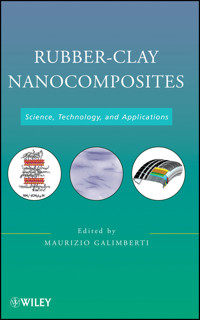
Rubber-Clay Nanocomposites E-Book
145,99 €
Mehr erfahren.
- Herausgeber: John Wiley & Sons
- Kategorie: Wissenschaft und neue Technologien
- Sprache: Englisch
The one-stop resource for rubber-clay nanocomposite information The first comprehensive, single-volume book to compile all the most important data on rubber-clay nanocomposites in one place, Rubber-Clay Nanocomposites: Science, Technology, and Applications reviews rubber-clay nanocomposites in an easy-to-reference format designed for R&D professionals. Including contributions from experts from North America, Europe, and Asia, the book explores the properties of compounds with rubber-clay nanocomposites, including their rheology, curing kinetics, mechanical properties, and many others. Rubber-clay nanocomposites are of growing interest to the scientific and technological community, and have been shown to improve rubber compound reinforcement and impermeability. These natural mineral fillers are of potential interest for large-scale applications and are already making an impact in several major fields. Packed with valuable information about the synthesis, processing, and mechanics of these reinforced rubbers, the book covers assorted rubber-clay nanocomposites applications, such as in automotive tires and as polymer fillers. Promoting common knowledge and interpretation of the most important aspects of rubber-clay nanocomposites, and clarifying the main results achieved in the field of rubbers and crosslinked rubbers--something not covered in other books in the field--Rubber-Clay Nanocomposites helps scientists understand morphology, vulcanization, permeability, processing methods, and characterization factors quickly and easily.
Sie lesen das E-Book in den Legimi-Apps auf:
Seitenzahl: 1034
Veröffentlichungsjahr: 2011
Ähnliche




















Contents
Cover
Title Page
Copyright
Preface
A New Generation of Fillers for Rubbers: Nano-Fillers
Clays As Nano-Fillers for Rubbers
Why A Book on Rubber–Clay Nano-Composites?
A Brief Summary of the Book
References
Contributors
Section I: Clays for Nanocomposites
Chapter 1: Clays and Clay Minerals
1.1 What's in a Name
1.2 Multiscale Organization of Clay Minerals
1.3 Intimate Organization of the Layer
1.4 Most Relevant Physicochemical Properties of Clay Mineral
1.5 Availability of Natural Clays and Synthetic Clay Minerals
1.6 Clays and (Modified) Clay Minerals as Fillers
Acknowledgment
References
Chapter 2: Organophilic Clay Minerals
2.1 Organophilicity/Lipophilicity and the Hydrophilic/Lipophilic Balance (HLB)
2.2 From Clays to Organoclays in Polymer Technology
2.3 Methods of Organoclay Synthesis
2.4 Other Types of Clay Modifications for Clay-Based Nanomaterials
2.5 Fine-Tuning of Organoclays Properties
2.6 Some Introductory Reflections on Organoclay Polymer Nanocomposites
References
Chapter 3: Industrial Treatments and Modification of Clay Minerals
3.1 Bentonite: From Mine to Plant
3.2 Processing of Bentonite
3.3 Purification of Clay
3.4 Reaction of Clay with Organic Substances
3.5 Particle Size Modification
References
Chapter 4: Alkylammonium Chains on Layered Clay Mineral Surfaces
4.1 Structure and Dynamics
4.2 Thermal Properties
4.3 Layer Separation and Miscibility with Polymers
4.4 Mechanical Properties of Clay Minerals
References
Chapter 5: Chemistry of Rubber–Organoclay Nanocomposites
5.1 Introduction
5.2 Organic Cation Decomposition In Salts, Organoclays and Polymer Nanocomposites
5.3 Mechanism of Thermal Decomposition of Organoclays
5.4 Role of Organic Cations in Organoclays as Rubber Vulcanization Activators
References
Section II: Preparation and Characterization of Rubber–Clay Nanocomposites
Chapter 6: Processing Methods for the Preparation of Rubber–Clay Nanocomposites
6.1 Introduction
6.2 Latex Compounding Method
6.3 Melt Compounding
6.4 Solution Intercalation and In Situ Polymerization Intercalation
6.5 Summary and Prospect
Acknowledgment
References
Chapter 7: Morphology of Rubber–Clay Nanocomposites
7.1 Introduction
7.2 Background for the Review of RCN Morphology
7.3 Rubber–Clay Nanocomposites with Pristine Clays
7.4 Rubber–Clay Nanocomposites with Clays Modified with Primary Alkenylamines
7.5 Rubber–Clay Nanocomposites with Clays Modified with an Ammonium Cation Having three Methyls and One Long-Chain Alkenyl Substituents
7.6 Rubber–Clay Nanocomposites with Montmorillonite Modified with Two Substituents Larger Than Methyl
7.7 Rubber Composites with Montmorillonite Modified with an Ammonium Cation Containing a Polar Group
7.8 Rubber Nanocomposites with Montmorillonite Modified with an Ammonium Cation Containing Two Long-Chain Alkenyl Substituents
7.9 Proposed Mechanisms for the Formation of Rubber–Clay Nanocomposites
Abbreviations
Acknowledgment
References
Chapter 8: Rheology of Rubber–Clay Nanocomposites
8.1 Introduction
8.2 Rheological Behavior of Rubber–Clay Nanocomposites
8.3 General Remarks on Rheology of Rubber–Clay Nanocomposites
8.4 Overview of Rheological Theories of Polymer–Clay Nanocomposites
8.5 Conclusion and Outlook
References
Chapter 9: Vulcanization Characteristics and Curing Kinetics of Rubber–Organoclay Nanocomposites
9.1 Introduction
9.2 Vulcanization Reaction
9.3 Rubber Cross-Linking Systems
9.4 The Role of Organoclay on Vulcanization Reaction
9.5 Vulcanization Kinetics of Rubber–Organoclay Nanocomposites
9.6 Conclusions
References
Chapter 10: Mechanical and Fracture Mechanics Properties of Rubber Compositions with Reinforcing Components
10.1 Introduction
10.2 Testing of Viscoelastic and Mechanical Properties of Reinforced Elastomeric Materials
10.3 Characterization of the Fracture Behavior of Elastomers
10.4 Mechanism of Reinforcement in Rubber–Clay Composites
10.5 Theories and Modeling of Reinforcement
10.6 Acknowledgments
References
Chapter 11: Permeability of Rubber Compositions Containing Clay
11.1 Introduction
11.2 Nanocomposites
11.3 Preparation of Elastomer Nanocomposites
11.4 Temperature and Compound Permeability
11.5 Vulcanization of Nanocomposite Compounds and Permeability
11.6 Thermodynamics and BIMSM Montmorillonite Nanocomposites
11.7 Nanocomposites and Tire Performance
11.8 Summary
References
Section III: Compounds with Rubber–Clay Nanocomposites
Chapter 12: Rubber–Clay Nanocomposites Based on Apolar Diene Rubber
12.1 Introduction
12.2 Preparation Methods
12.3 Cure Characteristics
12.4 Clay Dispersion
12.5 Properties
12.6 Applications and Future Trends
Acknowledgment
References
Chapter 13: Rubber–Clay Nanocomposites Based on Nitrile Rubber
13.1 Introduction
13.2 Preparation Methods and Clay Dispersion
13.3 Cure Characteristics
13.4 Properties
13.5 Outlook
Acknowledgment
References
Chapter 14: Rubber–Clay Nanocomposites Based on Butyl and Halobutyl Rubbers
14.1 Introduction
14.2 Types of Clays Useful in Butyl Rubber–Clay Nanocomposites
14.3 Compatibilizer Systems for Butyl Rubber–Clay Nanocomposites
14.4 Methods of Preparation of Butyl Rubber–Clay Nanocomposites
14.5 Properties and Applications of Butyl Rubber–Clay Nanocomposites
14.6 Conclusions
References
Chapter 15: Rubber–Clay Nanocomposites Based on Olefinic Rubbers (EPM, EPDM)
15.1 Introduction
15.2 Types of Clay Minerals Useful in EPM–, EPDM–Clay Nanocomposites
15.3 Compatibilizer Systems for Olefinic Rubber–Clay Nanocomposites
15.4 Preparation of EPDM–Clay Nanocomposites by an In Situ Intercalation Method
15.5 Characteristics of EPDM–Clay Nanocomposites
15.6 Preparation and Characteristics of EPM–Clay Nanocomposites
15.7 Conclusions
References
Chapter 16: Rubber–Clay Nanocomposites Based on Thermoplastic Elastomers
16.1 Introduction
16.2 Selection of Materials
16.3 Experimental
16.4 Numerical
16.5 Discussion of Results
16.6 Summary and Conclusions
16.7 Nomenclature
Acknowledgments
References
Section IV: Applications of Rubber–Clay Nanocomposites
Chapter 17: Automotive Applications of Rubber–Clay Nanocomposites
17.1 Introduction
17.2 Automotive Application of Rubber
17.3 Prime Requirement of Different Elastomeric Auto Components from Application Point of View
17.4 Elastomeric Nanocomposites and Rubber Industry
17.5 Superiority of Clay/Clay Mineral in Comparison to Other Nanofillers
17.6 Organo-Modified Clay/Clay Minerals
17.7 Scope of Application of Elastomeric Nanocomposites in Automotive Industry
17.8 Disadvantages of Use of Organoclay Elastomeric Nanocomposites in Automotive Industry
17.9 Conclusion
Acknowledgment
References
Chapter 18: Nonautomotive Applications of Rubber–Clay Nanocomposites
18.1 Water-Based Nanocomposites
18.2 Applications
References
Index
Copyright © 2011 by John Wiley & Sons, Inc. All rights reserved.
Published by John Wiley & Sons, Inc., Hoboken, New Jersey.
Published simultaneously in Canada.
No part of this publication may be reproduced, stored in a retrieval system, or transmitted in any form or by any means, electronic, mechanical, photocopying, recording, scanning, or otherwise, except as permitted under Sections 107 or 108 of the 1976 United States Copyright Act, without either the prior written permission of the Publisher, or authorization through payment of the appropriate per-copy fee to the Copyright Clearance Center, Inc., 222 Rosewood Drive, Danvers, MA 01923, (978) 750-8400, fax (978) 750-4470, or on the web at www.copyright.com. Requests to the Publisher for permission should be addressed to the Permissions Department, John Wiley & Sons, Inc., 111 River Street, Hoboken, NJ 07030, (201) 748-6011, fax (201) 748-6008, or online at http://www.wiley.com/go/permission.
Limit of Liability/Disclaimer of Warranty: While the publisher and author have used their best efforts in preparing this book, they make no representations or warranties with respect to the accuracy or completeness of the contents of this book and specifically disclaim any implied warranties of merchantability or fitness for a particular purpose. No warranty may be created or extended by sales representatives or written sales materials. The advice and strategies contained herein may not be suitable for your situation. You should consult with a professional where appropriate. Neither the publisher nor author shall be liable for any loss of profit or any other commercial damages, including but not limited to special, incidental, consequential, or other damages.
For general information on our other products and services or for technical support, please contact our Customer Care Department within the United States at (800) 762-2974, outside the United States at (317) 572-3993 or fax (317) 572-4002.
Wiley also publishes its books in a variety of electronic formats. Some content that appears in print may not be available in electronic formats. For more information about Wiley products, visit our web site at www.wiley.com.
Library of Congress Cataloging-in-Publication Data:
Rubber-clay nanocomposites: science, technology, and applications / edited by Maurizio Galimberti.
p. cm.
Includes bibliographical references and index.
ISBN 978-0-470-56210-9
1. Nanocomposites (Materials) 2. Rubber. I. Galimberti, Maurizio.
TA455.R8R825 2011
620.1'94–dc23
2011021008
oBooK ISBN: 978-1-118-09286-6
ePDF ISBN: 978-1-118-09288-0
ePub ISBN: 978-1-118-09287-3
Preface
A New Generation of Fillers for Rubbers: Nano-Fillers
The properties of rubbers have always fascinated the human mind. “I wonder why the night, as a rubber, is of endless elasticity and softness” wrote a novelist [1] and the inventor of vulcanization, Charles Goodyear, reported “There is probably no other inert substance the properties of which excite in the human mind an equal amount of curiosity, surprise, and admiration. Who can examine and reflect upon this property of gum-elastic without adoring the wisdom of the Creator?” [2]. Rubbers are indeed fundamental materials for the human life but their properties are not sufficient for their applications, not even after vulcanization. To achieve the required physical–mechanical properties, rubbers have to be reinforced with the so-called reinforcing fillers.
The addition of carbon black was observed to improve the physical properties of vulcanized rubbers already at the beginning of twentieth century, although its use was delayed by consumers resistance to the black color. The first synthetic rubber tires in a car, of Emperor Wilhelm, were of a white color. Fillers such as carbon black and silica were developed all over the last century and allowed to improve a large set of rubber properties, such as impermeability, tear, fatigue and abrasion resistance, while simultaneously increasing antagonistic properties such as modulus and elongation at break: this phenomenon is known as the paradox of elastomers. Carbon black and silica are made of spherical primary particles, with an average size in a range from 5 to 100 nm, and are present in the rubber matrix as aggregates that cannot be separated via thermomechanical mixing, having dimensions up to several hundreds of nanometers.
Over the past two decades, new characters appeared on the scene of fillers for polymeric materials, the so-called nano-fillers: they can be dispersed in a polymer matrix as individual particles with at least one dimension at the nanoscale. This nanometric size is correlated with features such as a huge specific surface area, a very low concentration for establishing a network in a polymer matrix (what is known as the percolation threshold) and also, often, a high length-to-width ratio, that is, a high aspect ratio. Most researches performed both in the academic and industrial fields on polymer composites with nano-fillers, that is, on polymer nano-composites aimed to exploit the enormous potential of nano-fillers.
Clays As Nano-Fillers for Rubbers
Among nano-fillers, clays undoubtedly play a major role. These layered silicates are available as inexpensive natural minerals and, as in the case of the most diffused cationic clay, montmorillonite, are considered to have a safe toxicologic profile, as they appear to have little chance to cross biological barriers. They are thus suitable for large scale applications and were used to prepare novel rubber/inorganic materials. Clays are hydrophilic and need to be compatibilized with the hydrocarbon rubber matrix: the most applied organophilic modifiers, ammonium cations bearing long-chain alkenyl substituents, are able to build up a variety of crystalline arrangements in the interlayer space. The so-formed organically modified clays promote a multiscale organization in the rubber matrix, from its distribution and dispersion to a reorganization of the organic moiety between two opposite layers, potentially involving the polymer chains. The onium modifiers are also known as efficient accelerators of the cross-linking reactions. Moreover, all these aspects depend, to a different extent, on the type of rubber adopted as the matrix. All these aspects are degrees of freedom but represent at the same time a complexity for the development of these novel rubber materials.
Rubber–clay nanocomposites (RCN) have been extensively investigated. Hundreds of papers are available in the scientific literature, with a large number of data and some proposed interpretations. Some industrial applications have already been successfully brought to a commercial scale, backed by hundreds of patent applications and based in particular on the improvement of mechanical properties as well as of impermeability. However, in spite of the large scientific investigation and of some commercial applications, the potential of clays in imparting new properties to a rubber composite could be exploited to a much larger extent.
Why A Book on Rubber–Clay Nano-Composites?
This book moves from the awareness of the state of the art of RCN and its identity is determined by the following objectives. To make available an updated recollection of data, interpretations and theories reported in the open scientific literature. Time is mature for proposing a rationalization of what so far discovered, to the benefit of both students and professionals. A further objective is to allow scientists and technologists working in the field to critically review the common perception of RCN, building a sound cultural base, prodrome of further R&D activities and further innovations. As a key feature of this book, items involved in RCN science, technology, and applications are discussed providing a comprehensive overview from clay structural features to application (e.g., in an automotive part). This book wishes thus to contribute to a better exploitation of RCN potential.
A Brief Summary of the Book
This book is organized in four sections.
In the first section, clays and organoclays for rubber composites are introduced. In Chapter 1, Bergaya et al. present natural and synthetic clay minerals, from crystallographic structure to fundamental aspects such as the multiscale clay organization and, in particular, the intimate organization of the layers. Most relevant clay physicochemical properties are also discussed. Clay modification with the preparation of organoclays is covered by the same authors in Chapter 2, analyzing the fine-tuning of organoclays properties. The industrial treatments of a bentonite clay is discussed by Della Porta in Chapter 3: processing, purification, reaction with organic substances. Heinz illustrates in Chapter 4, the alkylammonium chains on layered clay mineral surfaces: structure and dynamics, thermal and mechanical properties, layer separation, and miscibility with polymers. Giannini et al. deal with chemistry of rubber–organoclay nanocomposites in Chapter 5, from their thermal decomposition to the interaction with the sulfur-based vulcanization chemistry.
The second section is dedicated to preparation and characterization of RCN. Zhang et al. present in Chapter 6 the processing methods for the preparation of RCN, in particular latex and melt compounding, from mechanism to influencing factors. Galimberti et al. rationalize the RCN morphology in Chapter 7: the multiscale organization in the rubber matrix is discussed for pristine clays and organoclays, as a function of processing method, type of rubber, and in particular of the organic modifier. Mechanisms proposed for the formation of intercalated and exfoliated clays are critically reviewed. Isaev et al. deal with RCN rheology in Chapter 8, taking into consideration various types of rubbers and providing an overview of proposed theories. Vulcanization characteristics and curing kinetic of RCN are discussed by Lopez Manchado et al. in Chapter 9, focusing the attention on the role of organoclay in a vulcanization reaction and on the influence of its structural characteristics. The mechanical and fracture mechanics properties of RCN are reviewed by Reincke et al. in Chapter 10, dealing with viscoelastic and mechanical properties, fracture behavior and mechanisms, theories and modeling of reinforcement. The permeability of RCN is covered by Rodgers et al. in Chapter 11, with particular reference to butyl type rubbers, to influencing factors such as rubber vulcanization and temperature and to an important application such as the one in a tire compound.
The third section is dedicated to RCN based on a particular type of rubber. Karger-Kocsis et al. deal with apolar diene rubber and with nitrile rubber in Chapters 12 and 13, respectively. RCN based on butyl and halobutyl rubbers are covered by Magill et al. in Chapter 14. Makoto and Koo et al. discuss RCN based on olefinic rubbers and thermoplastic elastomers in Chapters 15 and 16, respectively. Preparation methods are covered, key aspects such as barrier, vulcanization, mechanical properties are discussed.
In the final section, main applications of RCN are presented. Bandyopadhyay et al. discuss automotive applications in Chapter 17 and Feeney et al. present in Chapter 18 nonautomotive applications such as the one for sport balls.
Last but not the least, as the editor I wish to acknowledge the work of all the authors, done with much involvement and enthusiasm. We felt as a team, with the common aim to give a profitable contribution to all the readers.
I would like finally to aknowledge the work done by my coworkers, Valeria Cipolletti and Michele Coombs, in editing this book.
References
1. Yoshimoto, B. Asleep, Grove/Atlantic, Inc, New York, 2000.
2. Goodyear, C. Gum Elastic and its Variation with a Detailed Account of its Applications and Uses, New Haven, 1855, Vol. 1.
Contributors
Dana Adkinson, Lanxess, Inc., Butyl Rubber Global Research and Development, London, Ontario, Canada
Samar Bandyopadhyay, Hari Shankar Singhania Elastomer and Tyre Research Institute, Rajsamand, Rajasthan, India
Faïza Bergaya, CRMD-CNRS, University of Orleans, Orleans, France
Natacha Bitinis, Instituto de Ciencia y Tecnología de Polímeros, CSIC, Madrid, Spain
Morgan C. Bruns, Department of Mechanical Engineering, The University of Texas at Austin, Austin, Texas, USA
Sugata Chakraborty, Hari Shankar Singhania Elastomer and Tyre Research Institute, Rajsamand, Rajasthan, India
Jaesun Choi, Institute of Polymer Engineering, University of Akron, Akron, Ohio, USA
Valeria Rosaria Cipolletti, Pirelli Tyre S.p.A., Milan, Italy
Attilio Citterio, Dipartimento di Chimica, Materiali e Ingegneria Chimica, Politecnico di Milano, Milan, Italy
Dafne Cozzi, Dipartimento di Chimica, Materiali e Ingegneria Chimica, Politecnico di Milano, Milan, Italy
Cinzia Della Porta, Laviosa Chimica Mineraria S.p.A., Livorno, Italy
Ofodike. A. Ezekoye, Department of Mechanical Engineering, The University of Texas at Austin, Austin, Texas, USA
Carrie Feeney, InMat Inc., Hillsborough, New Jersey, USA
Maurizio Galimberti, Pirelli Tyre S.p.A., Milan, Italy; and Dipartimento di Chimica, Materiali e Ingegneria Chimica, Politecnico di Milano, Milan, Italy
Konstantinos G. Gatos, Megaplast S.A., Research & Development Center, Athens, Greece
Luca Giannini, Pirelli Tyre S.p.A., Milan, Italy
Simona Giudice, Dipartimento di Chimica, Materiali e Ingegneria Chimica, Politecnico di Milano, Milan, Italy
Harris A. Goldberg, InMat Inc., Hillsborough, New Jersey, USA
Wolfgang Grellmann, Center of Engineering Sciences, Martin Luther University of Halle-Wittenberg, Halle, Germany
Hendrik Heinz, Department of Polymer Engineering, University of Akron, Akron, Ohio, USA
Marianella HernÁ1ndez-Santana, Instituto de Ciencia y Tecnología de Polímeros, CSIC, Madrid, Spain
Wai K. Ho, Department of Mechanical Engineering, The University of Texas at Austin, Austin, Texas, USA
Avraam I. Isayev, Institute of Polymer Engineering, University of Akron, Akron, Ohio, USA
Maguy Jaber, LRS-CNRS, University of Paris, Paris, France
József Karger-Kocsis, Tshwane University of Technology, Pretoria, South Africa; and Budapest University of Technology and Economics, Budapest, Hungary
Makoto Kato, Toyota Central R&D Labs, Inc., Nagakute, Aichi, Japan
JosÈ Maria Kenny, Instituto de Ciencia y Tecnología de Polímeros, CSIC, Madrid, Spain
Joseph H. Koo, Department of Mechanical Engineering, The University of Texas at Austin, Austin, Texas, USA
Jean-François Lambert, LRS-CNRS, University of Paris, Paris, France
Jason C. Lee, Department of Mechanical Engineering, The University of Texas at Austin, Austin, Texas, USA
David J. Lohse, ExxonMobil Research & Engineering Co. 1545 Route 22 East P. O. Box 998 Annandale, NJ 08801-3059
Miguel Angel Lopez-Manchado, Instituto de Ciencia y Tecnología de Polímeros, CSIC, Madrid, Spain
Yong-Lai Lu, Beijing University of Chemical Technology, Beijing, China
Charles Philippe Magill, Lanxess, Inc., Butyl Rubber Global Research and Development, London, Ontario, Canada
Rabindra Mukhopadhyay, Hari Shankar Singhania Elastomer and Tyre Research Institute, Rajsamand, Rajasthan, India
Katrin Reincke, Center of Engineering Sciences, Martin Luther University of Halle-Wittenberg, Halle, Germany
Brendan Rodgers, ExxonMobil Chemical Company, Baytown, Texas, USA
Ralf I. Schenkel, Lanxess, Inc., Butyl Rubber Global Research and Development, London, Ontario, Canada
John Soisson, ExxonMobil Chemical Company, Baytown, Texas, USA
Raquel Verdejo, Instituto de Ciencia y Tecnología de Polímeros, CSIC, Madrid, Spain
Walter Waddell, ExxonMobil Chemical Company, Baytown, Texas, USA
Robert Webb, ExxonMobil Chemical Company, Baytown, Texas, USA
Weiqing Weng, ExxonMobil Chemical Company, Baytown, Texas, USA
Li-Qun Zhang, Beijing University of Chemical Technology, Beijing, China
Section I
Clays for Nanocomposites
Chapter 1
Clays and Clay Minerals
Faïza Bergaya
Maguy Jaber
Jean-François Lambert
1.1 What's in a Name
The term “clay” was used in everyday language long before being imbued with a well-defined scientific meaning. Therefore, it is not surprising that it carries different connotations to different communities. To the industrialist, it is a raw material available in large amounts at cheap prices, characterized by its macroscopic properties relative to various applications. To the geologist working in the field, it is a particular secondary mineral largely found in weathered deposits from sedimentary or volcanic origin. To the chemist and mineralogist, it refers to a particular type of mineral structure defined at the atomic level.
Recent recommendations of the JNC1 advise to use the term “clay minerals” to refer to precisely determined crystallographic structures, and define “clays” in terms of macroscopic properties.2 Therefore, a natural clay will consist of a/several clay minerals mixed with additional minerals as impurities. However, the distinction is not always clearly made and many papers that use well-defined clay minerals will refer to them as “clays” because the full denomination is somewhat cumbersome [1].
Here we will build on the crystallographic view, which is the most rigorous, and try to indicate how the atomic structure dictates the properties at other levels.
The most salient structural feature of clay minerals is that they are layered. That is to say they belong to a large class of inorganic compounds built by the stacking of two-dimensional units, known as layers, whose internal coherence is due to strong iono-covalent bonds, while in the direction perpendicular to the stacking they are bound to each other through weaker forces. This means that the layers can be separated from each other relatively easily, and the volume included between two successive layers, whatever its content, is called the “interlayer space” (the term “gallery” or “intergallery space” was formerly used synonymously but has to be discarded). A macroscopic analogy would be a pile of paper sheets, or may be a deck of cards depending on the semirigidity assumed for the layers.
Clay minerals are a subset of the family of layered oxides (or oxyhydroxides), which can be classified in three different categories according to the electrical charge of the layer (Figure 1.1):
i. Neutral layers, as in pyrophyllite, talc, and kaolinite. The layers are held together by van der Waals interactions and/or hydrogen bonds.
ii. Negatively charged layers. Since the structure as a whole must be neutral, the negative layer charge must be compensated exactly by an equal amount of positive charges provided by cations located in the interlayer space (compensating cations). These minerals are most often listed as phyllosilicates, and the most widespread in nature (especially montmorillonite which is the major component of commercial bentonites) belong to this group, and are therefore called “cationic clays” when specification is needed.
iii. Positively charged layers with compensating anions in the interlayer space. The most common natural mineral in this group is hydrotalcite (HT), but this belongs to a broader family of “HT-like” materials most often synthesized in the laboratory and called layered double hydroxides or LDH. These are also called “anionic clays” [2–4].
Figure 1.1 The basic architecture of a clay mineral at the nanometric scale: (a) neutral layers; (b) negatively charged layers with compensating cations (cationic clays); and (c) positively charged layers with compensating anions (anionic clays).
It should be noted that we have characterized clay minerals as layered “oxides” or “oxyhydroxides” rather than layered silicates (or “phyllosilicates”). Indeed some of them do not contain any silicon in their formula (the LDH) and thus are certainly not silicates. Even in the case of cationic clays, an argument could be made that the term “silicate” obscures the real structure of the layers (as outlined in Section 1.3.1.3 and corresponding inset) and is a leftover from a time when only the raw formula was known.
Let us come now to the clay as a macroscopic material. Historically, the criterion of particle size has been used a lot to define clays, although different disciplines and professions have fixed different size limits. The “clay fraction” has been defined as fine-grained materials with a maximum particle size (or, rather, an equivalent spherical diameter) ≤2 μm.
Lesen Sie weiter in der vollständigen Ausgabe!
Lesen Sie weiter in der vollständigen Ausgabe!
Lesen Sie weiter in der vollständigen Ausgabe!
Lesen Sie weiter in der vollständigen Ausgabe!
Lesen Sie weiter in der vollständigen Ausgabe!
Lesen Sie weiter in der vollständigen Ausgabe!
Lesen Sie weiter in der vollständigen Ausgabe!
Lesen Sie weiter in der vollständigen Ausgabe!
Lesen Sie weiter in der vollständigen Ausgabe!
Lesen Sie weiter in der vollständigen Ausgabe!
Lesen Sie weiter in der vollständigen Ausgabe!
Lesen Sie weiter in der vollständigen Ausgabe!
Lesen Sie weiter in der vollständigen Ausgabe!
Lesen Sie weiter in der vollständigen Ausgabe!
Lesen Sie weiter in der vollständigen Ausgabe!
Lesen Sie weiter in der vollständigen Ausgabe!
Lesen Sie weiter in der vollständigen Ausgabe!
Lesen Sie weiter in der vollständigen Ausgabe!
Lesen Sie weiter in der vollständigen Ausgabe!
Lesen Sie weiter in der vollständigen Ausgabe!
Lesen Sie weiter in der vollständigen Ausgabe!




