



Erhalten Sie Zugang zu diesem und mehr als 300000 Büchern ab EUR 5,99 monatlich.
- Herausgeber: Titan Books
- Kategorie: Gesellschafts- und Liebesromane
- Sprache: Englisch
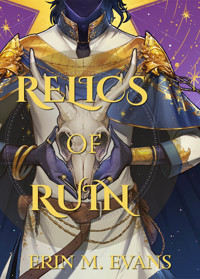
There are strange happenings in the desert. Learn the truth about the Hereditas Expedition in this hair-raising tale of betrayal, devotion and religious fanaticism. Was the Hereditas Expedition doomed from the start? Led by Pontifex Bilrach, the Mahjarrat must find the artifacts of the dead god Tumeken and complete the Ritual of Rejuvenation, otherwise they face extinction. Forced to work together by Zaros, the Mahjarrat form an uneasy alliance, though they all have their own ambitions. Having found only sand and false hope wandering through the Kharidian Desert, the search is becoming ever more frustrating and the casualties mount as the humans die for the Mahjarrat cause. The desert is vast and full of danger, the sun is oppressive, and there are traitors in their midst. Can the Mahjarrat succeed despite these impossible odds?
Sie lesen das E-Book in den Legimi-Apps auf:
Seitenzahl: 399
Veröffentlichungsjahr: 2025
Das E-Book (TTS) können Sie hören im Abo „Legimi Premium” in Legimi-Apps auf:
Ähnliche



















Contents
Cover
Title Page
Leave us a Review
Copyright
Dedication
One
Two
Three
Four
Five
Six
Seven
Eight
Nine
Ten
Eleven
Twelve
Thirteen
Fourteen
Fifteen
Sixteen
Seventeen
Eighteen
Nineteen
Acknowledgements
About the Author
ALSO AVAILABLE FROM TITAN BOOKS
RuneScape: The Gift of Guthix
RuneScape: The Fall of Hallowvale
RuneScape: The Official Cookbook
ALSO AVAILABLE FROM TITAN COMICS
RuneScape: Untold Tales of the God Wars
LEAVE US A REVIEW
We hope you enjoy this book – if you did we would really appreciate it if you can write a short review. Your ratings really make a difference for the authors, helping the books you love reach more people.
You can rate this book, or leave a short review here:
Amazon.com,
Amazon.co.uk,
Goodreads,
Barnes & Noble,
Waterstones,
or your preferred retailer.
RUNESCAPE: SHADOWS OF AMASCUT
Print edition ISBN: 9781803366067
E-book edition ISBN: 9781835412305
Published by Titan Books
A division of Titan Publishing Group Ltd 144
Southwark Street, London SE1 0UP
www.titanbooks.com
First edition: November 2025
10 9 8 7 6 5 4 3 2 1
This is a work of fiction. All of the characters, organizations, and events portrayed in this novel are either products of the author’s imagination or are used fictitiously. Any resemblance to actual persons, living or dead (except for satirical purposes), is entirely coincidental.
Copyright © 2025 Jagex Ltd.
Published by Titan Books under licence from Jagex Ltd. © Jagex Ltd. JAGEX®, the “X” logo, RuneScape®, Old School RuneScape® and Guthix are registered and/or unregistered trade marks of Jagex Ltd in the United Kingdom, European Union, United States and other countries.
Cover Illustration: Mark Montague
No part of this publication may be reproduced, stored in a retrieval system, or transmitted, in any form or by any means without the prior written permission of the publisher, nor be otherwise circulated in any form of binding or cover other than that in which it is published and without a similar condition being imposed on the subsequent purchaser.
A CIP catalogue record for this title is available from the British Library.
EU RP (for authorities only)eucomply OÜ, Pärnu mnt. 139b-14, 11317 Tallinn, [email protected], +3375690241
To Tim.
ONE
The weak may yet become strong if they are not crushed early.
—CODEX INVIOLABILIS,THE WORDS OF ZAROS, 3:12
The edge of the thick forest that once covered the Kharid was only a scar on the horizon, the death of the sun spreading a desert over the land, year by year, the sands swallowing everything living. Damaris, Ghorrocis Maximus, Tribune of Zaros, recipient of the corona linum, pulled the hood of her cape forward, shading her eyes against the high desert sun as she surveyed the dig site below.
Somewhere nearby, the echo of the dead god’s power pulsed like a heart. Damaris’s skin vibrated with it. From the crumbling bulk of an ancient wall, she studied the humans below her, digging trenches in parallel lines, searching for the hidden source of that insistent divine energy. Which of them might find the remains of Tumeken’s power?
“Tribune.”
She turned at the voice—Pontifex Bilrach, still as stone, stood behind her, a sword’s-length away. The soul jewel at the centre of his forehead, the rukhud, red and glowing as the sun hit it just so. His ambages, the dark lines on his pale grey skin that so defined Bilrach to any Mahjarrat’s eye, made stark arrows over his forehead and cheeks in the bright light of noon. The face he wore beneath those lines—craggy, angular—he’d worn so often, for so long, that this, too, was Bilrach, much as the look of disapproval was distinctively the pontifex’s.
“What progress?” he demanded.
“The same as the last time,” Damaris said mildly. “They are digging. They have found nothing yet.”
The pontifex grunted as if this did not satisfy him, but he would waste no more time on it. This expedition—the Hereditas Expedition, as he’d named it—was, nominally, under his command. But the intrusion of Damaris, a tribune Zaros himself had inexplicably bestowed honours on after the Siege of Ghorrock—this rankled Bilrach. Every interaction with him, she could sense him trying to decipher why she was here, chasing the relics of Tumeken, the Menaphites’ dead god of the sun. Who sent you? His narrowed gaze, the sharp bend of his ambages around the purse of his mouth. Who is trying to bring me down?
The wrong questions—but Bilrach was the sort to think only of his betters and what they wished, how the hierarchy might be shifting around him. Nothing greater.
“It takes time,” offered Mirza, one of the other two tribunes. “They are numerous but not very strong.” Her rukhud a cluster of pale blue, her ambages serpentine over her cheeks, her expression grim—Mirza caught Damaris’s eye. Mirza knew her purpose—shared her purpose—and knew it did not serve either of them to draw the attention of the pontifex.
“Perhaps Lucien could encourage them to work faster,” Damaris mused, knowing the coming reply. And as if forced into retreat by the thrust of her question, at the third tribune’s name, Pontifex Bilrach gave another snort of disgust and stormed away, leaving Damaris to return to her survey of the workers.
She found Lucien down below, pacing the boundary of the dig site, as though the humans might all rise up and run away, and only Lucien, Tribune of Zaros, would be able to stop them. He towered over them, half as tall again as any of the humans, but regarded the workers as though they were all venomous serpents, any one ready to attack. A trio of skeletons trailed after him, their swords dragging in the sand.
Mirza sidled up beside Damaris. “I wish Sliske hadn’t started teaching him necromancy. Those things are ridiculous. They keep scaring the camels.”
“Well, he wasn’t going to become a great warrior on his own merits,” Damaris murmured back. “Who knows? Maybe this will be his calling.”
“‘Do not hunt for a purpose, for your purpose is the empire,’” Mirza said, wryly.
“Heed the words of Zaros,” Damaris replied, as automatic as breathing now. The Mahjarrat, after all, were the warriors of Zaros, god of fate, god of empire. But even as she spoke the answering verse, a twinge of disgust shook Damaris’s steadiness.
They were not so far away from the time before Zaros, not so long past that Damaris could forget they’d had whole ways of living, of being Mahjarrat that had nothing to do with this world, with Zaros, with the Menaphite gods, even with humans. The soul of the Mahjarrat yearned toward the vorzen—the axis, the centre of power—that was how it always had been. One among them was the strongest, and the strongest was the centre. But now Zaros had replaced the vorzen in their souls, and imperator had slid into their mouths the way the god’s language had replaced their own.
Almost, Damaris thought. There was still time.
“Do you think this is it?” Mirza asked. “Does it still feel strongest here?”
“‘There is value in assessing all possible resources.’” Damaris knew better than to promise. The divine energy rose out of the ground like a geyser, but the sites she’d found before had yielded only the usual sort of artifacts, the fallen god-blessed trappings of priests. Nothing like what they needed.
“Heed the words of Zaros,” Mirza answered. Then, “I think that one was the Pontifex Maximus’s revision. I think I was there for the imperator saying something more like, ‘If that mine’s run out, then go find some hole in the hinterlands, I need steel.’”
“It gets to the point,” Damaris allowed.
“Have you thought of how you’ll explain things to Azzanadra?”
“Too early,” Damaris said, adjusting her cape again as the sun drifted down, breaching the barrier of the hood embroidered with the crown of flax that signified her honours. “Let us worry about how the Pontifex Maximus will respond to our plan once we have the soul in hand.”
Damaris did not suggest the possibility that they would have to evade Azzanadra’s notice, and therefore the notice of Zaros, the god and emperor, the force they all aligned themselves around. This, she felt sure, would be too much to ask of Mirza.
Damaris eyed the humans below, the Zarosians armoured and proud, the Menaphites dressed lightly for the heat and spindly, their muscles straining against buckets of sand and shovels, heaving stones. Small and hairy and damp with sweat. Numbers were never a problem for humans—any two of them could make a half-dozen more in the blink of an eye.
“If we can re-establish the Ritual—” Mirza began.
Damaris held up a hand, still watching the diggers. “We don’t have the soul yet. Don’t get ahead of yourself.”
One human stopped, looked up at Damaris, their face almost meaningless. Blank of identifying lines, except for the sweaty hair that had escaped the knot at the back of their head, ambages born of effort. The woman looked down at the ground, then rested the blade of her shovel against the compacted sand and stone and waved a hand to Damaris.
At her feet, a dark hole opened into the stone.
“Tell the pontifex we have made progress,” she told Mirza, and leapt from the outcropping.
Damaris landed in a crouch at the edge of the dig site and strode to the trench and the hole in the ground. The sand had been removed to a depth of two feet, the stonework of an ancient floor revealed in the base of the trench. The humans stood nearby, work halted, as Damaris knelt beside the hole in the floor, hoping for a temple. The river goddess, Elidinis, the wife of the sun, kept her sacred spaces underground in these parts of the kingdom.
Someone had tried to fill in the door that led through the ceiling, probably when the temple was abandoned, and the wooden frame of the door had merged with hardened sand and rock and mud.
Damaris took the pouch from around her neck, and removed the treasure Bilrach had given her while the diggers worked: a glittering topaz the size of a human’s fist, the Name of the Sun.
This radiated divine energy, pulsed with the self-same beat that throbbed in the ruins. The people of the spreading desert held that their god did not have a united soul. Rather, the god’s soul was in seven parts—seven gems, one assumed. When Tumeken had destroyed himself, sacrificed to drive away the armies of Zaros—victory in loss, loss in victory—his fragmented soul pieces had remained. And his people had found them, hidden them away, the Mahjarrat were sure of it.
The topaz pulsed, its uncanny light flashing in an agitated pattern, and Damaris found herself hoping there was another here. The magic felt like Tumeken’s.
There were five Menaphite humans standing around the hole, holding digging irons and shovels and rakes. Staring at the soul of their sacrificed god.
One stepped forward. “Do you need someone to go down first?”
Female, Damaris thought, small and wiry with muscle, dark-haired and olive-skinned the way they all were, but with a thin red scar at the right corner of her mouth that flew at a diagonal up toward the outer corner of her eye. She might have been the one that waved Damaris down, but again, without the ambages, she was not good at faces. “Yes. What are you called?”
The woman was silent the barest moment, as if she were sizing up Damaris, considering challenging her. “Satia.”
Damaris suppressed a laugh. Like a kitten testing its claws. “Go down and tell me if it’s worth opening the entrance carefully. Is there space for me down there? Stay if there is.”
“And if there isn’t?”
“Then come back out,” Damaris said, “and we’ll blast it bigger.”
Satia exchanged the smallest of looks with the man beside her, before she squeezed down the jagged-edged hole.
Damaris ignored the humans and waited for Satia to call back up. They were Menaphites, but from the southern edge of the empire, and they knew their place in this expedition perfectly well. They were paid for their work, and there was a treaty in place. There was no point in terrorizing them, easy as it was.
After a moment, Satia called up. “It’s… It’s a sanctuary. Of Elidinis. And there’s room.”
Perfect, Damaris thought.
“Widen the hole,” she ordered the humans. As it was, only a human would fit down the passage, but only Damaris would hold the Name of the Sun. “Broad as my shoulders. Satia, stay there, I’m coming down.”
The humans all stared at her, frozen a moment. Damaris frowned—she was sure all of them spoke the language of the empire. In the name of efficiency, they’d made certain not to bother enlisting the ones who only spoke the desert languages.
“It… it is the sanctuary of—” one began to protest. Another man shushed him, eyes on Damaris.
“It is a ruin,” Damaris said. “I promise you Elidinis will not punish you. Widen the hole.” They set to work, reluctant but quiet.
Once, Damaris imagined, this would have been a sprawling temple complex, nestled amid the verdant jungles of the Sun’s kingdom, springs rising from the now-barren ground in delight of the goddess of rivers and springs. Damaris had not travelled in this part of the country, and she had never been one to visit the gods of Menaphos’s temples, but they were everywhere. The gods loved their people. The people loved their gods. Elidinis loved the water, and if her beloved river was not near then she would bless a spring to rise up in that place to better hear prayers for abundance and fertility as she dangled her feet in the water.
Or rather, she had, once. Things changed, after all.
The humans levered out the stones that surrounded the entrance, sand crumbling down into the sanctuary below. Damaris could have ripped them out herself, could have smashed her way into the spring below. Perhaps it was weakness, perhaps only nostalgia—the passage of time would erase these traces of the fallen kingdom soon enough and it didn’t please her to hurry that along.
When it was wide enough, Damaris wriggled down into the sanctuary and called forth a mote of light to illuminate the space: a long rectangular room with a ceiling that forced Damaris to crouch. At the rear, the light just touched the remains of the spring with its black and green stains and a stone throne. Satia stood beside one wall, looking up at the paintings flaking from the stucco.
Crumbling trees and broken flowers. Humans with their faces half torn away by blazing white plaster, as if the brilliant death of their god had rewritten their fates even here.
The goddess, pitted and stained with ancient moulds that made ambages down her lovely face, lines of fury and grief and retribution.
Something deep in Damaris shuddered, as if struggling up out of the sucking mud. Damaris reached out and raked a hand down the plaster, destroying the painting. Elidinis will not punish you, she told herself. Elidinis cannot punish you.
You are already damned, a little voice added inside her thoughts.
Satia stifled a cry at the destruction, reminding Damaris of her presence. She stared up at Damaris with horror and fear in her eyes, her mouth a hard line around the sound that had escaped.
“Elidinis will not mind,” Damaris assured her. “It was not a flattering portrait. Come.”
The mote of light followed Damaris into the darkness, casting shadows that shifted along the haunting paintings, the niches that lined the walls, empty now. The spring was drying up without the goddess’s attention, the desert sands seeping in, unstoppable as grief. It you didn’t know this was a sanctuary of Elidinis, Flower of the Desert, you would guess it was a tomb, lost and forgotten.
The plume of divine energy radiated from the deepest part of the sanctuary, near to the empty throne. Damaris directed Satia to dig away the sand near its feet and turned her own attention to the throne itself. As her hand brushed the stone at the seat of the chair, she realised her mistake: there was no soul-gem.
The throne radiated the energy, the memory of the dead god. Once, Tumeken must have come into his wife’s sanctuary, perhaps before thrones and paintings and stonework, when they were young and newly alive. Once, he must have blessed this place, added his power to hers. The people who lived here must have venerated this stone, this spring, and the divine power had remained. Damaris imagined Elidinis, her husband, kneeling enamoured at her feet in this place of her power, their subjects returning year after year, begging for renewal, for regrowth, for plenty, and being awestruck by the blessings, rewarded for their devotion.
Damaris sat back on her heels and sighed. The god-blessed stone might have served the needs of humans, but it wasn’t any good for her purposes. If it were, none of them would be in this situation.
North of Ghorrock, the fortress where she’d earned her accolades, her corona, a stone shaped from blessed rock, stood sentinel out in the cold wastes. A god-touched stone that aped the one that stood in Freneskae, the Mahjarrat’s far-off home world.
On Freneskae, when their goddess called them, with earthquake and fire, they would gather at that stone, they would know one of them would be sacrificed, to return to Mother Mah and give her strength to dream more of them into being. And they would gather again to draw her power to them, to welcome more Mahjarrat into their ranks, to grow strong again, to stand against the dangers of Freneskae, the vile enemies that threatened the Mahjarrat.
The Ritual of Rejuvenation. The Ritual of Enervation. The endless cycle of the vorzen and the Mahjarrat.
Here, there was no Mother Mah. The vorzen was Zaros, Imperator, dark god of all order, all fate. It was correct to align with such a strong force, such an ideal vorzen—but he could not give them the ritual as Mother Mah had. He could not make more of them. He could not stop them from decaying, from the slow death away from the source of their strength.
And so: the stone, north of Ghorrock. The meeting place, and the ritual they swore to do each time the planets aligned. One Mahjarrat sacrificed, just as if they had been on Freneskae, to provide strength to the many. A new Ritual of Rejuvenation.
But none would be born or reborn. They couldn’t be. Half the rite—the Ritual of Enervation—was beyond any power they had on Gielinor. Until they found a way to re-establish the rites, the number of the Mahjarrat would dwindle down and down, until there was only one left.
Damaris shut her eyes a moment in the silence of the fallen sanctuary and tried to imagine being utterly alone.
Even here, deep in the earth, with only a human scratching at the dust beside her, Damaris could not do it. She knew exactly where Bilrach stood, where Mirza waited, where Lucien paced. She knew how far it was to Senntisten, the capital of the empire, where so many of her brothers and sisters were—and every Mahjarrat on this world could find her just as easily, bound together by ties stronger than blood, more demanding than promises.
Damaris could feel, too, as all of them could, where the lost were not. Untrad, Aspasia, Temekel, a hundred more. Dead in battle, dead in ritual, dead in the sacrifice of the desert god—fewer and fewer every year.
Now the cracks were showing. They had survived—had thrived—by being as one, but in this world, that wasn’t what mattered. They eyed each other, speculative and measuring. Not all of them, after all, could survive the next ritual, where death was not a return to their mother, not a gift to them all, but an ignominious defeat. The ultimate mark of weakness, because they must each be a vorzen unto themselves. They must each be the strongest or die.
“We still have time,” she said aloud.
“Your pardon?” Satia asked, looking up from her sifting.
“Nothing,” Damaris said. “There’s nothing here. Let’s go back up.”
Bilrach and Mirza stood over the exit as she climbed out, and from this angle the hollowing of their faces, the beginning of the slow decay that necessitated the rituals, was unavoidable.
“Well?” Bilrach demanded. “Did you find one?”
“Nothing, Pontifex,” she said. “An old blessing bleeding off power. We should move on to the next site.”
Bilrach sighed, a gravelly sound in the base of his throat. “I told you this wouldn’t be it. Give me the soul-gem back.”
“‘Diligence is a virtue well-prized in every warrior,’” Mirza recited.
“Heed the words of Zaros,” Damaris replied, thinking Azzanadra had overdone that one a little as she handed over the topaz in its pouch.
Bilrach’s eyes narrowed. “Are you quoting the holy codex at me?”
Before Mirza could reply, a wild scream arose on the eastern side of the dig site, behind Damaris. She turned to see a crowd of humans racing over the dune toward them.
Dozens of them, scores of them. Swords and bronze axes flashing in the sun. A volley of arrows sailed over the sands, peppering the dig site, sending their human workers scattering, falling under the assault. Shouting, screaming, words Damaris didn’t know how to speak, but understood all the same: death to you, death to your empire.
An arrow hit Mirza in the thigh with a meaty thwack. Damaris drew her sword, gauged the distance to the line of fighters—
Bilrach set a hand on her shoulder. “This is not Ghorrock,” he said with disgust. “Don’t trouble yourself. Lucien!” he shouted down to the fourth Mahjarrat. Bilrach waved at the horde of humans as though they were a swarm of flies. “Deal with it!”
Lucien saluted, then turned to his skeletons, directing them toward the wave of humans rushing at him. One immediately collapsed, its leg buckling under it as it started forward. The other two charged ahead, though the left-hand one veered strongly away from the horde.
“Lucien!” Bilrach shouted. “Leave your toys, and deal with the attackers!”
Lucien turned, sweeping his arms together and driving a column of power through the mass of humans. They parted like stalks of grass before a wind, bodies crashing into bodies. Swords plunged into allies, axes cracked into skulls. Injured humans scattered on the sands, bleeding from innumerable wounds. The Zarosian soldiers formed up, shields high, and swept in behind Lucien and the struggling skeletons.
“How long to get to the next site?” Bilrach asked Damaris, as if the sounds of battle were a conversation he was ignoring.
“Two days,” she said.
Bilrach made another irritated sound. “Mirza, go help that idiot clear this mess up. And keep them away from the camels. I want to be on our way within the hour.”
“Of course, Pontifex.” Mirza yanked the arrow out of her leg and tossed it to the side, striding along the edge of the dig site as Lucien took hold of his spear and waded into the sea of bodies. One charged the Mahjarrat only to be skewered as he ran. Lucien hardly missed a step as he flicked the body aside, shaking his spear free. The skeleton that had veered off course tramped after him, one arm now missing.
Bilrach swore in Mahjarrat, an oath full of shattered stone and boiling lava. “He really is useless.”
Damaris did not defend Lucien, nor point out she could have helped him. “You know we can’t leave yet,” she said instead. “The workers and the legionaries—they need food and water and rest.”
“Again? Already?” Bilrach turned to look down at the workers cowering in the ruins, as the clash of battle, the screams of dying humans rang out over the desert. “Every day I wonder how they survive to the next, let alone thrive long enough to find gods and kingdoms.”
“I believe the legions have already set a camp,” Damaris said. “I’ll start leading these over there while Lucien and Mirza finish, and then give the centurions orders for departure so we’re ready in the morning,”
They still had time, Damaris thought, if they used it wisely.
TWO
Do not scheme against the people, for Amascut knows the unworthy by sight.
—THE MAXIMS OF TUMEKEN
Satia’s downfall began with a dream.
She had been twelve—soft with childhood, about to bolt like a weed in the heat, but for the moment pudgy, solid. She had woken in the night, cold with sweat soaking her curling black hair, prickling on her coppery skin.
“A fire,” she told the priestess of Amascut who found her, one of the many in the temple that had taken in Satia and her twin brother when they were orphaned by a Zarosian raid. “A terrible fire, and a serpent rises out of it, swallows the altar, and the earth shakes, the columns crumble, and there was a lady weeping and—and then a monster—”
“Shhhhh,” the priestess said, smoothing a hand over Satia’s hair. “A nightmare.”
But three days later, an earthquake shook the town of Hatra where she lived. Fires broke out. Seven people died. The ceiling of the sanctuary of Crondis, the wise and patient crocodile goddess, collapsed, bringing down half the temple of the bau-gods on the farther side of the complex. In response to the catastrophe, a contingent from Kharid-et arrived, trailed by one of the Mahjarrat, and the temple to the bau-gods was torn down for their safety. They left a new temple of Zaros behind, crouching on the farmland of a dead man.
“You saw this happening?” demanded the High Priestess of Amascut, the Divine Guardian of the Daughter’s Justice. She had been ancient, even then, and Satia could not recall a name for her other than the Divine Guardian of the Daughter’s Justice. The Divine Guardian’s dark eyes were lined with kohl so thick and heavy she seemed to be peering out of a mask, her crepey throat swathed in a delicate collar of bright beads and golden lion-heads, a single golden signet ring on her thumb. “Why didn’t you tell me?”
“It was only a dream,” Satia said. “I told the priestess—”
“It was a prophecy,” the Divine Guardian intoned. “The gods speak to us in dreams and you, I think, have been selected to be their mouthpiece.” She tilted her head, considering Satia. “You are the twin. Auspicious.”
“Yes, great lady,” Satia said. “My brother, Djer—”
“The foundlings from the destruction of Sestris,” she went on. “A miracle—two babes in the ruins, a desecration by the Zarosians that killed most of the village.” She leaned forward. “You have intrigued me since that day, Satia, you and your brother. And I think this is why. You are very clearly marked by the twin gods.” She gestured up at the statues, at canine-headed Icthlarin and feline Amascut.
“Djer is swift as the Opener of the Ways, keen-sighted as Icthlarin the Unceasing. You…” She turned and frowned at Satia, unremarkable, ill-defined. “You are patient. And now you are far-sighted. The blessings of Amascut, surely.” The priestess set her knobby hand on Satia’s head, her grip strong, the sharp edge of the signet ring pressing painfully into Satia’s left eyebrow.
“Blessed One of Amascut,” the Divine Guardian pronounced. “You shall become the Divine Guardian of the Daughter’s Justice after I am gone.”
And so Satia trained under the Divine Guardian as a priestess of Amascut. The prayers and the offerings, but also how to judge fairly and bring justice swiftly. How to determine the remedy of a crime. How to enforce it. How to execute a man before a crowd for his crimes, and how to give a victim justice when it must be discreet—poison and accidents and sharp knives in the night. She prayed for sturdiness, for sureness. When the day came that death was her duty, she could not flinch from the need.
She dreamed—of course she dreamed—but they were the ordinary dreams of a child living on the edge of a war, in the tumult of a changing world. When she had passed a harvest and a sowing without another dream of prophecy, the Divine Guardian’s regard became suspicious.
“I don’t know how to make it happen again,” she told her brother, her confidant, her dearest friend. Now that they were of age, they were separated by the priestly orders and the dormitories, but every moment they could escape their duties was spent together. This time, they were walking the edge of the desert, where the fields of chickpeas and wheat ended and the sands began. “I keep trying to remember what made it happen,” she told him. “But nothing seems to work?”
Djer, at nearly fourteen, had grown taller than her, muscles carving his rangy body slowly into a man’s from a boy’s. They’d shaved his head that year, the beginning of adulthood for him. He looked like a stranger. But he still had Satia’s heavy dark brows and Satia’s thick lashes, Satia’s arched nose and Satia’s cleft chin. On Djer, with his sharp cheekbones, it was beginning to look handsome and hawkish—Satia, with her round face and large eyes, looked kittenish and always surprised.
“Just try things,” Djer advised. “What’s the worst that can happen?”
“I just told you, you onion-head! Nothing has worked! And don’t say ‘what’s the worst that can happen?’ That’s just inviting trouble in.”
He yanked a stalk of grass from the field’s edge, stripping its seeds into his palm. “Oh, onion-head yourself—did you ever think maybe Amascut doesn’t have anything to tell you? Maybe you need to figure out what to do on your own.”
Satia sighed. “That’s not the answer the Divine Guardian wants.”
Djer shrugged and tossed the seeds into the desert sands. “Who says she needs to know if you actually dreamt anything? Just tell her what she wants to hear.”
“I can’t lie to the Divine Guardian!”
“Then she might throw you out,” he said. “Look, she wants advice and Amascut doesn’t want to give that to her—so you do it. Maybe that’s what the goddess wants, you don’t know.”
She didn’t, to be fair, and she didn’t have another solution.
So Satia lied.
“I dreamt of a swarm of locusts,” she said, “that buzzed with the name of the Imperator. They devour the fields down to the roots and the people weep with hunger.” She met the Divine Guardian’s dark gaze. “I think… I think the Zarosians will demand tribute. We should hide the grain and give them a smaller share.”
When the Temple of Zaros next hosted the forces of the Imperator, they did indeed demand a tribute from the village they had overtaken—but this was not a surprise, to Satia. The farmers fretted about it constantly. Having hidden a third of their crop in the shabby new Temple of Amascut and Icthlarin, though, the tribute was minor—after all, it would not do to starve the farmers, but a little deprivation would motivate them to do better next time.
“You are blessed, my dear,” the Divine Guardian told her. “We are fortunate Amascut sent you to us.”
So it continued—Satia was sent no dreams of prophecy, but she reported now and again, a vision that warned the temple to prepare, the priests to stand firm. The Zarosians remained a constant menace, the cycle of the harvest predictable in its concerns. This murder meant a dream of outrage at the lack of justice. That rumour of the headman seducing someone’s wife meant a dream of Elidinis weeping. A careful dance, to take care of the village, to take care of her duties, but always seem as though she knew what was coming.
Until the day she hadn’t. Until the day it all fell apart.
* * *
In the site where the Mahjarrat had brought them to dig, Satia prayed as she gathered up the tools. O Amascut of the Ten Thousand Blades, the Unflinching, Eye of the Sun! Tear the unworthy from this life and deliver us from their predations.
She did not look at the dead, the rebels who had tried to ambush the Mahjarrat and those willing to assist them, their bodies scattered on the sands. Had she known them? Had they come all the way from Kharid-et, or were they from the villages along the brink of the desert, the towns doomed to the same fate as the ruin she stood in.
O Icthlarin of the Ten Thousand Paths, she prayed, the Unceasing, Voice of the Sun! Lead us to the fortress of your strength, the springs of your mother’s bounty that our enemies might not plague us!
The gods did not answer, so far off in their duties as they were. The Zarosians returned again and again, and the sands of the desert, the desiccating death they called Elidinis’s Grief and—more quietly—Tumeken’s Demise, chewed away at their croplands every season.
Djer sidled up beside her. “What did it do down in the sanctuary?” he whispered.
Satia thought of the Mahjarrat, her face a perpetual snarl, raking her hand down the image of Elidinis, obliterating it as easily as brushing away lines in the sand.
“Nothing,” Satia said. “Exactly what she said. She thought there was a soul down there, but it was just a blessed altar.”
Djer huffed out a breath. At twenty-three, he was taller than her by a head, broad of shoulder and just as fast and keen-eyed as the priests of Icthlarin had hoped. He had grown into his sharp-edged face and out of the gangly frame he’d had as a boy—but he had not grown out of his impulsiveness.
When Satia had volunteered to join the expedition which rumour said was to find the lost souls of Tumeken, he had volunteered right beside her, even though he had nothing to atone for.
“There’s eighty dead,” he murmured. “We should have done something.”
Satia shook her head. “What would you have done? Leaped in front of that whirlwind? Broken the tribune’s spear? This is the torment of our task. We have to stay hidden.” She glanced back at the other workers tasked with piling the bodies of the failed attack beside the dig site. “Such fools,” she said, full of pity. “We won’t survive flinging ourselves against the Mahjarrat. Icthlarin brought them here because they’re almost invulnerable.”
Ages ago, when the threat of Zaros first arose, Icthlarin, Opener of the Ways, had gone with his fierce sister to the world beyond the Sun, beyond the Sky. The Dark Dream, they said, a place that held warriors great enough to secure the kingdom of the Sun. They had found the Mahjarrat, the Stern Judges of Icthlarin, and for a time, until the Betrayal, they had been the great defenders of the Menaphites.
Satia watched the Mahjarrat confer, the one called Damaris pointing into the desert, toward the east, the one called Lucien making sharp agitated gestures that Satia didn’t understand. Beside them the workers scurried to pack tools and supplies, even the tallest man like a child coming only to the towering Mahjarrat’s chests.
“That one I followed down into the sanctuary. The one with the green jewel in her head. She can sense divine magic.”
“I think they all can.”
“But she can tell which way to go, and she can tell it’s Tumeken’s blessings, his power she’s chasing. She’s the one we need to watch.”
Djer hesitated. “Do you think she can sense other gods’ gifts too?”
Satia nearly laughed thinking he meant her—she was not, it was clear, the goddess’s favourite the way she’d let the priestesses believe—but then she remembered the dagger.
The expedition had left from Kharid-et two weeks before, but rumours of the Zarosians’ purpose had raced ahead of the Mahjarrat, streaking out into the countryside to the settlements all along the desert’s edge, until they reached Satia’s village.
“They seek the souls of Tumeken.” The High Priest of Icthlarin had a face like a scythe, long and sharp. Dark and lined with the sun, he spoke every whispered word like a pronouncement from the Guardian of Souls. “Their foul Imperator-God wishes to steal the sun’s essence. You will go with them. You will make certain they don’t succeed.”
In another time, another place, he would have been resplendent in his regalia, his staff of office, his white headcloth, the golden pectoral, belt, bracelets of a high priest. Satia knew this because he told her of them once—they had been sold off long ago to buy grain and fava, and feed for cattle. But here, now, in the aftermath of the Zarosian Empire’s continued expansion and the death—disappearance—of Tumeken, the Lord of Light, the high priest was a herdsman, worn and rangy, the only sign of Icthlarin’s favour his sonorous voice, his stately demeanour.
He produced a dagger, small and shining, the hilt adorned with a gem that shimmered like the eye of a great cat. He handed this to Satia, who tested the weight of it—it felt no different than the knives she had trained with, the tools of a priestess of justice.
“You want me to kill someone,” she asked quietly. It was a task given to Amascut’s priesthood, a task she knew would be asked of her one day. But she did not relish it.
“No,” the high priest said. “You must rescue someone. Something,” he amended. “The Zarosians have found the Name of Tumeken. That soul is a topaz the size of a fist. His bau-soul is known, having manifested as the lesser gods, but the others must persist while he is… dreaming.”
The slightest hesitation before the word, the only hint of the rumour that the Sun God might indeed be dead, passed on into the Underworld or wherever gods went when they died.
The priest produced a slim leather sheath, marked all over with the words of spells for protection. “This dagger was once one of Amascut’s ten thousand blades. It is unbreakable, un-dullable, and filled with her righteousness. I know the Divine Guardian would have wished you to have it, Satia.” He handed her the sheath. “Keep it safe in this until you mean to draw it. If the Zarosians find the relics,” the priest went on, “and there is no chance of retrieving and returning them, then you will use the dagger to destroy the gems and free Tumeken’s souls, that he may be strengthened for his return to us.”
She could not agree, but she also could not argue. The High Priest of Icthlarin didn’t know how she had failed, how unworthy she had made herself.
Outwardly, she’d made herself as indistinguishable as possible from any other worker. She shed her priestly garments, her amulets, her sistrum. She carried only a pouch of small votive figurines, statuettes to stand for the eight gods if she needed to pray. The sacred dagger in its protective scabbard she wore at small of her back, tucked into the belt beneath her tunic.
The Mahjarrat had not commented on it. Perhaps there was nothing magical about the dagger. She hadn’t tested its strength or its sharpness. Perhaps the high priest was lying too.
“I’ve been asking around,” Djer began.
Satia bit back a sigh. “I told you I don’t want to involve anyone else.”
“We might need help!”
“You don’t know which of these people would be on our side,” Satia said. “Some of them are collaborators.”
She jerked her head toward the man ticking off items on a wax tablet as the workers added them to the sledge. Nebra looked to be twice Satia and Djer’s age, perhaps fifty, with the physique of a man who had been strong all his life, and only lately begun yielding to time. He charted paths for the expedition against the stars and kept the records. He wore the white robes of a priest, to be sure, the gold jewellery. But the icon around his neck was the encircled X and cross of Zaros, the god and emperor seeking to subjugate the whole world.
“I wouldn’t ask him,” Djer said witheringly.
“He’s Menaphite,” Satia pointed out.
“And he’s sworn himself to Zaros—give me a little credit. He’s so deep in the Mahjarrat’s ears he’s tickling their brains.” He nodded toward the man approaching Nebra. “That priest, though. Abeni.”
The man was as tall as the two camels he was hauling toward the sledge of tools. Broad-shouldered and muscular, younger than Nebra but rougher too. He was bald as an egg, browned by the sun, a man who didn’t shirk any sort of work. “He’s a priest of Het,” Djer said. “A proper one.”
“Some of them have thrown in with Zaros,” Satia pointed out. “Might makes right, after all.”
“We won’t know,” Djer said, “unless we ask.”
The Zarosian Empire had its heart in a city so distant it might as well have been a myth, officially at peace with the cities that had been the Menaphite Kingdom once—the ones that hadn’t fallen under its control in the war—but Zaros’s influence seeped in and asserted its authority in a thousand ways, great and small. What you could buy and where you could go without being bothered and how you called to the gods, how you swore and how you celebrated, how you entered and left this world—the Zarosians had their fingers in all of it, approving and dismissing and changing life to their whims. This was always ours and this was always how it was and this is a blight, you will thank us for removing it.
The great Temple of Het remained, for Het, Stone of the North, Fist of the Desert, was a god the Zarosians could respect, but the Temple of Apmeken, Joy of the West, Delight of the Desert, had been razed, her priests driven into hiding. When the Mahjarrat had come seeking workers for their expedition, there were those who said yes because work was hard to come by, and those who said yes because they had given up, let the Zarosians in as their masters.
You did what was necessary to survive, Satia knew, but it grated all the same.
They walked back toward the ruin, the wall that protruded from the sands made a shady refuge for the workers to gather under. Damaris was there with the other female Mahjarrat. She was studying the glyphs carved into the stone, worn down by time and weather.
“Those three,” Djer said, pointing with his chin to a cluster of workers on the edge of the shade: a man with a short curly beard, a tall woman with her black hair cropped close to her skull, and another with her hair in braids, bound back, whose long hands fluttered gracefully before her as she spoke. “He’s Padanu, the tall woman is Henaka, and the shorter one Karytis. They’re from Uzer, over by the sea, you know? The city whose governor calls himself the Lord of the Second Sun?”
Satia paused. She’d heard of the Lord of the Second Sun and what he’d done to the Zarosian emissaries sent to bargain with him—humans, of course, not Mahjarrat, but still, you had to be brave to signal your rebellion like that. The Lord of the Second Sun was one of a half-dozen minor rulers and officials she knew of trying to secure themselves enough to remake the lost Menaphite kingdom—he was certainly one of the better-known would-be pharaohs.
“You can’t say they wouldn’t be on our side,” Djer pointed out.
“And you can’t say they wouldn’t hand over the souls of Tumeken to their Lord of the Second Sun.” She shook her head. “It’s too risky.”
“I’m just going to talk to them.”
“Satia?” a voice called. She looked up to see Damaris beckoning her over the other workers’ heads, face a masklike scowl. Satia exchanged a glance with Djer, full of warning—don’t do anything foolish—before she hurried over to the Mahjarrat and made a bow.
“What do you need, Tribune?”
Damaris pointed at the glyphs. “Can you read these?”
Satia’s gaze traced the shapes of the words. Elidinis, Flower of the Sun, rich in provisions, sweet of scent, the one whose coming makes peace, ever-increasing, the one who gives plenty to the orphan. She flicked a gaze to the Mahjarrat. “It’s in praise of Elidinis.”
“Yes, that’s her name there,” Damaris said, indicating a fluid cluster of symbols that did indeed say Elidinis. “But the rest. Can you read it? In Menaphite?”
Satia recited the hymn, feeling the eyes of the Mahjarrat on her, not sure of what she was giving them. When she’d finished, Damaris nodded as if she approved.
“You have a very lovely sounding language,” she said.
“What is the purpose of this?” Mirza asked. “Does it compel Elidinis?”
“No, tribune,” Satia said. “It’s… Do you not have songs of praise for… Zaros?” She didn’t even like saying the name of the Empty Lord. It felt greasy on her tongue, as if she were making herself more unworthy by acknowledging his existence.
Mirza stared at her, expressionless. “Why would we?”
“The humans do,” Damaris told her. “It is flattery. A low form of subservience to the vorzen.”
Satia bristled inside. Whatever a vorzen was, the hymns were holy and beautiful—there was nothing low about them. “They are not flattery,” she said. “They are true.”
Damaris frowned at her. “Do they tell how your gods were weak? How they failed you?” She did not ask it cruelly—she said it simply, like a child asking why the river kept flowing or why the sky was blue. But it was a cruel question anyway, and Satia swallowed down her rage, her pride.
“No, Tribune,” she forced out. “May I go?”
“Yes, of course,” Damaris said, turning back to the other Mahjarrat, as if by that gesture she had put Satia and all her people entirely out of mind, as if she had erased them as easily as she had destroyed the painting of Elidinis.
Satia went to end of the wall where the shade ended and the workers weren’t as dense. She took a bowl of water from the legionaries rationing from the big jars they’d hauled from the far-off river, and sat down as far from the others as she could.
She slipped a hand into the pouch of votives, found by touch the statue of Elidinis, and uttered a quiet prayer to the river goddess, an apology for the earlier defilement, gratitude for the water she sipped as she watched the Mahjarrat, and wondered if there were any hope of stopping them, as strong as they were, as indefatigable, as full of magic—
Satia was so intent on the Mahjarrat that when the small paw tapped her hand holding the bowl, she startled. The cat that was edging toward her water, leapt back, but did not flee.
“Sorry,” she said. “Oh sorry—here, kitty. Here.” She took another swallow from the bowl and offered the rest to the cat. He was a sleek, tawny-red, with faint stripes along his sides, leggy with a long face and big ears. His whiskers curved forward, ears pricked as he slunk toward the offered water. He lapped it greedily with the curl of a pink tongue, lifting his head once to sniff Satia’s proffered fingertips, which he rubbed his jaw and cheek against.
Satia felt a rush of excitement—silly but hopeful. Cats were sacred to Amascut, their quick strike and quiet judgement emulating the goddess of justice. But they did not keep cats in the temple—they would never stay. And yet here one had found her, on this holy errand.
It was a good sign, surely.




