


10,55 €
Mehr erfahren.
- Herausgeber: Fernhurst Books Limited
- Kategorie: Lebensstil
- Sprache: Englisch
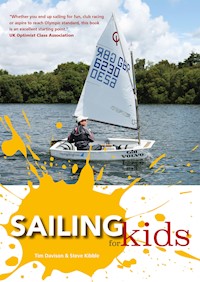
Sailing for Kids is aimed at children aged 8-15 who are taking their first steps into the fantastic world of sailing. Packed full of colour photographs and diagrams, this straightforward and easy-to-understand guide is the perfect introduction to the sport. It is based on the Optimist dinghy, which is the most popular children's sailing dinghy worldwide, and endorsed by the UK Optimist Class Association. Topics covered include what to wear, setting up the boat, sailing and safety. For those who want to go further, there are also tips on sailing faster and preparing to race.
Das E-Book können Sie in Legimi-Apps oder einer beliebigen App lesen, die das folgende Format unterstützen:
Veröffentlichungsjahr: 2015
Ähnliche















Copyright © 2015 Fernhurst Books Limited
This second edition first published in 2015 by Fernhurst Books Limited
62 Brandon Parade, Holly Walk, Leamington Spa, Warwickshire, CV32 4JE, UK Tel: +44 (0) 1926 337488 | www.fernhurstbooks.com
All rights reserved. No part of this publication may be reproduced, stored in a retrieval system or transmitted, in any form or by any means, electronic, mechanical, photocopying, recording, scanning or otherwise, except under the terms of the Copyright, Designs and Patents Act 1988 or under the terms of a license issued by The Copyright Licensing Agency Ltd, Saffron House, 6-10 Kirby Street, London EC1N 8TS, UK, without the permission in writing of the Publisher.
Designations used by companies to distinguish their products are often claimed as trademarks. All brand names and product names used in this book are trade names, service marks, trademarks or registered trademarks of their respective owners. The Publisher is not associated with any product or vendor mentioned in this book.
This publication is designed to provide accurate and authoritative information in regard to the subject matter covered. It is sold on the understanding that the Publisher is not engaged in rendering professional services. If professional advice or other expert assistance is required, the services of a competent professional should be sought. The Publisher accepts no responsibilty for any errors or omissions, or for any accidents or mishaps which may arise from the use of this publication.
A catalogue record for this book is available from the British Library
ISBN 978-1-909911-26-0 (Paperback)
ISBN 978-1-912621-00-2 (eBook)
Cover photograph by Tim Hore
Photographs on pages 1-10; 14-15; 17-22; 27-29; 31; 36; 38 (bottom); 40 by Tim Hore Photographs on pages 11-13; 16; 24-26; 38 (top); 43 © Rachel Atkins
Fernhurst Books and the authors would like to thank those who sailed fantastically on the photoshoots – Milo Gill-Taylor at Spinnaker Sailing Club and Katie Byne at Draycote Water Sailing Club, and their parents who accompanied them during the photoshoots.
Edited, designed & illustrated by Rachel Atkins
Foreword
Chapter 1Parts of the boat
Chapter 2Rigging
Chapter 3Your first sail
Chapter 4Launching
Chapter 5Reaching
Chapter 6Beating
Chapter 7Running
Chapter 8Sailing a circular course
Chapter 9Landing
Chapter 10Safety
Chapter 11How the wind moves your boat
Chapter 12Knots
Chapter 13The rules
Chapter 14How to go faster
Chapter 15What’s next?
Sailing for Kids provides an introduction to sailing for children based on the Optimist dinghy. What is an Optimist? You will see from the photos that it is a single-handed boat for children, both boys and girls, up to the age of 15 and it is one of the most popular dinghies. It is sailed in countries around the world, in local flotillas and sailing clubs.
It is a great boat in which to learn to sail but it is also the boat many top class sailors have started in. As boys and girls become more skilful, many will learn to race in local regattas. For those that become very good, there is even a World Championship each year.
As the Optimist is so popular, it is easy to buy a second-hand one for a good price and it will keep its value.
Whether you start sailing in an Optimist or another type of dinghy, sailing is a great sport for children. It not only teaches them a new skill but it also fosters independence, self-respect, resilience, communication and organisation skills. Most importantly it is fun and many friendships that are made in Optimists are friends for life.
The Optimist Class Association in the UK is delighted to recommend this book. Sailing for Kids is a great introduction to our sport and whether you end up sailing for fun, club racing or aspire to reach Olympic standard, this book is an excellent starting point.
As a class association, we actively support local Optimist flotillas up and down the country encouraging local training and regattas and supporting parents and sailors at all points on their Optimist journey. Please check out our website: www.optimistsailing.org.uk. We are also affiliated with the International Optimist Dinghy Association (www.optiworld.org).
Enjoy your sailing.
Mark Lyttle
Chairman of the UK Optimist Class Association
The photo below and the one on the next page show an Optimist dinghy. The main parts of the boat are labelled. Try to remember as many as you can! These terms will be used in the book – if you can’t remember what they mean, look back at these photos to remind yourself.
You can test how well you can remember the parts of the boat (and what they do) by printing off the photos with the labels missing:
• Fill in all the parts and descriptions you can remember.
• Check to see if you are correct.
• Go over the parts that you couldn’t remember!
The photos (with labels missing) can be downloaded from: www.fernhurstbooks.com/other-resources/sailing-for-kids
Now you know what all the parts of the boat are, you are ready to put them together!
Rigging Setting up the sail and poles on your boat, ready to sail.
Lay the sail out on the floor (starboard side up), with the boom at the bottom.
Tie the sail onto the boom using the sail ties (threading them through the cringles on the sail and round the boom).
Tie the outhaul to the sail.
Thread the outhaul through the eye at the end of the boom and then back through the cleat. This allows you to adjust the outhaul to change the curve in the foot of the sail.




