


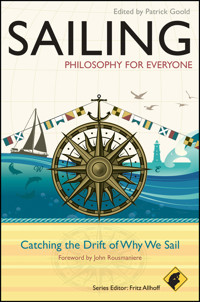
Sailing - Philosophy For Everyone E-Book
15,99 €
Mehr erfahren.
- Herausgeber: John Wiley & Sons
- Kategorie: Geisteswissenschaft
- Serie: Philosophy for Everyone
- Sprache: Englisch
This volume reveals the wisdom we can learn from sailing, a sport that pits human skills against the elements, tests the mettle and is a rich source of valuable lessons in life. * Unravels the philosophical mysteries behind one of the oldest organized human activities * Features contributions from philosophers and academics as well as from sailors themselves * Enriches appreciation of the sport by probing its meaning and value * Brings to life the many applications of philosophy to sailing and the profound lessons it can teach us * A thought-provoking read for sailors and philosophers alike
Sie lesen das E-Book in den Legimi-Apps auf:
Seitenzahl: 395
Veröffentlichungsjahr: 2012
Ähnliche




















Contents
FOREWORD
THE PHILOSOPHICAL SAILOR
ACKNOWLEDGMENTS
PART 1 PASSING THROUGH PAIN AND FEAR IN THE PLACE OF PERPETUAL UNDULATION
CHAPTER 1 SHIPS OF WOOD AND MEN OF IRON
CHAPTER 2 WINNING PHILOSOPHY
CHAPTER 3 “HARD A’ LEE”
Preparing the Boat to Sail
Casting Off
Some Existentialist Reflections
Cruising
The Social Dimensions of Sailing
“Hard a’ Lee” or Coming About
Sailing Close-Hauled
Noticing the “Presence of the Absence” (Heavy Sailing Ahead)
The Broad Reach
Practical Wisdom
Capsizing
Human Experience
Returning to the Pier
Pleasure, Elegance, and Truth
Final Tasks
CHAPTER 4 SOLO SAILING AS SPIRITUAL PRACTICE
A Phenomenology of Moral Presence at Sea
Tragic Comedy (or Comic Tragedy): The Paradox of Sailing
PART 2 THE MEANING OF THE BOAT: THREE SCHOOLS OF THOUGHT
CHAPTER 5 BUDDHA’S BOAT
CHAPTER 6 FREEDOM OF THE SEAS
Cheerful Resignation
Self-Sufficiency
Murphy was an Optimist: Negative Visualization
Agency and Control
Fate, Freedom, and Sailing
CHAPTER 7 SAILORS OF THE THIRD KIND
PART 3 BEAUTY AND OTHER AESTHETIC ASPECTS OF THE SAILING EXPERIENCE
CHAPTER 8 WHAT THE RACE TO MACKINAC MEANS
CHAPTER 9 SAILING, FLOW, AND FULFILLMENT
The Key: Losing Oneself
Windsurfing
Performance, Psychology, and Embedded Cognition
Windsurfing and Flow
CHAPTER 10 ON THE CREST OF THE WAVE
Ahoy!
The Sublime Poetry of Sail and Wind
Poseidon’s Wrath
She Moves
One is Free … on a Boat?
CHAPTER 11 NAVIGATING WHAT IS VALUABLE AND STEERING A COURSE IN PURSUIT OF HAPPINESS
What’s So Great About Sailing?
Aristotle, Virtues, and Flourishing
Is Sailing Virtuous?
Is Sailing More Virtuous Than Other Pursuits?
Conclusion
PART 4 PHYSICS AND METAPHYSICS FOR THE PHILOSOPHICAL SAILOR
CHAPTER 12 DO YOU HAVE TO BE (AN) EINSTEIN TO UNDERSTAND SAILING?
Introduction
Don’t Laugh at “Slow” Sailing: Average Versus Instantaneous Motion
Motion Relative to What? – Galilean Relativity
But There are No Fixed Reference Frames – Special Relativity
General Relativity – Can it Really Matter?
CHAPTER 13 PARADOXES OF SAILING
Appendix: Analysis of the Wind-Powered Boat
CHAPTER 14 THE NECESSITY OF SAILING
Of Greek Gods, the Judaeo-Christian God, and the Sea
A Ship Bound for India
Beyond the Pillars of Hercules
CHAPTER 15 THE CHANNEL
NOTES ON CONTRIBUTORS
VOLUME EDITOR
PATRICK GOOLD is Associate Professor of Philosophy at VirginiaWesleyan College. His current research focuses on defining rationality. He is co-editor with Steven Emmanuel of the Blackwellanthology Modern Philosophy from Descartes to Nietzsche. Patrick ispassionate about sailing, and, in addition to maintaining a smalldaysailer and a cruising boat of his own, frequently crews on the boatsof others. The bays and sounds of Virginia and North Carolina are hishome waters but he has sailed the length of the East Coast of the United States from Hilton Head to Long Island Sound, made aBermuda crossing, done club racing in Brittany, and cruised in theLesser Antilles.
SERIES EDITOR
FRITZ ALLHOFF is an Associate Professor in the Philosophydepartment at Western Michigan University, as well as a senior researchfellow at the Australian National University’s Centre for AppliedPhilosophy and Public Ethics. In addition to editing the Philosophy forEveryone series, he is also the volume editor or co-editor for severaltitles, including Wine and Philosophy (Wiley-Blackwell, 2007), Whiskeyand Philosophy (with Marcus P. Adams, Wiley-Blackwell, 2009), andFood and Philosophy (with Dave Monroe, Wiley-Blackwell, 2007). Hisacademic research interests engage various facets of applied ethics,ethical theory, and the history and philosophy of science.
PHILOSOPHY FOR EVERYONE
Series editor: Fritz Allhoff
Not so much a subject matter, philosophy is a way of thinking. Thinking not just about the Big Questions, but about little ones too. This series invites everyone to ponder things they care about, big or small, significant, serious… or just curious.Running & Philosophy: A Marathon for the MindEdited by Michael W. AustinWine & Philosophy: A Symposium on Thinking and DrinkingEdited by Fritz AllhoffFood & Philosophy: Eat, Think and Be MerryEdited by Fritz Allhoff and Dave MonroeBeer & Philosophy: The Unexamined Beer Isn’t Worth DrinkingEdited by Steven D. HalesWhiskey & Philosophy: A Small Batch of Spirited IdeasEdited by Fritz Allhoff and Marcus P. AdamsCollege Sex – Philosophy for Everyone: Philosophers With BenefitsEdited by Michael Bruce and Robert M. StewartCycling – Philosophy for Everyone: A Philosophical Tour de ForceEdited by Jesús Ilundáin-Agurruza and Michael W. AustinClimbing – Philosophy for Everyone: Because It’s ThereEdited by Stephen E. SchmidHunting – Philosophy for Everyone: In Search of the Wild LifeEdited by Nathan KowalskyChristmas – Philosophy for Everyone: Better Than a Lump of CoalEdited by Scott C. LoweCannabis – Philosophy for Everyone: What Were We Just Talking About?Edited by Dale JacquettePorn – Philosophy for Everyone: How to Think With KinkEdited by Dave MonroeSerial Killers – Philosophy for Everyone : Being and KillingEdited by S. WallerDating – Philosophy for Everyone: Flirting With Big IdeasEdited by Kristie Miller and Marlene ClarkGardening – Philosophy for Everyone: Cultivating WisdomEdited by Dan O’BrienMotherhood – Philosophy for Everyone: The Birth of WisdomEdited by Sheila LintottFatherhood – Philosophy for Everyone: The Dao of DaddyEdited by Lon S. Nease and Michael W. AustinCoffee – Philosophy for Everyone: Grounds for DebateEdited by Scott F. Parker and Michael W. AustinFashion – Philosophy for Everyone: Thinking with StyleEdited by Jessica Wolfendale and Jeanette KennettYoga – Philosophy for Everyone: Bending Mind and BodyEdited by Liz Stillwaggon SwanBlues – Philosophy for Everyone: Thinking Deep About Feeling LowEdited by Abrol Fairweather and Jesse SteinbergTattoos – Philosophy for Everyone: I Ink, Therefore I AmEdited by Robert ArpSailing – Philosophy for Everyone: Catching the Drift of Why We SailEdited by Patrick Goold
This edition first published 2012© 2012 John Wiley & Sons, Inc
Wiley-Blackwell is an imprint of John Wiley & Sons, formed by the merger of Wiley’s global Scientific, Technical and Medical business with Blackwell Publishing.
Registered OfficeJohn Wiley & Sons, Ltd., The Atrium, Southern Gate, Chichester, West Sussex, PO19 8SQ, UK
Editorial Offices350 Main Street, Malden, MA 02148-5020, USA9600 Garsington Road, Oxford, OX4 2DQ, UKThe Atrium, Southern Gate, Chichester, West Sussex, PO19 8SQ, UK
For details of our global editorial offices, for customer services, and for information about how to apply for permission to reuse the copyright material in this book please see our website at www.wiley.com/wiley-blackwell.
The right of Patrick Goold to be identified as the author of the editorial material in this work has been asserted in accordance with the UK Copyright, Designs and Patents Act 1988.
All rights reserved. No part of this publication may be reproduced, stored in a retrieval system, or transmitted, in any form or by any means, electronic, mechanical, photocopying, recording or otherwise, except as permitted by the UK Copyright, Designs and Patents Act 1988, without the prior permission of the publisher.
Wiley also publishes its books in a variety of electronic formats. Some content that appears in print may not be available in electronic books.
Designations used by companies to distinguish their products are often claimed as trademarks. All brand names and product names used in this book are trade names, service marks, trademarks or registered trademarks of their respective owners. The publisher is not associated with any product or vendor mentioned in this book. This publication is designed to provide accurate and authoritative information in regard to the subject matter covered. It is sold on the understanding that the publisher is not engaged in rendering professional services. If professional advice or other expert assistance is required, the services of a competent professional should be sought.
Library of Congress Cataloging-in-Publication Data
Sailing : philosophy for everyone : catching the drift of why we sail / edited by Patrick Goold; Foreword by John Rousmaniere. p. cm. Includes bibliographical references.
ISBN 978-0-470-67185-6 (pbk.)1. Sailing–Philosophy. I. Goold, Patrick Allen. GV811.S25515 2012 797′.124–dc23
2012009766
A catalogue record for this book is available from the British Library.
JOHN ROUSMANIERE
FOREWORD
The Craft and the Mystery
This welcome collection of essays about the examined life under sail touches many of my nerve endings. A topic I call “the meaning of the boat” has been high on my agenda for many years, and I have long been fascinated by the passionate connection that so many of us feel with boats and the sea. Who reading this does not agree or at least sympathize with E. B. White’s declaration, “With me, I cannot not sail”?1 For most sailors, this intense engagement is much more than a mere intellectual decision. It is a transforming connection between mind and heart, thought and belief, boat and sea.
This is what Joseph Conrad referred to when he wrote of “our fellowship in the craft and the mystery of the sea” in his seafaring memoir, The Mirror of the Sea, one of the crucial texts of meaning-of-the-boat studies.2 Here is a fine match: craft (what might be called “the physics of sailing”) and mystery (“the metaphysics of sailing”). Craft we all know – or at least we know we should know. It is the skills and equipment needed to get a boat from one place to another. Mystery, however, is a little more complex.
Recently, during a panel discussion of an upcoming race across the Atlantic, the moderator, Gary Jobson, asked me to describe my most vivid memory of transatlantic sailing. I could have mentioned the thrill of starting a race to Spain, or exuberant days of fast running before westerly gales in seas seemingly as high as the boat was long. Stretching the subject a little, I might have said something about a brutal beat out to Fastnet Rock in a force-ten storm, or carefully skirting Bermuda’s reef after four days at sea, sailing the boat like a dinghy as we fought to win a Newport Bermuda Race. I might well have recalled many of those memories of great excitement, but, somewhat to my surprise, my mind went immediately to an altogether different moment.
Deep into a moonless night during my first long Atlantic voyage, a perfect calm enveloped the big ketch. The skipper came on deck, took a look around, and cut the engine. He didn’t have to explain why; we understood. The boat carried her way for a few minutes as the bow wave trickled into silence, and our little world was inhabited by stillness. The only sound was the occasional flutter of empty sails or confused birds. The single sign of reckoning time was the slow march of constellations across the great dome of darkness overhead. We could have been anywhere, at any moment.
After a while – I can’t say how long because minutes and hours were abstractions – someone switched on the spreader lights, and we tiptoed to the rail and peered down many fathoms into the clear, magical sea. Suspended between those two worlds in that moment, decades ago, I felt more connected to the eternal mysteries than any prayer or song or poem has ever allowed.
I am reminded of this magical moment by a photograph on my study wall. An anonymous sailor, his back to us, stands on the deck of a sailboat becalmed on a still dawn, peering ahead at the rising sun. Is he searching for land? For wind? Or for himself?
FIGURE F.1 Photo used by permission of Mystic Seaport.
Many sailors of all levels of ability have told me that they have had similar moments afloat, when time stood still and they discovered another world. The mystery of the sea is shared by all sailors, even (perhaps especially) the most technically gifted masters of the craft. The man who took this photograph was one of the most successful ocean racing sailors who ever lived, Carleton Mitchell. The high naval official Samuel Pepys was taking a row on the Mediterranean in 1683 when he was overwhelmed by one of these moments. He later wrote in a journal, “I know nothing that can give a better notion of infinity and eternity than the being upon the sea in a little vessel without anything in sight but yourself within the whole hemisphere.”3 Pepys was no flake but a tough-minded inspector of warships whose outbursts (as anyone who has read his diary knows) tended to be sexual, not spiritual; yet on this day the sea took on a whole new meaning for him.
More than two hundred years later, a self-promoting New York City magazine editor and ocean sailor named Thomas Fleming Day explained why he founded a race to Bermuda in this way: “Sailors wanted to get a smell of the sea and forget for the time being that there is such a thing as God’s green earth in the universe.”4 In short, they were seeking another world. So was an exceptionally experienced English writer-sailor, Maurice Griffiths, who laid out his feelings upon heading out in a small cruising boat in these words:
I found my pulse beating with suppressed excitement as I threw the mooring buoy overboard. It seemed as if that simple action had severed my connection with the life on shore; that I had thereby cut adrift the ties of convention, the unrealities and illusions of cities and crowds; that I was free now, free to go where I chose, to do and to live and to conquer as I liked, to play the game wherein a man’s qualities count for more than his appearance.5
A few years ago the champion long-distance racer Ellen MacArthur wrote in her log as she neared the finish of a solo transatlantic race:
I now feel so wonderfully in tune with the boat and the sea that I know I shall really miss this once the race is over. At night I watch the sun go down and in the morning the sky is there above me, a wonderful feeling of space and timelessness.6
And a pioneer British ocean racer of the 1920s, George Martin, noted that there are times when, “except for the knowledge of contact with the deck, one seemed to have passed right out of the world.”7
One point to make about these visions is that nobody should ever feel embarrassed to have them. Not only are they common – sometimes so much so as to be commonplace – but they are paths to valuable truths. In fact, they carry considerable philosophical weight. The adjective often applied to them is “numinous,” a term originated by Rudolph Otto (1869–1937), a German theologian and authority in the field of comparative religions. In his influential book The Idea of the Holy, Otto defined a numinous event as a non-rational, non-sensory experience or feeling whose primary and immediate object is outside the self.8 That object might be called God or “the wholly other.” The experience of confrontation, the “mysterium tremendum,” inspires great awe, distance, humility, and even fear.
Two decades before Otto, the American philosopher and psychologist William James (1842–1910) described this engagement with the sacred slightly differently. Collecting reports of mystical states, he noted patterns. Some included a sense of déjà vu. In others, everything seemed to carry special meaning. A common theme was oneness with the absolute, which sometimes had a maritime setting; one of James’ sources described a mystical state in which he was “immersed in the infinite ocean of God.” James emphasized that, while these states may appear non-rational, they can influence and even team up with our thinking. Their existence, James wrote, “absolutely overthrows the pretension of non-mystical states to be the sole and ultimate dictators of what we may believe.”9
A sailor living an examined life could do a lot worse than read up on William James. He is mentioned briefly in this volume in Chapter 10, but more really should be said about this great thinker and man who so well appreciated the call of the sea. James did a little sailing as a young man in Newport, and evidently learned something because he employed a clever nautical metaphor to make a point about one of his favorite causes, free will. How can human beings be automatons, he asked, if, when they are passengers in a sailboat, they freely volunteer to take the helm or help with the reefing when the wind comes up?10 James’ own sport of choice was mountain hiking. That and his own psychology and intellectual work gave him an intimate understanding of the needs and life of the thoughtful adventurer. He urged opening ourselves up to making choices, pushing aside dogmatic determinism, and trusting that feeling can be a reliable adjunct to thinking (all good options for sailors, I would say). Finding meaning and mental health in vigorous adventures, he propounded a notion familiar to any sailor who has ever been at one and the same time wet, worn out, and exhilarated (and what sailor hasn’t?): “It is indeed a remarkable fact that sufferings and hardships do not, as a rule, abate the love of life; they seem, on the contrary, usually to give it a keener zest.”11
The philosopher Charles Taylor has described James as “our great philosopher of the cusp,” explaining, “He tells us more than anyone else about what it’s like to stand in that open space and feel the winds pulling you now here, now there.”12 The analogy is apt; few people face more decisions than the typical sailor on an average day. Should we reef now? Tack now? Anchor here? Heave to? Do nothing? There is no room for indecisiveness or complacency either in William James or in the best-sailed boats.
I have long wondered whether James knew about the extraordinary Richard T. McMullen, a pioneer cruising sailor who was never happier than when things were toughest. He first headed out in 1850 and was still at it forty-two years later, when he died at the helm while singlehanding. In his collection of sea stories, Down Channel, first published in 1869, he laid down a personal philosophy of vigorous yacht cruising that he summarized in the phrase, “my hard sailing habits.” He loved a hard beat to windward in a strong breeze, an activity that he called “terrible but very grand.” McMullen memorably said of good sailing that it “is not unlike the pleasure human nature has invariably found in successfully gathering roses off thorns.” There may be the occasional bloody finger, but there are great rewards.13
There is much in these pages to prove that the joy in nautical rose-picking and the old sense of mystery both remain alive among sailors. Nicholas Hayes, in Chapter 8, for instance, describes the second day in a typical Chicago to Mackinac race as “a day of transcendence and transformation. Sailors will tell you that every person who starts this race will finish as someone new.” Yet mystery and romance cannot suffice on their own. It has been wisely said that, in a boat at sea, “piety is no substitute for seamanship.”14 Romantics who have fallen in love with “the dream” head out with too little knowledge, and they and their rescuers suffer for it. The most famous example of inappropriate romance is the poet Percy Bysshe Shelley. So incompetent a seaman that he bragged about it, he built himself a boat that was “fast as a witch” but utterly unseaworthy, and he drowned in it. We certainly don’t want to encourage more Shelleys by suggesting that all it takes to sail around the world (much less around the harbor) is one numinous experience.15
Mystery and craft, feelings and intellect – they function at their best when they team up to work together. As Joseph Conrad, himself a consummate mariner, knew very well, a numinous experience is not at all incompatible with competence and technology. In fact, they often nurture each other, making sailing even more of an obsession than it already is.
NOTES
1 E. B. White, “The sea and the wind that blows,” in Peter Neill (Ed.), American Sea Writing: A Literary Anthology (New York: Library of America, 2000), p. 612.
2 Joseph Conrad, Mirror of the Sea (Doylestown, PA: Wildside Press, 2003), p. 177.
3 Claire Tomalin, Samuel Pepys, The Unqualified Self (New York: Knopf, 2003), p. 330.
4 John Rousmaniere, Berth to Bermuda: 100 Years of the World’s Classic Ocean Race (Mystic, CT: Mystic Seaport and Cruising Club of America, 2006), p. 17.
5 Maurice Griffiths, Magic of the Swatchways (Dobbs Ferry, NY: Sheridan, 1997 [1932]), p. 50.
6 Ellen MacArthur, Taking on the World (New York: McGraw-Hill/International Marine, 2003), pp. 137–138.
7 E. G. Martin, Deep Water Cruising (New York: Yachting, 1928), p. 99.
8 Rudolf Otto, The Idea of the Holy (New York: Oxford University Press, 1958), pp. 10–11.
9 William James, Varieties of Religious Experience (New York: Viking Penguin, 1982 [1902]), p. 427.
10 Robert D. Richardson, William James: In the Maelstrom of American Modernism, a Biography (Boston, MA: Houghton Mifflin Harcourt, 2007), p. 199.
11 William James, “Is life worth living?” In Will to Believe and Other Essays in Popular Philosophy (New York: Dover, 1959), p. 47.
12 Charles Taylor, “Risking belief,” Commonweal, March 8 2002, pp. 14–17.
13 Richard T. McMullen, Down Channel (London: Rupert Hart-Davis, 1949 [1869]), pp. 147, 272.
14 Donald Wharton, “Biblical archetypes.” In John Rousmaniere (Ed.), Oxford Encyclopedia of Maritime History, vol. 1 (New York: Oxford University Press, 2007), p. 285.
15 John Rousmaniere, After the Storm: True Stories of Disaster and Recovery at Sea (New York: McGraw-Hill/International Marine, 2002), p. 12.
PATRICK GOOLD
THE PHILOSOPHICAL SAILOR
An Introduction to Sailing – Philosophy for Everyone
Why philosophize about sailing? Because people sail! Serious people – that is, people serious about life – pour their time and treasure into sailing. They drag their families into it, or abandon friends and family to do it. They even risk their lives. Why do they do this? Can there be any sense to it? Every activity is a possible subject for philosophical reflection, the more so the more deliberately and passionately the activity is pursued and the more demanding it is. Committed action pre-supposes goals, values, and meanings. These give it its structure. Philosophical reflection wants to explicate these goals, in order to comprehend them, to see how they hang together with one another and with the larger set of commitments that the actor shares with others, and, finally, to interpret them as a signpost pointing us toward wisdom. Philosophical reflection focuses attention on what matters in the activity and on the fit and finish of its implicit ideals. Connections with the larger human drama are made. Lines of improvement in the activity might be suggested. Meaning and value grow. The activity becomes a practice, with a code of conduct (perhaps unspoken), an unfolding tradition with recognizable heroes and reformers, a sense of camaraderie with others similarly engaged, and more or less formal modes of organization to protect it. And so it could be with sailing. Philosophical sailors have more fun sailing. Sailing becomes bigger for them and more real.
Lesen Sie weiter in der vollständigen Ausgabe!
Lesen Sie weiter in der vollständigen Ausgabe!
Lesen Sie weiter in der vollständigen Ausgabe!
Lesen Sie weiter in der vollständigen Ausgabe!
Lesen Sie weiter in der vollständigen Ausgabe!
Lesen Sie weiter in der vollständigen Ausgabe!
Lesen Sie weiter in der vollständigen Ausgabe!
Lesen Sie weiter in der vollständigen Ausgabe!
Lesen Sie weiter in der vollständigen Ausgabe!
Lesen Sie weiter in der vollständigen Ausgabe!
Lesen Sie weiter in der vollständigen Ausgabe!
Lesen Sie weiter in der vollständigen Ausgabe!
Lesen Sie weiter in der vollständigen Ausgabe!
Lesen Sie weiter in der vollständigen Ausgabe!
Lesen Sie weiter in der vollständigen Ausgabe!
Lesen Sie weiter in der vollständigen Ausgabe!
Lesen Sie weiter in der vollständigen Ausgabe!
Lesen Sie weiter in der vollständigen Ausgabe!
Lesen Sie weiter in der vollständigen Ausgabe!
Lesen Sie weiter in der vollständigen Ausgabe!
Lesen Sie weiter in der vollständigen Ausgabe!




