


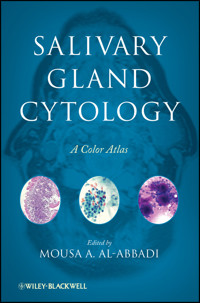
Salivary Gland Cytology E-Book
107,99 €
Mehr erfahren.
- Herausgeber: John Wiley & Sons
- Kategorie: Fachliteratur
- Sprache: Englisch
This atlas provides a comprehensive outline of all but the very rarest salivary gland diseases, detailing the most common benign and malignant tumors with their radiological, cytopathological, and histological features. The differential diagnosis of each tumor is presented with essential tips on the use of fine needle aspiration (FNA) and making a correct diagnosis. Three separate chapters are dedicated to: introduction to salivary gland FNA with emphasis on the technique used to perform the aspiration; the surgical anatomy of these glands; and the various radiological characteristics of these lesions, including primarily CT scans and MRI studies.
Sie lesen das E-Book in den Legimi-Apps auf:
Seitenzahl: 263
Veröffentlichungsjahr: 2011
Ähnliche




















CONTENTS
Preface
Contributors
Chapter 1: Introduction to Salivary Gland Lesions Cytology
1.1 Introduction
1.2 Basic Histology and Physiology
1.3 Diseases that Affect Salivary Glands
1.4 Epidemiology of Salivary Gland Tumors
1.5 Indications for Salivary Gland Fine Needle Aspiration and Practical Considerations
1.6 Accuracy of Salivary Gland Fine Needle Aspiration
Acknowledgments
Recommended Readings
Chapter 2: Surgery for Salivary Gland Lesions: A Surgeon’s Perspective
2.1 Surgical Anatomy
2.2 The Role of Imaging
2.3 Fine Needle Aspiration
2.4 Salivary Gland Tumors
2.5 Surgical Approach
2.6 Role of Frozen Section (FS) Analysis
2.7 Complications of Salivary Gland Surgeries
Recommended Readings
Chapter 3: Radiological Investigation of Salivary Gland Lesions
3.1 Introduction
3.2 Overview of Imaging Modalities
3.3 Anatomical and Pathological Considerations
Recommended Readings
Chapter 4: Infectious and Inflammatory Diseases of Salivary Glands
4.1 Introduction
4.2 Acute Sialadenitis/Parotitis
4.3 Acute Sialadenitis/Parotitis of the Neonate
4.4 Chronic Bacterial Parotitis
4.5 Chronic Sialadenitis
4.6 Acute Viral Parotitis (MUMPS)
4.7 HIV Sialadenitis/Parotitis
4.8 Tuberculous Sialadenitis/Parotitis
4.9 Other Granulomatous Sialadenitis
4.10 Necrotizing Sialometaplasia
4.11 Autoimmune Sialadenitis
4.12 Radiation Sialadenitis
4.13 Sialadenosis (Sialosis)
4.14 Salivary Gland CYST
Recommended Readings
Chapter 5: Pleomorphic Adenoma
5.1 Introduction
5.2 Clinical Features
5.3 Cytologic Features and Histologic Correlates
5.4 Cytologic Differential Diagnosis
5.5 Treatment and Prognosis
Recommended Readings
Chapter 6: Warthin’s Tumor
6.1 Introduction
6.2 Clinical Features
6.3 Cytopathological Features
6.4 Histological Correlates
6.5 Prognosis and Treatment
Recommended Readings
Chapter 7: Mucoepidermoid Carcinoma
7.1 Introduction
7.2 Clinical Features
7.3 Cytological Features
7.4 Differential Diagnosis
7.5 Treatment and Prognosis
Recommended Readings
Chapter 8: Carcinoma Ex Pleomorphic Adenoma
8.1 Introduction
8.2 Clinical Features
8.3 Cytological Features and Histological Correlation
8.4 Major Cytologic Differential Diagnosis
8.5 Prognosis and Treatment
Recommended Readings
Chapter 9: Acinic Cell Carcinoma
9.1 Introduction
9.2 Clinical Features
9.3 Cytological Features and Histological Correlates
9.4 Cytologic Differential Diagnosis
9.5 Treatment of Choice and Prognosis
Recommended Readings
Chapter 10: Basaloid Salivary Gland Tumor
10.1 Introduction
10.2 Basal Cell Adenoma
10.3 Basal Cell Adenocarcinoma
10.4 Solid Variant of Adenoid Cystic Carcinoma
10.5 Poorly Differentiated Neuroendocrine Tumor (Small Cell Carcinoma)
10.6 Other Possible, Much Less Common Differential Diagnoses of Basaloid Tumors
Recommended Readings
Chapter 11: Adenoid Cystic Carcinoma
11.1 Introduction
11.2 Clinical Features
11.3 Cytologic Features and Histologic Correlation
11.4 Cytologic Differential Diagnosis
11.5 Prognosis and Treatment
Recommended Readings
Chapter 12: Oncocytoma
12.1 Introduction
12.2 Clinical Features
12.3 Cytologic Features with Histologic Correlates
12.4 Cytologic Differential Diagnosis
12.5 Treatment of Choice and Prognosis
Recommended Readings
Chapter 13: Myoepithelioma and Related Lesions
13.1 Introduction
13.2 Myoepithelioma
13.3 Malignant Myoepithelioma (Myoepithelial Carcinoma)
13.4 Epithelial-Myoepithelial (Intercalated Duct) Carcinoma
Recommended Readings
Chapter 14: Polymorphous Low-Grade Carcinoma
14.1 Introduction
14.2 Clinical Features
14.3 Cytological Features and Histological Correlates
14.4 The Major Cytological Differential Diagnosis and Clues to Make the Distinction
14.5 Treatment of Choice and Prognosis
Recommended Readings
Chapter 15: Salivary Duct Carcinoma
15.1 Introduction
15.2 Clinical Features
15.3 Cytological Features and Histological Correlate
15.4 Major Cytological Differential Diagnosis and Clues to Make the Distinction
15.5 Treatment of Choice and Prognosis
Recommended Readings
Chapter 16: Salivary Gland Lymphomas
16.1 Introduction
16.2 Hodgkin Lymphoma
16.3 Extranodal Marginal Zone Lymphoma of Mucosa-Associated Lymphoid Tissue (Malt Lymphoma)
16.4 Follicular Lymphoma
16.5 Diffuse Large B-Cell Lymphoma
16.6 Plasma Cell Neoplasms
Recommended Readings
Chapter 17: Metastases and Rare Primary Neoplasms of Salivary Glands
17.1 Introduction
17.2 Metastatic Tumors to Salivary Glands
17.3 Rare Primary Neoplasms of Salivary Glands
Acknowledgment
Recommended Readings
Index
The contents of this book do not represent the views of the Department of Veterans Affairs or the United States Government.
This work was supported by resources of the James H. Quillen VA Medical Center, Mountain Home, Tennessee, USA.
Copyright © 2011 by Wiley-Blackwell. All rights reserved.
Published by John Wiley & Sons, Inc., Hoboken, New Jersey
Published simultaneously in Canada
No part of this publication may be reproduced, stored in a retrieval system, or transmitted in any form or by any means, electronic, mechanical, photocopying, recording, scanning, or otherwise, except as permitted under Section 107 or 108 of the 1976 United States Copyright Act, without either the prior written permission of the Publisher, or authorization through payment of the appropriate per-copy fee to the Copyright Clearance Center, Inc., 222 Rosewood Drive, Danvers, MA 01923, (978) 750-8400, fax (978) 750-4470, or on the web at www.copyright.com. Requests to the Publisher for permission should be addressed to the Permissions Department, John Wiley & Sons, Inc., 111 River Street, Hoboken, NJ 07030, (201) 748-6011, fax (201) 748-6008, or online at http://www.wiley.com/go/permission.
Limit of Liability/Disclaimer of Warranty: While the publisher and author have used their best efforts in preparing this book, they make no representations or warranties with respect to the accuracy or completeness of the contents of this book and specifically disclaim any implied warranties of merchantability or fitness for a particular purpose. No warranty may be created or extended by sales representatives or written sales materials. The advice and strategies contained herein may not be suitable for your situation. You should consult with a professional where appropriate. Neither the publisher nor author shall be liable for any loss of profit or any other commercial damages, including but not limited to special, incidental, consequential, or other damages.
For general information on our other products and services or for technical support, please contact our Customer Care Department within the United States at (800) 762-2974, outside the United States at (317) 572-3993 or fax (317) 572-4002.
Wiley also publishes its books in a variety of electronic formats. Some content that appears in print may not be available in electronic formats. For more information about Wiley products, visit our web site at www.wiley.com.
Library of Congress Cataloging-in-Publication Data:
Salivary gland cytology : a color atlas / [edited by] Mousa A. Al-Abbadi.
p. ; cm.
Includes bibliographical references.
ISBN 978-0-470-50092-7 (cloth)
1. Salivary glands — Tumors — Cytopathology — Atlases. I. Al-Abbadi, Mousa A. [DNLM: 1. Salivary Gland Neoplasms — pathology — Atlases. 2. Cytodiagnosis — Atlases. 3. Salivary Gland Neoplasms — diagnosis — Atlases. 4. Salivary Glands — cytology — Atlases. WI 17]
RC280.S3S25 2011
616.99′431—dc22
2010028405
PREFACE
Real victories are those that protect human life, not those that result from its destruction or emerge from its ashes.
King Hussein
This book is dedicated to all humans suffering from the calamities of cancer. I would like specifically to devote this effort to the late King Hussein of the Hashemite Kingdom of Jordan, who succumbed to cancer. God bless his soul.
In my early professional years, I was always intrigued and fascinated by salivary gland cytology; it often appeared simple and straightforward, yet at times was very challenging. It is hoped that this first edition will help clarify, simplify, and streamline the diagnostic thought process when facing an aspirate from a salivary gland lesion. I had the good fortune to work in an institution with a very busy otolaryngology oncology service, and hence, fine needle aspiration of such lesions was very common. The wealth of the material that we studied was rich and with a broad spectrum of flavors.
All pathologists know that a very diverse group of diseases can originate from the salivary gland and that tumors from such a small organ are numerous. A great deal of overlap is evident using routine histology and even more with cytology, which led to diagnostic challenges for both the surgical pathologist and the cytopathologist alike. That is why I became interested in the subject and started the preparations to contribute with an atlas describing these lesions. The hope is to provide additional information to what has already been published about the topic. Fortunately for all of us practicing diagnosticians, only a handful of salivary gland tumors comprise the majority of neoplasms that we face. Although some pathologists are hesitant to accept fine needle aspiration biopsy as an initial diagnostic tool, we strongly believe that proper sampling and proper technique combined with the utilization of adequate clinical data provide enough ammunition to establish either a categorical or a specific diagnosis. It is hoped that this atlas, in its first edition, will help readers in their diagnostic journey of salivary gland cytology.
The readers will cruise through this atlas easily finding answers to many questions about salivary gland lesions cytology. After a brief introduction, the key cytologic diagnostic features are demonstrated followed by a differential diagnosis and clues to make a definite interpretation. The summary of these two critical issues is shown in a simple table format. A brief description of the histologic correlate with key illustrations follows. I believe that the aforementioned strategy helps resolve many questions for the clinical practitioner.
It is hoped that this book will be a positive addition and will complement many other valuable contributions on the subject by many colleagues.
I am deeply indebted to all my previous teachers and mentors who, over the years, gave me encouragement and support leading to this work. I would also like to thank all our contributors for their efforts to help make this atlas a reality. Without their efforts this would not be possible. The last chapter was not initially planned since it describes rare entities that are difficult to find. However, it was accomplished with valuable illustrations shared by our contributors.
Finally, I would like to thank all members of my family for all the support they have given me over the years.
Mousa A. Al-Abbadi
CONTRIBUTORS
Mousa A. Al-Abbadi, MD, FIAC
Professor & Chief of Pathology
James H. Quillen VA Medical Center
East Tennessee State University
Johnson City, Tennessee 37684, USA
Ozlem E. Tulunay-Ugur, MD
Assistant Professor & Director of Laryngology
University of Arkansas for Medical Sciences
Little Rock, Arkansas 72205, USA
Imad Zak, MD
Associate Professor of Radiology
Wayne State University School of Medicine
Detroit, Michigan 48201, USA
Wael N. Zakaria, MD
Professor of Medicine and Infectious Diseases
James. H. Quillen VA Medical Center
East Tennessee State University
Johnson City, Tennessee 37684, USA
Isam A. Eltoum, MD, MBA, FIAC
Professor and Section Head of Cytopathology
University of Alabama
Birmingham, Alabama 35249, USA
Jining Feng, MD, PhD
Associate Professor of Pathology
Wayne State University
Detroit, Michigan 48201, USA
Ruba A. Halloush, MD
King Hussein Cancer Center
Amman – Jordan
Husain A. Saleh, MD, FIAC, MBA
Professor & Chief of Pathology
Sinai – Grace Hospital
Wayne State University
Detroit, Michigan 48235, USA
Eyas M. Hattab, MD
Associate Professor & Director of Immunohistochemistry
Indiana University School of Medicine
Indianapolis, Indiana 46202, USA
Harvey M. Cramer, MD
Associate Professor & Director of Cytopathology
Indiana University School of Medicine
Indianapolis, Indiana 46202, USA
Jerzy Klijanienko, MD, PhD
Institut Curie
Paris – France
Jay K. Wasman, MD
Assistant Professor of Pathology
University Hospitals Case Medical Center
Cleveland, Ohio 44106, USA
Fadi W. Abdul-Karim, MD
Professor and Director of Anatomic Pathology
University Hospitals Case Medical Center
Cleveland, Ohio 44106, USA
Pamela Papas, MD
University of Illinois Medical Center
Chicago, Illinois 60612, USA
Momin T. Siddiqui, MD, FIAC
Associate Professor & Director of Cytopathology
Emory University School of Medicine
Atlanta, Georgia 30322, USA
Mohammad Abuel-Haija, MD
Assistant Professor of Pathology
Indiana University School of Medicine
Indianapolis, Indiana 46202, USA
Magdalena Czader, MD, PhD
Associate Professor & Director of Flow Cytometry Laboratory
Indiana University School of Medicine
Indianapolis, Indiana 46202, USA
CHAPTER 1
INTRODUCTION TO SALIVARY GLAND LESIONS CYTOLOGY
MOUSA A. AL-ABBADI, MD, FIAC
1.1 INTRODUCTION
The salivary glands are part of the exocrine secretory apparatus that are traditionally considered part of the upper gastrointestinal tract. They are a very small organ with an average total weight of 50 g in adults compared with other systems. They are composed of two major groups: the major and minor salivary glands. The major glands are composed of three paired relatively larger glands: the parotid, submandibular, and sublingual. The minor group is numerous and widely distributed in the upper aerodigestive tract ().
Lesen Sie weiter in der vollständigen Ausgabe!
Lesen Sie weiter in der vollständigen Ausgabe!
Lesen Sie weiter in der vollständigen Ausgabe!
Lesen Sie weiter in der vollständigen Ausgabe!
Lesen Sie weiter in der vollständigen Ausgabe!
Lesen Sie weiter in der vollständigen Ausgabe!
Lesen Sie weiter in der vollständigen Ausgabe!
Lesen Sie weiter in der vollständigen Ausgabe!
Lesen Sie weiter in der vollständigen Ausgabe!
Lesen Sie weiter in der vollständigen Ausgabe!
Lesen Sie weiter in der vollständigen Ausgabe!
Lesen Sie weiter in der vollständigen Ausgabe!
Lesen Sie weiter in der vollständigen Ausgabe!
Lesen Sie weiter in der vollständigen Ausgabe!
Lesen Sie weiter in der vollständigen Ausgabe!
Lesen Sie weiter in der vollständigen Ausgabe!
Lesen Sie weiter in der vollständigen Ausgabe!




