


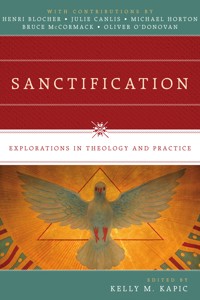
Sanctification E-Book
Erhalten Sie Zugang zu diesem und mehr als 300000 Büchern ab EUR 5,99 monatlich.
- Herausgeber: IVP Academic
- Kategorie: Religion und Spiritualität
- Sprache: Englisch
Often treated like the younger sibling in theology, the doctrine of sanctification has spent the last few decades waiting not-so-patiently behind those doctrines viewed as more senior. With so much recent interest in ideas like election and justification, the question of holiness can often seem to be of secondary importance, and widespread misunderstanding of sanctification as moralism or undue human effort further impedes thoughtful engagement. But what if we have missed the boat on what sanctification really means for today's believer?The essays in this volume, which come out of a recent Edinburgh Dogmatics Conference, address this dilemma through biblical, historical, dogmatic and pastoral explorations. The contributors sink their teeth into positions like the "works" mentality or "justification by faith alone" and posit stronger biblical views of grace and holiness, considering key topics such as the image of God, perfection, union with Christ, Christian ethics and suffering. Eschewing any attempt to produce a unified proposal, the essays included here instead offer resources to stimulate an informed discussion within both church and academy.Contributors include: - Henri Blocher - Julie Canlis - Ivor Davidson - James Eglinton - Brannon Ellis - Michael Horton - Kelly M. Kapic - Richard Lints - Bruce McCormack - Peter Moore - Oliver O?Donovan - Derek Tidball
Sie lesen das E-Book in den Legimi-Apps auf:
Seitenzahl: 538
Veröffentlichungsjahr: 2014
Das E-Book (TTS) können Sie hören im Abo „Legimi Premium” in Legimi-Apps auf:
Ähnliche




















Sanctification
Explorations in Theology and Practice
Edited by Kelly M. Kapic
www.IVPress.com/academic
InterVarsity Press P.O. Box 1400, Downers Grove, IL 60515-1426 World Wide Web:www.ivpress.comEmail:[email protected]
©2014 by Kelly M. Kapic
All rights reserved. No part of this book may be reproduced in any form without written permission from InterVarsity Press.
InterVarsity Press®is the book-publishing division of InterVarsity Christian Fellowship/USA®, a movement of students and faculty active on campus at hundreds of universities, colleges and schools of nursing in the United States of America, and a member movement of the International Fellowship of Evangelical Students. For information about local and regional activities, write Public Relations Dept., InterVarsity Christian Fellowship/USA, 6400 Schroeder Rd., P.O. Box 7895, Madison, WI 53707-7895, or visit the IVCF website atwww.intervarsity.org.
Scripture quotations, unless otherwise indicated, are from The Holy Bible, English Standard Version, copyright ©2011 by Crossway Bibles, a division of Good News Publishers. Used by permission. All rights reserved.
While all stories in this book are true, some names and identifying information in this book have been changed to protect the privacy of the individuals involved.
Cover design: David Fassett Images: Holy Spirit (photo)/Godong/UIG/The Bridgeman Art Library
©Chris Schmidt/iStockphoto
ISBN 978-0-8308-9693-6 (digital) ISBN 978-0-8308-4062-5 (print)
To
Tabitha Kapic,
Susan Hardman Moore,
Elizabeth Patterson,
Dayle Seneff
and
Lynn Hall
Each of you has, in various ways, had a profound impact on my life, especially through your own particular experiences of faith amid diverse struggles. In both strong and subtle ways, each of you has pointed me to the promises and call of sanctification in Christ by his Spirit.
I remain deeply in your debt.
Contents
Introduction
Abbreviations
Contributors
PRELUDE: AN OPENING HOMILY
1. Holiness: Restoring God’s Image
Colossians 3:5-17
Derek Tidball
PART ONE: SANCTIFIED BY GRACE THROUGH FAITH IN UNION WITH CHRIST
2. Living by Faith—Alone?
Reformed Responses to Antinomianism
Richard Lints
3. Sanctification by Faith?
Henri Blocher
4. Covenantal Union and Communion
Union with Christ as the Covenant of Grace
Brannon Ellis
5. Sanctification After Metaphysics
Karl Barth in Conversation with John Wesley’s Conception of “Christian Perfection”
Bruce L. McCormack
PART TWO: HUMAN AGENCY AND SANCTIFICATION’S RELATIONSHIP TO ETHICS
6. “Let the Earth Bring Forth . . .”
The Spirit and Human Agency in Sanctification
Michael Horton
7. Sanctification and Ethics
Oliver O’Donovan
8. On Bavinck’s Theology of Sanctification-as-Ethics
James Eglinton
PART THREE: THEOLOGICAL AND PASTORAL MEDITATIONS ON SANCTIFICATION
9. Gospel Holiness
Some Dogmatic Reflections
Ivor J. Davidson
10. Faith, Hope and Love
A Theological Meditation on Suffering and Sanctification
Kelly M. Kapic
11. Sonship, Identity and Transformation
Julie Canlis
12. Sanctification Through Preaching
How John Chrysostom Preached for Personal Transformation
Peter Moore
Subject and Name Index
Scripture Index
Notes
Praise for Sanctification
About the Author
More Titles from InterVarsity Press
Introduction
While there is nothing new under the sun, different seasons do make us sensitive to changes in our environment. When winter dawns our attention turns to jackets, scarves and gloves; when spring arrives the renewed warmth of the sun beckons us outside. On cue, the seasons come and go and we would be foolish to treat them all the same. Each needs our attentiveness in due course, as each has a particular power over our lives and calls for us to respond accordingly.
Similarly, the church often lives through different doctrinal seasons. With the faith, we embrace the truth of God in all its varied theological realities, but inevitably there are periods when one truth requires our renewed consideration. At times we discover we have neglected or distorted a biblical truth, and the result is similar to realizing you are trying to live through winter in your shorts and T-shirt. Sure, it can be done, but it is certainly not a healthy way to exist.
In recent decades debates about justification have dominated the attention of many Protestants. While at times the cool winds of that season can still blow with great power, there are indications that a new season, with new challenges, is at hand. Evangelicals in particular demonstrate strong signs of a growing need to revisit the topic of sanctification. Fresh concern about this vital theological locus is surfacing, which is wonderful since this is where the church so often lives and breathes.
Set free from the dominion of sin, “saints” are set apart for kingdom purposes: as God is holy, so he has called his people holy and promises to renew them in the image of his Son. In a way this is a simple idea. Yet, as will become apparent in the essays that follow, the topic of sanctification is profoundly intertwined with all manner of other topics, beyond simply its contested relationship to justification. Although justification remains a key idea that can never be left behind, one must also learn to appreciate how sanctification relates to ethics, union with Christ, ecclesiology, adoption, eschatology and so on.
Evangelicalism appears to be in a season of struggling with how best to think about sanctification. What is the relationship between “faith” and human responsibility? How might human agency relate not only to questions of God’s saving grace but also to the way he sustains and preserves us by his grace? Does effort undermine the role of faith? How does all of this relate to our creaturely existence as it is fundamentally empowered by the Spirit? How do we understand the promises of God as we live in the eschatological tension of the now and the not yet?
At the more popular level we see mistrust and misunderstanding perpetuated. For some, the temptation is to reduce the gospel to moral improvement, while for others, human effort appears irrelevant—if not downright antithetical—to the Christian life. On the one hand, a number of prominent voices have emphatically focused their message on the “gospel,” by which some tend to mean narrowly “justification by faith alone.” Such voices have at times appeared to provide balm to wounded souls; too many have labored under the suffocating weight of certain forms of rigid fundamentalism that reduced the gospel to a list of oppressive rules. To be told over and over of God’s unflinching love and grace, of your secure position as declared righteous because of Christ’s righteousness, can be both liberating and invigorating to such anguished listeners.
On the other hand, some raise the concern that such a perspective, if left undeveloped, might actually risk perverting grace rather than fully proclaiming it. They worry that if in the process of declaring the “good news” we end up belittling the significance of human will and agency, we are not ultimately liberating people; we might be undermining the fullness of gospel life. Not only is the believer set free from the condemning power of sin, but they are also set free to love and serve others, to grow and to flourish under God’s care. A growing multitude echoes this renewed emphasis on personal piety, holiness and justice concerns even as it has welcomed renewed exploration on the topic of human agency.
While many of the representative voices on both sides of this come from the Reformed tradition, this conversation is being engaged in by a much larger audience, including many across the spectrum of evangelicalism.
Unfortunately, much of the current conversation is only taking place at the more popular level. In this book, we offer something a bit different. It is not intended as a direct engagement with those particular popular authors, but rather provides some “outside” perspective from theologians who are nevertheless also deeply concerned with the Protestant doctrine of sanctification (and justification!). Representing a good portion of the breadth of the Reformed tradition, these scholars gathered in Edinburgh a number of years ago to offer extended reflections on sanctification. Most of the essays in this book grew out of that Edinburgh Dogmatics Conference.
No attempt has been made to provide a unified perspective on sanctification here—we are not presenting some new school of thought or anything like that, as some of the subtle disagreements even within this volume indicate. Instead, this is an opportunity to explore the doctrine of sanctification; offer various proposals that might stimulate further thought and discussion; and also hopefully encourage pastoral reflection that is biblically, theologically and historically informed. It is our great hope that these essays by ecclesial-minded scholars might stimulate and foster this growing discussion.
Beginning and ending with ecclesial concerns, this volume opens with a homily and closes with theological and pastoral meditations: we aim to place this discussion squarely within the life of the church, even if at times it can appear somewhat technical or philosophical. The following brief reviews of the essays in this volume aim to give potential readers a survey of the work, hopefully orienting them to some of the directions in which the discussion will move.
Derek Tidball’s homily on holiness as the restoration of God’s image combines careful exegesis with pastoral wisdom. Using Colossians 3:5-17 as a lens for understanding what it means for a believer to be holy, he proposes that the meaning of holiness in this passage is threefold: to have a Christlike character, to have a Christ-renewed mind and to belong to a Christ-renewed community. Holiness is relational because the church is the place where a new habitus is cultivated, where the image of God is restored.
Richard Lints opens up the first section by addressing the relationship between sanctification and faith, and how this relationship is similar to and different from justification and faith. Eschewing any simple dichotomy between sanctification and justification, Lints suggests that faith is just as operative in sanctification as it is in justification: both are “exterior”; that is, sanctification is just as much dependent on divine grace as justification. In this way, the law in sanctification functions sapientially for the believer, rather than judicially. Sanctification is not primarily about moral progress but about the Spirit’s restoration of human desires and worship.
Although Henri Blocher’s essay has close affinities to Lints’s, Blocher advances the discussion by providing nuanced definitions and a fresh discussion of law and obedience, as well as carefully navigating the relationship between faith and human agency. After providing a sound introduction to sanctification’s key motifs and to the basic questions surrounding the relationship between justification, sanctification and faith, Blocher argues that sanctification is by faith because sanctification occurs in Christ and requires the renewed believer continually to adhere to a person outside of herself. But sanctification by faith is different from justification by faith in that sanctification is progressive and incremental, involving work and response. The works involved, however, are not “meritorious” in any sense, for Blocher maintains the monergistic givenness of holiness by the Spirit in sanctification, just as in justification.
Brannon Ellis hopes to enrich conversations between sanctification and justification by considering the place of union with Christ in sanctification, especially in terms of the communion of the saints. Ellis argues that to be made new by Christ is inextricably bound to being “in” Christ, which in turn is inextricably bound to belonging to the church. In doing this, he does not collapse soteriology and ecclesiology into one another, but emphasizes the inseparability of the new covenant membership with the mystical union. In this respect, rather than seeing union with Christ as holding a particular place on the ordosalutis, it spans the ordo’s outworking of redemption from beginning to end.
Bruce McCormack’s essay is historically centered, comparing the theologies of John Wesley and Karl Barth and exploring their respective contributions to the doctrine of sanctification. At first glance this might look like an odd pairing, but McCormack insightfully shows how Barth’s notion of sanctification, though it differs philosophically from Wesley’s, is not far from Wesley in that they both affirm the possibility—indeed, the actuality—of Christian perfection now. For Barth, of course, this Christian perfection is different from Wesley’s in that Barth argues that perfection is not possible within a person herself, but it is found in Jesus Christ. Sanctification on this conception highlights not so much personal, private piety but communal participation in the life-ministry of Jesus.
Michael Horton’s essay, which begins part two, is a helpful prolegomenon to addressing the role of agency and ethics in sanctification. Specifically, he explains just how sanctification works, given the real activity of both God and humans. Rejecting both theological determinism and theological openness, Horton suggests that God sanctifies humans by acting on, with and within creaturely reality. This “cooperation” rests on the analogical assumption that God and humans act in a single event without disrupting the other’s free action.
In “Sanctification and Ethics,” Oliver O’Donovan offers a fresh framework for interpreting the practical meaning of sanctification. Arguing that the usual terms employed in the sanctification conversation are reductive and overly binary, O’Donovan challenges the reader to see sanctification as it unfolds from the threefold chord of faith, love and hope, in that order. Significantly, O’Donovan argues that sanctification is only incremental in that it involves the acquisition of practical wisdom. The wisdom of love and faith, though, is insufficient unless it is “led out” by hope into vocation and ethics, which clings to the promises of God and anticipates the resurrection life that is to come.
James Eglinton also considers sanctification as it relates to ethics, but with a historical bent toward Herman Bavinck’s theology of sanctification. By exploring Bavinck’s thought, Eglinton delves into a rich historical proposal that illumines a way forward for understanding the intricate relationship between dogmatics and ethics. With regard to sanctification, Eglinton musters Bavinck’s insights to suggest that whereas justification consists of an objective declaration, sanctification consists of both an objective declaration of holiness and a subjective process of becoming more holy.
In order to liberate the Christian conception of holiness from misrepresentations that present it as stifling and life-denying on the one hand or over-realized on the other, Ivor Davidson ably starts off part three by providing a dogmatic account of how the theological foundations of this doctrine should inform our lives. This task leads him to reconsider the manifestation of Yahweh’s holiness in the Bible, which culminates in Christ’s life, and in contemporaneous Christian praxis. God, in se, is wholly other and, as such, is qualitatively unique and incomparably holy. This holiness, as exemplified in the life of Christ, often confounds us: it exhibits an intense jealousy for sinners and concomitant concern for sinful creatures. And because of the definitiveness of Christ’s holiness, Davidson argues that believers are, in a very real sense, holy now. Christian participation in his holiness imitates the cruciformity of Jesus through enacting a life-activity of repentance and faith.
I, Kelly Kapic, offer some reflections on the relationship between physical suffering and sanctification. Employing the theological virtues of faith, hope and love, I argue for the importance of the community during times of suffering and struggle. Drawing on the likes of Kierkegaard and Luther, for example, I suggest that we should view our Christian life, especially during times of great difficulty, in much more communal ways. Put simply, when we are having trouble believing, our sisters and brothers in Christ believe for us—thus representing us to God; when we find it almost impossible to have hope, fellow saints bring us the fresh waters of promise in a way we can drink of them—thus representing God to us; finally, such faith and hope requires a context of love, otherwise the call to faith can become insensitive and the appeal to hope abusive. But in the context of love, the people of God grow in grace and truth as they sustain one another in faith and hope. In a brief conclusion, I raise three theological images as correspondents to these truths: cross, resurrection and feast—each of them provides the rich background for how we experience and understand faith, hope and love.
Like Ellis in his essay, Julie Canlis offers an incisive reflection on union with Christ and its connection to sanctification. Aiming to provide a creative and fertile discussion without getting bogged down by what she sees as recent unhelpful infighting about this doctrine, she argues that union with Christ was meant to ensure adoption and to unify the ecclesial community. Far from being a substantial infusion of grace or a purely legal transaction, adoptive union is made real by receiving the person of Jesus, not just his mere benefits, and this is always through the person of the Holy Spirit. In this thoroughly interpersonal affair, the Spirit is the one who makes us daughters and sons and empowers us to live out our sonship in meaningful action.
Peter Moore’s essay, “Sanctification Through Preaching,” looks to the pedagogical method of John Chrysostom to offer wisdom for contemporaries in pastoral leadership who are concerned with the sanctification of their people. Confronting traditional notions of education and transformation as merely the transfer of ideas, Moore shows how Chrysostom emphasized the sanctifying effect of encountering another disciple and being transformed by his gnōmē (γνώμη), that is, his “chosen life trajectory.” Accordingly, he argues that sanctification often occurs as the believer lives with and inevitably starts to follow a Christian mentor, since that embodied guide points them to the good life of communion with God.
Many should be thanked for helping make this volume possible, but only a relatively few can be mentioned here. First and foremost, it is only by the generosity of Rutherford House and under the leadership of Andrew McGowan that this work exists. Second, I have been greatly assisted by two former students of mine: Grady Dickinson at the start of the editorial process, and even more by Jimmy Myers, who helped me in endless ways to see it to completion. Third, while the opinions expressed in this publication are those of the authors and do not necessarily reflect the views of the John Templeton Foundation or Biola’s Center for Christian Thought, this publication benefited from a research fellowship at Biola University’s Center for Christian Thought, which was made possible through the support of a generous grant from the John Templeton Foundation. I was able to complete this manuscript while beginning my time at CCT. While there, Dave Strobolakos carefully reviewed the manuscript for me, and Steve Porter, C. Stephen Evans, Thomas Crisp, David Horner, William Struthers, James Wilhoit, Christopher Kaczor, Rachel Dee, Evan Rosa and others provided a fantastic working environment. Fourth, Brannon Ellis, David Congdon and Andy Le Peau, all of whom represented IVP Academic very well, deserve thanks for their productive encouragement, feedback and help. Finally, volumes like this are only as good as the contributors, and I am thankful to those who were so receptive to editorial feedback and took the time to revise their essays with the hope that they might prove useful to a wider audience. Our great hope and prayer is that readers may find this volume in some ways helpful, drawing them back to consider afresh what it means to be united to Christ, sanctified by his Spirit and drawn into genuine communion with the living God and his people.
Abbreviations
CD
Karl Barth. Church Dogmatics. Edited by Geoffrey W. Bromiley and Thomas F. Torrance. 4 vols. in 13 parts. Edinburgh: T & T Clark, 1956–1975.
CO
Ioannis Calvini Opera quae supersunt omnia. Edited by Guilielmus Baum, Eduardus Cunitz and Eduardus Reuss. 59 vols. Corpus Reformatorum 29–87. Brunsvigae: Schwetschke, 1863–1900.
ET
English translation
KD
Karl Barth. Die Kirchliche Dogmatik. 4 vols. in 13 parts. Munich: Chr. Kaiser, 1932; Zürich: Theologischer Verlag Zürich, 1938–1965.
WA
D. Martin Luthers Werke [Weimarer Ausgabe]. Weimar: Böhlau, 1883–1993.
Contributors
Henri Blocher is professor of systematic theology at the Faculte Libre de Theologie Evangelique, Vaux-sur-Seine, France. His works include Original Sin: Illuminating the Riddle (InterVarsity Press, 2001), Evil and the Cross: An Analytical Look at the Problem of Pain (Kregel, 2005), La Doctrine du Christ (Edifac, 2002) and La Bible au microscope (Edifac, 2006).
Julie Canlis earned her PhD from the University of St Andrews, winning the 2007 John Templeton Award for Theological Promise for her work on John Calvin. Her book Calvin’s Ladder (Eerdmans, 2010) won the Christianity Today Award of Merit for Theology in 2011.
Ivor J. Davidson is professor of systematic and historical theology at the University of St Andrews. He is author of A Short History of Arianism (Cambridge University Press, 2013), The Birth of the Church (Baker Books, 2004), A Public Faith (Baker Books, 2005), editor of the two-volume Ambrose: De Officiis (Oxford University Press, 2002) and coeditor with Murray A. Rae of God of Salvation: Soteriology in Theological Perspective (Ashgate, 2010).
James Eglinton is Meldrum Lecturer in Reformed Theology at New College, University of Edinburgh. His publications include Trinity and Organism: Towards a New Reading of Herman Bavinck’s Organic Motif (T & T Clark, 2012) and articles such as “To Transcend and to Transform: The Neo-Calvinist Relationship of Church and Cultural Transformation” (The Kuyper Center Review 3 [2012]).
Brannon Ellis (PhD, University of Aberdeen) is acquisitions editor for Lexham Press. He is the author of various essays as well as Calvin, Classical Trinitarianism, and the Aseity of the Son (Oxford University Press, 2012).
Michael Horton is J. Gresham Machen Professor of Systematic Theology and Apologetics at Westminster Seminary, California, as well as the editor in chief of Modern Reformation magazine and host of White Horse Inn. Some of Horton’s many books include Covenant and Eschatology: The Divine Drama (Westminster John Knox, 2002), Lord and Servant: A Covenant Christology (Westminster John Knox, 2005), People and Place: A Covenant Ecclesiology (Westminster John Knox, 2008) and The Christian Faith: A Systematic Theology for Pilgrims on the Way (Zondervan, 2011).
Kelly M. Kapic is professor of theological studies at Covenant College. Some of his publications include Communion with God: The Divine and the Human in John Owen’s Theology (Baker Academic, 2007), God So Loved, He Gave (Zondervan, 2010), A Little Book for New Theologians: Why and How to Study Theology (IVP Academic, 2012), as well as serving as coeditor with Bruce McCormack of Mapping Modern Theology (Baker Academic, 2012) and coauthor with Wesley Vander Lugt of Pocket Dictionary of the Reformed Tradition (InterVarsity Press, 2013).
Richard Lints is Andrew Mutch Distinguished Professor of Theology and vice president for academic affairs at Gordon-Conwell Theological Seminary. His publications include The Fabric of Theology (Eerdmans, 1993), Renewing the Evangelical Mission (Eerdmans, 2011), Progressive and Conservative Religious Ideologies: The Tumultuous Decade of the 1960s (Ashgate, 2010) and Personal Identity in Theological Perspective (coedited with Michael Horton and Mark Talbot, Eerdmans, 2006).
Bruce L. McCormack is Charles Hodge Professor of Systematic Theology at Princeton Theological Seminary. He is author of Karl Barth’s Critically Realistic Dialectical Theology: Its Genesis and Development, 1909–1936 (Oxford University Press, 1995), Orthodox and Modern: Studies in the Theology of Karl Barth (Baker Academic, 2008), as well as serving as coeditor of such volumes as Karl Barth and American Evangelicalism (Eerdmans, 2011) and Mapping Modern Theology (Baker Academic, 2012). McCormack is also a member of the Karl Barth Stiftung in Basel, Switzerland, and the North American coeditor of the Zeitschrift für Dialektische Theologie.
Peter Moore (PhD, Macquarie University) is lecturer in theology with the Timothy Partnership in Sydney, Australia, and has served as a Presbyterian minister for twenty-three years. His work has included an extensive mentoring ministry supporting Presbyterian, Anglican and Baptist pastors. Moore’s publications include “Gold Without Dross: Assessing the Debt of John Calvin to the Preaching of John Chrysostom” (Reformed Theological Review 68, no. 2 [2009], which is also his PhD title), “Plain Talk with a Gilt Edge: An Exploration of the Relation Between ‘Plain’ Biblical Exposition and Persuasion, in Chrysostom and Calvin” (Westminster Theological Journal 73, no. 1 [Spring 2011]) and a recent essay on Chrysostom in Studia Patristica, vol. LXVII (Leuven: Peeters, 2013).
Oliver O’Donovan is professor emeritus of Christian ethics and practical theology at the University of Edinburgh. His numerous publications include The Problem of Self-Love in Saint Augustine (Yale University Press, 1979), Begotten or Made? (Oxford University Press, 1984), Resurrection and Moral Order (Eerdmans, 1986), Peace and Certainty (Eerdmans, 1989), The Desire of the Nations (Cambridge University Press, 1996), Common Objects of Love (Eerdmans, 2002) and The Ways of Judgment (Eerdmans, 2005).
Derek Tidball is currently visiting scholar at Spurgeon’s College, London, and he serves as editor of the widely used Bible Speaks Today Bible Themes series. Previously, he was principal of the London School of Theology. He is author of Skillful Shepherds: An Introduction to Pastoral Theology (Zondervan, 1986), Who Are the Evangelicals? Tracing the Roots of Modern Movements (Marshall Pickering, 1994) and The Reality Is Christ: The Message of Colossians for Today (Christian Focus, 1999).
Prelude
An Opening Homily
- 1 -
Holiness
Restoring God’s Image
Colossians 3:5-17
Derek Tidball
Put to death, therefore, whatever belongs to your earthly nature: sexual immorality, impurity, lust, evil desires and greed, which is idolatry. Because of these, the wrath of God is coming. You used to walk in these ways, in the life you once lived. But now you must rid yourselves of all such things as these: anger, rage, malice, slander, and filthy language from your lips. Do not lie to each other, since you have taken off your old self with its practices and have put on the new self, which is being renewed in knowledge in the image of its Creator. Here there is no Greek or Jew, circumcised or uncircumcised, barbarian, Scythian, slave or free, but Christ is all, and is in all.
Therefore, as God’s chosen people, holy and dearly loved, clothe yourselves with compassion, kindness, humility, gentleness and patience. Bear with each other and forgive whatever grievances you may have against one another. Forgive as the Lord forgave you. And over all these virtues put on love, which binds them all together in perfect unity.
Let the peace of Christ rule in your hearts, since as members of one body you were called to peace. And be thankful. Let the word of Christ dwell in you richly as you teach and admonish one another with all wisdom, and as you sing psalms, hymns and spiritual songs with gratitude in your hearts to God. And whatever you do, whether in word or deed, do it all in the name of the Lord Jesus, giving thanks to God the Father through him.
Colossians 3:5-17 NIV1
Michelangelo sculpted his exquisite Pietà, the statue of Mary nursing her crucified yet serene son, when he was just twenty-four. It was the only sculpture he ever signed. Installed in St. Peter’s Basilica, Rome, in 1500, the Pietà stood there mostly undisturbed2 until Laszio Toth, a thirty-three-year-old Hungarian-born Australian, attacked it with a hammer in 1972. Toth’s onslaught resulted in severe damage to the nose, left eye and veil of Mary as well as leaving her left arm shattered. Onlookers reportedly took some of these shattered pieces away as souvenirs. The masterpiece of Renaissance art was now a damaged masterpiece in need of restoration. Over succeeding months the sculpture was painstakingly repaired by taking a block of marble from its back, where the hole left behind would not be seen, and restoring the Pietà to its original image.
Holiness may be defined in many ways. The heart of holiness lies in the restoration of God’s image in us. As with the Pietà, an enemy has entered our world and attacked human beings, who were made in the image of God (Gen 1:27), leaving us damaged and lacking. We are spoiled masterpieces. The enemy’s attack is not the whole story explaining our fall from God’s gracious intention at creation. Like any statue, we pick up the grime of life, and the pollution of our fallen world takes its toll. Unlike a lifeless statue, the defacement of God’s image in us is due not only to enemy attack or to the effect of a fallen environment but also to much self-harm, as we choose to live in disobedience to and alienation from God. The cumulative result of the onslaughts of the devil, the world and the flesh is that we are spoiled masterpieces in need of restoration.
Christ is the masterful craftsman who painstakingly sets about the work of restoring God’s image in us through his Holy Spirit.
Colossians 3:5-17 does not say everything there is to be said about sanctification, but it takes us to the heart of Christ’s work of restoration. The Christians in Colossae had a wrong understanding of how God’s image could be restored in them. They believed that holiness would develop through the adoption of ascetic practices or through undergoing extraordinary spiritual experiences (Col 2:16-23). But their belief was mistaken because it was based on an insufficient grasp of the work of Christ’s sufficiency.
In correcting them Paul explains the meaning of holiness in three dimensions.
Holiness Is to Have a Christlike Character
Paul provides the Colossians with two lists of characteristics that are incompatible with living a life in Christ. The first starts with actions and leads to attitudes: “sexual immorality, impurity, lust, evil desires and greed, which is idolatry” (Col 3:5). The second goes in the reverse direction, starting with attitudes and leading to actions: “anger, rage, malice, slander, and filthy language” (Col 3:8) and lying (Col 3:9). These attitudes and actions, he said, were to be “put to death” (Col 3:5) as surely as a crucified man was put to death, and got rid of (Col 3:8) as surely as last week’s rubbish is removed by the trash collectors.
He gives several reasons why we take such decisive action, including the avoidance of the “wrath of God” that is coming (Col 3:6). But the deeper reason is not a pragmatic one—in order to avoid punishment—but a more worthy one. We divest ourselves of these qualities because they are incompatible with our identity as Christians. Using language that by common consent picks up the image of baptism, where candidates would disrobe to be baptized and clothe themselves in new garments after emerging from the water, Paul reminds them that in becoming followers of Christ, they have “taken off [the] old self with its practices and have put on the new self, which is being renewed in knowledge in the image of its Creator” (Col 3:9-10).
In perhaps more contemporary terms it is a question of whose uniform we are wearing. Uniforms display not only what we are called to do but also to whom we belong and whose management we are under. Are we wearing the old and shabby uniform of Adam or the renewed designer clothes of Christ? The context suggests that the “self” spoken of here refers not so much to the personal, inner, motivating power of sin as to our corporate identity. As Douglas Moo explains, “The contrast of the ‘old self’ and ‘new self’ alludes to one of Paul’s most fundamental theological conceptions: the contrast between a realm in opposition to God, rooted in Adam’s sin and characterized by sin and death, and the new realm, rooted in Christ’s death and resurrection and characterized by righteousness of life.”3 The corporate dimension surfaces clearly in verse 11, and is a crucial, if neglected, dimension of the meaning of holiness.
The “putting off” of the old uniform in verses 5-9 is balanced by the “putting on” of verses 12-17. Holiness does not consist of stopping bad behavior and eschewing sinful attitudes alone but of replacing them with good behavior and pursuing Christlike attitudes. Years ago, Michael Griffiths warned that “there is a kind of Christian negative holiness which rejoices in discarding various forms of worldliness, but which leaves the individual stark naked.”4 Paul would have us clothed “with compassion, kindness, humility, gentleness and patience” (Col 3:12). Then he calls us to “put on love, which binds them all together in perfect unity” (Col 3:14). These are characteristics that describe Jesus Christ perfectly. We all know of Christians who believe themselves to be holy because they avoid certain things, but they are inhibited people, often pharisaical in disposition, who, as Mark Twain said, are “good in the worst sense of the word.” Holiness is more than avoiding sin. It is cultivating the character of Christ in us.
Although the “self” spoken of here is corporate, the implications are personal and individual. We are each called to work out the reality of our transfer to the new realm of being under Christ. The difficulty we face is that the old realm still exists. Since it has not yet been destroyed it still has some attraction for us. So working out our new position is often a struggle, but in the gradual transformation of our characters into Christlikeness we see the new realm dawning and advancing toward its fullness.
To help us understand further, Paul focuses on the role that our minds play in this.
Holiness Is to Have a Christ-Renewed Mind
On this occasion Paul does not say that we are being renewed in the image of our Creator but that we are being “renewed in knowledge in the image of [our] Creator” (Col 3:10). Why does he insert the words “in knowledge,” which seem to interrupt what might be the more natural flow of his words?
The account of the fall in Genesis 2:17 draws attention to the importance of the mind in causing humanity’s downfall; consequently, it is vital that that which played such a crucial role in causing the problem should be addressed in the giving of the solution. Adam and Eve were told by God, “You must not eat from the tree of knowledge of good and evil” (Gen 2:17). While it is difficult to unpack the meaning of the tree’s mysterious title in full, it is evident that this was a tree that would provide Adam and Eve with knowledge beyond what was good for them as human beings. Its fruit would lead them to know everything as God knows it and so to become independent from their Creator, dispensing with the need for him, and leading them to live autonomous and self-sufficient lives.
The mind in Hebrew thought was not so much about abstract intellectual or philosophical thought, as in the Greek world, but about practical wisdom. So we must be careful not to apply this life of the mind simply to the importance of correct theological discussion, much beloved in academia. That may miss the point. The way we think shapes the way we live and governs what we do. As Proverbs 4:23 puts it: “Be careful how you think; your life is shaped by your thoughts” (TEV). This is as true of young rioters as of aid workers, of middle-class materialists as of selfless monks, of school dropouts as of university professors. All need their minds renewed in Christ. It is about thinking correctly, as God would have us think, so that we might live correctly. As Paul expressed it in the parallel text in Ephesians 4:22-24, “You were taught . . . to be made new in the attitude of your minds; and to put on the new self, created to be like God in true righteousness and holiness.”
Paul tells us that such a renewal is going to be a progressive work of God. He uses the passive continuous tense: “which is being renewed.” Paul is not intent here on encouraging passivity, which leaves the work of transformation wholly up to God and treats the believer as if he or she were an anaesthetized body, undergoing an operation by a divine surgeon. There are plenty of active commands in the context to prevent us from falling into that error (although we may want to debate exactly how the divine and human interact). His point is rather that the renewal of the mind, and so of God’s image in us, is a process: it does not take place in an instant, nor has it taken place fully yet. When the allied forces withdrew from Iraq and returned the country to the new regime in Baghdad, they wrote what was called “a script for reconstruction.” Believers, having withdrawn from being under Adam’s regime and now serving under Christ’s lordship, are engaged by the grace of God and in the power of his Spirit in enacting a script for reconstruction throughout their lives. Peter O’Brien speaks of it as “the believers’ progressive ability to recognize God’s will and command” and to live in accordance with it.5
If it is progressive and we have an active part in it, it means we must work out our new identity daily, learning new habits, adopting new disciplines, practicing the steps that will enable us to become the persons God intended us to be, manifesting his image in the world. The transformation of character does not just happen. It happens, as Tom Wright has recently pointed out, partly in the same way we learn anything, by adopting those steps that help us get to our goal and practicing them until they “become habitual, a matter of second nature.”6
If holiness is progressive, it is also purposeful. The goal is not that we should just become better people, nicer neighbors (although that should be a byproduct) and certainly not necessarily more astute or pedantic theologians, but that we should be renewed “in the image of the Creator.”
In Colossians, such a phrase drives us back to the “hymn” in Colossians 1:15, which celebrates the Son as “the image of the invisible God” and the one in whom, through whom and for whom all things were created. So the goal is to become Christlike. In the words of C. F. D. Moule, re-creation “is in the pattern of Christ, who is God’s Likeness absolutely.”7 This is none other than the ancient call to “be holy because I, the LORD your God, am holy” (Lev 19:2), updated by the new covenant, which gives us the advantage of seeing what it means to be perfectly holy, what the unblemished image of God looks like in a human being, and so what it means to be truly human, modeled by the person of Christ.
To be holy is to have the image of God, given to us at creation, restored in us. It is, therefore, to be truly human and truly Christlike.
Holiness Is to Belong to a Christ-Transformed Community
The whole thrust of Paul’s writing in Colossians 3 prevents us from taking holiness as limited to personal ethics or individual character. It is about living in the new community. Again this is the new covenant outworking of God’s unchanging desire to have people of his own, evident first in the Garden of Eden, but then advanced through the call of Abraham and in the calling of Israel. So holiness is relational, and no one can claim to be holy if they are isolated or insulated from others who name Christ as Lord. Isolationist Christians are a contradiction to what it means to be in Christ. Holiness is about belonging to a holy people (Ex 19:5; 1 Pet 2:9).
In Colossians 3:11-17 Paul expresses the nature of a Christ-transformed community, first negatively and then positively.
Negatively it is clear that the old identity markers that discriminated between people in the conventional world—that is, the world of Adam, of the old self—no longer have currency. They are like an ancient, defunct currency that no longer has any trading value. Four such boundaries are mentioned. They are ethnic (“no Greek or Jew”), ritual (“circumcised or uncircumcised”), cultural (“barbarian, Scythian”) and social (“slave or free”).8 A church where such distinctions matter has not understood holiness. An individual who is racist, who judges people by their religious rituals, or is a social snob, or for that matter, one who is sexist, has not begun to understand the meaning of holiness.
By contrast, positively, the only thing that matters is that “Christ is all and is in all.” Consequently, if holiness is living in his image, we relate to one another as he related to others. That means
the character of Christ will shape us (Col 3:12-14): “compassion, kindness, humility, gentleness and patience,” bearing with one another and forgiving as he forgave us;
the peace of Christ will rule between us (Col 3:15): causing us to settle disputes and arguments and working for unity;
the word of Christ will dwell in us (Col 3:16): so that all we do will seek to be consistent with his message; and
the honor of the name of Christ will determine our behavior (Col 3:17) in every dimension of our lives.
For many Christians this corporate dimension is the missing dimension of holiness. I know many who would never dream of getting drunk or committing adultery, and rightly so, yet have no conscience about having a row in church or speaking in a racist way or espousing other socially divisive attitudes.
Holiness is wider than we think! Holiness is about
our separation from sin;
our devotion to Christ;
our adoption of godly habits; and
our identification with Christ in practice.
But holiness is also about
the individual and relational dimensions of our lives;
the detailed and specific as well as the general and comprehensive aspects of our living;
our doing and our being;
our thinking and our acting; and
our being passively transformed and actively obedient.
Holiness is the painstaking restoration, by the most skilled craftsman of all, of ruined masterpieces in the image of their creator.
Part One
Sanctified by Grace Through Faith in Union with Christ
- 2 -
Living by Faith—Alone?
Reformed Responses to Antinomianism
Richard Lints
The just shall live by faith.
HABAKKUK 2:4 (NKJV), CITED IN ROMANS 1:17, GALATIANS 3:11 AND HEBREWS 10:38
When the prophet says, “The just shall live by faith,” the statement does not apply to impious and profane persons, whom the Lord by turning them to faith may justify, but the utterance is directed to believers and to them life is promised by faith. We must have this blessedness not just once (in justification) but must hold to it throughout life. To the very end of life believers have no other righteousness than that which is described as the free reconciliation with God by faith.
John Calvin1
The gospel is the story of God creating, redeeming, sustaining and consummating a people for his own possession. In that narrative is embedded the entire Christian life. There is no other story that narrates our reconciliation with God past, present or future. As a gift from God, the gospel is received by faith alone. The gospel is also continually embraced by faith throughout the entirety of the Christian life. Protestant traditions have generally affirmed that faith in the triune God of this gospel is the sole instrumental ground of justification. They have spoken with less than a ringing consensus about faith as the instrumental ground of sanctification. If the gospel is God’s redeeming actions past, present and future, and faith is the instrument by which believers embrace it, consistency would suggest that there is essential continuity to the role of faith in justification and sanctification. That is not the case for many Protestants, and many Protestants in the Reformed tradition specifically. This essay attempts to get at the underlying reasons why this is so.
The argument unfolds in several stages. It begins by tracing the erroneous assumption that good works (in contrast to faith) are necessary to sanctification in order to avoid the problem of antinomianism. It is erroneous because sanctified believers remain always sinners and there is no partial righteousness sufficient to satisfy the critics of antinomianism. In effect, there are two types of antinomianism; only one is to be avoided, and sola fide is not susceptible to the dangerous type. Faith is the orientation of persons outside of themselves. As such it is the instrument by which believers embrace divine holiness, and it restrains them from notions of achieving holiness themselves. Divine holiness is nothing less than the ongoing presence of the Holy Spirit to believers. Because of that presence, the law ceases to function forensically (i.e., acting as judge) and instead operates sapientially in the life of believers. The final section of the argument suggests that the conceptual resources of imaging and idolatry underwrite a reorientation of the doctrine of sanctification that does not depend on notions of good works or moral progress.
If the gospel is the narrative of God’s creating, redeeming and consummating work in Christ, there is no progress beyond the gospel in the Christian life. There is no story beyond the story. The Christian life is about growing deeper into the gospel, which therefore implies living by faith, not beyond faith. The significance of sola fide in this context is, quite simply, immense.2 Faith alone constitutes the means by which sinners are reconciled to the living God, and by virtue of which they continue to cling to reconciliation to God as their only hope. It is vital not to refer to this faith as the good work of the sinner, which would wrongly connote that sinners engage God by being good enough. Their relationship with God is and always is based on grace. It is God who graciously reconciles sinners with himself as an act of his divine compassion.
Being reconciled is not only initiated by God but continues by virtue of his grace. We may refer to Christian holiness as that ongoing work of divine grace by which reconciliation with God is sustained in the life of the believer. Holiness attaches to the divine declaration that his people are set apart in Christ. The creaturely counterpart to this divine declaration is faith. Yet in many Protestant traditions, the believer’s actions (i.e., their good works) in sanctification come perilously close to being precisely another instrumental ground of one’s ongoing reconciliation before God.3 The logic of this tendency is simply that the alternative appears to be some form of antinomianism, wherein the actions of believers are inconsequential to the covenant relationship to God. If one downplays the necessity of “good works” in sanctification, then one appears dangerously close to answering Paul’s rhetorical question of Romans 6:1, “Are we to continue in sin that grace may abound?” in the affirmative. Yet, as I shall argue, by emphasizing the necessity of good works in sanctification, the risk is that one’s continued reconciliation with their covenant Lord will be based on a “boast” before God, which Paul expressly denies in Romans 4. The danger of boasting is mitigated only by keeping faith as central to sanctification as it is to justification. As Calvin reminds, “Let us not consider works to be so commended after free justification that they afterward take over the function of justifying man or share this office with faith.”4
Two Courtrooms?
Protestants have often interpreted Paul’s rhetorical question in Romans 6:1 as implying the necessity of good works in sanctification.5 There can be no antinomian license to sin in the face of divine grace, so the argument goes. Charles Hodge offers a representative exposition of the Protestant framework of sanctification in the light of this fear of antinomianism. “Justification,” he writes, “is a forensic act, God acting as judge, declaring justice satisfied so far as the believing sinner is concerned, whereas sanctification is an effect due to the divine efficiency.”6 On this rendering justification is the declaration of God toward sinners based solely on the finished work of Christ. Sanctification, by contrast, is the inward renewal of character that results from the infusion of the Holy Spirit as the gracious gift of God to those who are justified. Faith is the means by which believers embrace the full penal satisfaction of Christ’s death on the cross on their behalf. After that and by means of the impartation of divine grace, “sinful acts become more infrequent and holy acts more and more habitual and controlling.”7 The Holy Spirit provides the “occasion for the exercise of . . . submission, confidence, self-denial, patience and meekness as well as faith, hope and love.”8 Real moral progress appears to be the hallmark of sanctification. Hodge goes so far as to say, “The best Christians are in general those who not merely from restless activity of natural disposition, but from love to Christ and zeal for his glory, labor most and suffer most in his service.”9
But what does “best” amount to in this instance? It appears from Hodge’s exposition that “best” is a qualitative term applied to believers who are more cooperative with the Holy Spirit’s inward renewal of their character. The language of “best” implies a scale defined by the amount of “holy acts” performed by the believer and the infrequency of “sinful acts” performed. That scale determines the “happiness or blessedness of believers in a future life in proportion to the devotion to the service of Christ in this life.”10
The scales of divine justice operate according to two different and conflicting principles for Hodge. From one angle, the justice of God is satisfied by Christ’s death as the federal representative of his people and the imputation of Christ’s righteousness to them. In this divine courtroom, the innocent one (Jesus) has been declared guilty in the place of the guilty ones (believers), and in turn the guilty ones have been declared innocent in place of the innocent one. But evidently in another divine courtroom nearby with those very same believers, as Hodge says, “a man shall reap what he sows, and God will reward everyone according to his works.”11
The reason Hodge backs himself into this corner is straightforward. To avoid any hint of Roman Catholic moralism on the one hand, Hodge affirms double imputation with respect to justification. To avoid any hint of antinomianism on the other hand, he affirms the necessity of good works in sanctification. He cites Luther’s denunciation of Agricola as the confirming historical evidence that Protestants are committed to the necessity of good works.12 Good works are not meritorious in justification, but they are “rewarded” and appear to have a judicial function in sanctification according to Hodge.
Hodge attempted to suppress the overtly meritorious consequences in his doctrine of sanctification by arguing that the Holy Spirit is the efficient cause of these good works, and therefore they accrue no merit on behalf of the believer: they are rewarded but not because of any merit. This curious reality is made more perplexing by the odd asymmetry of justice in this second courtroom of sanctification. Good works are rewarded, while bad works receive no condemnation. Justice, or some form of it, appears to work in only one direction. Hodge appears to think that good works function as instrumental, nonmeritorious grounds in sanctification analogous to the manner in which faith functions as the instrumental, nonmeritorious ground in justification.
The problem is twofold. First, in Hodge’s portrayal justification is grounded in faith precisely because good works are in sufficiently short supply as to warrant condemnation rather than reward. But in sanctification, there appear to be a sufficient supply of good works to warrant blessing. Second and more importantly, Christ’s redeeming work is entirely sufficient for the reconciliation of sinners, but in the courtroom of sanctification the verdict is based on the good works of believers as well.13 There appear to be works worthy of a reward without being meritorious. At the very least this is confusing.
The tacit assumption in Hodge is that good works as well as faith are actions of the human will, whose meritorious standing is avoided by the causal precedents of the Holy Spirit. However, faith must be distinguished from good works at the very point where Hodge wants to make them analogous. Faith has no “boast” (i.e., merit) before God not only because of its causal ancestry in the Holy Spirit but also primarily because its reference point lies outside of itself. The causal conditions of faith appear irrelevant to its meritorious standing (or lack thereof) in Romans 3 and 4. There is no reference to the work of the Holy Spirit’s producing faith at the critical juncture in Paul’s argument against moralism (“having a boast”) nor against antinomianism (“a license to sin”). Rather, Paul depicts faith in contrast to works, as hoping and trusting in something (Christ) outside of one’s self (Rom 4:3-5, 21-25). It has a fundamental exteriority about it in this respect. By contrast, works have no such fundamental exteriority about them. They belong to the one who does them. When works are conceptually contrasted to faith, it is the contrast between an action without an external reference and an action with an external reference. In this regard, Hodge responded to the antinomian criticism only by implicitly affirming self-referencing action, or self-righteousness in theological terms.
What is required is a reframing of the issues. There is a danger of antinomianism but not of the sort portrayed by Hodge. Let me suggest that there are two different (and contrasting) forms of antinomianism, only one of which is theologically dangerous. Antinomianism type 1 affirms that obedience to law cannot serve as the basis of a relationship to God. Antinomianism type 2 affirms that there is no normative moral center within the triune community. Both forms of antinomianism work against the intuition that moral norms are intrinsically connected to God by means of obedience to the law. Type 2 repudiates the connection between the divine being and fixed moral norms. “Freedom in Christ” according to antinomianism type 2 entails a freedom from all fixed moral norms.14 One upshot of type 2 antinomianism is the embrace of the self as the determiner of all moral standards. By contrast, antinomianism type 1 affirms that there are fixed moral norms in the divine being but that obedience to them does not serve as the basis of the relationship to God. That relationship, after the fall, is grounded in divine grace.15
Type 1 antinomianism should actually be embraced if faith is the sole instrument by which believers lay hold of Christ. Type 2 antinomianism should be rejected because divine holiness requires a normative moral center. Arguing for the former notion of antinomianism and against the latter requires that the difference between faith and works in sanctification is accentuated and any hint of intrinsic righteousness in sinners is avoided.16 Calvin pungently reminds: “God does not as many stupidly believe once for all reckon to us as righteousness that forgiveness of sins concerning which we have spoken in order that having obtained pardon for our past life, we may afterward seek righteousness in the law. This would be only to lead us into false hope, to laugh at us and mock us.”17
Simul Sanctus et Peccator
“There is no greater sinner than the Christian Church,” said Luther in his Easter Day sermon in 1531.18 Calvin’s rhetorical flourish may be less startling, but his conviction is remarkably similar in this regard.
The best work that can be brought forward from them is still always spotted and corrupted with some impurity of the flesh and some dregs mixed with it. Let a holy servant of God choose from the whole course of his life what an especially noteworthy character he thinks he has done. Let him well turn over in his mind its several parts. He will somewhere perceive that it savors of the rottenness of the flesh. We have not a single work going forth from the saints that if it be judged in itself deserves not shame as its just reward.19
Whatever else may be said about works performed by believers, it is clear that essential goodness is not one of their primary attributes. Sin and grace are never mere “quanta” in process, grace increasing and sin decreasing.20 The situation in which believers find themselves is always one in which their works are tinged with sin. Their obedience is always filled with mixed motives. Their actions are never devoid of self-centeredness. So it is that there is no such thing as a gradual purification by which their need for the forgiveness of sins would diminish. They remain sinners through and through. They are also, surprisingly, declared holy and sanctified by God.
Both Luther and Calvin affirm that believers are simultaneously sanctified and sinful, but how so?21 At the very least sanctification must not be equated with intrinsic righteousness, nor with a notion of inward renewal that implies the (increasing) absence of sin. The simultaneity of sin and sanctification prohibits the interpretation of sanctification as ethical self-improvement, nor can sanctification signal the emergence of self-sufficiency in any form.22
When Paul declares the saints at Corinth to be sanctified (1 Cor 1:2) it is not grounded in their good works. It is by virtue of belonging to Christ that they are declared sanctified. There is also a surprising reversal of this claim later in the very same chapter, namely, that Christ is the sanctification of the saints (1 Cor 1:30). Paul was making the claim that belonging to Christ was the meaning of their sanctification. The saints are sanctified “in Christ,” not “in themselves.”
There is no stage in the life of the sanctified believer that the forgiveness of sins is not absolutely central to their relationship to God. G. C. Berkouwer refers to this as the “constant commerce with the forgiveness of sins” in the life of the believer.23 There is no point, in other words, when Christ ceases to be the representative mediator between them and God. This also is to resist the notion of an infused principle into believers by which they become Christlike and thereby are less in need of divine forgiveness. Grace is not like an antibiotic given to the sick patient to ward off the infection of sin and enabling them to take on a less sinful posture.
If dependence on divine grace is a hallmark of sanctification then faith is the primary expression of this orientation precisely because faith orients the believers outside of themselves.24 In this regard repentance rather than moral exertion is the appropriate response that flows from this faith. Repentance manifests the ongoing necessity of divine forgiveness. And insofar as divine forgiveness is in view in every act of repentance, it is grounded in the gospel declaration of reconciliation through the death and resurrection of the Son. Salvation is not grounded in the believer’s being like Christ, but rather being forgiven “in Christ.”25 It is not grounded in any notion of a partial righteousness or holiness in the believer.26
Calvin goes so far as to suggest that the works of believers are acceptable to God only because Christ’s righteousness has been imputed to these works.
After forgiveness of sins is set forth, the good works that now follow are appraised otherwise than on their own merit. For everything imperfect in them is covered by Christ’s perfection, every blemish or spot is cleansed away by his purity in order not to be brought in question at the divine judgment. Therefore after the guilt of all transgressions that hinder man from bringing forth anything pleasing to God has been blotted out, and after the fault of imperfection, which habitually defiles even good works is buried, the good works done by believers are accounted righteous, or what is the same thing, are reckoned as righteous [Rom 4:22].27
Sanctifying Faith
Faith is the instrument by which we lay hold of Christ, because faith has a reference point outside of itself. Protestant affirmations of sola fide with regard to justification have thus seemed logically connected to the solus Christus claims of the gospel. The exteriority of faith draws the attention of believers outside of themselves to Christ. As the instrument through which believers look outside themselves, faith is the “true orientation toward the grace of God.”28 As articulated in the gospel this grace is the source of the church’s well-being. By faith, the church embraces “the life which flourishes on this divine grace, on the forgiveness of sin.”29Sola fide




