


93,99 €
Mehr erfahren.
- Herausgeber: John Wiley & Sons
- Kategorie: Wissenschaft und neue Technologien
- Serie: Wireless Communications and Mobile Computing
- Sprache: Englisch
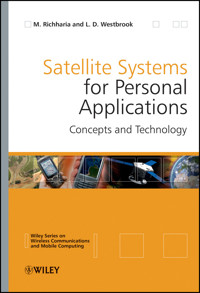
Presents the concepts, technology, and role of satellite systems in support of personal applications, such as mobile and broadband communications, navigation, television, radio and multimedia broadcasting, safety of life services, etc. This book presents a novel perspective on satellite systems, reflecting the modern personal technology context, and hence a focus on the individual as end-user. The book begins by outlining key generic concepts before discussing techniques adopted in particular application areas; next, it exemplifies these techniques through discussion of state-of-art current and emerging satellite systems. The book concludes by contemplating the likely evolution of these systems, taking into consideration influences and trends in technology, in conjunction with growing user expectations. In addition to addressing satellite systems that directly interact with personal devices, the book additionally considers those indirect applications where there is an increasing interest by individuals - notably, in remote sensing. As such, the book uniquely encompasses the entire gamut of satellite-enabled personal / end-user applications. Key Features: * Broad scope - views satellite systems generically with regards to their applicability across a wide range of personal application areas * Strong foundation in underlying concepts * State-of-the-art system examples * Review of trends in relevant areas of satellite technology * Revision questions at the end of each chapter The book is suited to individuals, engineers, scientists, service providers, system operators, application developers and managers interested or involved in the use of satellite technology for personal applications. It should also hold interest for use in research institutes interested in promoting inter-disciplinary cross-fertilization of ideas, as well as by financiers, policy makers, and strategists interested in gaining a better understanding of this technology.
Sie lesen das E-Book in den Legimi-Apps auf:
Seitenzahl: 884
Veröffentlichungsjahr: 2011
Ähnliche



















Contents
About the Series Editors
Preface
Acknowledgements
1 Introduction
1.1 Scope
1.2 Perspective
1.3 Background and Applications
1.4 Trends
1.5 Overview of this Book
References
Part I BASIC CONCEPTS
2 Satellites and High-Altitude Platforms
2.1 Introduction
2.2 Satellites
2.3 High-Altitude Platforms
Revision Questions
References
3 Spectrum and Propagation
3.1 Introduction
3.2 Spectrum
3.3 Propagation
Revision Questions
References
4 Antennas and Noise
4.1 Introduction
4.2 Antennas
4.3 Noise
Revision Questions
References
5 Modulation and Coding
5.1 Introduction
5.2 Modulation
5.3 Error Control Coding
Revision Questions
References
6 Satellite Access and Networking
6.1 Introduction
6.2 Satellite Access
6.3 Payloads
6.4 Networks
Revision Questions
References
7 Doppler and Pseudorange (Navigation)
7.1 Introduction
7.2 Doppler
7.3 Pseudoranging
Revision Questions
References
8 Compression, Speech, Audio and Video Encoding
8.1 Introduction
8.2 Lossless Data Compression
8.3 Digitizing Analogue Signals
8.4 Speech Encoding
8.5 Audio Encoding
8.6 Video Encoding
Revision Questions
References
Part II TECHNIQUES AND SYSTEMS
9 Digital Broadcasting Techniques and Architectures
9.1 Introduction
9.2 MPEG Multimedia Standards
9.3 Direct-to-Home Broadcast System
9.4 Direct Broadcasts to Individuals and Mobile Users
9.5 Military
Revision Questions
References
10 Broadcast Systems
10.1 Introduction
10.2 Satellite Radio Systems
10.3 Direct Multimedia Broadcast
10.4 Direct-to-Home Television
10.5 Military Multimedia Broadcasts
Revision Questions
References
11 Communications Architectures
11.1 Introduction
11.2 Role
11.3 Circuit-Switched Services
11.4 Packet-Switched and Converged Services
11.5 Satellite Communications Networks
11.6 High-Altitude Platform Systems
Revision Questions
References
12Satellite Communications Systems
12.1 Introduction
12.2 Mobile Communications
12.3 Fixed Communications
12.4 Military Communications
12.5 Amateur Communications
12.6 HAP Communicat035ions
Revision Questions
References
13Satellite Navigation Techniques
13.1 Introduction
13.2 Categorization
13.3 Doppler-Assisted Navigation
13.4 Range-Assisted Navigation
13.5 Satellite Augmentation System
13.6 Navigation–Communication Hybrid Architecture
13.7 Receiver Architecture
13.8 Distress, Safety and Location-Based Services
Revision Questions
References
14Navigation, Tracking and Safety Systems
14.1 Introduction
14.2 Global Navigation Satellite Systems
14.3 Regional Navigation Systems
14.4 Satellite-Based Augmentation Systems
14.5 Distress and Safety
14.6 Location-Based service
Revision Questions
References
15Remote Sensing Techniques
15.1 Introduction
15.2 Remote Sensing Data
15.3 Sensors
15.4 Image Processing
15.5 Image Interpretation
15.6 System Characteristics
Revision Questions
References
16Remote Sensing Systems
16.1 Introduction
16.2 Commercial Imaging
16.3 Meteorology
16.4 Land Observation
Revision Questions
References
17The Future
17.1 Introduction
17.2 Influences
17.3 Trend
17.4 The Long Term
17.5 Satellites and the Environment
17.6 Conclusion
Revision Questions
References
Appendix
Index
Wiley Series on Wireless Communications and Mobile Computing
Series Editors:Dr Xuemin (Sherman) Shen, University of Waterloo, CanadaDr Yi Pan, Georgia State University, USAThe ‘Wiley Series on Wireless Communications and Mobile Computing’ is a series of comprehensive, practical and timely books on wireless communication and network systems. The series focuses on topics ranging from wireless communication and coding theory to wireless applications and pervasive computing. The books provide engineers and other technical professionals, researchers, educators and advanced students in these fields with invaluable insight into the latest developments and cutting-edge research
Other titles in the series:
Misic and Misic: Wireless Personal Area Networks: Performance, Interconnection, and Security with IEEE 802.15.4 , Janyary 2008, 978-0-470-51847-2
Takagi and Walke: Spectrum Requirement Planning in Wireless Communications: Model and Methodology for IMT-Advanced, April 2008, 978-0-470-98647-9
Pérez-Fontáan and Espieira: Modeling the WirelessPropagation Channel: A simulation approach with MATLAB®, August 2008, 978-0-470-72785-0
Ippolito: Satellite communications Systems Engineering: Atmospheric Effects, Satellite Link Design and System Performance, August 2008, 978-0-470-72527-6
Lin and Sou: Charging for Mobile All-IP Telecommunications, September 2008, 978-0-470-77565-3
Myung and Goodman: Single Carrier FDMA: A New Air Interface for Long Term Evalution, October 2008, 978-0-470-72449-1
Wang, Kondi, Luthra and Ci: 4G Wireless Video Communications, April 2009, 978-0-470-77307-9
Cai, Shen and Mark: Multimedia Services in Wireless Internet: Modeling and Analysis, June 2009, 978-0-470-77065-8
Stojmenovic: Wireless Sensor and Actuator Networks: Algorithms and Protocols for Scalable Coordination and Data Communication, February 2010, 978-0-470-17082-3
Liu and Weiss, Wideband Beamforming: Concepts and Techniques, March 2010, 978-0-470-71392-1
Hart, Tao and Zhou: Mobile Multi-hop WiMAX: From Protocol to Performance, October 2010, 978-0-470-99399-6
Qian, Muller and Chen: Security in Wireless Networks and Systems, January 2011, 978-0-470-512128
This edition first published 2010© 2010 John Wiley & Sons Ltd
Registered office
John Wiley & Sons, Ltd, The Atrium, Southern Gate, Chichester, West Sussex PO19 8SQ, United Kingdom
For details of our global editorial offices, for customer services and for information about how to apply for permission to reuse the copyright material in this book, please see our website at www.wiley.com.
The right of the author to be identified as the author of this work has been asserted in accordance with the Copyright, Designs and Patents Act 1988.
All rights reserved. No part of this publication may be reproduced, stored in a retrieval system, or transmitted, in any form or by any means, electronic, mechanical, photocopying, recording or otherwise, except as permitted by the UK Copyright, Designs and Patents Act 1988, without the prior permission of the publisher.
Wiley also publishes its books in a variety of electronic formats. Some content that appears in print may not be available in electronic books.
Designations used by companies to distinguish their products are often claimed as trademarks. All brand names and product names used in this book are trade names, service marks, trademarks or registered trademarks of their respective owners. The publisher is not associated with any product or vendor mentioned in this book. This publication is designed to provide accurate and authoritative information with regard to the subject matter covered. It is sold on the understanding that the publisher is not engaged in rendering professional services. If professional advice or other expert assistance is required, the services of a competent professional should be sought.
Library of Congress Cataloging-in-Publication Data
Richharia, M. (Madhavendra)Satellite systems for personal applications : concepts and technology / Madhavendra Richharia, Leslie Westbrook.p. cm.Includes bibliographical references and index.ISBN 978-0-470-71428-7 (cloth)1. Artificial satellites in telecommunication. 2. Personal communication service systems. I. Westbrook, Leslie. II. Title.TK5104.R5323 2010621.382′5 – dc22
2010003320
A catalogue record for this book is available from the British Library
ISBN 978-0-470-71428-7 (H/B)
About the Series Editors
Xuemin (Sherman) Shen (M’97–SM’02) received a BSc degree in Electrical Engineering from Dalian Maritime University, China, in 1982, and MSc and PhD degrees (both in Electrical Engineering) from Rutgers University, New Jersey, United States, in 1987 and 1990 respectively. He is a Professor and University Research Chair, and the Associate Chair for Graduate Studies, Department of Electrical and Computer Engineering, University of Waterloo, Canada. His research focuses on mobility and resource management in interconnected wireless/wired networks, UWB wireless communications systems, wireless security and ad hoc and sensor networks. He is a coauthor of three books, and has published more than 300 papers and book chapters in wireless communications and networks, control and filtering. Dr Shen serves as a Founding Area Editor for IEEE Transactions on Wireless Communications, as Editor-in-Chief for Peer-to-Peer Networking and Application and as Associate Editor for IEEE Transactions on Vehicular Technology; KICS/IEEE Journal of Communications and Networks, Computer Networks, ACM/Wireless Networks, Wireless Communications and Mobile Computing (John Wiley & Sons), etc. He has also served as Guest Editor for IEEE JSAC, IEEE Wireless Communications and IEEE Communications Magazine. Dr Shen received the Excellent Graduate Supervision Award in 2006, the Outstanding Performance Award in 2004 from the University of Waterloo, the Premier’s Research Excellence Award (PREA) in 2003 from the Province of Ontario, Canada, and the Distinguished Performance Award in 2002 from the Faculty of Engineering, University of Waterloo. He is a registered Professional Engineer of Ontario, Canada.
Dr Yi Pan is the Chair and a Professor in the Department of Computer Science at Georgia State University, United States. He received his BEng and MEng degrees in Computer Engineering from Tsinghua University, China, in 1982 and 1984 respectively, and his PhD degree in Computer Science from the University of Pittsburgh, in 1991. His research interests include parallel and distributed computing, optical networks, wireless networks and bioinformatics. Dr Pan has published more than 100 journal papers, with over 30 papers published in various IEEE journals. In addition, he has published over 130 papers in refereed conferences (including IPDPS, ICPP, ICDCS, INFOCOM and GLOBECOM). He has also coedited over 30 books. Dr Pan has served as Editor-in-Chief or as an editorial board member for 15 journals, including five IEEE Transactions, and has organized many international conferences and workshops. He has delivered over 10 keynote speeches at many international conferences. Dr Pan is an IEEE Distinguished Speaker (2000–2002), a Yamacraw Distinguished Speaker (2002) and a Shell Oil Colloquium Speaker (2002). He is listed in Men of Achievement, Who’s Who in America, Who’s Who in American Education, Who’s Who in Computational Science and Engineering and Who’s Who of Asian Americans.
Preface
People in our modern society are profoundly dependent on technology for their work, well-being and quality of life. In recent years, satellite systems have introduced a universal dimension to this technological landscape – although the individual may not always be aware of the extent of the contribution of satellite systems. Satellite technology is today accessible and affordable by individuals, and this book has been created to lay a strong technical foundation towards understanding the role and functioning of existing and emerging satellite systems for personal (i.e. end-user) applications.
Whereas previous books have addressed satellite technology and the personal role of satellite systems in individual service areas – notably personal satellite communications – this book spans the entire breadth of satellite-enabled end-user applications. The aim has been to present the subject matter in a clear and concise manner with key illustrative examples.
After an introductory chapter, the book presents fundamental concepts applicable generally across all the systems. Subsequent chapters delve into techniques and examples of specific systems and services available directly from personal satellite terminals. Such applications encompass broadcasting, communications (narrowband and wideband, commercial, military and amateur), navigation and satellite-based distress services. The book additionally covers those services that are gradually permeating into the personal domain–in particular, satellite imaging and remote sensing.
Finally, the authors explore the trends and evolution of such satellite systems, taking into consideration the influences, user expectations, technology evolution, regulatory efforts and characteristics of satellite systems.
Readers wishing to glean further useful information about the book, to obtain a list of errata, and/or provide feedback to the authors may wish to visit the website at http://www.SatellitesAndYou.com.
Acknowledgements
The authors gratefully acknowledge those individuals and organizations who have kindly given permission for their material to be included in this book. Every effort has been made to obtain permission from the appropriate copyright holders but in the event that any have been inadvertently overlooked they should contact the authors in the first instance (via the publisher), who will endeavor to make appropriate arrangements at the earliest practical opportunity.
Grateful thanks are extended to Tiina Ruonamaa, Sarah Tilley and the team at John Wiley & Sons for their invaluable support, patience and timely guidance throughout the project. The authors express their gratitude to the series editors for their support and thank the anonymous reviewers for their constructive assessment and critique which helped the authors to present the book in its present form.
The authors would also like to take the opportunity to acknowledge those colleagues and fellow researchers who have so enthusiastically shared their extensive knowledge of satellite technology over the years, and who have thus contributed indirectly to the content of this book.
Lastly, and most importantly, some personal thanks:
I (MR) would like to thank my wife Kalpana wholeheartedly for bearing my long absences patiently during the family’s prime time.
I (LDW) thank my wife Eva for her enduring patience and continued support, without which I could not have completed this project.
1
Introduction
1.1 Scope
The past two decades have seen a quiet revolution in satellite-based services. Once the preserve of governments, international bodies, public utilities and large corporations, today the majority of satellite service users are individuals, who can now access, directly, a wide range of satellite services – typically using personal, mass-market and even handheld devices. These satellite systems now fulfil a variety of personal necessities and aspirations spanning telecommunications, broadcast services, navigation, distress and safety services and (indirectly) remote sensing, in the commercial, military and amateur sectors. It therefore seems an appropriate time for a book that addresses these services from the perspective of their support for, and functionality delivered to, individual users.
This book therefore aims to:
enhance awareness regarding the expanding role of satellite systems in individuals’ daily lives;lay a strong technical foundation of the basic principles and functioning of these satellite systems for personal communications, navigation, broadcasting and sensing applications;illustrate current practice using selected example systems in each field;review current trends in relevant satellite and related technology.The book aims to address an audience that is inquisitive and keen to understand the role of satellites in our daily lives and the underpinning concepts, and, in contrast to alternative offerings, the focus in this book is on the individual and the end-user application. It aims to provide all of the relevant concepts, in a clear and concise manner, together with descriptions of key systems as illustrations of their implementation in practice.
Satellite services are formally categorized by the International Telecommunications Union (ITU) according to their broad service types. For example, the Broadcast Satellite Service (BSS) addresses recommendations and specifications related to satellite-enabled broadcasts. This book, instead, attempts to address all the services with respect to a user’s application perspective – be it telecommunications, broadcast, navigation, amateur, military or safety-related systems.
Space technology comprises a number of branches – satellite communications, satellite aids to the amateur, space exploration, radio astronomy, remote sensing/earth observation, military reconnaissance/surveillance, deep-space communication, launch technology, interplanetary exploration, radio astronomy, space tourism, etc. This book focuses on those technologies where individuals benefit, in a direct or tangible way, from a satellite system. A user interacts directly with a personal satellite broadband terminal when communicating via satellite or interacts with a direct-to-home television receiver when viewing a programme directly from a broadcast satellite. Similarly, an individual using satellite navigation interacts directly with a Global Positioning System (GPS) receiver.
In some cases the user may not interact directly but nevertheless benefits from information obtained (only) through the use of a satellite system, with some aspects of user hardware or software typically tailored to exploit that system’s capabilities, and such applications are also included in the scope of this book. An application in this category would be viewing images of the Earth’s weather system appearing daily on our television and computer screens. Here, the pictures transmitted from the satellite are processed elsewhere for the intended audience. Nevertheless, in such instances the individual is conscious that a satellite system is involved.
Those applications and systems where satellites remain in the background are not addressed here, although the same technical concepts apply in the majority of the cases. Examples of this category are interconnection between telecommunication traffic nodes or terrestrial base stations, remote sensing for government (e.g. monitoring vegetation), military surveillance and communications dealing with weapons delivery, television programme distribution between broadcasters, etc. Space tourism (personal spaceflight) is not included in this edition of the book.
1.2 Perspective
Modern society leans heavily on technology for its personal needs – be it entertainment, communications, travel, safety services or domestic appliances. This book deals with the role of satellites in the consumer (or individual) technology paradigm. Consequently, generic user terminal technologies such as terrestrial mobile systems, personal digital assistants, personal computers, etc., are discussed where relevant to personal satellite systems use.
The dependency on satellites in the developed world is quite remarkable. Furthermore, it continues to increase in both the developing and the underdeveloped world owing to falling technology costs together with a growing awareness of the accruing benefits. It must be remarked here, though, that there is a significant difference in priorities in each sector. In an affluent modern society, a majority of people expect a ubiquitous voice service with broadband Internet access, whether they are at home, away or travelling. Many individuals also now aspire to owning a converged handset encompassing some or all of the complementary features such as computing and database functionalities, a hi-fi digital music player, a camera, including video, a radio receiver and mobile television.
In the less developed world, individual requirements and aspirations are curtailed by lower affordability, infrastructure limitations and social conditions. It has been observed that the Gross Domestic Product (GDP) of an economy increases in direct proportion to the improvements to the communications infrastructure. Therefore, there is a great interest in the developing world for deploying wired and wireless technologies such as mobile telephony, the wireless local area network (WLAN) and satellite communications. In the developing world, there is typically minimal fixed infrastructure, with the result that satellites offer an attractive means to build up services, before it becomes economic to introduce fixed assets. One also expects some modifications to mainstream technologies for them to be cost effective and relevant in this environment. The notion that a personal handset is unaffordable, or that the average daily use of such terminals is miniscule, is offset by the fact that such resources are often shared by groups or communities. An example of technical adaptation in a developing region is the extended WLAN trials reported by Raman and Chebrolu (2007) where WLAN coverage was extended to a much wider area than in developed countries, to support scattered rural communities.
Lesen Sie weiter in der vollständigen Ausgabe!
Lesen Sie weiter in der vollständigen Ausgabe!
Lesen Sie weiter in der vollständigen Ausgabe!
Lesen Sie weiter in der vollständigen Ausgabe!
Lesen Sie weiter in der vollständigen Ausgabe!
Lesen Sie weiter in der vollständigen Ausgabe!
Lesen Sie weiter in der vollständigen Ausgabe!
Lesen Sie weiter in der vollständigen Ausgabe!
Lesen Sie weiter in der vollständigen Ausgabe!
Lesen Sie weiter in der vollständigen Ausgabe!
Lesen Sie weiter in der vollständigen Ausgabe!
Lesen Sie weiter in der vollständigen Ausgabe!
Lesen Sie weiter in der vollständigen Ausgabe!
Lesen Sie weiter in der vollständigen Ausgabe!
Lesen Sie weiter in der vollständigen Ausgabe!
Lesen Sie weiter in der vollständigen Ausgabe!
Lesen Sie weiter in der vollständigen Ausgabe!
Lesen Sie weiter in der vollständigen Ausgabe!
Lesen Sie weiter in der vollständigen Ausgabe!
Lesen Sie weiter in der vollständigen Ausgabe!




