


116,99 €
Mehr erfahren.
- Herausgeber: John Wiley & Sons
- Kategorie: Wissenschaft und neue Technologien
- Sprache: Englisch
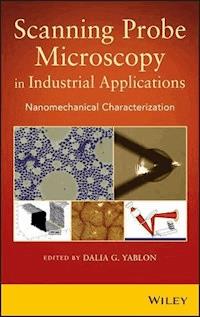
Describes new state-of-the-science tools and their contribution to industrial R&D With contributions from leading international experts in the field, this book explains how scanning probe microscopy is used in industry, resulting in improved product formulation, enhanced processes, better quality control and assurance, and new business opportunities. Readers will learn about the use of scanning probe microscopy to support R&D efforts in the semiconductor, chemical, personal care product, biomaterial, pharmaceutical, and food science industries, among others. Scanning Probe Microscopy in Industrial Applications emphasizes nanomechanical characterization using scanning probe microscopy. The first half of the book is dedicated to a general overview of nanomechanical characterization methods, offering a complete practical tutorial for readers who are new to the topic. Several chapters include worked examples of useful calculations such as using Hertz mechanics with and without adhesion to model a contact, step-by-step instructions for simulations to guide cantilever selection for an experiment, and data analysis procedures for dynamic contact experiments. The second half of the book describes applications of nanomechanical characterization in industry, including: * New formulation development for pharmaceuticals * Measurement of critical dimensions and thin dielectric films in the semiconductor industry * Effect of humidity and temperature on biomaterials * Characterization of polymer blends to guide product formulation in the chemicals sector * Unraveling links between food structure and function in the food industry Contributions are based on the authors' thorough review of the current literature as well as their own firsthand experience applying scanning probe microscopy to solve industrial R&D problems. By explaining the fundamentals before advancing to applications, Scanning Probe Microscopy in Industrial Applications offers a complete treatise that is accessible to both novices and professionals. All readers will discover how to apply scanning probe microscopy to build and enhance their R&D efforts.
Sie lesen das E-Book in den Legimi-Apps auf:
Seitenzahl: 671
Veröffentlichungsjahr: 2013
Ähnliche



















Contents
Contributors List
Preface
Acknowledgments
Chapter 1: Overview of Atomic Force Microscopy
1.1 A WORD ON NOMENCLATURE
1.2 ATOMIC FORCE MICROSCOPY—THE APPEAL TO INDUSTRIAL R&D
1.3 MECHANICAL PROPERTIES
1.4 OVERVIEW OF AFM OPERATION
1.5 NANOMECHANICAL METHODS SURVEYED IN BOOK
1.6 INDUSTRIES REPRESENTED
ACKNOWLEDGMENTS
REFERENCES
Chapter 2: Understanding the Tip–Sample Contact: An Overview of Contact Mechanics from the Macro- to the Nanoscale
2.1 HERTZ EQUATIONS FOR ELASTIC CONTACT
2.2 ADHESIVE CONTACTS
2.3 FURTHER EXTENSIONS OF CONTINUUM CONTACT MECHANICS MODELS
2.4 THIN FILMS
2.5 TANGENTIAL FORCES
2.6 APPLICATION OF CONTINUUM MECHANICS TO NANOSCALE CONTACTS
ACKNOWLEDGMENTS
APPENDIX 2A SURFACE ENERGY AND WORK OF ADHESION
REFERENCES
Chapter 3: Understanding Surface Forces Using Static and Dynamic Approach–Retraction Curves
3.1 TIP–SAMPLE INTERACTION FORCES
3.2 STATIC F–ZCURVES
3.3 DYNAMIC AMPLITUDE/PHASE–DISTANCE CURVES
3.4 BRIEF GUIDE TO VEDA SIMULATIONS
3.5 CONCLUSIONS
GLOSSARY
REFERENCES
Chapter 4: Phase Imaging
4.1 INTRODUCTION
4.2 BISTABILITY: ATTRACTIVE AND REPULSIVE MODE
4.3 COMPLICATIONS IN PHASE QUANTIFICATION
REFERENCES
Chapter 5: Dynamic Contact AFM Methods for Nanomechanical Properties
5.1 INTRODUCTION
5.2 FORCE MODULATION MICROSCOPY (FMM)
5.3 CONTACT RESONANCE (CR) TECHNIQUES
5.4 COMPARISON OF FMM AND CR-FM
5.5 OTHER DYNAMIC CONTACT APPROACHES
5.6 SUMMARY AND CONCLUSIONS
ACKNOWLEDGMENTS
APPENDIX 5A DATA ANALYSIS PROCEDURE FOR CONTACT RESONANCE SPECTROSCOPY MEASUREMENTS
REFERENCES
Chapter 6: Guide to Best Practices for AFM Users
6.1 FORCE–DISTANCE MEASUREMENTS—INSTRUMENTAL SOURCES OF NONIDEALITY
6.2 FORCE–DISTANCE MEASUREMENTS—PHYSICAL SOURCES OF NONIDEALITY
REFERENCES
Chapter 7: Nanoindentation Measurements of Mechanical Properties of Very Thin Films and Nanostructured Materials at High Spatial Resolution
7.1 INTRODUCTION
7.2 BULK MATERIALS
7.3 COATINGS
7.4 CONCLUSIONS
ACKNOWLEDGMENTS
REFERENCES
Chapter 8: Scanning Probe Microscopy for Critical Measurements in the Semiconductor Industry
8.1 INTRODUCTION
8.2 CRITICAL DIMENSION IN THE SEMICONDUCTOR INDUSTRY
8.3 CD METROLOGY TECHNIQUES FOR PRODUCTION
8.4 OBTAINING ACCURATE CD IN THE SEMICONDUCTOR INDUSTRY
8.5 HYBRID METROLOGY AS A FINAL SOLUTION TO OVERCOME CD-AFM, CD-SEM, AND SCATTEROMETRY INTRINSIC LIMITATIONS
8.6 CONCLUSION
REFERENCES
Chapter 9: Atomic Force Microscopy of Polymers
9.1 INTRODUCTION
9.2 TAPPING PHASE AFM
9.3 NANOINDENTATION
9.4 FORCE MODULATION
9.5 PULSED FORCE IMAGING
9.6 FORCE–VOLUME AFM
9.7 HARMONIX AND PEAK FORCE QNM IMAGING
9.8 SUMMARY
REFERENCES
Chapter 10: Unraveling Links between Food Structure and Function with Probe Microscopy
10.1 INTRODUCTION
10.2 GELS AND THICKENERS: MOLECULAR NETWORKS
10.3 EMULSIONS AND FOAMS: PROTEIN–SURFACTANT COMPETITION
10.4 INTERFACIAL STRUCTURE AND DIGESTION: DESIGNER INTERFACES
10.5 FORCE SPECTROSCOPY: MODEL EMULSIONS
10.6 FORCE SPECTROSCOPY: ORIGINS OF BIOACTIVITY
10.7 CONCLUSIONS
REFERENCES
Chapter 11: Microcantilever Sensors for Petrochemical Applications
11.1 INTRODUCTION
11.2 BACKGROUND
11.3 APPLICATIONS
11.4 CONCLUSION
REFERENCES
Chapter 12: Applications of Scanning Probe Methods in Cosmetic Science
12.1 INTRODUCTION
12.2 SUBSTRATES OF COSMETICS
12.3 MECHANICAL PROPERTIES AND MODIFICATIONS BY COSMETIC PRODUCTS
12.4 SCANNING PROBE TECHNOLOGIES ADAPTED TO COSMETIC SCIENCE
12.5 CONCLUSIONS
REFERENCES
Chapter 13: Applications of Scanning Probe Microscopy and Nanomechanical Analysis in Pharmaceutical Development
13.1 INTRODUCTION
13.2 APPLICATIONS OF SPM IMAGING
13.3 SPM AS A SCREENING TOOL
13.4 APPLICATIONS OF NANOINDENTATION
13.5 CONCLUSION
ACKNOWLEDGMENTS
REFERENCES
Chapter 14: Comparative Nanomechanical Study of Multiharmonic Force Microscopy and Nanoindentation on Low Dielectric Constant Materials
14.1 INTRODUCTION
14.2 EXPERIMENTAL
14.3 RESULTS AND DISCUSSIONS
14.4 CONCLUSIONS
ACKNOWLEDGMENTS
REFERENCES
Chapter 15: Nanomechanical Characterization of Biomaterial Surfaces: Polymer Coatings That Elute Drugs
15.1 INTRODUCTION
15.2 MATERIALS AND METHODS
15.3 DEXAMETHASONE IN PBMA OR PBMA–PLMA POLYMER BLENDS
15.4 SIMVASTATIN IN PEO–PBT COPOLYMERS
15.5 CONCLUDING COMMENTS
ACKNOWLEDGMENTS
REFERENCES
Supplemental Images
Index
Copyright © 2014 by John Wiley & Sons, Inc. All rights reserved.
Published by John Wiley & Sons, Inc., Hoboken, New JerseyPublished simultaneously in Canada
No part of this publication may be reproduced, stored in a retrieval system, or transmitted in any form or by any means, electronic, mechanical, photocopying, recording, scanning, or otherwise, except as permitted under Section 107 or 108 of the 1976 United Stated Copyright Act, without either the prior written permission of the Published, or authorization through payment of the appropriate per-copy fee to the Copyright Clearance Center, Inc., 222 Rosewood Drive, Danvers, MA 01923, (978) 750-8400, fax (978) 750-4470, or on the web at www.copyright.com. Requests to the Publisher for permission should be addressed to the Permissions Department, John Wiley & Sons, Inc., 111 River Street, Hoboken, NJ 07030, NJ 07030, (201) 748-6011, fax (201) 748-6008, or online at http://www.wiley.com/go/permission.
Limit of Liability/Disclaimer of Warranty: While the publisher and author have used their best efforts in preparing this book, they make no representations or warranties with respect to the accuaracy or completeness of the contents of this book and specifically disclaim any implied warranties of merchantability or fitness for a particular purpose. No warranty may be created or extended by sales representation or written sales materials. The advice and strategies contained herein may not be suitable for your situation. You should consult with a professional where appropriate. Neither the publisher nor author shall be liable for any loss of profit or any other commercial damages, including but not limited to special, incidental, consequential, or other damages.
For general information on our other products and services or for technical support, Please contact our Customer Care Department within the United States at (800) 762-2974, outside the United States at (371) 572-3993 or fax (317) 572-4002.
Wiley also publishes its books in variety of electronic formats. Some content that appears in print may not be available in electronic formats. For more information about Wiley products, visit our web site at www.wiley.com.
Library of Congress Cataloging-in-Publication Data:
Scanning probe microscopy for industrial applications : nanomechanical characterization / edited by Dalia G. Yablon. pages cm Includes bibliographical references and index.
ISBN 978-1-118-28823-8 (hardback)1. Materials–Microscopy. 2. Scanning probe microscopy–Industrial applications. I. Yablon, Dalia G., 1975– TA417.23.S33 2013 620.1′127–dc23
2013009638
Printed in the United States of America
10 9 8 7 6 5 4 3 2 1
Dedicated with love to:AndrewandAyelet, Daniela, Mati, and Eli
Contributors List
Sudharsan BalasubramaniamDepartment of Mechanical EngineeringPurdue UniversityWest Lafayette, INSteve J. BullSchool of Chemical Engineering and Advanced MaterialsUniversity of NewcastleNewcastle upon Tyne, United KingdomRobert W. CarpickDepartment of Mechanical Engineering and Applied MechanicsUniversity of PennsylvaniaPhiladelphia, PAGeraud DuboisIBM Almaden Research CenterSan Jose, CAJohann FoucherLETI–CEAGrenoble, FranceJane FrommerIBM Almaden Research CenterSan Jose, CAAnthony GallianoL’Oreal Research and InnovationAulnay sous Bois, FranceA. Patrick GunningInstitute of Food ResearchNorwich Research ParkNorwich, United KingdomGreg HaugstadUniversity of MinnesotaMinneapolis, MNDonna C. HurleyNational Institute of Standards and TechnologyBoulder, COTevis D. B. JacobsDepartment of Materials Science and EngineeringUniversity of PennsylvaniaPhiladelphia, PAJason P. KillgoreNational Institute of Standards and TechnologyBoulder, CORobin KingIBM Almaden Research CenterSan Jose, CADaniel KiracofeDepartment of Mechanical EngineeringPurdue UniversityWest Lafayette, INMatthew S. LammMerck Research LaboratoriesMerck & Co.Summit, NJGustavo S. LuengoL’Oreal Research and InnovationAulnay sous Bois, FranceC. Mathew MateHGST, A Western Digital CompanySan Jose, CAVictor J. MorrisInstitute of Food ResearchNorwich Research ParkNorwich, United KingdomArvind RamanDepartment of Mechanical EngineeringPurdue UniversityWest Lafayette, INAlan M. SchilowitzExxonMobil Research and EngineeringAnnandale, NJAndy H. TsouExxonMobil Research and EngineeringAnnandale, NJKevin T. TurnerDepartment of Mechanical Engineering and Applied MechanicsUniversity of PennsylvaniaPhiladelphia, PAKumar VirwaniIBM Almaden Research CenterSan Jose, CAWilli VolksenIBM Almaden Research CenterSan Jose, CAKatharine WalzIBM Almaden Research CenterSan Jose, CAKlaus WormuthInstitute for Physical ChemistryUniversity of CologneCologneGermanyDalia G. YablonSurfaceChar, LLC.Sharon, MA
Preface
The idea for this book came a couple of years ago after perusing atomic force microscopy (AFM) book collections at many professional society conferences over the years and finding that there was constantly a key topic missing: how AFM was used practically in industrial R&D. This topic is close to my heart as I have pursued a career developing novel methods and applying scanning probe microscopy (SPM) to a wide variety of industrial R&D problems at ExxonMobil Research and Engineering’s Corporate Strategic Research in New Jersey for over a decade. At ExxonMobil, I have had the opportunity to explore application of AFM in the three vast sectors in the petroleum industry: the downstream, chemicals, and upstream sector studying a wide variety of problems from corrosion to lubrication to geology to polymer materials. All the AFM-focused books I found were research reviews on focused topical areas or textbooks on operating principles and theory. So though these books offered excellent technical treatments of a variety of topics, the incredible utility, applicability, and flexibility of AFM to solve real-world everyday problems was lacking.
My background in graduate school was actually in scanning tunneling microscopy (STM), as I studied self-assembled monolayers at the liquid–solid interface in George Flynn’s lab at Columbia University’s chemistry department, not the most relevant “real-world, industrial” problem. However, being an STM lab in the 1990s, we also had AFMs in the lab (since they shared the same “brain,” the controller), so every once in a while we would help out a colleague and study their samples. As I moved to ExxonMobil after graduate school in 2002, my intent was not necessarily to continue in scanning probe microscopy. In fact, it was serendipity that upon arriving at ExxonMobil’s Corporate Strategic Research labs as a postdoctoral fellow, I found an unused Digital Instruments Nanoscope III controller with a fully accessorized Multimode. The rest, as they say, is history.
Over my time at ExxonMobil, I ran into many like-minded colleagues in other industrial facilities using AFM, and we would hold fascinating discussions of how the technology was used in one’s particular field. On the other side, I could sense great interest from my academic colleagues that industrial researchers were using SPM to such a great extent, as well as recent graduates trying to connect their hard-earned knowledge and expertise in the field as students to practical, useful areas. A book covering this material for the wider audience did indeed seem missing.
And so I began to survey the industrial R&D community––both members I had known for years and new ones––to gauge interest in putting such a volume together. I was inspired by the enthusiasm I received from my colleagues and decided to go forward. Then came the question of what kind of AFM? As surveyed in Chapter 1, AFM is a tremendously broad field that characterizes a wide variety of material and surface properties. However, at its heart, AFM is a high-resolution nanomechanical probe of the surface. That probe can be coated with an electronically conducting layer or magnetic material, or even replaced by an optical fiber tip in order to probe a variety of properties. However, a strong majority of the industrial R&D both in my own direct personal experience and those that I was familiar with was conducted with mechanical probing of properties. Of course, there are some key counterexamples that stand out, such as electrostatic force microscopy to probe electrical properties of conducting and semiconducting materials and magnetic force microscopy to probe magnetic storage devices. Perhaps those applications will be covered in a future volume! But the overwhelming use of AFM in industrial R&D was nanomechanical characterization, and thus it was quickly chosen as the focus for this book.
It was important that this book be self-contained. While the book’s focus is on the applications, it is intended to be accessible to a broad audience both from a professional and educational background so that everyone from an advanced undergraduate to a seasoned professional will benefit. Various professional backgrounds should benefit as well from those in an academic or academic-like environment who wish to learn how AFM is used in an industrial environment to those in an industrial environment eager to learn what other applications are possible. While a freshman chemistry and physics background is assumed, no prior experience with AFM is assumed. There is certainly advanced information in each chapter so that the content should appeal to a variety of backgrounds in the AFM community from novice to expert.
With this aim of appealing to a broad audience, I include a tutorial on nanomechanical methods in the first half of the book so that applications could be understood and appreciated with context without having to refer to other books or references. I chose the topics that I felt were most relevant to studying nanomechanical characterization in the practical industrial environment: contact mechanics, force curves, phase imaging, dynamic contact methods, and nanoindentation. Note that this is not an exhaustive list of all the nanomechanical characterization methods available with AFM.
I worked closely with my co-authors to make these overview chapters as practical as possible and not overwhelming in theoretical detail; several chapters include worked examples of useful calculations (e.g., using Hertz mechanics with and without adhesion to model a contact in Chapter 2 or data analysis of contact resonance measurements in Chapter 5). These chapters are meant to be overviews to introduce the terminology and key concepts. They are not meant to be an exhaustive step-by-step guide to the operation of various techniques; those treatments are done elsewhere and are referenced in the book. Chapter 6 is a somewhat unique chapter on “Best Practices in AFM Imaging” that I co-wrote with my colleague Greg Haugstad. This chapter outlines some of the common pitfalls encountered by AFM users, again with a practical approach to what the most common and most important problems are and how to avoid them.
Chapters 7–15 then dive into how AFM has been used in a variety of industrial R&D areas to explore (a) phenomena and processes such as new formulation development in pharmaceuticals, the effect of humidity and temperature on biomaterials, and nanostructure formation in food processing, (b) characterization of various materials including polymer blends and composites in the chemicals sector, skin and hair in personal care products, coatings and thin dielectric films in the semiconductor industry, (c) AFM’s function as a key quality control tool in semiconductor metrology, and (d) a slightly different application of AFM microcantilevers as a physical and chemical sensors in the petroleum industry.
My hope is that this book will show what an incredibly useful tool AFM has become to industrial R&D in its short 25 years. It is currently an indispensable tool in any microscopy laboratory, despite its commercial youth. So while the AFM field continues to grow and develop in terms of its capability and understanding, spearheaded by many notable groups in academia and elsewhere, it has already penetrated significantly into a wide variety of industrial labs. This trend will only continue and grow. As the penetration into industrial labs continues, it is my hope that the reader understands not only how the AFM capability increasingly benefits industry but also that industrial labs are quickly becoming a partner in driving AFM’s innovation and research as its commercial and practical utility and importance continue to thrive.
DALIA G. YABLONSharon, MA
Acknowledgments
I have been blessed to have wonderful colleagues to share ideas with and gain inspiration from during this process. First and foremost, I must thank my co-authors on this book. Working with each and every author has been an absolute pleasure. I had the distinct pleasure of working closely with Andy Tsou and Alan Schilowitz for many years at ExxonMobil. Some of the other co-authors I have been fortunate to count as longstanding collaborators including Rob Carpick, Greg Haugstad, Jason Killgore, and Donna Hurley; I thank them for their support and enthusiastic participation for this particular project. From all I learned so much technically, and made many new friends in the process. This book would not have been possible without everyone’s collective hard work to share their insights and wisdom with us.
I would like to thank my colleagues at ExxonMobil with whom I have had the pleasure of developing our AFM capabilities in our AFM lab. Specifically, Jean Grabowski deserves a special callout and has been a tremendous asset to our efforts as well as a genuine friend along the way. I also would like to thank Rebecca Locker, Ishita Chakraborty, and Daniel Kiracofe. I also would like to thank Steve Minne and Roger Proksch for help and guidance in the incipient stages of this project, as well as Emily Rapalino and Susan Klein for advice and proofreading!
Most of all, I have to thank my husband Andrew for his absolute unwavering support and cheerleading throughout the past year and a half. His confidence in me was a source of real motivation and inspiration to carry forward despite obstacles. And logistically, of course, I have to thank him for providing childcare to our children in the evenings and weekends (covering for me on many, many bath nights and storyreading––such as on this night) so that I could complete this book, one which hopefully one day they might be interested in enough to read and understand.
Chapter 1
Overview of Atomic Force Microscopy
Dalia G.Yablon
SurfaceChar LLC, Sharon, MA
Atomic force microscopy (AFM) is a family of nanoscale characterization techniques that has exploded onto the overall characterization and nanotechnology field as its versatility and high resolution continue to feed a dizzying variety of disciplines from biology to physics and chemistry to engineering. AFM entered the scientific arena in 1981 with the now famous invention of its older sibling in the scanning probe microscopy family, the scanning tunneling microscope (STM) in the IBM Zurich labs of Gerd Binnig and Heinrich Rohrer, for which they received the Nobel Prize in Physics in 1986. The AFM was then invented in 1986 by Gerd Binnig, Cal Quate, and Christoph Gerber [1]. Together, STM and AFM formed the scanning probe microscopy (SPM) family, which includes other methods such as near-field scanning optical microscopy (NSOM).
The STM spawned the next 25 years of the continuously developing field of scanning probe microscopy and specifically atomic force microscopy, which now includes dozens of different methods under its name to probe various properties—including mechanical, electrical, magnetic, chemical, and optical—of materials and surfaces. Atomic force microscopy is a powerful tool in various research enterprises. It is found in practically any university characterization facility alongside optical and electron microscopes, and most undergraduates in science or engineering fields at this point are at least familiar with it, if not have performed a laboratory experiment in their undergraduate curriculum.
The focus of this book is to understand and appreciate the role this young technique has played inindustrial research and development (R&D). AFM has penetrated into a variety of industrial research sectors as witnessed by the diverse set of applications described in this book. Alongside electron and optical microscopy, which have been around for decades and have reached an impressive level of commercial maturity and ease of use, AFM has become a vital characterization method despite its youth and continued technical evolution. So, though AFM is still an active area of academic research as its capabilities continue to develop and be better understood, it has proven to be a useful microscopy to address industrial and commercial needs from quality control and assurance to product formulation and process monitoring.
The goal of this introductory chapter is to provide an overview of AFM to nonspecialists and introduce the various topics that are the subject of subsequent individual chapters. As such, this chapter will provide a brief review of the beginnings of AFM and special features that make it particularly suited for industrial research. Then a brief overview of AFM operation will be presented including the hardware, software, calibrations involved, and finally the different nanomechanical methods that will be described in detail both in theory and application. Entire books are written on AFM operation, and this chapter is not meant to be an exhaustive introduction to its operation, merely serving to provide enough information for the rest of the book to be followed intelligently. Readers interested in more detail about AFM operation can consult a number of excellent books on the topic [2–5].
1.1 A WORD ON NOMENCLATURE
Before the rest of this chapter continues, some definitions are in order. Similar to many other surface science techniques, AFM has succumbed to a somewhat unwieldy mess of abbreviations and jargon that has become a hard-to-navigate alphabet soup. SPM refers to an umbrella of a variety of methods. Methods that fall under SPM include perhaps its most famous member, atomic force microscopy (AFM), in addition to others such as scanning tunneling microscopy (STM), near-field scanning optical microscopy (NSOM or SNOM, depending on the continent), and other lithographic methods. And then within AFM there are dozens of methods that rely on the AFM probe–sample interactions to provide a variety of material properties including electrical, optical, magnetic, and mechanical properties. To date, there are dozens of SPM/AFM-based methods. It is beyond the scope of this book to list and/or define all the related methods. These methods characterize a huge variety of material properties. Some of the more common methods have been included in with the category of properties that they measure. The wide diversity of properties of materials that can be measured with AFM is clear. The focus of this book is on nanomechanical characterization, due to its broad appeal in industrial R&D. Again, is offered to demonstrate the variety and flavor of properties that can be probed with SPM.
Lesen Sie weiter in der vollständigen Ausgabe!
Lesen Sie weiter in der vollständigen Ausgabe!
Lesen Sie weiter in der vollständigen Ausgabe!
Lesen Sie weiter in der vollständigen Ausgabe!
Lesen Sie weiter in der vollständigen Ausgabe!
Lesen Sie weiter in der vollständigen Ausgabe!
Lesen Sie weiter in der vollständigen Ausgabe!
Lesen Sie weiter in der vollständigen Ausgabe!
Lesen Sie weiter in der vollständigen Ausgabe!
Lesen Sie weiter in der vollständigen Ausgabe!
Lesen Sie weiter in der vollständigen Ausgabe!
Lesen Sie weiter in der vollständigen Ausgabe!
Lesen Sie weiter in der vollständigen Ausgabe!
Lesen Sie weiter in der vollständigen Ausgabe!
Lesen Sie weiter in der vollständigen Ausgabe!
Lesen Sie weiter in der vollständigen Ausgabe!




