


Erhalten Sie Zugang zu diesem und mehr als 300000 Büchern ab EUR 5,99 monatlich.
- Herausgeber: Autores Associados
- Kategorie: Bildung
- Sprache: Englisch
As indicated in the title, the axis around which the content of this work revolves are the relations between education and democracy. If it is reasonable to suppose that democracy is not taught through undemocratic practices, it must not be inferred that the democratization of internal relations within the school is a sufficient condition for preparing young people for active participation in the democratization of society. It is not simply a matter of choosing between authoritarian or democratic relations within the classroom, but rather of articulating the work developed in schools with the process of democratization of society. The pedagogical practice contributes in a specific way, that is to say, pedagogically, to the democratization of society insofar as one understands how the question of democracy is posed with regard to the proper nature of pedagogical work, which, in turn, implies a real inequality (at the point of departure) and a possible equality (at the point of arrival).
Sie lesen das E-Book in den Legimi-Apps auf:
Seitenzahl: 247
Veröffentlichungsjahr: 2019
Das E-Book (TTS) können Sie hören im Abo „Legimi Premium” in Legimi-Apps auf:
Ähnliche











Copyright © 2018 by Editora Autores Associados Ltda.
Todos os direitos desta edição reservados à Editora Autores Associados Ltda
Dados Internacionais de Catalogação na Publicação (CIP)(Câmara Brasileira do Livro, SP, Brasil)
Saviani, Dermeval
School and democracy [livro eletrônico] / Dermeval Saviani ; [translation Top Traduções]. – Campinas, SP: Autores Associados, 2018.
2 Mb ; e-PUB
Título original: Escola e democracia
Bibliografia
ISBN 978-85-7496-418-8
1. Democracia 2. Educação – Filosofia 3. Política e educação I. Título.
18-18459 CDD-379Índice para catálogo sistemático:
1. Política e educação
379
Ebook – janeiro de 2019
EDITORA AUTORES ASSOCIADOS LTDA.
An educational publisher in the service of the Brazilian culture
Av. Albino J. B. de Oliveira, 901 | Barão Geraldo
CEP 13084-008 | Campinas-SP
Telephone: +55 (19) 3789-9000
E-mail: [email protected]
Online catalog: www.autoresassociados.com.br
Editorial Board “Prof. Casemiro dos Reis Filho”
Bernardete A. Gatti
Carlos Roberto Jamil Cury
Dermeval Saviani
Gilberta S. de M. Jannuzzi
Maria Aparecida Motta
Walter E. Garcia
Executive Director
Flávio Baldy dos Reis
Assistant Editor
Érica Bombardi
Translation
Top Traduções
Technical Review
Juliana Pasqualini
Interior Page Layout
Érica Bombardi
Cover
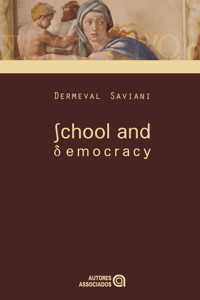
Daphne, the Delphic Sibyl, Michelangelo, fresco in the Sistine Chapel (c. 1510)
For Benjamin,hoping that the children of his generation will be able to study in a truly democratic school.
Summary
FOREWORD
Michael Young
PREFACE TO THE 43RD BRAZILIAN EDITION
PREFACE TO THE URUGUAYAN EDITION
Ema Julia Massera Garayalde
PRESENTATION
CHAPTER 1THEORIES OF EDUCATION AND THE PROBLEM OF MARGINALITY
1. The Problem
2. Non-Critical Theories
3. Critical-Reproductivist Theories
4. For a Critical Education Theory
5. Post-Scriptum
CHAPTER 2SCHOOL AND DEMOCRACY – I THE STICK BENDING THEORY
1. The Free Man
2. The Interests Change
3. The False Belief of the New School
4. Teaching Is Not Research
5. The New School Is Not Democratic
6. New School: The Ruling Class Hegemony
CHAPTER 3SCHOOL AND DEMOCRACY IIBEYOND THE STICK BENDING THEORY
1. New Pedagogy and Pedagogy of Existence
2. Beyond Essence and Existence Pedagogies
3. Beyond New and Traditional Methods
4. Beyond the Authoritarian or Democratic Relationship in the Classroom
5. Conclusion: the Teacher’s Contribution
CHAPTER 4ELEVEN THESES ON EDUCATION AND POLITICS
APPENDIXSEVENTY YEARS OF THE “MANIFEST” AND TWENTY YEARS OFSCHOOL AND DEMOCRACY: BALANCE OF A CONTROVERSY
1. The Central Theme of the “Manifest of the New Education Pioneers”
2. The Context in which School and democracy arose
3. The “Manipulation of Concepts and the Historical Process” in the book School and democracy, according to Clarice Nunes
4. Paschoal Lemme in the “Manifest”: A Stranger in the Pioneers’ Nest?
5. The New School Exercising the “Stick Bending Theory”
ANNEXLETTER FROM ZAIA BRANDÃO
REFERENCES
ABOUT THE AUTHOR
I first came across the ideas of Dermeval Saviani nearly 30 years ago but it is only recently with this translation that I have become aware of their importance beyond as well as within Brazil. I have long admired the writings on politics and education of the Italian revolutionary socialist, Antonio Gramsci. I was most impressed with how Professor Saviani drew on his ideas and their relevance on the Brazilian contexto. The contexts in which his book will be read by English speakers will be very diferent. However, the all will be able to identify with the inequalities of Brazilian society which Saviani has struggled to overcome in his long career.
Saviani writes as a philosopher and I am a sociologist but we share an understanding of the importance of schools and their unique capacity to give acess to “powerful knowledge” to all students. In the section of the book analysing an empirical study of a Brazilian primary school, Saviani makes two important points that are not found in the writings of Anglophone writers about education. One is that hedraws explicitly from Gramsci on the importance of knowledge contents in all subjects of the curriculum. It is only in schools that students can access this knowledge; students build their knowledge in the modern world, not just on their experience as progressive educators like Dewey assume but on knowledge itself. Saviani’s second point is to show very clearly in practical concrete terms, what Gramsci meant in his argument that education is inescapably political. As he shows, Gramsci did not mean “political” in the sense of the dogmas of one or other political Party or only in the decisons made by a government, but in the everyday activity of teachers in their relationships with their students.
The most important aim of Saviani’s book for me is how he describes his critical pedagogical theory and locates it in the context of contemporary Brazil and its reality. He endorses in his own unique way, the English educationist, Harold Entwhistle’s claim that Gramsci combined a revolutionary politics with a conservative respect for knowledge.
At last English speaking readers across the world have the opportunity to know and engage with the work of this outstanding Brazilian intellectual and how his ideas have a strong foundations in Gramsci’s thinking.
Although many of Gramsci’s works are translated into English, few of them show how his pedagogic ideas are expressed in the daily life of teachers in the way that Saviani achieves.
I did not find this book an easy read, because important ideas are never easy to engage with; he makes his readers work hard. However, I persisted and commend it to all English speakers involved in education and beyond. It is particularly important at this difficult time for Brazil to remember that Antonio Gramsci to whom Saviani is so indebted is famous in the English speaking world for what are called his Prison Notebooks and his famous frase “pessimisim of the intellect and optimism of the will”. The spirit of that slogan is kept alive in Saviani’s book.
October 2018
Michael Young
Professor of Sociology of Curriculum at UCL Institute of Education.
His most recent book is Curriculum and the specialisation of Knowledge
With Johan Muller (University of CapeTown) – his research interests centre round the question of knowledge in education and how “powerful knowledge” can be made accessible to all pupils
This year, September 2018, this book completes 35 years of uninterrupted circulation, moment of which, as it reaches its 43rd edition, a new phase begins. Effectively, as of this edition, the book will be edited in a larger format, absorbing all contents contained in the special edition, launched in 2008, celebrating the 25th anniversary of the first edition publication back in September 1983. And in this same format and with the same content, this work will be published in Spanish and English in this new phase.
This change was made by Editora Autores Associados during a dramatic political phase experienced by the country in which the democratic Rule of Law established under the Constitution of 1988 was severely hit, resulting in drastic consequences for the relationship between school and democracy, the central theme of this book.
The democratization process of education in Brazil suffers from the legal-media-parliamentary coup in several ways. It suffers from the constitutional amendment, called “end-of-the-world amendment”, which froze public spending for twenty years, restricting occasional increases only to last year’s inflation. As a result, goals of the National Education Plan (PNE), approved on June 25, 2014, came out unfeasible, especially the target 20, which aimed to increase resources invested in education in 2019 to 7% and reaching 10%, in 2024, of gross domestic product (GDP) of the whole country. But education has been suffering as well with the regressive and authoritarian measures taken by the illegitimate and anti-popular government that usurped the federal power. This is where the reform of secondary education stands, being lowered by provisional measure without even giving prior knowledge to the departments of education and to the state education councils that, under the Law on Brazilian Education Guidelines and Bases (LDB) are responsible for public provision of this level of education.
An authoritarian nature is also clear in measures concerning the realization of the next National Education Conference (CONAE), with intervention of the Ministry of Education (MEC) in the National Forum of Education, in absence of Law N. 13.005, dated June 25, 2014, which approved the PNE 2014-2024. With this arbitrary intervention, the government changed the forum composition without consulting entities that, according to legal norms, have a say in the matter, having withdrawn CONAE’s coordination of the preparation and implementation process, a function assigned to the government by the same law, allocating it to MEC’s Executive Department. Such authoritarianism is still present in the “Non-partisan School” Movement, which emerged within the framework of civil society, constituted as a non-governmental organization (NGO) and now presents itself as bills in the Chamber of Deputies, in the Federal Senate and in several national state assemblies and municipal chambers intending to impose themselves, also, in the scope of political society through the state power. In this condition, such a project is deservedly called by its critics as the “gag law”, because it explicits a series of restrictions to the teaching exercise denying the principle of didactic autonomy established in the norms of teaching performance.
Now, the driving force that runs through the book is exactly the relationship between school and politics, which stems from the inseparability between politics and education. Thus, this book, especially its chapter four, “Eleven theses on education and politics,” operates as an antidote to the self-styled proposal of “Non-partisan School.” As I said in the fourth chapter, “because it’s a relationship that is fundamentally antagonistic, politics presupposes the division of society into irreconcilable parts. That is why political practice cannot be partisan. On the other hand, education, being a relationship that is fundamentally between non-antagonistic, supposes the union and tends to be situated in the universality perspective. That is why it cannot be partisan”. And then I add: “political practice rests on the truth of power; the educational practice, in the power of truth”.
Now, the driving force that runs through the book is exactly the relationship between school and politics, which stems from the inseparability between politics and education. Thus, this book, especially its chapter four, “Eleven theses on education and politics,” operates as an antidote to the self-styled proposal of “Non-partisan School.” As I said in the fourth chapter, “because it’s a relationship that is fundamentally antagonistic, politics presupposes the division of society into irreconcilable parts. That is why the political practice cannot be partisan. On the other hand, education, being a relationship that is fundamentally between non-antagonistic, supposes the union and tends to be situated in the universality perspective. That is why it cannot be partisan”. And then I add: “political practice rests on the truth of power; the educational practice, in the power of truth”.
In light of this, the reader may ask: but what is the difference between the position assumed in the book School and democracy and the one defended by the NGO “Non-partisan School” based on the relation between school and politics? It so happens that, although this NGO proclaims that it intends to subtract the school from the party influence, what it intends, in fact, is to depoliticize schools. Unlike such position, this book affirms, at the same time, a non-identity between education and politics and its inseparability. Consequently, in class society, therefore, in our society, education is always a political act, given the real subordination of education to politics. Therefore, acting as if education were exempt from political influence is an efficient way of placing it at the service of dominant interests. And that is the meaning of the “Non-partisan School” Movement, which explicitly seeks to subtract school from what its supporters perceive as “left ideologies”, from the influence of left parties, placing it under the influence of ideology and right parties, therefore in the service of dominant interests. In proclaiming the neutrality of education in relation to politics, the goal is to stimulate teacher’s idealism by making them believe in the autonomy of education in relation to politics, which will make them achieve the opposite result to what they are seeking: instead, as they believe, to be preparing their students to act autonomously and critically in society, they will be shaping to better adjust them to the existing order and accept conditions of domination to which they are submitted. This is why the “Non-partisan School” proposal originates from parties positioned to the right of the political spectrum, with special emphasis on the Social Christian Party (PSC) and the Social Democracy Party (PSDB), backed by the Democrats (DEM), Progressive Party (PP), Republic Party (PR), Brazilian Republican Party (PRB) and the most conservative sectors of the Brazilian Democratic Movement Party (PMDB), which, in an extraordinary convention held on December 19, 2017, decided to remove from its name the word “party”, again identifying itself by the acronym MDB. As you can see, the “Non-partisan School” is, in fact, a party school. It is the school of the right-wing parties, the conservative and reactionary parties that aim to maintain the current state of affairs with all the injustices and inequalities characterizing a form of dominant society in today’s world.
It is therefore necessary to resist and fight against the “Non-partisan School” project. This struggle must be stopped by showing that this proposal is nothing more than an aberration, because it defies common sense, goes against the place attributed to the school in modern society and denies principles and norms that make up the legal system in force in Brazil, being manifestly non-constitutional.
It defies common sense, since it removes the inherent role from teachers of shaping new generations in order to be actively involved in society, which implies working the available knowledge with students, having as criterion and purpose searching for the truth without any kind of restriction.
It goes against modern society that, in the eighteenth century, forged the concept of a state public school and sought to implant, in the nineteenth century, national education systems as instruments of democratization with the goal of converting subjects to citizens. This is the condition for the existence of democratic societies, even in a capitalist and bourgeois form that proclaims democracy as the regime based on popular sovereignty. And the people, to be shaped from subject to citizen, that is, to be able to govern or to elect and control who governs, must be educated. To this end, a universal, obligatory, free and secular public school was instituted.
In consonance with this school’s historical significance, the Constitution in force in Brazil defines as the education’s purpose as “a person’s full development, their preparation for exercising their citizenship and their qualification for work”. Now, the preparation for exercising citizenship has a political significance.
Concerning the “eleven theses on education and politics”, I explained, in the preface to the 20th edition of this book (SAVIANI, 2008, pp. xxxvii-xli) that I tried, in this text, to situate the pedagogical debate far beyond generally narrow limits by the repetition of slogans emptied of content. In fact, without losing sight of the concrete reality of class society, reflection was casted onto the horizon of possibilities, that is, for the transition moment from realm of necessity to the realm of freedom, the constitution moment of society without classes, the cathartic moment par excellence, in which all human society finds itself. Some readers seem to have escaped such an attempt, perhaps because of the overt character of formulated theses and brevity of explanations presented. The matter of the “disappearance of the State” illustrates this point. In the text I affirm: “It is known that it’s not a matter of destroying the State; it will simply disappear because it’s no longer necessary”. Obviously, the context seen is that of the passage from the realm of necessity to the realm of freedom, hence the transition from socialism to communism, which signifies an advent of classless society. Consequently, the State that had been used by the proletariat as an instrument of transition to a classless society, upon its consolidation, loses its reason for existing and disappears.
What, then, can we say of the interpretation which considers the supposition above to indicate that the bourgeois State is not destroyed, but allows it to disappear? Before any other consideration, it should be noted that such an interpretation does not correspond to what was recorded in the text. Indeed, it’s written: “It is known that this is not a matter of destroying the State”; and, not, “It is known that this is not a matter of destroying the bourgeois State”. At this point of the consideration, we assume that the bourgeois society has already been superseded. Now, the socialist (proletarian) revolution does not destroy the State in itself. By conquering power, the proletariat, by means of the same revolutionary act, removes (destroys) the bourgeois State and constitutes the proletarian State. How to talk about, in this new situation, the destruction of the State? Who will destroy the proletarian State? It will not be another class, because with the conquest of power by the proletariat, which is the class whose dominion consists in overcoming classes, there is no other class that can be opposed to it as historically progressive. Would that be the proletariat itself? In fact, this is not about the destruction of the State. Once the role of coercive instrument has been fulfilled in order to prevent attempts to restore the bourgeois power, the State (political society) will no longer be necessary and will disappear.
The above-mentioned conception is found repeatedly in Marx’s writings, thus resulting in a counter-claim to invoke this author to disavow the line of thought I have developed (cf. MARX, s.d., p. 38; 1974, p. 80 e 90; 1968, p. 47-48; 1984, p. 62-68). For the sake of this preface, I quote only the end of The Poverty of Philosophy: “Only in an order of things where there are no classes and no class antagonism will social evolution cease to be political revolution” (MARX, 1985, p. 160). The same is true about Gramsci:
The end of the State underlined by Marx and Lenin is conceived by Gramsci as the absorption, by civil society, of the political society which, in a classless society, is destined to be extinguished in proportion as and insofar as the interests of the proletariat and interests of the social body as a whole [GRISONI; MAGGIORI, 1973, p. 177-178].
In the words of Gramsci himself:
The bourgeois class is “saturated”; not only does it not expand, but it disintegrates; not only does it not assimilate new elements, but it demeans a part of itself (or, at least, de-assimilations are vastly more numerous than assimilations). A class that considers itself capable of assimilating society as a whole, and at the same time is really capable of expressing this process, brings this conception of State and Rule of Law to perfection, in such a way to conceive the end of the State and the Rule of Law, by virtue to have completed their mission and to have been absorbed by Civil Society [GRAMSCI, 1976, p. 147].
And further on: “The State-coercion element can be imagined in the disappearance process, as more and more conspicuous elements of a regulated society (or ethical state or civil society) are affirmed” (idem, p. 149).
As I have reiterated on different occasions, what in this book is presented under the name “revolutionary pedagogy”, from 1984 corresponds to “historical-critical pedagogy”. Therefore, in the preface to the 35th edition (SAVIANI, 2008, p. xxv-xxviii), written on August 29, 2002, at the occasion of celebrating the 70th anniversary of the New Education Pioneers Manifest, contrary to the understanding of some critics, the book School and democracy did not propose to be an “anti-Manifest of 1932”. If it is read as a manifest, then it considered as the manifest for publishing a new pedagogical theory, a non-reproductive critical theory, or, as it was named the following year after its publish, a historical-critical pedagogy proposed in 1984. Yes. This book can be considered the manifest publish of the historical-critical pedagogy. Read as manifest, this is how it is structured:
The first chapter presents the diagnosis of the main pedagogical theories. It shows contributions and limits of each one of them. And it ends announcing the need for a new theory.
The second chapter is the moment to expose. By way of controversy, it aims to dismantle the perception that was believed to be progressive so as to pave the way for the formulation of a surpassing alternative. That is why I stated in the text for the celebratory symposium of the 70th anniversary of the “New Education Pioneers Manifest” that what was at stake at the turn of the 1970s to the 1980s was to make the social group of teachers autonomous in relation to an ideology that it had welcomed criticism and no “benefit of inventory”. It was not at stake to uncover an alleged “true story of the New Education pioneers” nor the “fixation of another memory”. The context of the discourse was, therefore, a polemic rather than a historiography.
The third chapter presents basic characteristics and methodological orientation of the new theory that has come to be called historical-critical pedagogy, clarifying, in Chapter Four, the conditions of its production and operation in societies such as ours, marked by the primacy of policy on education.
In some of the new editions I took the opportunity to write prefaces by highlighting a certain peculiarity of the moment which placed new demands on developing and diffusing the historical-critical pedagogy.
Thus, the preface to the 30th edition (SAVIANI, 2008, p. xxxv-xxxvi), written on March 19, 1996, shows the contrast between the effervescence that characterized the educators movement in the 1980s and the atmosphere of perplexity and disbelief which marked the 1990s, I pointed out that the neoliberal orientation assumed by Fernando Collor and later by Fernando Henrique Cardoso’s government was characterized by laxative educational policies, combining a discourse that recognizes the importance of education with the reduction of investments in the area and calls for private enterprise and non-governmental organizations, as if the State’s responsibility for education could be transferred to an ethereal “public goodwill”. In this context, the fact that this book, which constitutes at the same time as an exposure of the disguised forms of educational discrimination and the announcement of a pedagogy that overcomes inequalities, has reached thirty editions, almost a third of them already in the difficult 1990s is any less comforting. And he urged: effectively, if conditions have become adverse, this fact, instead of leading us to discouragement, as unfortunately tends to happen, lead us to expand our capacity of struggle, organizing ourselves more strongly and to act decisively within schools and together with the State in order to transform into practical truth the already consensual awareness of the strategic importance of education and the urgency of solving its problems.
At the publishing of the 33rd edition in 2000, which coincided with the celebrations of the centenary of the birth of Anísio Teixeira, I remembered in the preface dated August 27, 2000 (SAVIANI, 2008, p. xxxiii-xxxiv) that the great theme of the whole pedagogical, theoretical and practical work of Anísio is the relation between education and democracy, converging, therefore, to the central subject of this book. Like Marx, who, in spite of being a critic of Hegel, proclaimed him a great thinker, I paid tribute to the great educator Anísio Teixeira, who endeavored, by all means, to fight for a public school of good quality open to all Brazilians indistinctly. And in the preface to the 34th edition (SAVIANI, 2008, p. xxix-xxxi), written on October 16, 2001, I reported on the preparations for the celebration of the 70th anniversary of the New Education Pioneers Manifest, which included the National Colloquium “70 years of the Pioneers Manifest: an educational legacy in debate”, scheduled to take place on August 19, 20 and 21 in Belo Horizonte, by initiative of the History Education Research Group (GEPHE), of Federal University of Minas Gerais (UFMG).
In the preface to the 36th edition (SAVIANI, 2008, p. xxiii-xxiv), written on September 21, 2003, marking the 20 years of uninterrupted circulation of this work, I considered it auspicious that, in the first decade of the twenty-first century, the theoretical perspective inaugurated with School and democracy, and that continued with Historical-critical pedagogy, regained new strength, being enriched with new theoretical contributions and resuming a certain protagonism in the formulation and implementation of educational policies in this or that state of the Brazilian federation, which may be illustrated by the cases in the state of Mato Grosso and Paraná.
After I referred to the preface to the 40th edition (SAVIANI, 2008a), on May 14, 2008, upon the publisher’s decision to publish a commemorative edition for the 25th anniversary of this book, in the preface to the 41st edition (SAVIANI, 2009, p. vii-viii), wrote on April 9, 2009, I pointed out that, along with the studies that have tried to insert historical-critical pedagogy within the educational practice of public education networks in which the urban pattern prevails, a promising dialogue with initiatives within the so-called field education is now opened.
In the first case, that of public schools that are organized according to the urban pattern, I refer to the works that have sought to make explicit contributions of the historical-critical pedagogy to child education and to teaching practices of various disciplines that integrate the school curriculum, such as Mathematics, Biology, Physics, History, Geography, Portuguese, Physical Education, Environmental Education and Natural Sciences.
In the second case, I am referring to the “XIII Regional Pedagogical Meeting of CEFFAS’ School Monitors”, that is, the Family Training Centers for Alternation. This meeting was organized by the Regional Association of Family Training Centers for Alternation of Espírito Santo (RACEFFAES), which brings together nineteen CEFFAS’ associations that work with “pedagogy of alternation”. This meeting took place on April 6, 7 and 8, 2009, at CEFFA of Bley, in the municipality of São Gabriel da Palha, northern region of the state of Espírito Santo, with the participation of approximately 150 school monitors, designation given to teachers who work in Agricultural Family Schools. The main purpose of the meeting was to examine the potential of historical-critical pedagogy for a theoretical foundation of pedagogical practice developed in rural’ schools. And to prepare for the meeting, all of them were dedicated to the prior study of the book School and democracy.
Finally, the advent of a new edition gave me the opportunity to remember, in the preface to the 42nd edition (SAVIANI, 2012, p. vii-ix), dated October 10, 2012, a coincidence that in that year we were celebrating 80 years of publishing the New Education Pioneers Manifest.
The memory of the 80 years of the Manifest was opportune, not only because it is a landmark of the most relevant educational life in our country, but also because, in 2012, the Brazilian House of Representatives approved the Substitute for the National Education Plan, which still must be submitted to the Federal Senate for consideration and vote. Thus, although we are at the brink of a new education plan entering into force, the diagnosis expressed in the following sentence of the New Education Pioneers Manifesto still seems current even eighty years later: “all our efforts, without unity of plan and without a spirit of continuity, have not yet succeeded in creating a system of school organization, which keeps up with modern needs and needs of the country”.
This lack of “unity of plan” associated with lack of “spirit of continuity” explains why, as a rule, plans in Brazil succeed without any capacity to guide policies and actions of the educational field. This assertion confirms the fact that the last PNE, which was approved on January 9, 2001 and is effective until January 9, 2011, was no more than a letter of intent and had no influence on educational policies and on the life of schools. The main reason for the ineffectiveness of our education plans must be credited to the “political culture” rooted in the practice of our rulers, averse to planning and driven more by immediate, mediatic and populist appeals than by the requirement of rationality inherent in the planned action.
In contrast to this situation, historical-critical pedagogy, whose methodological proposition was formulated thirty years ago and divulged in the third chapter of this book, has been resisting the immediacy and improvisation tendency present in the history of Brazilian education. Advocating a consistent theoretical foundation and careful planning of actions both in the macro context regarding educational policies and at the micro level regarding operation of schools, the historical-critical pedagogy has been adding an increasingly broader group of educators from various regions of the country. This can be seen, among other initiatives, by the Seminar “Historical-critical pedagogy: 30 years”, held in December 2009 at the “Júlio de Mesquita Filho” Paulista State University (UNESP) in Araraquara; by the Congress “Childhood and historical-critical pedagogy” held in June 2012 in Vitória, Federal University of Espírito Santo (UFES); and by the discipline “Historical-critical pedagogy: a collective construction” delivered at the State University of Campinas (UNICAMP) in the second term of 2012, given as videoconferences, with the collaboration of more than a dozen exhibitors, with rooms and individual computers connected in different institutions of several Brazilian states.
I would like to add that this collective construction movement of historical-critical pedagogy continues on, whether with new disciplines delivered in the form of videoconferences or in the form of new events, such as the XI Conference of HISTEDBR held at the Western Paraná State University (UNIOESTE)




