


Science and the Garden E-Book
48,99 €
Mehr erfahren.
- Herausgeber: John Wiley & Sons
- Kategorie: Fachliteratur
- Sprache: Englisch
Most conventional gardening books concentrate on how and when to carry out horticultural tasks such as pruning, seed sowing and taking cuttings. Science and the Garden, Third Edition is unique in explaining in straightforward terms some of the science that underlies these practices. It is principally a book of 'Why' Why are plants green? Why do some plants only flower in the autumn? Why do lateral buds begin to grow when the terminal bud is removed by pruning? Why are some plants successful as weeds? Why does climate variability and change mean change for gardeners? But it also goes on to deal with the 'How', providing rationale behind the practical advice.
The coverage is wide-ranging and comprehensive and includes: the diversity, structure, functioning and reproduction of garden plants; nomenclature and classification; genetics and plant breeding; soil properties and soil management; environmental factors affecting growth and development; methods of propagation; size and form; colour, scent and sound; climate; environmental change; protected cultivation; pest, disease and weed diversity and control; post-harvest management and storage; garden ecology and conservation; sustainable horticulture; gardens and human health and wellbeing; and gardens for science.
This expanded and fully updated Third Edition of Science and the Garden includes two completely new chapters on important topics:
- Climate and Other Environmental Changes
- Health, Wellbeing and Socio-cultural Benefits
Many of the other chapters have been completely re-written or extensively revised and expanded, often with new authors and/or illustrators, and the remainder have all been carefully updated and re-edited. Published in collaboration with the Royal Horticultural Society, reproduced in full colour throughout, carefully edited and beautifully produced, this new edition remains a key text for students of horticulture and will also appeal to amateur and professional gardeners wishing to know more about the fascinating science behind the plants and practices that are the everyday currency of gardening.
Sie lesen das E-Book in den Legimi-Apps auf:
Seitenzahl: 1237
Veröffentlichungsjahr: 2015
Ähnliche




















About The Royal Horticultural Society
The Royal Horticultural Society is the UK's leading gardening charity dedicated to advancing horticulture and promoting good gardening. Its charitable work includes providing expert advice and information, training the next generation of gardeners, creating hands-on opportunities for children to grow plants and conducting research into plants, pests and environmental issues affecting gardeners.
Science and the Garden
The scientific basis of horticultural practice
EDITED BY
David S. Ingram
Daphne Vince-Prue
Peter J. Gregory
THIRD EDITION
This edition first published 2016 © 2016 by John Wiley & Sons, Ltd.
Published in association with the Royal Horticultural Society.
First published 2002 by Blackwell Science Ltd; Second Edition 2008 by Blackwell Publishing Ltd.
Registered office: John Wiley & Sons, Ltd, The Atrium, Southern Gate, Chichester, West Sussex, PO19 8SQ, UK
Editorial offices: 9600 Garsington Road, Oxford, OX4 2DQ, UK The Atrium, Southern Gate, Chichester, West Sussex, PO19 8SQ, UK 111 River Street, Hoboken, NJ 07030-5774, USA
For details of our global editorial offices, for customer services and for information about how to apply for permission to reuse the copyright material in this book please see our website at www.wiley.com/wiley-blackwell.
The right of the author to be identified as the author of this work has been asserted in accordance with the UK Copyright, Designs and Patents Act 1988.
All rights reserved. No part of this publication may be reproduced, stored in a retrieval system, or transmitted, in any form or by any means, electronic, mechanical, photocopying, recording or otherwise, except as permitted by the UK Copyright, Designs and Patents Act 1988, without the prior permission of the publisher.
Designations used by companies to distinguish their products are often claimed as trademarks. All brand names and product names used in this book are trade names, service marks, trademarks or registered trademarks of their respective owners. The publisher is not associated with any product or vendor mentioned in this book.
Limit of Liability/Disclaimer of Warranty: While the publisher and author(s) have used their best efforts in preparing this book, they make no representations or warranties with respect to the accuracy or completeness of the contents of this book and specifically disclaim any implied warranties of merchantability or fitness for a particular purpose. It is sold on the understanding that the publisher is not engaged in rendering professional services and neither the publisher nor the author shall be liable for damages arising herefrom. If professional advice or other expert assistance is required, the services of a competent professional should be sought.
Library of Congress Cataloging-in-Publication Data
Science and the garden : the scientific basis of horticultural practice / edited by David S. Ingram, Daphne Vince-Prue, Peter J. Gregory. – Third edition. pages cm Includes bibliographical references and index. ISBN 978-1-118-77843-2 (pbk.) 1. Horticulture. 2. Gardening. I. Ingram, David S. II. Vince-Prue, Daphne. III. Gregory, P. J. SB318.S29 2016 635—dc23
2015024749
A catalogue record for this book is available from the British Library.
Wiley also publishes its books in a variety of electronic formats. Some content that appears in print may not be available in electronic books.
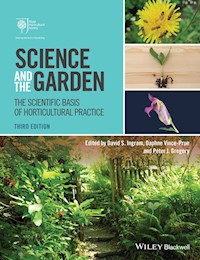
Cover images: Large image [of garden steps and gate; Fig. 1.1 in 3rd edition] - Photograph © David S. Ingram. Top small image [flower with hoverflies; Fig. 18.3c in 3rd edition] - Photograph © and reproduced courtesy of the University of Warwick.
Centre small image [rooted cutting; Fig. 11.5c in 3rd edition] - Photograph © and courtesy of the Royal Horticultural Society. Bottom small image [half flower of Antirrhinum; Fig. 3.5 in 3rd edition] - Scan and © John Bebbington, FRPS.
Contents
Preface to third edition
Preface to second edition
Preface to first edition
Chapter 1 Diversity in the plant world
Summary
Introduction
Creating order out of disorder
Colonisation of the land
Communities and the diversity of life forms
Conclusion
Further reading
Authors and affiliations
Chapter 2 The plant body: structure and function
Summary
Introduction
Energy flow in the biosphere: photosynthesis and respiration
The leaf: into the labyrinth
The stem: reach for the sky
The root: mining for minerals and water
Conclusion
Further reading
Authors and affiliations
Chapter 3 Reproduction: securing the future
Summary
Introduction
Vegetative reproduction
Sexual reproduction
Conclusion
Further reading
Authors and affiliations
Chapter 4 Naming plants
Summary
Introduction
Latin botanical names
Taxonomy: order in diversity
Cultivated plant taxonomy
Why plants change their names
The quest for stability and linking information systems
How to identify a plant
Conclusion
Further reading
Authors and affiliations
Chapter 5 Selecting and breeding plants
Summary
Introduction: adaptation and design
Genes
Genomes
Mutation
Heterozygosity and homozygosity
Breeding systems
Recombinant DNA technology
Conclusion
Further reading
Authors and affiliations
Chapter 6 Soils and roots
Summary
Introduction
How soils are formed
Physical properties of soils
Chemical properties of soils
Biological properties of soils
Roots and soils
Conclusion
Further reading
Authors and affiliations
Chapter 7 Soil cultivation and fertility
Summary
Cultivating the soil
Managing soil nutrients
Sources of the major plant nutrients
Fertilisers
Manures
Composts
Managing soil pH
Managing water
Conclusion
Further reading
Authors and affiliations
Chapter 8 The plant environment: light and water
Summary
Introduction
Light and photosynthesis
The effects of shade
Water
Physical structures that help to conserve water
Biochemical pathways that help conserve water
Salinity
Too much water
Aquatic plants
Watering in the garden
Choosing plants for particular conditions
Conclusion
Further reading
Authors and affiliations
Chapter 9 Plants and the seasons
Summary
Introduction
Day-length
Temperature
Direct effects of temperature on flowering
Conclusion
Further reading
Authors and affiliations
Chapter 10 Growing plants from seed
Summary
Introduction
Seed production and germination
Seed storage
Dormancy
Germination
Some practical considerations
Collecting seeds, and F1 hybrids
Further reading
Authors and affiliations
Chapter 11 Vegetative propagation
Summary
Introduction
Characteristics of vegetative propagation and its value to gardeners
How plants regenerate
Practical propagation
Conclusion
Further reading
Authors and affiliations
Chapter 12 Size and form
Summary
Introduction
How size is controlled
Form and size can be manipulated by the gardener
Conclusions
Further reading
Authors and affiliations
Chapter 13 Colour, scent and sound in the garden
Summary
Introduction
Colour in plants
Variegation
Environmental factors influencing colour
The use of colour in the garden
Scent and flavour
Scent wheels
Sound
Conclusion
Further reading
Authors and affiliations
Chapter 14 Climate and weather
Summary
Introduction
Temperature
Precipitation
Wind
Pressure
Light
Seasonality
Climate
Conclusion
Further reading
Authors and affiliations
Chapter 15 Climate and other environmental changes
Summary
Global environmental change
Changes in atmospheric composition
Climate change and climate variation
Changes in nutrient cycles
Other environmental changes
Conclusions
Further reading
Authors and affiliations
Chapter 16 Protected cultivation
Summary
Why protect plants?
What are the benefits?
Principles of protection
Cladding materials
Types of protection
Systems to be added
Does protection have disadvantages?
Crops grown under protection
Conclusions
Further reading
Authors and affiliations
Chapter 17 The diversity of the undesirables
Summary
Introduction
Pests
Diseases
Weeds
Intraspecific diversity
Deciding whether an organism is a problem
Poisonous and irritant plants
Conclusion
Further reading and sources of information
Authors and affiliations
Chapter 18 Controlling the undesirables
Summary
Introduction
Keeping out the undesirables
Know your enemy
Control
Conclusions
Further reading and sources of information
Authors and affiliations
Chapter 19 Maturation, ripening and storage
Summary
Introduction
Changes in metabolism and ethylene synthesis
Maturation and ripening
Pre-harvest influences on storage quality
Harvesting, handling and preparation for storage
Post-harvest treatments
The storage environment
Trends in commercial storage
Non-commercial storage
Conclusion
Further reading
Authors and affiliations
Chapter 20 Garden ecology
Summary
Ecology and ecosystems
Habitats
Biodiversity
Conclusions
Further reading
Authors and affiliations
Chapter 21 Garden wildlife and conservation
Summary
Natives and aliens
Gardens and the wider environment
Conservation in gardens
Conclusions
Websites and further reading
Authors and affiliations
Chapter 22 Low-input and low-impact gardening
Summary
Introduction
Conservation of resources in the garden
Wildlife
Carbon and greenhouse gas emissions
Conclusions
Further reading
Authors and affiliations
Chapter 23 Health, well-being and socio-cultural benefits
Summary
Gardens and ecosystem service provision
Why garden?
Gardens and green therapy
Restorative landscapes
Horticultural therapy
Health risks
Crime and antisocial behaviour
Social and educational opportunities
Children and green space
Encouraging a balanced diet
Gardening and attitudes to the wider environment
Conclusions
Further reading
Author and affiliations
Chapter 24 Gardens for science
Summary
Introduction
Botanic gardens
The gardens of horticultural societies
Private and small commercial gardens
Universities and independent research institutes
Conclusion
Further reading
Authors and affiliations
Glossary
Index
EULA
List of Tables
Chapter 1
Table 1.1
Table 1.2
Table 1.3
Table 1.4
Chapter 2
Table 2.1
Chapter 4
Table 4.1
Chapter 6
Table 6.1
Table 6.2
Table 6.3
Chapter 7
Table 7.1
Table 7.2
Table 7.3
Table 7.4
Table 7.5
Table 7.6
Table 7.7
Chapter 8
Table 8.1
Table 8.2
Table 8.3
Chapter 9
Table 9.1
Table 9.2
Table 9.3
Table 9.4
Table 9.5
Table 9.6
Table 9.7
Table 9.8
Table 9.9
Chapter 10
Table 10.1
Table 10.2
Chapter 13
Table 13.1
Table 13.2
Chapter 14
Table 14.1
Table 14.2
Table 14.3
Table 14.4
Table 14.5
Chapter 15
Table 15.1
Chapter 16
Table 16.1
Chapter 17
Table 17.1
Table 17.2
Table 17.3
Chapter 19
Table 19.1
Chapter 20
Table 20.1
Table 20.2
Table 20.3
Table 20.4
Table 20.5
Table 20.6
Chapter 21
Table 21.1
Chapter 22
Table 22.1
Table 22.2
Chapter 23
Table 23.1
Chapter 24
Table 24.1
Table 24.2
Table 24.3
Table 24.4
List of Illustrations
Chapter 1
Figure 1.1
‘The most remarkable thing about plants is that they are green.’ Entrance to the ‘Professor’s Garden’ at Brantwood, Coniston, Cumbria. Photograph by David S. Ingram.
Figure 1.2
It is the usual experience that inanimate things, left to themselves, like this VW Beetle, eventually reach a state of disorder. In contrast, living things, like the plants of oilseed rape that surround it, are able to create order out of disorder, assembling atoms and molecules to form tissues and bodies of great complexity and sophistication. Photograph by David S. Ingram.
Figure 1.3
A chain of cells of the cyanobacterium (blue-green)
Anabaena
. Light microscope photograph by Patrick Echlin.
Figure 1.4
Chloroplasts in the cells of a moss leaf. Light microscope photograph by Patrick Echlin.
Lesen Sie weiter in der vollständigen Ausgabe!
Lesen Sie weiter in der vollständigen Ausgabe!
Lesen Sie weiter in der vollständigen Ausgabe!
Lesen Sie weiter in der vollständigen Ausgabe!
Lesen Sie weiter in der vollständigen Ausgabe!
Lesen Sie weiter in der vollständigen Ausgabe!
Lesen Sie weiter in der vollständigen Ausgabe!
Lesen Sie weiter in der vollständigen Ausgabe!
Lesen Sie weiter in der vollständigen Ausgabe!
Lesen Sie weiter in der vollständigen Ausgabe!
Lesen Sie weiter in der vollständigen Ausgabe!
Lesen Sie weiter in der vollständigen Ausgabe!
Lesen Sie weiter in der vollständigen Ausgabe!
Lesen Sie weiter in der vollständigen Ausgabe!
Lesen Sie weiter in der vollständigen Ausgabe!
Lesen Sie weiter in der vollständigen Ausgabe!
Lesen Sie weiter in der vollständigen Ausgabe!
Lesen Sie weiter in der vollständigen Ausgabe!
Lesen Sie weiter in der vollständigen Ausgabe!
Lesen Sie weiter in der vollständigen Ausgabe!
Lesen Sie weiter in der vollständigen Ausgabe!
Lesen Sie weiter in der vollständigen Ausgabe!
Lesen Sie weiter in der vollständigen Ausgabe!
Lesen Sie weiter in der vollständigen Ausgabe!
Lesen Sie weiter in der vollständigen Ausgabe!
Lesen Sie weiter in der vollständigen Ausgabe!
Lesen Sie weiter in der vollständigen Ausgabe!
Lesen Sie weiter in der vollständigen Ausgabe!
Lesen Sie weiter in der vollständigen Ausgabe!
Lesen Sie weiter in der vollständigen Ausgabe!




