


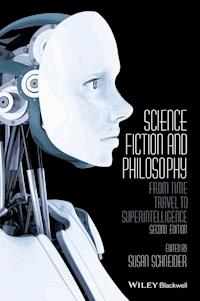
Science Fiction and Philosophy E-Book
15,99 €
Mehr erfahren.
- Herausgeber: John Wiley & Sons
- Kategorie: Geisteswissenschaft
- Sprache: Englisch
Featuring numerous updates and enhancements, Science Fiction and Philosophy, 2nd Edition, presents a collection of readings that utilize concepts developed from science fiction to explore a variety of classic and contemporary philosophical issues.
- Uses science fiction to address a series of classic and contemporary philosophical issues, including many raised by recent scientific developments
- Explores questions relating to transhumanism, brain enhancement, time travel, the nature of the self, and the ethics of artificial intelligence
- Features numerous updates to the popular and highly acclaimed first edition, including new chapters addressing the cutting-edge topic of the technological singularity
- Draws on a broad range of science fiction’s more familiar novels, films, and TV series, including I, Robot, The Hunger Games, The Matrix, Star Trek, Blade Runner, and Brave New World
- Provides a gateway into classic philosophical puzzles and topics informed by the latest technology
Sie lesen das E-Book in den Legimi-Apps auf:
Seitenzahl: 897
Veröffentlichungsjahr: 2015
Ähnliche




















Table of Contents
Cover
Title Page
Introduction
Part I: Could I Be in a “Matrix” or Computer Simulation?
Part II: What Am I? Free Will and the Nature of Persons
Part III: Mind: Natural, Artificial, Hybrid, Alien and “Superintelligent”
Part IV: Ethical and Political Issues
Part V: Space and Time
Conclusion
References
Part I: Could I Be in a “Matrix” or Computer Simulation?
1 Reinstalling Eden: Happiness on a Hard Drive
2 Are You in a Computer Simulation?
3 Plato’s Cave. Excerpt from
The Republic
4 Some Cartesian thought Experiments. Excerpt from
The Meditations on First Philosophy
Of the Things of which we May Doubt
5
The Matrix
as Metaphysics
I. Brains in Vats
II. Envatment Reconsidered
III. The Metaphysical Hypothesis
IV. The Matrix Hypothesis as a Metaphysical Hypothesis
V. Life in the Matrix
VI. Objections
VII. Other Skeptical Hypotheses
Part II: What Am I? Free Will and the Nature of Persons
6 Where Am I?
7 Personal Identity
1. The Problems of Personal Identity
2. Understanding the Persistence Question
3. Accounts of Our Identity through Time
4. Psychological-Continuity Views
5. Fission
6. The Too-Many-Thinkers Problem
7. Brute-Physical Views
8. Wider Themes
Bibliography
8 Divided Minds and the Nature of Persons
The Ego Theory and the Bundle Theory
What We Believe Ourselves to Be
How We Are Not What We Believe
How the Split-Brain Cases Support the Bundle Theory
9 Who Am I? What Am I?
10 Free Will and Determinism in the World of
Minority Report
Hard Determinism and the Threat to Free Will
The Soft Determinist Gambit
On Behalf of Freedom
The Verdict on Precrime
11 Excerpt from “The Book of Life: A Thought Experiment”
Part III: Mind: Natural, Artificial, Hybrid, and Superintelligent
12 Robot Dreams
13 A Brain Speaks
14 Cyborgs Unplugged
Rats in Space
Implant and Mergers
A Day in the Life
Dovetailing
15 Superintelligence and Singularity
The Intuitive Linear View Versus the Historical Exponential View
The Six Epochs
The Singularity Is Near
16 The Singularity: A Philosophical Analysis
1. Introduction
2. The Argument for a Singularity
3. The Intelligence Explosion Without Intelligence
4. Obstacles to the Singularity
5. Negotiating the Singularity
6. Internal Constraints: Constraining Values
7. External Constraints: The Leakproof Singularity
8. Integration into a Post-Singularity World
9. Uploading and Consciousness
10. Uploading and Personal Identity
11. Conclusions
Bibliography
17 Alien Minds
Alien Superintelligence
Would Superintelligent Aliens Be Conscious?
How Might Superintelligent Aliens Think?
Conclusion
References
Part IV: Ethical and Political Issues
18 The Man on the Moon
Holy Wars
Unholy Wars
The Man on the Moon
Genetic Engineering
Toward the Posthuman
New Crusades
19
Mindscan
: Transcending and Enhancing the Human Brain
The Transhumanist Position
The Nature of Persons
Robert Sawyer’s
Mindscan
and the Reduplication Problem
A Response to the Reduplication Problem
Two Issues that Modified Patternism Needs to Address
Conclusion
References
20 The Doomsday Argument
21 The Last Question
22 Asimov’s “Three Laws of Robotics” and Machine Metaethics
Introduction
“The Bicentennial Man”
Machine Metaethics
Characteristic(s) Necessary To Have Moral Standing
Why the Three Laws are Unsatisfactory even if Machines Don’t have Moral Standing
Conclusion
References
23 The Control Problem. Excerpts from
Superintelligence: Paths, Dangers, Strategies
Two Agency Problems
Capability Control Methods
Motivation Selection Methods
Synopsis
References
Part V: Space and Time
24 A Sound of Thunder
25 Time
The Flow of Time
The Space-Time Theory
Arguments against the Space-Time Theory: Change, Motion, Causes
26 The Paradoxes of Time Travel
27 The Quantum Physics of Time Travel
28 Miracles and Wonders
Humeans on Miracles
Three Modern Miracle Mongers
Three of my Favorite Sci-Fi Things: Time Travel, Other Dimensions, and Simulations
Simulation Epistemology and Metaphysics
An Argument for Miracles
References
Appendix: Philosophers Recommend Science Fiction
Novels and Short Stories
Movies and Television
Index
End User License Agreement
List of Tables
Chapter 23
Table 23.1 Different kinds of tripwires
Table 23.2 Control methods
List of Illustrations
Introduction
Figure I.1 Plato’s Cave
Chapter 15
Figure 15.1
Linear versus exponential
: linear growth is steady; exponential growth becomes explosive.
Figure 15.2
The Six Epochs of Evolution
: Evolution works through indirection: it creates a capability and then uses that capability to evolve the next stage.
Figure 15.3
Countdown to Singularity
: Biological evolution and human technology both show continual acceleration, indicated by the shorter time to the next event (two billion years from the origin of life to cells; fourteen years from the PC to the World Wide Web).
Figure 15.4
Linear view of evolution
: This version of the preceding figure uses the same data but with a linear scale for time before present instead of a logarithmic one. This shows the acceleration more dramatically, but details are not visible. From a linear perspective, most key events have just happened “recently.”
Figure 15.5
Fifteen views of evolution
: Major paradigm shifts in the history of the world, as seen by fifteen different lists of key events. There is a clear trend of smooth acceleration through biological and then technological evolution.
Figure 15.6 Canonical milestones based on clusters of events from thirteen lists.
Figure 15.7
A mathematical singularity
: As
x
approaches zero (from right to left), 1/
x
(or
y
) approaches infinity.
Chapter 19
Figure 19.1
Figure 19.2
Chapter 25
Figure 25.1 The movement of a train defined by reference to time
Figure 25.2 The moving of the present moment
Figure 25.3 High-school physics graph of a particle moving through time
Figure 25.4 Space-time diagram
Figure 25.5 Where is the “real here”?
Figure 25.6 “Now” for me and for Guy Fawkes
Figure 25.7 Moving back and forth in space
Figure 25.8 Moving back and forth in time, temporal axis vertical
Figure 25.9 Moving back and forth in time, temporal axis horizontal
Chapter 27
Figure 27.1 GRANDFATHER PARADOX, in which a time traveler prevents his or her own birth, is a stock objection to time travel.
Figure 27.2 SPACE AND TIME are combined into one four-dimensional entity, space-time. Here we show two space dimensions and time. A worldline connects all events in our life in space-time; since we have some size, a person’s worldline is more like a worm extending from birth to death than a line. The worldlines of light rays emanating in all space directions from an event trace out a cone in space-time, called a lightcone. The worldline of any object, such as the navel of this figure, cannot stray outside a lightcone emanating from any point in its past.
Figure 27.3 CLOSED TIMELIKE CURVE can be formed if space-time loops around. Entering such a curve tomorrow and moving forward in time, we can end up at today.
Figure 27.4 NEUTRON DECAY can occur at any time, though some times are more likely than others. For each instant in which the neutron might decay, there is a universe in which it decays at that instant, according to Everett’s multiverse interpretation of quantum mechanics.
Figure 27.5 MULTIVERSE PICTURE OF REALITY unravels the time-travel paradoxes. Sonia plans to enter the time machine tomorrow and travel back to today but resolves that if she emerges from the time machine today, she will not enter tomorrow. She is able to carry out this plan, without paradox. In a B-universe she does not emerge today and so enters the time machine tomorrow. She then emerges today, but in an A-universe, and meets her copy – who does not enter the time machine.
Guide
Cover
Table of Contents
Begin Reading
Pages
ii
iii
iv
iv
v
1
2
3
4
5
6
7
8
9
10
11
12
13
14
15
16
17
19
20
21
22
23
24
25
26
27
28
29
30
31
33
34
32
35
36
37
38
39
40
41
42
43
44
45
46
47
48
49
50
51
52
53
54
55
57
58
59
60
61
62
63
64
65
66
67
68
69
70
71
72
73
74
75
76
77
78
79
80
81
82
83
84
85
86
87
88
89
90
91
92
93
94
95
96
97
98
99
100
101
102
103
104
105
106
107
108
109
110
111
112
113
114
115
117
118
119
120
121
122
123
124
125
126
127
128
129
130
131
132
133
134
135
136
137
138
139
140
141
142
143
144
145
146
147
148
149
150
151
152
153
158
159
154
155
156
157
160
161
162
163
164
165
166
167
168
169
170
171
172
173
174
175
176
177
178
179
180
181
182
183
184
185
186
187
188
189
190
191
192
193
194
195
196
197
198
199
200
201
202
203
204
205
206
207
208
209
210
211
212
213
214
215
216
217
224
218
222
223
219
220
221
225
226
227
228
229
230
231
232
233
234
235
236
237
238
239
240
241
242
243
244
245
246
247
248
249
250
251
252
253
254
255
256
257
258
259
260
261
262
263
264
265
266
267
268
269
270
271
272
273
274
275
276
277
278
279
280
281
282
283
284
285
286
287
288
289
290
291
292
293
294
295
296
297
298
299
300
301
302
303
304
305
306
307
308
309
310
311
312
313
314
315
316
317
318
319
320
321
322
323
324
325
326
327
328
329
330
331
333
334
335
336
337
338
339
340
341
342
343
344
345
346
347
348
349
350
351
352
353
354
355
356
357
358
359
360
361
362
363
364
365
366
367
368
369
370
371
372
373
374
375
376
377
378
379
380
381
382
383
384
385
386
387
388
389
390
391
392
393
394
395
396
397
398
399
400
401
402
403
404
405
406
407
408
409
410
411
412
413
414
415
416
417
418
419
420
421
422
Praise for the First Edition
“… a successful marriage of art with analytic philosophy.”
Mind & Machines, Fall 2010
“Susan Schneider is the Sarah Connor of philosophy as she ponders the role of science fiction and thought experiments to help understand uploading, time travel, superintelligence, the singularity, consciousness … and physicalism. Hasta La Vista baby.
” Richard Marshall, 3Quarks Daily
“Science Fiction and Philosophy brings two areas together and into a dialogue … science fiction reminds philosophy that all reason and no play makes thought a very dull thing indeed.
” Discover Magazine, November 2010
“Looking over the pages one can see Schneider’s attention to detail … Schneider has obviously made her choices for their accessibility and we should applaud her for this.
” Metapsychology
“I’ve always said that science fiction is a lousy name for this field; it’s really philosophical fiction: phi-fi not sci-fi! This book proves that with its penetrating analysis of the genre’s treatment of deep questions of reality, personhood, and ethics.”
Robert J. Sawyer, Hugo Award-winning author of Hominids
Science Fiction and Philosophy
From Time Travel to Superintelligence
SECOND EDITION
Edited by
Susan Schneider
This second edition first published 2016Editorial material and organization © 2016 John Wiley & Sons, Inc.
Edition history: Blackwell Publishing Ltd (1e, 2009)
Registered OfficeJohn Wiley & Sons, Ltd, The Atrium, Southern Gate, Chichester, West Sussex, PO19 8SQ, UK
Editorial Offices350 Main Street, Malden, MA 02148-5020, USA9600 Garsington Road, Oxford, OX4 2DQ, UKThe Atrium, Southern Gate, Chichester, West Sussex, PO19 8SQ, UK
For details of our global editorial offices, for customer services, and for information about how to apply for permission to reuse the copyright material in this book please see our website at www.wiley.com/wiley-blackwell.
The right of Susan Schneider to be identified as the author of the editorial material in this work has been asserted in accordance with the UK Copyright, Designs and Patents Act 1988.
All rights reserved. No part of this publication may be reproduced, stored in a retrieval system, or transmitted, in any form or by any means, electronic, mechanical, photocopying, recording or otherwise, except as permitted by the UK Copyright, Designs and Patents Act 1988, without the prior permission of the publisher.
Wiley also publishes its books in a variety of electronic formats. Some content that appears in print may not be available in electronic books.
Designations used by companies to distinguish their products are often claimed as trademarks. All brand names and product names used in this book are trade names, service marks, trademarks or registered trademarks of their respective owners. The publisher is not associated with any product or vendor mentioned in this book.
Limit of Liability/Disclaimer of Warranty: While the publisher and author have used their best efforts in preparing this book, they make no representations or warranties with respect to the accuracy or completeness of the contents of this book and specifically disclaim any implied warranties of merchantability or fitness for a particular purpose. It is sold on the understanding that the publisher is not engaged in rendering professional services and neither the publisher nor the author shall be liable for damages arising herefrom. If professional advice or other expert assistance is required, the services of a competent professional should be sought.
Library of Congress Cataloging-in-Publication Data
Names: Schneider, Susan, 1968– editor.Title: Science fiction and philosophy : from time travel to superintelligence/ edited by Susan Schneider.Description: Second edition. | Hoboken : Wiley, 2016. | Includes bibliographical references and index.Identifiers: LCCN 2015038424 (print) | LCCN 2015039864 (ebook) | ISBN 9781118922613 (pbk.) | ISBN 9781118922620 (pdf) | ISBN 9781118922606 (epub)Subjects: LCSH: Science fiction–Philosophy. | Philosophy–Introductions. | Philosophy in literature.Classification: LCC PN3433.6 .S377 2016 (print) | LCC PN3433.6 (ebook) | DDC 809.3/8762–dc23LC record available at http://lccn.loc.gov/2015038424
A catalogue record for this book is available from the British Library.
Cover image: © magictorch / Getty Images
For Dave – stellar shipmate throughout life’s journeys and fellow lover of science fiction
IntroductionThought Experiments: Science Fiction as a Window into Philosophical Puzzles
Susan Schneider
Let us open the door to age-old questions about our very nature, the nature of the universe, and whether there are limits to what we, as humans, can understand. But as old as these issues are, let us do something relatively new – let us borrow from the world of science fiction thought experiments to fire the philosophical imagination. Good science fiction rarely disappoints; good philosophy more rarely still.
Thought experiments are imagination’s fancies; they are windows into the fundamental nature of things. A philosophical thought experiment is a hypothetical situation in the “laboratory of the mind” that depicts something that often exceeds the bounds of current technology or even is incompatible with the laws of nature, but that is supposed to reveal something philosophically enlightening or fundamental about the topic in question. Thought experiments can demonstrate a point, entertain, illustrate a puzzle, lay bare a contradiction in thought, and move us to provide further clarification. Indeed, thought experiments have a distinguished intellectual history. Both the creation of relativity and the interpretation of quantum mechanics rely heavily upon thought experiments. Consider, for instance, Einstein’s elevator and Schrödinger’s cat. And philosophers, perhaps even more than physicists, make heavy use of thought experiments. René Descartes, for instance, asked us to imagine that the physical world around us was an elaborate illusion. He imagined that the world was merely a dream or, worse yet, a hoax orchestrated by an evil demon bent on deceiving us. He then asked: How can we really be certain that we are not deceived in either of these ways? (See Descartes’ piece, Chapter 4 in this volume.) Relatedly, Plato asked us to imagine prisoners who had been shackled in a cave for as long as they can remember. They face a wall. Behind them is a fire. Between the prisoners and the fire is a pathway, where men walk, carrying vessels, statues, and other objects (see Figure I.1).
Figure I.1 Plato’s Cave
As the men walk behind the prisoners, they and the objects they carry cast shadows on the cave wall. The prisoners are thus not able to see the actual men and objects; their world is merely a world of shadows. Knowing nothing of the real causes of the shadows, the prisoners would naturally mistake these shadows for the real nature of things. Plato then asked: Is this analogous to our own understanding of reality? That is, is the human condition such that our grasp of reality is only partial, catching only the slightest glimpse into the true nature of things, like the prisoners’ world of shadows?
Lesen Sie weiter in der vollständigen Ausgabe!
Lesen Sie weiter in der vollständigen Ausgabe!
Lesen Sie weiter in der vollständigen Ausgabe!
Lesen Sie weiter in der vollständigen Ausgabe!
Lesen Sie weiter in der vollständigen Ausgabe!
Lesen Sie weiter in der vollständigen Ausgabe!
Lesen Sie weiter in der vollständigen Ausgabe!
Lesen Sie weiter in der vollständigen Ausgabe!
Lesen Sie weiter in der vollständigen Ausgabe!
Lesen Sie weiter in der vollständigen Ausgabe!
Lesen Sie weiter in der vollständigen Ausgabe!
Lesen Sie weiter in der vollständigen Ausgabe!
Lesen Sie weiter in der vollständigen Ausgabe!
Lesen Sie weiter in der vollständigen Ausgabe!
Lesen Sie weiter in der vollständigen Ausgabe!
Lesen Sie weiter in der vollständigen Ausgabe!
Lesen Sie weiter in der vollständigen Ausgabe!
Lesen Sie weiter in der vollständigen Ausgabe!
Lesen Sie weiter in der vollständigen Ausgabe!
Lesen Sie weiter in der vollständigen Ausgabe!
Lesen Sie weiter in der vollständigen Ausgabe!
Lesen Sie weiter in der vollständigen Ausgabe!
Lesen Sie weiter in der vollständigen Ausgabe!
Lesen Sie weiter in der vollständigen Ausgabe!
Lesen Sie weiter in der vollständigen Ausgabe!
Lesen Sie weiter in der vollständigen Ausgabe!
Lesen Sie weiter in der vollständigen Ausgabe!
Lesen Sie weiter in der vollständigen Ausgabe!
Lesen Sie weiter in der vollständigen Ausgabe!
Lesen Sie weiter in der vollständigen Ausgabe!
Lesen Sie weiter in der vollständigen Ausgabe!
Lesen Sie weiter in der vollständigen Ausgabe!
Lesen Sie weiter in der vollständigen Ausgabe!
Lesen Sie weiter in der vollständigen Ausgabe!
Lesen Sie weiter in der vollständigen Ausgabe!
Lesen Sie weiter in der vollständigen Ausgabe!




