


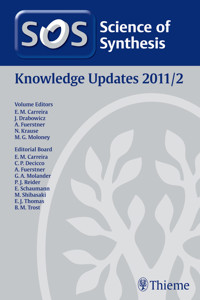
Science of Synthesis Knowledge Updates 2011 Vol. 2 E-Book
2.799,99 €
Mehr erfahren.
- Herausgeber: Thieme
- Kategorie: Wissenschaft und neue Technologien
- Sprache: Englisch
The Science of Synthesis Editorial Board,together with the volume editors and authors, is constantly reviewing the whole field of synthetic organic chemistry as presented in Science of Synthesis and evaluating significant developments in synthetic methodology. Four annual volumes updating content across all categories ensure that you always have access to state-of-the-art synthetic methodology.
Content of this volume: Organometallic Complexes of Gold, Benzylstannanes, Allylstannanes, Furans, Thiophenes, Thiophene 1,1-Dioxides, and Thiophene 1-Oxides, Synthesis with Retention of the Functional Group, Alkanesulfonic Acids and Acyclic Derivatives.
Das E-Book können Sie in Legimi-Apps oder einer beliebigen App lesen, die das folgende Format unterstützen:
Seitenzahl: 1047
Veröffentlichungsjahr: 2014
Ähnliche




















Science of Synthesis
Science of Synthesis is the authoritative and comprehensive reference work for the entire field of organic and organometallic synthesis.
Science of Synthesis presents the important synthetic methods for all classes of compounds and includes:
Methods critically evaluated by leading scientists
Background information and detailed experimental procedures
Schemes and tables which illustrate the reaction scope
Preface
As the pace and breadth of research intensifies, organic synthesis is playing an increasingly central role in the discovery process within all imaginable areas of science: from pharmaceuticals, agrochemicals, and materials science to areas of biology and physics, the most impactful investigations are becoming more and more molecular. As an enabling science, synthetic organic chemistry is uniquely poised to provide access to compounds with exciting and valuable new properties. Organic molecules of extreme complexity can, given expert knowledge, be prepared with exquisite efficiency and selectivity, allowing virtually any phenomenon to be probed at levels never before imagined. With ready access to materials of remarkable structural diversity, critical studies can be conducted that reveal the intimate workings of chemical, biological, or physical processes with stunning detail.
The sheer variety of chemical structural space required for these investigations and the design elements necessary to assemble molecular targets of increasing intricacy place extraordinary demands on the individual synthetic methods used. They must be robust and provide reliably high yields on both small and large scales, have broad applicability, and exhibit high selectivity. Increasingly, synthetic approaches to organic molecules must take into account environmental sustainability. Thus, atom economy and the overall environmental impact of the transformations are taking on increased importance.
The need to provide a dependable source of information on evaluated synthetic methods in organic chemistry embracing these characteristics was first acknowledged over 100 years ago, when the highly regarded reference source Houben–Weyl Methoden der Organischen Chemie was first introduced. Recognizing the necessity to provide a modernized, comprehensive, and critical assessment of synthetic organic chemistry, in 2000 Thieme launched Science of Synthesis, Houben–Weyl Methods of Molecular Transformations. This effort, assembled by almost 1000 leading experts from both industry and academia, provides a balanced and critical analysis of the entire literature from the early 1800s until the year of publication. The accompanying online version of Science of Synthesis provides text, structure, substructure, and reaction searching capabilities by a powerful, yet easy-to-use, intuitive interface.
From 2010 onward, Science of Synthesis is being updated quarterly with high-quality content via Science of Synthesis Knowledge Updates. The goal of the Science of Synthesis Knowledge Updates is to provide a continuous review of the field of synthetic organic chemistry, with an eye toward evaluating and analyzing significant new developments in synthetic methods. A list of stringent criteria for inclusion of each synthetic transformation ensures that only the best and most reliable synthetic methods are incorporated. These efforts guarantee that Science of Synthesis will continue to be the most up-to-date electronic database available for the documentation of validated synthetic methods.
Also from 2010, Science of Synthesis includes the Science of Synthesis Reference Library, comprising volumes covering special topics of organic chemistry in a modular fashion, with six main classifications: (1) Classical, (2) Advances, (3) Transformations, (4) Applications, (5) Structures, and (6) Techniques. Titles will include Stereoselective Synthesis, Water in Organic Synthesis, and Asymmetric Organocatalysis, among others. With expert-evaluated content focusing on subjects of particular current interest, the Science of Synthesis Reference Library complements the Science of Synthesis Knowledge Updates, to make Science of Synthesis the complete information source for the modern synthetic chemist.
The overarching goal of the Science of Synthesis Editorial Board is to make the suite of Science of Synthesis resources the first and foremost focal point for critically evaluated information on chemical transformations for those individuals involved in the design and construction of organic molecules.
Throughout the years, the chemical community has benefited tremendously from the outstanding contribution of hundreds of highly dedicated expert authors who have devoted their energies and intellectual capital to these projects. We thank all of these individuals for the heroic efforts they have made throughout the entire publication process to make Science of Synthesis a reference work of the highest integrity and quality.
July 2010
The Editorial Board
E. M. Carreira (Zurich, Switzerland)
C. P. Decicco (Princeton, USA)
A. Fuerstner (Muelheim, Germany)
G. A. Molander (Philadelphia, USA)
P. J. Reider (Princeton, USA)
E. Schaumann (Clausthal-Zellerfeld, Germany)
M. Shibasaki (Tokyo, Japan)
E. J. Thomas (Manchester, UK)
B. M. Trost (Stanford, USA)
Abstracts
3.6.11 Organometallic Complexes of Gold (Update 1)
V. López-Carrillo and A. M. Echavarren
The topic of this update is gold-catalyzed cycloisomerization of enynes.
Gold(I) catalysts are the most alkynophilic amongst the electrophilic metals that catalyze the cyclization of 1,n-enynes leading to a wide diversity of cyclic structures under mild conditions. This section reviews the major gold-catalyzed cycloisomerization pathways as well as cyclization reactions that occur with concomitant addition of heteroand carbonucleophiles.
Keywords: gold · enynes · alkynes · cyclization · cycloisomerization · rearrangement
3.6.12 Organometallic Complexes of Gold (Update 2)
L. Zhang
The topic of this update is gold-catalyzed propargylic rearrangement.
Gold-catalyzed 3,3-rearrangements of propargylic carboxylates lead to the formation of carboxyallenes, which can subsequently undergo a range of fascinating in situ transformations, leading to various versatile functional structures.
Keywords: gold · catalysis · rearrangement · oxidation · cross coupling · cyclization · nucleophile · electrophile · oxocarbenium · propargyl · allene · enyne · diene
3.6.13 Organometallic Complexes of Gold (Update 3)
M. N. Hopkinson and V. Gouverneur
The topic of this update is gold-catalyzed coupling reactions.
This chapter covers homo- and cross-coupling reactions mediated by gold complexes under homogeneous conditions. In the first two sections, coupling reactions mediated by stoichiometric gold(III) complexes and catalytic cross-coupling reactions involving oxidative addition to gold(I) are presented. This is followed in the subsequent two sections by a discussion of recently developed gold-catalyzed homo- and cross-coupling processes using external oxidants.
Keywords: gold · cross coupling · homocoupling · carbon—carbon bond formation · oxidation · cascade reactions · C—H functionalization · cyclization · rearrangement · fluorination
5.2.27 Product Subclass 27: Benzylstannanes
J. S. Snaith
This manuscript is a revision of an earlier Science of Synthesis contribution describing methods for the synthesis of benzylstannanes. The principal routes to benzylstannanes are discussed, the most important being those involving stannyl metal species and benzyl halides or benzyl metal species and stannyl halides, including Barbier reactions. Also discussed are methods for the synthesis of enantiomerically enriched benzylstannanes via enantioselective deprotonation and stannylation at benzylic centers.
Keywords: Barbier reaction · benzylic compounds · C—Sn bonds · Grignard reagents · lithium compounds · stannanes · Stille coupling · transmetalation · tin compounds
5.2.28 Product Subclass 28: Allylstannanes
J. S. Snaith
This manuscript is a revision of an earlier Science of Synthesis contribution describing methods for the synthesis of allylstannanes. The principal routes to allylstannanes are discussed, with the most important being those involving stannylmetal species and allyl halides or allylmetal species and stannyl halides, including Barbier reactions. Other important methods discussed include palladium-catalyzed reactions with allylic acetates, reactions of allylic sulfur derivatives, eliminations, stannylation of allenes, and the reaction of stannyl anion equivalents with carbonyls.
Keywords: allylstannanes · stannanes · Barbier reaction · carbon—tin bonds · allylic compounds · Grignard reagents · lithium compounds · tin compounds · Stille coupling · transmetalation · allylation · radicals
9.9.5 Furans
X.-L. Hou, X.-S. Peng, K.-S. Yeung, and H. N. C. Wong
This manuscript is an update to the earlier Science of Synthesis contribution describing methods for the synthesis of substituted furans. It focuses on the literature published between 1999 and early 2010.
Keywords: substituted furans · cyclization · cycloisomerization · electrophilic · nucleophilic · replacement · catalytic · multicomponent reaction · coupling reaction · regioselectivity · rearrangement
9.10.4 Thiophenes, Thiophene 1,1-Dioxides, and Thiophene 1-Oxides
J. Schatz and M. Seßler
This manuscript is an update to the earlier Science of Synthesis contribution describing methods for the synthesis of thiophenes. The main focus lies on modern synthetic transformations, such as transition-metal-mediated coupling reactions, leading to functionalized thiophenes. Owing to the increasing interest in organic materials based on the thiophene skeleton, oligothiophenes are discussed separately within this manuscript, in ▶ Section 9.10.4.2.
Keywords: thiophenes · five-membered rings · ring formation · halogenation · oxidation · cross-coupling reactions · oligomerizations
20.5.1.7.15 Synthesis with Retention of the Functional Group
G. Landelle and J.-F. Paquin
This manuscript is an update to the earlier Science of Synthesis contribution describing methods for the conjugate addition to unsaturated esters. It focuses on the literature published in the period 1990–2010.
Keywords: conjugate addition · carboxylic esters · unsaturated compounds · organometallic reagents · stereoselectivity · regioselectivity
39.1.15 Alkanesulfonic Acids and Acyclic Derivatives
P. Łyżwa
This section describes the applications of alkanesulfonyl halides in organic synthesis, for example their use as protecting groups, in the synthesis of thiols, disulfides, sulfinic acids, sulfones, in C—C and C=C bond-forming reactions, epoxidation, and lactone inversion.
Keywords: alcohols · amines · alkanethiols · dialkyl disulfides · sulfones · cyclization · inversion · aldehydes · thioacetals
Science of Synthesis Knowledge Updates 2011/2
Preface
Abstracts
Table of Contents
3.6.11 Organometallic Complexes of Gold (Update 1, 2011)
V. López-Carrillo and A. M. Echavarren
3.6.12 Organometallic Complexes of Gold (Update 2, 2011)
L. Zhang
3.6.13 Organometallic Complexes of Gold (Update 3, 2011)
M. N. Hopkinson and V. Gouverneur
5.2.27 Product Subclass 27: Benzylstannanes
J. S. Snaith
5.2.28 Product Subclass 28: Allylstannanes
J. S. Snaith
9.9.5 Furans (Update 2011)
X.-L. Hou, X.-S. Peng, K.-S. Yeung, and H. N. C. Wong
9.10.4 Thiophenes, Thiophene 1,1-Dioxides, and Thiophene 1-Oxides (Update 2011)
J. Schatz and M. Seßler
20.5.1.7.15 Synthesis with Retention of the Functional Group (Update 2011)
G. Landelle and J.-F. Paquin
39.1.15 Alkanesulfonic Acids and Acyclic Derivatives (Update 2011)
P. Łyżwa
Author Index
Abbreviations
Table of Contents
Volume 3: Compounds of Groups 12 and 11 (Zn, Cd, Hg, Cu, Ag, Au)
3.6 Product Class 6: Organometallic Complexes of Gold
3.6.11 Organometallic Complexes of Gold (Update 1)
V. López-Carrillo and A. M. Echavarren
3.6.11 Organometallic Complexes of Gold (Update 1)
3.6.11.1 Gold-Catalyzed Cycloisomerizations of Enynes
3.6.11.1.1 Method 1: Cycloisomerization of 1,6-Enynes
3.6.11.1.1.1 Variation 1: Formation of 1,3-Dienes
3.6.11.1.1.2 Variation 2: Formation of Cyclobutenes or Cyclobutanones
3.6.11.1.1.3 Variation 3: Formation of Cyclopropyl Rings
3.6.11.1.1.4 Variation 4: Formation of Fused Rings by Cycloisomerization of Substituted 1,6-Enynes by Friedel–Crafts-Type Processes
3.6.11.1.2 Method 2: Cycloisomerization of Dienynes
3.6.11.1.3 Method 3: Cycloisomerization of Oxo-1,6-enynes
3.6.11.1.3.1 Variation 1: Applications of the Cycloisomerization of Oxo-1,6-enynes in Total Synthesis
3.6.11.1.4 Method 4: Inter- and Intramolecular Addition of Nucleophiles to 1,6-Enynes
3.6.11.1.5 Method 5: Cycloisomerization of 1,5-Enynes
3.6.11.1.6 Method 6: Inter- and Intramolecular Addition of Nucleophiles to 1,5-Enynes
3.6.11.1.7 Method 7: Cycloisomerization of 1,n-Enynes via Migration of Propargyl Groups
3.6.11.1.8 Method 8: Cycloisomerization of 1,7- and Higher Enynes
3.6.12 Organometallic Complexes of Gold (Update 2)
L. Zhang
3.6.12 Organometallic Complexes of Gold (Update 2)
3.6.12.1 Gold-Catalyzed Propargylic Rearrangements
3.6.12.1.1 Synthetic Method Development Based on Gold-Catalyzed 3,3-Rearrangements of Propargylic Carboxylates
3.6.12.1.1.1 Reactions via Gold-Containing Oxocarbenium Intermediates
3.6.12.1.1.1.1 Method 1: Reactions Using Indole-3-acetyl as the Acyl Group
3.6.12.1.1.1.2 Method 2: Reactions of Substrates with Functionality at the Alkyne Terminus of the Propargylic Group
3.6.12.1.1.1.2.1 Variation 1: Using Enyne Substrates
3.6.12.1.1.1.2.2 Variation 2: Using 4-(Trimethylsilyl)but-2-ynyl Substrates
3.6.12.1.1.1.3 Method 3: Reactions of 1-Arylpropargylic Carboxylates
3.6.12.1.1.1.4 Method 4: Reactions with Hydrolytic Treatment
3.6.12.1.1.1.4.1 Variation 1: Formation of α-Unsubstituted Enones
3.6.12.1.1.1.4.2 Variation 2: Formation of α-Iodo- or α-Bromoenones
3.6.12.1.1.1.5 Method 5: Intramolecular Acyl Migration
3.6.12.1.1.1.6 Method 6: Reactions Incorporating Gold(I)/Gold(III) Catalysis
3.6.12.1.1.1.6.1 Variation 1: Gold-Catalyzed Oxidative Homocoupling
3.6.12.1.1.1.6.2 Variation 2: Gold-Catalyzed Oxidative Cross-Coupling Reaction
3.6.12.1.1.1.6.3 Variation 3: Gold-Catalyzed Oxidative C—O Bond Formation
3.6.12.1.1.2 Nucleophilic Attack on the (Acyloxy)allene at the β- or γ-Position
3.6.12.1.1.2.1 Method 1: Nucleophilic Attack at the γ-Position
3.6.12.1.1.2.2 Method 2: Nucleophilic Attack at the β-Position
3.6.12.1.1.3 (Acyloxy)allenes as Nucleophiles
3.6.12.1.1.4 (Acyloxy)allenes as All-Carbon 1,3-Dipoles
3.6.13 Organometallic Complexes of Gold (Update 3)
M. N. Hopkinson and V. Gouverneur
3.6.13 Organometallic Complexes of Gold (Update 3)
3.6.13.1 Gold-Catalyzed Coupling Reactions
3.6.13.1.1 Oxidative Coupling with Gold(III) as a Stoichiometric Oxidant
3.6.13.1.1.1 Method 1: Reductive Elimination from Stoichiometric Organogold(III) Complexes
3.6.13.1.1.2 Method 2: Oxidative Chlorination of Nonactivated Arenes
3.6.13.1.1.3 Method 3: Oxidative Alkynylation of Nonactivated Arenes
3.6.13.1.1.4 Method 4: Oxidative Amination of Nonactivated Arenes
3.6.13.1.1.5 Method 5: Oxidative Homocoupling via C—H Bond Functionalization
3.6.13.1.1.6 Method 6: Homocoupling as a Side Reaction in Cyclizations Catalyzed by Gold(III)
3.6.13.1.2 Gold-Catalyzed Cross Coupling with Substrates as Oxidants
3.6.13.1.2.1 Method 1: Gold-Catalyzed Suzuki Reactions
3.6.13.1.2.2 Method 2: Gold-Catalyzed Sonogashira Reactions
3.6.13.1.2.3 Method 3: Gold-Catalyzed Alkynylation of Heterocycles Using Alkynyliodine(III) Reagents
3.6.13.1.3 Gold-Catalyzed Oxidative Homocoupling with External Oxidants
3.6.13.1.3.1 Method 1: Homocoupling of Nonactivated Arenes Using (Diacetoxyiodo)benzene
3.6.13.1.3.2 Method 2: Synthesis of Dicoumarins via Cyclization–Homocoupling Using tert-Butyl Hydroperoxide
3.6.13.1.3.3 Method 3: Cyclization–Homocoupling of 2-Alkynylphenols with (Diacetoxyiodo)benzene
3.6.13.1.3.4 Method 4: Homocoupling of Propargyl Acetates Using Selectfluor
3.6.13.1.3.5 Method 5: Homocoupling from Stoichiometric Organogold(I) Complexes Using Electrophilic Fluorinating Reagents
3.6.13.1.4 Gold-Catalyzed Oxidative Cross Coupling with External Oxidants
3.6.13.1.4.1 Method 1: Oxidative Alkynylation of Nonactivated Arenes Using (Diacetoxyiodo)benzene
3.6.13.1.4.2 Method 2: Oxidative Diamination of Alkenes Using (Diacetoxyiodo)benzene
3.6.13.1.4.3 Method 3: Synthesis of 1-Carboxyvinyl Ketones via Oxidative C—O Bond Formation Using Selectfluor
3.6.13.1.4.4 Method 4: Oxidative Arylation with Arylboronic Acids Using Selectfluor
3.6.13.1.4.4.1 Variation 1: Synthesis of α-Aryl Enones from Propargyl Acetates
3.6.13.1.4.4.2 Variation 2: Oxidative Carboheterofunctionalization of Alkenes
3.6.13.1.4.4.3 Variation 3: Synthesis of α-Aryl α-Fluoro Ketones via Oxidative Functionalization of Alkynes
3.6.13.1.4.5 Method 5: Oxidative Arylation with Arylsilanes Using Selectfluor
3.6.13.1.4.6 Method 6: Oxidative Aminooxygenation and Aminoamidation of Alkenes Using Selectfluor or (Diacetoxyiodo)benzene
3.6.13.1.4.7 Method 7: Cascade Cyclization–Intramolecular Arylation with Nonactivated Arenes Using External Oxidants
3.6.13.1.4.7.1 Variation 1: Cascade Cyclization–Intramolecular Arylation of Benzyl-Substituted Allenoates Using Selectfluor
3.6.13.1.4.7.2 Variation 2: Cascade Cyclization–Intramolecular Arylation of Alkenes
3.6.13.1.4.8 Method 8: Cascade Cyclization–Oxidative Alkynylation of Allenoates Using Selectfluor
3.6.13.1.4.9 Method 9: Isolation of a Gold(III) Fluoride Complex and Its Use in Cross Coupling
Volume 5: Compounds of Group 14 (Ge, Sn, Pb)
5.2 Product Class 2: Tin Compounds
5.2.27 Product Subclass 27: Benzylstannanes
J. S. Snaith
5.2.27 Product Subclass 27: Benzylstannanes
Synthesis of Product Subclass 27
5.2.27.1 Method 1: Synthesis from (Trialkylstannyl)- or (Triarylstannyl)lithiums
5.2.27.1.1 Variation 1: From (Trialkylstannyl)- or (Triarylstannyl)lithiums and Benzyl Halides
5.2.27.1.2 Variation 2: From (Trialkylstannyl)lithiums or (Trialkylstannyl)sodiums and α,β-Unsaturated Esters
5.2.27.2 Method 2: Synthesis from Organomagnesium Derivatives and Organotin Halides
5.2.27.2.1 Variation 1: From Benzyl Halides by Barbier Reactions
5.2.27.2.2 Variation 2: Sonication-Promoted Barbier Reactions
Lesen Sie weiter in der vollständigen Ausgabe!
Lesen Sie weiter in der vollständigen Ausgabe!
Lesen Sie weiter in der vollständigen Ausgabe!
Lesen Sie weiter in der vollständigen Ausgabe!
Lesen Sie weiter in der vollständigen Ausgabe!
Lesen Sie weiter in der vollständigen Ausgabe!
Lesen Sie weiter in der vollständigen Ausgabe!
Lesen Sie weiter in der vollständigen Ausgabe!
Lesen Sie weiter in der vollständigen Ausgabe!
Lesen Sie weiter in der vollständigen Ausgabe!
Lesen Sie weiter in der vollständigen Ausgabe!
Lesen Sie weiter in der vollständigen Ausgabe!
Lesen Sie weiter in der vollständigen Ausgabe!
Lesen Sie weiter in der vollständigen Ausgabe!
Lesen Sie weiter in der vollständigen Ausgabe!
Lesen Sie weiter in der vollständigen Ausgabe!




