


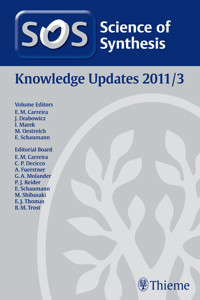
Science of Synthesis Knowledge Updates 2011 Vol. 3 E-Book
2.799,99 €
Mehr erfahren.
- Herausgeber: Thieme
- Kategorie: Wissenschaft und neue Technologien
- Sprache: Englisch
The Science of Synthesis Editorial Board,together with the volume editors and authors, is constantly reviewing the whole field of synthetic organic chemistry as presented in Science of Synthesis and evaluating significant developments in synthetic methodology. Four annual volumes updating content across all categories ensure that you always have access to state-of-the-art synthetic methodology.
Content of this volume: Organometallic Complexes of Titanium, Silenes, Carboxylic Acids, Carboxylic Acid Esters, Imines, Iminium Salts, Alkanesulfinic Acids and Acyclic Derivatives, Alkanethiols, Alkanethiolates of Group 1, 2, and 13-15 Metals, Cyclic Alkanetelluronic Acid Derivatives, Metal-Mediated Cyclizations of Amines.
Das E-Book können Sie in Legimi-Apps oder einer beliebigen App lesen, die das folgende Format unterstützen:
Seitenzahl: 1091
Veröffentlichungsjahr: 2014
Ähnliche




















Science of Synthesis
Science of Synthesis is the authoritative and comprehensive reference work for the entire field of organic and organometallic synthesis.
Science of Synthesis presents the important synthetic methods for all classes of compounds and includes:
Methods critically evaluated by leading scientists
Background information and detailed experimental procedures
Schemes and tables which illustrate the reaction scope
Preface
As the pace and breadth of research intensifies, organic synthesis is playing an increasingly central role in the discovery process within all imaginable areas of science: from pharmaceuticals, agrochemicals, and materials science to areas of biology and physics, the most impactful investigations are becoming more and more molecular. As an enabling science, synthetic organic chemistry is uniquely poised to provide access to compounds with exciting and valuable new properties. Organic molecules of extreme complexity can, given expert knowledge, be prepared with exquisite efficiency and selectivity, allowing virtually any phenomenon to be probed at levels never before imagined. With ready access to materials of remarkable structural diversity, critical studies can be conducted that reveal the intimate workings of chemical, biological, or physical processes with stunning detail.
The sheer variety of chemical structural space required for these investigations and the design elements necessary to assemble molecular targets of increasing intricacy place extraordinary demands on the individual synthetic methods used. They must be robust and provide reliably high yields on both small and large scales, have broad applicability, and exhibit high selectivity. Increasingly, synthetic approaches to organic molecules must take into account environmental sustainability. Thus, atom economy and the overall environmental impact of the transformations are taking on increased importance.
The need to provide a dependable source of information on evaluated synthetic methods in organic chemistry embracing these characteristics was first acknowledged over 100 years ago, when the highly regarded reference source Houben–Weyl Methoden der Organischen Chemie was first introduced. Recognizing the necessity to provide a modernized, comprehensive, and critical assessment of synthetic organic chemistry, in 2000 Thieme launched Science of Synthesis, Houben–Weyl Methods of Molecular Transformations. This effort, assembled by almost 1000 leading experts from both industry and academia, provides a balanced and critical analysis of the entire literature from the early 1800s until the year of publication. The accompanying online version of Science of Synthesis provides text, structure, substructure, and reaction searching capabilities by a powerful, yet easy-to-use, intuitive interface.
From 2010 onward, Science of Synthesis is being updated quarterly with high-quality content via Science of Synthesis Knowledge Updates. The goal of the Science of Synthesis Knowledge Updates is to provide a continuous review of the field of synthetic organic chemistry, with an eye toward evaluating and analyzing significant new developments in synthetic methods. A list of stringent criteria for inclusion of each synthetic transformation ensures that only the best and most reliable synthetic methods are incorporated. These efforts guarantee that Science of Synthesis will continue to be the most up-to-date electronic database available for the documentation of validated synthetic methods.
Also from 2010, Science of Synthesis includes the Science of Synthesis Reference Library, comprising volumes covering special topics of organic chemistry in a modular fashion, with six main classifications: (1) Classical, (2) Advances, (3) Transformations, (4) Applications, (5) Structures, and (6) Techniques. Titles will include Stereoselective Synthesis, Water in Organic Synthesis, and Asymmetric Organocatalysis, among others. With expertevaluated content focusing on subjects of particular current interest, the Science of Synthesis Reference Library complements the Science of Synthesis Knowledge Updates, to make Science of Synthesis the complete information source for the modern synthetic chemist.
The overarching goal of the Science of Synthesis Editorial Board is to make the suite of Science of Synthesis resources the first and foremost focal point for critically evaluated information on chemical transformations for those individuals involved in the design and construction of organic molecules.
Throughout the years, the chemical community has benefited tremendously from the outstanding contribution of hundreds of highly dedicated expert authors who have devoted their energies and intellectual capital to these projects. We thank all of these individuals for the heroic efforts they have made throughout the entire publication process to make Science of Synthesis a reference work of the highest integrity and quality.
July 2010
The Editorial Board
E. M. Carreira (Zurich, Switzerland)
C. P. Decicco (Princeton, USA)
A. Fuerstner (Muelheim, Germany)
G. A. Molander (Philadelphia, USA)
P. J. Reider (Princeton, USA)
E. Schaumann (Clausthal-Zellerfeld, Germany)
M. Shibasaki (Tokyo, Japan)
E. J. Thomas (Manchester, UK)
B. M. Trost (Stanford, USA)
Abstracts
2.10.18 Organometallic Complexes of Titanium
T. Takeda and A. Tsubouchi
This manuscript is an update to the earlier Science of Synthesis contribution describing methods for the preparation of organometallic complexes of titanium. ▶ Section 2.10.18.1 focuses on the preparation of titanocene alkylidenes by the reductive titanation of thioacetals, gem-dihalides, and alkyl halides, and their synthetic application in carbonyl alkenation reactions.
▶ Section 2.10.18.2 highlights the preparation of titanocene derivatives of metallacyclobutanes derived from titanocene alkylidenes and alkenes, and their synthetic application, mainly in the metathesis reaction. Other types of degradation of titanacyclobutanes such as reductive elimination and β-hydride elimination are also included. In connection with alkene metathesis, titanacyclobutenes, which are intermediates for enyne metathesis, are also discussed.
Keywords: alkenation · alkene metathesis · alkenes · alkenylcyclopropanes · carbene complexes · conjugate dienes · β-hydride elimination · reductive titanation · titanacyclobutanes · titanacyclobutenes · titanium complexes · titanocenes
4.4.2.5 Silenes (Update 1)
H. Ottosson and A. M. Rouf
The topic of this update is synthesis of silenes, compounds with Si=C bonds, which are generally highly reactive and sensitive to the ambient atmosphere. Synthetic routes published since 2001 yielding either persistent silenes or transient silenes that can be trapped by suitable reagents are discussed. Both novel routes and modifications of earlier established routes, now employing less forcing conditions than previously reported, are covered.
Keywords: silicon compounds · silenes · unsaturated compounds · lithium compounds · rearrangement · Peterson alkenation · elimination · isomerization
4.4.2.6 Silenes (Update 2)
H. Ottosson and J. Ohshita
This section describes the synthesis of silen-2-olates, silicon analogues of enolates with formal Si=C bonds, for example through trimethylsilyl–metal exchange of acylpolysilanes using organolithium or organopotassium reagents. The fundamental reactions of silenolates and the structural differences between silenolates dominated by keto-form versus enol-form resonance structures are also presented.
Keywords: silicon compounds · silenes · silenolates · silyl anions · lithium compounds · potassium compounds · mercury compounds · silyl–metal exchange
20.2.1.2.10 Synthesis from Carboxylic Acid Derivatives
A. K. Mourad and C. Czekelius
This manuscript is an update to the earlier Science of Synthesis contribution describing general methods to synthesize carboxylic acids from their derivatives. This update addresses more specific methods, new developments, and transformations of carboxylic acid derivatives which were not covered in the original contribution.
Keywords: acid catalysts · carboxylic acid derivatives · carboxylic acids · enzyme catalysis · esters · halo compounds · hydrazides · hydrolysis · oxidative cleavage · photolysis · reductive cleavage · silyl esters
20.5.1.2.8 Synthesis from Carboxylic Acids and Derivatives
A. K. Mourad and C. Czekelius
This manuscript is an update to the earlier Science of Synthesis contribution describing general methods to synthesize esters from carboxylic acids and their derivatives. This update addresses more specific methods, new developments, and transformations of carboxylic acid derivatives which were not covered in the original contribution.
Keywords: alkylations · carboxylic acid derivatives · carboxylic acids · enzyme catalysis · esters · halo compounds · hydrazides · oxidative cleavage · thioesters
27.7.6 Imines
S. Dekeukeleire, M. D’hooghe, and N. De Kimpe
This manuscript is an update to the earlier Science of Synthesis contribution describing methods for the synthesis of imines. It focuses on the literature published in the period 2004–2010.
Keywords: 2H-azirines · imines · N-unsubstituted imines · N-silyl imines · N-alkyl imines · N-aryl imines · 2,3-dihydroazetes · imino esters · nitrogen heterocycles · synthesis design
27.8.2 Iminium Salts
S. Dekeukeleire, M. D’hooghe, and N. De Kimpe
This manuscript is an update to the earlier Science of Synthesis contribution describing methods for the synthesis of iminium salts. It focuses on the literature published in the period 2004–2010.
Keywords: iminium salts · nitrogen heterocycles · synthesis design
39.3.9 Alkanesulfinic Acids and Acyclic Derivatives
R. Kawęcki
This chapter is an update to the earlier Science of Synthesis, Section 39.3, describing the synthesis and applications of alkanesulfinic acids and acyclic derivatives. It includes discussion of the applications of alkanesulfinyl halides and the synthesis of alkanesulfinic acid esters, alkanethiosulfinic acid esters, and alkanesulfinamides, focusing on the literature in the period 2006–2010.
It also contains an extension of the coverage of the previous contribution describing the synthesis and applications of N-alkylidenealkanesulfinamides, here focusing on literature in the period 1997–2010.
Keywords: sulfinyl halides · sulfinic acid esters · sulfinates · sulfinylation · sulfoxides · aziridines · asymmetric synthesis · boron trichloride complexes · thiosulfinic acid esters · thiosulfinates · disulfides · asymmetric oxidation · sulfinamides · N-sulfinylimines · sulfinimines · 1,2-addition · allylation · nucleophilic addition · imines
39.5.2 Alkanethiols
D. Witt
This manuscript is an update to the earlier Science of Synthesis contribution on alkanethiols, and describes applications of alkanethiols as a starting material in organic synthesis. Thiols can be converted into sulfonic, sulfinic, and sulfenic acids and their derivatives, as well as sulfides, disulfides, polysulfides, sulfonium salts, and thiiranes, etc. These transformations are accomplished by nucleophilic displacement or addition, oxidation, condensation, or coupling reactions involving the thiol group.
Keywords: alkanethiols · organosulfur compounds · sulfur electrophiles · sulfur functional groups · sulfur nucleophiles · sulfur oxidation states
39.6.1.2 Alkanethiolates of Group 1, 2, and 13–15 Metals
D. Witt
This update to the earlier Science of Synthesis contribution describing methods for the synthesis of alkanethiolates of group 1, 2, and 13–15 metals focuses on applications of these compounds in organic synthesis. Alkanethiolates can be converted into S-alkyl thiocarboxlyates, 1-thioglycosides, S-alkyl thiosulfinates, tetrahydro-1,4-thiazin-3-ones, sulfides, disulfides, sulfonium salts, dithioacetals, and dithioketals. These transformations are accomplished by nucleophilic displacement or addition, condensation, or coupling reactions involving the thiolate group.
Keywords: alkanethiolates · S-alkyl thiocarboxylates · disulfides · dithioacetals · dithioketals · organosulfur compounds · sulfur electrophiles · sulfides · sulfonium salts · sulfur nucleophiles · thioacetals · 1-thioglycosides
39.39.1 Product Subclass 1: Cyclic Alkanetelluronic Acid Derivatives
T. Kimura
Keywords: tellurium · telluronic acid esters · telluronic acid thioesters · telluronic acid amides
39.39.2 Product Subclass 2: Cyclic Dialkyl Tellurones and Derivatives
T. Kimura
This section describes the synthesis of cyclic compounds with one or more tellurium atoms, where a tellurium atom bridges two sp3 carbon atoms to form a cyclic structure and this tellurium atom has two tellurium-heteroatom double bonds (Te=O or Te=N). Thus, this product subclass contains cyclic tellurones, cyclic telluroximides, cyclic telluronediimines, and cyclic dialkyl tetrasubstituted λ6-tellanes. At present, no examples of cyclic telluroximides or cyclic telluronediimines have been prepared in a stable form.
Keywords: tellurium · cyclic tellurones · cyclic telluroximides · telluronic acid amides · cyclic dialkyl-λ6-tellanes
40.1.1.5.5 Metal-Mediated Cyclizations of Amines
J. Ipaktschi and M. R. Saidi
This review summarizes the transition-metal-catalyzed reactions of N-tethered 1,nenynes, 1,n-diynes, and 1,n-dienes. The emphasis of the review is on the presentation of useful methods for the synthesis of nitrogen-containing heterocycles. Enyne cycloisomerization without and with skeletal reorganization, metathesis of N-tethered dienes and enynes, and transition-metal-catalyzed cycloaddition reactions are discussed in the earlier parts of the review. In later parts, the Mizoroki–Heck reactions of amines and amides and palladium-mediated cascade cross coupling/electrocyclization are discussed with regard to construction of fused bi- and tricyclic nitrogen-containing systems.
Keywords: nitrogen heterocycles · enynes · cycloisomerization · rearrangement · homogeneous catalysis · asymmetric catalysis · aqueous media · alkene metathesis · enantioselectivity · metallacycles · reductive cyclization · natural products · transition metals · nickel · iron · palladium · rhodium · ruthenium · molybdenum · silver · gold
Science of Synthesis Knowledge Updates 2011/3
Preface
Abstracts
Table of Contents
2.10.18 Organometallic Complexes of Titanium (Update 2011)
T. Takeda and A. Tsubouchi
4.4.2.5 Silenes (Update 1, 2011)
H. Ottosson and A. M. Rouf
4.4.2.6 Silenes (Update 2, 2011)
H. Ottosson and J. Ohshita
20.2.1.2.10 Synthesis from Carboxylic Acid Derivatives (Update 2011)
A. K. Mourad and C. Czekelius
20.5.1.2.8 Synthesis from Carboxylic Acids and Derivatives (Update 2011)
A. K. Mourad and C. Czekelius
27.7.6 Imines (Update 2011)
S. Dekeukeleire, M. D’hooghe, and N. De Kimpe
27.8.2 Iminium Salts (Update 2011)
S. Dekeukeleire, M. D’hooghe, and N. De Kimpe
39.3.9 Alkanesulfinic Acids and Acyclic Derivatives (Update 2011)
R. Kawęcki
39.5.2 Alkanethiols (Update 2011)
D. Witt
39.6.1.2 Alkanethiolates of Group 1, 2, and 13–15 Metals (Update 2011)
D. Witt
39.39.1 Product Subclass 1: Cyclic Alkanetelluronic Acid Derivatives
T. Kimura
39.39.2 Product Subclass 2: Cyclic Dialkyl Tellurones and Derivatives
T. Kimura
40.1.1.5.5 Metal-Mediated Cyclizations of Amines
J. Ipaktschi and M. R. Saidi
Author Index
Abbreviations
Table of Contents
Volume 2: Compounds of Groups 7-3 (Mn⋯, Cr⋯, V⋯, Ti⋯, Sc⋯, La⋯, Ac⋯)
2.10 Product Class 10: Organometallic Complexes of Titanium
2.10.18 Organometallic Complexes of Titanium
T. Takeda and A. Tsubouchi
2.10.18 Organometallic Complexes of Titanium
2.10.18.1 Titanium-Mediated Alkenation Reactions
2.10.18.1.1 Method 1: Using Thioacetals as Carbene Complex Precursors
2.10.18.1.2 Method 2: Using Monohalides as Carbene Complex Precursors
2.10.18.1.3 Method 3: Using gem-Dichlorides as Carbene Complex Precursors
2.10.18.1.4 Method 4: Using 1,1-Dichloroalk-1-enes as Carbene Complex Precursors
2.10.18.1.5 Method 5: Using Alkenyl and Alkynyl Sulfones
2.10.18.2 Titanium-Mediated Alkene Metathesis
2.10.18.2.1 Method 1: Metathesis and Related Reactions via Titanacyclobutanes
2.10.18.2.1.1 Variation 1: Reaction of Titanocene Alkylidenes with Alkenes
2.10.18.2.1.2 Variation 2: Intramolecular Reaction of Titanocene Alkylidenes Bearing an Alkene Moiety
2.10.18.2.1.3 Variation 3: Reaction of Unsaturated Titanocene–Carbene Complexes with Alkenes
2.10.18.2.2 Method 2: Metathesis and Related Reactions via Titanacyclobutenes
2.10.18.2.2.1 Variation 1: Reaction of Alkenylcarbene Complexes of Titanium with Acetylene
2.10.18.2.2.2 Variation 2: Reaction of Titanocene Alkylidenes with Alkynes
2.10.18.2.2.3 Variation 3: Reaction of Titanocene Alkenylidenes with Alkynes
2.10.18.2.2.4 Variation 4: Reaction of Titanocene Alkylidenes with Alkynyl Sulfones
2.10.18.2.2.5 Variation 5: Valence Tautomerization of Alkenylcarbene Complexes
2.10.18.2.2.6 Variation 6: Titanium-Promoted Alkylation of Propargyl Carbonates
Volume 4: Compounds of Group 15 (As, Sb, Bi) and Silicon Compounds
4.4 Product Class 4: Silicon Compounds
4.4.2.5 Silenes (Update 1)
H. Ottosson and A. M. Rouf
4.4.2.5 Silenes (Update 1)
4.4.2.5.1 Method 1: Synthesis of Silenes by Photolysis or Thermolysis of Acylpolysilanes and Derivatives
4.4.2.5.1.1 Variation 1: Thermolysis of Carbamoylpolysilanes
4.4.2.5.1.2 Variation 2: Thermal Rearrangement of Mercury Bis(acylsilanes)
4.4.2.5.2 Method 2: Salt Elimination Methods
4.4.2.5.2.1 Variation 1: Reaction of Lithium Disilenides with Acyl or Vinyl Halides
4.4.2.5.2.2 Variation 2: Reaction of Dilithiosiloles with Ketones
4.4.2.5.3 Method 3: Sila-Peterson Alkenation Reactions
4.4.2.5.4 Method 4: Silylene–Silene and Carbene–Silene Isomerizations
4.4.2.6 Silenes (Update 2)
H. Ottosson and J. Ohshita
4.4.2.6 Silenes (Update 2)
4.4.2.6.1 Silenolates
4.4.2.6.1.1 Method 1: Synthesis of Silen-2-olates by Trimethylsilyl–Metal Exchange
4.4.2.6.1.1.1 Variation 1: With Germyllithium Reagents
4.4.2.6.1.1.2 Variation 2: With Silyllithium Reagents
4.4.2.6.1.1.3 Variation 3: With Potassium tert-Butoxide
4.4.2.6.2 Method 2: Synthesis of Silen-2-olates by Reaction of Bis(lithiosilyl)mercury Compounds with Acyl Chlorides
20.2 Product Class 2: Carboxylic Acids
20.2.1.2.10 Synthesis from Carboxylic Acid Derivatives
A. K. Mourad and C. Czekelius
20.2.1.2.10 Synthesis from Carboxylic Acid Derivatives
20.2.1.2.10.1 Method 1: Hydrolysis of Esters
20.2.1.2.10.1.1 Variation 1: Nucleophile-Promoted Cleavage
20.2.1.2.10.1.2 Variation 2: Hydrogenolytic Cleavage of Benzyl Esters
20.2.1.2.10.1.3 Variation 3: Transition-Metal-Mediated Cleavage of Allyl Esters
20.2.1.2.10.1.4 Variation 4: Cleavage of 2-Haloethyl Esters
20.2.1.2.10.1.5 Variation 5: Light-Induced Cleavage
20.2.1.2.10.1.6 Variation 6: Fluoride-Mediated Cleavage of Silyl Esters
20.2.1.2.10.1.7 Variation 7: Enzymatic Hydrolysis
20.2.1.2.10.2 Method 2: Hydrolysis of Hydrazides
20.2.1.2.10.2.1 Variation 1: Base-Mediated Hydrolysis
20.2.1.2.10.2.2 Variation 2: Acid-Catalyzed Hydrolysis
20.2.1.2.10.2.3 Variation 3: Oxidative Hydrolysis
20.2.1.2.10.2.4 Variation 4: Enzymatic Hydrolysis
20.2.1.2.10.3 Method 3: Hydrolysis of 1,1,1-Trihalides
20.5 Product Class 5: Carboxylic Acid Esters
20.5.1.2.8 Synthesis from Carboxylic Acids and Derivatives
A. K. Mourad and C. Czekelius
20.5.1.2.8 Synthesis from Carboxylic Acids and Derivatives
20.5.1.2.8.1 Synthesis from Carboxylic Acids
20.5.1.2.8.1.1 Method 1: Synthesis via Active Esters
20.5.1.2.8.1.1.1 Variation 1: Via Mixed Sulfonic Anhydrides
20.5.1.2.8.1.1.2 Variation 2: Via (Acyloxy)phosphorus Compounds
20.5.1.2.8.1.1.3 Variation 3: Via Esters of Electron-Deficient Alcohols or of N-Acylhydroxylamines
20.5.1.2.8.1.1.4 Variation 4: Via Ketene Acyl Acetals
20.5.1.2.8.1.2 Method 2: Oxidative Coupling
20.5.1.2.8.1.3 Method 3: Electrophilic Esterification
20.5.1.2.8.1.3.1 Variation 1: Using Alkyl Halides
20.5.1.2.8.1.3.2 Variation 2: Using Diazoalkanes
20.5.1.2.8.1.4 Method 4: Enzymatic Esterification
20.5.1.2.8.2 Synthesis from Carboxylic Acid Derivatives
20.5.1.2.8.2.1 Method 1: Synthesis from Thioesters
20.5.1.2.8.2.2 Method 2: Synthesis from Carboxylic Acid Hydrazides
Volume 27: Heteroatom Analogues of Aldehydes and Ketones
27.7 Product Class 7: Imines
27.7.6 Imines
S. Dekeukeleire, M. D’hooghe, and N. De Kimpe
27.7.6 Imines
27.7.6.1 N-Unsubstituted Imines
27.7.6.1.1 Synthesis of N-Unsubstituted Imines
27.7.6.1.1.1 Method 1: Reaction of Aldehydes and Ketones with Ammonia
27.7.6.1.1.2 Method 2: Synthesis from Oximes
27.7.6.1.1.3 Method 3: Oxidation of Primary Amines
27.7.6.1.1.4 Method 4: Synthesis from Nitriles
27.7.6.1.1.5 Method 5: Miscellaneous Procedures
27.7.6.2 N-Silylimines
27.7.6.2.1 Synthesis of N-Silylimines
27.7.6.2.1.1 Method 1: Reaction of Carbonyl Compounds with Lithium Hexamethyldisilazanide
27.7.6.2.1.2 Method 2: Reaction of Nitriles with Organometallic Reagents
27.7.6.3 N-Alkyl- and N-Arylimines
27.7.6.3.1 Synthesis of N-Alkyl- and N-Arylimines
27.7.6.3.1.1 Method 1: Reaction of Aldehydes or Ketones with Primary Amines
27.7.6.3.1.1.1 Variation 1: With Azeotropic Removal of Water
Lesen Sie weiter in der vollständigen Ausgabe!
Lesen Sie weiter in der vollständigen Ausgabe!
Lesen Sie weiter in der vollständigen Ausgabe!
Lesen Sie weiter in der vollständigen Ausgabe!
Lesen Sie weiter in der vollständigen Ausgabe!
Lesen Sie weiter in der vollständigen Ausgabe!
Lesen Sie weiter in der vollständigen Ausgabe!
Lesen Sie weiter in der vollständigen Ausgabe!
Lesen Sie weiter in der vollständigen Ausgabe!
Lesen Sie weiter in der vollständigen Ausgabe!
Lesen Sie weiter in der vollständigen Ausgabe!
Lesen Sie weiter in der vollständigen Ausgabe!
Lesen Sie weiter in der vollständigen Ausgabe!
Lesen Sie weiter in der vollständigen Ausgabe!
Lesen Sie weiter in der vollständigen Ausgabe!
Lesen Sie weiter in der vollständigen Ausgabe!
Lesen Sie weiter in der vollständigen Ausgabe!
Lesen Sie weiter in der vollständigen Ausgabe!
Lesen Sie weiter in der vollständigen Ausgabe!
Lesen Sie weiter in der vollständigen Ausgabe!
Lesen Sie weiter in der vollständigen Ausgabe!
Lesen Sie weiter in der vollständigen Ausgabe!
Lesen Sie weiter in der vollständigen Ausgabe!




