


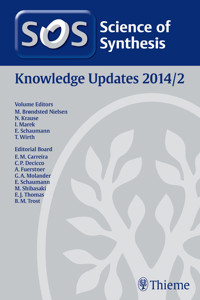
Science of Synthesis Knowledge Updates 2014 Vol. 2 E-Book
2.999,99 €
Mehr erfahren.
- Herausgeber: Thieme
- Kategorie: Wissenschaft und neue Technologien
- Sprache: Englisch
Science of Synthesis is a reference work for preparative methods in synthetic chemistry. Its product-based classification system enables chemists to easily find solutions to their synthetic problems. Key Features: The Science of Synthesis Editorial Board, together with the volume editors and authors, is constantly reviewing the whole field of synthetic organic chemistry as presented in Science of Synthesis and evaluating significant developments in synthetic methodology. Four annual volumes updating content across all categories ensure that you always have access to state-of-the-art synthetic methodology.
Das E-Book können Sie in Legimi-Apps oder einer beliebigen App lesen, die das folgende Format unterstützen:
Seitenzahl: 864
Veröffentlichungsjahr: 2014
Ähnliche




















Science of Synthesis
Science of Synthesis is the authoritative and comprehensive reference work for the entire field of organic and organometallic synthesis.
Science of Synthesis presents the important synthetic methods for all classes of compounds and includes:
Methods critically evaluated by leading scientists
Background information and detailed experimental procedures
Schemes and tables which illustrate the reaction scope
Preface
As the pace and breadth of research intensifies, organic synthesis is playing an increasingly central role in the discovery process within all imaginable areas of science: from pharmaceuticals, agrochemicals, and materials science to areas of biology and physics, the most impactful investigations are becoming more and more molecular. As an enabling science, synthetic organic chemistry is uniquely poised to provide access to compounds with exciting and valuable new properties. Organic molecules of extreme complexity can, given expert knowledge, be prepared with exquisite efficiency and selectivity, allowing virtually any phenomenon to be probed at levels never before imagined. With ready access to materials of remarkable structural diversity, critical studies can be conducted that reveal the intimate workings of chemical, biological, or physical processes with stunning detail.
The sheer variety of chemical structural space required for these investigations and the design elements necessary to assemble molecular targets of increasing intricacy place extraordinary demands on the individual synthetic methods used. They must be robust and provide reliably high yields on both small and large scales, have broad applicability, and exhibit high selectivity. Increasingly, synthetic approaches to organic molecules must take into account environmental sustainability. Thus, atom economy and the overall environmental impact of the transformations are taking on increased importance.
The need to provide a dependable source of information on evaluated synthetic methods in organic chemistry embracing these characteristics was first acknowledged over 100 years ago, when the highly regarded reference source Houben–Weyl Methoden der Organischen Chemie was first introduced. Recognizing the necessity to provide a modernized, comprehensive, and critical assessment of synthetic organic chemistry, in 2000 Thieme launched Science of Synthesis, Houben–Weyl Methods of Molecular Transformations. This effort, assembled by almost 1000 leading experts from both industry and academia, provides a balanced and critical analysis of the entire literature from the early 1800s until the year of publication. The accompanying online version of Science of Synthesis provides text, structure, substructure, and reaction searching capabilities by a powerful, yet easy-to-use, intuitive interface.
From 2010 onward, Science of Synthesis is being updated quarterly with high-quality content via Science of Synthesis Knowledge Updates. The goal of the Science of Synthesis Knowledge Updates is to provide a continuous review of the field of synthetic organic chemistry, with an eye toward evaluating and analyzing significant new developments in synthetic methods. A list of stringent criteria for inclusion of each synthetic transformation ensures that only the best and most reliable synthetic methods are incorporated. These efforts guarantee that Science of Synthesis will continue to be the most up-to-date electronic database available for the documentation of validated synthetic methods.
Also from 2010, Science of Synthesis includes the Science of Synthesis Reference Library, comprising volumes covering special topics of organic chemistry in a modular fashion, with six main classifications: (1) Classical, (2) Advances, (3) Transformations, (4) Applications, (5) Structures, and (6) Techniques. Titles will include Stereoselective Synthesis, Water in Organic Synthesis, and Asymmetric Organocatalysis, among others. With expert-evaluated content focusing on subjects of particular current interest, the Science of Synthesis Reference Library complements the Science of Synthesis Knowledge Updates, to make Science of Synthesis the complete information source for the modern synthetic chemist.
The overarching goal of the Science of Synthesis Editorial Board is to make the suite of Science of Synthesis resources the first and foremost focal point for critically evaluated information on chemical transformations for those individuals involved in the design and construction of organic molecules.
Throughout the years, the chemical community has benefited tremendously from the outstanding contribution of hundreds of highly dedicated expert authors who have devoted their energies and intellectual capital to these projects. We thank all of these individuals for the heroic efforts they have made throughout the entire publication process to make Science of Synthesis a reference work of the highest integrity and quality.
The Editorial Board
July 2010
E. M. Carreira (Zurich, Switzerland)
C. P. Decicco (Princeton, USA)
A. Fuerstner (Muelheim, Germany)
G. A. Molander (Philadelphia, USA)
E. Schaumann (Clausthal-Zellerfeld, Germany)
M. Shibasaki (Tokyo, Japan)
E. J. Thomas (Manchester, UK)
B. M. Trost (Stanford, USA)
Abstracts
2.7.10 Carbonyl Complexes of Chromium, Molybdenum, and Tungsten with σ-Bonded Ligands
E. Aguilar and L. A. López
This chapter is an update to the earlier Science of Synthesis contribution (Section 2.7.1) describing the chemistry of Fischer carbene complexes of chromium, molybdenum, and tungsten. The synthesis of acyclic, carbocyclic, and heterocyclic compounds is presented following an approach based on the nature of the starting carbene complex. Relevant mechanistic pathways are also discussed to allow a better understanding of the reactivity displayed.
Keywords: Fischer carbene complexes • Dötz benzannulation • Hegedus photochemistry • cyclopropanation • transmetalation • nonstabilized carbene complexes • chromium compounds • molybdenum compounds • tungsten compounds • heterocycles • carbocycles • metal migration
2.8.10 Organometallic Complexes of Vanadium
O. S. Shneider and A. M. Szpilman
This manuscript is an update to the earlier Science of Synthesis contribution describing methods for synthesis of organometallic complexes of vanadium. It summarizes previous methods and focuses on the literature published in the period 2000–2010.
Keywords: hydridovanadium complexes • vanadium • vanadium–alkene complexes • vanadium–alkyne complexes • vanadium–arene complexes • vanadium–carbene complexes • vanadocenes
3.4.8 Organometallic Complexes of Copper
B. H. Lipshutz and S. Ghorai
The topic of this update chapter is asymmetric copper hydride catalyzed transformations. Copper hydride complexes containing nonracemic ligands catalyze asymmetric 1,2- and 1,4-addition to a variety of unsymmetrical ketones and Michael acceptors.
Keywords: activated alkenes • asymmetric catalysis • asymmetric conjugate reduction • copper hydride • hydrosilylation • nonracemic ligands • unsymmetrical ketones
24.1.1.3 1,1-Dihaloallenes
K. Fuchibe and J. Ichikawa
This chapter is an update to Science of Synthesis Section 24.1.1. Syntheses and applications of 1,1-dihaloallenes reported between 2005 and 2013 are described. 1,1-Difluoroallenes are synthesized by elimination reactions of difluoroallylic compounds (formation of a second C=C bond in fluorinated alkenes) or by nucleophilic and electrophilic substitutions of difluoropropargylic compounds (rearrangement of the C≡C bonds in fluorinated alkynes). 1,1-Difluoroallenes are used for the syntheses of unsaturated fluorine-containing compounds, mainly by nucleophilic substitutions and additions at the positions α and/or γ to the fluorine substituents. Cycloadditions of tetrafluorobuta-1,2,3-triene are also described.
Keywords: allenes • alkenes • cumulenes • cycloaddition • domino reaction • electrophilic substitution • elimination • fluorine compounds • metalation • nucleophilic addition • nucleophilic substitution • propargylic compounds
24.1.16 1,1-Bis(heteroatom-functionalized) Allenes
C. Ibis
This chapter updates Science of Synthesis Sections 24.1.3, 24.1.10, 24.1.14, and 24.1.15. Mono-, bis-, tris-, and tetrakis(sulfanyl-substituted) butatrienes are obtained from alkyl-sulfanyl- or arylsulfanyl-substituted buta-1,3-dienes in the presence of base in petroleum ether at room temperature. The treatment of 1,1,4,4-tetrakis[4-(dimethylamino)pyridin-1-ium]-2,3-dichlorobuta-1,3-diene with thiolates in dimethyl sulfoxide leads to the formation of tetrakis(sulfanyl-substituted) butatrienes. Allenylphosphonates are synthesized by the reaction of aliphatic- or aromatic-substituted propargylic alcohols and chlorophosphites in the presence of triethylamine. The reaction of 1-bromo-1-silylallenes with butyl-lithium and then chlorodiphenylphosphine in tetrahydrofuran gives 1,1-bis(diphenyl-phosphino)allenes.
Keywords: butadienes • butatrienes • butenynes • elimination • allenylphosphonates • allenylphosphine oxides • silylallenes • diphenylphosphines • diphenylphosphine oxides • propargylic alcohols
24.2.11.3 1,1-Bis(organosulfanyl)alk-1-enes (Ketene S,S-Acetals)
Q. Liu
This chapter is an update to Science of Synthesis Section 24.2.11 describing methods for the synthesis of 1,1-bis(organosulfanyl)alk-1-enes (ketene S,S-acetals). It focuses on the literature published in the period 2000-2013 and gives several examples of the use of ketene S,S-acetals as versatile intermediates for organic synthesis.
Keywords: [5 + 1]-annulation reactions • [7 + 1]-annulation reactions • 1,1-bis(organosulfanyl)alk-1-enes • carbonyl condensation reactions • domino reactions • α-functionalization • substitution–cycloaromatization reactions
24.2.20 1,1-Bis(heteroatom-functionalized) Alk-1-enes (Update 1)
P. Beier
This chapter is an update to the earlier Science of Synthesis contributions describing 1-halo-alk-1-enes that bear an oxygen (Section 24.2.2), chalcogen (Section 24.2.3), nitrogen (Section 24.2.4), or phosphorus substituent (Section 24.2.5) at the 1-position. This review focuses on literature published in the period 2005–2013.
Keywords: alkenes • halo compounds • oxygen compounds • chalcogen compounds • nitrogen compounds • phosphorus compounds
24.2.21 1,1-Bis(heteroatom-functionalized) Alk-1-enes (Update 2)
M. H. Vilhelmsen
This chapter is an update to the existing Science of Synthesis contributions on the synthesis of ketene O,S-acetals (Section 24.2.7), ketene O,N-acetals (Section 24.2.9), and (1-alkoxyalk-1-enyl)phosphonates (enolphosphonates, Section 24.2.10). The reviewed synthetic methodologies are from literature published since 2005.
Keywords: (1-alkoxyalk-1-enyl)phosphonates • ketene O,S-acetals • ketene O,N-acetals • enolphosphonates • ring-opening reactions • carbohydrates • heterocycles
27.1.6 Sulfur Ylides
G. Mlostoń and H. Heimgartner
This chapter is an update to the earlier Science of Synthesis contribution describing methods for the in situ generation of thiocarbonyl ylides and Corey–Chaykovsky reagents (sulfonium and sulfoxonium methylides). Whereas thiocarbonyl ylides react as electron-rich 1,3-dipoles, Corey–Chaykovsky reagents act as methylene-transfer agents. The most relevant application of thiocarbonyl ylides relates to the synthesis of tetrahydrothiophene (thiolane) and 1,3-dithiolane derivatives, via [3 + 2]-cycloaddition reactions with electron-deficient C,C and C,S dipolarophiles, respectively. In the last decade, Corey–Chaykovsky reagents have been widely applied for cyclopropanation, epoxidation, and aziridination, as well as for diverse heterocyclization reactions. In all cases, asymmetric versions of the applied protocols are of great interest.
Keywords: aziridination • cyclopropanation • cycloaddition • five-membered rings • sulfur heterocycles • sulfides • sulfur ylides • thiiranes • thiones
27.4.3 Thioaldehyde and Thioketone S-Oxides and S-Imides (Sulfines and Derivatives)
G. Mlostoń and H. Heimgartner
This chapter is an update to the earlier Science of Synthesis contribution describing methods of synthesis and new applications for thiocarbonyl S-oxides (sulfines) and thiocarbonyl S-imides. In general, thiocarbonyl S-oxides are more stable and in many instances can be isolated. The in situ generated thiocarbonyl S-imides are efficient “sulfur-transfer agents” via the isomeric thiaziridines, formed as products of electrocyclic ring closure. Stable thiocarbonyl S-imides, derived from hexafluorothioacetone, are useful 1,3-dipoles and are applied in the preparation of fluorinated five-membered heterocycles.
Keywords: thiazolidines • cycloaddition • five-membered rings • oxidation • small-ring systems • thiones
27.26 Product Class 26: Thioaldehyde and Thioketone S-Sulfides (Thiosulfines)
G. Mlostoń and H. Heimgartner
This chapter is an overview of methods for the in situ generation and application of highly reactive thiocarbonyl S-sulfides. Typically, thiocarbonyl S-sulfides react as sulfur-rich 1,3-dipoles and trap both electron-deficient C,C-dipolarophiles and thiocarbonyl substrates, yielding the corresponding five-membered cycloadducts. In some instances, intermediate thiocarbonyl S-sulfides and/or their cyclic isomers (i.e., dithiiranes) act as sulfur-transfer agents leading to sulfur-rich heterocycles such as pentathiepanes and hexathiepanes.
Keywords: dipolar cycloaddition • dithiolanes • five-membered rings • multicomponent reactions • sulfur heterocycles • thiones
35.1.1.3.5 Synthesis by Substitution of Carbon Functionalities
P. Margaretha
This update summarizes reactions wherein an alkyl radical is formed by cleavage of an appropriately functionalized C—C bond, followed by trapping of this intermediate by a chlorine atom source to afford a chloroalkane. It covers the literature up until late 2013.
Keywords: chlorination • radicals • carboxylic acids • silver carboxylates • decarboxylation • Hunsdiecker reaction • Kochi reaction • Barton reaction • 1-(acyloxy)pyridine-2-(1H)-thiones • Barton esters • peroxyacetals
35.1.1.4.3 Synthesis by Substitution of Other Halogens
P. Margaretha
This is an update to Science of Synthesis Section 35.1.1.4, describing the synthesis of chloroalkanes from other haloalkanes, and covers the literature up until late 2013.
Keywords: chlorination • substitution • halogen exchange
35.1.1.5.13 Synthesis by Substitution of Oxygen Functionalities
P. Margaretha
This update summarizes reactions wherein compounds containing C-O bonds are transformed into chloroalkanes via nucleophilic substitution at the sp3-hybridized carbon atom. It covers the literature up until late 2013.
Keywords: substitution • chlorination • chloroformates • decarboxylation • sulfonates • alcohols • chlorodehydroxylation
35.1.1.6.2 Synthesis by Substitution of Sulfur, Selenium, or Tellurium Functionalities
P. Margaretha
This is an update to Science of Synthesis ection 35.1.1.6, describing the synthesis of chloroalkenes from sulfur-, selenium-, or tellurium-substituted alkyl compounds and covers the literature up until late 2013.
Keywords: chlorination • substitution • halogen exchange • halogenase • methionine
35.1.4.2.4 Synthesis by Substitution of σ-Bonded Heteroatoms
P. Margaretha
This update summarizes reactions wherein allylic alcohols (or their anions) are transformed into rearranged allylic chlorides via an SN2′-reaction. It covers the literature up until late 2013.
Keywords: chlorination • allylic alcohols • allylic chlorides • substitution • rearrangement • methylenecyclohexanes • cyclohexenes • alkoxides
35.2.1.3.5 Synthesis by Substitution of Carbon Functionalities
P. Margaretha
This update summarizes reactions wherein an alkyl radical is formed by cleavage of an appropriately functionalized C—C bond, followed by trapping of this intermediate by a bromine atom source to afford a bromoalkane. It covers the literature up until late 2013.
Keywords: bromination • radicals • carboxylic acids • silver carboxylates • decarboxylation • Hunsdiecker reaction • Cristol–Firth reaction • Barton reaction • 1-(acyloxy)pyridine-2-(1H)-thiones • Barton esters • peroxyacetals
35.2.1.8.10 Synthesis by Addition to π-Type C—C Bonds
Q. Yin and S.-L. You
This is an update to the earlier Science of Synthesis contribution (Section 35.2.1.8) on the preparation of bromoalkanes by additions to p-type C—C bonds, covering material published from 2004 to the end of 2013. Methods for carbobromination, including bromocyclization and asymmetric intramolecular carbobromination, are presented.
Keywords: bromocyclization • enantioselective •` Friedel-Crafts • oxindole • polyene • spirocyclohexadienone • semipinacol rearrangement
Science of Synthesis Knowledge Updates 2014/2
Preface
Abstracts
Table of Contents
2.7.10 Carbonyl Complexes of Chromium, Molybdenum, and Tungsten with σ-Bonded Ligands (Update 2014)
E. Aguilar and L. A. López
2.8.10 Organometallic Complexes of Vanadium (Update 2014)
O. S. Shneider and A. M. Szpilman
3.4.8 Organometallic Complexes of Copper (Update 2014)
B. H. Lipshutz and S. Ghorai
24.1.1.3 1,1-Dihaloallenes (Update 2014)
K. Fuchibe and J. Ichikawa
24.1.16 1,1-Bis(heteroatom-functionalized) Allenes (Update 2014)
C. Ibis
24.2.11.3 1,1-Bis(organosulfanyl)alk-1-enes (Ketene S,S-Acetals) (Update 2014)
Q. Liu
24.2.20 1,1-Bis(heteroatom-functionalized) Alk-1-enes (Update 1, 2014)
P. Beier
24.2.21 1,1-Bis(heteroatom-functionalized) Alk-1-enes (Update 2, 2014)
M. H. Vilhelmsen
27.1.6 Sulfur Ylides (Update 2014)
G. Mlostoń and H. Heimgartner
27.4.3 Thioaldehyde and Thioketone S-Oxides and S-Imides (Sulfines and Derivatives) (Update 2014)
G. Mlostoń and H. Heimgartner
27.26 Product Class 26: Thioaldehyde and Thioketone S-Sulfides (Thiosulfines)
G. Mlostoń and H. Heimgartner
35.1.1.3.5 Synthesis by Substitution of Carbon Functionalities (Update 2014)
P. Margaretha
35.1.1.4.3 Synthesis by Substitution of Other Halogens (Update 2014)
P. Margaretha
35.1.1.5.13 Synthesis by Substitution of Oxygen Functionalities (Update 2014)
P. Margaretha
35.1.1.6.2 Synthesis by Substitution of Sulfur, Selenium, or Tellurium Functionalities (Update 2014)
P. Margaretha
35.1.4.2.4 Synthesis by Substitution of σ-Bonded Heteroatoms (Update 2014)
P. Margaretha
35.2.1.3.5 Synthesis by Substitution of Carbon Functionalities (Update 2014)
P. Margaretha
35.2.1.8.10 Synthesis by Addition to π-Type C—C Bonds (Update 2014)
Q. Yin and S.-L. You
Author Index
Abbreviations
Table of Contents
Volume 2: Compounds of Groups 7–3 (Mn•••, Cr•••, V•••, Ti•••, Sc•••, La•••, Ac•••)
2.7 Product Class 7: Carbonyl Complexes of Chromium, Molybdenum, and Tungsten with σ-Bonded Ligands
2.7.10 Carbonyl Complexes of Chromium, Molybdenum, and Tungsten with σ-Bonded Ligands
E. Aguilar and L. A. López
2.7.10 Carbonyl Complexes of Chromium, Molybdenum, and Tungsten with σ-Bonded Ligands
2.7.10.1 Metal–Carbene Complexes
2.7.10.1.1 Synthesis of Metal–Carbene Complexes
2.7.10.1.1.1 Method 1: Fischer Method
2.7.10.1.1.2 Method 2: Synthesis from Hexacarbonylmetal(0) Complexes by Photochemical Cleavage of One Carbonyl Ligand
2.7.10.1.1.3 Method 3: Synthesis from Acidic Carbene Complexes: Preparation of Alkenylcarbene Complexes by Aldol Condensation
2.7.10.1.1.4 Method 4: Synthesis from Ordinary Alkoxycarbene Complexes: Preparation of Enantiopure Alkynylcarbene Complexes via Non-Heteroatom-Stabilized Carbene Complexes
2.7.10.1.2 Applications of Metal–Carbene Complexes in Organic Synthesis
2.7.10.1.2.1 Release of the Organic Moiety from Fischer Carbene Complexes
2.7.10.1.2.1.1 Method 1: Nonoxidative Release of the Organic Moiety from Carbene Complexes
2.7.10.1.2.1.2 Method 2: Oxidation of Carbene Complexes
2.7.10.1.2.2 Reactions of Alkyl- and Arylcarbene Complexes
2.7.10.1.2.2.1 Method 1: Synthesis of Acyclic Compounds
2.7.10.1.2.2.1.1 Variation 1: Synthesis of Dipeptides or Carboxylic Esters by Addition of Nucleophiles to Photochemically Generated Ketene Intermediates
2.7.10.1.2.2.1.2 Variation 2: Synthesis of 2-Acyl Enol Ether sand β-Oxo Esters
2.7.10.1.2.2.2 Method 2: Synthesis of Three-Membered Carbocycles
2.7.10.1.2.2.3 Method 3: Synthesis of Four-Membered Carbocycles: Synthesis of Cyclobutanones by [2 + 2] Cycloaddition to Photochemically Generated Ketene Intermediates
2.7.10.1.2.2.4 Method 4: Synthesis of Five-Membered Carbocycles
2.7.10.1.2.2.4.1 Variation 1: Synthesis of Cyclopentadienes via [2 + 2 + 1]-Cycloaddition Reaction
2.7.10.1.2.2.4.2 Variation 2: Synthesis of Cyclopentenones by Reaction of a Chromium–Cyclopropylcarbene Complex with Alkynes
2.7.10.1.2.2.4.3 Variation 3: Synthesis of Cyclopentanols
2.7.10.1.2.2.5 Method 5: Synthesis of Six-Membered Carbocycles
2.7.10.1.2.2.5.1 Variation 1: Synthesis of Cyclohexanediols
2.7.10.1.2.2.5.2 Variation 2: Synthesis of Naphthalene Derivatives by Isoindole Cyclization, Diels–Alder Cycloaddition, and Related Processes
2.7.10.1.2.2.5.3 Variation 3: Synthesis of 4-Hydroxycyclohex-2-enones
2.7.10.1.2.2.6 Method 6: Synthesis of Seven-Membered Carbocycles
2.7.10.1.2.2.6.1 Variation 1: Synthesis of Cycloheptadienones by a Formal [4 + 2 + 1]-Cycloaddition Reaction of a Tungsten (or Molybdenum) Cyclopropylcarbene Complex with Alkynes
2.7.10.1.2.2.7 Method 7: Synthesis of Heterocycles
2.7.10.1.2.2.7.1 Variation 1: Synthesis of Lactams or Lactones by [2 + 2] Cycloaddition to Photochemically Generated Ketene Intermediates
2.7.10.1.2.2.7.2 Variation 2: Synthesis of Lactones by Reaction with Alkynyl Alcohols or Protected Alkynyl Alcohols
2.7.10.1.2.2.7.3 Variation 3: Synthesis of Five-Membered Heterocycles by a Formal Three-Component [2 + 2 + 1]-Cycloaddition Reaction with Alkynyl-lithium Reagents
2.7.10.1.2.2.7.4 Variation 4: Synthesis of Five-Membered Heterocycles by Benzo[c] furan Cyclization and Related Processes
2.7.10.1.2.2.7.5 Variation 5: Synthesis of Fused Bicyclic But-2-enolides
2.7.10.1.2.3 Reactions of Alkenylcarbene Complexes
2.7.10.1.2.3.1 Method 1: Synthesis of Acyclic Compounds
2.7.10.1.2.3.2 Method 2: Synthesis of Three-Membered Carbocycles
2.7.10.1.2.3.2.1 Variation 1: Cyclopropanation of Nonactivated Alkenes
2.7.10.1.2.3.2.2 Variation 2: Synthesis of Cyclopropane Derivatives from Halomethyllithium and Related Systems
2.7.10.1.2.3.3 Method 3: Synthesis of Five-Membered Carbocycles
2.7.10.1.2.3.3.1 Variation 1: Cyclopentadienes, Cyclopentenones, and Indenes from Alkynes via [3 + 2]-Cyclization Reactions
2.7.10.1.2.3.3.2 Variation 2: Cyclopentanone and Cyclopentenone Derivatives from Enamines and Enolates via [3 + 2]-Cyclization Reactions
2.7.10.1.2.3.3.3 Variation 3: 2- and 3-Alkylidenecyclopentanone Derivatives from Allenes via [3 + 2]-Cyclization Reactions
2.7.10.1.2.3.3.4 Variation 4: Cyclopentene Derivatives from 1,3-Dienes
2.7.10.1.2.3.4 Method 4: Synthesis of Six-Membered Carbocycles
2.7.10.1.2.3.4.1 Variation 1: Phenols and Naphthols from Alkynes via [3 + 2 + 1]-Cyclization Reactions
2.7.10.1.2.3.4.2 Variation 2: Cyclohexene Derivatives via [4 + 2]-Cyclization Reactions
2.7.10.1.2.3.4.3 Variation 3: Indenes from Fulvenes via [6 + 3]-Cyclization Reactions
2.7.10.1.2.3.5 Method 5: Synthesis of Seven-Membered Carbocycles
2.7.10.1.2.3.5.1 Variation 1: Cycloheptanone Derivatives from Dienes and Dienamines via Sequential [2 + 1] Cyclization/[3,3]-Sigmatropic Rearrangement
2.7.10.1.2.3.5.2 Variation 2: Cycloheptenones from Enolates Derived from α,β-Unsaturated Carbonyl Compounds
2.7.10.1.2.3.5.3 Variation 3: Cycloheptatriene Derivatives from Terminal Alkynes via a Nickel(0)-Mediated [3 + 2 + 2]-Cyclization Reaction
2.7.10.1.2.3.5.4 Variation 4: 1,2-and 1,3-Dialkylidenecycloheptanes from Allenes via [3 + 2 + 2]-Cyclization Reactions
2.7.10.1.2.3.6 Method 6: Synthesis of Nitrogen Heterocycles
2.7.10.1.2.3.6.1 Variation 1: Pyrazole and Pyrrole Derivatives via 1,3-Dipolar Cycloadditions
2.7.10.1.2.3.6.2 Variation 2: Pyrrolidine Derivatives via Conjugate Addition of Iminoenolates Followed by Ring Closure
2.7.10.1.2.3.6.3 Variation 3: Synthesis of Dihydropyrrole Derivatives from Simple Imines via [3 + 2]-Cyclization Reactions
2.7.10.1.2.3.6.4 Variation 4: Synthesis of Tetrahydro-1-azaazulene and Cyclohepta[]pyridinone Derivatives via [8 + 2] and [8 + 3] Cyclization with 8-Azaheptafulvenes
Lesen Sie weiter in der vollständigen Ausgabe!
Lesen Sie weiter in der vollständigen Ausgabe!
Lesen Sie weiter in der vollständigen Ausgabe!
Lesen Sie weiter in der vollständigen Ausgabe!
Lesen Sie weiter in der vollständigen Ausgabe!
Lesen Sie weiter in der vollständigen Ausgabe!
Lesen Sie weiter in der vollständigen Ausgabe!
Lesen Sie weiter in der vollständigen Ausgabe!
Lesen Sie weiter in der vollständigen Ausgabe!
Lesen Sie weiter in der vollständigen Ausgabe!
Lesen Sie weiter in der vollständigen Ausgabe!
Lesen Sie weiter in der vollständigen Ausgabe!
Lesen Sie weiter in der vollständigen Ausgabe!
Lesen Sie weiter in der vollständigen Ausgabe!
Lesen Sie weiter in der vollständigen Ausgabe!
Lesen Sie weiter in der vollständigen Ausgabe!
Lesen Sie weiter in der vollständigen Ausgabe!
Lesen Sie weiter in der vollständigen Ausgabe!
Lesen Sie weiter in der vollständigen Ausgabe!
Lesen Sie weiter in der vollständigen Ausgabe!
Lesen Sie weiter in der vollständigen Ausgabe!
Lesen Sie weiter in der vollständigen Ausgabe!
Lesen Sie weiter in der vollständigen Ausgabe!
Lesen Sie weiter in der vollständigen Ausgabe!




