


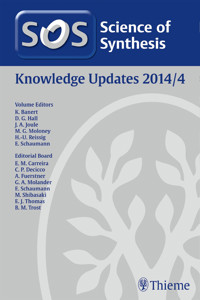
Science of Synthesis Knowledge Updates 2014 Vol. 4 E-Book
2.999,99 €
Mehr erfahren.
- Herausgeber: Thieme
- Kategorie: Wissenschaft und neue Technologien
- Sprache: Englisch
The Science of Synthesis Editorial Board, together with the volume editors and authors, is constantly reviewing the whole field of synthetic organic chemistry as presented in Science of Synthesis and evaluating significant developments in synthetic methodology. Four annual volumes updating content across all categories ensure that you always have access to state-of-the-art synthetic methodology.
Das E-Book können Sie in Legimi-Apps oder einer beliebigen App lesen, die das folgende Format unterstützen:
Seitenzahl: 977
Veröffentlichungsjahr: 2015
Ähnliche




















Science of Synthesis
Science of Synthesis is the authoritative and comprehensive reference work for the entire field of organic and organometallic synthesis.
Science of Synthesis presents the important synthetic methods for all classes of compounds and includes:
Methods critically evaluated by leading scientists
Background information and detailed experimental procedures
Schemes and tables which illustrate the reaction scope
Preface
As the pace and breadth of research intensifies, organic synthesis is playing an increasingly central role in the discovery process within all imaginable areas of science: from pharmaceuticals, agrochemicals, and materials science to areas of biology and physics, the most impactful investigations are becoming more and more molecular. As an enabling science, synthetic organic chemistry is uniquely poised to provide access to compounds with exciting and valuable new properties. Organic molecules of extreme complexity can, given expert knowledge, be prepared with exquisite efficiency and selectivity, allowing virtually any phenomenon to be probed at levels never before imagined. With ready access to materials of remarkable structural diversity, critical studies can be conducted that reveal the intimate workings of chemical, biological, or physical processes with stunning detail.
The sheer variety of chemical structural space required for these investigations and the design elements necessary to assemble molecular targets of increasing intricacy place extraordinary demands on the individual synthetic methods used. They must be robust and provide reliably high yields on both small and large scales, have broad applicability, and exhibit high selectivity. Increasingly, synthetic approaches to organic molecules must take into account environmental sustainability. Thus, atom economy and the overall environmental impact of the transformations are taking on increased importance.
The need to provide a dependable source of information on evaluated synthetic methods in organic chemistry embracing these characteristics was first acknowledged over 100 years ago, when the highly regarded reference source Houben–Weyl Methoden der Organischen Chemie was first introduced. Recognizing the necessity to provide a modernized, comprehensive, and critical assessment of synthetic organic chemistry, in 2000 Thieme launched Science of Synthesis, Houben–Weyl Methods of Molecular Transformations. This effort, assembled by almost 1000 leading experts from both industry and academia, provides a balanced and critical analysis of the entire literature from the early 1800s until the year of publication. The accompanying online version of Science of Synthesis provides text, structure, substructure, and reaction searching capabilities by a powerful, yet easy-to-use, intuitive interface.
From 2010 onward, Science of Synthesis is being updated quarterly with high-quality content via Science of Synthesis Knowledge Updates. The goal of the Science of Synthesis Knowledge Updates is to provide a continuous review of the field of synthetic organic chemistry, with an eye toward evaluating and analyzing significant new developments in synthetic methods. A list of stringent criteria for inclusion of each synthetic transformation ensures that only the best and most reliable synthetic methods are incorporated. These efforts guarantee that Science of Synthesis will continue to be the most up-to-date electronic database available for the documentation of validated synthetic methods.
Also from 2010, Science of Synthesis includes the Science of Synthesis Reference Library, comprising volumes covering special topics of organic chemistry in a modular fashion, with six main classifications: (1) Classical, (2) Advances, (3) Transformations, (4) Applications, (5) Structures, and (6) Techniques. Titles will include Stereoselective Synthesis, Water in Organic Synthesis, and Asymmetric Organocatalysis, among others. With expert-evaluated content focusing on subjects of particular current interest, the Science of Synthesis Reference Library complements the Science of Synthesis Knowledge Updates, to make Science of Synthesis the complete information source for the modern synthetic chemist.
The overarching goal of the Science of Synthesis Editorial Board is to make the suite of Science of Synthesis resources the first and foremost focal point for critically evaluated information on chemical transformations for those individuals involved in the design and construction of organic molecules.
Throughout the years, the chemical community has benefited tremendously from the outstanding contribution of hundreds of highly dedicated expert authors who have devoted their energies and intellectual capital to these projects. We thank all of these individuals for the heroic efforts they have made throughout the entire publication process to make Science of Synthesis a reference work of the highest integrity and quality.
The Editorial Board
July 2010
E. M. Carreira (Zurich, Switzerland)
C. P. Decicco (Princeton, USA)
A. Fuerstner (Muelheim, Germany)
G. A. Molander (Philadelphia, USA)
E. Schaumann (Clausthal-Zellerfeld, Germany)
M. Shibasaki (Tokyo, Japan)
E. J. Thomas (Manchester, UK)
B. M. Trost (Stanford, USA)
Abstracts
5.2.16.11 Tin Cyanides and Fulminates
P. B. Wyatt
This chapter is an update to the earlier Science of Synthesis contribution (Section 5.2.16) describing synthetic methods that involve tin cyanides and fulminates. It focuses on applications of these compounds reported in the period 2000–2013.
Keywords: cyanation • cyanometalation • ynamines • platinum • catalysis
5.2.17.9 Acylstannanes (Including S, Se, and Te Analogues)
P. B. Wyatt
This chapter is an update to the earlier Science of Synthesis contribution (Section 5.2.17) describing synthetic methods that involve acylstannanes and analogues incorporating heavier chalcogens. This update focuses on applications of acylstannanes reported in the period 2000–2013. These include cross-coupling reactions with carbon electrophiles and transition-metal-catalyzed additions to carbon—carbon multiple bonds.
Keywords: acylmetalation • allenes • palladium • nickel • catalysis
5.2.18.8 Imidoylstannanes, Diazoalkylstannanes, Tin Isocyanates, and Tin Isothiocyanates
P. B. Wyatt
This chapter is an update to the earlier Science of Synthesis contribution (Section 5.2.18) describing synthetic methods that involve imidoylstannanes, diazoalkylstannanes, tin isocyanates, and tin isothiocyanates. It focuses on applications of these compounds reported in the period 2000–2013.
Keywords: 1,3,2-diazaboroles • cyclopropanes • copper • N-heterocyclic carbene complexes
6.1.42 Product Subclass 42: N-Heterocyclic Carbene Borane Complexes
A.-L. Vallet and E. Lacôte
N-Heterocyclic carbene borane complexes are a family of new reagents for organic chemistry and polymer synthesis. This chapter summarizes first the preparations and modifications of these reagents. It then focuses on the applications of the title compounds as radical hydrogen-atom donors, hydrides, hydroborating reagents, and radical photopolymerization initiators.
Keywords: anionic reagents • boranes • borohydrides • boron compounds • carbenes • hydroboration • polymers • radical reactions • reductions
10.1 Product Class 1: Benzo[b]furans
H. Kwiecień
This chapter is a revision of the earlier Section 10.1 in Science of Synthesis. It describes methods for the synthesis of benzo[b]furans and related compounds such as benzo[b]furan-3(2H)- and benzo[b]furan-2(3H)-ones. Classical routes to benzo[b]furans involve intramolecular cyclizations of suitably substituted arenes, most often phenols and aryloxy carbonyl compounds and their derivatives, or intermolecular cyclization reactions based on 2-halophenols and alkynes. However, very popular metal-catalyzed developments, with various approaches, are also included. Methods for the synthesis of benzo[b]furans from furans by construction of the homocyclic aromatic ring, including homogeneous metal-catalyzed benzannulation, are also presented.
Keywords: benzo compounds • benzo[b]furans • benzo[b]furan-3(2H)-ones • benzo[b]furan-2(3H)-ones • phenols • alkenes • alkynes • halo compounds • carbonyl compounds • palladium catalysts • copper catalysts • cyclization • ring closure • annulation • cross-coupling reactions
18.16.20 Other Tetraheterosubstituted Methanes
W. Kantlehner
This article is an update to the earlier Science of Synthesis contribution (Section 18.16) describing methods for the preparation of tetraheterosubstituted methanes. Tetraalkyl orthocarbonates have turned out to be useful starting compounds for the preparation of low-shrinking polymeric compounds. In addition, new compound types such as tetraazidomethane or tetrakis(oligonitroalkyl) orthocarbonates are reported, some of which have been prepared for the first time.
Keywords: amino(alkylsulfanyl)dialkoxymethanes • aminobis(organosulfanyl)phosphinomethanes • aminobis(organosulfanyl)phosphorylmethanes • amino(organooxy)-bis(organosulfanyl)methanes • aminotris(organosulfanyl)methanes • alkoxybis(alkylsulfanyl)phosphorylmethanes • alkoxytriaminomethanes • alkoxytris(organosulfanyl)methanes • bis(organoamino)(organooxy)sulfanylmethanes • dialkoxybis(alkylsulfanyl)methanes • dialkoxybis(phosphino)methanes • dialkoxydiaminomethanes • diaminobis(organosulfanyl)methanes • tetraalkoxymethanes • tetraheterosubstituted methanes • tetrakis(dialkylamino)methanes • tetrakis(organosulfanyl)methanes • trialkoxy(phosphino)methanes • trialkoxy(phosphoryl)methanes • trialkoxy(alkylsulfanyl)-methanes • triamino(organosulfanyl)methanes • triamino(organoselanyl)methanes • tris(alkylsulfanyl)phosphorylmethanes
27.1.7 Sulfur Ylides
G. Mlostoń and H. Heimgartner
A comprehensive update of methods for the in situ generation of sulfonium ylides (sulfonium methanides, Corey–Chaykovsky reagents) and their applications for the synthesis of more complex molecules via methylene transfer is presented. Sulfonium ylides are widely applied in synthetically relevant reactions, such as cyclopropanation, aziridination, and epoxidation. Asymmetric versions of these processes are also summarized. In the presence of appropriate catalysts, preferably metal salts and/or complexes of gold or palladium, sulfonium ylides can undergo cascade heterocyclizations or C—H-insertion reactions.
Keywords: asymmetric synthesis • aziridination • chemoselectivity • cyclopropanation epoxidation • heterocycles • insertion reactions • sulfonium ylides • sulfur ylides
32.3.1.3 1,2-Dihaloalkenes
A. Bredenkamp and S. F. Kirsch
The present chapter is an update to the earlier Science of Synthesis contribution Section 32.3.1 (written by Nubbemeyer in 2008) describing general synthetic methods to access 1,2-dihaloalkenes. It focuses on new synthetic developments for this rather broad class of compounds, covering the literature from 2005 until the end of 2013. Some exceptions from before 2005 are included if they are of current interest and are not covered in the original contribution. Due to the vast number of examples in the literature, the current overview does not include methods where new compounds with 1,2-dihaloalkene units are formed from compounds with the same 1,2-dihaloalkene unit through side-chain manipulations. The focus is on synthetic methods that are capable of newly creating the title 1,2-dihalogenated alkene moiety. The update does not include halogenations of aromatics or heteroaromatics.
Keywords: iodine • bromine • chlorine • alkynes • halogenations • alkenes
Science of Synthesis Knowledge Updates 2014/4
Preface
Abstracts
Table of Contents
5.2.16.11 Tin Cyanides and Fulminates (Update 2014)
P. B. Wyatt
5.2.17.9 Acylstannanes (Including S, Se, and Te Analogues) (Update 2014)
P. B. Wyatt
5.2.18.8 Imidoylstannanes, Diazoalkylstannanes, Tin Isocyanates, and Tin Isothiocyanates (Update 2014)
P. B. Wyatt
6.1.42 Product Subclass 42: N-Heterocyclic Carbene Borane Complexes
A.-L. Vallet and E. Lacôte
10.1 Product Class 1: Benzo[b]furans
H. Kwiecień
18.16.20 Other Tetraheterosubstituted Methanes (Update 2014)
W. Kantlehner
27.1.7 Sulfur Ylides (Update 2014)
G. Mlostoń and H. Heimgartner
32.3.1.3 1,2-Dihaloalkenes (Update 2014)
A. Bredenkamp and S. F. Kirsch
Author Index
Abbreviations
Table of Contents
Volume 5: Compounds of Group 14 (Ge, Sn, Pb)
5.2 Product Class 2: Tin Compounds
5.2.16.11 Tin Cyanides and Fulminates
P. B. Wyatt
5.2.16.11 Tin Cyanides and Fulminates
5.2.16.11.1 Method 1: Application of Tin Cyanides in the Synthesis of Alkenylstannanes by Trialkylstannylcyanation of Alkynes
5.2.17.9 Acylstannanes (Including S, Se, and Te Analogues)
P. B. Wyatt
5.2.17.9 Acylstannanes (Including S, Se, and Te Analogues)
5.2.17.9.1 Applications of Acylstannanes in Organic Synthesis
5.2.17.9.1.1 Method 1: Synthesis of β,γ-Unsaturated Ketones by Acylation of Allylic Esters with Acylstannanes
5.2.17.9.1.2 Method 2: Synthesis of ɑ-Oxoamides by Reaction of Stannanecarboxamides with Acyl Chlorides
5.2.17.9.1.3 Method 3: Synthesis of 3-(Trialkylstannyl)alk-2-enamides by Carbamoylstannylation of Terminal Alkynes
5.2.17.9.1.4 Method 4: Synthesis of 1,4-Dicarbonyl Compounds by Acylstannylation of ɑ,ß-Unsaturated Carbonyl Compounds
5.2.17.9.1.5 Method 5: Synthesis of ε-Oxoallylstannanes by Acylstannylation of 1,3-Dienes
5.2.17.9.1.6 Method 6: Synthesis of ɑ-(Acylmethyl)vinylstannanes by Acylstannylation of 1,2-Dienes
5.2.17.9.1.7 Method 7: Synthesis of Alkenylstannanes by Decarbonylative Carbostannylation of Alkynes
5.2.18.8 Imidoylstannanes, Diazoalkylstannanes, Tin Isocyanates, and Tin Isothiocyanates
P. B. Wyatt
5.2.18.8 Imidoylstannanes, Diazoalkylstannanes, Tin Isocyanates, and Tin Isothiocyanates
5.2.18.8.1 Method 1: Application of Imidoylstannanes in the Synthesis of 1,3,2-Di-azaboroles from Aryldibromoboranes
5.2.18.8.2 Method 2: Application of Diazoalkylstannanes in the Synthesis of Cyclo-propylstannanes from Alkenes
Volume 6: Boron Compounds
6.1 Product Class 1: Boron Compounds
6.1.42 Product Subclass 42: N-Heterocyclic Carbene Borane Complexes
A.-L. Vallet and E. Lactôe
6.1.42 Product Subclass 42: N-Heterocyclic Carbene Borane Complexes
6.1.42.1 Synthesis of Product Subclass
6.1.42.1.1 Method 1: Synthesis by Carbene-Boron Bond Formation
6.1.42.1.1.1 Variation 1: Reaction of a Borane with a Stable Carbene
6.1.42.1.1.2 Variation 2: Reaction of “Ate” Complexes with an Imidazolium Salt
6.1.42.1.1.3 Variation 3: Synthesis from Lithiated Hetarenes and 1-Boryl-1-silylalkenes
6.1.42.1.1.4 Variation 4: Synthesis of Abnormal (Mesoionic) Carbene Boranes
6.1.42.1.1.5 Variation 5: Synthesis from Imidazole Boranes
6.1.42.1.1.6 Variation 6: Synthesis from Isonitriles
6.1.42.1.1.7 Variation 7: Miscellaneous Syntheses
6.1.42.1.2 Method 2: Electrophilic Modification of N-Heterocyclic Carbene Borane Complexes
6.1.42.1.3 Method 3: Modification of Carbene Boranes via Anionic Derivatives
6.1.42.1.3.1 Variation 1: Reaction of Carbene Boryl Anions
6.1.42.1.3.2 Variation 2: Deprotonation on the Carbene Backbone
6.1.42.1.4 Method 4: Modification via N-Heterocyclic Carbene Boryl Radical Formation
6.1.42.1.4.1 Variation 1: Formation and Physical Organic Characterization of N-Heterocyclic Carbene Boryl Radicals
6.1.42.1.4.2 Variation 2: Access to N-Heterocyclic Carbene Boryl Sulfides
6.1.42.1.4.3 Variation 3: Formation of Diborenes and Diborynes
6.1.42.1.5 Method 5: Modification via Borylene Formation
6.1.42.1.6 Method 6: Modification via Rearrangement and Sigmatropic Reactions
6.1.42.1.6.1 Variation 1: Reaction in Close Proximity to the Boron Atom
6.1.42.1.6.2 Variation 2: Reaction Directly Involving the Boron Atom
6.1.42.2 Applications of Product Subclass 42 in Organic Synthesis
6.1.42.2.1 Method 1: Use as Hydride, Aryl, Boryl, and Silyl Donors in Ionic and Organometallic Reactions
6.1.42.2.1.1 Variation 1: Hydride Donors
6.1.42.2.1.2 Variation 2: Transmetalation Reactions
6.1.42.2.1.3 Variation 3: N-Heterocyclic Carbene Catalyzed Boryl and Silyl Transfer from Diboranes and Silylboranes
6.1.42.2.2 Method 2: Use of N-Heterocyclic Carbene Boranes as Hydrogen Donors in Molecular Free-Radical Reactions
6.1.42.2.2.1 Variation 1: Deoxygenations
6.1.42.2.2.2 Variation 2: Dehalogenations
6.1.42.2.2.3 Variation 3: Hydroxymethylation
6.1.42.2.3 Method 3: Use of N-Heterocyclic Carbene Boranes as Initiators for Free-Radical Polymerizations
6.1.42.2.4 Method 4: Use in Alkene and Alkyne Hydroborations
Volume 10: Fused Five-Membered Hetarenes with One Heteroatom
10.1 Product Class 1: Benzo[b]furans
H. Kwiecień
10.1 Product Class 1: Benzo[b]furans
10.1.1 Synthesis by Ring-Closure Reactions
10.1.1.1 Annulation to an Arene
10.1.1.1.1 Formation of One O—C and One C—C Bond
10.1.1.1.1.1 Formation of 1—2 and 3—3a Bonds
10.1.1.1.1.1.1 Method 1: Synthesis from 2-Halophenols and Alkynes
10.1.1.1.1.1.1.1 Variation 1: 2-Halophenols and Copper(I) Acetylides
10.1.1.1.1.1.1.2 Variation 2: 2-Halophenols and Alkynes with a Copper Catalyst
10.1.1.1.1.1.1.3 Variation 3: 2-Halophenols and Alkynes with a Palladium(II) Catalyst
10.1.1.1.1.1.1.4 Variation 4: 2-Halophenols and Alkynes with a Palladium(N) and Copper(I) Catalyst System
10.1.1.1.1.1.1.5 Variation 5: 2-Halophenols and Alkynes with a Palladium(0)/Copper(I) Catalyst System
10.1.1.1.1.1.1.6 Variation 6: 2-Halophenols, Propargyl Bromide, and Amines or Potassiumc Amides under Palladium/Copper Catalysis
10.1.1.1.1.1.1.7 Variation 7: Combinatorial Procedure from 2-Halophenols and Alkynes with Palladium/Copper
10.1.1.1.1.1.1.8 Variation 8: 2-Halophenols with Palladium/Magnesium
10.1.1.1.1.1.2 Method 2: Synthesis from Aryl Halides, Protected 2-Iodophenols, and 1-Ethynylcyclohexanol
10.1.1.1.1.1.3 Method 3: Synthesis from Phenols and β-Oxo Esters with an Iron Catalyst
10.1.1.1.1.1.4 Method 4: Synthesis from Phenols and Bromoalkynes
10.1.1.1.1.1.5 Method 5: Synthesis from 2-Bromophenols and Enolates with a Palladium Catalyst
10.1.1.1.1.1.6 Method 6: Synthesis from Phenols by Dehydrative C—H Alkenylation and Annulation with 1,2-Diols
10.1.1.1.1.1.7 Method 7: Synthesis from Phenols via Direct ortho Functionalization by Extended Pummerer Reaction
10.1.1.1.1.1.8 Method 8: Synthesis of 3-Iodobenzo[b]furans from 2-Iodoanisole and Alkynes
10.1.1.1.1.1.9 Method 9: Synthesis from O-Aryloximes via [3,3]-Sigmatropic Rearrangement
10.1.1.1.1.1.10 Method 10: Synthesis from 2-Halophenols and Alkynes via Photochemical Reaction
10.1.1.1.1.1.11 Method 11: Synthesis from 1,4-Quinones
10.1.1.1.1.2 Formation of 1—2 and 2—3 Bonds
10.1.1.1.1.2.1 Method 1: Synthesis from 2-Hydroxyarylaldehydes or 2-Hydroxyaryl Ketones
10.1.1.1.1.2.1.1 Variation 1: 2-Hydroxybenzaldehydes and Chloroacetone
10.1.1.1.1.2.1.2 Variation 2: 2-Hydroxybenzaldehydes and 1-Aryl-2-haloethanones
10.1.1.1.1.2.1.3 Variation 3: 2-Hydroxybenzonitriles and a 1-Aryl-2-bromoethanone
10.1.1.1.1.2.1.4 Variation 4: 2-Hydroxybenzaldehydes and 1-Aryl-2-bromoethanones
10.1.1.1.1.2.1.5 Variation 5: 2-Hydroxybenzaldehydes and α-Halo Esters
Lesen Sie weiter in der vollständigen Ausgabe!
Lesen Sie weiter in der vollständigen Ausgabe!
Lesen Sie weiter in der vollständigen Ausgabe!
Lesen Sie weiter in der vollständigen Ausgabe!
Lesen Sie weiter in der vollständigen Ausgabe!
Lesen Sie weiter in der vollständigen Ausgabe!
Lesen Sie weiter in der vollständigen Ausgabe!
Lesen Sie weiter in der vollständigen Ausgabe!
Lesen Sie weiter in der vollständigen Ausgabe!
Lesen Sie weiter in der vollständigen Ausgabe!
Lesen Sie weiter in der vollständigen Ausgabe!
Lesen Sie weiter in der vollständigen Ausgabe!
Lesen Sie weiter in der vollständigen Ausgabe!
Lesen Sie weiter in der vollständigen Ausgabe!
Lesen Sie weiter in der vollständigen Ausgabe!
Lesen Sie weiter in der vollständigen Ausgabe!
Lesen Sie weiter in der vollständigen Ausgabe!




