


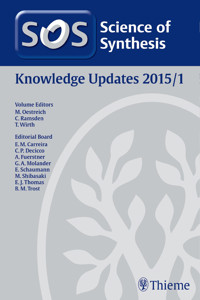
Science of Synthesis Knowledge Updates 2015 Vol. 1 E-Book
2.999,99 €
Mehr erfahren.
- Herausgeber: Thieme
- Kategorie: Wissenschaft und neue Technologien
- Sprache: Englisch
The Science of Synthesis Editorial Board, together with the volume editors and authors, is constantly reviewing the whole field of synthetic organic chemistry as presented in Science of Synthesis and evaluating significant developments in synthetic methodology. Four annual volumes updating content across all categories ensure that you always have access to state-of-the-art synthetic methodology.
Das E-Book können Sie in Legimi-Apps oder einer beliebigen App lesen, die das folgende Format unterstützen:
Seitenzahl: 1076
Veröffentlichungsjahr: 2015
Ähnliche




















Science of Synthesis
Science of Synthesis is the authoritative and comprehensive reference work for the entire field of organic and organometallic synthesis.
Science of Synthesis presents the important synthetic methods for all classes of compounds and includes:
Methods critically evaluated by leading scientists
Background information and detailed experimental procedures
Schemes and tables which illustrate the reaction scope
Preface
As the pace and breadth of research intensifies, organic synthesis is playing an increasingly central role in the discovery process within all imaginable areas of science: from pharmaceuticals, agrochemicals, and materials science to areas of biology and physics, the most impactful investigations are becoming more and more molecular. As an enabling science, synthetic organic chemistry is uniquely poised to provide access to compounds with exciting and valuable new properties. Organic molecules of extreme complexity can, given expert knowledge, be prepared with exquisite efficiency and selectivity, allowing virtually any phenomenon to be probed at levels never before imagined. With ready access to materials of remarkable structural diversity, critical studies can be conducted that reveal the intimate workings of chemical, biological, or physical processes with stunning detail.
The sheer variety of chemical structural space required for these investigations and the design elements necessary to assemble molecular targets of increasing intricacy place extraordinary demands on the individual synthetic methods used. They must be robust and provide reliably high yields on both small and large scales, have broad applicability, and exhibit high selectivity. Increasingly, synthetic approaches to organic molecules must take into account environmental sustainability. Thus, atom economy and the overall environmental impact of the transformations are taking on increased importance.
The need to provide a dependable source of information on evaluated synthetic methods in organic chemistry embracing these characteristics was first acknowledged over 100 years ago, when the highly regarded reference source Houben–Weyl Methoden der Organischen Chemie was first introduced. Recognizing the necessity to provide a modernized, comprehensive, and critical assessment of synthetic organic chemistry, in 2000 Thieme launched Science of Synthesis, Houben–Weyl Methods of Molecular Transformations. This effort, assembled by almost 1000 leading experts from both industry and academia, provides a balanced and critical analysis of the entire literature from the early 1800s until the year of publication. The accompanying online version of Science of Synthesis provides text, structure, substructure, and reaction searching capabilities by a powerful, yet easy-to-use, intuitive interface.
From 2010 onward, Science of Synthesis is being updated quarterly with high-quality content via Science of Synthesis Knowledge Updates. The goal of the Science of Synthesis Knowledge Updates is to provide a continuous review of the field of synthetic organic chemistry, with an eye toward evaluating and analyzing significant new developments in synthetic methods. A list of stringent criteria for inclusion of each synthetic transformation ensures that only the best and most reliable synthetic methods are incorporated. These efforts guarantee that Science of Synthesis will continue to be the most up-to-date electronic database available for the documentation of validated synthetic methods.
Also from 2010, Science of Synthesis includes the Science of Synthesis Reference Library, comprising volumes covering special topics of organic chemistry in a modular fashion, with six main classifications: (1) Classical, (2) Advances, (3) Transformations, (4) Applications, (5) Structures, and (6) Techniques. Titles will include Stereoselective Synthesis, Water in Organic Synthesis, and Asymmetric Organocatalysis, among others. With expert-evaluated content focusing on subjects of particular current interest, the Science of Synthesis Reference Library complements the Science of Synthesis Knowledge Updates, to make Science of Synthesis the complete information source for the modern synthetic chemist.
The overarching goal of the Science of Synthesis Editorial Board is to make the suite of Science of Synthesis resources the first and foremost focal point for critically evaluated information on chemical transformations for those individuals involved in the design and construction of organic molecules.
Throughout the years, the chemical community has benefited tremendously from the outstanding contribution of hundreds of highly dedicated expert authors who have devoted their energies and intellectual capital to these projects. We thank all of these individuals for the heroic efforts they have made throughout the entire publication process to make Science of Synthesis a reference work of the highest integrity and quality.
The Editorial Board
July 2010
E. M. Carreira (Zurich, Switzerland)
C. P. Decicco (Princeton, USA)
A. Fuerstner (Muelheim, Germany)
G. A. Molander (Philadelphia, USA)
E. Schaumann (Clausthal-Zellerfeld, Germany)
M. Shibasaki (Tokyo, Japan)
E. J. Thomas (Manchester, UK)
B. M. Trost (Stanford, USA)
Abstracts
4.4.4.8 Silyl Hydrides
R. W. Clark and S. L. Wiskur
This chapter is an update to the earlier article in Science of Synthesis (Section 4.4.4) covering the synthesis and use of silyl hydrides. Recent advances in synthetic preparations of silyl hydrides are explored, as well as the use of silyl hydrides for hydrosilylation, reduction, and dehydrogenative silylation.
Keywords: silyl hydrides • silanes • organosilanes • chiral silanes • hydrosilylation • dehydrogenative silylation • reduction
4.4.34.35 Vinylsilanes
E. A. Anderson and D. S. W. Lim
This chapter is an update to the earlier Science of Synthesis contribution (Section 4.4.34) describing methods for the synthesis of vinylsilanes. It focuses on the literature published in the period 2000–2014, with a particular emphasis on metal-catalyzed methods.
Keywords: vinylsilanes • vinylmetals • transition-metal catalysis • hydrosilylation • alkynes • silylmetalation • alkynylsilanes • hydrogenation • hydrometalation • coupling reactions • dehydrogenative silylation • alkenes • carbometalation • metathesis • rearrangements
31.1.2 Fluoroarenes
A. Harsanyi and G. Sandford
This chapter is an update to the earlier Science of Synthesis contribution (Section 31.1) describing methods for the synthesis of fluoroarenes. It focuses on the literature published in the period 2007–2014, with a particular emphasis on transition-metal-mediated fluorination processes.
Keywords: organofluorine • fluoroarenes • fluoroaromatics • fluorination • transition-metal-mediated fluorination
31.2.3 Chloroarenes
S. P. Stanforth
This chapter updates the previous Science of Synthesis contribution (Section 31.2) published in 2007. Methods for the chlorination of arenes are described. The application of chloroarenes in synthesis, principally in transition-metal-catalyzed cross-coupling reactions, is discussed.
Keywords: chlorination • cross-coupling reactions • transition-metal-catalyzed reactions • aryl—carbon bond formation • aryl—heteroatom bond formation
31.3.3 Bromoarenes
S. P. Stanforth
This chapter updates the previous Science of Synthesis contribution (Section 31.3), published in 2007, describing the preparation of bromoarenes and their applications in synthesis. In recent years, the use of bromoarenes in transition-metal-catalyzed cross-coupling reactions has attracted considerable interest.
Keywords: bromoarenes • bromination • cross-coupling reactions • Suzuki reaction • Sonogashira reaction • Buchwald–Hartwig reaction • hydrodebromination • transhalogenation
31.4.1.3 Hypervalent Iodoarenes and Aryliodonium Salts
V. V. Zhdankin
This chapter provides an update to the earlier Science of Synthesis contribution (Section 31.4.1) describing the preparation and synthetic applications of hypervalent iodoarenes and aryliodonium salts. Recently, the chemistry of hypervalent iodine compounds has experienced several significant new developments, the most important of which are represented by the discovery of catalytic reactions promoted by in situ generated hypervalent iodine species, the development of highly enantioselective reactions of chiral hypervalent iodine reagents, and the preparation and synthetic application of numerous recyclable hypervalent iodine reagents.
Keywords: iodine • iodonium compounds • alkynylation • arylation • trifluoromethylation • oxidation • oxidative cleavage • catalysts • chiral compounds • fluorination • iodination • Hofmann rearrangement
31.41.3 Arylphosphine Oxides and Heteroatom Derivatives
O. M. Demchuk, M. Stankevič, and K. M. Pietrusiewicz
This chapter is an expanded update to the earlier Science of Synthesis contribution (Section 31.41), describing methods for the synthesis of arylphosphine oxides, arylphosphine sulfides, arylphosphine selenides, and aryl(imino)phosphoranes. Classical routes to arylphosphine chalcogenides involve the oxidation of parent phosphines by the pertinent chalcogenide oxidant. Other methods involve the formation of the lacking P—C bond(s) in oxidized electrophilic, nucleophilic, and radical phosphorus(V) precursors. Newer methods are based on hydrophosphinylation and coupling processes catalyzed by transition-metal complexes. Classical synthesis of aryl(imino)phosphoranes involves the reaction of the parent phosphines with organic azides (the Staudinger reaction), but methods based on the use of aminophosphonium intermediates are also reviewed. Approaches involving modifications of the carbon skeleton in existing arylphosphine chalcogenides are included as well.
Keywords: phosphorus compounds • phosphines • phosphine oxides • phosphine sulfides • phosphine selenides • iminophosphoranes • phosphorus heterocycles • phosphinylation • addition reactions • nucleophilic substitution • coupling reactions • cycloadditions • 1,3-dipolar cycloaddition • oxidation • radical addition • P—C bond formation • P—C bond cleavage
35.2.5.1.9 Synthesis by Addition across C=C Bonds
G. Dagousset and G. Masson
This chapter is an update to the earlier Science of Synthesis Section 35.2.5.1, written by Troll in 2006, on the synthesis of 1-bromo-n-heteroatom-functionalized alkanes (n ≥2), with both functions formed simultaneously by addition across C=C bonds. It focuses on recent advances in the field of bromofunctionalization of alkenes in the period 2007–2014, in particular on catalytic enantioselective syntheses.
Keywords: bromine compounds • carbon—bromine bonds • carbon—heteroatom bonds • bromination of alkenes • alkoxybromination of alkenes • bromolactonization • aminobromination • catalytic enantioselective reactions
Science of Synthesis Knowledge Updates 2015/1
Preface
Abstracts
Table of Contents
4.4.4.8 Silyl Hydrides (Update 2015)
R. W. Clark and S. L. Wiskur
4.4.34.35 Vinylsilanes (Update 2015)
E. A. Anderson and D. S. W. Lim
31.1.2 Fluoroarenes (Update 2015)
A. Harsanyi and G. Sandford
31.2.3 Chloroarenes (Update 2015)
S. P. Stanforth
31.3.3 Bromoarenes (Update 2015)
S. P. Stanforth
31.4.1.3 Hypervalent Iodoarenes and Aryliodonium Salts (Update 2015)
V. V. Zhdankin
31.41.3 Arylphosphine Oxides and Heteroatom Derivatives (Update 2015)
O. M. Demchuk, M. Stankevič, and K. M. Pietrusiewicz
35.2.5.1.9 Synthesis by Addition across C=C Bonds (Update 2015)
G. Dagousset and G. Masson
Author Index
Abbreviations
Table of Contents
Volume 4: Compounds of Group 15 (As, Sb, Bi) and Silicon Compounds
4.4 Product Class 4: Silicon Compounds
4.4.4.8 Silyl Hydrides
R. W. Clark and S. L. Wiskur
4.4.4.8 Silyl Hydrides
4.4.4.8.1 Synthesis of Silyl Hydrides
4.4.4.8.1.1 Method 1: From Inorganic Silanes
4.4.4.8.1.2 Method 2: From Alkyl-orArylsilanes
4.4.4.8.1.3 Method 3: From Silyl Halides
4.4.4.8.1.4 Method 4: From Silyl Ethers
4.4.4.8.1.5 Method 5: From Other Silyl Hydrides by Monohalogenation or Deuterium Exchange
4.4.4.8.2 Applications of Silyl Hydrides in Organic Synthesis
4.4.4.8.2.1 Method 1: Hydrosilylation of Alkenes, Alkynes, and Related Compounds
4.4.4.8.2.2 Method 2: Silyl Hydrides as Reducing Agents
4.4.4.8.2.3 Method 3: Dehydrogenative Silylation
4.4.34.35 Vinylsilanes
E. A. Andersonand D. S. W. Lim
4.4.34.35 Vinylsilanes
4.4.34.35.1 Vinylmetal Addition to Silane Electrophiles
4.4.34.35.1.1 Method 1: Addition to Chlorosilanes
4.4.34.35.1.2 Method 2: Addition to Cyclic Siloxanes
4.4.34.35.2 Hydrosilylation of Alkynes
4.4.34.35.2.1 Method 1: Transition-Metal-Catalyzed β-Hydrosilylation of Terminal Alkynes To Give E-Vinylsilanes
4.4.34.35.2.1.1 Variation 1: PlatinumCatalysis
4.4.34.35.2.1.2 Variation 2: Rhodium Catalysis
4.4.34.35.2.1.3 Variation 3: PalladiumCatalysis
4.4.34.35.2.1.4 Variation 4: Iridium Catalysis
4.4.34.35.2.2 Method 2: Transition-Metal-Catalyzed β-Hydrosilylation of Terminal Alkynes To Give Z-Vinylsilanes
4.4.34.35.2.2.1 Variation 1: Ruthenium Catalysis
4.4.34.35.2.2.2 Variation 2: Rhodium Catalysis
4.4.34.35.2.2.3 Variation 3: Iridium Catalysis
4.4.34.35.2.3 Method 3: Transition-Metal-Catalyzed α-Hydrosilylation of Terminal Alkynes
4.4.34.35.2.3.1 Variation 1: Ruthenium Catalysis
4.4.34.35.2.3.2 Variation 2: PlatinumCatalysis
4.4.34.35.2.4 Method 4: Transition-Metal-Catalyzed syn Hydrosilylation of Internal Alkynes
4.4.34.35.2.4.1 Variation 1: Platinum Catalysis
4.4.34.35.2.4.2 Variation 2: PalladiumCatalysis
4.4.34.35.2.5 Method 5: Transition-Metal-Catalyzed anti Hydrosilylation of Internal Alkynes
4.4.34.35.2.6 Method 6: Lewis Acid CatalyzedHydrosilylation
4.4.34.35.2.7 Method 7: RadicalHydrosilylation
4.4.34.35.3 Silylmetalation of Alkynes
4.4.34.35.3.1 Method 1: Silylcupration
4.4.34.35.3.1.1 Variation 1: Silylcupration Using Silyllithium Reagents
4.4.34.35.3.1.2 Variation 2: Silylcupration Using Silylboronic EsterReagents
4.4.34.35.3.2 Method 2: Copper-Catalyzed Silylmetalation
4.4.34.35.3.3 Method 3: Silylzincation
4.4.34.35.3.4 Method 4: Silylrhodation
4.4.34.35.4 Addition to Alkynylsilanes
4.4.34.35.4.1 Method 1: Hydrogenation
4.4.34.35.4.2 Method 2: Hydrometalation
4.4.34.35.4.2.1 Variation 1: HydrometalationFollowed by Protodemetalation
4.4.34.35.4.2.2 Variation 2: HydrometalationFollowed by Halogenation
4.4.34.35.4.2.3 Variation 3: HydrometalationFollowed by Alkylation
4.4.34.35.4.3 Method 3: Carbometalation
4.4.34.35.5 Intermolecular Coupling of Alkynylsilanes
4.4.34.35.5.1 Method 1: Ruthenium-Catalyzed Alder-Ene Reaction
4.4.34.35.5.2 Method 2: Reductive Coupling
4.4.34.35.5.3 Method 3: Enyne Cross Metathesis
4.4.34.35.6 Ring-Closing Metathesis of α-Substituted Vinylsilanes
4.4.34.35.7 Dehydrogenative Silylation of Alkenes
4.4.34.35.7.1 Method 1: Reaction with Silanes
4.4.34.35.7.2 Method 2: Reaction with Halosilanes or Silyl Trifluoromethanesulfonates
4.4.34.35.7.3 Method 3: Transfer Silylation
4.4.34.35.7.4 Method 4: Reaction with Siletanes
4.4.34.35.8 Carbometalation of Vinylsilanes
4.4.34.35.8.1 Method 1: Heck Reaction with Aryl Halides
4.4.34.35.8.2 Method 2: Heck-Type Reaction with Benzonitriles
4.4.34.35.8.3 Method 3: Iron-Catalyzed Oxidative Arylation
4.4.34.35.9 Addition to Carbonyl Compounds
4.4.34.35.9.1 Method 1: Reaction with (Dihalomethyl)silane Reagents
4.4.34.35.9.2 Method 2: Reaction with Disilylmethyllithium Reagents
4.4.34.35.9.3 Method 3: Reaction with (Halomethyl)silane Reagents
4.4.34.35.9.4 Method 4: Reaction with (α-Silylallyl)borane Reagents
4.4.34.35.10 Rearrangements
4.4.34.35.10.1 Method 1: Gold-Catalyzed Rearrangement of Allyl(alkynyl)silanes
4.4.34.35.10.2 Method 2: Rearrangement of (α-Hydroxypropargyl)silanes
4.4.34.35.10.3 Method 3: Rearrangement of Silyl Allenoates
4.4.34.35.11 Synthesis of Cyclic Vinylsilanes
4.4.34.35.11.1 Method 1: Intramolecular Hydrosilylation of Alkynes
4.4.34.35.11.1.1 Variation 1: Metal-Catalyzed syn-exo Hydrosilylation
4.4.34.35.11.1.2 Variation 2: Metal-Catalyzed anti-exo Hydrosilylation
4.4.34.35.11.1.3 Variation 3: Metal-Catalyzed endo-Hydrosilylation
4.4.34.35.11.1.4 Variation 4: Base-Promoted Hydrosilylation
4.4.34.35.11.2 Method 2: Cyclization of Vinylsilanes
4.4.34.35.11.2.1 Variation 1: By Ring-Closing Metathesis with Terminal Vinylsilanes
4.4.34.35.11.2.2 Variation 2: By Silylvinylation
4.4.34.35.11.3 Method 3: Cyclization of Alkynylsilanes
4.4.34.35.11.3.1 Variation 1: By Ring-Closing Enyne Metathesis
4.4.34.35.11.3.2 Variation 2: By Reductive Coupling of Alkynylsilanes
4.4.34.35.11.3.3 Variation 3: By Gold-CatalyzedCyclization
4.4.34.35.11.3.4 Variation 4: By Semihydrogenation
4.4.34.35.11.4 Method 4: Three-ComponentCoupling
4.4.34.35.11.5 Method 5: Ring Contraction of Cyclic Vinylsilanes
4.4.34.35.12 Synthesis from Acylsilanes
4.4.34.35.13 Synthesis from Allenes
4.4.34.35.13.1 Method 1: Hydrosilylation
4.4.34.35.13.2 Method 2: Silylmetalation
31.1 Product Class 1: Fluoroarenes
31.1.2 Fluoroarenes
A. Harsanyi and G. Sandford
31.1.2 Fluoroarenes
31.1.2.1 Synthesis of Fluoroarenes
31.1.2.1.1 Synthesis by Substitution of Hydrogen
31.1.2.1.1.1 Method 1: Reaction with Hydrogen Fluoride–Pyridine Complex
31.1.2.1.1.2 Method 2: Reaction with Silver(II) Fluoride
31.1.2.1.1.3 Method 3: Reaction with Fluorinating Agents Mediated by Transition-Metal Catalysts
31.1.2.1.2 Synthesis by Substitution of Organometallic Groups
31.1.2.1.2.1 Method 1: Substitution of Boronic Acids and Esters
31.1.2.1.2.1.1 Variation 1: Reaction with Silver(I) Trifluoromethanesulfonate and Selectfluor
31.1.2.1.2.1.2 Variation 2: Reaction with AcetylHypofluorite
31.1.2.1.2.1.3 Variation 3: Palladium-Catalyzed Fluorodeboronation
31.1.2.1.2.1.4 Variation 4: Copper-Catalyzed Fluorodeboronation
31.1.2.1.3 Synthesis by Substitution of Halogens
31.1.2.1.3.1 Method 1: Reaction with Anhydrous Tetrabutylammonium Fluoride
31.1.2.1.3.2 Method 2: Reactions Catalyzed by Transition Metals
31.1.2.1.3.2.1 Variation 1: Palladium-Catalyzed Reactions
31.1.2.1.3.2.2 Variation 2: Copper-Catalyzed Reactions
31.1.2.1.4 Synthesis by Substitution of Nitrogen
31.1.2.1.5 Synthesis by Substitution of Oxygen
31.1.2.1.5.1 Method 1: Palladium-Catalyzed Displacement of Trifluoromethanesulfonate by Cesium Fluoride
31.1.2.1.5.2 Method 2: Deoxyfluorination Using PhenoFluor
31.2 Product Class 2: Chloroarenes
31.2.3 Chloroarenes
S. P. Stanforth
31.2.3 Chloroarenes
31.2.3.1 Synthesis of Chloroarenes
31.2.3.1.1 Synthesis by Substitution
31.2.3.1.1.1 Method 1: Electrophilic Chlorination
31.2.3.1.1.1.1 Variation 1: Of Phenols and Anisoles
31.2.3.1.1.1.2 Variation 2: Of Anilines, Acetanilides, and Related Compounds
31.2.3.1.1.1.3 Variation 3: Of Benzene and Alkylbenzene Derivatives
31.2.3.1.1.1.4 Variation 4: Of Electron-Deficient Benzene Derivatives
31.2.3.1.1.2 Method 2: Substitution of Boron
31.2.3.1.1.3 Method 3: Substitution of Bromine
31.2.3.1.2 Synthesis by Addition–Elimination
31.2.3.2 Applications of ChloroarenesinOrganic Synthesis
31.2.3.2.1 Method 1: Cross-Coupling Reactions
31.2.3.2.1.1 Variation 1: Synthesis of Biaryls
31.2.3.2.1.2 Variation 2: Synthesis of Arylalkenes
31.2.3.2.1.3 Variation 3: Synthesis of Arylalkynes
31.2.3.2.1.4 Variation 4: Synthesis of Arylalkanes
31.2.3.2.1.5 Variation 5: Carbonylation and Cyanation Reactions
31.2.3.2.1.6 Variation 6: Metal-CatalyzedHeterosubstitution Reactions
31.3 Product Class 3: Bromoarenes
31.3.3 Bromoarenes
S. P. Stanforth
31.3.3 Bromoarenes
31.3.3.1 Synthesis of Bromoarenes
31.3.3.1.1 Synthesis by Substitution
31.3.3.1.1.1 Method 1: Electrophilic Bromination
31.3.3.1.1.1.1 Variation 1: Of Phenols and Anisoles
31.3.3.1.1.1.2 Variation 2: Of Anilines, Acetanilides, and Related Compounds
31.3.3.1.1.1.3 Variation 3: Of Benzene and Alkylbenzene Derivatives
31.3.3.1.1.1.4 Variation 4: Of Electron-Deficient Benzene Derivatives
31.3.3.1.1.1.5 Variation 5: Of Arylboronates
31.3.3.1.1.2 Method 2: Synthesis from Organometallics
31.3.3.1.1.2.1 Variation 1: From Arylboronates
31.3.3.1.1.3 Method 3: Substitution of a Trifluoromethanesulfonate Group
31.3.3.2 Applications of Bromoarenes in Organic Synthesis
31.3.3.2.1 Method 1: Cross-Coupling Reactions
31.3.3.2.1.1 Variation 1: Synthesis of Biaryls
31.3.3.2.1.2 Variation 2: Synthesis of Arylalkenes
31.3.3.2.1.3 Variation 3: Synthesis of Arylalkynes
31.3.3.2.1.4 Variation 4: Synthesis of Arylalkanes
31.3.3.2.1.5 Variation 5: Carbonylation and Cyanation Reactions
31.3.3.2.1.6 Variation 6: Metal-CatalyzedHeterosubstitution Reactions
31.3.3.2.1.7 Variation 7: Borylation Reactions
31.3.3.2.1.8 Variation 8: Phosphonylation Reactions
31.3.3.2.1.9 Variation 9: Transhalogenation Reactions
31.3.3.2.2 Method 2: Hydrodebromination Reactions
31.4 Product Class 4: Aryl Iodine Compounds
31.4.1.3 Hypervalent Iodoarenes and Aryliodonium Salts
V. V. Zhdankin
31.4.1.3 Hypervalent Iodoarenes and Aryliodonium Salts
31.4.1.3.1 Synthesis of Hypervalent Iodoarenes and Aryliodonium Salts
31.4.1.3.1.1 Synthesis by Oxidative Addition to Iodoarenes
31.4.1.3.1.1.1 Method 1: Iodylarenes by Oxidation of Iodoarenes
31.4.1.3.1.1.1.1 Variation 1: Acyclic Iodylarenes
31.4.1.3.1.1.1.2 Variation 2: Cyclic Iodylarenes
31.4.1.3.1.1.1.3 Variation 3: Polymer-Supported Iodylarenes
31.4.1.3.1.1.2 Method2: (Difluoroiodo)arenes by Fluorination of Iodoarenes
31.4.1.3.1.1.2.1 Variation 1: (Difluoroiodo)arenes by One-Pot Synthesis from Arenes
31.4.1.3.1.1.3 Method 3: (Dichloroiodo)arenes by Chlorination of Iodoarenes
31.4.1.3.1.1.4 Method 4: [Bis(acyloxy)iodo]arenes by Oxidation of Iodoarenes in the Presence of aCarboxylic Acid
31.4.1.3.1.1.5 Method 5: Aryliodine(III) Sulfonates by Oxidation of Iodoarenes in the Presence of aSulfonic Acid
31.4.1.3.1.2 Synthesis by LigandExchange of Hypervalent Iodine Compounds
31.4.1.3.1.2.1 Method 1: 1-Oxo-1-(tosyloxy)-1H-1λ5-benzo[d][1,2]iodoxol-3-one from 2-Iodoxybenzoic Acid by Exchange with 4-Toluenesulfonic Acid
31.4.1.3.1.2.2 Method 2: [Bis(acyloxy)iodo]arenes from Other [Bis(acyloxy)iodo]arenes by Exchange with Carboxylic Acids
31.4.1.3.1.2.3 Method 3: Phenyliodine(III) Sulfate from (Diacetoxyiodo)benzene
31.4.1.3.1.2.4 Method 4: Iodosylarenes by Hydrolysis of [Bis(acyloxy)iodo]arenes
31.4.1.3.1.2.5 Method 5: Aryliodine(III) Amides from (Acyloxyiodo)arenes
31.4.1.3.1.2.6 Method 6: Alkynyl(aryl)iodonium Salts from Hypervalent Iodoarenes
31.4.1.3.1.2.6.1 Variation 1: Alkynyl(aryl)iodonium Tetrafluoroborates
31.4.1.3.1.2.6.2 Variation 2: Alkynyl(aryl)iodonium Trifluoroacetates
31.4.1.3.1.2.6.3 Variation 3: Alkynyl(aryl)iodonium Organosulfonates
31.4.1.3.1.2.6.4 Variation 4: 1-Alkynylbenziodoxoles
31.4.1.3.1.2.7 Method 7: Aryl- and Hetaryliodonium Salts from Hypervalent Iodoarenes
31.4.1.3.1.2.7.1 Variation 1: AryliodoniumTetrafluoroborates
31.4.1.3.1.2.7.2 Variation 2: Aryl- and Hetaryliodonium Sulfonates
31.4.1.3.1.2.7.3 Variation 3: Aryliodonium Halides
31.4.1.3.1.2.7.4 Variation 4: 1-Arylbenziodoxoles
31.4.1.3.1.2.8 Method 8: 1-(Trifluoromethyl)benziodoxoles by Trifluoromethylation of Other Benziodoxoles
31.4.1.3.1.2.9 Method 9: AryliodoniumYlides from (Diacetoxyiodo)arenes
31.4.1.3.1.2.10 Method 10: AryliodoniumImides from (Diacetoxyiodo)arenes
31.4.1.3.2 Applications of Hypervalent Iodoarenes and Aryliodonium Salts in Organic Synthesis
31.4.1.3.2.1 Preparation of Products with a New C—C Bond
31.4.1.3.2.1.1 Method 1: Alkynylation Using 1-Alkynylbenziodoxoles
31.4.1.3.2.1.2 Method 2: Arylation Using Diaryliodonium Salts
31.4.1.3.2.1.3 Method 3: Trifluoromethylation Using (Trifluoromethyl)benziodoxoles
31.4.1.3.2.1.4 Method 4: Reactions of Aryliodonium Ylides
31.4.1.3.2.2 Preparation of Products with a New C—F Bond
31.4.1.3.2.2.1 Method 1: α-Fluorination of Carbonyl Compounds
31.4.1.3.2.2.2 Method 2: Fluorination of Aromatic Compounds
31.4.1.3.2.3 Preparation of Products with a New C—Cl Bond
31.4.1.3.2.3.1 Method 1: Chlorination of Unsaturated Compounds
31.4.1.3.2.4 Preparation of Products with a New C—I Bond
31.4.1.3.2.4.1 Method 1: Oxidative Iodination Using Hypervalent Iodoarenes
31.4.1.3.2.5 Oxidations and Oxidative Rearrangements
31.4.1.3.2.5.1 Reactions with Iodine(V) Reagents
31.4.1.3.2.5.1.1 Method 1: Oxidations with Iodylarenes
31.4.1.3.2.5.1.2 Method 2: Iodine(V)-Catalyzed Oxidations
31.4.1.3.2.5.1.2.1 Variation 1: Catalytic Oxidation of Alcohols to Carbonyl Compounds
31.4.1.3.2.5.1.2.2 Variation 2: Catalytic Oxidation at the Benzylic Position
31.4.1.3.2.5.1.2.3 Variation 3: Catalytic Preparation of α,β-Unsaturated Carbonyl Compounds
31.4.1.3.2.5.2 Reactions with Iodine(III) Reagents
31.4.1.3.2.5.2.1 Method 1: 2,2,6,6-Tetramethylpiperidin-1-oxyl-Catalyzed Oxidation of Alcohols
31.4.1.3.2.5.2.2 Method 2: Diacetoxylation of Alkenes
31.4.1.3.2.5.2.3 Method 3: Oxidative Dearomatization of Phenols and Phenol Ethers
31.4.1.3.2.5.2.3.1 Variation 1: Oxidation of 4-SubstitutedPhenols
31.4.1.3.2.5.2.3.2 Variation 2: Oxidation of 2-SubstitutedPhenols
31.4.1.3.2.5.2.4 Method 4: Iodine(III)-Catalyzed Oxidations
31.4.1.3.2.5.2.4.1 Variation 1: Catalytic α-Functionalization of Carbonyl Compounds
31.4.1.3.2.5.2.4.2 Variation 2: Catalytic Lactonization Reactions
31.4.1.3.2.5.2.4.3 Variation 3: Catalytic Stereoselective Diacetoxylation of Alkenes
31.4.1.3.2.5.2.4.4 Variation 4: Catalytic Oxidative Cleavage of Alkenes and Alkynes
31.4.1.3.2.5.2.4.5 Variation 5: Catalytic Spirocyclization of Aromatic Substrates
31.4.1.3.2.6 Preparation of Products with a New C—N Bond
31.4.1.3.2.6.1 Method 1: Azidations with Iodine(III) Reagents
31.4.1.3.2.6.2 Method 2: Aminations with Iodine(III) Reagents
31.4.1.3.2.6.3 Method 3: Reactions of Aryliodonium Imides
31.4.1.3.2.6.3.1 Variation 1: C—H Amidation
31.4.1.3.2.6.3.2 Variation 2: Aziridination of Alkenes
31.4.1.3.2.7 Oxidations at Nitrogen
31.4.1.3.2.7.1 Method 1: Hypervalent Iodoarenes as Reagents for Hofmann Rearrangement
31.4.1.3.2.7.1.1 Variation 1: Hypervalent Iodine CatalyzedHofmann Rearrangement
31.4.1.3.2.7.2 Method 2: Hypervalent Iodoarenes as Reagents for Generation of Nitrile Oxides from Oximes
31.4.1.3.2.7.2.1 Variation 1: Synthesis of Dihydroisoxazoles via Hypervalent Iodine Catalyzed Generation of Nitrile Oxides
31.41 Product Class 41: Arylphosphine Oxides
31.41.3 Arylphosphine Oxides and Heteroatom Derivatives
O. M. Demchuk, M. Stankevič,and K. M. Pietrusiewicz
31.41.3 Arylphosphine Oxides and Heteroatom Derivatives
31.41.3.1 Arylphosphine Oxides
31.41.3.1.1 Synthesis of Arylphosphine Oxides
31.41.3.1.1.1 Method 1: Oxidation of Phosphines and Derivatives
31.41.3.1.1.1.1 Variation 1: Oxidation with Dioxygen or Air
31.41.3.1.1.1.2 Variation 2: Catalytic Oxidation
31.41.3.1.1.1.3 Variation 3: Oxidation with Peroxides
31.41.3.1.1.1.4 Variation 4: Photooxidation
31.41.3.1.1.1.5 Variation 5: Oxidation with Miscellaneous Oxidants
31.41.3.1.1.1.6 Variation 6: Oxidation of Chalcogen Phosphine Derivatives and Phosphine–Boranes
31.41.3.1.1.2 Method 2: Addition of Secondary Phosphine Oxides to Unsaturated Bonds
31.41.3.1.1.2.1 Variation 1: Addition to Unsaturated Carbon—Carbon Bonds
31.41.3.1.1.2.2 Variation 2: Addition to Imines
31.41.3.1.1.2.3 Variation 3: Addition to Carbonyl Compounds
31.41.3.1.1.2.4 Variation 4: Conjugate Addition to Activated Alkenes
31.41.3.1.1.3 Method 3: Nucleophilic Substitution at the Phosphorus Atom
31.41.3.1.1.3.2 Variation 2: P—O Bond Cleavage
31.41.3.1.1.3.3 Variation 3: P—C Bond Cleavage
31.41.3.1.1.3.4 Variation 4: Hydrolysis of Phosphonium Salts
31.41.3.1.1.3.5 Variation 5: Electrophilic Aromatic Substitution
31.41.3.1.1.4 Method 4: Nucleophilic Substitution with Phosphorus Nucleophiles
31.41.3.1.1.4.1 Variation 1: Michaelis–Becker Reactions
31.41.3.1.1.4.2 Variation 2: Michaelis–Arbuzov Reactions
31.41.3.1.1.5 Method 5: Transition-Metal-Mediated P—C Bond Formation
31.41.3.1.1.5.1 Variation 1: Copper-Mediated Reactions
31.41.3.1.1.5.2 Variation 2: Nickel-Mediated Reactions
31.41.3.1.1.5.3 Variation 3: Palladium-Mediated Reactions
31.41.3.1.1.5.4 Variation 4: Other Metal-Mediated Reactions
31.41.3.1.1.6 Method 6: Other Reactions
31.41.3.1.1.6.1 Variation 1: Phosphinylation of Ortho Esters
31.41.3.1.1.6.2 Variation 2: Manganese(III)-Mediated Free-Radical Phosphinylation
31.41.3.1.1.6.3 Variation 3: Palladium-Catalyzed Intramolecular Dehydrogenative Cyclization
31.41.3.1.1.6.4 Variation 4: Reaction of Elemental Phosphorus
31.41.3.1.1.6.5 Variation 5: The Wittig Reaction
31.41.3.1.1.6.6 Variation 6: The Appel Reaction
31.41.3.1.1.6.7 Variation 7: The Mitsunobu Reaction
31.41.3.1.1.7 Method 7: Modification of Phosphine Oxides without Substitution at Phosphorus
31.41.3.1.1.7.1 Variation 1: Monoreduction of Bisphosphine Dioxides
31.41.3.1.1.7.2 Variation 2: Deprotonation Directed by the P=OGroup
31.41.3.1.1.7.3 Variation 3: Nucleophilic Aromatic Substitution Promoted by the P=O Group
31.41.3.1.1.7.4 Variation 4: Alkene Metathesis
31.41.3.1.1.7.5 Variation 5: Cycloaddition Reactions
31.41.3.1.1.7.6 Variation 6: Annulation Reactions
31.41.3.1.1.7.7 Variation 7: Cross-Coupling Reactions
31.41.3.1.2 Applications of Arylphosphine Oxides in Organic Synthesis
31.41.3.2 Arylphosphine Sulfides
31.41.3.2.1 Synthesis of Arylphosphine Sulfides
31.41.3.2.1.1 Method 1: Sulfuration of Phosphines
31.41.3.2.1.1.1 Variation 1: Using Elemental Sulfur
31.41.3.2.1.1.2 Variation 2: Using Polysulfide Reagents
31.41.3.2.1.1.3 Variation 3: Using Other Sulfur Sources
31.41.3.2.1.1.4 Variation 4: Via Sulfuration of Phosphine–Borane Species
31.41.3.2.1.1.5 Variation 5: Via Sulfuration of Other Chalcogen Phosphine Derivatives
31.41.3.2.1.2 Method 2: Addition of Secondary Phosphine Sulfides to Unsaturated Bonds
31.41.3.2.1.2.1 Variation 1: Addition to Carbonyl Compounds
31.41.3.2.1.2.2 Variation 2: Addition to Alkenes
31.41.3.2.1.2.3 Variation 3: Conjugate Addition to Activated Alkenes
31.41.3.2.1.3 Method 3: Nucleophilic Substitution with Phosphorus Nucleophiles
31.41.3.2.1.3.1 Variation 1: Transition-Metal-Mediated Substitution
31.41.3.2.1.3.2 Variation 2: Thio-Michaelis–Arbuzov Reactions
31.41.3.2.1.4 Method 4: Nucleophilic Substitution at the Phosphorus Atom
31.41.3.2.1.4.2 Variation 2: P—S Bond Cleavage
31.41.3.2.1.4.3 Variation 3: P—C Bond Cleavage
31.41.3.2.1.4.4 Variation 4: P—O Bond Cleavage
31.41.3.2.1.4.5 Variation 5: Solvolysis of Phosphorus(V) Compounds
31.41.3.2.1.5 Method 5: Other Reactions
31.41.3.2.1.5.1 Variation 1: Reaction of Sulfides with Elemental Phosphorus
31.41.3.2.1.5.2 Variation 2: Cycloaddition of Strained Cyclic Phosphine Sulfides with Dienes
31.41.3.2.1.5.3 Variation 3: Wittig Reaction with Thiocarbonyl Compounds
31.41.3.2.1.5.4 Variation 4: Reaction of Ylides with Elemental Sulfur and with Thiiranes
31.41.3.2.1.5.5 Variation 5: Cycloaddition of (Alkylsulfanyl)(chloro)phosphines
31.41.3.2.1.5.6 Variation 6: Reaction of Butadienylphosphine Sulfides
31.41.3.2.1.6 Method 6: Modification of Phosphine Sulfides without Substitution at Phosphorus
31.41.3.2.1.6.1 Variation 1: α-and ortho-Deprotonation
31.41.3.2.1.6.2 Variation 2: Cycloaddition Reactions
31.41.3.2.1.6.3 Variation 3: Annulation Reactions
31.41.3.2.2 Applications of Arylphosphine Sulfides in Organic Synthesis
31.41.3.3 Arylphosphine Selenides
31.41.3.3.1 Synthesis of Arylphosphine Selenides
31.41.3.3.1.1 Method 1: Selenation of Free Phosphines with Elemental Selenium
31.41.3.3.1.2 Method 2: Other Methods
31.41.3.3.2 Applications of Arylphosphine Selenides in Organic Synthesis
31.41.3.4 Aryl(imino)phosphoranes
31.41.3.4.1 Synthesis of Aryl(imino)phosphoranes
31.41.3.4.1.1 Method 1: The Staudinger Reaction of Free Phosphines and Azides
31.41.3.4.1.2 Method 2: Synthesis via Aminophosphonium Salts
31.41.3.4.2 Applications of Aryl(imino)phosphoranes in Organic Synthesis
Volume 35: Chlorine,Bromine,and Iodine
35.2 Product Class 2: One SaturatedCarbon—Bromine Bond
35.2.5.1.9 Synthesis by Addition across C=C Bonds
G. Dagousset and G. Masson
35.2.5.1.9 Synthesis by Addition across C=C Bonds
35.2.5.1.9.1 Method 1: Hydroxy- and Alkoxybromination of Alkenes
35.2.5.1.9.2 Method 2: Aminobromination of Alkenes
35.2.5.1.9.3 Method 3: Azidobromination of Alkenes
35.2.5.1.9.4 Method 4: Phosphobromination of Alkenes
35.2.5.1.9.5 Method 5: Catalytic Enantioselective Syntheses
35.2.5.1.9.5.1 Variation 1: Bromination of Alkenes
35.2.5.1.9.5.2 Variation 2: Hydroxy- and Alkoxybromination of Alkenes
35.2.5.1.9.5.3 Variation 3: Aminobromination of Alkenes
Author Index
Abbreviations
4.4.4.8 Silyl Hydrides (Update 2015)
R. W. Clark and S. L. Wiskur
General Introduction
The product subclass discussed herein is previously discussed in Houben–Weyl, Vol. 13/5, pp 79–96; silyl hydrides and their application as reducing agents is included in Houben–Weyl, Vol. 13/5, pp 350–360. More detailed examples include asymmetric reductions (Houben–Weyl, Vol. E 21, pp 4067–4081), transition-metal-catalyzed hydrosilylations (Houben–Weyl, Vol. E 18, pp 685–742), and stereoselective hydrosilylations of alkenes and dienes (Houben–Weyl, Vol. E 21, pp 5733–5740). This section is limited in scope to silicon-based compounds containing at least one Si-H bond. Specifically, the subsequent section highlights recent scientific discoveries regarding the subclass since last reviewed in in 2001 (Section 4.4.4). The text that follows is not all inclusive, but rather seeks to highlight the most synthetically viable preparation methods for this class of compounds, including the preparation of chlorinated silyl hydrides and silyl hydrides that are stereogenic at silicon. The use of these silyl hydrides will also be explored. The application of silyl hydrides as reagents in other important synthetic processes is of particular interest; therefore, this update has a large focus on this. Progress in the field of hydrosilylation, reduction, and dehydrogenative silylation of carbonyl compounds, alkenes, alkynes, and other functional groups is discussed in the following sections.
Lesen Sie weiter in der vollständigen Ausgabe!
Lesen Sie weiter in der vollständigen Ausgabe!
Lesen Sie weiter in der vollständigen Ausgabe!
Lesen Sie weiter in der vollständigen Ausgabe!
Lesen Sie weiter in der vollständigen Ausgabe!
Lesen Sie weiter in der vollständigen Ausgabe!
Lesen Sie weiter in der vollständigen Ausgabe!
Lesen Sie weiter in der vollständigen Ausgabe!
Lesen Sie weiter in der vollständigen Ausgabe!
Lesen Sie weiter in der vollständigen Ausgabe!
Lesen Sie weiter in der vollständigen Ausgabe!
Lesen Sie weiter in der vollständigen Ausgabe!
Lesen Sie weiter in der vollständigen Ausgabe!
Lesen Sie weiter in der vollständigen Ausgabe!
Lesen Sie weiter in der vollständigen Ausgabe!




