


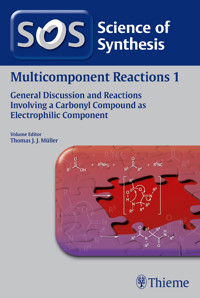
Science of Synthesis: Multicomponent Reactions Vol. 1 E-Book
259,99 €
Mehr erfahren.
- Herausgeber: Thieme
- Kategorie: Wissenschaft und neue Technologien
- Sprache: Englisch
The two volumes "Science of Synthesis: Multicomponent Reactions" critically review the state of the art of domino, sequential, and consecutive multicomponent reactions in what is a highly dynamic field. They serve as the basis for practical application to reach the goals of diversity-oriented synthesis, reaction design, and novel synthetic concepts. As is typical for the Science of Synthesis series, the reference work on multicomponent reactions presents the best synthetic methods as judged by experts in the field and includes typical and general experimental procedures.
The volume "Reactions Involving a Carbonyl Compound as Electrophilic Component" covers the following topics:
- Biginelli Reaction
- Strecker Reaction
- Hantzsch Pyridine Synthesis
- Mannich Reaction
- Petasis Reaction
- Willgerodt-Kindler Reaction
- Kabachnik-Fields Reaction
- Passerini Reaction
- Ugi Reaction
- Gewald Reaction
Das E-Book können Sie in Legimi-Apps oder einer beliebigen App lesen, die das folgende Format unterstützen:
Seitenzahl: 1306
Veröffentlichungsjahr: 2014
Ähnliche




















Science of Synthesis
Science of Synthesis is the authoritative and comprehensive reference work for the entire field of organic and organometallic synthesis.
Science of Synthesis presents the important synthetic methods for all classes of compounds and includes:
Methods critically evaluated by leading scientists
Background information and detailed experimental procedures
Schemes and tables which illustrate the reaction scope
Preface
As the pace and breadth of research intensifies, organic synthesis is playing an increasingly central role in the discovery process within all imaginable areas of science: from pharmaceuticals, agrochemicals, and materials science to areas of biology and physics, the most impactful investigations are becoming more and more molecular. As an enabling science, synthetic organic chemistry is uniquely poised to provide access to compounds with exciting and valuable new properties. Organic molecules of extreme complexity can, given expert knowledge, be prepared with exquisite efficiency and selectivity, allowing virtually any phenomenon to be probed at levels never before imagined. With ready access to materials of remarkable structural diversity, critical studies can be conducted that reveal the intimate workings of chemical, biological, or physical processes with stunning detail.
The sheer variety of chemical structural space required for these investigations and the design elements necessary to assemble molecular targets of increasing intricacy place extraordinary demands on the individual synthetic methods used. They must be robust and provide reliably high yields on both small and large scales, have broad applicability, and exhibit high selectivity. Increasingly, synthetic approaches to organic molecules must take into account environmental sustainability. Thus, atom economy and the overall environmental impact of the transformations are taking on increased importance.
The need to provide a dependable source of information on evaluated synthetic methods in organic chemistry embracing these characteristics was first acknowledged over 100 years ago, when the highly regarded reference source Houben–Weyl Methoden der Organischen Chemie was first introduced. Recognizing the necessity to provide a modernized, comprehensive, and critical assessment of synthetic organic chemistry, in 2000 Thieme launched Science of Synthesis, Houben–Weyl Methods of Molecular Transformations. This effort, assembled by almost 1000 leading experts from both industry and academia, provides a balanced and critical analysis of the entire literature from the early 1800s until the year of publication. The accompanying online version of Science of Synthesis provides text, structure, substructure, and reaction searching capabilities by a powerful, yet easy-to-use, intuitive interface.
From 2010 onward, Science of Synthesis is being updated quarterly with high-quality content via Science of Synthesis Knowledge Updates. The goal of the Science of Synthesis Knowledge Updates is to provide a continuous review of the field of synthetic organic chemistry, with an eye toward evaluating and analyzing significant new developments in synthetic methods. A list of stringent criteria for inclusion of each synthetic transformation ensures that only the best and most reliable synthetic methods are incorporated. These efforts guarantee that Science of Synthesis will continue to be the most up-to-date electronic database available for the documentation of validated synthetic methods.
Also from 2010, Science of Synthesis includes the Science of Synthesis Reference Library, comprising volumes covering special topics of organic chemistry in a modular fashion, with six main classifications: (1) Classical, (2) Advances, (3) Transformations, (4) Applications, (5) Structures, and (6) Techniques. Titles will include Stereoselective Synthesis, Water in Organic Synthesis, and Asymmetric Organocatalysis, among others. With expert-evaluated content focusing on subjects of particular current interest, the Science of Synthesis Reference Library complements the Science of Synthesis Knowledge Updates, to make Science of Synthesis the complete information source for the modern synthetic chemist.
The overarching goal of the Science of Synthesis Editorial Board is to make the suite of Science of Synthesis resources the first and foremost focal point for critically evaluated information on chemical transformations for those individuals involved in the design and construction of organic molecules.
Throughout the years, the chemical community has benefited tremendously from the outstanding contribution of hundreds of highly dedicated expert authors who have devoted their energies and intellectual capital to these projects. We thank all of these individuals for the heroic efforts they have made throughout the entire publication process to make Science of Synthesis a reference work of the highest integrity and quality.
July 2010
The Editorial Board
E. M. Carreira (Zurich, Switzerland)
C. P. Decicco (Princeton, USA)
A. Fuerstner (Muelheim, Germany)
G. A. Molander (Philadelphia, USA)
P. J. Reider (Princeton, USA)
E. Schaumann (Clausthal-Zellerfeld, Germany)
M. Shibasaki (Tokyo, Japan)
E. J. Thomas (Manchester, UK)
B. M. Trost (Stanford, USA)
Volume Editor’s Preface
One-pot methodologies are finding increasing application in all fields of chemistry. This two-volume reference work on Multicomponent Reactions has been designed to cover a highly dynamic field, which is of particular interest to synthetic practitioners in both academia and industry. The whole endeavor of summarizing the state of the art of this historical and developing concept in synthetic methodology would not have been possible without the team of distinguished experts who have contributed by writing a chapter. Their names are all mentioned individually in my Introduction chapter, and I thank them for their dedication and enthusiasm. Furthermore, I am very grateful to my coaching senior editor, Ernst Schaumann, whose guidance has always been helpful and who always constructively stimulated feedback circles. Many thanks also go to the editorial team at Thieme, particularly to Toby Reeve, the scientific editor in charge of coordinating these two volumes; he always kept the ball rolling and raised many issues. Last but not least, I want to express my deep-felt thanks to my wife, Marion, and to our kids, Lukas, Laura, and Felix, for their understanding and tolerance of this project of two volumes that has absorbed me over the past two years.
With respect to the importance of his work and also to his visionary power, these two volumes are dedicated to the memory of Karl Ivar Ugi, the pioneer of modern multi-component chemistry. Eventually, he recognized that multicomponent reactions are a never-ending story, full of many episodes of exciting, breathtaking, innovative, and elegant syntheses.
Düsseldorf, July 2013
Volume Editor
Thomas J. J. Müller
Multicomponent Reactions Volumes
Multicomponent Reactions 1
General Discussion and Reactions Involving a Carbonyl Compound as Electrophilic Component
Volume Editor: T. J. J. Müller
Multicomponent Reactions 2
Reactions Involving an α,β-Unsaturated Carbonyl Compound as Electrophilic Component, Cycloadditions, and Boron-, Silicon-, Free-Radical-, and Metal-Mediated Reactions
Volume Editor: T. J. J. Müller
Abstracts
1.1 Relative Reactivities of Functional Groups as the Key to Multicomponent Reactions
T.J.J. Müller
Multicomponent reactions are based upon the concept of consecutive transformations where intermediates created in the preceding step react with additional reaction partners. Based on the type of intermediate involved, multicomponent reactions can be categorized as following polar or nonpolar mechanisms. However, there are two outstanding functionalities that dominate hitherto known multicomponent reactions: the carbonyl and the isocyanide groups. Nonetheless, multicomponent reactions from the relatively young fields of organometallic chemistry and radical chemistry are quickly catching up, simultaneously enabling unusual multicomponent reaction sequences. Multicomponent reactions inherently allow for a high degree of building-block diversity and, therefore, they are perfectly suited for diversity-oriented syntheses and for inventing new types of one-pot syntheses for exploring huge structural and chemical dimensions in manifold applications.
Keywords: organic reactivity • reactive functionalities • diversity-oriented synthesis
1.2.1.1 Third Component 1,3-Dicarbonyl Compound (with Ureas: Biginelli Reaction)
V. A. Chebanov, N. Yu. Gorobets, and Yu. V. Sedash
This chapter is devoted to a comprehensive analysis of the literature data concerning multicomponent Biginelli heterocyclization and contains descriptions of the diverse synthetic approaches to 1,4-dihydropyrimidines, illustrated by general experimental procedures as well as typical and specific examples.
Keywords: multicomponent heterocyclization • Biginelli reaction • acid catalysts • organosilicon promoters • ionic liquids • ultrasonication • microwave-assisted synthesis • polymer-supported synthesis • solvent-free synthesis • stereoselective reaction
1.2.1.2 Third Component 1,3-Dicarbonyl Compound (with Ammonia or Amines: Hantzsch Pyridine Synthesis)
J. J. Vanden Eynde and A. Mayence
Aldehydes, β-dicarbonyl compounds, and a source of ammonia or, in fewer cases, an amine, react readily under mild conditions to yield 1,4-dihydropyridines. This procedure, as well as alternative routes to these heterocycles and structurally related analogues, including unsymmetrical compounds, are reviewed.
Keywords: aldehyde • ammonium acetate • combinatorial chemistry • 1,4-dihydropyridines • enamino ester • Hantzsch • microwave-assisted synthesis • β-oxo ester • pyridine synthesis • solvent-free reaction
1.2.1.3 Third Component Cyanide (Strecker and Strecker-Type Reactions)
M. Ayaz, F. De Moliner, G. A. Morales, and C. Hulme
Under typical reaction conditions, the condensation of an amine, a carbonyl compound, and a cyanide ion source smoothly affords an α-aminonitrile. The process has also been proven to be feasible in an asymmetric fashion and is thus widely exploited to provide enantiomerically pure products, which are predominantly converted into α-amino acids.
Keywords: Strecker reaction • amines • carbonyl compounds • cyanides • α-aminonitriles • α-amino acids • asymmetric synthesis • Lewis acid catalysts • Brønsted acid catalysts
1.2.1.4 Third Component Enolizable Carbonyl Compound (Mannich Reaction)
L. Bernardi and A. Ricci
The three-component Mannich reaction between in situ generated imines and enolates gives rapid access to diverse β- and δ-amino carbonyl compounds. The employment of tailored catalysts and promoters permits control of the regio-, chemo-, and stereoselectivity in both direct and indirect variants of the Mannich reaction.
Keywords: aldehydes • amines • anilines • asymmetric catalysis • Betti reaction • Brønsted acid catalysts • C—C bond formation • imines • ketones • Lewis acid catalysts • Lewis base catalysts • Mannich reaction
1.2.1.5 Third Component Metal Alkyl or Aryl
E. Le Gall
Multicomponent Mannich-like reactions of preformed or in situ generated organometallic reagents, amines, and aldehydes provide a straightforward access to a range of nitrogen-containing derivatives including (diarylmethyl)amines, β-arylethylamines, homoallylic amines, propargylic amines, and α-amino esters.
Keywords: aldehydes • amines • Barbier conditions • Mannich-like reaction • organometallic reagents
1.2.1.6 Third Component Alkyne
W.-J. Yoo, L. Zhao, and C.-J. Li
The metal-catalyzed A3-coupling reaction (between an aldehyde, an alkyne, and an amine) is a versatile and powerful multicomponent process that leads to propargylic amines in a facile and atom-economical manner. This chapter describes the recent progress in this field and highlights the A3-coupling reaction as a valuable synthetic tool in accessing complex molecules in a rapid and modular fashion.
Keywords: A3-coupling • aldehydes • alkynes • amines • metal catalysis
1.2.1.7 Third Component Boronic Acid (Petasis Reaction)
B. Carboni and F. Berrée
Following the pioneering work by Petasis on the stepwise condensation between amines, aldehydes, and alkenyl- or arylboronic acids, the borono-Mannich reaction has been extended to a wide variety of carbonyl compounds, organoboranes, and amine partners. This three-component reaction allows the synthesis of a large variety of molecules with high levels of structural diversity. The use of chiral ligands as effective catalysts for the asymmetric version greatly expands the scope and utility of this important tool for the formation of new C—C bonds.
Keywords: amines • α-amino acids • boron compounds • carbonyl compounds • diastereoselectivity • enantioselectivity • heterocycles • natural products • sugars
1.2.1.8 Third Component Sulfur (Willgerodt–Kindler Reaction)
Y. Huang and A. Dömling
The Willgerodt–Kindler reaction (three-component coupling reaction of aldehydes or ketones, amines, and elemental sulfur) has been used to synthesize various thioamides. In this chapter are presented examples of Willgerodt–Kindler reactions reported since 2000, as well as discussion of their scope and limitations for the synthesis of thioamides.
Keywords: Willgerodt–Kindler reaction • thioamides • sulfur • amines • aryl ketones • aldehydes
1.2.1.9 Third Component Phosphonate (Kabachnik–Fields Reaction)
N. S. Zefirov, E. D. Matveeva, and M. V. Shuvalov
This chapter reviews the latest advances in the synthesis of α-amino phosphonates by the Kabachnik–Fields reaction, which greatly extend the range of applicability of the classical reaction. The recent interest in this area has in part been generated by the biological activity of this class of compounds.
Keywords: acid catalysis • aldehydes • aldimines • amines • α-amino acids • asymmetric synthesis • azomethines • C—N bonds • C—P bonds • imines • ketones • Lewis acid catalysis • phosphites • phosphonates • phosphonic acids • phosphorylation • phthalocyanines
1.2.2 With an Enamine as One Component
M. J. Arévalo and R. Lavilla
The reaction of amines (normally aromatic) with carbonyl compounds and enamines under acid catalysis to yield multicomponent adducts is reviewed. The processes comprise mainly Povarov reactions, leading to tetrahydroquinolines, and also some transformations dealing with Pictet–Spengler processes involving indoles (as formal enamine derivatives) which yield gramine-type products and β-carbolines. The scope of these reactions is wide, allowing structural variations on each component; intramolecular versions and in situ generation of some components are also reported. The stereoselectivity varies from nonselective processes to highly diastereoselective transformations. The range of catalysts include Lewis and Brønsted acids. Recently, some catalytic enantioselective methods have been disclosed that enable the preparation of enantiopure compounds in a reliable manner.
Keywords: amines • carbonyl compounds • enamines • Povarov reaction • Pictet–Spengler reaction • tetrahydroquinolines • indoles • gramines • β-carbolines • Lewis acid catalysis • Brønsted acid catalysis
1.2.3.1 Third Component Carboxylic Acid (Passerini Reaction)
R. Riva, L. Banfi, and A. Basso
This chapter describes the scope and applications of the Passerini three-component reaction, including the classical reaction and its variants, stereochemical issues, post-condensation transformations, and applications to the synthesis of complex structures. The review focuses mostly on the literature published since 2003.
Keywords: Passerini reaction • isocyanides • acyl anion equivalent • acids • carbonyl compounds • depsipeptides • α-acyloxy amides • carboxamides • esters • heterocycles • medicinal chemistry • asymmetric synthesis
1.2.3.2 Further Components Carboxylic Acid and Amine (Ugi Reaction)
L. A. Wessjohann, G. N. Kaluđerović, R. A. W. Neves Filho, M. C. Morejon, G. Lemanski, and T. Ziegler
The Ugi reaction is the archetypal and arguably also the most frequently used multicomponent reaction. It can be seen as a variation of the Passerini reaction, in which the oxo component is substituted by an in situ formed imine or rather iminium species. It produces a (usually mono-N-alkylated) dipeptide, i.e. a peptoid-like backbone, found not only in peptides but also in many alkaloids and other heterocycles of biological importance. Beyond its value in combinatorial, heterocyclic, and medicinal chemistry, the Ugi reaction has in recent times gained increased acceptance because it can be considered environmentally friendly (water is the only formal byproduct), and is very easy to perform in almost any solvent, or even without solvent. It allows the rapid and predictable combination of four building blocks, even in the presence of water and air, if the reagents permit. Furthermore, the reaction is unusually insensitive to steric interference, rendering it ideal to generate otherwise difficult-to-reach crowded peptide moieties.
In this chapter, the focus is on the Ugi reaction in its classical four-component version (Ugi-4CR or U4CR), including related Ugi four-center, three-component reactions, i.e. Ugi four-component reactions with bifunctional building blocks.
Keywords: Ugi reaction • isocyanides • peptides • natural product synthesis • green chemistry • macrocycles • heterocycles
1.2.3.3 Modifications of the Ugi Reaction
R. S. Menon and V. Nair
On a very fundamental level, the Passerini reaction as well as the Ugi reaction involve the addition of an isocyanide to an electrophile (aldehyde or imine) and the subsequent interception of the resultant intermediate with a third component (acid). In a similar manner, addition of isocyanides to electrophilic alkynes generates 1,3-zwitterionic intermediates that can be intercepted by another reactant to afford valuable products in a one-pot, three-component reaction. Dimethyl acetylenedicarboxylate has been shown to participate exceedingly well in such three-component reactions. The isocyanide–dimethyl acetylenedicarboxylate derived zwitterion has been intercepted successfully with aldehydes, N-tosylaldimines, arylalkenes, and various enols to furnish 2-aminofurans, 2-aminopyr-roles, aminocyclopentadienes, and aminopyrans as products. Arynes also behave as electron-deficient alkynes in such three-component reactions, allowing the synthesis of iminobenzo[c]furans, iminoisoindolines, iminoindenes, substituted pyridines, and isoquinolines. Related three-component reactions that involve formal [4 + 1] annulations of electrophilic entities (generated by the union of two stable reactants) and isocyanides afford valuable heterocycles as products. This class of multicomponent reactions stands out in the realm of isocyanide chemistry owing to the diversity of product scaffolds they directly afford.
Keywords: isocyanides • 1,3-dipoles • dimethyl acetylenedicarboxylate • aryne • benzyne aminofurans • aminopyrroles • alkynes
1.2.4 Using a Nitrile and Sulfur as Nucleophiles (Gewald Reaction)
Y. Huang and A. Dömling
The Gewald three-component reaction of sulfur, cyanoacetic acid derivatives, and a carbonyl component yielding highly substituted thiophen-2-amine derivatives has seen diverse applications in synthetic chemistry. The scope and limitations, synthetic methodology, and combinatorial chemistry of Gewald products are summarized in this chapter.
Keywords: Gewald three-component reaction • thiophen-2-amine • sulfur • cyanoacetamide • malononitrile
Multicomponent Reactions 1
General Discussion and Reactions Involving a Carbonyl Compound as Electrophilic Component
Preface
Volume Editor’s Preface
Abstracts
Table of Contents
Introduction
T. J. J. Müller
1.1 Relative Reactivities of Functional Groups as the Key to Multicomponent Reactions
T. J. J. Müller
1.2 Reactions Involving a Carbonyl Compound as Electrophilic Component
1.2.1 With an Amine or Analogue as One Nucleophilic Component
1.2.1.1 Third Component 1,3-Dicarbonyl Compound (with Ureas: Biginelli Reaction)
V. A. Chebanov, N. Yu. Gorobets, and Yu. V. Sedash
1.2.1.2 Third Component 1,3-Dicarbonyl Compound (with Ammonia or Amines: Hantzsch Pyridine Synthesis)
J. J. Vanden Eynde and A. Mayence
1.2.1.3 Third Component Cyanide (Strecker and Strecker-Type Reactions)
M. Ayaz, F. De Moliner, G. A. Morales, and C. Hulme
1.2.1.4 Third Component Enolizable Carbonyl Compound (Mannich Reaction)
L. Bernardi and A. Ricci
1.2.1.5 Third Component Metal Alkyl or Aryl
E. Le Gall
1.2.1.6 Third Component Alkyne
W.-J. Yoo, L. Zhao, and C.-J. Li
1.2.1.7 Third Component Boronic Acid (Petasis Reaction)
B. Carboni and F. Berrée
1.2.1.8 Third Component Sulfur (Willgerodt–Kindler Reaction)
Y. Huang and A. Dömling
1.2.1.9 Third Component Phosphonate (Kabachnik–Fields Reaction)
N. S. Zefirov, E. D. Matveeva, and M. V. Shuvalov
1.2.2 With an Enamine as One Component
M. J. Arévalo and R. Lavilla
1.2.3 With an Isocyanide as One Component
1.2.3.1 Third Component Carboxylic Acid (Passerini Reaction)
R. Riva, L. Banfi, and A. Basso
1.2.3.2 Further Components Carboxylic Acid and Amine (Ugi Reaction)
L. A. Wessjohann, G. N. Kaluđerović, R. A. W. Neves Filho, M. C. Morejon, G. Lemanski, and T. Ziegler
1.2.3.3 Modifications of the Ugi Reaction
R. S. Menon and V. Nair
1.2.4 Using a Nitrile and Sulfur as Nucleophiles (Gewald Reaction)
Y. Huang and A. Dömling
Keyword Index
Author Index
Abbreviations
Table of Contents
Introduction
T. J. J. Müller
Introduction
1.1 Relative Reactivities of Functional Groups as the Key to Multicomponent Reactions
T. J. J. Müller
1.1 Relative Reactivities of Functional Groups as the Key to Multicomponent Reactions
1.1.1 Organic Reactivity
1.1.2 Selected Reactive Functionalities in Multicomponent Reactions
1.1.2.1 The Carbonyl Group: Gradual Transformations of an Electrophile
1.1.2.2 The Isocyanide: A Perfectly Suited Electronic Amphiphile
1.1.2.3 Generation and Transformation of Pericyclic Intermediates
1.1.2.4 Insertions Guide the Way to Catalytic Transition-Metal-Catalyzed Multicomponent Reactions
1.1.3 Types of Multicomponent Reactions
1.1.4 Diversity of Multicomponent Reactions
1.2 Reactions Involving a Carbonyl Compound as Electrophilic Component
1.2.1 With an Amine or Analogue as One Nucleophilic Component
1.2.1.1 Third Component 1,3-Dicarbonyl Compound (with Ureas: Biginelli Reaction)
V. A. Chebanov, N. Yu. Gorobets, and Yu. V. Sedash
1.2.1.1 Third Component 1,3-Dicarbonyl Compound (with Ureas: Biginelli Reaction)
1.2.1.1.1 Biginelli Heterocyclizations Catalyzed by Brønsted Acids
1.2.1.1.1.1 Classical Reaction
1.2.1.1.1.2 Reaction with Fluorinated β-Dicarbonyl Compounds
1.2.1.1.2 Application of Lewis Acid Catalysis
1.2.1.1.3 Organosilicon Compounds as Biginelli Reaction Promoters
1.2.1.1.4 Application of Ionic Liquids
1.2.1.1.4.1 Ionic Liquid Mediated or Catalyzed Biginelli Reaction
1.2.1.1.4.2 Ionic Liquid Supported Biginelli Reaction
1.2.1.1.5 Application of Ultrasonication
1.2.1.1.6 Application of Microwave Irradiation
1.2.1.1.7 Polymer-Supported Biginelli-Type Heterocyclizations
1.2.1.1.8 Solvent-Free Biginelli-Type Heterocyclizations
1.2.1.1.9 Stereoselective Biginelli Heterocyclizations
1.2.1.1.9.1 Application of Chiral Metal Complexes
1.2.1.1.9.2 Application of Organocatalysts
1.2.1.2 Third Component 1,3-Dicarbonyl Compound (with Ammonia or Amines: Hantzsch Pyridine Synthesis)
J. J. Vanden Eynde and A. Mayence
1.2.1.2 Third Component 1,3-Dicarbonyl Compound (with Ammonia or Amines: Hantzsch Pyridine Synthesis)
1.2.1.2.1 Mechanism, Relevant Modifications, and Scope
1.2.1.2.2 Preparation of Symmetrical 1,4-Dihydropyridines
1.2.1.2.2.1 Variations in the Solvent
1.2.1.2.2.1.1 Reactions in an Ionic Liquid
1.2.1.2.2.1.2 Reactions in a Fluorinated Solvent
1.2.1.2.2.1.3 Reactions in Water
1.2.1.2.2.1.4 Reactions in the Absence of Solvent
1.2.1.2.2.2 Variations in the Nitrogen Component
1.2.1.2.2.3 Variations in the Aldehyde Component and Use of Alternative Reagents
1.2.1.2.3 Preparation of Unsymmetrical 1,4-Dihydropyridines
1.2.1.2.3.1 Preparation of Diastereomeric Mixtures
1.2.1.2.3.1.1 Reactions in an Organic Solvent
1.2.1.2.3.1.2 Reactions in an Ionic Liquid
1.2.1.2.3.1.3 Reactions in Water
1.2.1.2.3.1.4 Reactions in the Absence of Solvent
1.2.1.2.3.2 Preparation of Enantiopure 1,4-Dihydropyridines
1.2.1.2.3.2.1 By Recrystallization or Chromatography
1.2.1.2.3.2.2 Using a Chiral Reagent
1.2.1.2.3.2.3 Using a Chiral Catalyst
1.2.1.2.3.2.4 By Enzymatic Resolution
1.2.1.2.4 Preparation of Isotopically Labeled 1,4-Dihydropyridines
1.2.1.2.5 Assisted Syntheses
1.2.1.2.5.1 Ultrasound-Assisted Syntheses
1.2.1.2.5.2 Microwave-Assisted Syntheses
1.2.1.2.5.3 Use of Immobilized Reagents and Combinatorial Approaches
1.2.1.2.5.4 Use of Baker’s Yeast
1.2.1.3 Third Component Cyanide (Strecker and Strecker-Type Reactions)
M. Ayaz, F. De Moliner, G. A. Morales, and C. Hulme
1.2.1.3 Third Component Cyanide (Strecker and Strecker-Type Reactions)
1.2.1.3.1 Classic Strecker Procedure
1.2.1.3.2 Strecker Reactions Employing Trimethylsilyl Cyanide
1.2.1.3.2.1 Uncatalyzed Strecker Reactions Employing Trimethylsilyl Cyanide
1.2.1.3.2.2 Lewis Acid Catalyzed Strecker Reactions Employing Trimethylsilyl Cyanide
1.2.1.3.2.3 Brønsted Acid Catalyzed Strecker Reactions Employing Trimethylsilyl Cyanide
1.2.1.3.2.4 Strecker Reactions Employing Trimethylsilyl Cyanide under Combined Brønsted/Lewis Acid Catalysis
1.2.1.3.3 Strecker Reactions Employing Other Cyanide Ion Sources
1.2.1.3.4 Asymmetric Strecker Reactions
1.2.1.3.4.1 Auxiliary-Controlled Asymmetric Strecker Reactions
1.2.1.3.4.2 Chiral Pool Approach
1.2.1.3.4.3 Metal 1,1′-Bi-2-naphtholate Catalysis
1.2.1.3.4.4 Organocatalytic Asymmetric Strecker Reactions
1.2.1.3.4.4.1 Brønsted Acids as Organocatalysts
1.2.1.3.4.4.2 Chiral Thioureas as Organocatalysts
1.2.1.3.4.5 Summary and Outlook of Asymmetric Strecker Reactions
1.2.1.3.5 Strecker-Type Reactions
1.2.1.3.5.1 Oxidative Strecker Reactions
1.2.1.3.5.2 Porta Radical-Type Strecker Reactions
1.2.1.3.5.3 Three-Center Five-Component Sequential Strecker-like/Strecker Reactions
1.2.1.3.5.4 Bucherer–Bergs Hydantoin Synthesis
1.2.1.3.5.5 Reissert Reactions
1.2.1.4 Third Component Enolizable Carbonyl Compound (Mannich Reaction)
L. Bernardi and A. Ricci
1.2.1.4 Third Component Enolizable Carbonyl Compound (Mannich Reaction)
1.2.1.4.1 Indirect Mannich Reactions
1.2.1.4.1.1 Lewis Acid Catalyzed Indirect Mannich Reaction
1.2.1.4.1.2 Lewis Acid Catalyzed Indirect Vinylogous Mannich Reaction
1.2.1.4.1.3 Brønsted Acid Catalyzed Indirect Mannich Reaction
1.2.1.4.1.4 Brønsted Acid Catalyzed Indirect Enantioselective Mannich Reaction
Lesen Sie weiter in der vollständigen Ausgabe!
Lesen Sie weiter in der vollständigen Ausgabe!
Lesen Sie weiter in der vollständigen Ausgabe!
Lesen Sie weiter in der vollständigen Ausgabe!
Lesen Sie weiter in der vollständigen Ausgabe!
Lesen Sie weiter in der vollständigen Ausgabe!
Lesen Sie weiter in der vollständigen Ausgabe!
Lesen Sie weiter in der vollständigen Ausgabe!
Lesen Sie weiter in der vollständigen Ausgabe!
Lesen Sie weiter in der vollständigen Ausgabe!
Lesen Sie weiter in der vollständigen Ausgabe!
Lesen Sie weiter in der vollständigen Ausgabe!
Lesen Sie weiter in der vollständigen Ausgabe!
Lesen Sie weiter in der vollständigen Ausgabe!
Lesen Sie weiter in der vollständigen Ausgabe!
Lesen Sie weiter in der vollständigen Ausgabe!
Lesen Sie weiter in der vollständigen Ausgabe!
Lesen Sie weiter in der vollständigen Ausgabe!
Lesen Sie weiter in der vollständigen Ausgabe!
Lesen Sie weiter in der vollständigen Ausgabe!
Lesen Sie weiter in der vollständigen Ausgabe!
Lesen Sie weiter in der vollständigen Ausgabe!
Lesen Sie weiter in der vollständigen Ausgabe!
Lesen Sie weiter in der vollständigen Ausgabe!




