


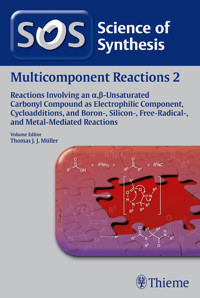
Science of Synthesis: Multicomponent Reactions Vol. 2 E-Book
259,99 €
Mehr erfahren.
- Herausgeber: Thieme
- Kategorie: Wissenschaft und neue Technologien
- Sprache: Englisch
The two volumes "Science of Synthesis: Multicomponent Reactions" critically review the state of the art of domino, sequential, and consecutive multicomponent reactions in what is a highly dynamic field. They serve as the basis for practical application to reach the goals of diversity-oriented synthesis, reaction design, and novel synthetic concepts. As is typical for the Science of Synthesis series, the reference work on multicomponent reactions presents the best synthetic methods as judged by experts in the field and includes typical and general experimental procedures.
The volume "Reactions Involving an alpha,beta-Unsaturated Carbonyl Compound as Electrophilic Component" covers the following topics:
- Michael Additions
- Wittig Reactions
- Cycloadditions
- Reactions Involving an alpha,beta-Unsaturated Carbonyl Compound as Electrophilic Component with Electron-Deficient Alkynes as Electrophiles
- Reactions with Cycloaddition as the Key Step
- Boron-Mediated Multicomponent Reactions
- Silicon-Mediated Multicomponent Reactions
- Free-Radical Mediated Multicomponent Reactions
- Metal-Mediated Multicomponent Reactions
Das E-Book können Sie in Legimi-Apps oder einer beliebigen App lesen, die das folgende Format unterstützen:
Seitenzahl: 1093
Veröffentlichungsjahr: 2014
Ähnliche




















Science of Synthesis
Science of Synthesis is the authoritative and comprehensive reference work for the entire field of organic and organometallic synthesis.
Science of Synthesis presents the important synthetic methods for all classes of compounds and includes:
Methods critically evaluated by leading scientists
Background information and detailed experimental procedures
Schemes and tables which illustrate the reaction scope
Preface
As the pace and breadth of research intensifies, organic synthesis is playing an increasingly central role in the discovery process within all imaginable areas of science: from pharmaceuticals, agrochemicals, and materials science to areas of biology and physics, the most impactful investigations are becoming more and more molecular. As an enabling science, synthetic organic chemistry is uniquely poised to provide access to compounds with exciting and valuable new properties. Organic molecules of extreme complexity can, given expert knowledge, be prepared with exquisite efficiency and selectivity, allowing virtually any phenomenon to be probed at levels never before imagined. With ready access to materials of remarkable structural diversity, critical studies can be conducted that reveal the intimate workings of chemical, biological, or physical processes with stunning detail.
The sheer variety of chemical structural space required for these investigations and the design elements necessary to assemble molecular targets of increasing intricacy place extraordinary demands on the individual synthetic methods used. They must be robust and provide reliably high yields on both small and large scales, have broad applicability, and exhibit high selectivity. Increasingly, synthetic approaches to organic molecules must take into account environmental sustainability. Thus, atom economy and the overall environmental impact of the transformations are taking on increased importance.
The need to provide a dependable source of information on evaluated synthetic methods in organic chemistry embracing these characteristics was first acknowledged over 100 years ago, when the highly regarded reference source Houben–Weyl Methoden der Organischen Chemie was first introduced. Recognizing the necessity to provide a modernized, comprehensive, and critical assessment of synthetic organic chemistry, in 2000 Thieme launched Science of Synthesis, Houben–Weyl Methods of Molecular Transformations. This effort, assembled by almost 1000 leading experts from both industry and academia, provides a balanced and critical analysis of the entire literature from the early 1800s until the year of publication. The accompanying online version of Science of Synthesis provides text, structure, substructure, and reaction searching capabilities by a powerful, yet easy-to-use, intuitive interface.
From 2010 onward, Science of Synthesis is being updated quarterly with high-quality content via Science of Synthesis Knowledge Updates. The goal of the Science of Synthesis Knowledge Updates is to provide a continuous review of the field of synthetic organic chemistry, with an eye toward evaluating and analyzing significant new developments in synthetic methods. A list of stringent criteria for inclusion of each synthetic transformation ensures that only the best and most reliable synthetic methods are incorporated. These efforts guarantee that Science of Synthesis will continue to be the most up-to-date electronic database available for the documentation of validated synthetic methods.
Also from 2010, Science of Synthesis includes the Science of Synthesis Reference Library, comprising volumes covering special topics of organic chemistry in a modular fashion, with six main classifications: (1) Classical, (2) Advances, (3) Transformations, (4) Applications, (5) Structures, and (6) Techniques. Titles will include Stereoselective Synthesis, Water in Organic Synthesis, and Asymmetric Organocatalysis, among others. With expert-evaluated content focusing on subjects of particular current interest, the Science of Synthesis Reference Library complements the Science of Synthesis Knowledge Updates, to make Science of Synthesis the complete information source for the modern synthetic chemist.
The overarching goal of the Science of Synthesis Editorial Board is to make the suite of Science of Synthesis resources the first and foremost focal point for critically evaluated information on chemical transformations for those individuals involved in the design and construction of organic molecules.
Throughout the years, the chemical community has benefited tremendously from the outstanding contribution of hundreds of highly dedicated expert authors who have devoted their energies and intellectual capital to these projects. We thank all of these individuals for the heroic efforts they have made throughout the entire publication process to make Science of Synthesis a reference work of the highest integrity and quality.
July 2010
The Editorial Board
E. M. Carreira (Zurich, Switzerland)
C. P. Decicco (Princeton, USA)
A. Fuerstner (Muelheim, Germany)
G. A. Molander (Philadelphia, USA)
P. J. Reider (Princeton, USA)
E. Schaumann (Clausthal-Zellerfeld, Germany)
M. Shibasaki (Tokyo, Japan)
E. J. Thomas (Manchester, UK)
B. M. Trost (Stanford, USA)
Volume Editor’s Preface
One-pot methodologies are finding increasing application in all fields of chemistry. This two-volume reference work on Multicomponent Reactions has been designed to cover a highly dynamic field, which is of particular interest to synthetic practitioners in both academia and industry. The whole endeavor of summarizing the state of the art of this historical and developing concept in synthetic methodology would not have been possible without the team of distinguished experts who have contributed by writing a chapter. Their names are all mentioned individually in my Introduction chapter, and I thank them for their dedication and enthusiasm. Furthermore, I am very grateful to my coaching senior editor, Ernst Schaumann, whose guidance has always been helpful and who always constructively stimulated feedback circles. Many thanks also go to the editorial team at Thieme, particularly to Toby Reeve, the scientific editor in charge of coordinating these two volumes; he always kept the ball rolling and raised many issues. Last but not least, I want to express my deep-felt thanks to my wife, Marion, and to our kids, Lukas, Laura, and Felix, for their understanding and tolerance of this project of two volumes that has absorbed me over the past two years.
With respect to the importance of his work and also to his visionary power, these two volumes are dedicated to the memory of Karl Ivar Ugi, the pioneer of modern multicomponent chemistry. Eventually, he recognized that multicomponent reactions are a never-ending story, full of many episodes of exciting, breathtaking, innovative, and elegant syntheses.
Düsseldorf, July 2013
Volume Editor
Thomas J. J. Müller
Multicomponent Reactions Volumes
Multicomponent Reactions 1
General Discussion and Reactions Involving a Carbonyl Compound as Electrophilic Component
Volume Editor: T. J. J. Müller
Multicomponent Reactions 2
Reactions Involving an α,β-Unsaturated Carbonyl Compound as Electrophilic Component, Cycloadditions, and Boron-, Silicon-, Free-Radical-, and Metal-Mediated Reactions
Volume Editor: T. J. J. Müller
Abstracts
2.1.1 Michael Addition as the Key Step
J. Rodriguez, D. Bonne, Y. Coquerel, and T. Constantieux
This chapter focuses on multicomponent reactions involving an α,β-unsaturated compound as an electrophilic component and in which a Michael addition is a key step during the process. The Michael addition step can be either the starting point or a late event in the domino sequence. These reactions are extremely powerful processes, allowing the synthesis of diverse, valuable carbocyclic, heterocyclic, or acyclic scaffolds.
Keywords: α,β-unsaturated compounds • Michael addition • domino reactions • carbocycles • heterocycles • stereoselective synthesis
2.1.2 In Situ Generation of the α,β-Unsaturated Carbonyl Component by Wittig-Type Reaction
N. S. Alavijeh, E. Ghabraie, and S. Balalaie
This chapter describes various multicomponent reactions (MCRs) involving in situ generated α,β-unsaturated carbonyl compounds formed by Wittig-type reactions.
Keywords: Diels–Alder reaction • Horner–Wadsworth–Emmons reaction • Knoevenagel condensation • Michael addition • multicomponent reaction • unsaturated carbonyl compounds • Wittig reaction
2.1.3 With Isocyanide Participation
A. Shaabani, A. Sarvary, and S. Shaabani
Isocyanide-based multicomponent reactions represent a very important synthetic method for the synthesis of heterocyclic compounds with potential biological and medicinal activities. The nucleophilic property of isocyanides makes them a popular reactant class for the development of novel multicomponent reactions. One of the isocyanide-based multicomponent reaction approaches involves the generation of a dipolar intermediate by the addition of isocyanides to electron-deficient α,β-unsaturated carbonyl compounds such as dialkyl acetylenedicarboxylates; the dipolar intermediate can then be captured efficiently by various dipolarophiles such as CH-, NH-, and OH-acids, electron-deficient alkenes, and imines to form diverse cycloadducts.
Keywords: isocyanides • α,β-unsaturated carbonyl compounds • dialkyl acetylenedicarboxylates • dipolar intermediates • dipolarophiles • heterocycles
2.1.4 Electron-Deficient Alkynes as Electrophiles
A. Shaabani, A. Sarvary, and S. Shaabani
This chapter describes multicomponent reactions involving electron-deficient alkynes as electrophiles. The main focus is the addition of nucleophiles such as aza-aromatics, amines, and carbenes to electron-deficient alkynes in the presence of various suitable components such as CH-, NH-, and OH-acids, carbonyl and imine compounds, and electron-deficient alkenes. These multicomponent reactions result in the synthesis of various heterocyclic and open-chain organic products.
Keywords: electron-deficient alkynes • carbonyl compounds • electrophile • nucleophile • heterocycles • cyclization
2.1.5 [2+2] Cycloaddition as the Key Step
K. Takasu
This chapter covers multicomponent reactions involving the thermal [2+2] cycloaddition of electron-rich alkenes, such as enamines, silyl enol ethers, allylsilanes, or styrenes, with electron-deficient alkenes or alkynes. In one strategy, the process affords multisubstituted and/or polycyclic four-membered carbocycles in a single operation. In another, the multicomponent reaction utilizes the [2+2] cycloadduct as an intermediate for further transformation.
Keywords: allylsilanes • cycloaddition • cyclobutanes • cyclobutenes • enamines • silyl enol ethers • styrenes
2.1.6 [3+2] Cycloaddition as the Key Step
R. Raghunathan and S. Purushothaman
α,β-Unsaturated carbonyl compounds, which act as dipolarophiles in [3+2]-cycloaddition reactions with azomethine ylides, have been used for the highly regio- and stereoselective construction of heterocycles such as spiro-fused pyrrolidines. Azomethine ylides generated from isatin (1H-indole-2,3-dione) and cyclic and acyclic α-amino acids are considered to be important 1,3-dipoles, since their cycloaddition to α,β-unsaturated carbonyl compounds leads to the formation of spiro[indoline-3,2′-pyrrolidin]-2-ones, which form the basic building units of several natural and biologically active compounds.
Keywords: azomethine ylides • [3+2]-cycloaddition reactions • 1,3-dipoles • spiro-fused pyrrolidines • stereoselective synthesis • α,β-unsaturated carbonyl compounds
2.1.7 [4+2] Cycloaddition as the Key Step
M. C. Elliott and D. H.Jones
α,β-Unsaturated carbonyl compounds are widely used as dienes and as dienophiles in [4+2] cycloadditions. This review covers those cycloaddition reactions in which a multicomponent reaction is used either in the formation of the α,β-unsaturated carbonyl compound or for the assembly of the final product. The review is organized according to the role of the carbonyl component (diene or dienophile) and whether it is introduced as a reagent or formed during the reaction.
Keywords: alkenation • asymmetric synthesis • [4+2] cycloaddition • cyclohexenes • Diels–Alder reaction • diketones • enals • enones • isoindoles • Knoevenagel condensation • oxazoles • pyridines
2.2.1 [3+2] Cycloaddition
S. G. Modha and E. V. Van der Eycken
The cycloaddition reaction of a 1,3-dipole and a dipolarophile, commonly known as the [3+2]-cycloaddition reaction, has become well established over the years. Multicomponent reactions involving a [3 +2] cycloaddition as the key step conveniently generate diversely substituted heterocycles. In contrast to Section 2.1.6, the focus here is on reactions not involving α,β-unsaturated carbonyl compounds.
Keywords: alkynes • α-amino acids • azides • carbenes • dipolar cycloaddition • isoxazoles • nitrile oxides • nitrones • pyrroles • triazoles • ylides
2.2.2 [4+2] Cycloaddition
L. G. Voskressensky and A. A. Festa
The Diels–Alder reaction, with its diverse and extremely rich synthetic potential, is a powerful protocol in synthetic strategies toward natural and unnatural carbo- and heterocycles. This chapter describes multicomponent reaction sequences in which a [4+2]-cycloaddition reaction is a key step. In contrast to Section 2.1.7, the focus here is on cycloaddition reactions not involving α,β-unsaturated carbonyl compounds. Examples are described both where the [4+2] cycloaddition is the first step in the multicomponent sequence and where the [4+2] cycloaddition is a later step in the sequence, with the requisite diene and/or dienophile being formed in the initial steps.
Keywords: Diels–Alder reaction • cycloaddition • dienes • heterodienes • dienophiles • carbocycles • heterocycles • allylboration • hydrovinylation • Povarov reaction • Knoevenagel reaction
2.3 Boron-Mediated Multicomponent Reactions
K. J. Szabó
Organoboronates are important reagents in modern synthetic applications. However, some organoboronates are unstable or difficult to purify. A possible solution is to perform organic transformations with in situ generated organoboronates. The organoboronates react selectively with many substrates, such as carbonyl compounds (allylation reactions) or organohalides (Suzuki–Miyaura coupling). Furthermore, synthesis of organoboronates and the subsequent transformations can be easily combined in the same reaction vessel. This chapter presents examples of these reactions including generation of organoboronates from simple prefunctionalized substrates (such as alcohols) and via C–H functionalization processes.
Keywords: homogeneous catalysis • C–B bond formation • allylation • Suzuki-Miyaura coupling • selectivity
2.4 Silicon-Mediated Multicomponent Reactions
J.-P. Wan
Silicon reagents are commonly employed in organic synthesis as catalysts or promoters because of their availability and versatile catalytic activity. Some typical silicon reagents, such as trimethylsilyl halides (where the halide is chlorine or iodine) or trimethylsilyl trifluoromethanesulfonate, are known to be capable of acting as Lewis acids, Brønsted acids (upon hydrolysis), and water scavengers. This section presents an overview of the particularly broad application of silicon reagents in multicomponent reactions. Silicon-mediated multicomponent processes that lead to both cyclic and acyclic products are summarized.
Keywords: Biginelli reactions • cyclization reactions • 1,3-dicarbonyl compounds • imidazoles • pyridine synthesis • quinoxalines • silicon reagents • tetrahydropyridinones • 1,3-thiazines
2.5 Free-Radical-Mediated Multicomponent Reactions Involving Carbon Monoxide
A. Fusano and I. Ryu
This review describes free-radical-mediated multicomponent reactions leading to a variety of carbonyl compounds, such as ketones, esters, amides, and the related cyclic carbonyl compounds, with introduction of carbon monoxide as the carbonyl function. All reactions are carried out in a single vessel using a stainless steel autoclave with a glass liner, and are therefore one-pot synthetic processes.
Keywords: alkyl halides • carbon monoxide • carbonylation • carbonyl compounds • C–C bond formation • multicomponent reactions • radical addition • radical cyclization • radical reactions
2.6.1 Stoichiometric Metal Participation
C. Xi and C. Chen
Multicomponent reactions (MCRs) make possible the rapid synthesis of molecular libraries that have a high degree of structural diversity. Metal-mediated multicomponent reactions are particularly interesting as they give access to processes that occur with high chemo-, regio-, and stereoselectivity with excellent functional group tolerance. For example, reductive coupling of two unsaturated compounds on reduced zirconocene affords a variety of zirconacycles, which react with electrophiles to form various carbo- and heterocycles.
Keywords: carbene complexes • chemoselectivity • C–M bonds • main group metals • metallacycles • regioselectivity • stereoselectivity • stoichiometric reactions • transition metals
2.6.2 Catalytic Metal Participation
B. A. Arndtsen and J. Tjutrins
Transition-metal-catalyzed multicomponent reactions are of great utility in organic synthesis. These transformations exploit the reactivity of metal catalysts to both activate simple substrates toward reactions, and control how they react, thereby allowing the assembly of structurally complex products in an efficient fashion via the coupling of simple building blocks. This chapter highlights a number of important examples of such transformations, with a focus on those that lead to formation of three or more bonds, from substrates that are both widely available and easily tuned.
Keywords: transition-metal catalysis • heterocycles • carbonylation reactions • reductive couplings • cycloadditions • cross-coupling reactions • 1,3-dipolar cycloaddition
Multicomponent Reactions 2
Reactions Involving an α,β-Unsaturated CarbonylCompound as Electrophilic Component, Cycloadditions,and Boron-, Silicon-, Free-Radical-, and Metal-Mediated Reactions
Preface
Volume Editor’s Preface
Abstracts
Table of Contents
2.1 Reactions Involving an α,β-Unsaturated Carbonyl Compound or Analogue as Electrophilic Component
2.1.1 Michael Addition as the Key Step
J. Rodriguez, D. Bonne, Y. Coquerel, and T. Constantieux
2.1.2 In Situ Generation of the α,β-Unsaturated Carbonyl Component by Wittig-Type Reaction
N. S. Alavijeh, E. Ghabraie, and S. Balalaie
2.1.3 With Isocyanide Participation
A. Shaabani, A. Sarvary, and S. Shaabani
2.1.4 Electron-Deficient Alkynes as Electrophiles
A. Shaabani, A. Sarvary, and S. Shaabani
2.1.5 [2+2] Cycloaddition as the Key Step
K. Takasu
2.1.6 [3+2] Cycloaddition as the Key Step
R. Raghunathan and S. Purushothaman
2.1.7 [4+2] Cycloaddition as the Key Step
M. C. Elliott and D. H. Jones
2.2 Reactions with Cycloaddition as the Key Step (Not Involving α,β-Unsaturated Carbonyl Compound Electrophiles)
2.2.1 [3+2] Cycloaddition
S. G. Modha and E. V. Van der Eycken
2.2.2 [4+2] Cycloaddition
L. G. Voskressensky and A. A. Festa
2.3 Boron-Mediated Multicomponent Reactions
K. J. Szabó
2.4 Silicon-Mediated Multicomponent Reactions
J.-P. Wan
2.5 Free-Radical-Mediated Multicomponent Reactions Involving Carbon Monoxide
A. Fusano and I. Ryu
2.6 Metal-Mediated Multicomponent Reactions
2.6.1 Stoichiometric Metal Participation
C. Xi and C. Chen
2.6.2 Catalytic Metal Participation
B. A. Arndtsen and J. Tjutrins
Keyword Index
Author Index
Abbreviations
Table of Contents
2.1 Reactions Involving an α,β-Unsaturated Carbonyl Compound or Analogue as Electrophilic Component
2.1.1 Michael Addition as the Key Step
J. Rodriguez, D. Bonne, Y. Coquerel, and T. Constantieux
2.1.1 Michael Addition as the Key Step
2.1.1.1 Achiral and Racemic Reactions
2.1.1.1.1 Multicomponent Reactions Initiated by a Michael Addition
2.1.1.1.2 Multicomponent Reactions Not Initiated by a Michael Addition
2.1.1.2 Diastereoselective Reactions
2.1.1.2.1 Multicomponent Reactions Initiated by a Michael Addition
2.1.1.2.2 Multicomponent Reactions Not Initiated by a Michael Addition
2.1.1.3 Enantioselective Reactions
2.1.1.3.1 Multicomponent Reactions Initiated by a Michael Addition
2.1.1.3.2 Multicomponent Reactions Not Initiated by a Michael Addition
2.1.2 In Situ Generation of the α,β-Unsaturated Carbonyl Component by Wittig-Type Reaction
N. S. Alavijeh, E. Ghabraie, and S. Balalaie
2.1.2 In Situ Generation of the α,β-Unsaturated Carbonyl Component by Wittig-Type Reaction
2.1.2.1 Chemoselective Multicomponent Synthesis of α,β-Unsaturated Esters and Their Subsequent Diels–Alder Reactions
2.1.2.2 Oxidation/Wittig Alkenation/Diels–Alder Multicomponent Reactions
2.1.2.3 Enantioselective Organocatalytic Michael/Wittig/Michael/Michael Reactions
2.1.2.4 Catalytic Asymmetric Tandem Wittig–Cyanosilylation Reactions
2.1.2.5 Tandem Horner–Wadsworth–Emmons Alkenation/Cyclization Sequences
2.1.2.6 Wittig/Knoevenagel/Diels–Alder/Huisgen Cycloaddition Reactions
2.1.2.7 Wittig/Michael Reactions
2.1.3 With Isocyanide Participation
A. Shaabani, A. Sarvary, and S. Shaabani
2.1.3 With Isocyanide Participation
2.1.3.1 Reactions with a CH-Acid Component
2.1.3.2 Reactions with an NH-Acid Component
2.1.3.3 Reactions with an OH-Acid Component
2.1.3.4 Reactions with a Carbonyl Compound Component
2.1.3.5 Reactions with an Isocyanate or Isothiocyanate Component
2.1.3.6 Reactions with an Imine or Iminium Component
2.1.3.7 Miscellaneous Reactions
2.1.4 Electron-Deficient Alkynes as Electrophiles
A. Shaabani, A. Sarvary, and S. Shaabani
2.1.4 Electron-Deficient Alkynes as Electrophiles
2.1.4.1 Nitrogen Nucleophiles
2.1.4.1.1 Aza-aromatics
2.1.4.1.2 Primary and Secondary Amines
2.1.4.1.3 Other Nitrogen Nucleophiles
2.1.4.2 Carbene Nucleophiles
2.1.4.3 Miscellaneous Reactions
2.1.4.4 Conclusions
2.1.5 [2+2] Cycloaddition as the Key Step
K. Takasu
2.1.5 [2+2] Cycloaddition as the Key Step
2.1.5.1 Reaction Using Enamines as the Nucleophilic Component
2.1.5.2 Reaction Using Silyl Enol Ethers as the Nucleophilic Component
2.1.5.3 Reaction Using Allylsilanes as the Nucleophilic Component
2.1.5.4 Reaction Using Styrenes as the Nucleophilic Component
2.1.6 [3+2] Cycloaddition as the Key Step
R. Raghunathan and S. Purushothaman
2.1.6 [3+2] Cycloaddition as the Key Step
2.1.6.1 Reactions Involving Cyclic α,β-Unsaturated Carbonyl Compounds as Dipolarophiles
2.1.6.2 Reactions Involving More than Three Components
2.1.6.2.1 Synthesis of Polycyclic Spiro-Fused Pyrrolidines by Five-Component Reaction
2.1.6.2.2 Synthesis of Polycyclic Spiro-Fused Pyrrolizidines by Four-Component Reaction
2.1.6.3 Reactions Involving β-Lactam-Derived Dipolarophiles
2.1.6.4 Reactions Involving Baylis–Hillman Adducts as Dipolarophiles
2.1.6.5 Reactions Involving Ferrocene-Appended Dipolarophiles
2.1.6.6 Transition-Metal-Catalyzed Carbonyl Ylide [3+2] Cycloadditions
2.1.6.7 Asymmetric Synthesis Involving [3+2]-Cycloaddition Reactions of α,β-Unsaturated Carbonyl Compounds
2.1.6.7.1 Asymmetric Synthesis of Spiro-Fused Pyrrolidines, Pyrrolizidines, or Pyrrolothiazoles Using Chiral Dipolarophiles
2.1.6.7.2 Asymmetric Synthesis of Pyrrolidines Using Chiral Dipoles
2.1.6.7.3 Asymmetric Synthesis of Pyrrolidines Using a Chiral Catalyst
2.1.7 [4+2] Cycloaddition as the Key Step
M. C. Elliott and D. H. Jones
2.1.7 [4+2] Cycloaddition as the Key Step
2.1.7.1 α,β-Unsaturated Carbonyl Compounds Used as Reagent
2.1.7.1.1 α,β-Unsaturated Carbonyl Compounds Used as Diene
2.1.7.1.2 α,β-Unsaturated Carbonyl Compounds Used as Dienophile
2.1.7.1.3 α,β-Unsaturated Carbonyl Compounds Used as Diene and as Dienophile
2.1.7.2 α,β-Unsaturated Carbonyl Compounds Formed In Situ
2.1.7.2.1 α,β-Unsaturated Carbonyl Compounds Used as Diene
2.1.7.2.2 α,β-Unsaturated Carbonyl Compounds Used as Dienophile
2.1.7.2.3 α,β-Unsaturated Carbonyl Compounds Used as Diene and as Dienophile
2.2 Reactions with Cycloaddition as the Key Step (Not Involving α,β-Unsaturated Carbonyl Compound Electrophiles)
2.2.1 [3+2]Cycloaddition
S. G. Modha and E. V. Van der Eycken
2.2.1 [3+2] Cycloaddition
2.2.1.1 The Azide–Alkyne Huisgen Cycloaddition
2.2.1.1.1 Microwave-Assisted Synthesis of 1,4-Disubstituted 1,2,3-Triazoles
2.2.1.1.2 One-Pot Multicomponent Synthesis of Fully Substituted 1,2,3-Triazoles
2.2.1.1.3 Microwave-Assisted Benzyne–Azide Cycloaddition
2.2.1.1.4 Use of an Epoxide Precursor to an Organic Azide
2.2.1.1.5 Stereo- and Regioselective One-Pot Synthesis of Triazole-Based Unnatural Amino Acids and 1-(β-Aminoalkyl)triazoles
2.2.1.2 Nitrile Oxides as 1,3-Dipoles
2.2.1.2.1 4,5-Dihydroisoxazoles via a Multicomponent Cascade Reaction
2.2.1.3 Nitrones as 1,3-Dipoles
2.2.1.3.1 Synthesis of Isoquinolin-1-amines via an In Situ Generated Nitrone
2.2.1.4 Nitronates as 1,3-Dipoles
2.2.1.4.1 Domino [4+2]/[3+2]-Cycloaddition Reactions
2.2.1.5 Azomethine Ylides as 1,3-Dipoles
2.2.1.5.1 Three-Component Synthesis of Polysubstituted 1H-Pyrroles
2.2.1.6 Reactions of Other 1,3-Dipoles Generated from Carbenes
2.2.2 [4+2] Cycloaddition
L. G. Voskressensky and A. A. Festa
2.2.2 [4+2] Cycloaddition
2.2.2.1 Carbodienes
2.2.2.1.1 Sequence of [4+2]/[2+2] Cycloadditions
2.2.2.1.2 Reactions with an Allylboration Step
2.2.2.1.2.1 Diels–Alder/Allylboration Reaction Sequence
2.2.2.1.2.2 Diels–Alder/1,4-Hydrovinylation/Allylboration Reaction Sequence
2.2.2.1.3 Cycloaddition of Sulfur Dioxide
2.2.2.2 Heterodienes
2.2.2.2.1 Azadienes
2.2.2.2.1.1 Aza-[4+2]/Allylboration Reaction Involving Maleimides
2.2.2.2.1.2 Aza-[4+2]/Allylboration Reaction Involving Sulfinimide Dienophiles
2.2.2.2.2 Oxadienes
2.2.2.2.3 Other Heterodienes
2.2.2.3 Late-Stage [4+2] Cycloadditions
2.2.2.3.1 Intramolecular [4+2] Cycloaddition
2.2.2.3.1.1 Heterodienes
2.2.2.3.1.1.1 Intramolecular Diels–Alder Reaction on Furan (IMDAF)
2.2.2.3.1.1.2 Intramolecular Diels–Alder Reaction on Oxazole
2.2.2.3.2 Intermolecular [4+2] Cycloaddition
2.2.2.3.2.1 Carbodiene Components
2.2.2.3.2.1.1 Carbodienes Generated from Amides and Aldehydes
2.2.2.3.2.1.2 Carbodienes Generated from Anhydrides (or Ortho Esters, or Alcohols) and Aldehydes
2.2.2.3.2.1.3 Carbodienes Generated from Isocyanates and Aldehydes
2.2.2.3.2.2 The Povarov Reaction
2.2.2.3.2.2.1 First Multicomponent Version of the Povarov Reaction
2.2.2.3.2.2.2 Povarov Reaction Catalyzed by Lanthanide Trifluoromethanesulfonates
2.2.2.3.2.2.3 Multicomponent Synthesis of Furo[3,2-c]quinolines and Pyrano[3,2-c]quinolines via Povarov Reaction
2.2.2.3.2.2.4 Multicomponent Povarov Reaction with Ring-Strained Alkenes
2.2.2.3.2.2.5 The Organocatalytic Asymmetric Three-Component Povarov Reaction
2.2.2.3.2.2.6 Base-Catalyzed Three-Component Povarov Reaction on a Poly(ethylene glycol) Support
2.2.2.3.2.3 Multicomponent Domino Knoevenagel/Hetero-Diels–Alder Reaction
2.2.2.3.2.3.1 Multicomponent Domino Knoevenagel/Hetero-Diels–Alder Reaction with 1,3-Dicarbonyl Compounds
2.2.2.3.2.3.2 Multicomponent Domino Knoevenagel/Hetero-Diels–Alder Reaction with Benzoquinone Derivatives
2.3 Boron-Mediated Multicomponent Reactions
K. J. Szabó
2.3 Boron-Mediated Multicomponent Reactions
2.3.1 General Strategies
2.3.2 Alkylboronates as Reaction Intermediates
2.3.2.1 Reactions Involving Hydroboration of Alkenes
2.3.3 Multicomponent Reactions via Allylboration
2.3.3.1 Allylboronates from Allyl Alcohols and Derivatives
2.3.3.1.1 Reactions with Aldehydes
2.3.3.1.1.1 Synthesis of Homoallylic Alcohols and Amines
2.3.3.1.1.2 In Situ Formation of Unstable Aldehydes
2.3.3.1.1.3 Petasis Reaction
2.3.3.1.1.4 Ring-Closing Metathesis
2.3.3.1.2 Reactions with Ketones
2.3.3.1.3 Suzuki–Miyaura Coupling
2.3.3.2 Allylboronates by Metathesis
2.3.3.3 Allylboronates by C–H Activation
2.3.3.4 Three-Component Hetero-[4+2]-Cycloaddition/Allylboration Approach
2.3.4 Vinyl- and Arylboronates as Key Components in Multicomponent Reactions 2.3.4.1 Vinyl- and Arylboronates by C-H Activation
2.3.4.1.1 Suzuki Coupling
2.3.4.1.2 Synthesis of Phenols, Anilines, and Arenecarbonitriles
2.3.5 Arylboronates from Aryl Halides
2.3.6 Summary and Outlook
2.4 Silicon-Mediated Multicomponent Reactions
J.-P. Wan
2.4 Silicon-Mediated Multicomponent Reactions
2.4.1 Multicomponent Reactions Providing Cyclic Products
2.4.1.1 [3+2+1]-Cyclization Reactions
2.4.1.1.1 Biginelli Reactions
2.4.1.1.1.1 Biginelli Reactions Using Acyclic 1,3-Dicarbonyl Compounds
2.4.1.1.1.2 Biginelli Reactions Using Cyclic 1,3-Dicarbonyl Compounds
2.4.1.1.1.3 Biginelli-Like Reactions Using Monocarbonyl Substrates
2.4.1.1.1.4 Biginelli-Like Reactions Using Activated Alkenes
2.4.1.1.1.5 Biginelli-Like Reactions Using Trifluoromethyl-Functionalized 1,3-Dicarbonyl Compounds
2.4.1.1.2 Three-Component Synthesis of 1,3-Thiazines and Tetrahydropyrimidinones
2.4.1.1.3 Three-Component Synthesis of Pyridines
2.4.1.1.4 Three-Component Synthesis of 1,4-Dihydropyridines
2.4.1.2 [3+1+1]-Cyclization Reactions
2.4.1.2.1 Three-Component Synthesis of 4,5-Dihydro-1H-imidazoles
2.4.1.2.2 Three-Component Synthesis of Imidazole-Fused Heterocycles
2.4.1.2.2.1 Synthesis of 2-Piperazin-1-ylimidazo[2,1-b][1,3,4]thiadiazoles
2.4.1.2.2.2 Synthesis of Imidazo[1,2-a]quinoxalines
2.4.1.3 [4+1+1]-Cyclization Reactions
2.4.1.4 [5+1+1]-Cyclization Reactions
2.4.1.5 [2+2+1+1]-Cyclization Reactions
2.4.1.6 Cyclization Reactions Providing Fused Systems
2.4.2 Multicomponent Reactions Providing Acyclic Products
2.4.2.1 Based on the Addition of Carbon Nucleophiles
2.4.2.1.1 Addition to Imide Intermediates
2.4.2.1.2 Addition to Imine Intermediates
2.4.2.1.3 Addition to Carbonyl Electrophiles
2.4.2.2 Based on the Addition of Phosphorus Nucleophiles
2.4.2.3 Based on the Addition of Nitrogen Nucleophiles
2.5 Free-Radical-Mediated Multicomponent Reactions Involving Carbon Monoxide
A. Fusano and I. Ryu
2.5 Free-Radical-Mediated Multicomponent Reactions Involving Carbon Monoxide
2.5.1 Synthesis of Unsymmetrical Ketones by Three-Component Radical Reactions
2.5.1.1 Reactions Comprising Alkyl Halides, Carbon Monoxide, and Electron-Deficient Alkenes
2.5.1.2 Reactions Comprising Alkanes, Carbon Monoxide, and Electron-Deficient Alkenes
2.5.2 Synthesis of Acrylamides and Lactams by Multicomponent Radical Reactions
2.5.2.1 Reactions Comprising Alkynes, Carbon Monoxide, and Amines
2.5.2.2 Reactions Comprising Alkynyl Imines, Carbon Monoxide, and Group 14 and 16 Hydrides
2.5.3 Synthesis of Unsymmetrical Ketones by Multicomponent Radical Reactions Using Unimolecular Chain-Transfer Reagents
2.5.3.1 Reactions Using Allyltin Compounds
2.5.3.2 Reactions Using Tin Enolates
2.5.3.3 Reactions Using Sulfonyl Oxime Ethers
2.5.4 Synthesis of Carbonyl Compounds by Multicomponent Radical Carbonylation Reactions Involving Group Transfer
2.5.4.1 Reactions with Organoselenium Transfer
2.5.4.2 Reactions with Iodine Transfer
2.6 Metal-Mediated Multicomponent Reactions
2.6.1 Stoichiometric Metal Participation
C. Xi and C. Chen
2.6.1 Stoichiometric Metal Participation
2.6.1.1 Multicomponent Reactions Mediated by Main Group Metallic Reagents
2.6.1.1.1 Magnesium-Mediated Reactions
2.6.1.1.1.1 Vinylmagnesium Chloride Mediated Synthesis of 2-Vinylbut-2-ene-1,4-diols
2.6.1.1.1.2 Organomagnesium Chloride Mediated Synthesis of Furans
2.6.1.1.2 Indium-Mediated Reactions
2.6.1.1.2.1 Indium-Mediated Synthesis of Homoallylic Esters
2.6.1.1.2.2 Indium-Mediated Synthesis of N-Homoallylic 2-Amino Alcohols
2.6.1.1.2.3 Indium-Mediated Synthesis of N-Aryl-Substituted Homoallylic Amines
2.6.1.1.2.4 Indium-Mediated Synthesis of 2-Amino-4H-1-benzopyrans
2.6.1.2 Multicomponent Reactions Mediated by Transition Metals
2.6.1.2.1 Titanium-and Zirconium-Mediated Reactions
2.6.1.2.1.1 Titanium(II)-Mediated Reactions
2.6.1.2.1.1.1 Titanocene(II)-Mediated Synthesis of Vinylallenes
2.6.1.2.1.1.2 Titanium(II) Alkoxide Mediated Synthesis of Benzenes
2.6.1.2.1.1.3 Titanium(II) Alkoxide Mediated Synthesis of Pyridines
2.6.1.2.1.2 Zirconocene-Mediated Reactions
2.6.1.2.1.2.1 Zirconacyclopentene-Mediated Synthesis of Cyclopentenones
2.6.1.2.1.2.2 Zirconacyclopentene-Mediated Synthesis of γ-Enones
2.6.1.2.1.2.3 Zirconacyclopentadiene-Mediated Synthesis of Cyclopentadienones
2.6.1.2.1.2.4 Zirconacyclopentadiene-Mediated Synthesis of Fused Cyclohex-2-ene-1,4-diones and Higher p-Quinones
2.6.1.2.1.2.5 Oxazirconacyclopentene-Mediated Synthesis of 3-Methylene-3,6-dihydro-2H-pyran-2-ones
2.6.1.2.1.2.6 Azazirconacyclopentadiene-Mediated Synthesis of Pyridines
2.6.1.2.2 Chromium-, Molybdenum-, and Tungsten-Mediated Reactions
2.6.1.2.2.1 Multicomponent Reactions Mediated by Group 6 Fischer Carbene Complexes
2.6.1.2.2.1.1 Synthesis of Substituted Cyclopentanols
2.6.1.2.2.1.2 Synthesis of 1-Allylcyclohexane-1,4-diols
2.6.1.2.2.1.3 Synthesis of 1,2,3,4-Tetrahydro-1,4-epoxynaphthalene Derivatives
2.6.1.2.2.1.4 Synthesis of Functionalized Naphthalenes
2.6.1.2.2.1.5 Coupling of Carbene Complexes with Allenes
2.6.1.2.2.1.6 Coupling of Carbene Complexes with Alkynes
2.6.1.2.2.1.7 Coupling of Carbene Complexes with 2-Aminobuta-1,3-dienes
2.6.1.2.2.1.8 Coupling of Carbene Complexes with Nitrones and Isocyanides
2.6.1.2.2.1.9 Coupling of Carbene Complexes with Diazo(trimethylsilyl)methane and tert-Butyl Isocyanide
2.6.1.2.2.2 Synthesis of Polycyclic Ring Systems Mediated by Tricarbonyl(ƞ6-cycloheptatriene)chromium Complexes
2.6.1.2.3 Organocuprate-Mediated Synthesis of 4-(Methoxycarbonyl)azetidin-2-ones
2.6.1.2.4 Zinc-Mediated Reactions
2.6.1.2.4.1 Arylzinc-Mediated Synthesis of (Diarylmethyl)amines
2.6.1.2.4.2 Arylzinc-Mediated Synthesis of α-Amino Esters
2.6.1.2.4.3 Zinc-Mediated Synthesis of α-Branched Amines
2.6.1.2.4.4 Zinc-Mediated Synthesis of α-Amino Esters
2.6.2 Catalytic Metal Participation
B. A. Arndtsen and J. Tjutrins
2.6.2 Catalytic Metal Participation
2.6.2.1 Multicomponent Cross Coupling and Carbonylation Reactions
2.6.2.1.1 Cyclization of Alkene-and Alkyne-Containing Nucleophiles
2.6.2.1.1.1 Synthesis of 3-Alkylidenetetrahydrofurans
2.6.2.1.1.2 Synthesis of 2,3,4-Substituted Furans
2.6.2.1.1.3 Synthesis of 3-Methylenepyrrolidines
2.6.2.1.1.4 Synthesis of Imidazolidin-2-ones
2.6.2.1.2 Cyclization of Products of Palladium-Catalyzed Cross-Coupling Reactions
2.6.2.1.2.1 Synthesis of Pyrimidines
2.6.2.1.2.2 Synthesis of Trisubstituted Quinolines
2.6.2.1.2.3 Four-Component Synthesis of Pyrazoles and Isoxazoles
2.6.2.1.2.4 Palladium-Catalyzed Three-Component Synthesis of Isoxazoles
2.6.2.1.2.5 Synthesis of Pyrroles and Furans
2.6.2.1.2.6 Synthesis of 1,2,4-Triazoles
2.6.2.1.3 Fused-Ring Heterocycles from ortho-Halogenated Arenes
2.6.2.1.3.1 Synthesis of Indoles and Benzofurans from 2-Iodoanilines and 2-Iodophenols
2.6.2.1.3.2 Synthesis of 2,3-Disubstituted Indoles
2.6.2.1.3.3 Synthesis of Indoles from Dihaloarenes
2.6.2.1.3.4 Synthesis of 10H-Phenothiazines
2.6.2.1.3.5 Synthesis of Substituted 3-Methyleneisoindolin-1-ones
2.6.2.1.3.6 Carbonylative Synthesis of Quinolines
2.6.2.1.3.7 Synthesis of Isoquinolines and 1,6-Naphthyridines from Aldehydes, Alkynes, and Ammonia
2.6.2.2 Metallacycles in Multicomponent Reactions
2.6.2.2.1 Nickel-Catalyzed Reductive Coupling Reactions
2.6.2.2.1.1 Synthesis of Allylic Alcohols from Carbonyl Compounds and Alkynes
2.6.2.2.1.2 Synthesis of Allylic Amines from Alkynes, Imines, and Boranes
2.6.2.2.1.3 Synthesis of Homoallylic and Alk-4-en-1-ols from Carbonyl Compounds and Dienes
2.6.2.2.1.4 Synthesis of Homoallylic and Alk-4-en-1-amines from Imines and Dienes
2.6.2.2.1.5 Synthesis of Alk-4-en-1-ones from Enones and Alkynes
2.6.2.2.1.6 Synthesis of 1,4-Dienes
2.6.2.2.2 Ring-Forming Reactions via Cycloaddition Reactions
2.6.2.2.2.1 Metal-Catalyzed [2+2+2]-Cycloaddition Reactions
2.6.2.2.2.1.1 Synthesis of Fused-Ring Arenes
2.6.2.2.2.1.2 Regioselective Synthesis of Tetrasubstituted Arenes
2.6.2.2.2.1.3 Cyclotrimerization of Arynes, Alkenes, and Alkynes
2.6.2.2.2.1.4 Cyclotrimerization of Three Unsymmetrical Alkynes Using Boron Tethers
2.6.2.2.2.1.5 Synthesis of Polysubstituted Cycloheptadienes via [3+2+2]-Cycloaddition Reactions
2.6.2.2.3 Early Transition Metal Catalyzed Cycloadditions
2.6.2.2.3.1 Synthesis of 1,4,5-Substituted 1H-Pyrazoles
2.6.2.2.3.2 Synthesis of Quinolines
2.6.2.2.3.3 Synthesis of 2,3-Diaminopyrroles
2.6.2.3 Multicomponent Approaches to 1,3-Dipolar Cycloaddition Reactions
2.6.2.3.1 Azide and Alkyne Cycloadditions
2.6.2.3.1.1 Synthesis of 1,2,3-Triazoles
2.6.2.3.1.2 Synthesis of 1-(1-Alkoxyalkyl)-1,2,3-triazoles
2.6.2.3.2 Multicomponent Cycloaddition Reactions with Ylides
2.6.2.3.2.1 Synthesis of 2,5-Dihydrofurans and Tetrahydrofurans
2.6.2.3.2.2 Stereoselective Synthesis of Functionalized 2,5-Dihydropyrroles and Pyrrolidines
2.6.2.3.2.3 Synthesis of 1,2-Diarylpyrroles
2.6.2.3.3 Multicomponent Syntheses Using 1,3-Oxazolium-5-olates (Münchnones)
2.6.2.3.3.1 Synthesis of Pyrroles
2.6.2.3.3.2 Synthesis of Imidazoles
2.6.2.3.3.3 Synthesis of Dihydroimidazoles
2.6.2.3.3.4 Synthesis of β-Lactams
Keyword Index
Author Index
Abbreviations
2.1 Reactions Involving an α,β-Unsaturated Carbonyl Compound or Analogue as Electrophilic Component
2.1.1 Michael Addition as the Key Step
J. Rodriguez, D. Bonne, Y. Coquerel, and T. Constantieux
General Introduction
Since the first condensation of diethyl malonate with ethyl cinnamate, reported more than 120 years ago, the archetypal 1,4-conjugate addition of nucleophiles, nowadays referred to as the Michael addition, has constituted one of the most popular, reliable, and efficient methods for the formation of a C—C bond.[1] Despite the importance of this reaction and its intrinsic atom economy, the Michael addition came to be of interest for multi-component reactions only recently. It is now established as a key transformation for synthetic applications in multicomponent reactions with a great potential for heterocycle synthesis. In this chapter the reader will find a selection of multicomponent reactions for the synthesis of diverse families of valuable acyclic, carbocyclic, and heterocyclic scaffolds, in which the Michael addition is either the initiating step or, less often, a late event of the domino sequence. All the examples concern transformations in which each component is present at the beginning of the reaction, thus excluding multicomponent reactions in which the α,β-unsaturated electrophilic component is formed in situ. The main sections have been organized to present first achiral and racemic reactions, then diastereoselective reactions, and finally enantioselective reactions, with each subsection first discussing carba-Michael additions and then, when applicable, hetero-Michael additions.
Lesen Sie weiter in der vollständigen Ausgabe!
Lesen Sie weiter in der vollständigen Ausgabe!
Lesen Sie weiter in der vollständigen Ausgabe!
Lesen Sie weiter in der vollständigen Ausgabe!
Lesen Sie weiter in der vollständigen Ausgabe!
Lesen Sie weiter in der vollständigen Ausgabe!
Lesen Sie weiter in der vollständigen Ausgabe!
Lesen Sie weiter in der vollständigen Ausgabe!
Lesen Sie weiter in der vollständigen Ausgabe!
Lesen Sie weiter in der vollständigen Ausgabe!
Lesen Sie weiter in der vollständigen Ausgabe!
Lesen Sie weiter in der vollständigen Ausgabe!
Lesen Sie weiter in der vollständigen Ausgabe!
Lesen Sie weiter in der vollständigen Ausgabe!
Lesen Sie weiter in der vollständigen Ausgabe!
Lesen Sie weiter in der vollständigen Ausgabe!
Lesen Sie weiter in der vollständigen Ausgabe!
Lesen Sie weiter in der vollständigen Ausgabe!
Lesen Sie weiter in der vollständigen Ausgabe!




