


Erhalten Sie Zugang zu diesem und mehr als 300000 Büchern ab EUR 5,99 monatlich.
- Herausgeber: Luath Press
- Kategorie: Geisteswissenschaft
- Sprache: Englisch
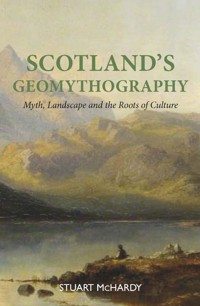
What can we learn from our landscape? How can Geomythography help us understand our cultural heritage? What is Geomythography? Geomythography: The interpretation of prehistoric and later societies at specific locales through a combination of oral tradition, place-names, landscape analysis and archaeology. The process is a means of finding new perspectives and interpretations to further the understanding of early and extant cultures and the continuities between them. In this book, Stuart McHardy unveils the intricate ties between Scotland's landscapes and the rich tapestry of its pre-Christian and later traditions. Geomythography is a vital lens through which to understand the enduring relationship between the land and its people. He invites you to discover how communities have thrived within the land of Scotland, fostering a deep-rooted cultural connection. He argues that respect for our ancestors and the knowledge they imparted shape not only individual identity but also communal responsibility towards future generations. This book is an essential read for history enthusiasts, folklore lovers and anyone interested in finding out more about Scotland's Geomythography. Connect to the past and Scotland's natural environment in this captivating exploration of cultural continuity.
Sie lesen das E-Book in den Legimi-Apps auf:
Seitenzahl: 202
Veröffentlichungsjahr: 2025
Das E-Book (TTS) können Sie hören im Abo „Legimi Premium” in Legimi-Apps auf:
Ähnliche







STUART McHARDY is a writer, historian and storyteller. He has long lectured on many aspects of Scottish history and culture both in Scotland and abroad. Combining the roles of scholar and performer gives McHardy a particular insight into tradition. As happy singing old ballads as analysing ancient legends, he has held such posts as Director of the Scots Language Resource Centre and President of the Pictish Arts Society. McHardy lives in Musselburgh with his wife Sandra.
By the same author:
Tales of Whisky and Smuggling (House of Lochar, 2002)
Scots Poems to be Read Aloud (ed.) (Luath Press, 2003)
MacPherson’s Rant and other tales of the Scottish Fiddle (Birlinn, 2004)
The Silver Chanter and other tales of Scottish Piping (Birlinn, 2004)
School of the Moon (Birlinn, 2004)
Tales of the Picts (Luath Press, 2005)
On the Trail of Scotland’s Myths and Legends (Luath Press, 2005)
The Well of the Heads and other Clan Tales (Birlinn, 2005)
The White Cockade and other Jacobite Tales (Birlinn, 2006)
On the Trail of The Holy Grail (Luath Press, 2006)
Tales of Edinburgh Castle (Luath Press, 2007)
Edinburgh and Leith Pub Guide (Luath Press, 2008)
Tales of Loch Ness (Luath Press, 2009)
Tales of Whisky (Luath Press, 2010)
Speakin o Dundee (Luath Press, 2010)
A New History of the Picts (Luath Press, 2011)
Tales of Bonnie Prince Charlie & the Jacobites (Luath Press, 2012)
Arthur’s Seat (Luath Press, 2012) with Donald Smith
Scotland the Brave Land (Luath Press, 2012)
Pagan Symbols of the Picts (Luath Press, 2012)
Calton Hill (Luath Press, 2013) with Donald Smith
Edinburgh Old Town (Luath Press, 2014) with John Fee & Donald Smith
Scotland’s Democracy Trail (Luath Press, 2014) with Donald Smith
Scotland’s Future History (Luath Press, 2015)
Scotland’s Future Culture (Luath Press, 2017)
The Stones of the Ancestors (Luath Press, 2020) with Douglas Scott
The Nine Maidens: Priestesses of the Ancient World (Luath Press, 2023)
Scotland’s Sacred Goddess: Hidden in Plain Sight (Luath Press, 2025)
First published 2025
ISBN: 978-1-80425-329-8
Typeset in 10.5pt Sabon by Lapiz
All photographs by Stuart McHardy unless otherwise stated.
The author’s right to be identified as author of this book under the Copyright, Designs and Patents Act 1988 has been asserted.
© Stuart McHardy 2025
For Ishbel Lily McHardy and Flora Beth McHardy
Contents
Introduction
Terminology
Chapter 1 Clustering
Chapter 2 The Spoken Word
Chapter 3 Archaeology
Chapter 4 The Natural World
Chapter 5 Supernatural Beings
Chapter 6 The Naming of Place
Chapter 7 Alignments
Chapter 8 Sources
Chapter 9 Locales: Scotland and Furth of Scotland
Notes
Bibliography
Geomythography: The interpretation of prehistoric and later societies at specific locales through a combination of oral tradition, place-names, landscape analysis and archaeology. The process is a means of finding new perspectives and interpretations to further the understanding of early and extant cultures and the continuities between them.
Introduction
GEOMYTHOGRAPHY IS THE interpretation of prehistoric and later societies through a combination of oral tradition, place-names, landscape analysis and archaeology. The process is a means of finding new perspectives and analyses to hopefully further the understanding of such societies, primarily by identifying sites of ritual and their associated beliefs. Although many such sites have retained local cultural relevance into modern times, eg the visitation of certain locales at specific times of the year, the significance of these traditions has not always been recognised by scholars in the past.
Most analyses of sites that had significance in the past has, understandably, used a comparative methodology, ie the comparison of one site with similar locales, either on the basis of physical likeness and/or being contemporaneous. In the Geomythographic process, which clearly draws in part on such comparisons, the primary focus is on the cultural continuities within specific sites. While one of the key points in developing this approach was considering the early Christian Church’s explicit policy of reusing ‘pagan precincts’, there is much more to this. The local importance of such sites was established long before the arrival of the monks – in some cases potentially a great deal earlier, and attendance at such churches can be understood as part of the community’s ongoing cultural continuity. Instead of simply seeing this as a break with the past, which on one level it certainly was, we can also see it as part of the community’s ongoing involvement with the landscape, rooted in both shared and individual experience. The inherited perception of such sites as being of significance was communal, but the attendance there was, as it had long been, a matter of individual participation. This is of specific importance when we come to consider the idea of an individual’s mind-map of the landscape which, although refined by personal experience, was rooted in the inherited communal awareness of the landscape.
Sites which attracted stories of supernatural beings often retain ongoing roles in local culture and behaviour. As an example, the area on the southern slopes of West Lomond Hill in Fife has a story of the Devil which is just such a remnant (see Chapter 2). It also became the area where locals gathered to hold the, then illegal, Presbyterian church services known as conventicles in the late 1600s. Close by is the rock pillar known as Carlin Maggie, named after a local woman who was said to be the leader of the local coven of witches and who clashed with the devil – she had a café named after her in the early years of this century. Elsewhere I have dealt with the probability that here both the Devil and Carlin Maggie are accretions to a story that originally involved a goddess figure.1 The particular combination and layering of stories, activities and newer stories – such as that of the Angel of the Lomonds who was said to have protected the locals at a conventicle here – alongside the extensive local archaeology give this locale a unique profile. Other sites have similar details and events in common with the Lomonds but what the process makes clear is that each site is a product of its own cultural continuity, and as such is unique.
Geomythography as an idea is rooted in the awareness that long-lasting communities develop relationships with their environment that shape and define their culture. The majority of the contemporary human population lives in cities, but in terms of the long history of humans on this planet, cities are a relatively recent phenomenon. The first cities are thought to have been built around 7,000 years ago, while humans, in one form or another, have been living in communities for many hundreds of thousands of years. Most interpretations of our past see humans as nomadic hunter-gatherers until only a few millennia ago. However, this should not lead us to think that nomadic communities had no attachment to the land. The exact opposite is the case. Most nomadic societies travel over well-worn paths, defined by the process of existence itself – you go where there are enough resources to feed your community, tribe or family. This means that relationships between groups of people and specific places in the landscape go back beyond measurable time; the relatively recent discovery of the decorated stones of Göbekli Tepe in Turkey underlines that people interacted with their physical environment in ways that developed into ritual behaviour long before the advent of settled human communities.2
We should also be aware that what is generally presented as the origin of farming is a somewhat simplistic analysis. Nomadic peoples utilised their environments, through methodologies like burning, to increase or perhaps just guarantee supplies of food in the future. This is a form of farming and we should perhaps consider redefining the farming process into pre- and post-fixed-field farming. It is the development of fixed-field farming – where land is ploughed and prepared for planting, generally by manuring – that led in time to the development of cities, but it was clearly not the first mode of farming. David Graeber and David Wengrow recently presented evidence that the domestication of plants in the Middle East may not have come about till three millennia after wild plants were first cultivated.3 And it is undeniable that some of the processes initially developed by hunter-gatherers, such as hunting and the foraging of wild foods, were a continuing part of the resource gathering of most communities here in Scotland until the 18th century, and later. Such activities continue to play a role in other societies today.
The pre- and post-fixed-field differentiation may seem simple to suggest, but the approach of Geomythography is to a large extent predicated on examining society’s past as part of a continuum. One of the key points in understanding Scotland’s past is perhaps best illustrated by realising how we inhabited our landscape as recently as the 18th century. It is only in relatively recent times that the extent of the clearance of long-established communities in the Lowlands has begun to be studied, accompanied by a growing awareness that most of this pre-dated the later and much better known Highland Clearances. The evidence of the Roy maps created in 1745–6 in response to the Jacobite Rebellion illustrates a remarkable fact.4 The vast majority, perhaps as much as 95 per cent of the population of Scotland, Highland and Lowland, were living in small, essentially self-sufficient, pastoral, kinship-based communities into the middle of the 18th century. This pattern appears to pre-date history, possibly going back to the Stone Age. In the case of the Highlands, the basic structure of society was still tribal into the 18th century, and in both Highlands and Lowland communities this pattern makes it probable that these communities had roots which preceded the arrival of Christianity. Many such communities had undergone radical linguistic, religious, political, social and economic change. But the communities themselves, rooted in their ancestral landscapes, continued.
While languages, religion and politics had all changed substantially, the basic pattern of human occupation, latterly referred to in Scotland as fermtoun and clachan, had apparently changed little over a considerable time; RN Millman suggests their origins may well have been prehistoric.5 These were the communities noted by Roy, which generally consisted of a handful or two of families intensively farming the ground around their clustered houses and utilising the land beyond for the grazing of livestock, as well as for hunting game, gathering fruits and herbs, etc.
If we accept this, then we have to be aware that the passing on of knowledge in such communities – whether concerning practical matters such as gathering food from the environment, caring for animals and creating shelter, or the creation of cultural material such as mythology and genealogy – could only be passed orally through the generations (Chapter 1). We should also be aware that such material was passed on within families, as well as within the wider community.
In the modern world, genealogy is big business; people want to know who their forebears were. In pre-literate times, this was of considerably more importance, and the fact that one’s predecessors were handing down the knowledge of how to live in, and respond to, the environment would have been well understood. This, I suggest, is what gave rise, in societies all across the planet, to a shared cultural habit of holding the ancestors in reverence. It has nothing to do with ‘worship’ of the ancestors, but everything to do with understanding that, without them, contemporary society would not exist (see Chapter 3). This respect for the ancestors may well have taken on spiritual or even mystical associations over time but was fundamentally rooted in a practical understanding of how the ancestors shaped contemporary society, in turn ensuring that the current generation would likewise pass on the necessary knowledge to the generations yet to come. This is an aspect of all kinship-based and tribal societies that is perhaps as yet insufficiently appreciated.
In his book The Archaeology of Natural Places (2000), Richard Bradley notes that people all across the world have chosen specific locales in the landscape that were completely natural for ritual/communal purposes (see Chapter 3).6 Apart from caves and wells, many such places were ‘distinguished from the surrounding landscape by their striking topography’.7 This awareness has underpinned my research for decades and the importance of specific, recurring shapes in the landscape has been one of the key elements in the development of Geomythography. It is through observing the landscape that I have come to the realisation that generations of people here in Scotland, as elsewhere, had a direct relationship with their physical environment in terms of the landscape, the seasons and the weather, that created patterns of understanding that were not only much more immediate than contemporary common human experience, but also had their roots in the very far past. It is plain that deep attachments to the land have been a part of all human societies for a very long time indeed. Such attachments are fundamental to the development of society itself, whether nomadic or fixed. And such attachments, developed over time, are visceral rather than intellectual.
Over the past few centuries, the once universal attachment to the land has been greatly weakened by enclosure, clearance and in all too many cases the removal of entire societies, generally in the name of economic efficiency designed to benefit the few against the interests of the many. Such uprooting of people, many of whom in Scotland had apparently been living in the same immediate area as their ancestors over several millennia, obviously removes the possibility of ongoing cultural continuity and leads to the loss of untold traditional material. However, as shown by the process of Geomythography here outlined, there is much still to be discerned about how our ancestors saw their world.
Most of the material presented here relates to Scotland for the simple reason that I am a Scot and have been studying my own culture and environment all my life. I fully understand that people from other lands will feel as deeply about their homes as I do about mine, and I have discovered much that is of relevance far beyond the boundaries of my native land. In a couple of external examples in Chapter 9, I hope I show that the approach has potentially universal application.
The role of history within the nation state is to give a useful and coherent picture of the past that will help keep society together. In this it reflects one of the fundamental truths of oral tradition. Storytelling in all traditional communities reminds people of their shared ancestry and interests, culture and environment, and serves the same function in giving a useful and coherent picture of the past. It helps people identify with their social/kinship/tribal group and can be seen as a kind of cultural glue, keeping people together. However, it does more. Story is fundamentally different from history in many ways, and as an illustration of this we should consider both storytelling tradition’s great strength and fundamental weakness, which go hand-in-hand. Stories keep their relevance for just as long as they are told within the communities in which they developed. If they lose that relevance and cease to be told, they disappear.
The British media was all of a flutter a couple of years back at some research done at Durham University which stated that using phylogenetic analysis, a biological technique, and applying it to culture, researchers had concluded that some basic story types are over 5,000 years old.8 This research, based on a process of analysis that I neither understand nor wish to, is as nothing compared to work published over 30 years ago in Australia. In 1979 Jennifer Isaacs published Australian Dreaming: 40,000 Years of Australian History which showed that Dreamtime stories of the indigenous people referring to giant marsupials had been corroborated by skeletons found in various parts of the continent, dated to as much as 40,000 years ago.9 This had given rise to a new genus of animals classified in the mid 19th century, the Diprotodontidae.10 This recognition of the tenacity of factual data surviving in a non-literate culture over such an extended period of time may only be the beginning of a new understanding. In my work on the Nine Maidens phenomenon I have come to think that the underlying stories of groups of nine women that survive in mythological and legendary material over much of the globe may have originated in Africa.11 If so, these stories may well have spread with the first humans to leave Africa and colonise the globe, which recent discoveries suggest may have been as much as 200,000 years ago.
There are other aspects of oral tradition worth taking note of. My own role as a storyteller began in 1974 when I heard what I thought was a joke in a Dundee pub. It was spoken by my friend Ben Hinnie, himself now a storyteller in Strathspey, and told of a miserable, avaricious person being given their comeuppance after the good luck of a friend inspired even more jealousy than usual. It was an urbanised version of a story well-known in Gaelic tradition, and over the years I have found versions of it from as far away as Japan and South America. This is not because somebody travelled the globe spreading this particular tale. It survived in so many places because it is a moral tale that has universal human relevance. All societies have variations of the same types of stories for the simple reason that all human societies are formed by a range of individuals who have much more in common than otherwise. Universal motifs in story can arise from common human experience and not necessarily from particular cultural contact, though that said, there is growing evidence for widespread human contact across many parts of the globe going back a very long time. A case in point would be the remarkable voyage of the Kon-Tiki in 1954 in which Thor Heyerdahl led a group of adventurers in a sea voyage to prove his suggestion that such voyages could have taken place in the far past.12 An idea that the then-experts said was nonsensical.
Tales such as the one mentioned above may possibly exist all over the planet because they were already part of human culture when humans began to spread across the world. It is even possible that some such material originated amongst humanoid communities that predate the emergence of homo sapiens sapiens. We will never know, but we can guess given how tenacious story is in the Australian examples, which apparently refer back to a time soon after humans first arrived on that continent. And we should remember that alongside these Dreamtime tales the indigenous culture devised a highly sophisticated capability to live off the land in what, to educated Westerners, seemed an utterly inhospitable landscape inimical to human existence. Such sophistication does not rest in technological advancement, the built environment or ever-fancier possessions, and has much to teach us about how to live in a harmonious relationship with our physical environment, something else that has become increasingly rare in an ever more urbanised, industrialised and essentially monetised world.
Stories change as society changes – they adapt to shifting cultural realities and thus retain their relevance. A case in point is how some caves, known as Prince Charlie’s Caves, were previously said to have been occupied by Wallace, an earlier hero, and it is certainly possible that some such had been associated in even earlier tales with the heroic figure of Arthur. We will look at how this process may have affected the great heroic tales that underpin so much of the storytelling tradition as they have been gathered variously over the years (see Chapter 4).
There is another aspect to oral transmission that should be considered. We all know the old cliché that history is written by winners. Do the losers never speak to each other again of their own experiences? Hardly. Should we assume because one group, nation, tribe or individual gained power over others, that those others promptly forgot all of their own culture? Isaacs’ work suggests not. The indigenous tribes of Australia were conquered and many slaughtered by the incoming white men, and in all too many cases were effectively de-cultured, yet they have survived, and their Dreamtime stories have survived with them, even as the tellers were marginalised by modern society.
Underlying this there is another limitation that arises from a reliance on literature. In Europe, for instance, the development of the traditions associated with university learning are grounded in religion. It is not just that the first book, for the Christians, was the Bible, but that the priesthood ran all the universities for centuries. The problem we face regarding literature is that most teaching in all European institutions was done from texts, and those texts had by necessity to conform to what was acceptable to the dominant religion. No one writes history without an agenda and though there may be no conscious or deliberate bias, all history has been written from specific political viewpoints or religious positions.
This leads to one of the key points about the geomythographic process. Just as I suggest we must approach all history in a critical frame of mind – history is always a tailored version of the past, not the actuality of what happened – it is absolutely necessary to take a similar approach to material coming from the oral tradition. And it has to be said from the start that much of what we know of the oral tradition is itself from accounts that have been written down. It is in linking such stories with the other types of material in specific locales that we can begin to create new pictures of how our ancestors may have lived and thought.
Even today, story survives within families and communities as it always has done. The role of the traditional storyteller overlapped in the past with other tradition-bearing roles like those of bards and minstrels, but story also continued to flourish within the families which made up scattered communities. Everyone, even today, knows someone, in their family or through friends or workplace activity, that ‘has the gift of the gab’. Someone who is a natural storyteller. Sometimes such people go on to become professional entertainers of various kinds, but very often they don’t. Those known for their capacity to tell stories generally enjoy their role and a natural corollary of this is to want to collect more material. Such people become story gatherers, and it has always been so. The role of storytelling is fundamental to our humanity. Think of how children learn language and become socialised. We tell them stories and sing them songs, and it seems hardwired in human brains to want to hear an enjoyable story again and again, and sometimes again and again.
It is through a growing understanding of how story works within communities, linked to an awareness of how such folklore relates not just to ancient monuments but to the landscape itself, that the geomythographic approach arose. How it works is to consider one particular locale through as many different aspects of human culture as possible over time. And at the heart of analysing such cultural artefacts – physical, mental and psychological – is the awareness that the transmission of culture happened uniquely within each community, and that such communities have deep roots, psychologically, culturally and physically, within their own locale.
Terminology
BECAUSE GEOMYTHOGRAPHY BY definition utilises a multi-disciplinary approach and is concerned with particular locales over time rather than a stratigraphic approach, whereby the primary analysis is through comparison with contemporary sites, some terms have been developed to have specific meanings.
Clustering




