


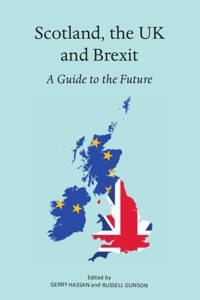
Scotland, the UK and Brexit E-Book
Erhalten Sie Zugang zu diesem und mehr als 300000 Büchern ab EUR 5,99 monatlich.
- Herausgeber: Luath Press
- Kategorie: Geisteswissenschaft
- Sprache: Englisch
The unexpected outcome of the 2017 UK general election means that the UK Government lacks a clear mandate on Brexit and also that the Scottish Government lacks a clear mandate on holding a second Independence Referendum consequent to the material change in circumstance which will be brought about by Brexit. We are in for a bumpy, unpredictable ride, one with profound consequences for the people of Scotland and the UK. In this collection of essays from a wide range of leading political specialists, journalists and academics, Hassan and Gunson have assembled a comprehensive guide to Brexit for the UK as a whole, and its constituent parts. From fisheries and agriculture to higher education and law, the whys and how of Brexit are challenged from all angles. Particular attention is paid to how Brexit will impact Scotland and the viability of a future independent Scotland.
Sie lesen das E-Book in den Legimi-Apps auf:
Seitenzahl: 377
Veröffentlichungsjahr: 2017
Das E-Book (TTS) können Sie hören im Abo „Legimi Premium” in Legimi-Apps auf:
Ähnliche




















First published 2017
ISBN: 978-1-912147-18-2
The authors’ right to be identified as author of this book under the Copyright, Designs and Patents Act 1988 has been asserted.
The paper used in this book is recyclable. It is made from low chlorine pulps produced in a low energy, low emission manner from renewable forests.
Printed and bound by Bell & Bain Ltd., Glasgow.
Typeset in 11 point Sabon by Lapiz
© the contributors 2017
Contents
Acknowledgements
Scotland, the UK and Brexit: an introduction
GERRY HASSAN AND RUSSELL GUNSON
Chapter 1
The UK’s approach to Brexit: where will it take us?
KIRSTY HUGHES
Chapter 2
A differentiated Brexit for Scotland?
TOBIAS LOCK
Chapter 3
Brexit and belonging: empathy, voice and moral authority
LAURA CRAM
Chapter 4
Scottish public opinion and Brexit: not so clear after all?
JOHN CURTICE
Chapter 5
What’s law got to do with it?
The Scottish parliament and the independence referendum
MATTHEW QVORTRUP
Chapter 6
Living in interesting times: Scotland’s economic development trajectory post-Brexit
ANDREW CUMBERS
Chapter 7
Brexit and Scotland’s public spending
RICHARD KERLEY
Chapter 8
Troubled waters: Scottish fisheries and the EU
GRIFFIN CARPENTER
Chapter 9
Farming, Scotland and Brexit
PETE RITCHIE
Chapter 10
The importance of Scotch whisky
RICHARD MARSH
Chapter 11
Scotland’s higher education
ANDREA M. NOLAN
Chapter 12
Financial Services
OWEN KELLY
Chapter 13
Brexit, Scotland and tourism
KEVIN HANNAM
Chapter 14
How might Brexit impact the UK energy industry?
GRANT ALLAN AND DAVID COMERFORD
Chapter 15
Brexit and the Scottish digital technologies industry
SVEA MIESCH
Chapter 16
Brexit, the UK and Scotland: the story so far. A constitutional drama in four acts
MARIA FLETCHER AND REBECCA ZAHN
Chapter 17
Keeping up the pressure. Equality and human rights in Scotland post-Brexit
ANGELA O’HAGAN
Chapter 18
Brexit and UK Energy Policy
AILEEN MCHARG
Chapter 19
Brexit, the SNP and independence
MARCO G. BIAGI
Chapter 20
Scotland, Britain, Europe: where now? A Conservative perspective
ADAM TOMKINS
Chapter 21
A better post-Brexit path for Scotland
DOUGLAS ALEXANDER
Chapter 22
Wales and Brexit
ED G. POOLE
Chapter 23
Northern Ireland: the promise broken?
DUNCAN MORROW AND JONNY BYRNE
Chapter 24
Brexit and Ireland
PAUL GILLESPIE
Chapter 25
The importance of borders: Britain in flux
MADELEINE BUNTING
Chapter 26
Soft power in hard times
JOHN EDWARD
Chapter 27
Somebody has to do it: Spain prepares for Brexit with an eye on Scotland and Gibraltar
ANA ROMERO GALáN
Chapter 28
Brexit and the future of Europe: a German perspective
MICHAEL WOHLGEMUTH
Chapter 29
The European Union’s multiple crises
FABIAN ZULEEG AND JANIS A. EMMANOUILIDIS
Chapter 30
Brexit and the political economy of Tory Britain
JIM BULLER
Chapter 31
What becomes of British Labour?
STEPHEN BUSH
Chapter 32
A global UK? The UK after Brexit
ANDREW GAMBLE
Contributors
About IPPR Scotland
Acknowledgements
A book like this is a product of many different hands. It has gained from much support, advice and the enthusiasm and skills of many people. It is impossible to individually thank each person who assisted and made this possible, but to everyone who played a part, we gratefully thank you.
First and foremost, we would like to thank every single contributor who gave their time, expertise and knowledge to make this happen. We gave people difficult remits, asking them to address a whole host of issues, many of which will evolve and change dramatically in the next few years, and asked them to bring calm heads and clear analysis. We could not have wished for a more impressive list of contributors to whom we are enormously grateful.
We would also like to thank colleagues in the Institute for Public Policy Research and in particular, Rachael Thomas in IPPR Scotland’s offices. Many thanks are also due to numerous people who gave their advice in the shaping of this book and its contents and contributors: Kirsty Hughes, Michael Keating, Nigel Smith, Douglas Fraser, Jeremy Cliffe of The Economist, and Stephen Booth of Open Europe.
Significant thanks are also due to the national treasures that are Luath Press - Gavin MacDougall and all his staff - who have been exemplary champions of this book from the outset, and who have, from the beginning to the end of this, made us confident that the entire project was safe in their formidable hands.
Finally, a project such as this has many eyes and supports, and this book would not have been possible without the insights and checking of Rosie Ilett and Ash Burnel who assisted in the latter stages of production.
The enclosed contents do not represent the collective opinions of IPPR or IPPR Scotland, but are an offering and contribution to inform this important and historic debate. We hope that readers will find the enclosed of interest, illuminating and stimulating, and a worthy contribution and guide to the next few years of developments in Scotland and the UK in relation to Brexit.
A final word over timing. In these bewildering and often fast-changing times, this book was written before the UK 2017 election was called by Theresa May, lost by her and the Tories, and won by no one. The entire book has been reviewed in light of this, and revised in several, but not all places. The general thesis of the challenges and ambiguities of Brexit for Scotland and the UK, and the absences of serious preparatory work and strategy by the UK Government remains as a factor which will define much of future events.
Gerry Hassan
Russell Gunson
Scotland, the UK and Brexit: an introduction
Gerry Hassan and Russell Gunson
Introduction
WE LIVE IN dramatic and unpredictable times. On 23 June 2016 UK voters were asked ‘Should the United Kingdom remain a member of the European Union or leave the European Union?’ and responded:
Thus began the ‘post-Brexit Britain’ political environment – with a majority of 1,269,501 voting to leave the EU; a decision that has understandably dominated and overshadowed British politics since. It was not, of course, a united UK that made that decision. Scotland voted (62:38) to remain, Northern Ireland (56:44), so too did significant parts of England, such as London (60:40).
The challenge this poses to the UK and its component parts is immense – as this IPPR Scotland book explores. Specifically, it addresses the consequences that flow from Brexit for Scotland, while also examining UK and international implications. It analyses the terrain, the major issues and possible developments, the context in which this takes place and how some of the major actors including the Scottish and UK governments, and the EU itself, may act.
The Scottish dimension
All of this poses numerous challenges for Scotland. One major factor is that in 2014 Scotland voted by 55 per cent to 45 per cent to remain in the UK. Yet less than two years later, in June 2016, by the margin of 62 per cent to 38 per cent, Scots voted to remain in the EU. This has brought to the fore one of the central tensions in Scottish politics – of two competing and contradictory mandates. People in Scotland are, in essence, told in no uncertain terms by the UK government, and by a significant proportion of Scottish parliament politicians, that they cannot have a political settlement that respects both.
There are problems for everyone politically. Much of pro-union opinion has come to state that Scotland voted to remain in the UK, and then voted as part of a UK that decided to come out of the EU. This is a literal interpretation of the events of the last two years which, while factual, does not really address issues of political legitimacy and perception. This is particularly the case, given the prominence of the EU in the first independence referendum campaigns.
The Scottish government, on the other hand, decided to set out its position post-Brexit in a White Paper, Scotland’s Future in Europe, which was seen by many as considered and thoughtful and a search for a middle ground (Scottish Government, 2016). The commentator Hugo Rifkind, normally no friend of the SNP, called it ‘a well-judged approach, because it cuts right to the heart of the current Scottish political crisis’ (Rifkind, 2016).
However, the case made by the Scottish government has significant political and constitutional consequences. First, there are the practical issues of how Scotland could sit in the single market and Customs Union while the rest of the UK (rUK) does not. How this would work economically and practically – as Tobias Lock addresses in his contribution – is filled with complications.
Second, and more important in exploring the possibilities of such arrangements, is the presence of political will (and goodwill) to see them a reality. This seems to be lacking from one part of the equation, the UK government, rather paradoxically in that the UK’s political elites have often celebrated their adaptability in governmental and constitutional manners. The UK government has so far, post-Brexit, shown no interest in pursuing a flexible and hybrid approach – a constitutional response so regularly championed within the UK – through a serious consideration of what a geographically differentiated Brexit would like within the UK, as opposed to sector-by-sector deals.
The next two years of Brexit Britain
The next two years, and more, will be full of drama, tension and high-wire negotiations as the UK, following the triggering of Article 50 in March 2017, tries to agree a deal and the details of withdrawal with the EU: the context and choices of which are laid out by Kirsty Hughes in her contribution. This will not be smooth or easy, as we enter uncharted waters with no member state having previously withdrawn. There have been three previous departures – Algeria in 1962 (it not officially being a French colony, but in a union with France, and hence part of the original six), Greenland in 1985 and Saint Barthélemy in the Caribbean in 2012. Similarly, there have been other examples of EU flexibility relevant to Scotland and Northern Ireland, such as the fast-tracking of East Germany into the EU in 1990 and the divided island of Cyprus becoming a member in 2004.
None of the examples of EU withdrawal were those of a member state, and there were none of the complexities and intricacies that will be associated with UK withdrawal. The attitudes that frame the UK-EU discussions take everyone into unknown territory – with very different expectations on both sides.
Two main deals need to be negotiated: an exit deal, which will cover the Brexit bill the UK will pay and a transition agreement to cover the period between UK withdrawal and a new trade agreement; secondly, a comprehensive UK-EU trade deal, alongside other cooperation agreements on judicial, foreign policy and security matters (Hughes, 2017).
With Article 50 triggered, negotiations begin between UK government ministers and the EU Commission, but one big question concerns who the UK is actually negotiating with. Formally it is the Commission and its chief negotiator Michel Barnier (acting on behalf of the European Council of Ministers and following their guidelines), but equally important are the individual EU27 states, bilateral relations with each member state, and in particular, Germany and France. At the same time, the UK government is, at least informally, in a process of negotiations with the devolved administrations of Scotland, Wales and Northern Ireland, which will have an impact on the UK-EU discussions, and attitude of the EU27.
One of the first substantive issues will be that of the 3.3 million EU citizens living in the UK – and the 1.2 million UK citizens living in the EU. This has proven enormously contentious with the UK government, who before triggering Article 50, refused to offer any guarantees to EU citizens in the UK and are being accused of using them as bargaining chips.
After this, the even more serious and complicated discussions begin. This will start with the exit deal, with huge tensions between the UK government and EU already evident about whether to start by talking about monies and the UK’s Brexit bill. There will also be issues between the exit and trade deals – and to what extent they run in tandem.
Then there are the specific details of how the UK secures, or does not secure, tariff-free access to the free market, alongside factors such as how the City of London’s special status as the financial capital of the EU (where 70 per cent of the euro denominated interest rate derivatives market takes place) is protected (Economist, 2016). All of this will keep the UK government busy, before it thinks about Scotland, Northern Ireland, Gibraltar and other sticky areas. A UK-EU deal has to be agreed by the British government and EU Commission, approved by the British and European parliament (with the prospect of one or both rejecting any deal) whilst some, such as the Lib Dems, are calling for a second referendum on any deal. And of course, there is even the prospect of no UK-EU deal.
The UK government and, even more, pro-Brexit opinion, seems to be based on an optimistic, somewhat rosy, version of the UK economy and its prospects post-withdrawal. It buys into hype about ‘the British jobs miracle’ in right-wing opinion, and has stressed the positive performance of the economy since the 23 June vote. What this willfully ignores are the long-term structural inadequacies of the British economy. These include poor productivity; low research and development; the highest Balance of Payments deficit in UK history; household, financial and corporate debt; ‘the lost decade’ of living standards which is now predicted to last at least fifteen years (2007-2022) and the over-dominance of London and the South East (which make up 40 per cent of the UK economy). None of these will be addressed or aided by Brexit, and indeed many could become more accentuated. These trends have been considered by IPPR through http://www.ippr.org/publications/out-of-shape and will be considered, among others, over the coming years through IPPR’S Commission on Economic Justice.
The United Kingdom, power and devolution
What does this situation say about the United Kingdom in terms of who has and does not have power? Firstly, the Supreme Court Article 50 process and decision in January 2017 underlined what has long been known: that the UK parliament is seen as ‘sovereign’ (Bowcott et al, 2017). The Scottish parliament, along with the Welsh and Northern Irish Assemblies, are not viewed as such but as creations of Westminster, with no right to a veto or substantive say in the Brexit process. Despite this, legal challenges by the devolved administrations may continue throughout the many stages of Brexit.
The Joint Ministerial Council (JMC), that brings together the UK government and the devolved administrations, could have become one of the key forums in which a UK-wide position was discussed and formulated in relation to Brexit. But it has not. Instead, the UK government has seemingly not used it to shape its negotiation positions, but instead to present its own Brexit position as a fait accompli, much to the loud and public dissatisfaction of the Scottish government (BBC News, 2017a).
The Brexit vote has exposed that the UK constitution and state has not adequately responded to the devolution of power to the nations of the UK. It has not developed many of the constitutional safety valves and safeguards at the UK level that would reflect the more dispersed nature of constitutional arrangements. This inaction has weakened the UK’s ability to respond to the multiple mandates offered by the Brexit vote. Many of these UK-wide constitutional responses, that have been lacking in their response to devolution, as exhibited in many other more federal countries, could have helped the UK to plot a path through the conflicting geographical mandates within the UK stemming from the Brexit vote.
Devolution, since 1999, should have been about the political centre of the UK reforming and democratising, changing its own character and the nature of its relationships with the devolved nations. This is missed by many accounts that describe the semi-federal, or emerging federalism, of the UK (for example, Blick and Jones, 2010). Federalism cannot come about by unilateral actions of Scotland, Wales and Northern Ireland. It requires the political will and action of Westminster, and a popular shift in English public sentiment that, for the foreseeable future, seems to be completely lacking.
Secondly, is what this says about the UK as an idea, and existentially, what does it say about the nature of the union, about the UK as a partnership of four nations, supposedly based on mutual understanding and respect? The UK is a multi-national, multi-cultural state and a union of four nations. The territorial dimensions of the UK are underpinned by political traditions and practices that reflect this patchwork, organic, even haphazard nature that has evolved over centuries, rather than by some grand design. However, little consideration has been given to which of the decisions faced by the UK should be taken by each of the nations with an equal 25 per cent say and for which should be based on population share; consideration that would have been very useful prior to the EU referendum.
At its heart the UK is meant to be what is called a union state: a state made up of a number of unions that retains some of the pre-union arrangements and characteristics of its constituent parts. An example of this is the institutional autonomy of Scotland that was specified in the Acts of Union of 1706–7, preserving the distinctiveness of the Kirk, law and education.
The union-state perspective used to be heretical as it challenged the British unitary state tradition, but slowly over the devolution years it became the conventional position, certainly amongst academics and British constitutional matters (see Mitchell, 2014; Bogdanor, 2009). Yet the experience of Brexit, coupled with the growing lack of understanding of the UK by its political elites, has shown that the earlier revisionism was overstated. Thus, while the UK has many characteristics of a union state, its political classes increasingly inhabit a unitary state idea of Britain, with devolution and Brexit aiding a return to this bunker. This is more than an arcane set of distinctions, for what it illuminates is how the British political establishment see the UK, where power lies, and the unfinished business of devolution, which to them was not, it seems, about changing the UK’s basic character.
Brexit challenges for the British and Scottish governments
Over the next two years the British government will have to conduct a series of fraught, multi-front debates with the EU, filled with tensions and potential conflicts and, now it seems, with Scotland and Northern Ireland. It needs to maintain, as much as is practically possible, a UK-wide united front – or at the very minimum, give the appearance of one – over the period of formal EU negotiations.
The Brexit vote brings with it the fundamental question of what kind of country the UK is, what it aspires to be and how it sees its role in the world. The right-wing Eurosceptic view of Brexit is one that the vast majority of the Scottish public would baulk at, as indeed would a majority of the public in the UK. But it has become increasingly influential, aided by the blank canvas of what Brexit is, and by the absence of coherent UK opposition to the UK government in the House of Commons; the House of Lords being a different proposition.
Brexit will test the UK government in how it can best do statecraft, diplomacy and the politics of deal making. Given the UK has long been considered ‘an awkward partner’ in the EU, this will be a severe test. The Scottish government on the other hand has little direct experience of diplomacy, but post 23 June has engaged in a politics of paradiplomacy, emphasising soft power, that could affect future Scottish positioning and influence leading into any EU negotiations – an arena that John Edward’s contribution considers.
The Scottish government is not an official player in the forthcoming EU-UK talks, by dint of the UK being the member state. It is not recognised by any of the EU member states or by the EU. Scotland does, on the other hand, have a lot of friends and sympathy in Europe. This does not translate into hard political power, but there are dynamics of timing, waiting and choosing the right moment to move, with huge awareness in EU elites and the EU27 of Scotland’s predicament.
The big Scottish question: a second independence referendum
With no Scottish-tailored solution looking likely to be offered from the UK government as a result of Brexit, the prospect of a second independence referendum has become real. Nicola Sturgeon has stated that in her dealings with the UK government post-Brexit she has ‘been met with a brick wall of intransigence’ which has not seen any compromise to Scotland. She called for the Scottish parliament to pass a Section 30 request to the UK parliament giving them the power to decide to hold another independence referendum (Sturgeon, 2017); and Holyrood voted on 22 March 2017, split down constitutional divides, for such a motion.
There are, in spring 2017, many variables: of timing, content and context. A critical factor for both the UK and Scottish governments is when any second independence referendum would take place in relation to Brexit: the UK government wanting any vote, if it happens at all, to take place after the culmination of the Brexit deal and process, and the Scottish government ideally wanting one before the UK, and thus Scotland, leaves the EU. This could, if both parties were prepared to compromise, and a second independence referendum were to be agreed, allow the ground to be identified for any vote from late 2019 onward – after the UK has just left the EU – into early 2020. But this supposes that the UK and EU negotiations keep to a two-year timetable. It is also based on assumptions prior to Theresa May calling a surprise UK general election for 8 June 2017 which resulted in her losing her majority and governing as a minority government, and in the SNP being reduced from 56 to 35 Westminster seats, which threw into doubt the calling and timing of any independence referendum before the next Scottish Parliament elections.
Nicola Sturgeon and the SNP’S thinking has initially pointed towards a preference for a vote before Brexit talks concluded, while seeing merits in a vote immediately after Brexit. Not surprisingly there is a degree of anxiety and nervousness in the party. This is because none of the above scenarios and dates are ideal, and each carry huge risks not only of losing, but of what could follow afterwards, and the economic and social dislocation associated with Brexit for Scotland.
A second independence referendum would clearly and obviously entail huge political questions. A major one is how a reformed independence offer would be put together in light of Brexit, particularly as Brexit negotiations are likely to be fluid and non-linear. If that were not enough in terms of hurdles to jump there are also significant challenges, not just in terms of the electoral terrain as described by John Curtice in this volume, but in the legality of a referendum investigated by Matthew Qvortrup.
In any complex standoff and dance between the Scottish and UK governments on holding a second independence referendum, a critical question will be the Westminster procedures to allow for a legal vote. This is because Section Five of the Scotland Act 1998 identifies ‘the constitution’ as ‘a reserved matter’ meaning reserved to Westminster. The 2014 referendum took place in the context of David Cameron passing a Section 30 order that gave the Scottish government temporary responsibility to hold an independence vote. This was part of the Edinburgh Agreement between the two governments in October 2012 that laid out the framework for the 2014 vote.
This time round the UK government has not indicated whether it will or will not facilitate such a Section 30 order, as it is clearly calculating the cost of any action north of the border and how any such referendum could unfold. A high cost approach would be to completely rule out a Section 30 which would risk giving the Scottish government the moral high ground and, importantly, potentially the democratic argument. It is also less likely that the UK government would give the Scottish government a Section 30 in the same form as last time in the terms the SNP want. So far the UK government has been playing for time, not acceding to the SNP’S requests or timetable, with Theresa May declaring, in response to Nicola Sturgeon stating she wished a 2018 or 2019 vote, that ‘now is not the time’: a holding statement which demands greater clarity down the line (BBC News, 2017b).
If a second independence referendum takes place at all, it is more probable that the UK government will offer what it will portray as a middle position, saying to the Scottish government that it cannot have a Section 30 order until the processes of Brexit UK-EU negotiations are completed and agreed in March 2019. Therefore, under this scenario, it would offer a Section 30 with both a sunrise and a sunset clause, which allows the Scottish government to call a vote post-Brexit. This would mean that the UK, including Scotland, would have left the EU by the time any second independence referendum took place: thereby leaving Scottish voters faced with Brexit as a fait accompli and thus, after one disruption, depicting independence as a second and unnecessary disruption.
Scotland isn’t the only constitutional problem facing the UK government. There is also Northern Ireland. Not only did it vote against Brexit, but the March 2017 Northern Irish Assembly elections provided another complication with, for the first time, the unionist community losing its majority in votes and Assembly seats. Such an event cannot be underestimated – it changed the nature of the dynamic between unionists and nationalists and dealt a severe blow to the psyche and confidence of the unionist political community.
Brexit brings big headaches to Northern Ireland around the sustainability of the peace process, the longevity of Stormont power-sharing, the nature of all-Ireland cooperation, and, in particular, the issue of what has been called ‘the borderless border’ (Meagher, 2016). With the UK outside the EU, the Irish-Northern Irish border becomes one between an EU member state and non-EU member state. This brings concerns about how to maintain the soft border that exists today. If that were not enough, any UK flexibility about the maintenance of a soft Irish border has implications for Scotland: either in any differentiated deal offered in the union (or why what is offered to Northern Ireland isn’t on offer to Scotland), or in a post-independence settlement.
Whatever happened to progressive Britain?
This brings us to the feasibility of a progressive Brexit. This was always one possible outcome of Brexit, given the blank canvas upon which people voted. However, this possibility is narrowing by the day, driven by politics, and the dynamic of the hard-Brexit agenda of influential sections of the Conservative Party and right-wing opinion.
Adding to this state of affairs is the, at times, incoherence of the Labour Party – Her Majesty’s Official Opposition – when it comes to Brexit. This has inevitable consequences for all British politics, democracy and thus Brexit, potentially splitting Labour’s traditional coalition in England, between the cities (more pro-remain) and the post-industrial areas of England (more pro-leave).
Fundamentally, without a differentiated Brexit deal, the feasibility of a progressive Brexit has to be underpinned by a progressive Britain. That is still there, but struggling to find a coherent voice and influence. It is not an accident that the main opposition to Brexit in the Commons has come from the pro-European SNP and Lib Dems. Or that former UK Prime Ministers Tony Blair and John Major, in their high profile February 2017 interventions, created impact (Blair, 2017; Major, 2017). Blair’s brought with it all the resultant baggage he comes with post-office: his opinion poll rating is well below Jeremy Corbyn’s at 14 per cent satisfaction (compared to Corbyn’s 24 per cent in February 2017). While Tory Brexiteers dismissed Major’s intervention as ‘bitter’, it was a calm, considered and rigorously argued case against Brexit. All of these interventions underline the deep vacuum at the heart of British politics that has life-changing consequences.
The present impasse should be seen as influenced and shaped by a series of multiple crises of the UK and its political traditions. This runs from unionism, to Toryism and Labourism: the tension points of the latter two explored by Jim Bullitt and Stephen Bush in their chapters on Tory and Labour Britain.
It was illuminating, in terms of the idea of Britain and unionism, that a recent Conservative Home blog survey of Tory members showed that the party of traditional unionism was at grass-roots-level seeing its commitment ebb away (Goodwin, 2017). Only 33 per cent of Tory members thought Scottish independence would cause ‘serious damage’ to the ‘remaining parts of the UK’. Another 22 per cent said independence would not be in the interests of rUK but any damage could be contained; 15 per cent thought independence a ‘shame’, but of ‘no real significance’; the remainder welcomed the prospect of ending ‘the unreasonable demands on England to provide ever-greater financial and political concessions to Scotland.’ An emphatic 93 per cent of English Tory respondents said devolution ‘has been harmful to England’.
A guide for non-Scottish readers
This brings us to a few key observations for English, Welsh and Northern Irish readers, as well as those in Europe, about what is happening and why, and where Brexit might take Scotland. First, the argument of some in UK and Scottish politics that the Nationalists should just drop any idea of a second independence referendum and concentrate on governing, while understandable as a political argument, is a misreading of the situation.
For a start, the trigger for the process of a second independence referendum in Scotland was the UK government calling and losing of the EU referendum. UK Prime Minister Theresa May’s criticisms of the SNP on their ‘constitutional obsessions’ and ‘tunnel vision nationalism’, could be seen as disingenuous (May, 2017), tapping into how majority nationalisms (British) the world over fail to see or understand themselves as nationalism.
Second, whether, or when, Scotland has a second independence referendum is one thing, but the threat of holding a vote is a powerful political weapon in the hands of the Scottish government. Why would they, in this taut and difficult period, want to unilaterally renounce its possible use?
Third is the democratic case contained in this. To only invoke the mandate of the UK vote is to miss the much more nuanced mandate when seen across the UK. Fourth, just as Scotland’s first independence referendum did not come from nowhere, this is also true of the 2016 EU vote. Instead, it was part of a forty-year, ongoing debate about whether the UK was a European country, in relation to the EU membership and project. That has now been decided, but carries with it consequences for the UK, Scotland and Northern Ireland which cannot be wished away.
An additional point is that Scotland is an increasingly self-governing nation, already quasi-independent in relation to many aspects of domestic policy.
Scotland, as a nation and a polity, voted by a significant majority to remain in the EU but is not having its wishes heard and respected. Consequences flow from such a situation and the perceptions associated with it. If the vote had been in favour of leave, it is interesting to consider what reforms and action would have taken place to respond to the significant and strong leave votes in many parts of the UK.
A helpful tool for understanding the UK, and specifically Scotland’s, predicaments is Albert O. Hirschman’s influential ‘Exit, Voice and Loyalty’ (Hirschman, 1970). In this analysis, voice is the act of dissent, agitation and lobbying, loyalty is the power of the group, collective action and solidarity, and exit concerns removing yourself from the situation or relationship. Hirschman took loyalty to be the traditional approach of the left, and exit of the right, while the greatest power was the often underused force of ‘voice’.
The UK’s relationship with the EU over the past 40 plus years has not shown much loyalty or attachment to the European project. Successive UK governments consistently portrayed EU membership on pragmatic, transactional terms. The UK, instead, expressed over these four decades, the politics of voice, of dissenting, complaining and advocacy for its own national interests. And over the period, this gave the UK what could be called the best of both worlds – membership of the EU, acting as an influencer and shaper in EU corridors, while being semi-detached and having rebates and opt-outs from the areas it did not like, such as the euro and euro bailout fund. This truly has been the power and potential of voice on display. But despite this, the UK has now decided to embark on the ultimate politics of exit and withdrawal from the EU.
Similarly, Scotland’s relationship within the UK union has historically been defined by both loyalty and voice. This was at its height a union with a deep, emotional and committed bond; that was much more than instrumental or merely transactional. Scotland has traditionally, through the years of loyalty, displayed a twin-track approach by also utilising voice. Pushing, agitating and lobbying for Scotland’s special interests, greater public spending and contracts, and that, over the three centuries, has paid impressive dividends (for example: the Scottish Office pre-devolution; Barnett and before Barnett, the Goschen formula).
This brings us to the politics of exit in both the UK and, separately, Scotland. The nature of the deal, and the price the UK is willing to pay to leave the EU, will be influenced by whether it is a complete or clean break, and whether, beyond transitional arrangements, the UK and EU continue to co-operate deeply. And the form of this exit will influence how the politics of exit take shape in relation to Scottish independence. In both cases, the psychologies of exit, and the crosscutting influence of Brexit and Scotland on each other, will be a major factor.
A Scotland with more powers and what that does to Scottish politics
An important dimension in Scotland’s debate will concern the powers that come to the Scottish parliament as a result of Brexit. This could include farming, fishing, food safety and numerous other areas such as VAT or immigration, and as important to how this pans out are the processes and consultations that the UK and Scottish governments enter into. EU powers will be repatriated to the UK parliament, with agreement then reached on powers devolved to Scotland and to elsewhere in the UK.
In this scenario there is room for the UK government to be bold and ambitious and to make real its commitment to a different kind of union, but there is also potential for major disagreements, in substance and process. If the UK government holds on to all-UK frameworks in farming and fishing for example, there is an opportunity for the Scottish government to claim it is acting in bad faith.
Moreover, a bigger set of dynamics are at work in the above, noting that new powers have come to the Scottish parliament in the Scotland Acts of 2012 and 2016. These dynamics are two-fold. Firstly, there is how the Scottish government chooses to use these powers on taxation and welfare. Opponents of the SNP government will perceive even not using them as a political act. Second there is how this environment affects the character of the SNP and Scottish nationalism (the two are not synonymous).
The successive devolution of powers northwards brings dilemmas for the Nationalists. Do they embrace the new Brexit-derived powers as part of a more autonomous and powerful Scottish parliament? Or while welcoming them, do they see them in a wider frame of Westminster belittling and diminishing the Scottish parliament?
A negative attitude will gain plaudits from the SNP base, and many independence supporters, but will not win over many new friends and converts. Opponents of the Nationalists portray their approach as ‘the politics of grievance’. While this is a caricature, the SNP have to speak with a voice that is measured and responsible, both as the Scottish government and as a party aspiring to speak for all of Scotland, not just to win a second referendum, but as good political practice.
This touches the wider terrain of political change and disruption within which Brexit, and any independence referendum, is located and how it is discussed and debated. Laura Cram’s chapter explores how Scottish nationalism has contributed to debates, and the importance of empathy, respect and understanding in how people interpret the world and make decisions. Madeleine Bunting takes us into the meanings of borders and borderlands, and how despite the ‘island history’ of the UK, this has also been a powerful thread in British history: the subtext being the prospective changing nature of borders, with the EU, Scotland and rUK, and on the island of Ireland.
The fraught natures of too many post-Brexit debates in the UK pose a responsibility to conduct political and public exchanges in a manner that reflects our mutual humanity. The language of portraying remainers, who want to contest the result as ‘remoaners’, or caricaturing all Brexit supporters as anti-immigration, racist little Englanders, does no one any favours and harms the wider body politic. Social media the world over hasn’t helped in this – from Brexit to Scottish independence and US politics in the age of Trump – with one Harvard University Professor, Cass Sunstein, calling for ‘an architecture of serendipity’ to counter the personalised echo chambers of social media, which masquerade as greater choice (Sunstein, 2017).
Finally, the entire Brexit debate has to be understood geo-politically. The United Kingdom is on the move in where it sees itself internationally, in trade, in diplomacy and in how it makes friends and allies. As Andrew Gamble points out in the concluding chapter, the UK could not be embarking on this at a more unpredictable time; Donald Trump’s inauguration as US President in January 2017 has to be seen not as the origin of disruption, but instead as a manifestation of the confused times we live in.
Brexit cannot be seen in isolation, instead it must be viewed as part of the picture of voter dissatisfaction across the West and disillusion with the EU as a project and set of institutions. This has direct impact on the Scottish debate and choices, with SNP policy since 1988 towards the EU under the auspices of ‘independence in Europe’ framed on the assumption of a stable, progressive EU that benignly looked after the smaller members of the club.
This position was already looking more in doubt prior to the Brexit vote, with mounting disquiet about how the eurozone worked, the huge financial and social costs inflicted on a host of ‘ClubMed’ countries, and in particular, the extreme example of how the EU handled the Greek crisis. Brexit, and the ruling out of any differentiated Brexit by the UK government for Scotland, makes it more likely that an independent Scotland would find itself outside the EU for at least a period. This has caused some senior SNP politicians to consider other options to the party’s traditional position of the last three decades, such as membership of the European Free Trade Union (EFTA) and through it, the single market via the European Economic Area (EEA).
This could allow independence to be reframed – sidestepping Spain, Schengen and the spectre of the eurozone – and even lead to the re-invoking of Alex Salmond’s vision of an ‘arc of prosperity’ of northern European countries – involving Norway and Iceland but minus Ireland (Dunt, 2017). However, it would require tactical dexterity by the SNP alongside public support of such a proposition when Europe is no longer, both in terms of the EU and as an idea, clearly associated with the positive or progressive qualities that it once was.
This collection does not claim to offer all of the answers. What it does is bring together an impressive range of experts and authorities from different backgrounds and perspectives to offer an informed guide to Brexit and to future developments over the next few years. We have done so in an open-minded and ecumenical way, commissioning across numerous areas of life – from Marco Biagi from the SNP, Adam Tomkins from the Conservatives, and Douglas Alexander from Labour, as well as perspectives from Spain by Ana Romero Galán, from Germany by Michael Wohlgemuth and from many other diverse perspectives.
The next few years will not be easy for Scotland or the wider UK, or indeed the EU. We can expect the unexpected to happen and can say with absolute certainty that nothing will ever be the same again. Brexit will affect nearly every single aspect of our lives, and be a profoundly disruptive act, whatever Scotland’s constitutional future. The UK is changing politically, diplomatically and geo-politically. So is Scotland. In both, we can already mark out the direction of travel, but not yet the final destination. Yet, Europe itself is also in flux and the European project itself is in crisis and facing questions of legitimacy and popular consent.
The UK Brexit and Scottish debates touch some of the most fundamental questions about what democracy means, who has power and voice, and how it lives and breathes in everyday life. In the next few years, we have to aspire to a level of debate and exchange of ideas that reflects this importance, and demand that our politics, politicians and governments live up to this. But it is about something even more profound: what kind of society do the citizens of Scotland aspire to live in, and what political and social union is the best way to nurture this? That is something that rightly concerns, and is the responsibility of, all of us.
The context of Brexit and this book does not need to over-emphasise the seriousness of the issues we are dealing with. In the course of the production of the book, Theresa May called the 2017 UK general election, lost her majority, and was returned with a minority government. At the same election, the SNP experienced a major setback, falling from 56 to 35 seats, while remaining by far the leading party in Scotland.
This has major implications for how the UK Government addresses Brexit: its lack of a clear mandate, status reduced, deep divisions in the governing party, and clear absence of preparatory work in the year after the Brexit vote. Similarly, the retreat of the SNP necessitates that the party think anew not just about an independence referendum, but also the multiple layers of Brexit, as well as wider politics. What is clear is that the next tw0 years and beyond aren’t going to be simple and involve a clear cut divorce between the UK and EU, and that we are instead in for a bumpy, unpredictable ride: one with profound consequences for the people of Scotland and the UK.
References
BBC News (2017a), ‘Devolved administrations hold ‘difficult’ Brexit talks’, 19 January.
http://www.bbc.co.uk/news/uk-scotland-scotland-politics-38670128
BBC News (2017b), ‘Scottish independence: Referendum demand ‘will be rejected’’, 17 March.
http://www.bbc.co.uk/news/uk-scotland-39293513
Blair, T. (2017), ‘Open Europe Speech’, 17 February.
http://www.open-britain.co.uk/full_tony_blair_speech_17th_february_2017
Blick, A. and Jones, G. (2010), A Federal Future for the UK: The Options, London: The Federal Trust.
Bogdanor, V. (2009), The New British Constitution, Oxford: Hart Publishing.
Bowcott, O., Mason, R. and Asthana, A. (2017), ‘Supreme Court rules Parliament must have vote to trigger Article 50’, The Guardian, 24 January.
https://www.theguardian.com/politics/2017/jan/24/supreme-court-brexit-ruling-parliament-vote-article-50
Dunt, I. (2017), ‘May just handed Nicola Sturgeon the greatest gift she could ever ask for’, politics.co.uk, 16 March.
http://www.politics.co.uk/blogs/2017/03/16/may-just-handed-nicola-sturgeon-the-greatest-gift
Goodwin, P. (2017), ‘Scotland, independence – and our survey finding. Are Conservative Party members Just about Unionist?’, Conservative Home, 2 March.
http://www.conservativehome.com/thetorydiary/2017/03/scotland-independence-and-our-survey-finding-are-conservative-party-members-just-about-unionist.html
Economist (2016), ‘International banking in a London outside the European Union’, 24 June.
http://www.economist.com/news/business-and-finance/21701334-after-post-vote-turmoil-international-banks-will-have-think-about-their
Harris, J. (2017), ‘Hard Brexit makes the case for Scottish independence’, The Guardian, 4 March.
https://www.theguardian.com/commentisfree/2017/mar/04/hard-brexit-case-scottish-independence-second-referendum
Hassan G. and Barrow, S. (eds) (2017), A Nation Changed? The SNP and Scotland Ten Years On, Edinburgh: Luath Press.
Hirschman, A.O. (1970), Exit, Voice and Loyalty: responses to Decline in Firms, Organisations and States, Massachusetts: Harvard University Press.
Hughes, K. (2017), ‘Brexit Talks: What will we know in autumn 2018?’, European Futures, 9 March.
http://www.europeanfutures.ed.ac.uk/article-4693
Macwhirter, I. (2017), Twitter, 3 March.
https://twitter.com/search?q=iainmacwhirter__devolution&src=typd
Major, J. (2017), ‘Speech on the Realities of Brexit for Britain and Europe’, Chatham House, 28 February.
https://www.chathamhouse.org/file/john-major-realities-brexit-britain-and-europe
May, T. (2017), ‘Speech to Conservative Party annual conference’, 3 March.
http://www.scottishconservatives.com/2017/03/theresa-may-speech-to-scottish-conservative-conference/
Meagher, K. (2016), United Ireland: Why Unification is Inevitable and How It Will Come About, London: Biteback Publishing.
Mitchell, J. (2014), The Scottish Question, Oxford: Oxford University Press.
Rifkind, H. (2016), ‘Canny Sturgeon can make fairytale come true’, The Times, 20 December.
http://www.thetimes.co.uk/article/canny-sturgeon-can-make-fairytale-come-true-f8sbn5kzt
Scottish Government (2016), Scotland’s Future in Europe.
http://www.gov.scot/Publications/2016/12/9234
Sturgeon, N. (2017), ‘First Minister’s Speech’, 13 March.
https://beta.gov.scot/publications/first-ministers-speech-bute-house-march-2017/
Sunstein, C. (2017), #Republic: Divided Democracy in the Age of Social Media, Princeton: Princeton University Press.




