


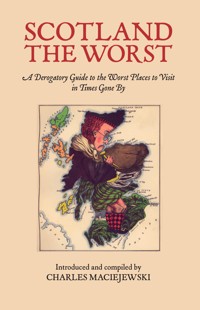
Scotland the Worst E-Book
Erhalten Sie Zugang zu diesem und mehr als 300000 Büchern ab EUR 5,99 monatlich.
- Herausgeber: Luath Press
- Kategorie: Lebensstil
- Sprache: Englisch
An alternative guide to our bonnie wee country and its inhabitants, this book is a compendium of the less generous comments made by 17th, 18th and 19th century visitors. Hopefully much has changed – and mostly for the better!
Sie lesen das E-Book in den Legimi-Apps auf:
Seitenzahl: 197
Veröffentlichungsjahr: 2019
Das E-Book (TTS) können Sie hören im Abo „Legimi Premium” in Legimi-Apps auf:
Ähnliche




















CHARLES MACIEJEWSKI was born in East Lothian 65 years ago and has spent most of his life in Scotland on both the east and west coasts. He currently lives on the outskirts of Inverness. He served in the British Army and the Scottish Police Service prior to working in the Middle East for a number of years. He enjoys spending his retirement touring Scotland with his wife and researching the places he visits through old books and journals, an activity which provided the inspiration for this book.
First published 2019
ISBN: 978-1-912387-63-2
The author’s right to be identified as author of this book under the Copyright, Designs and Patents Act 1988 has been asserted.
The paper used in this book is recyclable. It is made from low chlorine pulps produced in a low energy, low emission manner from renewable forests.
Typeset in 12 point P22MayflowerSmooth by Lapiz
Printed and bound by Martins the Printers Ltd., Berwick-upon-Tweed
Introduction and compilation © Charles Maciejewski 2019
CONTENTS
Introduction
Notes on language
Gazetteer
INTRODUCTION
Tour guides to Scotland usually start with a summary of the many delights that our country has to offer and there are many, not least the wonderful scenery and occasional periods of fine weather that allow one to actually see it. Here’s what an early writer had to say about our bonnie wee country and her inhabitants:
If the air was not pure and well refined by its agitation, it would be so infected with the stinks of their towns, and the steams of the nasty inhabitants, that it would be pestilent and destructive… The thistle was wisely placed there, partly to show the fertility of the country, nature alone producing plenty of these gay flowers, and partly as an emblem of the people, the top thereof having some colour of a flower, but the bulk and substance of it, is only sharp, and poisonous pricks.
KIRKE, T, A modern account of Scotland being an exact description of the country, and a true character of the people and their manners, 1679.
The works of Robert Burns and Sir Walter Scott did much to romanticise Scotland. Roads improved, the railways arrived and the visits by Queen Victoria and Prince Albert (and their purchase of Balmoral Castle in 1852) confirmed Scotland as a worthwhile tourist destination. There are now numerous guides available and, as a holiday destination, it rivals anywhere in the world – so much so that it often features in ‘best places to visit’ guides and articles.
Whilst it is always nice to read complimentary things about our country and ourselves, this, being an alternative guide, will concentrate on the less generous comments and views, scurrilous though they may seem.
The best known and oft-quoted travellers were Johnson and Boswell, who toured our fair land in 1773, but there were others before and since. This guide is a compendium of critical comments made by visitors to Caledonia from the 17th to the 19th centuries. Tourists during this period were generally wealthy and well-educated and some wrote books about their tours which often reflected their social, political and religious views, as well as their opinions about what they observed during their travels. Some were most likely deliberately insulting or satirical and reflective of the political tensions that existed between Scotland and England at the time. The authors quoted hailed not just from England and Scotland but also from Wales, Northern Ireland, America, Switzerland and Germany.
Scotland is renowned for whisky, golf and fine food – not forgetting its two most enduring symbols, kilts and bagpipes. Our travellers expressed opinions about all these things, as well as the people and the quality of the accommodation. Whilst today we are spoiled for choice in respect of the information available to budding visitors, the paucity of guide books then meant that great reliance was placed on those few that were available, which created a vision of Scotland and the Scots that, rightly or wrongly, determined the manner in which the country and people were viewed. I have selected what I consider to be the best of the worst.
It is hoped that modern-day visitors will find the places depicted much changed – and mostly for the better! Those of Scottish descent may feel inclined to arm themselves with a claymore and dirk but, instead, let us join together and have a smile, a chuckle and an outright laugh as to the manner in which Scotland and its people were once viewed. After all, as Scotland’s national bard, Robert Burns, once observed:
O wad some Power the giftie gie us
To see oursels as ithers see us!
NOTES ON LANGUAGE
The quotes are all replicated as they were written, except that current spellings of words and places have been updated to their current form.
The Gazetteer entries are listed under the old counties of Scotland, as opposed to the current council areas, the former being the means by which the quoted correspondents identified their locations.
The reader will see references to ‘Sawney’, which, in a Scottish etymological dictionary of 1825, stated that ‘Sandie’ was an abbreviation of Alexander – ‘Hence the English seemed to have formed their ludicrous national designation of Sawney for a Scotsman.’ An English etymological dictionary of 1846 defines Sawney as ‘a silly, stupid fellow – a sarcastic designation for a native of Scotland.’ The description is no longer in use.
GAZETTEER
Aberarder, Loch Laggan, Inverness-shire
The inn itself bore a close resemblance to a post house… It had originally been intended for a hunting box; but no care having been taken to keep it in repair, it was now fast hastening to decay. The walls of the rooms were dripping with damp and mildew; the flooring of the best room was broken up; and the night wind sighed mournfully through the innumerable fractures in the roof. It was, on the whole, in point of accommodation, a very miserable place.
SUTHERLAND, A, A Summer Ramble in the North Highlands, Edinburgh, 1825.
Aberdeen City, Aberdeenshire
Their manufacture is chiefly in stockings… and every morning the poor bring in loads to sell about the town… They are generally all white, when they bring them in, and exceedingly cheap; and the maid servants scour them by treading them in lye, in a large tub, which gives the strangers great diversion, for by so doing they are obliged to expose their legs and thighs, by holding up their coats sometimes rather too high.
VOLUNTEER, A Journey through part of England and Scotland… in the year 1746, London, 1747.
I went out after breakfast very willing to admire said Union Street, but could not get my admiration up to the required mark. True, the houses form two very long lines, but the buildings are low, and the dull grey granite is by no means pleasant to look upon.
WELD, C, Two months in the Highlands, Orcadia, and Skye, London, 1860.
Note book further makes particular attention of the fish-wives, a race of mighty ruddy-cheeked women, any one of whom would be a match in tongue, probably as well as muscle, for three ordinary city bred men.
WELD, C, Two months in the Highlands, Orcadia, and Skye, London, 1860.
A statue has also been erected in Castle Street… in honour of the late Duke of Gordon; a base and despicable, but, from manner, rather a popular fellow. A bad statue, but still very ornamental of a street… We had a beastly Circuit dinner, on a sanded floor, and came eagerly away this morning from the stinking Royal Hotel.
COCKBURN, H, Circuit Journeys by the late Lord Cockburn, Edinburgh, 1889.
Aberdeenshire
Before leaving Banffshire, however, we cannot refrain from paying a tribute to the prosperous appearance and civil deportment of its peasantry. In apparel, in cleanliness, and even in expression of countenance, they are infinitely superior to the boors of Aberdeenshire.
SUTHERLAND, A, A Summer Ramble in the North Highlands, Edinburgh, 1825.
Aberfeldy, Perthshire
Aberfeldy is a place that might properly be called Aberfilthy, for marvellously foul it is. You enter through a beggarly street and arrive at a dirty inn.
SOUTHEY, R, Journal of a tour in Scotland in 1819, London, 1929.
Aberfoyle, Perthshire
The Clachan itself is but a miserable fifth rate inn… the very look of which made us abandon our first intention of passing the night there… At length, the not very gracious landlady condescended to bring us some cold lamb, which tasted almost as musty as the room smelt, and some vinegar not quite as sour as her own looks.
TOWNSHEND, C, A Descriptive Tour of Scotland, London, 1840.
Aboyne, Aberdeenshire
Still exhibits all the signs of dilapidation and insolvency. But while his woods are failing, and railways are waiting to sleep upon them, the contemptible old monkey faced wretch of a beau, who danced at Versailles with Marie Antoinette about sixty years ago, is still grinning and dancing somewhere abroad, at the expense of creditors who can’t afford to let him die.
COCKBURN, H, Circuit Journeys by the late Lord Cockburn, Edinburgh, 1889.
Achanalt, by Garve, Ross and Cromarty
We went into the inn at Achanalt, a miserable place, bad as a Gallician posada, or an estallagem in Algarve… The house, wretched as it was, was not without some symptoms of improvement; there was the crank of a bell in the dirty, smoked, un-plastered wall, showing that it was intended to fit up the room.
SOUTHEY, R, Journal of a tour in Scotland in 1819, London, 1929.
Achnasheen, Ross and Cromarty
The inn, moreover, as it is called, is the most deplorable I have ever been within, worse by far than either Letterfinlay or Shiel House. No party of ladies could put up here… While our hideous dinner was preparing, I walked to the top of a hill.
COCKBURN, H, Circuit Journeys by the late Lord Cockburn, Edinburgh, 1889.
Altnaharra, Sutherland
Inn
This inn is miserable in the extreme.
ANDERSON, G & ANDERSON, P, Guide to the Highlands and Islands of Scotland, London, 1834.
Angus
We did not find so kind a reception among the common people of Angus, and the other shires on this side the country, as the Scots usually give to strangers: but we found it was because we were Englishmen.
DEFOE, D, A tour thro’ the whole Island of Great Britain, London, 1727.
Annan, Dumfriesshire
The face of trade is altered since that time, and by the ruins of the place the merchants, and men of substance, removed to Dumfries, the town continues, to all appearance, in a state of irrevocable decay.
DEFOE, D, A tour thro’ the whole Island of Great Britain, London, 1727.
Appin, Argyllshire
Appin is a miserable looking place.
CARR, J, Caledonian Sketches or A Tour through Scotland in 1807, London, 1809.
Arbroath, Angus
Arbroath, as a town, is entirely destitute of attraction. It is huddled together without plan, and built of a dull reddish sandstone, extremely irritating to the eye. A fetid rivulet, fringed with spinning mills, flows through it.
SUTHERLAND, A, A Summer Ramble in the North Highlands, Edinburgh, 1825.
Is not good.
COCKBURN, H, Circuit Journeys by the late Lord Cockburn, Edinburgh, 1889.
And here at Arbroath I saw more prostitutes walking the streets than would I think have been seen in any English town of no greater extent or population.
SOUTHEY, R, Journal of a tour in Scotland in 1819, London, 1929.
Ardersier, Inverness-shire
A place consists of numbers of very mean houses, owing its life and support to the neighbouring fort.
PENNANT, T, A Tour in Scotland 1769, London, 1771.
A paltry village.
BOTFIELD, B, Journal of a Tour Through the Highlands of Scotland during the Summer of 1829, Edinburgh, 1830.
Ardgour, Argyllshire
The present writer has seen a stout old fellow, of the very lowest class, in Ardgour, take his wife and daughter, with wicker baskets on their backs, to a dunghill, fill their baskets with manure, and send them to spread it with their hands on the croft; then, with his great coat on, lay himself down on the lee side of the heap, to bask and chew tobacco till they returned for another load.
BURT, E & JAMIESON, R, Letters from a Gentleman in the North of Scotland to his friend in London, London, 1818.
Arisaig, Inverness-shire
I was soon surrounded by the various naval characters, who expected to extract as many guineas out of the Sassenach as he should prove silly enough to give. One of these Vikings, half drunk, his mouth streaming tobacco from each angle, desired to know if I was the gentleman who wished to carry a horse to Skye.
MacCULLOCH, J The Highlands and Western Isles of Scotland, London, 1824.
A poor looking village, scattered along the shores of a bay.
TOWNSHEND, C, A Descriptive Tour of Scotland, London, 1840.
Arisaig Inn
Being conducted to an apartment upstairs, we found there a blackguard looking fellow eating herring and drinking whisky, the mingled fumes whereof were so intolerable that we made a rush into the open air, and, on finding that we could have no other sitting room, our disposition to remain was considerably abated.
TOWNSHEND, C, A Descriptive Tour of Scotland, London, 1840.
We arrived at Arisaig, which is so unusual a route anywhere, that the inn keeper seemed in as much consternation at the arrival of travellers, as if we had been comets, or had rode upon broomsticks… Here being allowed by special licence to partake of some refreshment, we ‘tea’d,’ though certainly the tea was not from Assam or from the Emperor of China’s own tea chest, but came, more probably, off the neighbouring hedges or hay-fields.
SINCLAIR, C, Scotland and the Scotch, New York, 1840.
Aros, Isle of Mull, Argyllshire
After ringing and ordering supper at least twenty times, we gave up the matter in pure despair, and at last actually went supperless to bed. The next morning, the girl apologised for our having been so badly waited on, and accounted for it by telling us that all the time we had been ringing and scolding, her mistress was bringing forth a man child into the world.
TOWNSHEND, C, A Descriptive Tour of Scotland, London, 1840.
Arrochar, Dunbartonshire
On our arrival at the front door, a servant came out and without saying with ‘your leave sir,’ directed the driver to go round to the other side of the house, where we were shown into a smoky, dirty room… we turned short upon our heels and directed the baggage to be again put into the cart, leaving the servant to stammer out an apology… I hope that none of my countrymen at least, will ever pay a sous to the landlord at Arrochar.
CARTER, N, Letters from Europe comprising The Journal of a Tour through… Scotland… in 1825, New York, 1827.
Auchterarder, Perthshire
We breakfasted at an incommodious and dirty inn.
HERON, R, Observations made in a journey through the Western Counties of Scotland in the autumn of 1792, Perth, 1793.
Aviemore, Inverness-shire
You must pass your night at the single house of Aviemore; sleep you cannot expect, it being the worst inn (except King’s House) that I met with in Scotland… I chose to breakfast in any manner, rather than at the dirty inn of Aviemore… No sooner had I put my foot within the walls of that horrible house, than my heart sunk; and I was glad to escape from its stink and smoke very early the next morning.
MURRAY, S, A Companion and Useful Guide to the Beauties of Scotland, London, 1799.
Came to Aviemore, but, it hurts me to say, I found the inn I now put up at differing from those I had passed, it being but very indifferently kept: the rooms were dirty.
THORNTON, T, A Sporting Tour through the Northern parts of England and great part of the Highlands of Scotland. London, 1804.
Ayr, Ayrshire
At present like an old beauty, it shows the ruins of a good face; but is also apparently not only decayed and declined, but decaying and declining every day.
DEFOE, D, A tour thro’ the whole Island of Great Britain, London, 1727.
The great deduction from the comfort and respectability of Ayr proper is this horrid Newton[a neighbourhood in Ayr], and the squalid lines of wretched overcrowded hovels, stared out of by unfed and half naked swarms of coal black and seemingly defying inhabitants, that form its eastern approaches.
COCKBURN, H, Circuit Journeys by the late Lord Cockburn, Edinburgh, 1889.
Badenoch, Inverness-shire
And so indecent are they at funerals, that lately, on the borders of Badenoch, when crossing a bridge, having placed the coffin on the parapet of the bridge to rest themselves, though there were near two hundred of them, it fell over into the water, and was carried down a considerable way, while the friends, relations, and mourners… went along with it, admiring how prettily it sailed… Indeed, as disputes sometimes arise at funerals, it is no uncommon thing to see twenty or thirty men fighting, some on horseback and some on foot, and the corpse laid down on the road, till they see how the fray will end.
HALL, J, Travels in Scotland by an unusual route, London, 1807.
Ballachulish, Argyllshire
Here too I saw, what is not often to be seen now, the waulking of a cloth [waulking is the softening of tweed cloth by soaking it in stale urine and working it with hands or feet]: coming suddenly on the bare legged nymphs in the very orgasm and fury of inspiration, kicking and singing and hallooing as if they had been possessed by twelve devils.
MacCULLOCH, J The Highlands and Western Isles of Scotland, London, 1824.
On Loch Leven the take off or toll one has to pay for the permission to enjoy, is – I despair of stating the matter poetically – a downright stench. The nose is mulcted for the pleasures of the eye. If the objects of sight appear to be a heaven, the smells certainly seem to proceed from the other place. This is occasioned by the dirtiness of the fishing villages along the banks of the loch which… have such an ancient and fish like odour, that they actually poison the air half way to Glencoe.
TOWNSHEND, C, A Descriptive Tour of Scotland, London, 1840.
We came from Ballachulish, along the shore of Loch Linnhe, this morning, but not so early as we wished… for the people hereabout are intolerably slow both in preparation and in action, and our vehicle (a cart) was long in getting under way, and was long very slowly driven; at one time the driver was actually asleep, and we had to shake him out of his trance.
TOWNSHEND, C, A Descriptive Tour of Scotland, London, 1840.
The faces of the people, and particularly of the women and children, would certainly bear a little more water… So long, however, as they are worse housed than their swine, nothing above the habits of swine can be expected.
COCKBURN, H, Circuit Journeys by the late Lord Cockburn, Edinburgh, 1889.
Ballantrae, Ayrshire
The dwelling houses in the village, are, most of them paltry huts. It has been long notable as a nest of smugglers.
HERON, R, Observations made in a journey through the Western Counties of Scotland in the autumn of 1792, Perth, 1793.
Ballindalloch, Banffshire
But for an inn, though I am not very easily distressed with bad accommodations… I never in my life saw a one as this; it is really a perfect burlesque on the name: – a house with rooms, indeed, but no windows. I fancy the people, from their extreme poverty, had taken them out… to save Mr Pitt’s additional duty [window tax]… I did not expect a sumptuous bill of fare… but I hoped to find eggs: however, they had none. I was thirsty; I asked for porter – they had none; for brandy – they had none; for rum – they had none… However, I expected that my horses would fare pretty well… but hay – they had none: that, I thought, might be obviated, by a double portion of corn; but alas!- they had none.
THORNTON, T, A Sporting Tour through the Northern parts of England and great part of the Highlands of Scotland. London, 1804.
Banavie, Fort William, Inverness-shire
As the steam boat for Inverness set out from Banavie… we were obliged to sleep at the inn there… beds were at a premium. We were obliged to be content with what the landlord facetiously called ‘the barracks,’ an out building of small rooms, in each of which four beds were boxed off against the wall. A more uncomfortable night I think I never passed.
PEDESTRIAN, A six weeks’ tour in the Highlands of Scotland, London, 1851.
Banff, Banffshire
The poor people in all the western part of it, are still living in miserable huts.
PENNANT, T, A Tour in Scotland 1769, London, 1771.
And here I cannot help mention the sagacity of some species of rats, to be found in the Highlands, and which there, as in other parts of Scotland, proceed from one district to another, not by the exercise of their feet, but by adhering to the tails of the horses.
HALL, J, Travels in Scotland by an unusual route, London, 1807.
Banff looks inviting at a distance; but, on entering it, the stranger wonders what has become of the smiling city that captivated him from the other side of the river.
SUTHERLAND, A, A Summer Ramble in the North Highlands, Edinburgh, 1825.
Bankfoot, Perthshire
We… stopped at the New Inn, about seven miles from Dunkeld, in hopes of getting some refreshment; and the hostess, a dirty, disagreeable young woman, pitted with the small pox, brought us some wash, she called it broth, which Cowan himself allowed that a pig would not have drunken.
BRISTED, J, A Pedestrian Tour through part of the Highlands of Scotland in 1801, London, 1803.
Beattock, Moffat, Dumfriesshire
This inn was built on a public view by a tax… But Sawney is not an inn-keeping animal. Civility, tidiness, and activity without bustle, are no parts of his nature. The landlord here is a living dunghill.
COCKBURN, H, Circuit Journeys by the late Lord Cockburn, Edinburgh, 1889.
Beauly, Inverness-shire
We had very good wine, but did not drink much of it; but one thing I should have told you was intolerable, viz. the number of Highlanders that attended at table, whose feet and foul linen, or woollen, I don’t know which, were more than a match for the odour of the dishes.
BURT, E & JAMIESON, R, Letters from a Gentleman in the North of Scotland to his friend in London, London, 1818.
A handsome new bridge renders easy the access to the miserable town of Beauly.
MacCULLOCH, J The Highlands and Western Isles of Scotland, London, 1824.
Nothing proves how little the beauties of Scotland are explored more obviously than the entire want of horses, accommodation, or comfort of any kind in a village like Beauly. The inn is little better than an ale house, with no ‘entertainment’ that we could see, fit for either man or horse.
SINCLAIR, C, Scotland and the Scotch, New York, 1840.
Benbecula, Outer Hebrides
A dreary level of dark peat moss and sodden morass… There is small temptation to linger here, so you hurry on to try and save the next ford, and so reach South Uist.
GORDON-CUMMING, C, From the Hebrides to the Himalayas, London, 1876.
Ben Nevis, Fort William, Inverness-shire
Ben Nevis is redolent of tourists. The path up it is a perfect turnpike road, where Mrs Dip, the chandler’s wife from Glasgow, parasol in hand, overwhelms with her bulk, some poor little sheltie (mountain pony), of which you can only see the head and tail; and greasy citizens lard the lean earth as they puff along after their guides, and cast impatient glances at the provision baskets they carry, prescient of ham, chicken, sausages and ginger-pop.
TOWNSHEND, C, A Descriptive Tour of Scotland, London, 1840.
Bettyhill, Sutherland
The hovels of the peasants near Bettyhill are extremely rude, and their occupants appeared to be far from prosperous.
WELD, C, Two months in the Highlands, Orcadia, and Skye, London, 1860.
Black Isle, Ross and Cromarty
The yeast in Inverness is obtained from the smugglers who make whisky in the Black Isle; that yeast is thought better than any other.
SOUTHEY, R,




