


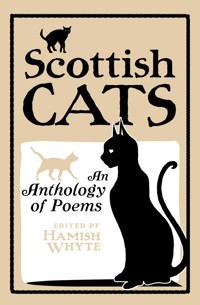
Scottish Cats E-Book
Erhalten Sie Zugang zu diesem und mehr als 300000 Büchern ab EUR 5,99 monatlich.
- Herausgeber: Birlinn
- Kategorie: Poesie und Drama
- Sprache: Englisch
Cats have always had a special appeal to poets - they exhibit so many human attributes, not least that characteristic Scottish trait, thrawnness. According to legend, the Scots were the first northern people to keep cats (Fergus I of Scotland is said to have brought one from Portugal in the fourth century BC), and Scots have taken cats to their hearts ever since. This anthology of over 60 poems explores the relationship between people and felines from Henryson's 15th-century account of 'Gib Hunter, our Jolie Cat' , through 18th century Aesopian tales, 19th-century cat-and-mouse tussles to more modern depictions of this domestic yet mysterious animal by poets such as Alastair Reid, who explore the ambivalent side of 'the tiger who eats from the hand'. Featuring the work of J.K. Annand, George Bruce, Valerie Gillies, Kathleen Jamie, Maurice Lindsay, George Macbeth, Brian McCabe, Norman MacCaig, Edwin Morgan, Tom Pow, Iain Crichton Smith, Allan Ramsay. There are also a number of traditional poems and nursery rhymes and charming line illustrations by James Hutcheson.
Sie lesen das E-Book in den Legimi-Apps auf:
Seitenzahl: 87
Veröffentlichungsjahr: 2013
Das E-Book (TTS) können Sie hören im Abo „Legimi Premium” in Legimi-Apps auf:
Ähnliche




















SCOTTISH CATS
Hamish Whyte, poet, editor and publisher, was born in Renfrewshire and educated in Glasgow, where he lived and worked as a librarian for many years. He moved to Edinburgh in 2004. He has published several collections of poetry, edited many anthologies of Scottish literature and runs Mariscat Press, which has published collections by poets such as Edwin Morgan and Douglas Dunn. He is an Honorary Research Fellow in the Department of Scottish Literature, Glasgow University. In his spare time he plays percussion with Edinburgh band The Whole Shebang.
This eBook edition published in 2013 by Birlinn Limited West Newington House Newington Road Edinburgh EH9 1QSwww.birlinn.co.uk
Text copyright © Hamish Whyte and the contributors, 2013 Illustrations copyright © James Hutcheson, 2013
The moral right of Hamish Whyte to be identified as the author of this work has been asserted by him in accordance with the Copyright, Designs and Patents Act 1988
All rights reserved. No part of this publication may be reproduced, stored or transmitted in any form without the express written permission of the publisher.
ISBN: 978-1-78027-139-2 eBook ISBN: 978-0-85790-658-8
British Library Cataloguing-in-Publication Data
CONTENTS
Introduction
J.K. Annand, ‘Cat and Mous’
Joanna Baillie, ‘The Kitten’
Robert Bain, ‘The Cat and the Man’
‘Baudron’s Sang’ (anon.)
George Bruce, ‘Poetry Circle in a Square Room’
Gerry Cambridge, ‘Tale of a Cat’
‘Little Drama’
‘The Cameronian Cat’ (ed. James Hogg)
Kate Clanchy, ‘Towards the End’
Stewart Conn, ‘Visitation’
Anna Crowe, ‘Cat and Water’
John Cunningham, ‘The Fox and the Cat: A Fable’
Catherine Czerkawska, ‘Apart’
M.L. Dalgleish, ‘An Edinburgh Cat’
Graham Fulton, ‘Wee Plebs’
‘Remainders’
Valerie Gillies, ‘Black Cat Boy’
Isobel Gowdie, ‘Spell to Change Into a Cat and Back’
W.S. Graham, ‘Master Cat and Master Me’
Alexander Gray, ‘On a Cat, Ageing’
Jen Hadfield, ‘In the same way’
Diana Hendry, ‘Cat in the Apple Tree’
Kate Hendry, ‘Taking Care of Fear’
Robert Henryson, ‘Gib Hunter, Our Jolie Cat’
Ellen Johnston, ‘Nellie’s Lament for the Pirnhouse Cat’
Jackie Kay, ‘The Nine Lives of the Cat Mandu’
Archie Lamont, ‘Sam and Jock the Lallans Cats’
Maurice Lindsay, ‘Between Two Worlds’
George MacBeth, ‘Fourteen Ways of Touching the Peter’
‘To the Flea, Combed from my Cat’s Back’
Brian McCabe, ‘The Cat’
Norman MacCaig, ‘Black Cat in a Morning’
Dugald S. McColl, ‘Connoisseurs’
James McGonigal, ‘Claire with the hindlegs’
Paddy McGown, ‘The Old Tom Cat’
Alasdair Maclean, ‘My Cat Asleep’
Joseph Gordon Macleod, ‘A Strange Cat Got In’
Gordon Meade, ‘Catfish’
Richard Medrington, ‘Bully Cat’
Edwin Morgan, ‘The Cat’
‘Like, Little Russian Cat’
‘Scotch Cat’
‘Three Cats’
James Munce, ‘Lines on a Bird and Cat Show in Glasgow’
John Murray, ‘The Meenister’s Cat’
William Neill, ‘Cat Accident’
Nursery Rhymes
Tom Pow, ‘A Cat Suite’
Alison Prince, ‘The Wildcat’
Allan Ramsay, ‘The Twa Cats and the Cheese’
Alastair Reid, ‘Propinquity’
‘Cat-Faith’
‘Curiosity’
Dilys Rose, ‘Nightlife’
Iain Crichton Smith, ‘The Cat’
‘The Cat’
‘The Wildcat’
Sydney Goodsir Smith, ‘Stormy Day and a Cat, November’
James Thomson, ‘Lisy’s Parting with her Cat’
Valerie Thornton, ‘Familiar’
‘The Cat’s Tale’
Gael Turnbull, ‘A Cat’
Hamish Whyte, ‘Otis’
Glossary
Notes on Sources, etc
Bibliography
Acknowledgements
To Anne Harrison, who loves cats and
Lizzie MacGregor, who loves anthologies.
INTRODUCTION
‘An excellent companion for
A literary gentleman, a cat’,
Said fat auld Gautier,
And, Dod, he was richt, at that.
SYDNEY GOODSIR SMITH
CATS HAVE ALWAYS HAD A SPECIAL APPEAL TO POETS, perhaps because they seem to exhibit so many human traits, not least that characteristic Scottish attribute, thrawnness. And Britain’s only indigenous cat, the Scottish wildcat, is held up to Scots as an example of fierce independence. (It has also by its agility added to the language in the phrase tummle one’s wilkies – tumble head over heels – from tummel the wulcat.)
According to legend the Scots were the first northern people to keep cats – Fergus I of Scotland (fl.330 BC) is said to have brought them from Portugal, his ancestors having taken cats there from Egypt – but judging by the many stories of cruelty towards cats, Scots have not been especially kind to them. Witness the charming pastime of ‘cat in the barrel’, in which a cat was hung up in a small barrel half-filled with soot and, in Bishop Percy’s words, ‘a parcel of clowns on horseback tried to beat out the ends of it, in order to show their dexterity in escaping before the contents fell upon them.’ Worse, if it can be believed, was the ceremony of the Taighheirm, which supposedly took place in the Western Isles until the seventeenth century. In this ghastly rite black cats were roasted alive to summon spirits from Hell and reward the sacrificer with riches and second sight. From the evidence of the Scottish witch trials the cat would appear to have been a common sacrificial animal, often baptized before being killed. Two hundred years later Neil Munro as a boy received a present of a catapult with a note attached: ‘From an uncle who does not like cats.’
The record is not all bad. Cats which have always been tolerated, if not loved, are those valued for their usefulness, like Towser the famous mouser of Glenturret Distillery (who in his 23-year-old life accounted for 27,000 mice) and the Glasgow People’s Palace cat Smudge who was a paid-up member of the GMBATU. The list of Scottish literary ailurophiles is long enough: Walter Scott, Byron, Thomas Carlyle, Joanna Baillie, Andrew Lang, Willa Muir, Compton Mackenzie, Sydney Goodsir Smith, George MacBeth et al. And a goodly number of Scottish poets particularly seem to have taken cats to their hearts.
The poems in Scottish Cats explore the poets’ feline relationships, from Henryson’s fifteenth-century account of ‘Gib Hunter, Our Jolie Cat’, through eighteenth-century Aesopian fables, nineteenth-century cat and mouse tussles, to contemporary musings on this domestic but mysterious animal – ‘tame but not tamed’, ‘the tiger who eats from the hand’, as the Japanese saying is: many of the poets exploit this ambivalence (see especially Alastair Reid’s ‘Propinquity’). And there is a preoccupation with a perceived correlation between cats and poems. There is also, as Gautier wrote in his introduction to Baudelaire’s Fleurs du Mal, a nocturnal side to cats, strange and cabalistic, which is very seductive to the poet. This aspect is perhaps hinted at in Joseph Macleod’s strange ‘A Strange Cat Got In’ or ‘Cat-Faith’ by Alastair Reid. The poems are certainly not all serious: there are Edwin Morgan’s verbally playful cats, for example, and Jackie Kay’s ‘The Nine Lives of the Cat Mandu’, into which she tries to cram as many cat puns and proverbs as she can – cats have always been a good source of wise saws (‘Well kens the Mouse that the Cat’s out of the House’).
I have also included a clutch of nursery rhymes. Compton Mackenzie in his Cats’ Company wrote ‘In the Nursery Rhymes, the cat always has precedence’ and there are at least a dozen traditional Scottish cat rhymes and several more literary ones. ‘Pussy-cat, Pussy-cat’ is probably one of the best known of all nursery rhymes; the Scottish version (‘Poussie, poussie baudrons’) first appeared in print in Robert Chambers’s The Popular Rhymes of Scotland, 1842. The version included here is from the 1870 edition. Baudrons, by the way, is the familiar Scots name for cat. I should confess also that I have shamelessly raided my earlier anthology, The Scottish Cat.
The poems of course do not aim to discover any elemental Scottishness in our cats – as noted, the only truly Scottish cat is the wildcat – but it is a truism that when we write about animals we are writing about ourselves. Scottish poets evidently subscribe to Christopher Smart’s opinion of his cat: ‘he is good to think on, if a man would express himself neatly.’
HAMISH WHYTE
Cat and Mous
Said the poussie
Til the mousie,
‘Let me intil
Your wee housie.
We will play
And we will sing
And we will dance
A jingo-ring.’
Said the mousie
Til the poussie,
‘Ye’ll no get
In my wee housie.
Ye are big
And I am wee
And ye wad eat me
For your tea.’
J.K. Annand (1908-1993)
The Kitten
Wanton droll, whose harmless play
Beguiles the rustic’s closing day,
When, drawn the evening fire about,
Sit aged crone and thoughtless lout,
And child upon his three-foot stool,
Waiting until his supper cool,
And maid, whose cheek outblooms the rose,
As bright the blazing fagot glows,
Who, bending to the friendly light,
Plies her task with busy sleight;
Come, show thy tricks and sportive graces,
Thus circled round with merry faces!
Backward coil’d and crouching low,
With glaring eyeballs watch thy foe,
The housewife’s spindle whirling round,
Or thread, or straw that on the ground
Its shadow throws, by urchin sly
Held out to lure thy roving eye;
The stealing onward, fiercely spring
Upon the tempting faithless thing.
Now, wheeling round with bootless skill,
Thy bo-peep tail provokes thee still,
As still beyond thy curving side
Its jetty tip is seen to glide;
Till from thy centre starting far,
Thou sidelong veerst with rump in air
Erected stiff, and gait awry,
Like madam in her tantrums high;
Though ne’er a madam of them all,
Whose silken kirtle sweeps the hall,
More varied trick and whim displays
To catch the admiring stranger’s gaze.
Doth power in measured verses dwell,
All thy vagaries wild to tell
Ah no! the start, the jet, the bound,
The giddy scamper round and round,
With leap and toss and high curvet,
And many a whirling somerset,
(Permitted by the modern muse
Expression technical to use)
These mock the deftest rhymester’s skill,
But poor in art, though rich in will.
The featest tumbler, stage bedight,
To thee is but a clumsy wight,
Who every limb and sinew strains
To do what costs thee little pains;
For which, I trow, the gaping crowd
Requite him oft with plaudits loud.
But, stopp’d the while thy wanton play,
Applauses too thy pains repay;
For then, beneath some urchin’s hand
With modest pride thou tak’st thy stand,
While many a stroke of kindness glides
Along thy back and tabby sides.
Dilated swells thy glossy fur,
And loudly croons thy busy purr,
As, timing well the equal sound,




