


5,95 €
Mehr erfahren.
- Herausgeber: Zombies Need Brains, LLC
- Kategorie: Fantasy und Science-Fiction
- Sprache: Englisch
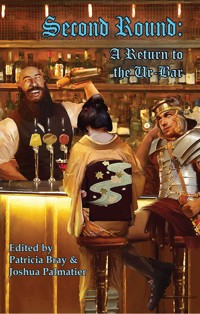
For thousands of years the immortal Gilgamesh has presided over the legendary Ur-Bar, witnessing history unfold from within its walls. Some days it is a rural tavern, others a fashionable wine shop. It may appear as a hidden speakeasy or take on the form of your neighborhood local. For most patrons it is simply a place to quench their thirst, but for a rare few the Ur-Bar is where they will meet their destiny. Join R.K. Nickel, Rachel Atwood, Kari Sperring, Jean Marie Ward, Gini Koch, Jacey Bedford, William Leisner, Garth Nix, Diana Pharaoh Francis, David Keener, Mike Marcus, Kristine Smith, Aaron M. Roth, and Juliet E. McKenna as they recount all new tales from the Ur-Bar. From humor to horror, from the Roman Empire to Martian Colonies, there's something to please everyone. Just remember to beware when the mysterious bartender offers you the house special …
Sie lesen das E-Book in den Legimi-Apps auf:
Seitenzahl: 432
Veröffentlichungsjahr: 2018
Ähnliche


















Second Round
A Return to the Ur-Bar
Other Anthologies Edited by:
Patricia Bray & Joshua Palmatier
After Hours: Tales from the Ur-Bar
The Modern Fae’s Guide to Surviving Humanity
Clockwork Universe: Steampunk vs Aliens
Temporally Out of Order
Alien Artifacts
Were-
All Hail Our Robot Conquerors!
Second Round: A Return to the Ur-Bar
S.C. Butler & Joshua Palmatier
Submerged
Guilds & Glaives
Laura Anne Gilman & Kat Richardson
The Death of All Things
Troy Carrol Bucher & Joshua Palmatier
The Razor’s Edge
Second Round
A Return to the Ur-Bar
Edited by
Patricia Bray
&
Joshua Palmatier
Zombies Need Brains LLC
www.zombiesneedbrains.com
Copyright © 2018 Patricia Bray, Joshua Palmatier, and
Zombies Need Brains LLC
All Rights Reserved
Interior Design (ebook): April Steenburgh
Interior Design (print): ZNB Design
Cover Design by ZNB Design
Cover Art “Second Round” by Justin Adams of Varia Studios
ZNB Book Collectors #11
All characters and events in this book are fictitious.
All resemblance to persons living or dead is coincidental.
The scanning, uploading, and distribution of this book via the Internet or any other means without the permission of the publisher is illegal and punishable by law. Please purchase only authorized electronic editions of this book, and do not participate or encourage electronic piracy of copyrighted material.
Kickstarter Edition Printing, August 2018
First Printing, September 2018
Print ISBN-10: 1940709180
Print ISBN-13: 978-1940709185
Ebook ISBN-10: 1940709199
Ebook ISBN-13: 978-1940709192
Printed in the U.S.A.
COPYRIGHTS
Introduction copyright © 2018 by Patricia Bray
“Honorbound” copyright © 2018 by Russ Nickel
“Forest Law, Wild and True” copyright © 2018 by Rachel Atwood
“The Wizard King” copyright © 2018 by K.L. Maund
“A Favor for Lord Bai” copyright © 2018 by Jean Marie Ward
“A Lawman, an Outlaw, and a Gambler Walk Into a Bar…” copyright © 2018 by Jeanne Cook
“Make Me Immortal With a Kiss” copyright © 2018 by Jacey Bedford
“Bound By Mortal Chains No More” copyright © 2018 by William Leisner
“Welcome to the Jungle Bar” copyright © 2018 by Garth Nix
“But If You Try Sometimes” copyright © 2018 by Diana Pharaoh Francis
“The Whispering Voice” copyright © 2018 by David Keener
“Ale for Humanity” copyright © 2018 by Mike Marcus
“West Side Ghost Story” copyright © 2018 by Kristine Smith
“Thievery Bar None” copyright © 2018 by Aaron Michael Roth
“Wanderlust” copyright © 2018 by Juliet E. McKenna
Table of Contents
Introduction by Patricia Bray
“Honorbound” by R.K. Nickel
“Forest Law, Wild and True”
by Rachel Atwood
“The Wizard King” by Kari Sperring
“A Favor for Lord Bai”
by Jean Marie Ward
“A Lawman, an Outlaw, and a Gambler Walk Into a Bar …” by Gini Koch (writing as A.E. Stanton)
“Make Me Immortal With a Kiss”
by Jacey Bedford
“Bound By Mortal Chains No More”
by William Leisner
“Welcome to the Jungle Bar”
by Garth Nix
“But If You Try Sometimes”
by Diana Pharaoh Francis
“The Whispering Voice”
by David Keener
“Ale for Humanity” by Mike Marcus
“West Side Ghost Story”
by Kristine Smith
“Thievery Bar None” by Aaron M. Roth
“Wanderlust” by Juliet E. McKenna
About the Authors
About the Editors
Acknowledgments
Introduction
Patricia Bray
They say you can’t go home again. But you can return to your favorite bar, the place where the bartender knows your favorite poison and the regulars know you by name. In that spirit we are pleased to present a brand-new collection of stories set in the Ur-Bar.
Back in 2010 a group of science fiction authors came up with the idea for an anthology of stories set in a bar. Not just any bar—the Ur-Bar, the ultimate watering hole. At any time throughout history, there is always one place that is closest to the ideal of what a bar should be. That place is the Ur-Bar, where you’ll find the immortal Gilgamesh pouring local beverages and the occasional mystic potion.
Unlike most ideas that authors have while drinking at science fiction conventions, this still seemed like a good idea in the light of day. Tekno Books and DAW agreed and AFTER HOURS: TALES FROM THE UR-BAR was released in 2011.
The first anthology set the tone for future projects, containing a variety of stories from humor to horror, and mixing bestselling authors with those seeing their print debut. Joshua Palmatier and I had so much fun with this project, in 2012 we followed it up with THE MODERN FAE’S GUIDE TO SURVIVING HUMANITY, also published with Tekno Books and DAW.
When Tekno Books scaled back their operations, Joshua Palmatier took the next leap forward, founding Zombies Need Brains, a small-press publishing original genre fiction anthologies. The first release from ZNB was CLOCKWORK UNIVERSE: STEAMPUNK VS ALIENS. This was quickly followed by a half-dozen other projects, with a wide variety of themes, from temporally malfunctioning objects to aliens, were-creatures to robot invaders, life under the sea and a collection of stories featuring Death as the central character.
Over the years, authors kept asking, “When are you going to do another Ur-Bar collection?” Seven years and eight projects later, we decided it was time to return to our favorite place. So pour a glass of your favorite beverage and get ready to enjoy fourteen new stories featuring the Ur-Bar in all new incarnations from the past to the near future.
Happy Reading!
Honorbound
R.K. Nickel
A wounded Gaul stepped up to the bar, then extended his mug with his good arm. The other, Gilgamesh noticed, ended in a stump that still oozed into a fresh bandage.
“Another,” said the Gaul, looking up to meet Gilgamesh’s gaze.
“You certain that’s wise?” asked Gilgamesh.
“If it’s all the same to you,” said the Gaul, “I’d rather die drunk.”
Gilgamesh shrugged and poured the Gaul a korma. The man lifted his mug in thanks and returned to his table. The entire bar was filled with the weary, the weak, the wounded. Missing limbs, bandages, scars—the true spoils of war.
Gilgamesh didn’t pity them. One of the greatest strengths of being human was the ability to grow accustomed to anything. Live a hundred lifetimes and there was little one wouldn’t see. Gilgamesh had already lived through dozens of sieges; this one was no different. He’d watched cities burn, seen children slaughtered. He’d held dying friends in his arms. He’d loved, and lost, and loved again. He’d pitied. Once. But no longer.
The true curse he’d accepted all those years ago was not immortality, but rather … apathy.
These men would live and die, and he would go on. After their children were born, and their children’s children beyond. On, and on, and on, always enduring the motions: sweep the floor, wipe the bar, pour the ale.
The door flew open, tearing Gilgamesh from his thoughts.
“Gilgameus!”
Vercingetorix strode through the doorway. The only man who could come close to matching Gilgamesh in strength and stature—in this time, at least—Vercingetorix’s lime-washed hair reached his shoulders and his thick mustache flowed past his chin. Longsword at his side and cloak over his shoulder, he played at general as well as any of the other fools Gilgamesh had seen slaughtered upon the battlefield.
“What is it?” asked Gilgamesh.
Vercingetorix looked behind him. “Exapia,” he called, and a woman followed him into the bar. “Gilgameus, this is my wife.”
She nodded her head slightly—acknowledgement, but not deference. Most people gaped when they first laid eyes on Gilgamesh; her façade of authority was nearly as good as her husband’s.
“Men,” said Vercingetorix, clearly attempting to sound commanding. “Return to your loved ones. The time for battle draws near.”
To his credit, the men obeyed, shuffling past Vercingetorix and saluting as they went.
“So kind of you to clear out my customers,” said Gilgamesh.
Vercingetorix stepped in close. Something about him forced Gilgamesh to stop his work and meet the man’s gaze—a frustrating quality.
“I have waited as long as I can for reinforcements,” he said. “Those who have come have come. Tomorrow, we lead our full force against a weak point in Caesar’s circumvallation. Our allies will strike from the surrounding countryside. If we can make it through their lines, we may yet win this war.”
“And how does this affect me?” Gilgamesh asked, turning back to the bar and cleaning a glass.
“I have faith in my men, but this is the greatest risk the Gauls have taken in generations. I would not see the Arverni people bent under Caesar’s will without a fight, but … there is a chance that we will fail.” Vercingetorix took a breath. “If we do, the city will fall.”
Gilgamesh didn’t reply. Why bother? If he were not in Alesia, he would be in some other city, with some other desperate leader. Humanity bled desperation, year after year.
Vercingetorix ground his teeth, displeased. “I know your secret,” he said
“Oh?” said Gilgamesh.
“I trade in myth and legend. Whatever may give me an edge over the Romans. And while I am willing to risk my life for my people, I will not risk my family.”
“Every choice brings risk,” said Gilgamesh.
“And I am doing my best to diminish it by asking of you a favor: protect them.”
“Why should I?”
“Because it is the right thing to do.”
“Ah, a moral argument,” Gilgamesh said. “It is right to kill Romans then? In trade for your wife’s life?”
“They are the aggressors.”
“Boys who grew to men in Roman cities, who knew no future other that that of legionnaire. Had they been born Arverni, they would fight beneath you instead. If you know my secret, then perhaps you’ll understand that morality grows subjective over time.”
Vercingetorix paused before speaking, a faraway look in his eye as he stroked his long mustache. Finally, his expression hardened. He locked eyes with Gilgamesh. Then uttered the most welcome words Gilgamesh had heard in ages: “I will take your place.”
Gilgamesh tried to suppress the surge of hope that beat suddenly in his heart. It pulsed so strongly he nearly had to steady himself with a hand. How long it had been since he’d felt an emotion break through the chitin that had grown inside him?
“You would bear my curse?”
“If the Romans break through the walls, and if you protect Exapia, then when I return, I will take your place.”
“Words,” said Gilgamesh, afraid to let himself trust this man.
“Please,” Vercingetorix implored. “Our child shelters not far from here, in Meclodunum. I will not allow him to grow up an orphan.”
“What if you fall in battle?”
“I may,” he said, “but I have lived thus far.”
The chance to leave this gods-forsaken bar. Gilgamesh could not pass that up.
“Give me your oath.”
“You have it. I swear by the thunder of Taranis and the serpent of Smetrios. If I return, you shall have your freedom.”
Gilgamesh extended his arm and Vercingetorix grasped it, grip strong. The pair stared into each other’s eyes, an understanding passing between them. He was a good man, this Vercingetorix, willing to sacrifice himself to save others.
Good men died much the same as bad.
Finally, they broke apart. “Here,” said Vercingetorix, unclasping his sword and handing it to Gilgamesh. “I’ll requisition another.”
Gilgamesh felt its weight in his hands. He’d conquered with a blade, killed so many with the biting embrace of bronze. But that had been a different time. A different man.
“Good luck,” he said.
“I welcome it,” said Vercingetorix. The Gaul crossed the room and spoke a few words to his wife. They embraced, then he left, the door slamming shut behind him with the dull thud of finality.
* * *
The sounds of battle carried through the air. Though distant, screams and whinnies rode the wind, conjuring images of blood and death. Exapia stood tall, facing away from Gilgamesh, muscles tense.
“Perhaps some korma would settle your nerves,” Gilgamesh finally said. She turned and looked up at him, bitter anger in her eyes.
“I think not.”
“Fine,” said Gilgamesh, then took a long drink of korma himself. Any joy the frothy ale might have brought had worn off a few thousand revelries ago, but still, if that woman was going to stand there like that the whole time, he might as well get drunk.
“I tried to counsel my husband not to bring me here,” she said. “I would rather stand and fight than play royal ward, hidden behind the arms of an ancient statue.”
“You pay me a compliment,” Gilgamesh replied. “Are statues not revered?”
“Perhaps, but the bright paints quickly wear off, leaving chalky, cold stone beneath.”
“I, for one,” said Gilgamesh, taking another swallow, “admire the passivity of stone. Stone, for instance, doesn’t seethe with hatred for the Romans.”
“I do not hate the Romans. I love the Arverni. I love riding wild with the boar, smoothing bark into homes, standing beside my husband on the war council. Each tribe has its own unique way of life. The Romans … the Romans consume everything they touch, creating a network of roads paved with blood, a spider’s web that connects all people and flattens them into a single entity. Caesar would make the whole world Roman.”
“Your husband would do the same.”
“My husband is more man than you and Caesar put together. Caesar does not risk himself for his people. He simply commands at a distance, letting his men take the risks, then returns home and brags of his valor to any who will listen. My husband fights not just for the Arverni, but the Carnutes, the Bituriges, the Lexovii, and all the rest who have banded together with us. And when this war is won, each tribe shall continue to be who they are, not who the Romans want them to be.”
Gilgamesh could not remember the last time he’d been so reprimanded. And the chastisement came from Exapia, small enough that the winds might pluck her into the sky.
In the silence that followed, the screams seemed louder, and was that the scent of death on the air, or was it merely a lingering memory? Flashes of times past tore through Gilgamesh’s mind: the feel of an axe in hand, the spatter of hot blood onto his face, Ekidu falling into the underworld, endless darkness.
Exapia drew in a sharp breath and Gilgamesh had the sudden, bizarre desire to reach out to her, but he extinguished the thought.
“It is unfortunate,” she said, “that someone stronger did not inherit your position. Think of the good that could be done with all your knowledge.”
Who was she to judge him so? She did not understand, could not possibly understand. Gilgamesh gritted his teeth and his earthen cup shattered in his massive grip, clay shards slicing into his hand.
Yes, let her see his strength. There was fear in her eyes now.
But how well she controlled it.
He would not let her stoke admiration in him. He had excised that feeling.
He forced a laugh. “I was a king, akin to a god. I built great walls, slew great beasts. I accomplished more in my first lifetime than any who have come since. I have glimpsed the underworld and denied it. You think you know death because you have seen battle? You think you know life because you have birthed it? I’ve witnessed a thousand thousand lives. I have borne the death of all who’ve known me. Life is the curse, death the blessing.”
“I am sorry you feel that way,” she said, unfazed by his outburst. “I can believe you were a good man once. For your sake, I hope you can be again.”
She turned her back then, once more facing the door.
Gilgamesh drowned himself in drink, letting it muddle his thoughts. At some point, he would blink and she would be gone, the bar in some new place. He would sigh, someone else would step through the doors, and he would sweep the floor, wipe the bar, pour the ale, and the entire cycle would begin anew. Exapia was no more than a fleeting dream, and soon enough he would wake.
Eventually, a Gallic soldier burst through the doors awash in sweat and blood, armor scored in a dozen places. With him, the sounds of battle poured in, far too near to be contained to the siege lines.
“Catacus!” cried Exapia. “What news?”
Why was this man here? Why some trusted aide rather than Vercingetorix?
“Our plan failed,” the soldier said. “We nearly broke through Labienus’ lines, but Caesar himself led his elite squadron and repelled us. I’m sorry, Exapia.”
“My husband?”
“Lives,” said the soldier, and Exapia breathed with relief.
There was still hope then. Gilgamesh’s mind raced with possibility. To hear the songs of birds, to hunt, to ride.
“Roman troops harried our retreat,” the soldier continued. “Nearly six cohorts followed us through our walls. Your husband leads the resistance. He will expel them.”
Gilgamesh stepped toward the man. “Bring him here. Now.”
Exapia moved to intercept him. “He will come,” she said.
“He fought. I guarded. Our deal is done.”
“Thank you for your message,” Exapia said to the guard. “Please, tell my husband to do what he must.”
“Bring him here!” Gilgamesh roared. He would not let this moment slip by.
“Barkeep, calm yourself,” said the soldier.
Gilgamesh growled in reply. “Exapia, tell him.”
Exapia stepped close. He could hear her breath, though she didn’t even come to his shoulders. “And what will you do,” she asked, “if I refuse?”
Images of his hands wrapped tight around Exapia’s soft throat flashed through his mind. It would be simple. Despite her bravado, she was a frail thing, and a single hand could surely crush her windpipe.
Gilgamesh withdrew, shaken. He had not realized how strongly he lusted for freedom. Too long had his heart lain dormant, and now that it beat, the blood coursed through him deadly hot.
“Do what you will,” he said, retreating to the bar and pouring himself another drink.
When the soldier finally left, Exapia bolted the door behind him.
How long they sat and waited, he did not know. The sounds of fighting grew louder, closing in on the bar, but not breaching it. Not yet.
Until suddenly the door shook. The bolt that held it closed was rusty, frail from countless years of use. The door shook again. Dust fell from the rafters.
“Will you do nothing?” asked Exapia. The venom in her words was sharper than the gash in his hand. Gilgamesh looked down. The gash was already healing. Of course it would be.
He owed these people nothing.
He had helped before.
He had failed before.
The door shook.
He had felt for people, cared for people, loved. He had defended, and aided, and bled. But not one life he’d saved had changed anything. Not one life he’d ended had altered the flow of time.
Yet there she stood, defiant, her eyes a challenge to him, to the Romans, to any who would threaten her people.
“Your choice matters,” she said, as if reading his very thoughts.
The door shook.
And Gilgamesh lifted the sword from behind the bar. The weapon felt good in his hands. It was no axe, but it would do.
“Get behind me,” he bellowed, shocked by the strength of his voice.
The bolt snapped and the door thumped to the ground, dust echoing through the bar. Gilgamesh stepped forward.
A Roman lieutenant stepped in … and stopped, taking in Gilgamesh’s hulking form. A flicker of fear crossed the man’s face, but then he comported himself. A handful of soldiers fanned out behind him.
“My name is Titus Labienus, lieutenant to Julius Caesar himself. Step aside and my men will be gracious enough not to slaughter you where you stand.”
“No,” said Gilgamesh. He preferred simplicity.
“My quarrel is not with you, but I will kill you if I have to.” The man held his head high, though his bearing bespoke compensation rather than confidence. His face was thin, with eyebrows scrunched too close together. Still, his short sword dripped blood.
“No,” said Gilgamesh. “You won’t.”
Labienus’ face reddened and he spat his words through clenched teeth. “I said stand aside! I have battle-hardened legionnaires with blood-whetted blades against what, a woman and a simpleton?” Labienus rounded on Exapia and extended his sword toward her. “You! You’re the one I want. Your ridiculous husband nearly overtook my cohort! But his men spilled the secrets of your whereabouts quickly enough when I squeezed their still-breathing lungs in my hands. Honorless curs who lessened my standing in front of Caesar. But history will know the name Titus Labienus. My sword sings a song of valor. My men ride with death by their side. And once I raise your head up in view of your precious Vercingetorix, he will fall to his knees and all will know that I was the one who ended the Gallic rebellion. I was the one who spread Rome’s glory and stamped out the last embers of resistance.”
“Your posturing does little to increase your manhood,” said Exapia. “When Caesar himself comes to the door, perhaps I will quiver, but not before. Maybe you should fetch him.”
Labienus growled, then leapt forward, his blade blindingly fast. Gilgamesh lifted Vercingetorix’s sword to meet the blow.
But he was too slow. Years had passed since he’d wielded a weapon—eons, it seemed—and now he paid the price.
Labienus’ blade bit into Gilgamesh’s shoulder, spilling blood as Gilgamesh bellowed in pain, turning with the blow to keep it from cutting him too deeply. Smirking, Labienus sent him stumbling to the ground with a kick. Gilgamesh tried to rise, but again, his muscles betrayed him—the warrior within him had atrophied, buried long ago.
“Kill them,” said Labienus, and the first of his men stepped into the bar.
From the ground, Gilgamesh watched Exapia draw two long, thin daggers from her sleeves.
Gilgamesh pushed himself up with his good hand, pain searing through him. Pain meant life. Pain meant choice. He switched his sword to his other arm, barely able to hold the blade for the blood slicking the pommel. Labienus, who had his back to Gilgamesh, must have sensed something, for he spun as Gilgamesh struck, blocking the weak, left-handed blow.
“You should not be standing,” said Labienus.
“You should not be breathing,” replied Gilgamesh.
Labienus thrust at him again, and though the angle was awkward, Gilgamesh barely batted away his attack.
Gilgamesh tried to parry Labienus’ next strike, but the short sword opened a gash along his side. Gilgamesh dropped his sword and grabbed the blade, using all his strength to keep it from digging into his gut. Blood poured from his hand. He tried to throw a punch, but Labienus grabbed Gilgamesh’s wrist with his off-hand and pulled him close, their faces a hand’s breadth apart. Gilgamesh screamed and blood flecked from his mouth, spattering Labienus’ cheek. The kick must have broken a rib.
“A giant you might be,” Labienus hissed, “but you fight with neither skill nor fire.” Labienus cracked his helmet into Gilgamesh’s forehead and let him tumble to the ground, then turned to face Exapia once more. “If you come willingly, your husband will surrender.”
“Excellent idea. Once you’ve brought me to your camps, I’m certain Caesar will be pleased to learn that his lieutenant went behind his back to steal glory for himself.”
“Your fight is lost,” Labienus growled. “Your city will burn. Your people will be sold as slaves. Why add your body to the pyre?”
Gilgamesh locked eyes with Exapia. There was resignation there, yes, but also somehow hope, a stalwart stubbornness. “Because the fight itself is worthwhile.”
“So be it,” said Labienus. “I probably would have killed you anyway.”
Gilgamesh tested his shoulder. The initial wound wasn’t as bad as he’d thought. How easily he’d grown used to his impotence. He switched his sword back to his right hand and, with a grunt, heaved himself to his feet, keeping his left hand over the wound in his side to staunch the bleeding.
Labienus turned. “You …” he said, growing pale. “You should be dead.”
“You don’t know how right you are,” replied Gilgamesh, lunging forward. He swung with everything he had, and it was Labienus who stumbled this time, combating both the blow and his shock.
“Men,” he shouted, fear tinging his voice. “To me!”
Gilgamesh hammered down blow after blow, a relentless force, and with each pounding connection a thrill coursed through him. The fierce joy of the fight, but more than that: the thrill of purpose. He would protect these people, this woman.
Roman soldiers tried to surge past him, but he struck at them, pushing them back toward the door. Exapia stepped to his side, her daggers finding weaknesses in armor, opening flesh. Where he was a hammer pounding against the anvil of oncoming soldiers, she was a buzzing mosquito, drawn to the sweat, too fast to catch, yet always drawing blood.
Gilgamesh ran a soldier through the chest, his nearly inhuman strength piercing leather, deflecting off bone, and punching out the other side. He ripped the blade free, taking a kick to his leg. As he fell to his knees, he grabbed the attacking soldier’s throat and crushed it between his hands.
Soon the bar ran with blood instead of ale, so slick that the fight became as much a contest of balance as of strength. Yet half the soldiers remained, and the pair of them slid backward along the blood-slicked wood.
But Gilgamesh would not let them have her. He was King of Uruk, ruler of the Sumerians, descended from the gods themselves, and he would kill any who stood in his way.
He and Exapia slew together, a comingling of spirit and action and death, and never before had Gilgamesh felt so connected to anyone. As they struck, they sometimes caught each other’s eye, and it was as if some spirit flowed between them. They were as one soul, born of one purpose. Her limbs were an extension of his being, her heart thumped in time to his.
But even still, he was just one man, and the precariously mortal Exapia had to dance away from oncoming edges. Through it all, Labienus played coward, watching for his moment, pressing only when it was safe.
Gilgamesh could not defend forever and Exapia’s breathing was heavy. She slipped, falling into the path of a blade, and Gilgamesh leapt in front of her.
The soldier’s sword cut into Gilgamesh’s left leg, forcing him to lean against the bar. The pain exploded in him. He screamed.
But still he fought.
“Demon,” shouted Labienus as Gilgamesh killed another soldier.
“Not exactly,” said Gilgamesh.
Another sword struck his left arm and he roared in pain. He stared. The arm hung uselessly at his side. Never in all his years had he been so grievously injured.
His flesh was torn, his blood spilled, his body broken.
But not his will.
After all, he had already endured lifetimes of pain. What did these wounds matter?
Gilgamesh focused his will, closed his eyes, pushed aside pained, clenched teeth. This would not be the end.
“The woman!” shouted Labienus. “Get me the woman!”
Gilgamesh’s vision grew darker as he poured all his energy inward, and in the haze, a man burst through the door, a blur of Gallic armor and purpose.
Vercingetorix.
“Exapia!” he shouted, joining the fight even as he sagged from exhaustion.
The pair of them fought together as Gilgamesh watched. They were beautiful, even more synchronized than he himself had been with her. A perfect match. Gilgamesh could only imagine what kind of man their child would grow into. The son of these two would be an indomitable force.
Soon the last of the Roman soldiers lay dead and only Labienus remained.
Gilgamesh rose once more. As he had time and time again, albeit lightheaded and unsteady. “Labienus,” he called. “You cannot defeat me. I am Gilgamesh, slayer of thousands, wielder of blades, the undying, the merciless, the cruel. I have broken walls.”
Gilgamesh took a lurching step toward the trembling man. “I will not hesitate to break you.”
Labienus’ sword wavered in his hand, then he turned and ran.
Exhausted, Gilgamesh slumped into a chair, surveying the carnage around him. He would not have thought men contained so much blood.
“Your wounds,” said Exapia, stepping up to him.
“Would have killed anyone else,” he replied.
“I’ll send for a healer,” Vercingetorix said, stepping outside.
Exapia took his hand. “Thank you,” she said.
Gilgamesh did not have the strength to respond.
Shortly, Vercingetorix returned and someone Gilgamesh did not recognize began to treat his wounds.
Vercingetorix stood tall, once more becoming the commander he had been when he’d set foot in the bar that morning. “You have my gratitude.”
“I think Exapia could have handled things on her own,” Gilgamesh said.
“Perhaps,” mused Vercingetorix, smiling, then turned to Exapia. “Caesar will not be pleased with his subordinate’s failure.”
“Is the city lost?” she asked.
“We drove out Labenius’ cohorts,” he replied, “but Caesar has repelled our best effort. Gilgamesh. I apologize, but I must break my oath.”
“What?” Gilgamesh roared, suddenly alive once more.
“I have spoken with the surviving leaders of the other tribes. Caesar demands recompense for the damage we have caused. My surrender can buy the lives of our people.”
Break his oath? Break his oath?! Gilgamesh would not allow it.
“I understand,” said Exapia, taking her husband’s hands.
“I’m sorry,” said Vercingetorix.
“Don’t be,” she said. “I love you.”
“You gave your word,” growled Gilgamesh.
“I know,” said Vercingetorix, “but before that, I gave my word to protect my people, and that oath calls to me now. If I surrender, our people will carry on. Under Roman rule, yes, but Caesar will allow us to continue our ways of life.”
“I do not care what Caesar will ‘allow,’” snarled Gilgamesh. “What of what I will ‘allow?’”
“The lives of eighty thousand Gauls supersede my personal honor. Would you truly force me to remain?”
Gilgamesh glared at the man, then turned to unleash his vitriol on Exapia—but when he met her gaze, he once more found himself staring into resolve.
Before he could open his mouth, she spoke: “I will take my husband’s place,” she said.
“Exapia, no,” said Vercingetorix.
“You have made your choice,” she replied. “Now let me make mine. Did you not marry me for my bullheadedness?” she continued, cutting him off before he could protest again. “I will take your place, Gilgameus. Will that satisfy you?”
Stunned, no answer came to his lips. “And who would lead the Arverni?” Gilgamesh asked her.
“We are a strong people,” she said.
“This will be a time of great pain and transition,” said Gilgamesh.
“We have weathered much. We will weather this.”
“And what of your son?”
She choked on her words, then took a breath and managed to get through them. “He will grow strong.”
How could she remain so calm? How could she care so much? For so long, Gilgamesh, builder of the great walls of Uruk, had used his skill to encircle his own mind, but somehow this woman, this family, had found a weak point in his defenses. Somehow, she’d helped him remember how it felt to have purpose. The feeling was intoxicating. To be human was not to grow accustomed, but to claw against darkness, fighting with every ounce of your strength for what you loved.
Finally, Gilgamesh spoke, hardly believing his words. “I have no doubt that you would manage the curse better than I,” he said, “but the simple truth is that you have lifted it already.”
“What?” she asked.
“The real curse is not eternal life, nor the prison of this place, but apathy, and of that I am cured.”
Exapia frowned.
“As he has said,” Gilgamesh continued, “your husband must surrender to the Romans, and I cannot leave your people without a leader. I cannot allow your son to grow up without a mother. Perhaps my choice will change nothing. But it is my choice.”
“Gilgameus—” she said, stepping toward him.
“I have made up my mind,” he said, then turned to Vercingetorix. “I would ask only one thing in return.”
“Name it,” said Vercingetorix.
“Save your surrender until morning. A handful of hours will make no difference. Once you have spoken to the leaders of the tribes and made all the necessary arrangements, there are rooms upstairs. Share one last night together. In the meantime,” Gilgamesh said, “I will keep watch.”
* * *
Gilgamesh awoke slowly, then forced himself out of bed, muscles aching, back cracking. Getting up in the morning was no easy task, especially after so many years. But underneath the weariness, Gilgamesh could feel a lightness to his motion that hadn’t been there before.
He looked outside.
Before him, buildings of stone stretched across a tan desert. Men and women clothed in headdresses and glittering jewelry bustled through a market square, a surprising number of cats weaving between their legs or lounging lazily in the setting sunlight. In the distance, a massive pyramid loomed.
So this was to be his next stop.
Gilgamesh smiled. One day, he would find someone to take his place—someone truly willing. In the meantime, he would make a difference.
He headed downstairs. After all, it was nearly dusk. Time for him to open up shop and see who stepped through the door.
Forest Law, Wild and True
Rachel Atwood
The fifteenth day June, in the seventeenth year of Our Reign:
Neither We nor Our Baliffs shall take, for Our castles or for any other work of Ours, wood which is not Ours, against the will of the owner of that Wood.
Magna Carta Clause #31.
~ ~ ~
All forests that have been made such in Our time shall forthwith be disafforested; and a similar course shall be followed with regard to riverbanks that have been placed in defense by Us in Our time.
Magna Carta Clause #47
~ ~ ~
“The Sheriff of Nottingham is taking wood from our forest!” Little John banged his wooden tankard against the rough table by the hearth in the public house at the edge of Windsor Village.
“Do we have title to the forest, or do we merely claim the land through centuries of common usage?” I asked. “To whom does the forest truly belong?” Damn all that legal training Tuck, or rather Abbot Mæson, force fed me. He made me question everything, including the foundation of a statement. Someday I would succeed him at Locksley Abbey in Nottinghamshire. Not soon I hoped.
I enjoyed my current apprenticeship at Windsor Castle as scribe to Archbishop Langdon. His Grace currently presided over meetings with King John and his Barons, drafting a peace treaty among them. So far, they addressed more pressing matters than the forest laws—like whether King John would be allowed to survive the signing of the treaty.
“Doesn’t the sheriff need the king’s permission to fell trees in a royal preserve?” Robin Goodfellow asked. He maintained his guise as a tall archer with no overlay of the ugly gnome that he sometimes used.
I was hard pressed to know for certain which was his original appearance.
“Sir Philip Marc wrote a petition to cut wood. I do not know if permission was granted,” I told my drinking companions.
“It is ours!” The tables shook as Little John pounded out his response.
“By who’s word, who’s law?” I asked again, in different words. “Why is it yours?”
“Don’t speak to me of your written laws. We are the forest folk, the Wild Folk. The woods were ours long before humans began taking our trees,” Robin Goodfellow said quietly. His human features slipped a bit, elongating his nose nearly to his chin and pointing his ears above his cocked hat. Then he shook himself and once more became human.
My ability to see their true selves was a gift from Elena, an ancient spirit who dwelled in a tiny three-faced pitcher. At first, I’d only seen beyond the obvious when I secreted her in my pocket. Now I need no longer carry the pitcher to have true sight. Little John, to those who knew him well, looked like a tall, well-muscled villein. Beneath this, I saw the forest giant clothed in leaves and twigs. Will Scarlett sang as sweetly as any bard or bird. The red feather in his cocked hat was the only token to his true avian heritage.
Father Tuck should have joined us for a tankard or two, but the Archbishop kept him close. Our good Abbot had not fled England seven years before along with the rest of the senior clergy when the Church in Rome broke with King John. Instead, Tuck, his youthful nickname, had taken up residence with the Woodwose—those who lived in the forest illegally—ministering to their needs as well as to the wild folk. He knew more about what England needed than King John, or Innocent III, the Holy Father in Rome.
I, Nicholas Withybeck, was an orphan; fetched up in the abbey at the age of three. Ten years later, in a moment of need, with the help of Elena, I had stumbled upon the Wild Folk one May Day. And now, in honor of their aide, I help them from time to time. This was one of those times.
My hand automatically went to the pocket in the front of my cowled habit, where once Elena’s gift had rested. It was a fleeting gift, for Elena gave nothing of permanence to anyone. The ancient pagan goddess of crossroads, cemeteries (the ultimate crossroad), and sorcery had taken herself and her three-faced pitcher back into the crypt of the abbey where she awaited the next young student willing to be guided by her wisdom and her laughter. There was emptiness in more than the pocket; my heart and my soul were yet to fully mend.
“The Sheriff of Nottingham has greater reasons than firewood,” Will said. He whistled a sprightly tune with hints of raucous laughter underneath the notes.
“And what might they be?” Little John demanded.
“To rob us of our home once and for all,” Robin replied. A sharp edge buried in the words, anger a hidden blade.
“His plans call for enough wood to heat his castle and repair the beams in his Hall three times over,” I grumbled. “His petition is tangled and obscure. It could mean many things. Or nothing at all. But he did request permission.”
“Human lies are given power when scrawled on parchment.” Robin growled out the words. He had no love of writing.
“True,” I said. “But there is more. What is his real reason? His darkest purpose?”
Little John snorted.
Robin held up a hand to quiet him.
I looked at each and finally Robin spoke.
“He still lusts after Herne’s water sprite Ardenia. He’ll destroy the entire forest to capture her spring.”
The words held anger deep and strong as only truth can. We all loved the gentle nurturing and healing powers of Ardenia’s spring. It nourished the forest. And all of those who lived there.
“Calm down.” The publican placed a heavy hand upon Robin’s shoulder, forcing him to remain seated.
“We’ll make certain he keeps his arrows in his quiver and his bow unstrung, Gilga,” Little John promised. “But pray bring us another round of ale.”
“Who’s paying?” the man who near equaled Little John in size asked. He looked me in the eye, as if he knew I was the only one of the group likely to have any coins.
I sighed. My debt to these folk came with many obligations. And of course I was the only one with coins. The others had no care of or need for money, except here at the Boar’s Head Inn. Gilgamesh often bartered ale for information, but not tonight apparently.
“So how do we stop Sir Philip Marc?” Will Scarlet asked as he held his tankard up for a pour from the freshly arrived pitcher.
I replenished his drink and moved on to the others.
“Can we inform the king of his perfidy?” Robin asked.
I choked on my laughter. King John had deeper problems than one patch of forest.
“First we’d have to catch the attention of His Highness,” I said. “Lately he listens to no one but Archbishop Langdon. He trusts no one but Langdon, and him only slightly.”
“Could his ear be bent by the words of Father Tuck?” asked Robin. “He has risen far in the church.”
I was about to form a protest when Gilgamesh caught my gaze and beckoned me to the bar.
I pushed my bench away from the rough table and approached the man of indeterminate years. He looked to be on the far side of forty but his eyes betrayed more experience than could be crammed into one lifetime. My special gifts told me to look deeply.Listen to the wisdom of the ages, Elena whispered to me, as she did from time to time, even though I no longer carried her with me.
“You heard her.” Gilgamesh fixed his gaze on me.
I gulped. He’d heard. No normal person could hear her unless he had carried the three-faced pitcher for a few years.
Both Elena and Gilga laughed, hers high and gentle like tiny crystal bells, his deep-throated and rumbling akin to thunder right on top of us.
“Common Law is giving way to Written Law,” Gilgamesh said. Where had he learned such things? I knew about them because I’d studied them in various scriptoriums throughout England.
“I suspect this Charter that King John and Langdon discuss will become the foundation of a new way of thinking about the law,” I said. “It’s a way to bring peace among the Barons, the king, and the Church.”
Gilgamesh stared at me until I returned his glare. His brown eyes opened wide and I … fell.
New images streamed from his mind to mine. Signed documents. Men arguing in a gathering place assigned to them to form our laws. Men with the authority of the Crown and the community capturing law breakers. Twelve good men, honest and true, announcing a verdict …
I closed my eyes to break his contact with me.
“Enough,” I said. “I understand. I can see.”
“It will only be enough when you use the law to save the forest home of your friends,” Gilgamesh said in low solemn tones.
And I knew that I must somehow use the law to stop Sir Philip Marc, the Sheriff of Nottingham, from declaring his own laws. And I had to do it before he finished cutting every tree. I already composed in my head a letter to the Sheriff to cease cutting until the king had time to address his petition.
Would he obey a command signed by Abbott Mæson?
Who could enforce the written law when the Sheriff was supposed to be the king’s deputy?
As I asked myself these questions, Little John clutched his chest over his heart. His left arm hung limply. “He’s taken an ax to my tree,” he gasped. Not just any tree, John’s personal tree, the place from where he took his strength. A refuge when he tired of his human guise. The place from where he watched the world and watched over the humans he loved.
Gilgamesh filled a different pitcher, a small pewter one, with liquid from a tiny barrel in a back corner of his domain behind the bar. The aroma wafting through the pub reminded me of spring rain, summer flowers, crisp autumn apples, and the bite of the first winter snow.
I found myself plodding blindly in Gilgamesh’s wake as he marched over to the settle where my friends sat. He poured a measure appropriate to the customer’s size and need. Will received only a few drops, Robin about three fingers, and Little John a nearly full cup.
“Get him home, now,” Gilgamesh ordered the Wild Folk, as if one of them.
I held my own cup out for some. Gilgamesh surveyed me from toe to brow and back again. “I suppose you need a bit to do what you have to do.” He tilted the pitcher over my cup and transferred the feeble stream to me.
Hastily I tipped the cup up and spilled the special brew onto my tongue. The flavors burst free, flooding every surface and crevice with incredible sweetness that would put honey to shame. At the same time, it satisfied my craving for salt—like cheese but better.
I blinked in astonishment. Strangely I wanted no more of the brew. My mind cleared and I knew what I had to do and how to do it.
By the time I swallowed and nodded my appreciation to the publican, my friends had vanished, undoubtedly sharing with Little John bits and pieces of their travel magic to get them home in time to stop the Sheriff’s woodsmen. A tiny part of me pitied the axmen.
I ducked out of the pub and ran back to the castle. By the time I arrived the sun had set and the gates had been pulled closed. For me this was an inconvenience, not a challenge. I’d been sneaking in and out of locked and guarded buildings for as long as I could remember. Keeping the ramparts of the Keep to my left, I inched around the curtain wall, counting my steps.
One hundred paces. I knelt and ran my hand along the next to lowest line of building stones. The rough texture changed slightly. I found the deeper crevice where mortar had never been. A gentle push on one corner and the stone slid inward. At the same time, an almost invisible door—wooden panels cleverly painted to look exactly like stone—swung outward.
That was the last of the ease. I had to shove hard to move the door enough to squeeze my tall body through the opening. Then I had to move quickly before it swung shut again, silently. Clerics had been using this portal for generations and we knew how to hide our passage as well as keep it secret.
I emerged into darkness behind St. George’s church. I paused a moment to assess the shadows, considering what they might shelter.
“Returning a little late, aren’t you?” Abbot Mæson said flatly.
I knew that tone, meant to quail bold novitiates and arrogant students. I had faced it many times over the years.
“Our friends from Nottinghamshire needed my advice,” I replied, also keeping my tone even to hide the thick lump in my throat, fearing their demise if they could not counter the woodsmen before I could dispatch trusted knights to enforce the king’s law.
“What now?” The Abbot shifted in the gloom so that I could see he straightened from a lean against the back wall of the Lady Chapel.
I repeated our conversationverbatimas he’d trained me, stopping the narration when I had moved to the bar and talked to Gilgamesh.
“And what did the publican Gilga say to you?” His voice shifted to a note of humor. He sounded younger than his many obvious years, more like the Tuck who had wandered the forest with his great-grandfather Herne, the huntsman.
“We spoke of the nature of law.”
“Ah.” He scratched his chin.
I wished we could move into the torchlit courtyard so I could read his expression and posture as well as his voice.
“Come, we do not have much time. Tonight I am tasked with transcribing the final agreements into a fair hand to receive the king’s seal tomorrow on neutral ground at Runnymede.” He beckoned me toward the steps to the church sacristy.
My mind circled around the problem, finally settling on one issue. “Will the document be read aloud before the signing?” Or rather how many in the audience could read and not notice the insertion of an item or two? Or four?
Northumberland and his allies would not agree to any document that did not call for King John’s immediate arrest and execution—without the benefit of the trial outlined in the charter. Making the king subject to the law was not enough for them.
“Yes, someone appointed by Archbishop Langdon will read the entire document,” Tuck replied. “That should be me …”
“Or me.” The Northumberland alliance would not suspect me, a lowly novice and scribe, of adding things to the charter. I could alter a clause or two without rousing suspicion. Those who accepted the king’s seal would have to abide by the entire document.
I lit oil lamps and wax candles for better light while Tuck brought forth pages of notes and fine parchment. I blended ink and sharpened quills. I’d need many of them before the night was through.
By dawn I had written out, in a fair hand, the complete text that would become known asMagna Carta. With Tuck’s help, I managed to word the phrases innocuously enough that no one could object to them. And so they were read aloud the next day on the field of Runnymede, a boggy meadow between Windsor, the king’s bastion, and Staines, the encampment of his rebellious barons. Though we tried to limit the weapons carried onto the field, honor dictated that every knight and baron be allowed to carry his sword and dagger. William the Marshall would make certain that no weapon came within six feet of the king.
No matter how hot the tempers, this stretch of land on the banks of the River Thames was not big enough or stable enough to become a battlefield.
While Tuck read aloud the entire charter, I moved silently and unnoticed through the crowd. And so did many of the Wild Folk. Not the friends I had sent back to Nottinghamshire, but others who called the woods, the rivers and springs, and the broad meadows home. They came by the hundreds, in human guise. I pointed them toward those most likely to cause trouble. Every time a man touched his sword, one of the Wild Folk restrained his hand by gentle force, a moment of confusion, and the hand would drop again.
And so, all the forests that had been reserved to the crown since the crowning of King John’s father, Henry II—the first of the Angevians—reverted to the original owners, and no one, not any of the barons, knights, foreign mercenaries, or even the king himself, could cut or burn the wood without their permission. The forest my friends called home reverted to Locksley Abbey. Sir Philip Marc, Sheriff of Nottingham, trespassed if he tried to cut any wood there, and Abbot Mæson of Locksley Abbey could bring down the wrath of the Church on any who so dared.
Sorting out the tangle of Forestry Laws and who had originally owned those lands, after so many decades, was a problem for later. I knew I’d be part of another charter designed specifically to protect the forests and the wild folk, but not today. The village of Woodwose—peopled by those who had no other home and thus lived illegally by their wits and the bounty of the forest—by custom owned their village as long as the Abbey ignored their presence. Little John’s tree was safe from the woodcutters.
The vision that Gilgamesh had granted me with his special ale had showed me that the forests would not last forever. Eventually, as England became more and more populous, people would till the land and take the forest. But not now. For now, Little John, Robin Goodfellow, Will Scarlet, and Father Tuck could live safely in their wooded home, and live on in the memories of those who came to love their freedoms as embodied in the great charter.
Historical Note: The document we call Magna Carta was renewed by King John’s son Henry III in 1216 after John’s death from dysentery. Some clauses were eliminated but the forestry references remained. Henry III reissued the document again in 1225 with a few more revisions. Alongside those revisions, he commissioned a special committee to map and document ownership of all the forests and set out new laws that applied to all of them uniformly. The Charter of the Forests has entered the historical record and become part of the British Constitution.




