


0,99 €
Niedrigster Preis in 30 Tagen: 0,00 €
Niedrigster Preis in 30 Tagen: 0,00 €
Mehr erfahren.
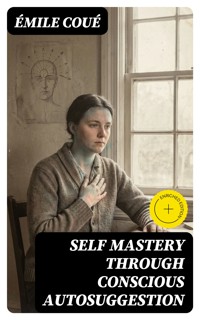
In "Self Mastery Through Conscious Autosuggestion," Émile Coué articulates his pioneering concepts of self-empowerment through the technique of autosuggestion. This insightful work delves into the interplay between consciousness and the subconscious, illustrating how positive affirmations can profoundly transform one's mental and emotional state. Coué's literary style is pragmatic yet inspirational, effectively communicating complex psychological ideas in accessible language. The book contributes significantly to the early 20th-century discourse on psychology and self-help, intertwining Coué's clinical experiences with emerging behavioral theories, positioning it as a precursor to contemporary self-improvement literature. Émile Coué, a French psychologist and pharmacist, was instrumental in the development of the autosuggestion method in the early 1900s. His background in pharmacy provided him a unique insight into the psychological aspects of healing. Coué's technique flourished during a time when traditional medicine was grappling with the rise of mental health awareness, allowing him to advocate for a more holistic approach to well-being that emphasized the power of the mind over physical ailments. For readers seeking a foundational understanding of self-help principles and the psychological strategies that inform them, Coué's "Self Mastery Through Conscious Autosuggestion" is an essential work. It invites individuals to engage actively with their thoughts and adopt a proactive stance toward their mental health, making it a transformative read for anyone looking to harness the power of their own mind. In this enriched edition, we have carefully created added value for your reading experience: - A succinct Introduction situates the work's timeless appeal and themes. - The Synopsis outlines the central plot, highlighting key developments without spoiling critical twists. - A detailed Historical Context immerses you in the era's events and influences that shaped the writing. - A thorough Analysis dissects symbols, motifs, and character arcs to unearth underlying meanings. - Reflection questions prompt you to engage personally with the work's messages, connecting them to modern life. - Hand‐picked Memorable Quotes shine a spotlight on moments of literary brilliance. - Interactive footnotes clarify unusual references, historical allusions, and archaic phrases for an effortless, more informed read.
Das E-Book können Sie in Legimi-Apps oder einer beliebigen App lesen, die das folgende Format unterstützen:
Veröffentlichungsjahr: 2022
Ähnliche



Self Mastery Through Conscious Autosuggestion
Table of Contents
Introduction
This book contends that the imagination, when deliberately guided, can quietly overrule the faltering exertions of will, offering a disciplined path toward self-mastery that replaces struggle with strategic suggestion, translates vague hope into systematic practice, and asks readers to test whether inner speech, repeated with calm conviction, can alter the rhythms of thought, feeling, and habit in daily life while raising a persistent, fertile tension between personal agency and the subconscious forces that seem to govern us, between observable results and inward belief, and between the promise of simple methods and the complexity of human suffering.
Self Mastery Through Conscious Autosuggestion is a compact work of applied psychology and self-help written by the French pharmacist and educator Émile Coué in the early twentieth century, emerging in English in the early 1920s amid widespread curiosity about psychotherapy outside clinical settings. Rooted in Coué’s observations in Nancy, where he instructed groups and individuals in simple mental practices, the book presents a method intended for ordinary readers rather than specialists. Its setting is at once intimate and public: the quiet of personal repetition, the clinic’s orderly demonstrations, and the lecture hall where the technique was codified for a general audience.
Coué’s premise is straightforward: by introducing carefully framed suggestions to oneself, one can recruit unconscious processes in the service of constructive goals, such as healthier habits and steadier moods, without coercion or strain. The reading experience is notably plainspoken, didactic, and encouraging. Coué writes as a patient instructor, favoring short, concrete explanations over jargon, and punctuates his discussion with illustrations from practice that keep the focus on what readers can try for themselves. The tone is confident yet measured, promising improvement through consistent method rather than dramatic revelation, and the prose favors clarity, repetition, and gentle insistence.
Several core ideas recur throughout. Attention directs outcomes by amplifying what the mind expects; suggestion, when repeated under relaxed conditions, reshapes that expectancy; and the imagination often proves stronger than sheer effort. The method therefore emphasizes steadiness, simplicity, and the avoidance of inner struggle. Coué describes how small, regular acts of autosuggestion can influence sensations, behaviors, and attitudes, illustrating changes in pain, performance, and self-control without claiming a universal cure. He frames the practice as a teachable skill available to anyone willing to learn a few rules and to persevere, making personal transformation a matter of method rather than mystique.
For contemporary readers, the book’s continuing relevance lies in how it speaks to the science and culture of expectation. Modern discussions of placebo effects, cognitive reframing, habit formation, and self-talk all resonate with Coué’s central claim that what we repeatedly tell ourselves influences what we notice, attempt, and sustain. While the language is of its era, the underlying intuition that attitude can shape outcome remains timely in workplaces, classrooms, clinics, and homes. The method’s accessibility also matters today: it offers a low-cost, low-risk way to practice deliberate attention, complementing rather than replacing professional care or evidence-based therapies.
The themes that animate the book are ethical as well as practical: agency without blame, discipline without harshness, and hope tethered to procedure. Coué argues that meaningful change flourishes when force gives way to cooperation with the mind’s tendencies, and he urges readers to seek gradual, observable progress rather than sudden transformation. The promise is modest yet provocative: improvement through consistent, conscious autosuggestion. This temperate ambition helps the book avoid extremes of miracle and cynicism, and it invites a reflective stance toward the limits and possibilities of self-influence, including the humility to recognize when outside help or different methods are warranted.
Approached today, Self Mastery Through Conscious Autosuggestion rewards slow reading and practical curiosity. It can be taken as both a historical document of early popular psychology and a hands-on primer whose value becomes clear only in practice. Readers will encounter clear instructions, illustrative cases, and a distinctive voice that insists effectiveness grows from regularity, calmness, and simplicity. Without promising a cure-all, the book offers a framework for experimenting with how language and attention shape lived experience. To read it is to engage a quiet, disciplined experiment in self-direction whose consequences, if any, are measured not in spectacle but in daily steadiness.
Synopsis
Self Mastery Through Conscious Autosuggestion presents Émile Coué’s practical method for directing the mind toward constructive change. Written in the early 1920s after years of public demonstrations, the book condenses his talks and lessons into a concise, accessible program. Coué proposes that everyday ideas, once accepted by the unconscious, tend to realize themselves in action, feeling, and habit. Rather than offering an abstract theory, he frames the work as a manual for cultivating beneficial ideas with precision and regularity. The chapters lay out definitions, principles, and stepwise instructions, interwoven with observations from his practice to show how suggestion can be applied safely.
Coué grounds his approach in experiences as a pharmacist, where he noticed that encouraging words sometimes increased the effectiveness patients reported from identical prescriptions. From this he inferred that expectation and mental imagery can influence bodily responses and behavior. He distinguishes between the conscious mind, which reasons and chooses, and the unconscious, which executes dominant ideas without debate. Because random, unexamined ideas often rule that deeper level, people inadvertently program themselves with doubt, fear, and limitation. The book therefore seeks to replace unhelpful suggestions with helpful ones, showing how clear, repeated ideas can take root and express themselves spontaneously.
At the core is the claim that imagination overrides will when the two are in conflict. Attempts to force an outcome by sheer effort often provoke the opposite result, a pattern he highlights through simple demonstrations of suggestion and common examples such as sleeplessness worsened by trying too hard. The practical consequence is to align imagination with desired ends, so that the unconscious carries them out naturally. Coué explains the formation of mental pictures, the impact of words and tone, and the advantages of brief, positive formulations that preclude doubt, thereby preventing the struggle that undermines persistent resolutions.




